
San Francisco helped build the modern software industry. Companies created tools for managing customers, tracking sales, running marketing campaigns, handling support requests, and organizing work. Businesses paid monthly subscriptions, employees learned how to use the software, and software companies grew by selling more licenses.
Now a different kind of software company is emerging across San Francisco and Silicon Valley. Instead of selling businesses another tool that employees must operate, these startups are building AI agents that can complete parts of the work themselves.
The difference sounds simple, but it could change how businesses buy software, how startups make money, and which companies control the next generation of business technology.
Consider a customer support team. With traditional software, an employee opens a ticket, checks the customer’s account, finds the right information, updates the order, and sends a reply. An AI agent can potentially carry out most of those steps without an employee moving between screens.
The company still needs software. It still needs accurate customer records, clear rules, security, and ways to check what happened. What changes is who operates the software and how much human effort is needed to finish the task.
This is why the debate about AI agents versus traditional SaaS matters so much.
For years, Software as a Service, or SaaS, grew by helping employees work faster. Agentic AI introduces a more challenging question: What happens when businesses can buy completed work instead of buying software access?
The money moving into this market suggests investors see a major opportunity. Menlo Ventures estimated that businesses spent $37 billion on generative AI in 2025, including $19 billion on AI applications. Meanwhile, San Francisco’s Sierra announced a $350 million funding round in September 2025, and AI customer service company Decagon announced another $250 million in January 2026.
Menlo Ventures
+2
But funding announcements do not prove that traditional SaaS is dying. They show that investors are willing to finance a different way of delivering software.
The more important evidence comes from what customers are buying, what software companies are charging for, and whether AI agents actually lower the cost of getting work done.
For SFTechScene, we examine public industry research, company disclosures, pricing pages, and the economics of running AI-powered workflows. We also introduce an original, reproducible analysis of market spending, software pricing, and customer support costs to test where AI agents could create real financial value.
The findings point toward a future in which AI agents transform parts of SaaS, while much of the software underneath them becomes more important than ever.
The Short Version: AI Agents Are Changing What Businesses Pay Software Companies to Do
Traditional SaaS sells access to tools. AI agents increasingly sell the ability to complete work.
That distinction matters because businesses do not ultimately care how many dashboards their employees open or how many buttons they click. They care about customers receiving help, invoices getting paid, sales leads being followed up, and daily operations running smoothly.
AI agents make it possible to connect software spending more closely to those business results.
Our analysis identifies five important shifts already shaping the market.
First, enterprise spending on AI applications has grown rapidly, but general-purpose AI assistants still account for much more measured spending than autonomous agent platforms. That suggests the transition is underway rather than complete.
Second, pricing is changing. Companies such as Intercom, Salesforce, and Zendesk now offer ways to pay for AI activity or completed customer service outcomes rather than relying entirely on employee subscriptions.
Third, startups such as Sierra and Decagon are building businesses around completing customer-facing tasks. Their rise shows that buyers are willing to consider specialized AI systems alongside established software platforms.
Fourth, replacing employee activity with automation does not automatically produce savings. An agent must complete tasks correctly, handle exceptions, and avoid creating expensive mistakes.
Finally, the strongest future businesses may combine both approaches. They will use familiar software to store trusted records while relying on AI agents to carry out approved tasks.
The opportunity for San Francisco startups is not simply to build another chatbot. It is to remove expensive, repetitive steps from business operations while making the results easy to verify.
What Is Traditional SaaS, and Why Has It Been So Successful?
Traditional SaaS Gives Employees Tools to Do Their Jobs
Traditional SaaS is software that businesses access over the internet, usually through a monthly or yearly subscription.
A sales team might use Salesforce to manage customer relationships. A support team might use Zendesk to organize questions. A marketing department might use HubSpot to track campaigns, while an engineering team uses Jira to manage development work.
These tools give employees a shared place to store information, follow processes, and see what needs attention.
Before cloud software became common, businesses often had to install and maintain programs on their own computers or servers. SaaS made software easier to access, update, and manage.
For growing companies, this was a major improvement. A startup could start using powerful business software without building its own technical infrastructure.
The Traditional SaaS Business Model Depends Heavily on Subscriptions
Many SaaS companies charge according to how many employees use the product.
A business with ten sales representatives might purchase ten licenses. When the sales team grows to fifty people, the business may need fifty licenses.
This creates predictable revenue for the software provider. Customers pay regularly, and expanding teams often produce larger contracts.
Other SaaS products use company-wide subscriptions, feature-based plans, or charges tied to data storage and activity. However, paid employee access remains a familiar part of the industry.
The model works well when people are the main users of software. It becomes more complicated when automated systems can complete work that previously required several employees.
Traditional Software Still Requires Human Effort
Imagine a business receives 500 customer questions every day.
Its support platform can organize those requests, show relevant customer details, suggest answers, and track employee performance. However, employees may still need to read each request and perform the necessary steps.
The software makes their work easier, but it does not necessarily eliminate the work.
This creates an important distinction between improving employee productivity and automating a business process.
Traditional SaaS usually helps people complete tasks. Agentic software aims to complete more of those tasks directly, with employees supervising the parts that need human judgment.
What Are AI Agents, and How Are They Different From Traditional Software?
AI Agents Can Take Actions Across Business Systems
An AI agent is a software system that uses AI to understand a task, choose steps, access permitted tools, and take actions toward a goal.
Some agents are simple. They answer questions using a company’s approved information.
Others can handle several connected steps. For example, an agent may read a customer message, check an order, confirm a delivery problem, create a replacement request, and update the customer record.
The key difference is that the system can act instead of only presenting information.
This does not mean every AI agent can safely operate without supervision. Businesses must decide which actions an agent can take, which require approval, and when the work should move to a human employee.
AI Agents vs. Traditional SaaS: The Main Differences
| Business feature | Traditional SaaS | AI-agent-powered software |
|---|---|---|
| Main purpose | Help employees manage work | Complete defined work with less human effort |
| Primary user | Human employee | AI system, employee, or both |
| Typical interaction | Forms, menus, dashboards | Instructions, events, automated actions |
| Common pricing | Per user or subscription | Per task, action, outcome, usage, or subscription |
| Business value | Better organization and productivity | Faster completion and lower manual effort |
| Main challenge | Adoption and workflow complexity | Reliability, control, and error handling |
| Human involvement | Usually frequent | Depends on risk and agent capability |
| Success measure | Usage, time saved, process quality | Correctly completed work and total cost |
| Best fit | Records, collaboration, reporting | Repeated tasks with clear rules and outcomes |
These differences describe common product approaches, not fixed rules. Modern SaaS platforms already contain AI agents, and many AI-first companies still charge subscriptions.
Why the Change Is Bigger Than Adding AI to Existing Software
Adding an AI writing assistant to a customer relationship platform can make employees more productive. They may write emails faster or summarize customer meetings in less time.
An agent that schedules follow-ups, updates customer records, prepares approved proposals, and alerts a manager when a deal needs attention changes the workflow itself.
That distinction matters because saving an employee five minutes is different from removing five manual steps from a process.
The first improves how someone works. The second may allow the business to serve more customers without expanding its team at the same rate.
The strongest AI products will be judged by the second kind of improvement.
Why San Francisco Has Become a Major Battleground for AI Agents
San Francisco Has the Talent and Infrastructure to Build AI-First Software
San Francisco has several advantages that make it a natural place for AI-agent companies to grow.
The Bay Area has a long history of building enterprise software, including customer management systems, cloud infrastructure, developer tools, and workplace applications. It also has major AI research companies, experienced founders, venture investors, and large business customers.
These parts of the ecosystem reinforce one another.
An AI startup may need access to advanced language models, software engineers who understand business systems, and companies willing to test new products. The Bay Area offers a dense network of people and organizations working on these problems.
However, location does not guarantee success. A technically impressive AI agent still needs to prove that customers will pay for it and continue using it.
Investors Are Funding Companies That Sell Work, Not Just Software Features
Some of the most interesting companies are not trying to replace every piece of enterprise software.
Instead, they focus on expensive tasks that businesses perform repeatedly.
Customer support is one example. Legal document review is another. Internal information search, software development, IT operations, and financial administration are also receiving attention.
These markets are attractive because businesses already spend money completing the work. A startup can show customers an existing cost and explain how its product could reduce that cost or improve the result.
That makes the sales conversation more concrete than simply promising that AI will improve productivity.
The Leading Companies Show Different Paths to Market

Sierra — AI agents for customer experiences
Sierra develops AI agents that handle customer conversations and actions. In May 2026, TechCrunch reported that the company was raising $950 million at a valuation above $15 billion. The report also described substantial adoption among large enterprises, based on company claims.
TechCrunch
+1
Its approach challenges customer service software that mainly helps human representatives work through support queues.

Decagon — Autonomous customer support
Decagon announced a $250 million financing round at a $4.5 billion valuation in January 2026. It builds agents that help businesses resolve customer requests across support channels.
Decagon
The opportunity is not just faster answers. It includes completing customer service work that previously required an employee to navigate several systems.

Harvey — AI systems for legal teams
In September 2026, Harvey announced a $550 million funding round at a $15.5 billion valuation. The company builds AI products for law firms and legal teams and is expanding tools that carry out legal workflows.
Harvey
Harvey illustrates how AI-first companies can compete for budgets previously spent on legal research tools, document systems, and manual professional work.

Glean — AI across company information
Palo Alto-based Glean announced $150 million in financing at a $7.2 billion valuation in June 2025. Its platform helps employees find information and use AI agents across enterprise systems.
Glean Press
Glean represents a different approach: becoming an intelligent layer across tools that companies already own, rather than replacing each underlying application.
These companies operate in different markets, and their products should not be treated as interchangeable. What connects them is a movement toward software that performs more work directly.
Their valuations also need to be interpreted carefully. Private funding valuations show what investors agreed to pay at a particular time; they are not proof of profitability, customer savings, or market share.
Original Research: How Much of the Enterprise AI Market Is Actually Moving Toward Agents?
There is a major difference between the excitement around autonomous agents and the amount of money companies are currently spending on them.
To examine that gap, SFTechScene performed a secondary analysis of the publicly reported market estimates in Menlo Ventures’ 2025 State of Generative AI in the Enterprise report.
Research Methodology: Recalculating the AI Spending Mix
We used Menlo Ventures’ published 2025 enterprise spending estimates as the base dataset. The original study combined a survey of roughly 500 US enterprise decision-makers with a model of the broader AI market.
Our analysis performs new calculations using those published numbers. We compare application spending, infrastructure spending, general AI assistants, and agent platforms to identify the relative size of each market.
We use the published estimates rather than attempting to reconstruct individual companies’ confidential revenue.
This is important because the results are an original analysis of existing public data, not a new customer survey or an independently measured census of AI-agent sales. Menlo’s estimates also carry the assumptions and uncertainty of its market model.
The source groups some AI offerings into broad categories, so the figures should not be treated as a perfect division between autonomous and non-autonomous software.
Menlo Ventures
Original Finding #1: AI Applications Account for Just Over Half of Enterprise Generative AI Spending
Total AI spending
$37B
AI applications
$19B
AI infrastructure
$18B
Enterprise generative AI spending, 2025
Original SFTechScene percentage calculations based on Menlo Ventures estimates. Figures rounded.
■ Applications
■ Infrastructure
Source: Menlo Ventures, 2025 State of Generative AI in the Enterprise. Figures in US$ billions.
Our calculation shows that AI applications represented approximately 51.4% of the $37 billion market in 2025, while infrastructure accounted for 48.6%.
That is significant because application software is where many traditional SaaS businesses compete.
Companies are no longer spending only on the models and computing systems that make AI possible. A slightly larger share of measured spending went toward products that employees and businesses use directly.
This creates opportunities for startups to build products that solve specific business problems.
However, the $19 billion application figure includes many AI tools that are not fully autonomous. It cannot be described as the size of the AI-agent market.
Original Finding #2: AI Agents Still Trail AI Assistants by a Wide Margin
Menlo Ventures estimated that horizontal AI applications attracted approximately $8.4 billion in enterprise spending in 2025.
Within that category, general-purpose copilots accounted for about $7.2 billion, compared with approximately $750 million for agent platforms.
Our calculations show that spending on copilots was about 9.6 times the estimated spending on agent platforms in that category.
Copilots vs. agent platforms, 2025
Estimated spending in US$ billions. Rounded source categories within horizontal AI, not the entire AI-agent market.

Source: Menlo Ventures. SFTechScene calculated the 9.6-to-1 spending ratio.
This finding challenges a common assumption in the AI industry.
Autonomous agents may dominate discussions about the future of work, but the available spending estimates show that businesses were still buying much more general AI assistance than broadly classified agent platforms in 2025.
That makes sense.
Businesses can adopt an AI writing assistant without changing how their financial systems operate. Allowing an agent to issue refunds, modify customer records, or approve purchases requires more testing and oversight.
The transition from assistance to autonomy involves more organizational change than the transition from manual writing to AI-assisted writing.
For startups, this creates a clear opening. Products that provide a smooth path from helping employees to completing approved work may find it easier to win business than products demanding full autonomy immediately.
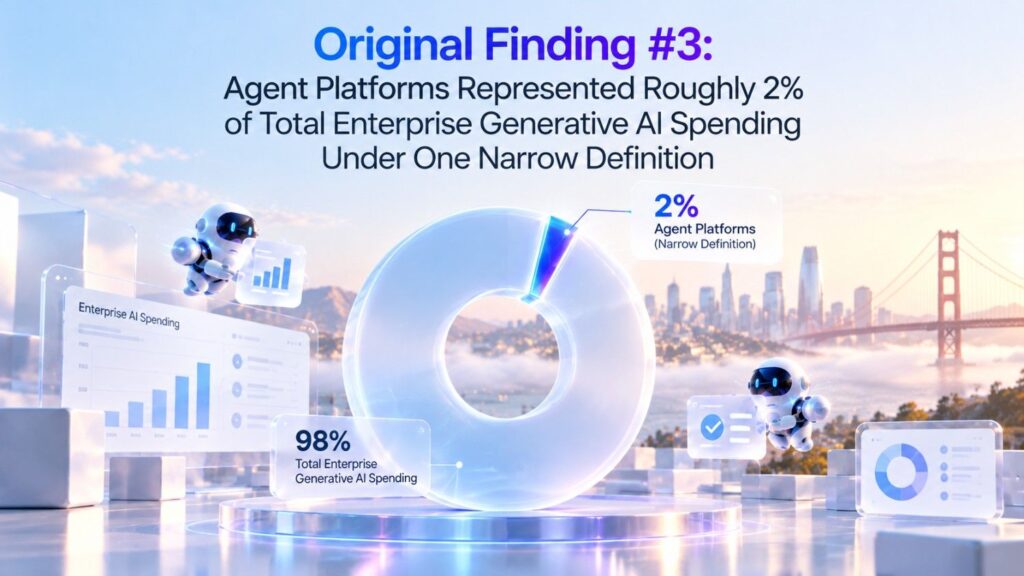
Original Finding #3: Agent Platforms Represented Roughly 2% of Total Enterprise Generative AI Spending Under One Narrow Definition
We divided Menlo Ventures’ approximately $750 million horizontal agent-platform estimate by its $37 billion total enterprise generative AI spending estimate.
The result is approximately 2.03%.
That is a useful measure of how early the market remained in 2025, but it needs a crucial qualification.
This does not mean all agentic AI represented only 2% of AI spending. Coding agents, industry-specific automation tools, and other agent capabilities can appear in different categories of the Menlo dataset.
The calculation measures one specifically identified segment against the overall market, not every product with an agent.
Even with that limitation, the result matters.
A relatively small identified spending category was attracting enormous attention because investors expected its future size to be much larger.
For founders, that creates both opportunity and danger. A market with room to grow can produce valuable companies, but excitement can also push expectations beyond what customers are ready to buy.
Original Finding #4: Software Startups Appear to Have an Advantage in AI Applications, but Not Across the Entire Technology Stack
Menlo Ventures reported that AI-native startups collectively earned nearly twice as much AI application revenue as incumbents in its market model.
At the infrastructure layer, established companies remained strong, with incumbents holding an estimated 56% market share.
Menlo Ventures
This difference helps explain why San Francisco startups are focusing on specialized business applications.
A small company may struggle to compete with a cloud provider’s computing infrastructure. It may have a better chance of building a product that understands a specific business process unusually well.
For example, an AI startup specializing in insurance claims does not need to build a cloud computing platform from the ground up. It can use available models and infrastructure while developing deep knowledge of claims handling.
The harder problem is building software that produces reliable results in that particular workflow.
What the Spending Data Actually Tells Us
| SFTechScene calculation | Result | What it means |
|---|---|---|
| AI application share of total spending | 51.4% | More than half of estimated AI spending reached applications |
| AI infrastructure share | 48.6% | Underlying infrastructure remains a major market |
| Copilot-to-agent-platform spending ratio | 9.6:1 | General AI assistance was much larger than the identified horizontal agent segment |
| Horizontal agent platforms as share of total AI spending | 2.0% | The narrowly defined segment was still early |
| AI applications as share of application plus infrastructure spending | 51.4% | The market is already split between usable products and the systems supporting them |
All calculations use rounded estimates, so small differences should not be interpreted as precise measurements.
The main conclusion is that agentic AI is a major strategic opportunity, but it has not already displaced the broader software industry.
This is a developing market in which customer adoption, product reliability, and business economics will determine how far the change goes.
The Software Pricing Revolution: From Paying for Employees to Paying for Work
One of the clearest signs of change is appearing on software pricing pages.
Traditional SaaS commonly charges for access. AI-agent products increasingly experiment with charging for actions, conversations, and completed outcomes.
These pricing models are not identical, but they change how buyers think about software value.
Why Seat-Based Pricing Becomes Less Natural When Agents Do the Work
Suppose a business uses a support platform with twenty employees.
The software provider charges for twenty seats. When the business grows and hires ten additional representatives, its software bill may increase.
Now suppose the company introduces AI agents that handle much of the repetitive work.
Customer demand might double while the number of support employees remains unchanged.
A traditional pricing model based solely on employee seats may no longer capture the growing value delivered through the platform.
Software providers therefore have a reason to consider charging for the work that AI systems perform.
Three Public Pricing Models Show the Direction of Change
| Company and product | Publicly described pricing approach | Unit being purchased |
|---|---|---|
| Intercom Fin | From $0.99 per defined AI outcome | A qualifying AI outcome |
| Salesforce Agentforce | $2 per conversation option | An eligible agent conversation |
| Salesforce Agentforce Flex Credits | $500 per 100,000 credits | Credits consumed by agent actions |
| Salesforce Agentforce add-on | $125 per user/month, listed option | Employee access and included capabilities |
| Zendesk AI agents | Usage measured through automated resolutions | Qualifying resolved customer requests |
Sources: public pricing and product documentation from
Plans for every team size
+2. Prices and included features can change, and enterprise contracts may differ.
The table reveals something important: AI agents are not producing a single universal pricing model.
Instead, software providers are experimenting with several ways to connect charges to usage and customer value.
Intercom Fin: Paying for Defined Outcomes
Intercom’s Fin AI Agent publicly lists pricing beginning at $0.99 per qualifying outcome.
For a support use case, an outcome can include a customer confirming that the response solved the problem or not requesting additional help after the AI response. Intercom also recognizes certain completed procedures, so a billable outcome is not always identical to independently verified problem resolution.
This distinction matters when comparing vendors.
A business should understand exactly what is counted, how follow-up messages are handled, and whether an unresolved issue could still trigger a charge under the contract.
Intercom
+1
Salesforce Agentforce: Combining Usage and Subscription Pricing
Salesforce provides an example of how established SaaS companies are adapting.
Its Agentforce pricing offers conversation-based charges, credits for actions, and employee-oriented licensing options.
The company has not simply abandoned subscriptions. It is developing additional methods of earning revenue when AI systems perform tasks.
That approach may be especially attractive to large enterprises that already rely on Salesforce for customer data and business processes.
Zendesk: Moving Toward Automated Resolution Pricing
Zendesk has also moved toward pricing that measures automated resolutions.
The company introduced outcome-based AI agent pricing in 2024 and has continued expanding its AI service platform.
Its documentation explains that AI agents can perform actions in authorized systems and that usage is measured through defined automated resolutions.
Zendesk
+1
This demonstrates why the debate should not be framed entirely as startups versus traditional software companies.
Established providers can adopt the same economic model that makes AI-native competitors appealing.
The real competition may come down to which vendor can deliver the best results at the lowest total cost.
Original Research: Can AI Agents Really Make Business Software Cheaper?
Lower software costs are one of the strongest arguments for AI agents.
However, comparing a SaaS subscription with an AI-agent subscription does not reveal whether a business actually saves money.
A useful comparison must include the people doing the work, the agent’s charges, the tasks that still need human attention, and the cost of checking results.
To make this comparison practical, SFTechScene built a transparent customer support cost model.
Research Methodology: A Reproducible 10,000-Request Support Model
We modeled a fictional business that receives 10,000 customer support requests per month.
The model uses Intercom Fin’s publicly listed $0.99 price as an illustrative charge for each successfully automated outcome. All other input values are scenario assumptions selected for analysis, not measurements of actual Intercom customers.
This model does not claim that a typical San Francisco support team has these costs or that a real deployment would achieve the assumed automation rates.
The purpose is to identify the financial conditions under which AI agents become economically attractive.
The Model’s Main Assumptions
| Input | Base assumption | Source or explanation |
|---|---|---|
| Monthly support requests | 10,000 | Hypothetical workload |
| Fully loaded human handling cost | $6 per request | Illustrative assumption |
| AI price per billable outcome | $0.99 | Intercom public starting rate |
| Human handling for requests not resolved by AI | $6 each | Same assumed manual cost |
| Human rework needed after an AI outcome | 8% of automated outcomes | Illustrative quality assumption |
| Cost of each rework | $6 | Same assumed manual cost |
| Extra monthly oversight and maintenance | $1,500 | Illustrative fixed cost |
| AI successful completion scenarios | 30%, 50%, 70% | Scenario variables |
The $6 figure represents a modeled cost of human handling. It could include employee pay, benefits, management, and the relevant portion of supporting operations, depending on how a real business measures its costs.
The $1,500 oversight allowance represents additional review, testing, and maintenance in this scenario. It does not include every possible implementation expense, such as a major one-time integration project.
The analysis also assumes that requests not resolved by AI are handled by humans and do not incur a separate AI outcome charge. That assumption fits the simplified pricing mechanism being modeled but must be checked against any actual contract.
How We Calculate Monthly AI Support Costs
For each scenario, we calculate total cost as:
\[ C=NrP+N(1-r)H+NrqH+F \]
Where:
- \(N\) = monthly requests
- \(r\) = AI completion rate
- \(P\) = price per completed AI outcome
- \(H\) = human handling cost
- \(q\) = fraction of AI outcomes that require human rework
- \(F\) = fixed oversight and maintenance cost
The first term represents AI charges. The second covers requests handled by employees because AI did not complete them. The third adds quality-related rework, and the fourth covers ongoing oversight.
The model treats rework as additional labor, so a request that initially counts as an automated outcome can still create human expense.
This is intentionally more conservative than a calculation that assumes every successful AI interaction eliminates all human effort forever.
Original Finding #5: AI Savings Depend Heavily on Reliable Completion
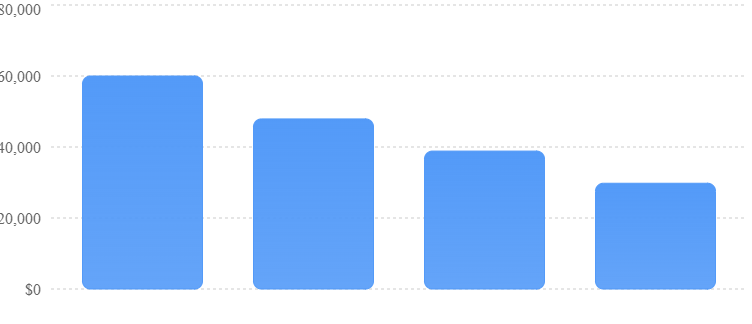
Modeled monthly support costs
SFTechScene original scenario model, USD. Assumes 10,000 requests per month, $6 manual handling cost, $0.99 per AI outcome, 8% rework and $1,500 fixed oversight.
| Scenario | Monthly modeled cost | Savings vs. manual baseline | Savings rate |
|---|---|---|---|
| Manual handling | $60,000 | — | — |
| 30% AI completion | $47,910 | $12,090 | 20.2% |
| 50% AI completion | $38,850 | $21,150 | 35.3% |
| 70% AI completion | $29,790 | $30,210 | 50.4% |
Original SFTechScene calculations. Values are hypothetical scenarios, not observed customer outcomes. Percentages are rounded.
The numbers show why automation attracts business interest.
In the middle scenario, the business spends $38,850 per month instead of $60,000. That produces modeled savings of $21,150 each month, or $253,800 over twelve months.
However, this result depends on the company actually avoiding the modeled manual costs. If employees remain fully paid and simply spend the saved time on other duties, the immediate cash savings may be smaller.
That does not make automation worthless. The business might handle more requests, improve service quality, or avoid hiring additional staff as demand grows.
But businesses should distinguish between cash saved, future hiring avoided, and time made available for other work.
Original Finding #6: The Financial Break-Even Point Can Be Surprisingly Low, but It Is Not the Same as Operational Success
Under our base assumptions, an AI-completed request costs $0.99 in outcome charges plus an expected $0.48 in human rework.
That gives a modeled variable cost of $1.47 per automated request.
The assumed manual handling cost is $6. The difference is $4.53.
After covering the model’s $1,500 monthly fixed oversight allowance, the break-even completion rate is approximately 3.31% of all incoming requests.
This is a mathematical result of the assumptions, not a prediction about real deployments.
A low modeled financial break-even rate does not mean that businesses should launch AI agents after testing only a few requests. Real deployments face security costs, implementation expenses, uneven case difficulty, and possible reputational damage when agents make mistakes.
It also assumes the value of avoided human work is actually realizable.

The useful insight is that inexpensive, reliable automation can create value without replacing the majority of a team’s work. A business may find a profitable starting point in a narrow task category before attempting broader automation.
Original Finding #7: Quality Failures Can Reduce Savings Faster Than Software Pricing Suggests
What happens if the agent needs much more human rework than expected?
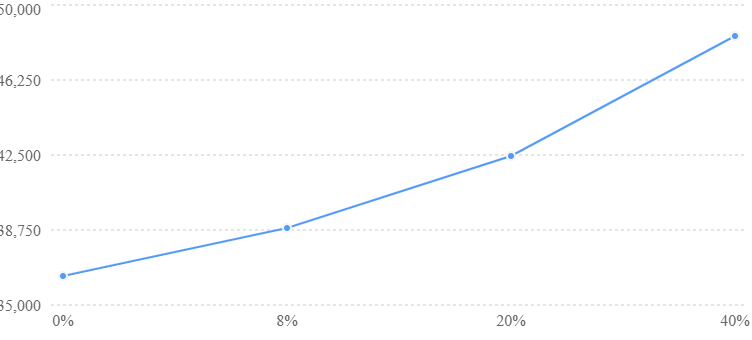
We kept the AI completion rate at 50% and varied only the percentage of automated outcomes that later require human handling.
How rework affects monthly cost
Modeled cost at a fixed 50% AI completion rate. Other assumptions remain unchanged.
This finding matters because AI providers often emphasize how many requests their systems can handle.
Completion rate alone can hide quality problems.
Suppose an agent closes a support conversation but gives the customer an incorrect answer. The customer contacts the company again, creating another request.
The system may appear successful in its own reporting, but the business has not truly solved the problem.
This is why companies should measure repeat contacts, correction costs, refunds, customer satisfaction, and human follow-up alongside automated completion.
A business buying AI agents needs to know whether work actually disappeared or was simply delayed.
A Practical Calculator for Business Owners
The following model lets readers change the most important assumptions.
AI Agent vs. Manual Support Cost Calculator
Interactive SFTechScene scenario analysis. Change the assumptions to test a business case.Requests per monthHuman cost per request ($)AI outcome price ($)Fixed monthly oversight ($)AI completion rate
50%Human rework after AI completion
8%
Manual baseline/month
$60,000
AI-assisted cost/month
$38,850
Modeled monthly savings
$21,150
35.3% change in cost relative to manual handling.
Reset assumptionsThis is a planning model, not a vendor quote or forecast. It excludes major one-time setup costs and assumes avoided manual work has economic value.
For business leaders, the calculator helps identify which inputs matter most before signing a contract.
A support team that handles thousands of repetitive requests has a different opportunity from a specialist legal team handling a small number of complex matters. The right unit of comparison depends on the actual work.
Are Traditional SaaS Companies Really Losing Their Advantage?
The strongest argument against the idea that AI agents will eliminate traditional SaaS is that agents still need trusted business systems.
An agent cannot reliably process an order without knowing what the customer bought. It cannot reconcile an invoice without accurate financial records. It cannot approve employee access without knowing the company’s identity and security rules.
These systems do more than display screens. They store important facts and enforce business controls.
Traditional SaaS Owns the Business Records That Agents Need
Consider a sales organization using a customer relationship management platform.
The CRM stores customer accounts, deal stages, transaction history, contracts, and communication records.
An AI agent may become the main way employees interact with that information. Instead of opening several pages, a sales manager might ask the agent to identify overdue follow-ups and prepare the next actions.
However, the underlying records still need somewhere reliable to live.
In some cases, the CRM could become even more important because automated systems need accurate data to work safely.
The User Interface May Become Less Important Than the Data Layer
Traditional software companies have spent years improving dashboards, menus, forms, and reporting screens.
As agents become more capable, employees may spend less time navigating those interfaces.
A manager may ask an agent to prepare a weekly sales report instead of opening several reporting pages. A support supervisor may request a summary of unresolved cases rather than manually checking different queues.
The data and reporting systems still operate behind the scenes.
This creates a new competitive question: Will the company that stores business information also control the AI agent that uses it?
If the answer is yes, established SaaS providers could remain powerful. If independent agents become the main interface across several vendors, some of that control could shift toward AI-first startups.
Salesforce Shows That Established SaaS Companies Can Benefit From AI Agents
Salesforce is a particularly important example because it has deep relationships with enterprises and large amounts of customer-related data.
In its August 26, 2026, fiscal second-quarter announcement, Salesforce reported that Agentforce annual recurring revenue exceeded $1.5 billion, growing more than 240% year over year.
The company also disclosed nearly $3.9 billion in combined Agentforce and Data 360 annual recurring revenue. Salesforce notes that the Agentforce figure includes a broader set of AI offerings under its updated reporting definition, so it should not be interpreted as revenue solely from independent autonomous agents.
Salesforce
These figures show that established software companies are already turning AI demand into commercial activity.
The challenge for startups is therefore more complex than simply producing a better chatbot.
They must convince companies to change how work happens, often while continuing to rely on software owned by the established vendors.
ServiceNow Demonstrates the Strength of Existing Enterprise Workflows
ServiceNow is another example of a company positioned to incorporate agents into existing workflows.
Its platform is deeply involved in managing IT services, employee requests, and other enterprise processes.
In its full-year 2025 results, the company reported fourth-quarter subscription revenue of approximately $3.47 billion, up 21% from the previous year.
ServiceNow Investor Relations
That growth does not tell us exactly how AI agents will affect ServiceNow over the long term.
However, it shows that traditional enterprise workflow platforms continued to attract substantial customer spending while interest in agents grew.
Businesses already using these systems may prefer AI features that work within established permissions and reporting controls.
The lesson is that replacing an employee-facing screen can be much easier than replacing the trusted system behind it.
Which SaaS Categories Face the Greatest Disruption From AI Agents?
Not every software market is equally exposed.
Products that mainly help people complete repeated administrative tasks may face stronger pressure than products responsible for storing critical records or enforcing security policies.
The distinction is not absolute. Many platforms perform both kinds of work.
Customer Support: One of the Clearest Early Opportunities
Customer support is especially attractive because businesses can measure incoming demand and the cost of handling each request.
An agent can answer common questions, check account information, guide customers through procedures, and sometimes take approved actions.
Success can be measured through resolution rates, repeat contacts, handling time, and customer satisfaction.
This makes it easier to connect software spending to results.
Startups such as Sierra and Decagon are competing in this market, while existing providers such as Zendesk and Intercom are adding their own automation capabilities.
Competition will likely focus on accurate resolution, ease of integration, safety, and total cost rather than simple conversation quality.
Sales Software: AI Agents Could Change How Sales Teams Operate
Sales software has traditionally been built around recording activity.
Employees enter customer information, update opportunities, schedule follow-ups, and review sales performance.
AI agents can reduce parts of this administrative burden.
For example, an agent may prepare account research, flag neglected opportunities, draft follow-up messages, and update approved CRM fields based on verified activity.
The challenge is deciding how much control to give the system.
Sending the wrong message to a major customer can damage a business relationship. Updating the wrong deal stage can distort revenue forecasts.
Sales automation therefore needs careful permissions, verified customer data, and clear review rules.
Marketing Software: The Bigger Opportunity Is Managing Entire Workflows
Marketing teams already use AI to draft content, suggest campaign ideas, and analyze performance.
Agentic tools could take on more connected work, such as preparing campaign variations, checking tracking data, identifying underperforming advertisements, and creating recommendations for budget changes.
Some systems may eventually execute approved adjustments within spending limits.
However, marketing involves brand judgment, customer trust, and commercial risk.
An agent that produces more content does not necessarily create better marketing. Businesses should measure qualified leads, sales, retention, and revenue rather than merely counting automated posts.
The opportunity is strongest when AI reduces repeated operational work without weakening the strategy behind it.
Human Resources: Administration May Become More Automated
HR software manages applications, employee records, leave requests, policies, and onboarding.
Many of these processes contain repeated steps.
An AI agent could help new employees complete onboarding, answer approved policy questions, prepare documentation, and route requests to the right people.
Decisions involving hiring, compensation, promotions, termination, or sensitive personal information require stronger controls.
Companies must also consider fairness, privacy, legal requirements, and the risk of inaccurate decisions.
That means HR automation may expand first in administrative work rather than in high-impact employment decisions.
Finance and Accounting: Clear Rules Create Opportunities, but Errors Are Expensive
Financial operations include invoice collection, expense reviews, reconciliations, and payment follow-ups.
These tasks often involve structured records and repeatable rules, making some parts suitable for automation.
An agent might match invoices to purchase orders, flag missing documents, prepare payment reminders, or identify records requiring review.
The stakes are higher when an agent can move money, change vendor banking details, or approve payments.
Businesses should begin with tasks that gather information and prepare recommendations before allowing automated financial actions.
A useful financial agent needs reliable controls as much as it needs AI capability.
Software Development: Agents Are Challenging the Developer Tool Market
AI coding tools are one of the strongest examples of how AI can change software work.
Menlo Ventures estimated that enterprise spending on AI coding products reached $4 billion in 2025.
Menlo Ventures
Coding agents can help developers inspect code, write tests, find bugs, make changes, and prepare code for review.
This could reshape demand for some development tools, particularly those focused on repetitive work.
Yet engineering teams still need version control, testing systems, deployment controls, security checks, and reliable records of changes.
AI may change how engineers use these products without removing the need for them.
An Analytical Framework for Comparing SaaS Disruption Exposure
| Software category | Likely near-term agent opportunity | Main limit on automation | Likely direction |
|---|---|---|---|
| Customer support | Routine request resolution | Incorrect answers, complex exceptions | High pressure on task-based software |
| Sales administration | CRM updates and follow-ups | Data quality, customer trust | Strong shift toward agent-led workflows |
| Marketing operations | Campaign preparation and analysis | Brand quality and business judgment | Automation within existing platforms |
| HR administration | Onboarding and routine requests | Privacy, fairness, sensitive decisions | Selective automation |
| Finance operations | Matching, checking, follow-ups | Fraud and financial controls | Gradual supervised automation |
| Software development | Coding and testing tasks | Reliability and security | Rapid workflow change |
| Enterprise records | Storing authoritative business data | Accuracy, compliance, continuity | Continued demand for core platforms |
SFTechScene qualitative assessment. This is an editorial framework based on workflow characteristics, not a measured industry disruption ranking.
The common pattern is that agents are most attractive when the task has a clear starting point, reliable information, and a measurable result.
They become harder to deploy when the work requires broad judgment, carries high risks, or depends on information that is difficult to verify.
Why AI Agents Are Not Ready to Replace Every SaaS Product
The excitement around AI agents can make the transition appear faster and easier than it actually is.
A product demonstration may show an agent successfully completing a difficult task. Running the same system thousands of times across different customers, changing business rules, and unusual situations is much harder.
Businesses need repeatable results, not occasional impressive examples.
Reliability Is a Bigger Challenge Than Intelligence
Suppose an agent completes a five-step process, and each step has a 98% chance of succeeding independently.
The probability of all five steps succeeding is approximately:
\[ 0.98^5=90.4\% \]
That means a process can still fail nearly one time in ten even when individual steps appear highly reliable.
This is an illustration, not an observed agent failure rate. Real steps may be dependent, and failures can sometimes be detected and corrected.
Still, the example explains why multi-step automation needs careful testing.
An agent that answers questions correctly most of the time may not be safe enough to approve payments, change account permissions, or complete sensitive financial actions without review.
Security Becomes More Important When Software Can Take Actions
Traditional software usually requires an employee to choose an action.
AI agents introduce another layer of risk because software can decide which permitted action to take.
A malicious instruction hidden inside a customer email, webpage, or uploaded document could attempt to influence an agent’s behavior.
An agent may also receive access to more information than it needs, creating unnecessary risk.
Businesses should give agents only the permissions required for their assigned tasks. Sensitive actions should have approval steps, and every important action should be recorded.
Security teams must be able to determine what an agent accessed, what it changed, and why.
Unclear Business Value Can Kill AI Projects
In June 2025, Gartner predicted that more than 40% of agentic AI projects would be canceled by the end of 2027 because of rising costs, unclear business value, or weak risk controls.
In October 2026, Gartner again emphasized that reliability and accountability must come before greater autonomy.
Gartner
+1
This is a forecast, not a measured cancellation rate for 2027.
Nevertheless, it highlights a practical problem. Many organizations are interested in AI agents before they have identified which business processes should be automated.
A project launched mainly to demonstrate technical capability may never produce enough savings to justify its cost.
The strongest deployments start with a specific operational problem and an agreed method for measuring improvement.
Original Finding #8: The Biggest SaaS Disruption May Be a Change in Buying Decisions
The most important long-term change may not be that AI agents replace every existing application.
It may be that businesses begin asking different questions when purchasing software.
Today, a software buyer often compares features, integrations, security, support, and monthly subscription costs.
As agents mature, buyers may increasingly compare how much work a product completes and how reliably it completes that work.
A vendor offering fifty features could lose to a simpler product that removes a major business expense.
Software Features Become Less Valuable When Customers Buy Outcomes
Consider two hypothetical products.
The first provides an attractive dashboard with detailed reports, workflow templates, and many administrative features.
The second has fewer visible features but completes most of a specific recurring task automatically.
If both are safe and reliable, a business may prefer the product that delivers the measurable result with less employee effort.
This changes how startups should build and market software.
Instead of beginning with a long list of features, founders should identify the expensive work their customers want completed.
That work becomes the center of product development, pricing, sales demonstrations, and customer success reporting.
Traditional Software Companies Must Protect Their Customer Relationships
Established SaaS vendors have valuable advantages.
They often control important business data, have existing contracts, understand customer workflows, and already meet enterprise security requirements.
AI-first startups may offer a better experience for a particular task.
The resulting competition is likely to involve three approaches: established platforms expanding their own agents, startups operating across existing systems, and industry-specific AI companies combining records and automation into new products.
Different markets may produce different winners.
For buyers, this competition could be beneficial if it leads to better performance and clearer pricing.
For software providers, it creates pressure to show business value beyond the number of employees using a product.
How San Francisco Startups Can Build AI Agents That Compete With Traditional SaaS
Founders entering this market need a more focused strategy than simply adding a language model to an existing application.
The challenge is building a product that customers can trust with real work.
Start With a Repeated Task That Already Costs Money
A strong AI-agent opportunity usually begins with work that businesses perform frequently.
Examples include reviewing incoming support requests, collecting missing documents, preparing standard reports, or checking records across multiple systems.
The task should have a clear definition of success.
If customers cannot explain what successful completion looks like, it will be difficult to build a reliable agent or prove its value.
Founders should spend time understanding the current process before building the product.
They need to know where information comes from, which decisions employees make, what happens when something goes wrong, and who is responsible for the final result.
Build Around an Existing Business System Before Trying to Replace It
New startups often benefit from connecting to software customers already use.
A support agent may need access to a helpdesk, order management platform, and customer database.
A financial agent may need to read accounting records and prepare approved updates.
Replacing every existing system creates additional adoption barriers. Connecting to them can make the first deployment easier.
Once the startup has proved that customers value its automation, it can decide whether it needs to own more of the underlying workflow.
Build a Strong Measurement System From the Beginning
An AI-agent company should measure more than conversations and activity.
The most useful metrics include the share of tasks completed correctly, human review required, time to resolution, repeat work, total operating costs, and customer satisfaction.
Founders should also track failures carefully.
When an agent produces an incorrect result, the system should preserve enough information to identify the cause and help prevent similar problems.
Reliable measurement becomes a competitive advantage because enterprise buyers need evidence before granting software more control.
Price the Product Around Value Without Hiding Costs
Outcome-based pricing can make an AI product attractive.
However, buyers need predictable bills, clear definitions, and confidence that the outcome being charged for represents useful work.
A vendor that charges only for completed tasks may still frustrate customers if it uses a weak definition of completion.
The best pricing model depends on how easily outcomes can be verified.
For some products, a combination of platform fees and usage charges may be more practical than charging for every action.
Founders should test pricing against customer savings and their own operating costs instead of copying a competitor’s rate.
How San Francisco Businesses Can Test Their First AI Agent in 90 Days
A business does not need to replace its entire software stack to explore agentic AI.
A narrower test can reveal whether the technology is useful without creating unnecessary risk.
The goal of the first ninety days should be to produce trustworthy evidence about one workflow.
A practical 90-day rollout
- Days 1–15: Measure the current processChoose one repeated task and collect baseline data. Measure how often it occurs, how long it takes, what it costs, and what errors happen. Define which parts of the process the agent is allowed to handle.
- Days 16–30: Prepare the systems and informationIdentify the data the agent needs and verify its quality. Create permissions, approval rules, and a method for recording actions. Prepare a test set containing common, unusual, and risky cases.
- Days 31–45: Run the agent without independent actionLet the agent suggest actions while employees review them. Compare its decisions with verified results and identify common mistakes. Do not rely only on vendor demonstrations or average accuracy claims.
- Days 46–60: Allow limited live automationStart with low-risk tasks that have clear rules and can be reversed if something goes wrong. Require human approval for sensitive actions and track every failure and escalation.
- Days 61–75: Compare actual costs and outcomesMeasure human handling time, agent charges, oversight, corrections, and customer impact. Compare these figures with the original baseline and include implementation spending.
- Days 76–90: Decide whether to expandExpand only if results meet agreed quality and economic requirements. Document the successful workflows, unresolved risks, and conditions that should trigger a return to human handling.
What Businesses Should Measure Before and After the Pilot
| Metric | Before deployment | After deployment |
|---|---|---|
| Monthly task volume | Actual workload | Same measure |
| Cost per correctly completed task | Manual baseline | Full AI-assisted cost |
| Time to completion | Existing average and spread | New average and spread |
| Error rate | Existing quality level | Independently checked AI results |
| Repeat work | Current corrections | AI-related corrections |
| Human effort | Minutes per task | Minutes per task including review |
| Customer experience | Current satisfaction | Satisfaction after automation |
| Operational risk | Existing incidents | New incidents and near misses |
A business should define success thresholds before seeing the pilot results.
For example, management might require lower total costs, no material increase in complaints, and a strict limit on sensitive errors.
The exact thresholds should depend on the task’s risk.
The right answer may be to automate only part of the workflow. An agent that reliably completes thirty percent of low-risk tasks can be more valuable than an ambitious system that attempts everything but creates frequent problems.
What Traditional SaaS Companies Should Do to Stay Competitive
Existing software companies should not treat AI agents only as another feature to add to their product roadmaps.
They need to examine how AI could change what customers expect from the software.
Identify Work Customers Still Perform Outside the Product
A useful starting point is observing how customers use the software in real workflows.
Employees may export data to spreadsheets, copy information between applications, manually prepare reports, or repeatedly update records.
These activities can reveal valuable automation opportunities.
The software provider should ask what the customer is trying to finish rather than merely how frequently a particular feature is used.
Build Agents Around Trusted Records and Clear Permissions
Established vendors have an advantage when they already store accurate customer information.
They should make that data useful to automated systems without weakening security.
Agents need clear limits on which records they can read, which actions they can perform, and when approval is required.
This may be more valuable than adding an impressive conversational interface.
Prepare for a Mixed Pricing Future
Seat-based subscriptions are unlikely to disappear immediately.
Businesses will continue paying for databases, collaboration systems, reporting, security, and employee access.
However, AI activity may create additional demand for usage-based or outcome-based pricing.
Software companies should understand how this affects customer budgets and their own revenue.
A good pricing model needs to remain understandable as customers move between human-led and agent-led workflows.
Compete on Verified Business Value
Established vendors have an opportunity to combine trusted software infrastructure with automation.
The strongest strategy is to show customers how much time, cost, and manual effort the platform actually removes.
That requires better reporting, more useful automation, and clear evidence of quality.
The software industry’s competitive advantage is shifting from simply providing capabilities toward consistently delivering results.
What Investors Should Watch in the AI Agents vs. SaaS Market Through 2027
Venture funding can move faster than business adoption.
For investors, the challenge is separating companies building lasting products from companies benefiting primarily from market excitement.
Several indicators deserve attention.
Customer Retention Is More Important Than Pilot Announcements
A startup may attract many businesses willing to experiment with AI.
The stronger signal is whether those customers continue using the product after six or twelve months and expand it into additional workflows.
Repeated usage suggests the agent has become part of regular operations.
A high number of trials means less if most never reach production.
Gross Margins Reveal Whether the Business Model Can Scale
AI-agent companies may face ongoing costs from model usage, computing infrastructure, customer support, integration work, and human review.
A product that charges for completed work must keep these costs below the revenue it earns from that work.
Investors should examine whether higher usage improves the business’s economics or requires proportionally more expensive human support.
A promising AI company should become more efficient as its technology and processes improve.
Integration Depth Can Become a Competitive Advantage
Many early AI tools are easy to imitate at the interface level.
Deeper integration with customer workflows is harder to reproduce.
A product that understands business rules, handles complex exceptions, and works safely with important records may be more difficult to replace.
However, integration depth can also create heavy maintenance costs. Investors should examine whether the company can reuse its work across customers instead of rebuilding everything for each deployment.
The Definition of Success Must Be Independently Verifiable
Some AI-agent businesses may report tasks attempted, conversations handled, or actions executed.
Those measures are not the same as work completed correctly.
Investors should look for customer evidence showing reliable results, lower costs, fewer errors, or faster processing.
The strongest companies will have clear methods for checking their own performance and admitting where automation still fails.
Will AI Agents Replace SaaS or Create a New Software Industry?
The evidence suggests that the answer is neither complete replacement nor business as usual.
AI agents are changing how software creates value.
Some existing SaaS products may become less important because employees no longer need to perform certain administrative tasks manually.
Other platforms may become more important because agents need reliable records, permissions, and systems to carry out their work.
Some AI startups will build entirely new products around completing business processes. Others will work across established applications, becoming the interface through which employees and customers interact with software.
The biggest change may be economic.
Traditional software has often been purchased as a tool employees use. Increasingly, businesses may purchase software based on the measurable work it completes.
That shift creates new opportunities for San Francisco founders, but it also raises expectations around quality, accountability, and trust.
The Most Likely Future Is a Hybrid Software Stack
A large business may eventually operate with several connected layers.
Its traditional software platforms will store customer, financial, and operational records.
AI agents will perform approved tasks across those systems.
Employees will supervise sensitive decisions, manage unusual cases, and improve the processes that agents follow.
Monitoring systems will track outcomes, security, costs, and errors.
This approach is more practical than assuming that a single intelligent agent can replace every enterprise application.
It also suggests that traditional SaaS companies and AI-native startups will increasingly compete and cooperate.
A business might purchase agent capabilities from its existing provider in one department and use a specialized startup in another.
What matters is whether the combination produces reliable work at an acceptable cost.
Final Takeaway: San Francisco’s Next Software Winners Will Sell Completed Work, Not Just Access to Tools
AI agents are challenging one of the most familiar ideas in enterprise technology: that employees must operate software to get work done.
For two decades, SaaS helped businesses become more organized, connected, and productive. It made powerful software accessible to companies of nearly every size.
Agentic AI builds on that foundation by asking whether software can complete more of the work itself.
San Francisco is well positioned to shape this change. Startups such as Sierra and Decagon are pushing customer service automation forward, while companies such as Harvey and Glean are expanding AI into specialized professional and enterprise workflows.
At the same time, established vendors are responding. Salesforce, Zendesk, Intercom, and other software providers are adding autonomous capabilities and exploring different pricing models.
Our original analysis highlights three lessons.
The first is that enterprise AI spending is substantial, but clearly identified horizontal agent-platform spending was still much smaller than general AI assistant spending in the published 2025 market estimates. The industry is growing, but the transition to autonomous work is far from finished.
The second is that automation can create meaningful financial value when tasks are completed reliably. Our support cost model shows how savings improve as successful automation increases, but also why human rework, oversight, and actual cost avoidance must be included.
The third is that AI agents do not remove the need for trusted software. They depend on accurate data, strong permissions, reliable integrations, and clear operating rules.
For San Francisco founders, the opportunity is to build systems that take expensive, repeated work off customers’ hands without creating new risks.
For businesses, the smart move is to test narrow workflows, measure the full economics, and expand only when the evidence supports it.
For traditional SaaS providers, the challenge is to move beyond selling features and prove that their products can help deliver better business outcomes.
The next generation of software leaders may not be the companies with the most features or the most impressive AI demonstrations. They may be the companies that can repeatedly complete important work, prove that it was done correctly, and make the economics attractive for customers.
That is the real disruption taking shape in San Francisco’s software industry.
Research Notes and Source Transparency
Research cutoff: October 13, 2026. Original SFTechScene calculations use publicly available secondary data and explicitly stated scenarios. Financial model assumptions are illustrative and should not be confused with measured company results.
The article’s quantitative analysis draws on Menlo Ventures’ enterprise AI market research, public pricing documentation from Intercom and Salesforce, Zendesk product documentation, Salesforce investor disclosures, and company financing announcements.
The research has three important limits. Menlo’s market categories do not capture all autonomous software in one group; private funding valuations are not measures of commercial performance; and the customer support financial model is a sensitivity analysis rather than an observed experiment.
The reproducible cost equations, input assumptions, calculated scenarios, and definitions are included above so readers can challenge them or substitute their own operating data.
Key sources include Menlo Ventures’ 2025 Enterprise AI report, Intercom’s pricing documentation, Salesforce Agentforce pricing, Salesforce’s August 2026 financial announcement, and Gartner’s October 2026 agent reliability analysis.