


Silicon Valley has found a new investment opportunity, and it goes far beyond chatbots that answer questions or AI tools that help employees write emails. Venture capital firms are putting billions of dollars into companies building software that can complete real business tasks, make decisions within set rules, and carry out work with much less human help.
This new category is called agentic AI, and it is changing how investors think about the future of business software.
For years, software companies made money by selling tools that helped people work faster. A sales platform helped salespeople manage customers. A customer support platform helped agents answer questions. A coding platform helped developers write software. The employee still did most of the work, while software made that work easier.
Agentic AI changes this relationship. Instead of giving employees another tool, companies can use AI systems to complete parts of the job themselves. An AI customer service agent can look up an order, check company rules, process an approved refund, and update the customer record. An AI coding agent can make changes across a software project, run tests, and prepare the work for human review.
Investors see a potentially much larger business opportunity in this shift. A company that helps an employee work faster competes for a share of the software budget. A company that reliably completes business work may also compete for spending that previously went toward manual labor, outside service providers, and repeated administrative tasks.
The funding numbers show how seriously investors are taking this possibility.
In May 2026, Sierra announced $950 million in new financing at a valuation above $15 billion. In January 2026, Decagon raised $250 million at a $4.5 billion valuation. In March 2026, Harvey announced another $200 million at an $11 billion valuation. These businesses serve different customers, but they share a larger goal: moving AI from answering questions to carrying out useful work.
Sierra
+2
For San Francisco founders, business owners, and investors, the important question is not simply why so much money is entering agentic AI. It is whether the companies receiving that money can build dependable, profitable businesses after the early excitement fades.
To examine that question, SFTechScene has compiled an original research sample of publicly announced funding rounds from eight agent-focused software companies in San Francisco and the wider Bay Area. The analysis looks at funding concentration, business categories, company valuations, and what these patterns mean for the next generation of startups.
The findings suggest that investors are not spreading their money evenly across every company calling itself an AI agent startup. Large checks are flowing toward businesses that can show a clear path from AI capability to valuable, repeatable work.
The Short Version: Silicon Valley Is Funding AI That Completes Work, Not Just AI That Talks
The agentic AI funding boom is part of a much larger change in venture capital. According to Crunchbase, AI-related companies received approximately $211 billion in funding during 2025, an increase of 85% from approximately $114 billion in 2024. AI captured roughly half of global venture funding that year, although those figures include model developers, computing infrastructure, and applications rather than agentic software alone.
Crunchbase News
+1
SFTechScene research sample
$4.251B
Eight disclosed funding rounds
Largest two rounds
76.5%
Share of sampled funding
Sample period
2025–26
Publicly announced rounds
SFTechScene calculations from eight selected Bay Area company funding announcements dated April 2025 through May 2026. This is a selected sample, not an estimate of total market funding.
Three changes help explain the funding rush.
First, AI systems have become more capable of completing tasks that involve several steps rather than producing a single answer. These systems can gather information, call software tools, apply rules, and continue working toward a defined result. That makes them useful for jobs that were difficult to automate with older software.
Second, businesses can often measure the value of agentic AI more clearly than the value of a general-purpose chatbot. A customer support leader can measure how many issues an AI agent solves without human help. A software team can track how much useful code an AI tool creates, how often it makes mistakes, and how much review time it requires.

Third, investors believe successful AI agent companies could become an important part of everyday business operations. If a company trusts an AI system to manage an important workflow, replacing that system may become difficult. The provider can then develop a lasting customer relationship, provided its product remains reliable and fairly priced.
These changes do not mean every startup will succeed. AI agents can still misunderstand instructions, make costly mistakes, and require human supervision. The next winners will likely be companies that solve these problems while showing customers a clear financial return.
Why Venture Capital Investors Are Moving Toward Agentic AI
Traditional Software Sells Tools. Agentic AI Can Sell Completed Work.
The difference between traditional business software and agentic AI sounds small until it is translated into money.
Consider a customer support team handling 50,000 requests every month. Traditional support software can organize the requests, show customer information, suggest answers, and help employees respond faster. The company still needs people to work through most of those requests.
An AI agent can potentially resolve some requests from beginning to end. If a customer wants to change an address, the system might verify the customer’s identity, check whether the order can still be edited, update the shipping details, and send confirmation. A human only needs to step in when the request falls outside the approved rules.
That creates a different value proposition. The software is no longer valuable only because it improves employee efficiency. It may also reduce the amount of routine work the company has to handle manually.
For a venture investor, this creates an opportunity to support software businesses that charge according to tasks, successful outcomes, or usage rather than only the number of employees using the product.
However, saving labor does not automatically mean a software provider can capture the full value of that saving. Customers will compare alternatives, negotiate prices, and keep some of the financial benefit themselves. The strongest investment opportunities are therefore not simply products that replace tasks, but companies that can defend their position as competition grows.
AI Agents May Expand the Market for Business Software
Traditional software companies often estimate their market by counting potential customers and the amount each customer spends on software.
Agentic AI providers may address a larger set of business costs. These can include software subscriptions, outsourced operations, manual processing, customer service staffing, and the cost of correcting repeated errors.
Imagine a company spending $2 million each year operating a service team. Its software budget might represent only a small part of that total. An AI system that safely handles a meaningful portion of the workload could justify a larger software contract than a basic productivity tool.
The key word is safely. A product that gives customers the wrong financial information or incorrectly changes account details can create expenses that exceed any savings.
Investors increasingly need to examine the full cost of operating an AI agent, not just its ability to complete impressive demonstrations. That includes computing costs, human reviews, integration work, security, customer onboarding, and support.
The Most Valuable Agents Become Part of Existing Workflows
AI agents are most useful when they can work inside the systems businesses already use.
A customer service agent may need access to order history, shipping updates, and billing records. A legal agent needs the documents, policies, and approved sources relevant to a client’s matter. A coding agent needs to understand a project’s files, tests, and development process.
Connecting these systems is often harder than generating a convincing answer.
That difficulty can become an advantage for startups that solve it well. Once a company’s AI agents are deeply connected to daily operations, customers may be less willing to switch providers because doing so requires new testing, approval, and staff training.
Still, integration alone is not a permanent competitive advantage. Large software providers can offer similar connections, and customers may prefer agents that work across different platforms. Startups need to build value through dependable execution, product quality, customer trust, and specialized knowledge.
Original Research: Where $4.25 Billion in Bay Area Agentic AI Funding Went
To understand what Silicon Valley investors are actually buying, SFTechScene examined eight companies building AI software for defined business tasks.
The research focuses on disclosed financing rounds rather than estimated private-market valuations or predictions from investment analysts. Each selected company has a product tied to a recognizable business function, such as customer support, software development, legal work, healthcare communication, enterprise knowledge, or sales.
Research Methodology: How SFTechScene Built the Funding Dataset
The research uses a company-level sample of eight Bay Area agent-focused businesses. For each company, we selected one publicly announced funding round during the period from January 1, 2025, through October 13, 2026. We favored the most recent round we could verify through a company announcement or reporting that clearly identified the amount and date.
The sample was deliberately restricted to companies with a substantial San Francisco Bay Area base and products that perform, automate, or directly support a defined business workflow. General-purpose foundation model developers, physical robotics companies, and businesses without sufficiently clear round information were excluded.
This is a purposive research sample, not an exhaustive record of all agentic AI funding. It cannot establish the market’s total funding, the average startup’s financing, or the probability of success for every agentic AI company.
The research measures three things: the amount of new financing announced in each selected round, the distribution of that capital across business categories, and how concentrated the funding is among the largest deals.
Original Research Dataset: Eight Bay Area AI Software Companies
| Company | Main business function | Selected round | Amount | Announced |
|---|---|---|---|---|
| Cursor (Anysphere) | AI coding | Series D | $2,300M | Nov. 2025 |
| Sierra | Customer service | New financing | $950M | May 2026 |
| Decagon | Customer service | New financing | $250M | Jan. 2026 |
| Replit | App development | Series C | $250M | Sept. 2025 |
| Harvey | Legal work | New financing | $200M | Mar. 2026 |
| Glean | Enterprise knowledge | Series F | $150M | June 2025 |
| Hippocratic AI | Healthcare communication | Series C | $126M | Nov. 2025 |
| Artisan | Sales automation | Series A | $25M | Apr. 2025 |
| Sample total | 8 rounds | $4,251M |
The figures are in US dollars. They represent the eight selected rounds only, not cumulative company funding. Each company appears once, preventing earlier rounds from being counted again when a later round is analyzed.
There are important differences between these businesses. Cursor and Replit provide products used in software creation, while Sierra and Decagon focus on customers needing help. Glean supports enterprise knowledge work, and Harvey focuses on legal workflows. Hippocratic AI and Artisan address more specialized tasks.
Grouping them together helps reveal where investors are placing large bets, but it does not mean all eight compete in one product market.
Original Finding #1: Two Companies Account for More Than Three-Quarters of Sampled Capital
Selected Bay Area AI funding rounds
Millions of US dollars, one disclosed round per company
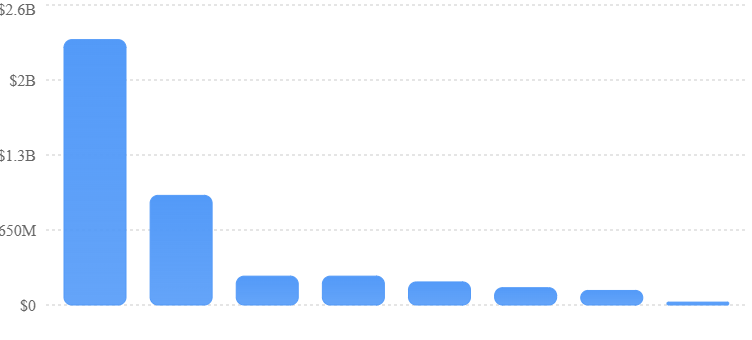
The most striking finding is the gap between the largest rounds and the rest of the sample.
Cursor’s $2.3 billion Series D represents approximately 54.1% of the $4.251 billion total. Sierra’s $950 million round contributes another 22.3%. Combined, the two companies account for approximately 76.5% of sampled financing.
The other six companies share the remaining 23.5%.
This matters because headlines about billions flowing into AI agents can create the impression that every startup has easy access to enormous amounts of capital. Our sample shows something different. A small number of established, heavily backed companies received much larger rounds than the others.
The arithmetic also shows why average funding figures can mislead readers.
The mean round size is approximately $531 million. Yet the median, calculated from the two middle rounds after sorting all eight by size, is $225 million.
The average is more than twice the median because the two largest rounds pull it upward.
For an early-stage founder, neither number is a realistic fundraising target. These companies are at different stages, have different customer bases, and operate with different financing needs. The value of the finding is that it exposes capital concentration, not that it establishes a normal startup funding amount.
Original Finding #2: Funding Concentration Is Even Clearer After Removing the Biggest Deals
| Measure | Calculated result |
| Total selected funding | $4,251M |
| Largest round | $2,300M |
| Two largest rounds | $3,250M |
| Remaining six rounds | $1,001M |
| Average across all eight | $531.4M |
| Median across all eight | $225M |
| Average excluding two largest | $166.8M |
SFTechScene calculations. Values are rounded where appropriate.
Removing Cursor and Sierra reduces the average disclosed round from $531.4 million to approximately $166.8 million.
That is a 68.6% reduction in the mean, even though only two of the eight observations have been removed.
This concentration is consistent with the broader AI funding environment. Crunchbase reported that 58% of global AI funding in its late-2025 analysis went into rounds of at least $500 million. That broader figure includes model developers and infrastructure companies, so it should not be treated as an agentic AI-only benchmark.
Crunchbase News
The implication for founders is important. Investors may have substantial appetite for AI, but access to the largest pools of capital is not evenly distributed.
A startup with a new product, a handful of paying customers, and limited proof of repeatable demand should not build its financial plan around receiving the kind of financing seen at Cursor or Sierra.
Instead, it should focus on proving that its product solves a specific problem, keeps customers, and can deliver work profitably.
Original Finding #3: Software Creation Accounts for 60% of Sampled Funding
The next question is where the money went by business function.
For this calculation, each company was placed into one primary category based on its main commercial product. Cursor and Replit were grouped under software creation. Sierra and Decagon were grouped under customer service. The other four companies were classified separately.
Funding by primary business function
Share of $4.251B selected sample
■ Customer service
■ Enterprise knowledge
■ Healthcare
■ Legal workflows
■ Sales
■ Software creation
| Business function | Companies | Total funding | Share |
|---|---|---|---|
| Software creation | Cursor, Replit | $2,550M | 60.0% |
| Customer service | Sierra, Decagon | $1,200M | 28.2% |
| Legal workflows | Harvey | $200M | 4.7% |
| Enterprise knowledge | Glean | $150M | 3.5% |
| Healthcare | Hippocratic AI | $126M | 3.0% |
| Sales automation | Artisan | $25M | 0.6% |
| Total | 8 companies | $4,251M | 100% |
Software creation captures the largest share in this sample, followed by customer service. Combined, these two categories represent approximately 88.2% of selected funding.
This does not prove they attract 88% of all agentic AI investment. The sample is small, and Cursor’s very large round strongly affects the distribution.
It does, however, point to a useful business pattern. Both categories involve high volumes of recurring work, and both have results that customers can measure.
A software development team can check whether an AI-generated change passes its tests. A customer support business can check whether an issue was solved correctly. Neither measure is perfect, but each provides more direct feedback than a general claim that AI makes employees productive.
Investors may find these categories attractive because companies can run repeated tests, improve their products, and show customers whether the software is delivering results.
Original Finding #4: Business Function Matters More Than an AI Agent Label
The sampled companies rarely sell AI automation as an abstract idea. Their products target recognizable kinds of work.
Harvey is built around legal tasks. Sierra and Decagon address customer interactions. Artisan targets sales activity. Replit focuses on software building, while Hippocratic AI develops healthcare communication agents.
This suggests an important competitive difference between broad automation platforms and products created for a particular industry.
A general AI tool may understand what a customer is asking. A specialized healthcare agent must also follow the organization’s approved procedures and know when a human professional needs to intervene.
A general coding assistant may generate a function. An effective coding agent must understand the larger software project, follow team rules, and handle tests and errors.
The closer an AI product gets to completing valuable work, the more important its understanding of the specific workflow becomes.
For San Francisco founders, this supports a practical strategy: begin with one expensive and repeatable business problem rather than promising to automate an entire company.
Original Finding #5: The Largest Funding Categories Are Not Necessarily the Best Opportunities for New Founders
Software creation and customer service dominate our sample by dollars, but those categories also contain highly funded competitors.
A founder trying to build another general-purpose AI coding tool may compete against businesses with large engineering teams, established customers, and considerable capital.
The opportunity could be better in a smaller business process that these companies do not serve well.
For example, a startup helping property management firms review maintenance requests, verify contractor invoices, or prepare tenant communications might address a narrower market. But if it solves a difficult task and can show reliable savings, it may create a sustainable business without needing hundreds of millions of dollars.

The correct lesson from the dataset is not simply to follow the largest funding category. It is to understand what makes a workflow valuable, how hard it is to automate, and whether customers are willing to pay for a dependable solution.
Research Limitations: What These Findings Do and Do Not Prove
The analysis provides a transparent view of eight selected funding events, not a complete market census.
Its company selection favors businesses with substantial public visibility and clearly disclosed rounds. Smaller private rounds may be underrepresented. Categories are assigned according to each company’s primary product, even though some companies operate across several functions.
The sample also compares rounds announced on different dates and at different stages. It cannot prove that one category is growing faster, that one company has better financial performance, or that investor returns will match current valuations.
The findings are strongest when used to understand concentration and funding patterns within this defined group. They should not be generalized into market-wide totals.
Why San Francisco Remains Central to the Agentic AI Funding Boom
The Bay Area Connects Founders, Capital, and Early Enterprise Customers
San Francisco’s advantage in AI is not based only on the number of AI companies operating in the city.
The wider Bay Area brings together model researchers, software engineers, experienced founders, venture firms, cloud technology providers, and businesses willing to test new software.
That combination matters particularly for agentic AI because creating a useful product requires more than connecting a model to a website.
Founders need to understand customer workflows, build reliable connections to business systems, test the software under real conditions, and improve it using customer feedback.
When the engineers building a product can work closely with the teams using it, they can identify problems faster.
The region also provides access to investors familiar with enterprise software. Firms such as Sequoia Capital, Andreessen Horowitz, Accel, and Kleiner Perkins appear across major AI application financing announcements. Their participation provides evidence of strong investor interest, although each firm’s investment approach differs.
Cursor
+3
San Francisco Has an Advantage in Turning AI Research Into Business Products
The Bay Area has long been successful at translating new computing technologies into software companies.
Agentic AI follows a similar pattern. Researchers improve model capabilities, startups build applications around those capabilities, and early customers help determine which applications solve meaningful problems.
The most promising products often begin with specific tasks that existing software handles poorly.
A company may start by helping account managers prepare reports, then expand into checking account activity and completing approved updates. Another startup may begin by helping legal teams review documents, then develop tools that manage larger parts of the review process.
This gradual expansion can be more practical than launching a product that claims to operate every department of a business.
The advantage belongs to the company that learns how work actually happens, not simply the one with access to the newest model.
San Francisco’s Biggest Challenge May Be Competition, Not Access to Talent
A crowded ecosystem can help founders build quickly, but it also means successful ideas attract competitors.
An AI startup may face three different kinds of competition at once.
It can compete against another young AI company solving the same task. It may also face established software vendors adding AI features to existing products. Finally, customers may decide to build their own agents using software frameworks and models available from larger technology providers.
This makes product differentiation important.
A company cannot depend forever on having a slightly better prompt, a more attractive interface, or earlier access to a model. Those advantages can disappear quickly.
More durable strengths may come from customer trust, specialized workflows, reliable performance, effective connections to existing tools, and a growing body of tested business knowledge.
Inside the Agentic AI Companies Attracting Major Investment
Sierra: Why Customer Service AI Is Becoming a Major Investment Category
Customer service automation | San Francisco
Sierra is one of the clearest examples of investors backing AI that performs customer-facing work.
The company develops AI agents for businesses that need to handle customer conversations across large numbers of interactions. Its systems are intended to do more than answer simple questions. They can connect customers with services and carry out supported actions within approved processes.
In May 2026, Sierra announced $950 million in new financing led by Tiger Global and GV, at a valuation above $15 billion. The company also reported that its technology was being used by more than 40% of Fortune 50 companies. These are company-reported figures, rather than independently audited evidence of agent performance.
Sierra
+1
The financial opportunity comes from the scale of customer service operations.
Large businesses handle millions of customer questions, requests, and complaints. Even a modest reduction in the human time needed for routine issues can have significant financial value.
But investors need to look beyond the percentage of requests that an AI system can handle.
A more useful measure is how many customer problems the system solves correctly without causing additional work. If the AI agent provides an incomplete answer and the customer contacts support again, the apparent savings may disappear.
This is why customer satisfaction, repeat contacts, error rates, and the cost of human intervention matter alongside automation rates.
For smaller San Francisco startups, Sierra demonstrates the value of building around a large, repeated business problem. It also shows how difficult direct competition can become when an established company has major financing and enterprise relationships.
Decagon: Building AI Agents That Manage Customer Relationships
Customer experience | San Francisco
Decagon is another major player in enterprise customer service agents.
Its approach centers on helping companies create AI customer experiences that go beyond older support chatbots. The goal is to let customers complete useful tasks through natural conversations while maintaining connections to company systems.
In June 2025, Decagon announced a $131 million Series C at a $1.5 billion valuation. Seven months later, in January 2026, it announced another $250 million, bringing its valuation to $4.5 billion. The company reported adding more than 100 new global enterprise customers during the preceding fiscal year.
Decagon
+1
The reported valuation increased threefold between those funding announcements. That is an increase in the price investors were willing to assign to the business, not proof that its revenue or profits increased by the same amount.
The strategic question is whether AI customer service providers can improve the customer experience as they reduce manual work.
A business does not want an agent that simply ends conversations quickly. It wants customers to get the right outcome without unnecessary steps.
This creates an opportunity for software providers to compete on successful outcomes rather than conversation volume.
For founders, Decagon offers another lesson: the interface is only one part of the product. The real work involves understanding company rules, connecting to tools, handling unexpected requests, and giving customers a safe path to human help.
Harvey: Why Legal AI Is Attracting Large Checks
Legal workflow automation | San Francisco
Harvey demonstrates why investors are excited about AI built for professional industries.
Legal work often involves expensive research, document review, contract analysis, and preparation. Much of this work requires professional judgment, but certain parts are repetitive and can be supported by software.
Harvey has developed AI products for law firms and legal teams. Its financing history shows how strongly investors value this opportunity.
In February 2025, the company announced a $300 million Series D at a $3 billion valuation. In June 2025, it announced another $300 million at $5 billion. By March 2026, Harvey announced $200 million in fresh financing at an $11 billion valuation.
Harvey
+2
Investors are backing the possibility that AI can become a standard part of legal workflows.
Yet the legal industry also shows why reliable automation matters more than generating impressive text.
An inaccurate summary of a legal document can create serious problems. An agent that misses an important contract clause may cost far more than it saves. Legal professionals therefore need clear sources, review controls, and an understanding of what the AI has actually done.
This creates a market where accuracy, security, and control can be valuable selling points.
Startups serving legal, financial, insurance, and other regulated industries should learn from this approach. The goal should not be to promise perfect automation. It should be to remove well-defined manual work while preserving the human decisions that matter.
Glean: The Importance of Helping AI Understand Business Information
Enterprise knowledge and AI agents | Palo Alto
Glean represents a different part of the agentic AI opportunity.
Many companies have information spread across documents, messaging systems, internal tools, and business applications. Employees waste time searching for the right information, checking which version is current, and determining what they are allowed to access.
AI agents face the same challenge.
An AI system cannot reliably complete a task if it lacks the correct information or does not understand the rules governing that information.
Glean has focused on enterprise knowledge and AI capabilities that help workers find and use company information. In June 2025, it announced a $150 million Series F at a $7.2 billion valuation.
Glean Press
The opportunity goes beyond search.
An enterprise AI agent might need to locate a policy, compare it with a customer request, identify the correct process, and prepare an approved action.
For a founder, this highlights why business context is a key part of agent performance. A powerful language model without access to accurate, current company information may be less useful than a smaller system connected to the right sources.
The ability to manage permissions and identify trustworthy information is especially important when AI agents begin acting on behalf of employees.
Cursor and Replit: Why Investors Are Funding AI Software Creation
AI coding and application development | Bay Area
Software development is one of the strongest categories in our funding sample.
Cursor’s $2.3 billion financing in November 2025 followed its $900 million round in June of that year. The company reported crossing $1 billion in annualized revenue when announcing the November funding.
Cursor
+1
Replit announced a $250 million financing round in September 2025. At that time, it reported that its annualized revenue had grown from $2.8 million to $150 million in less than a year, alongside the release of a more autonomous coding agent.
Replit
These numbers help explain investor interest.
Software creation involves clear deliverables. Code can be written, checked, tested, and improved. Teams can assess whether changes work and how much time developers spend reviewing AI-generated output.
That makes coding a promising area for increasingly autonomous software.
However, writing code is not the same as delivering reliable software. Human teams must still consider security, system design, user needs, maintainability, and whether the product is solving the right problem.
The greatest value may come from agents that work well alongside experienced developers rather than systems that simply generate more code.
For founders, there is also a wider lesson. As software becomes easier to create, the cost of building basic product features may fall. That can increase competition in many software markets.
Knowing what customers need, building trust, and reaching buyers may become even more important when competitors can develop similar technical features quickly.
Why Investors Are Betting on Specialized AI Agents
A Narrow Business Problem Can Be a Stronger Starting Point
Many AI startups begin with the ambition to become a platform for every industry.
That sounds attractive because the potential market appears enormous. But a broad product can become expensive to build, difficult to explain, and hard to sell.
A specialized agent has a simpler starting point.
It can focus on one type of customer, one collection of rules, and one measurable outcome.

An AI tool for insurance claims might start by checking submitted documents for missing information. A property management agent could begin by routing maintenance requests. A healthcare administration agent might help patients complete approved nonclinical scheduling tasks.
The company can learn which exceptions occur most often and improve the product using real customer feedback.
Only after the initial workflow is dependable should the startup expand into related work.
Specialized Knowledge Makes AI More Valuable
Businesses often operate according to rules that are not available in general AI training data.
A financial services company may have detailed approval requirements. An insurance business may follow state-specific procedures. A hospital may have strict limits on which patient communications can be automated.
An AI agent must operate within these limits.
That creates an opportunity for specialized software companies to build workflow knowledge into their products.
The value does not necessarily come from training a new AI model. It may come from building the surrounding system that helps a model use the correct information, follow approved steps, and request human help when necessary.
For a startup, this can be a more practical use of capital than attempting to compete with the largest model developers.
Customer Relationships Can Become a Competitive Advantage
AI companies often talk about technical advantages, but customers make purchasing decisions for business reasons.
A startup that understands how a customer’s team works may be able to solve problems that a more general platform overlooks.
Over time, close customer relationships can help the company identify new tasks worth automating. They also make it easier to understand where the existing product is failing.
This advantage is not automatic. A company still needs to turn customer knowledge into better software and measurable outcomes.
Founders should therefore treat early customer projects as a source of product learning, not merely as opportunities to collect testimonials.
What Makes Agentic AI Businesses Attractive to Venture Investors?
Recurring Revenue From Repeated Work
Venture investors generally prefer businesses that can grow without rebuilding the entire product for every customer.
Agentic AI can support this model when customers need the same types of work completed regularly.
A customer support agent handles requests every day. A software development agent supports repeated engineering tasks. A legal AI system may be used across many matters and documents.
If customers continue using the product and expand their usage over time, the company can build recurring revenue.
However, usage alone is not enough. The company must also keep the cost of delivering that work below the amount customers pay.
A product that becomes more expensive to operate every time customers use it may struggle to build a profitable business.
Strong Customer Retention
Retention shows whether customers find enough ongoing value to keep paying.
For agentic AI startups, retention may be especially important because many buyers begin with experiments.
A company might pay for a three-month pilot to test an AI agent. That early payment proves interest, but it does not show whether the product will become part of normal operations.
Investors should look for customers moving from experiments into production, renewing contracts, and increasing usage because the system delivers dependable value.
They should also ask how much technical help is required for each new deployment.
A startup that needs months of custom engineering for every customer may grow revenue while also accumulating high service costs.
Better Economics as the Product Improves
A strong agentic AI business should understand the cost of each successful task.
This includes model usage, infrastructure, integrations, customer support, and human reviews.
The company can improve its economics by using smaller models for simple jobs, reducing unnecessary processing, reusing verified information, and identifying situations that need human help before an error occurs.
These improvements matter because the price of AI technology can change quickly.
If model costs fall, competitors may reduce prices. If model costs rise or workloads become more complex, providers need enough room in their budgets to continue operating profitably.
The best businesses will not depend entirely on one model provider’s current pricing.
Original Analysis: How AI Agent Economics Can Change a Business
Funding announcements reveal what investors are willing to finance, but they do not directly show how much money AI agents save customers.
To examine that question, SFTechScene built a separate financial scenario for a hypothetical customer support operation.
This is a modeled business case, not an observed company result. The assumptions are provided so business owners can replace them with their own operating data.
A Model Customer Support Business Handling 100,000 Monthly Requests
Assume a company receives 100,000 support requests each month. Handling a request manually costs an average of $6, including the relevant labor and operating expenses.
The company is considering an AI agent that costs $1 for each automated interaction. It also expects 15% of attempted automated interactions to need human help, adding an average $6 cost for those cases.
The model assumes a fixed monthly platform and integration expense of $20,000.
| Input | Model assumption |
|---|---|
| Monthly requests | 100,000 |
| Cost of manual handling | $6 per request |
| Cost per AI-attempted request | $1 |
| Human escalation rate | 15% |
| Cost per escalated request | $6 |
| Fixed monthly AI platform expense | $20,000 |
Under this model, the effective variable cost of each AI-attempted request is $1.90: the $1 AI cost plus an expected $0.90 from human escalations.
A successful deployment must save enough money on the attempted requests to cover the fixed platform expense.
Scenario Analysis: How Savings Change With Automation Coverage
Modeled monthly support savings
Illustrative economics using stated assumptions, not observed company results

| Share attempted by AI | Cost without AI | Cost with AI | Monthly savings |
|---|---|---|---|
| 20% | $600,000 | $538,000 | $62,000 |
| 40% | $600,000 | $456,000 | $144,000 |
| 60% | $600,000 | $374,000 | $226,000 |
| 80% | $600,000 | $292,000 | $308,000 |
The calculation uses:
\[ \text{AI monthly cost} = (N-A)\times \$6 + A\times \$1.90 + \$20,000 \]
Here, \(N\) is the total number of requests and \(A\) is the number of requests attempted by AI.
The model suggests that higher levels of effective automation can produce meaningful savings. At 60% coverage, the modeled monthly savings reach $226,000, or approximately $2.71 million on an annualized basis.
But that result depends entirely on the assumptions. It presumes that the remaining manual costs are avoidable, the escalation rate stays at 15%, and the AI system does not create additional repeat contacts, compliance costs, or service problems.
It also assumes the AI can handle more requests without a major increase in cost or a decline in accuracy.
Real business outcomes can differ greatly.
Original Finding #6: The Cost of Failed Automation Can Change the Investment Case
The financial model becomes more useful when we test what happens if performance is worse than expected.
Suppose the company still sends 60,000 monthly requests to its AI agent, but the escalation rate increases.
| Escalation rate | Monthly savings |
|---|---|
| 10% | $244,000 |
| 15% | $226,000 |
| 25% | $190,000 |
| 40% | $136,000 |
| 60% | $64,000 |
SFTechScene scenario calculations using the same request volume, manual cost, AI cost, and fixed platform charge. Escalated requests incur both AI and manual handling costs.
At a 10% escalation rate, modeled savings are $244,000 each month. At 40%, savings decline to $136,000.
This shows why the percentage of customer requests handled without human help is so important.
An AI platform may appear affordable when looking only at the price of each AI interaction. The financial outcome depends on how many interactions require expensive follow-up work.
For venture investors, this creates a useful question: does the company improve its customers’ economics as usage grows, or simply generate more automated conversations?
For business buyers, it suggests that AI agents should be judged by the cost per correctly completed task.
That measure is more valuable than tracking how many messages the system sends or how many requests it attempts.
Original Finding #7: AI Agents Can Be Financially Valuable Before They Handle Most Work
The same model provides another useful insight.
Each AI-attempted request saves an expected $4.10 before fixed platform costs, given the base 15% escalation assumption.
Dividing the $20,000 fixed monthly expense by the $4.10 expected saving per attempted request gives approximately 4,878 requests.
This means the modeled operation reaches its financial break-even point at roughly 4.9% AI coverage, assuming all other costs behave as modeled.
That does not mean a real business should expect break-even at 4.9%. It means that under favorable unit economics, an agent does not have to automate most of a company’s work to justify its cost.
This has a direct implication for founders.
A startup may not need to promise that its agents can operate an entire department. It may be able to build a valuable business by solving a smaller set of recurring tasks extremely well.

The more important goal is to find work where the financial saving from a correct automated outcome is large relative to the cost of producing that outcome.
The Biggest Risks Behind the Agentic AI Funding Boom
High Valuations Can Create Difficult Expectations
Large funding rounds can help companies grow, but they also create pressure to deliver exceptional results.
A company valued at several billion dollars must eventually justify that valuation through revenue, growth, profitability, strategic value, or a future sale.
Investors may be willing to pay a high price today because they expect a market to become much larger over time. Those expectations can change if growth slows or competitors offer similar services at lower prices.
This is particularly important in agentic AI because the technology is changing quickly.
A feature that gives one startup an advantage today may become available through a major software platform within months.
Founders should therefore avoid using competitor valuations as evidence that their own business deserves a similar price. They need to show customers are buying, staying, and receiving enough value to justify continued spending.
Model Providers Could Capture More of the Market
Many agentic AI companies depend on foundation models developed by other businesses.
That allows startups to build products without spending enormous amounts of money training their own models.
The trade-off is dependence on outside providers for important technical capabilities.
If a model provider launches similar agent features, application startups may face new competition. If pricing or access terms change, their costs may also change.
Founders can reduce this risk by making their business value less dependent on one model.
A company with specialized customer knowledge, useful integrations, strong workflow controls, and a proven distribution strategy may remain valuable even when underlying models improve.
Reliability Problems Can Slow Enterprise Adoption
Businesses are often willing to experiment with AI tools that draft content or summarize documents because employees can review the output before using it.
Autonomous software creates a different risk.
An AI agent that sends an incorrect invoice, approves an unauthorized refund, or shares private customer information can cause immediate harm.
This is why successful deployment requires clear boundaries.
Businesses need to define which actions an agent can take, which actions require approval, what information it can access, and how errors will be detected.
The product must also keep useful records so teams can understand what happened when something goes wrong.
These controls create additional costs, but they can also make the product more valuable to serious customers.
The Economics of AI Usage May Not Stay the Same
AI computing costs have become an important part of software company financial planning.
Some tasks require only a short interaction with a model. Others involve repeated reasoning, searching through documents, calling multiple tools, and checking results.
The second type may be much more expensive.
An AI agent provider can become unprofitable if its customers pay a fixed price but consume far more computing power than expected.
Businesses must therefore measure cost at the task level and understand how those costs change as customers become more active.
This is especially important when customers use AI agents for complex workflows that may require several attempts before reaching a successful result.
How San Francisco Founders Can Build a Fundable Agentic AI Startup
Start With a Business Problem That Already Costs Money
A founder should begin by identifying a task that companies repeatedly pay people or service providers to perform.
Good candidates tend to have a clear starting point, a clear definition of success, and a repeatable process.
For example, a company may spend significant time checking invoices against purchase orders. The founder could build an AI agent that reads the documents, identifies mismatches, prepares the results, and sends uncertain cases to an employee.
The product has a clear purpose, and the customer can measure the result.
That is much easier to sell than a broad promise to make the whole company more productive.
The founder should interview potential customers before building the product, asking them to explain how the task works today, where errors occur, and how much effort each case requires.
Build a Financial Model Before Building a Complex Product
A startup can develop technically impressive software without creating a business that customers can afford.
Before investing heavily in development, founders should estimate the cost of the existing process and what the AI system would need to achieve to be worthwhile.
The model should include the direct cost of performing the task, how frequently it occurs, how often human intervention will be necessary, and how much the customer is likely to pay.
It should also reflect the cost of maintaining integrations, supporting customers, and correcting mistakes.
A founder who understands these numbers can make more informed product decisions.
For example, a feature that slightly improves response speed may be less valuable than one that reduces the number of cases needing human review.
Prove Reliability With Real Customer Work
Early demonstrations are useful, but they are not enough for an enterprise buyer.
A founder should test the AI system against actual examples from the customer’s workflow.
The test should include simple cases, unusual cases, incomplete information, conflicting instructions, and requests that should be rejected or sent to a human.
These tests reveal whether the product can operate safely outside a controlled demonstration.
A useful pilot report should show the number of attempted tasks, the percentage completed correctly, the average cost per successful task, the time saved, and the problems that remain unresolved.
It should also document any errors that could have caused financial, legal, or customer harm.
This evidence is far more persuasive than claiming that the system uses the newest model.
Design Human Review Into the Product
Founders sometimes believe that requiring human approval makes an AI agent less impressive.
For real business customers, the opposite can be true.
A product that recognizes uncertainty and requests approval before a risky action may be more useful than one that operates independently without appropriate limits.
Human review can also improve the product over time.
When employees correct the AI’s mistakes, developers can identify recurring failure patterns and improve instructions, tools, and tests.
The long-term objective should be to reduce unnecessary review while keeping important decisions under appropriate human control.
Build Distribution Before Competitors Crowd the Market
A strong technical product does not guarantee customer growth.
Agentic AI startups need a reliable way to reach buyers, explain the value of their solution, and convert trials into recurring contracts.
For a startup serving a specific industry, partnerships may be especially useful.
An AI company focused on accounting workflows might work with accounting firms or software providers that already serve the target customers. An insurance automation company could build relationships with firms specializing in claims operations.
These relationships can provide customer access that a small startup would struggle to develop through advertising alone.
In crowded categories, distribution may be just as important as technical performance.
A 90-Day Strategy for Building an Investor-Ready AI Agent Company
The best use of the first 90 days is not to build an enormous platform. It is to gather credible evidence that a narrow AI product can solve a problem customers care about.
90-day execution roadmap
- Days 1–30: Validate the problemInterview 15–20 potential customers in one industry. Map a repeated workflow, estimate its current cost, and collect examples that can be used for testing. Aim to identify at least three organizations willing to evaluate a working solution.
- Days 31–60: Build and test the first agentDevelop an agent for one defined task. Use approved data, limit available actions, and create a set of test cases covering both normal situations and likely failures. Track accuracy, human intervention, and cost per completed task.
- Days 61–90: Run paid pilots and measure valueDeploy the product with a small number of customers under agreed safeguards. Measure savings against the existing process, document unresolved problems, and test willingness to pay. Use those results to decide whether to improve, expand, or change direction.
What Investors Should Expect After 90 Days
A 90-day project is unlikely to prove that a startup can become a billion-dollar business.
It can, however, provide evidence that the founders understand their market and can turn AI technology into something customers value.
At this stage, investors should care more about the quality of customer evidence than ambitious market forecasts.
Useful signals include customers participating actively in pilots, repeated use of the product, improving reliability, and a clear plan for turning trials into paid contracts.
A startup should also understand its biggest technical and commercial risks.
If a product works only when a founder manually supervises every task, that needs to be reflected in the financial plan. If customer onboarding requires weeks of engineering work, the startup should explain how those costs could be reduced.
Credible reporting creates a stronger investment case than hiding problems behind impressive demonstrations.
What San Francisco Businesses Should Look for Before Buying AI Agents
Measure Outcomes Rather Than Conversation Quality
Many AI systems are good at sounding helpful.
That does not necessarily mean they can complete work accurately.
A business choosing an AI agent should define successful task completion before beginning a pilot.
For customer support, success might mean that a problem is resolved correctly without the customer contacting the company again. For invoice processing, success might mean that the system identifies the correct records and flags mismatches according to company rules.
The buyer should also measure how much employee time the system actually saves.
If staff must spend almost as much time reviewing the AI’s work as they previously spent completing the task, the product may deliver little financial value.
Evaluate Security and Access Controls
An AI agent often requires access to important business information.
Before deployment, buyers should understand what data the system can read, which applications it can modify, and what controls prevent unauthorized actions.
The provider should explain how activity is recorded, how access is limited, and what happens if the system behaves unexpectedly.
Companies should also review the provider’s approach to data retention, security incidents, and customer permissions.
These questions matter especially when agents interact with financial records, employee information, healthcare data, or private customer details.
Plan for Errors and Unexpected Situations
Every business process has exceptions.
A customer might ask for something that company policy does not permit. A document may be incomplete. A software system might be temporarily unavailable.
An AI agent should have a safe way to handle these situations.
The buying team should test what the product does when it cannot complete a request, not only when everything works correctly.
A reliable agent may stop and request human help. That is often better than making an unsupported decision.
What the Funding Boom Means for the Future of SaaS
The Software Market May Shift From Seats to Work
Traditional software subscriptions often charge according to the number of employees using a product.
Agentic AI could encourage different pricing models.
A company might pay for a certain number of completed tasks, a monthly volume of automated requests, or a combination of platform access and usage.
For example, a customer service provider might charge according to resolved cases, while a document processing platform could charge per processed document.
These models can help connect software spending with business outcomes.
They also create complications.
Vendors and customers must agree on what counts as a successful result. They need ways to handle disputed outcomes, complicated cases, and tasks completed only after human intervention.
A pricing model that appears simple can become difficult to manage when real workflows are involved.
Established Software Providers Will Not Disappear
Agentic AI is unlikely to eliminate all traditional business software.
Companies still need databases, security systems, financial records, communication platforms, and tools for human employees.
In many cases, AI agents will operate on top of existing applications rather than replace them completely.
This can create opportunities for both startups and established vendors.
Startups may develop new interfaces and task automation systems, while existing software companies can add agents to products customers already use.
The companies that succeed will be those that make business work easier and more reliable, regardless of whether they are new entrants or established providers.
AI Agents Could Change How Companies Organize Teams
As AI agents become more capable, businesses may rethink how work moves between employees and software.
Some teams could spend less time on routine processing and more time reviewing unusual cases, serving customers with complex needs, or improving operations.
Managers may need new ways to measure performance.
Instead of counting only how many tasks employees complete, they may track the quality of work produced by combined human and AI systems.
This shift could also create demand for people who understand how to design workflows, evaluate automated decisions, and maintain reliable AI operations.
The outcome will vary across industries. Some tasks will be easier to automate than others, and companies will make different choices about how much work should remain under direct human control.
What Investors and Founders Should Watch Through 2027
The next stage of the agentic AI market will likely be defined less by the number of startups announcing agents and more by the performance of those agents in production.
Funding will remain an important signal, but a large financing round is not the same as sustainable customer demand.
One useful indicator will be how many AI agent businesses can turn early pilots into repeatable, profitable deployments.
Another will be whether customers expand usage after the first contract. Expansion suggests the product is becoming useful in everyday operations rather than remaining an experiment.
Investors should also watch whether gross margins improve as products mature. If AI agents become more reliable but also much more expensive to operate, revenue growth may not translate into attractive financial returns.
A final signal will be the response from established software vendors and large model developers. If they make basic agent capabilities widely available, independent startups will need stronger reasons for customers to choose their products.
For San Francisco, the opportunity extends beyond today’s most heavily funded companies.
New startups can still build valuable businesses around specific workflows, difficult integrations, regulated industries, and groups of customers that larger vendors overlook.
The strongest founders will recognize that raising capital is a means to build a business, not the final measure of success.
Final Takeaway: Silicon Valley’s Agentic AI Winners Will Be Defined by Reliable Work, Not Funding Headlines
Silicon Valley’s agentic AI funding boom reflects a major change in what investors believe software can accomplish.
For decades, business software primarily helped employees perform work. Agentic AI offers the possibility of software completing more of that work directly.
That creates opportunities to improve productivity, reduce repetitive tasks, and build new types of software companies.
SFTechScene’s original research sample shows how concentrated the financing has become. Eight selected Bay Area companies announced a combined $4.251 billion in individual funding rounds, with Cursor and Sierra accounting for approximately 76.5% of the sampled capital.
Software creation and customer service received the largest shares in this dataset, but those results should not be mistaken for a complete picture of the agentic AI market.
The broader lesson is that venture investors are placing substantial bets on companies with products tied to real business activity.
For founders, the path forward is to find an expensive problem, automate a well-defined part of it, measure results, and expand only when customers can see dependable value.
For businesses buying AI agents, the priority should be correct outcomes, financial savings, strong security, and clear human oversight.
For investors, the challenge is to distinguish companies with strong long-term economics from those benefiting mainly from excitement around a fast-moving technology.
The biggest funding rounds may attract the most attention today. But the lasting value of agentic AI will be determined by something much simpler: whether businesses can trust the software to complete useful work, consistently and at a cost that makes sense.
That is where Silicon Valley’s next generation of software companies will either prove their value or fall short.
Research Notes and Source Transparency
This article uses publicly announced company financing events, industry funding research, and SFTechScene’s independently calculated descriptive statistics and illustrative financial scenarios. The original analysis is reproducible from the figures and assumptions published above.
The core research sources include Crunchbase’s 2026 AI Funding Analysis and 2025 AI Funding Trends, alongside company announcements from Cursor, Decagon, Harvey, Glean, Hippocratic AI, Replit, Artisan, and Sierra’s May 4, 2026 financing announcement.
Crunchbase News
+9
The funding concentration figures are derived from the selected dataset and rounded to one decimal place. The customer support savings calculations are hypothetical and should not be presented as measured results from any of the featured companies.
Research cutoff: October 13, 2026. Funding figures and private-company valuations may change after publication. The analysis does not establish investment returns, audited revenue, or the total size of the agentic AI funding market.