
San Francisco’s next big software boom is not simply about making artificial intelligence smarter. It is about giving AI the ability to complete real business work, from answering customer calls and reviewing insurance claims to processing invoices, finding sales leads, and operating software that employees once had to manage by hand.
For years, businesses bought software to help their employees work faster. Now, a growing group of San Francisco startups is building software that can carry out parts of the work itself. These products are known as AI agents, and they are changing what companies expect from business automation.
Consider a finance team that spends days checking transactions across different systems. An AI agent can collect the records, compare them, flag unusual activity, and prepare a report for review. A customer service agent can look up an order, check company rules, and complete an approved request without forcing the customer to contact several departments.
The business opportunity is significant. However, not every product described as an AI agent can work independently, and not every automated task delivers real savings.
That distinction matters especially in San Francisco, where founders are building everything from specialized agents for healthcare and banking to platforms that let other businesses create their own automated workers.
For this SFTechScene report, we examined 20 San Francisco AI agent startups, using publicly available company profiles, product descriptions, accelerator records, and technical information. We also created an original classification dataset to understand which business functions these companies target, how their products differ, and where business buyers should focus their attention.
Our analysis finds a particularly important pattern: the next stage of business automation is increasingly about completing work inside existing systems, rather than generating better answers in a chat window.
The companies that succeed will need more than impressive demonstrations. They will need to prove that their agents can perform work accurately, follow business rules, handle unusual situations, and deliver measurable value.
The Short Version: San Francisco’s AI Agent Startups Are Moving From Chatbots to Digital Workers
The most useful way to understand the San Francisco AI agent market in 2026 is to separate AI tools that provide information from AI tools that carry out work.
An ordinary AI assistant might explain how to handle a customer refund. An AI agent can potentially look up the order, check the refund policy, verify the customer’s eligibility, process the approved refund, update the customer record, and send a confirmation.
That difference changes the economics of business software.
Instead of paying only for access to a tool, businesses can increasingly evaluate software by the number of tasks completed, the quality of those results, and the amount of employee time saved.
Our research identified six areas of activity among the 20 selected startups: financial operations, healthcare administration, customer support, sales automation, broader business operations, and the infrastructure needed to operate AI agents.
SFTECHSCENE ORIGINAL RESEARCH • OCTOBER 2026
20
SF startups examined
6
Automation categories
10
2026 YC batch companies
Three findings stand out.
First, financial and healthcare operations are major areas of activity in our selected sample. Together, the two sectors account for half of the companies we studied. This suggests a strong opportunity where business work involves large numbers of documents, repeated decisions, complex rules, and expensive manual processes.
Second, many startups are trying to work with the software companies already use rather than demanding that customers replace everything. This is important because a promising AI agent becomes much less attractive when it requires a costly, months-long technology project before it can perform its first task.
Third, the market is producing two different kinds of products. Some startups sell agents that perform a specific business function. Others provide the systems, connections, permissions, and testing tools that make those agents possible.
Both groups matter. A business cannot safely automate important work without the infrastructure needed to control and verify what its agents do.
Our findings are based on a deliberately selected group of 20 companies, not a complete count of San Francisco startups. The category and batch figures describe this research sample and should not be treated as market-wide shares.
What Makes an AI Agent Different From Traditional Business Automation?
Traditional automation follows a fixed path
Companies have used automation for decades. A familiar example is a rule that sends an email whenever someone completes a form.
Other systems transfer information between applications, update records at scheduled times, or move documents through a defined approval process.
These tools work well when the steps are predictable. Their weakness appears when information arrives in an unfamiliar format, a process changes, or a decision requires understanding the meaning of a document.
Imagine a company receiving 500 supplier invoices every week. A traditional system might automatically store each attachment in a folder, but employees may still need to check the amounts, identify suppliers, assign expense categories, and resolve mismatches.
The software moves information. The employees perform much of the judgment.
AI agents can make decisions within a defined task
An AI agent uses a model to interpret information and decide which action should come next.
For example, an invoice-processing agent might recognize different invoice formats, match them to purchase orders, detect missing information, and prepare an approval request.
The agent may also use other business tools to complete the process.
This does not mean it should be allowed to make every decision independently. Companies still need approval limits, access controls, detailed records, and rules for when a person must intervene.
The most useful agent is not necessarily the one that acts with the least human involvement. It is the one that completes the greatest amount of work reliably while respecting the organization’s rules.
The three levels of business AI automation
| Level | What the software does | Business example |
|---|---|---|
| AI assistant | Gives information or suggests actions | Drafts a response to a customer |
| AI copilot | Helps an employee perform work | Reviews a customer case and suggests a resolution |
| AI agent | Carries out approved steps toward a goal | Checks the account, applies policy, updates records, and confirms resolution |
These categories can overlap. A single product may offer assistant, copilot, and autonomous modes.
For businesses evaluating the market, the key question is not what the vendor calls its technology. It is what the system can actually do, what permissions it needs, and what happens when it makes a mistake.
SFTechScene Original Research: How We Selected and Analyzed 20 San Francisco AI Agent Startups
Most lists of promising AI companies focus on funding rounds, investor names, and valuations. Those details can tell us which companies attract capital, but they do not necessarily tell businesses which kinds of automation are becoming useful.
We wanted to answer a different question: what business work are San Francisco AI agent startups actually trying to automate, and what can that tell us about where the market is heading?
To investigate, we built a structured dataset from public company information available through October 12, 2026.
Research Methodology: Selection, Verification, and Classification
Our main research source was the Y Combinator company directory. It provides a consistent starting point for examining startup locations, accelerator batches, company status, and product descriptions. The directory’s San Francisco AI category contained hundreds of businesses in October 2026, making it a useful source for identifying candidates.
Y Combinator
+1
We used five rules to select the companies.
- Location: The company’s current public YC profile had to identify San Francisco as its location.
- Business use: The product had to address work performed by businesses or organizations.
- Agent function: The company had to offer AI systems that take actions, carry out workflows, or provide infrastructure directly supporting such systems.
- Operating status: Its public profile had to identify the company as active when reviewed.
- Evidence: The company had to provide enough information to identify a primary automation use case.
We deliberately included both established startups and newer companies. This avoids producing a list based entirely on large financing rounds while overlooking smaller businesses working on specific operational problems.
We also included infrastructure providers. These companies may not directly replace a human workflow, but they create the tools that make other agents possible.
How the data was coded
Each company was assigned one primary category based on its most clearly described business use.
A startup offering several products was classified according to its main public positioning. For example, an agent serving both customer support and sales could be assigned to customer support when contact-center automation was the central product.
We also recorded the company’s YC batch and whether that batch belonged to 2026.
The final dataset contains 20 distinct companies. We counted each company once, and calculated category percentages by dividing the number of companies in a category by 20.
This produces reproducible descriptive findings, but there are important limits. These are researcher-assigned classifications, not independently measured customer outcomes. A company’s presence in the sample does not establish its product accuracy, financial strength, revenue, or superiority to another vendor.
Company descriptions and performance statements are primarily vendor-reported. Unless otherwise stated, we did not independently test their software or audit their customer results.
Original Finding #1: Finance and Healthcare Make Up Half of Our Selected AI Agent Startups
The first finding comes from grouping the companies by the business functions they primarily address.
Primary automation focus of 20 selected San Francisco AI agent startups
SFTechScene classification of public YC company profiles, October 12, 2026. Each company counted once.
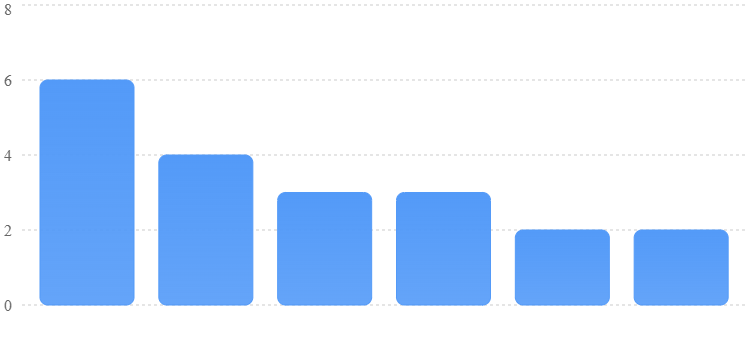
Source: SFTechScene’s original classification of 20 selected San Francisco YC company profiles. These are sample counts, not estimates of all companies in the city.
| Business category | Companies | Share of sample |
|---|---|---|
| Financial operations | 6 | 30% |
| Healthcare administration | 4 | 20% |
| Customer support | 3 | 15% |
| AI agent infrastructure | 3 | 15% |
| Sales automation | 2 | 10% |
| General business operations | 2 | 10% |
| Total | 20 | 100% |
The most interesting result is not that finance has the largest count in our selection. It is that finance and healthcare together account for 10 companies, or 50% of the sample.
These sectors share several practical problems. Employees routinely work across many systems, compare large amounts of information, apply detailed rules, and document their decisions. Much of this work is necessary but time-consuming.
That creates clear opportunities for automation.
Why finance is an attractive starting point
Financial operations produce many tasks that are repeated thousands of times. Teams reconcile transactions, check invoices, review suspicious activity, prepare reports, and confirm that records agree.
A well-designed agent can help complete these steps while keeping an evidence trail.
However, finance also shows why AI automation requires controls. An agent that saves hours but introduces a reporting error can create far more work than it removes.
The companies in this category are therefore interesting not simply because they promise speed. They are trying to connect automation with proof, compliance, and existing financial systems.
Why healthcare is another natural market
Healthcare providers face similar challenges, often with even more fragmented software.
Medical employees work with patient records, insurance portals, billing systems, authorization requests, and administrative forms. Re-entering information and checking records across these systems consumes time that could otherwise support patient care.
Healthcare agents can address these problems, but patient privacy, clinical safety, and billing accuracy create demanding requirements.
The opportunity is substantial, yet the cost of mistakes makes human review and reliable records especially important.
What this finding does and does not prove
This finding does not prove that finance and healthcare receive half of all San Francisco AI agent investment. Nor does it show that they represent half of total market demand.
It shows that these two areas are heavily represented in our deliberately selected cross-sector sample.
The strategic interpretation is that regulated, document-heavy business functions are worth examining closely. Their workflows provide clear problems for agent startups to solve, and the value of successful automation can often be measured.
The 20 San Francisco AI Agent Startups to Watch in 2026
The following list is organized by business function rather than funding size or an unsupported overall ranking.
Each company is included because its public product description offers a clear example of how agents could change business operations. For every startup, we examine the problem it addresses, the way its product works, and what a potential customer should test.
Quick Comparison: All 20 Startups
| # | Startup | Main automation focus | YC batch |
|---|---|---|---|
| 1 | Cignara | Enterprise customer service | Spring 2026 |
| 2 | Dialogus | AI voice contact centers | Summer 2026 |
| 3 | Clad Labs | Internal support requests | Fall 2025 |
| 4 | Frontrunner | Sales and lead workflows | Fall 2026 |
| 5 | Nex | High-volume sales operations | Summer 2026 |
| 6 | Monumint | Banking customer operations | Winter 2024 |
| 7 | Clerked | Accounts payable | Fall 2025 |
| 8 | Zomma | Financial operations and reviews | Summer 2026 |
| 9 | Definite | Financial reporting | Fall 2026 |
| 10 | TovenAI | Trading compliance | Summer 2026 |
| 11 | Qlo | Insurance underwriting | Summer 2026 |
| 12 | Aegis | Insurance denial appeals | Spring 2025 |
| 13 | Pelica | Healthcare plan operations | Spring 2025 |
| 14 | Novoflow | Medical practice workflows | Spring 2025 |
| 15 | Adentris | Medical billing and documentation | Spring 2025 |
| 16 | Eloquent AI | Regulated business operations | Spring 2025 |
| 17 | Soren | Cross-industry business operations | Fall 2025 |
| 18 | Browser Use | Browser-based AI actions | Winter 2025 |
| 19 | Chronicle Labs | AI agent testing | Spring 2026 |
| 20 | OneCLI | Secure AI teammates | Summer 2026 |
YC batches and locations reflect publicly displayed company records reviewed for this article. Inclusion is not a product endorsement or a claim of verified commercial performance.
Customer Support AI Agents: Automating Conversations and Resolutions
Customer support is one of the clearest markets for AI agents because much of the work starts with a question and ends with an action.
A customer wants to change an order, check a payment, update account information, or resolve a technical problem. The AI system must understand the request, find the right records, apply company policy, and complete the task when authorized.
The challenge is doing all of that without giving incorrect information or frustrating customers who need human assistance.
1. Cignara: Enterprise Customer Service That Can Act Inside Business Systems
Primary focus: Large-scale customer service and sales automation.
Cignara builds AI systems for large consumer-facing businesses. Its product supports voice and chat interactions and is designed to work inside the existing technology systems used by major organizations.
That matters because enterprise support is rarely limited to answering questions. Employees often need to open customer accounts, inspect transactions, make changes, and follow policies that vary by customer or product.
Cignara’s public YC profile describes agents that can execute policy-bound actions within older enterprise systems. It also identifies LG as a customer, though that relationship and the related performance claims are company-reported.
Y Combinator
Why Cignara matters for San Francisco businesses
Many large businesses have invested heavily in customer management software. Replacing those systems simply to adopt AI would be expensive and disruptive.
Cignara represents an approach in which agents work with existing systems rather than requiring complete replacement.
For companies with complicated customer journeys, that compatibility could matter more than whether a chatbot produces especially natural answers.
What buyers should test
A useful pilot would focus on one complete customer request, such as changing a subscription or resolving an account issue.
Measure whether the AI agent accurately checks customer identity, follows company policy, completes the requested action, and records what happened.
A good result is a correctly resolved issue, not simply a conversation that sounds convincing.
2. Dialogus: AI Voice Agents for High-Volume Contact Centers
Primary focus: Automated customer calls and contact-center operations.
Dialogus builds AI voice agents intended to handle customer support, sales, collections, and related conversations.
The company’s approach includes examining previous calls, finding where its agents struggle, testing improvements through simulated conversations, and applying changes with human oversight.
This is particularly relevant to businesses where small improvements in call handling can have large effects across thousands of interactions.
Dialogus describes production use in enterprise contact centers and positions its product as an alternative to parts of traditional call-center operations. These deployment claims come from the company’s own public profile.
Y Combinator
What makes the approach interesting
Voice automation creates challenges that ordinary text-based agents do not face.
Customers interrupt, speak unclearly, change their minds, and provide incomplete information. Background noise and strong accents can make understanding difficult.
A voice agent also needs to respond quickly enough for a natural conversation.
Dialogus is interesting because its product description places emphasis on improving performance from previous interactions rather than simply deploying a voice model.
What businesses should measure
A contact center should measure the percentage of conversations completed successfully, the number of repeat calls, customer complaints, and the quality of transfers to human staff.
It should also examine whether the agent makes the same mistakes repeatedly.
Improving the voice is useful. Improving the actual outcome of the customer interaction is much more valuable.
3. Clad Labs: AI Agents for Internal Support Teams
Primary focus: Support requests coming through workplace communication tools.
Clad Labs addresses a different part of the support market: problems employees and business customers send through tools such as Slack, Microsoft Teams, and email.
In many organizations, important requests arrive through several channels. Teams lose time deciding who owns a problem, gathering background information, and explaining the same solution repeatedly.
Clad’s stated approach is to bring these requests into an organized support queue, use agents to investigate and resolve cases, and convert completed conversations into reusable knowledge.
Y Combinator
Why internal support is an overlooked automation opportunity
Businesses often focus their AI spending on customer-facing tools because those products are easy to connect to revenue.
Yet internal support teams also handle repetitive questions about software access, system failures, process changes, and operational issues.
When those problems remain unresolved, many employees can lose time.
An agent that correctly resolves a request and documents the answer can potentially reduce future support demand as well.
Best first use case
Start with a limited category such as access requests, routine application errors, or common employee questions.
Require human approval for sensitive changes. Then evaluate the number of requests solved, the accuracy of the answers, and whether similar requests become easier to handle over time.
The goal is not to eliminate human support. It is to keep experienced employees focused on the difficult problems that genuinely need them.
Sales AI Agents: Turning Prospect Research Into a Complete Workflow
Sales teams spend considerable time on work that happens before and after customer conversations.
They research potential customers, maintain records, qualify inquiries, prepare follow-ups, and update sales systems. These steps matter, but they can crowd out time spent building relationships.
AI agents are increasingly designed to handle larger parts of this process.
4. Frontrunner: AI Agents That Build and Run Sales Workflows
Primary focus: Sales research, outreach preparation, campaign work, and customer record management.
Frontrunner allows teams to build agents for tasks such as researching accounts, finding prospects, managing campaigns, updating customer databases, and qualifying inbound leads.
The product is designed to connect with existing sales tools and support the people responsible for finding and winning customers.
Its Fall 2026 YC profile describes a system in which teams can create and manage these agents around their own sales processes.
Y Combinator
Why this approach could matter
A sales team may already use separate tools for lead research, email campaigns, meeting records, and customer management.
The problem is often not a shortage of tools. It is the work required to move information between them.
An agent that can complete a defined sales workflow reduces the need for employees to perform each step manually.
For example, a team might ask an agent to identify companies matching a target customer profile, gather relevant public information, prepare records, and suggest an outreach plan.
Human salespeople can then decide which opportunities deserve attention.
What founders and sales leaders should watch
The greatest risk in sales automation is confusing activity with progress.
An AI agent might research 5,000 prospects and create hundreds of emails without producing a meaningful customer conversation.
Businesses should therefore measure qualified meetings, accepted opportunities, customer responses, and revenue contribution rather than raw messages or records created.
Agents that produce useful commercial outcomes will be more valuable than those that simply generate more activity.
5. Nex: AI Agents Built for High-Volume Sales Operations
Primary focus: Large-scale sales and marketing workflows.
Nex approaches sales automation from the perspective of operating workflows at scale.
The company describes a product that converts business goals into automated processes running across connected tools. It targets tasks such as lead enrichment, customer record cleanup, outreach, and reviewing sales opportunities.
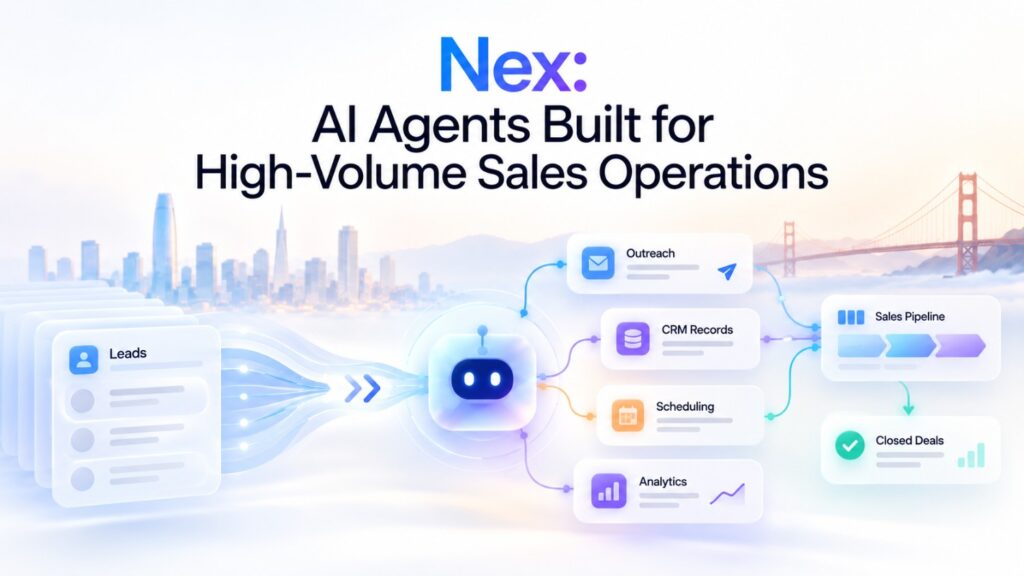
According to its YC profile, Nex was built by a team with previous experience at HubSpot and is designed to handle high-volume work that can become expensive or unreliable when every step depends on a general-purpose AI model.
Y Combinator
Why efficiency matters as much as intelligence
AI systems cost money every time they use computing resources to process information.
An agent that repeatedly asks an expensive model to make simple decisions may cost more than a carefully designed workflow that handles predictable steps with ordinary software.
Nex’s approach highlights an important principle: use AI judgment where it is needed, but do not use costly AI reasoning for every routine operation.
That distinction becomes more important when businesses process thousands of customer records rather than a few dozen.
A practical test for sales operations teams
Give the agent a sample of customer records containing missing fields, duplicates, outdated ownership information, and inconsistent formatting.
Ask it to identify and prepare corrections. Verify the proposed changes before allowing it to update the live customer database.
Measure the number of records corrected accurately and the total processing cost.
The most effective solution will combine reliable results with low operating costs, rather than simply promising the highest level of automation.
Financial AI Agents: The Startups Automating Banking, Accounting, and Compliance
Financial services is the largest category in our selected dataset, with six companies.
The category is particularly interesting because financial work needs clear evidence. A system cannot simply produce a plausible answer and expect an accountant, regulator, or compliance officer to accept it.
The agent must be able to show where the information came from and explain what action it performed.
This creates an opportunity for specialized products that combine AI with financial rules, document processing, and detailed records.
6. Monumint: AI Agents for Banking Customer Relationships
Primary focus: Customer operations for banks, credit unions, and lenders.
Monumint builds conversational AI for financial institutions. Its agents support processes including account opening, loan applications, loan servicing, and collections.
The company describes agents that operate across communication channels and take actions within systems financial institutions already use.
Its public positioning emphasizes the special compliance requirements of banking and lending.
Y Combinator
Why banking needs specialized agents
A customer asking about a loan may need help with documents, eligibility, payment dates, application progress, or an account change.
An AI agent cannot treat every request as a simple conversation. It may need to verify identity, apply financial rules, inspect records, and decide whether a request must be reviewed by an employee.
That combination of conversation and controlled action makes banking a natural but demanding market for AI automation.
Where a bank should start
A lender could begin with application status updates, document reminders, or routine servicing requests.
These tasks provide opportunities to improve response times without immediately handing the AI authority over major credit decisions.
The bank should measure successful resolutions, compliance exceptions, customer satisfaction, and human review time before expanding into more sensitive processes.
7. Clerked: AI Clerks for Accounts Payable
Primary focus: Invoice processing, supplier payments, and financial reporting.
Clerked builds AI-powered accounts payable software.
Its product is designed to help finance teams manage incoming invoices, organize payment information, examine spending, and prepare reports.
The company also describes interfaces through workplace communication tools, allowing finance users to interact with its systems without always opening a traditional accounting dashboard.
Y Combinator
Why accounts payable is a strong automation target
Accounts payable is filled with repetitive work.
Employees receive invoices, check supplier details, compare amounts with purchase orders, determine approval requirements, schedule payments, and update accounting records.
Each step is relatively straightforward when the information is clean.
The difficulty arises when suppliers use different formats, invoices contain errors, approval records are missing, or purchase orders do not match.
AI can help interpret these differences, but payment accuracy remains essential.
How businesses should evaluate Clerked
A useful trial would include ordinary invoices, duplicate submissions, missing purchase orders, incorrect tax details, and unfamiliar suppliers.
Require the agent to explain why it approved, rejected, or escalated each document.
Then compare processing time, exception rates, and financial accuracy against the current process.
A finance leader should never judge an invoice agent only by the number of invoices it processes. Preventing incorrect payments is equally important.
8. Zomma: AI Agents That Work Inside Financial Software
Primary focus: Financial operations, customer verification, transaction alerts, and disputes.
Zomma builds agents that interact with software screens in ways similar to human financial analysts.
Instead of relying entirely on connections built specifically for each application, its approach allows agents to navigate existing interfaces and perform defined tasks.
The company identifies customer verification, transaction investigations, and financial disputes as important use cases. It also describes preserving screenshots and records so reviewers can reconstruct the agent’s work.
Y Combinator
Why using existing screens matters
Banks and financial firms often operate older systems that are difficult to connect to newer software.
A modern automation platform may work with one application but fail when an employee must open a specialized portal or navigate an old desktop system.
Screen-based agents offer another possible route.
They can interact with applications through interfaces that employees already know.
However, this also introduces risks. Changes to a screen, unexpected pop-ups, or incorrect clicks can disrupt an automated process.
What financial companies should test
Choose a well-defined review process with historical completed cases.
Allow the agent to perform the work in a controlled environment, then compare its decisions with verified results.
Track missed problems, false alarms, processing time, and the completeness of its evidence trail.
Screen-based automation can be useful, but companies should demand proof that it remains dependable when the interface or underlying information changes.
9. Definite: AI Agents Built Around Reliable Financial Data
Primary focus: Back-office financial reporting and verification.
Definite builds an environment where finance teams can create agents using connected accounting and financial data.
The company describes collecting information from ledgers, payroll, payments, and business systems into a unified data model.
Users can then build agents that prepare reports and verify calculations. Its public description emphasizes read-only connections and states that the platform does not move money or write changes back to connected systems.
Y Combinator
The deeper problem Definite is addressing
Many companies think the main challenge of financial AI is getting a model to understand accounting questions.
In practice, a more basic problem often comes first: the financial information is spread across several systems, and those systems may disagree.
An intelligent agent cannot produce dependable results from records that are incomplete or inconsistent.
Definite’s approach reflects the importance of preparing and verifying information before an AI system uses it.
This is especially relevant for businesses producing reports that must withstand management, investor, or regulatory review.
The best test for a finance department
Provide the platform with financial records containing known reconciliation issues.
Ask its agents to prepare a specific report, trace each important figure to its source, and identify records that do not agree.
A successful result should allow an accountant to reproduce the calculations independently.
The ability to explain and verify a financial result may be more important than generating the report quickly.
10. TovenAI: AI Agents for Financial Trading Compliance
Primary focus: Compliance work at institutional trading firms.
TovenAI builds specialized agents that help financial compliance teams examine trading records, communications, and internal policies.
Its public product description includes tools for reconstructing trading activity and reviewing communications for potential problems.
The company reports integrations with more than 30 systems and says it has deployed agents in institutional brokerage environments. It also reports faster trade reconstruction and fewer unnecessary alerts in its own evaluations; these figures are vendor claims, not results independently audited by SFTechScene.
Y Combinator
Why compliance is difficult to automate
A compliance officer investigating a possible issue may need to connect information from trading software, recorded calls, internal messages, and regulatory rules.
The challenge is not simply finding documents.
The investigator must reconstruct events, understand what happened, and determine whether the activity requires further examination.
Agents can help assemble the evidence, but final judgments may still need experienced human reviewers.
A practical approach to buying compliance AI
Financial firms should test the system against historical cases whose outcomes are already known.
The sample must include genuine issues, harmless activity that originally triggered warnings, and complicated cases involving several data sources.
The company should measure how often the agent misses an actual concern and how frequently it creates unnecessary work.
The goal is to improve the quality of investigations while reducing the time spent gathering evidence.
11. Qlo: AI Agents for Commercial Insurance Underwriting
Primary focus: Commercial insurance operations and underwriting workflows.
Qlo is developing AI agents to handle operational work around commercial insurance underwriting.
Its public description explains that the system is intended to organize accounts, rules, documents, permissions, and workflow information so human underwriters and AI agents can work within the same process.
The company aims to automate more tasks over time rather than immediately remove people from every underwriting decision.
Y Combinator
Why underwriting is an important opportunity
Insurance underwriting involves gathering information about risks, checking documents, applying rules, and deciding what additional evidence is needed.
Much of that work takes place before the final insurance decision.
These earlier stages offer opportunities to reduce delays while keeping important judgment with trained professionals.
For insurers, even modest improvements in information gathering and review time can help employees process more submissions without lowering their standards.
Where insurers should begin
The first trial should focus on document intake, missing-information checks, and preparing files for underwriters.
Businesses should examine whether the agent identifies missing records correctly and follows the insurer’s established procedures.
More advanced automation should be introduced only when the organization has enough evidence that the system handles unusual risks properly.
Healthcare AI Agents: Reducing Administrative Work Around Patient Care
Healthcare automation has an important difference from many other software markets.
The consequences of an incorrect action can extend beyond a delayed report or wasted employee time. Errors may affect access to care, financial claims, privacy, or clinical decisions.
This makes healthcare one of the strongest examples of why AI agents must operate inside carefully defined limits.
The four companies in this category focus mainly on administrative and operational problems rather than replacing medical judgment.
12. Aegis: AI Agents for Denied Insurance Claims
Primary focus: Insurance claim denials and appeals.
Aegis develops automation for healthcare providers trying to recover payments after insurance claims are denied.
Its product is designed to help billing teams move through the appeal process, from collecting relevant information to preparing and managing the work required to resolve a denial.
The company’s public profile positions the platform for hospitals, providers, and medical billing organizations.
Y Combinator
Why denied claims create a business opportunity
A denied insurance claim does not always mean the provider should not be paid.
Some denials result from documentation gaps, coding problems, administrative errors, or disagreements about coverage.
Appealing the denial often requires employees to gather records, identify the reason for rejection, prepare supporting information, and follow deadlines.
This process can consume significant time.
An agent that helps assemble and organize the evidence may reduce the manual burden on billing teams.
How hospitals should measure value
A hospital should not evaluate denial automation only by counting appeals submitted.
It should compare the value of payments recovered, the cost of appeal work, processing time, and the rate of successful outcomes.
The system must also identify cases that should be escalated to experienced billing or clinical staff.
The strongest business case comes from improving actual recovery while protecting the accuracy and integrity of submitted information.
13. Pelica: AI Agents for Healthcare Organizations Managing Patient Populations
Primary focus: Healthcare quality and operational workflows.
Pelica builds specialized agents for healthcare organizations responsible for managing the health and costs of defined patient groups.
The company describes bringing together information from medical claims, electronic health records, pharmacy systems, laboratories, and other sources.
Its agents support tasks involving care gaps, quality improvement, medication-related processes, and administrative coordination. The company reports serving more than 350,000 members, a figure drawn from its own public profile.
Y Combinator
Why combining healthcare records matters
A healthcare organization may know that a patient requires a screening, follow-up appointment, or medication review.
The problem is that the information needed to act may be distributed across several systems.
An agent that brings these records together can help identify outstanding work and organize the next steps.
However, the information must be accurate and current.
A patient record that misses a completed appointment or recent medication change can lead to unnecessary outreach or incorrect decisions.
What healthcare leaders should prioritize
Begin with an administrative care-gap workflow where outcomes can be independently confirmed.
Measure whether the system identifies the right patients, gathers reliable information, and supports appropriate follow-up.
Clinical review should remain available wherever medical judgment is required.
Success should be measured through accurately completed work and verified care-process improvements, not simply the number of reminders generated.
14. Novoflow: AI Agents Operating Inside Medical Practice Software
Primary focus: Automating administrative tasks within electronic health record systems.
Novoflow builds AI agents that interact with the software medical practices already use.
Its public profile describes agents operating within electronic health record environments to address operational bottlenecks.
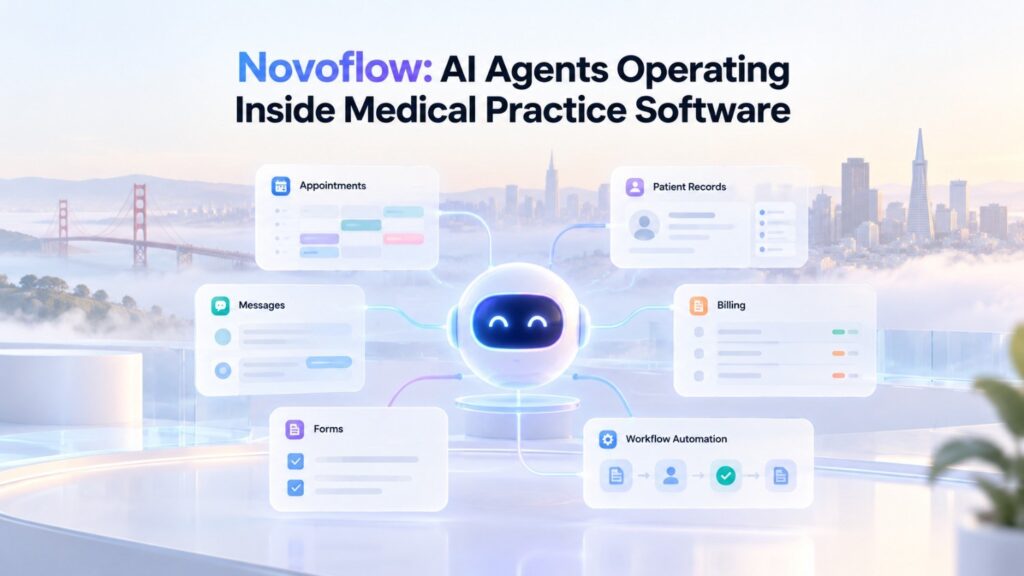
The company emphasizes reducing the need for clinics to change their existing processes before introducing automation.
Y Combinator
Why existing medical software is a major obstacle
Medical practices often depend on complex software systems that support patient records, appointments, billing, and other daily activities.
Replacing these systems can be costly and disruptive.
Even connecting a new tool may require specialized work because the data and processes differ between software providers.
Agents that operate through existing interfaces can potentially reduce part of this difficulty.
The tradeoff is that such agents must be tested carefully when screens, permissions, or workflows change.
What a medical practice should test
Start with a nonclinical administrative task such as checking document completeness or organizing appointment-related information.
Use a controlled test environment where possible and compare the agent’s actions with those of experienced employees.
Record every unexpected action, failed step, and required correction.
Clinics should expand automation only after showing that the system performs consistently and protects patient information.
15. Adentris: AI Agents for Medical Billing Accuracy
Primary focus: Healthcare revenue protection, documentation, and billing processes.
Adentris builds AI systems that examine medical records and payer interfaces to address problems that can lead to denied claims or lost payments.
Its public description covers documentation review, coding checks, prior authorization, insurance appeals, and related administrative work.
The company also describes using AI agents that interact directly with existing healthcare applications rather than requiring a separate connection for every system.
Y Combinator
Why preventing errors matters more than fixing them later
Many healthcare organizations invest resources in responding to insurance denials after they occur.
But some of the most valuable improvements may come earlier.
If a system can identify missing documentation or an inconsistent billing code before a claim is submitted, the organization may avoid the later cost of correcting and appealing the claim.
This creates a different economic model from simple task automation.
The value comes from preventing downstream problems, not merely performing an existing task faster.
A useful hospital pilot
A hospital could test an agent on historical claims containing documented billing or coding problems.
The agent would identify possible issues before submission, and trained reviewers would determine which warnings are valid.
The hospital should measure the percentage of important issues detected, the number of unnecessary warnings, and the time required to review them.
Reducing preventable errors while preserving clinical and billing accuracy is the core objective.
General Business AI Agents: Working Across Departments and Older Software
Not every company wants a different AI agent for every department.
Some businesses need automation that can move between finance, operations, customer service, and older applications.
This broader market is attractive because many workflows do not fit neatly within one software product.
Yet general-purpose agents face a difficult challenge: businesses have different rules, applications, and ways of working.
16. Eloquent AI: Automating Work in Regulated Business Systems
Primary focus: Complex financial-service and enterprise operations.
Eloquent AI develops agents that can learn from existing procedures and interact with business applications through browser and desktop interfaces.
Its product is aimed at operational work that may be difficult to automate with standard software connections.
The company reports automating substantial portions of selected customer workflows and emphasizes use in regulated settings. Those performance claims should be tested independently against the buyer’s own processes.
Y Combinator
Why observing existing work can be useful
Businesses often have operating processes that are not fully documented.
Employees learn how to complete certain tasks through experience, training, and informal instructions.
This makes traditional automation difficult because the company may first need to describe every step in detail.
An agent that can observe a defined process and learn how it works offers another possible approach.
However, observation alone is not enough. A procedure followed by employees may contain shortcuts, errors, or outdated practices.
Automation should improve and verify the workflow rather than blindly copy everything a person does.
Best use case
Choose a repeated process involving several applications and a clear final result.
Document the correct procedure before evaluating the agent.
Then compare its performance with the approved process, including how it handles missing information and unusual cases.
The system should demonstrate consistent results and leave enough evidence for employees to understand its actions.
17. Soren: Specialized AI Workers for Business Operations
Primary focus: Operational work across several industries.
Soren is building specialized AI agents for businesses in areas including legal work, finance, healthcare, and broader operations.
Its approach centers on agents that carry out defined business tasks rather than simply assisting employees with general questions.
The company’s public positioning focuses on using AI to perform recurring operational work across industries.
Y Combinator
Why specialization still matters in a broad platform
Businesses often assume a general AI model should be able to complete any task if it receives enough instructions.
Real operations are more complicated.
A legal workflow may require careful document handling and approval rules. A finance task may demand exact calculations. A healthcare process may involve patient privacy requirements.
A specialized agent can be designed around those specific conditions.
The underlying AI model may be general, but the workflow, access controls, validation rules, and human review process should reflect the business function.
What organizations should examine
Buyers should ask how the platform handles differences between industries and customers.
Does it use defined procedures? Can administrators limit actions? Does it maintain records? Can employees review and reverse mistakes?
These questions become especially important when the same platform may support several departments.
For most organizations, a successful rollout should begin with one clearly defined operational process before expanding across the company.
AI Agent Infrastructure: The Companies Building the Tools Behind Automation
The final three startups occupy a different part of the market.
They do not primarily sell completed customer service or accounting processes. Instead, they help businesses and developers build, operate, test, and control agents.
This infrastructure is important because an agent that works during a demonstration may still fail when exposed to real customers, changing software, or unexpected instructions.
18. Browser Use: Helping AI Agents Operate Web Applications
Primary focus: Browser interaction for AI agents.
Browser Use develops technology that allows AI systems to interact with websites through a browser.
Instead of requiring every application to provide a dedicated software connection, agents can potentially navigate pages, fill forms, click controls, and retrieve information through web interfaces.
Its open-source project has attracted substantial developer attention, and the company offers technology for teams building browser-based automation.
Y Combinator
Why browser control is important
A large amount of business work still happens through websites.
Employees log into supplier portals, government systems, customer platforms, insurance tools, and internal dashboards.
Some of these systems do not provide convenient ways for other software to interact with them.
Browser agents offer a possible way to automate work across these interfaces.
But browser control also creates problems.
Web pages change. Information loads unpredictably. Pop-ups appear. Sessions expire. A button may move to a different part of the screen.
Developers need systems that can detect these changes without performing unintended actions.
What businesses should test
Ask a browser agent to perform a process across several test websites or applications.
Include missing fields, session interruptions, changed layouts, and invalid information.
Measure whether the agent identifies problems correctly, retries when appropriate, and stops safely when the next step is uncertain.
A browser agent should never be given unrestricted access to sensitive business systems simply because it can navigate them.
19. Chronicle Labs: Testing AI Agents Before They Reach Customers
Primary focus: Testing, replaying, and evaluating agent behavior.
Chronicle Labs develops testing environments for business AI agents.
Its approach involves using past operational events to recreate situations and examine how agents would respond.
This lets developers evaluate changes without immediately exposing customers or live systems to untested behavior.
The startup’s public YC profile describes turning existing operational history into testing environments based on real business situations.
Y Combinator
Why testing agents is harder than testing ordinary software
Traditional software often follows a limited set of expected paths.
If a user presses a button, the system should produce a defined result.
AI agents can make different decisions depending on the information they receive.
Two similar customer requests may produce different actions, even when both seem valid.
This creates a testing challenge.
A company needs to know not only whether the agent handles the normal case, but also what happens when a customer provides confusing instructions, records disagree, or business rules change.
What engineering teams should prioritize
Build a test collection from real historical problems, with private information removed or protected.
Include ordinary requests, unusual cases, previous failures, and situations requiring human approval.
Run the agent against this collection before each significant update.
Track whether the latest version improves overall results without introducing new failures elsewhere.
The ability to test an agent repeatedly against realistic situations can become a major advantage as automated systems take on more responsibility.
20. OneCLI: Giving Employees Secure AI Teammates
Primary focus: Secure, company-managed AI agents connected to workplace applications.
OneCLI provides an open-source platform intended to give employees individual AI agents.
Its product can connect these agents to workplace applications while applying shared company policies.
A distinctive part of its public design is the separation of agent behavior from sensitive credentials. Instead of placing raw passwords or access keys inside the AI agent, the system is designed to authorize requests and provide the required access through a controlled layer.
Y Combinator
Why security becomes more important when AI can act
A chatbot that can only draft an email has limited power.
An agent that can send messages, download documents, change customer records, or access confidential information has much greater potential to cause harm.
This makes permissions central to AI deployment.
An employee’s agent should not automatically receive access to every system the employee can reach. It may need permission to read a particular document but not modify it.
OneCLI’s architecture represents an approach where organizations set those limits outside the AI model itself.
What companies should test
Give an agent access to a restricted test environment and deliberately ask it to perform actions outside its permissions.
The system should deny those actions reliably.
Companies should also check whether every permitted action can be connected to a specific user, rule, and approval.
A useful enterprise AI agent must be capable enough to perform work while remaining limited enough to be trusted.
Original Finding #2: Half of the Selected Companies Belong to 2026 YC Batches
One way to examine how recently a startup entered a public accelerator cohort is to look at its YC batch.
We divided the 20 selected startups into two groups: those belonging to 2026 batches and those belonging to earlier batches.
YC batch composition of the research sample
2026 batches
10 of 20
50% of sample
Earlier batches
10 of 20
50% of sample
SFTechScene calculations from publicly listed YC cohorts. Batch year is not the same as founding year.
This split is meaningful within our selection because it shows how newer teams are entering practical business automation categories.
The 2026 batch companies in the sample include customer support agents, sales automation platforms, finance and insurance tools, and technology for controlling and testing agents.
They are not all chasing the same use case.
That diversity suggests founders are finding opportunities at different stages of the automation process, from building customer-facing products to improving the infrastructure behind them.
Why startup age should not determine buying decisions
A company established earlier may have more experience operating software for customers. A newer startup may have a narrower focus or a more recent technical approach.
Neither advantage automatically guarantees a better product.
Business buyers should compare demonstrated reliability, customer references, security capabilities, integration requirements, support quality, and long-term cost.
A startup’s recent accelerator participation is evidence of timing, not proof that its product is better.
The 50% figure is also partly shaped by our intentional inclusion of recent entrants. It should not be interpreted as evidence that half of all San Francisco AI agent companies were founded or accelerated in 2026.
Original Finding #3: The Market Is Splitting Between Agents That Do Work and Systems That Make Agents Work
Our classification identifies three infrastructure-focused companies and 17 companies focused primarily on completing business workflows.
Direct business automation vs. agent infrastructure
20-company SFTechScene research sample.
■ Agent infrastructure
■ Business workflow agents
This distinction is important because businesses frequently compare products that solve entirely different problems.
A finance agent can help process financial records. A browser automation platform allows developers to build agents that interact with websites. An agent testing product helps determine whether those systems behave as expected.
All three may be described as AI agent technology, but they occupy different positions in the market.
The three-layer architecture emerging from the sample
LAYER 1 • BUSINESS OUTCOMES
Agents that complete tasks
Customer support, sales, finance, healthcare, and operations agents
LAYER 2 • ACTION AND INTEGRATION
Systems that connect AI with business tools
Browser interaction, software connections, workflow execution, and user access
LAYER 3 • CONTROL AND RELIABILITY
Systems that keep automation accountable
Permissions, approvals, testing, audit records, monitoring, and recovery
SFTechScene conceptual model derived from product functions in the sample. Layers can overlap within one company.
The strategic lesson is straightforward.
Businesses should avoid buying several overlapping products before understanding which layer they actually need.
A small company seeking to automate invoice handling may benefit from a specialized accounting product rather than building a custom agent system.
A software company creating agents for its customers may need browser infrastructure, testing environments, and permission management.
An enterprise may need both.
The best technology stack depends on the work to be completed, not the number of AI products available.
Original Finding #4: Existing Software Is Becoming the Workspace for AI Agents
A notable feature of the selected products is how often their descriptions refer to operating across systems businesses already use.
Examples include agents interacting with medical record platforms, reviewing financial systems, updating customer databases, navigating web applications, and responding through workplace communication channels.
This points toward an important architectural change.
For years, companies connected applications primarily to move data. Increasingly, they want software that can interpret information and carry out a process across several applications.
Why this matters for San Francisco startups
A founder building an AI agent faces two broad options.
The first is to create an entirely new application and convince customers to move their work into it.
The second is to make the agent useful within the systems customers already depend on.
The second approach can make adoption easier because customers may not need to replace major applications.
However, compatibility brings technical challenges.
The agent must understand different data formats, access rules, changing interfaces, and business procedures.
A solution that works for one customer may need substantial adjustments for another.
The strategic implication for software vendors
Traditional business software companies should examine whether agents could become a new way of interacting with their products.
For example, a customer might no longer open five dashboards to complete a process. Instead, the customer could give an agent a goal and approve the final action.
The underlying systems would still matter. They would store records, enforce rules, and provide the tools needed to complete the work.
This suggests that AI agents may change how business software is used without eliminating the need for the software itself.
That is an opportunity for startups creating connections between older systems, modern applications, and AI.
Original Finding #5: Regulated Industries May Reward Accuracy More Than Autonomy
Finance and healthcare account for half of our research sample. Several other companies, including Eloquent AI, also target work with strict rules.
This suggests an important distinction between general-purpose productivity agents and agents used in high-responsibility business processes.
A general productivity agent may be helpful even when it occasionally needs correction.
A financial reporting agent that regularly produces incorrect figures would be far less useful.
The same applies to healthcare billing, insurance reviews, and regulated financial investigations.
Why fully autonomous operation is not always the goal
Suppose an AI agent can complete 80% of a workflow independently while routing the remaining cases to trained employees.
That may be a better business outcome than an agent attempting 100% of the work but making costly errors.
The right level of automation depends on what happens when the agent is wrong.
For low-risk tasks, such as organizing non-sensitive research notes, mistakes may be inexpensive to correct.
For payment approvals, clinical records, or financial compliance decisions, mistakes may carry significant financial or legal consequences.
The goal should therefore be risk-adjusted automation: allowing the system to handle tasks where it performs reliably and requiring review where the consequences are greater.
A practical risk framework for businesses
| Task risk | Example | Suggested operating model |
|---|---|---|
| Low | Organizing public research | Agent can work with routine monitoring |
| Moderate | Updating ordinary CRM fields | Validation rules and sample reviews |
| High | Preparing supplier payments | Agent prepares; authorized employee approves |
| Very high | Changing sensitive financial or patient records | Strict permissions, verification, and qualified human oversight |
These are editorial recommendations, not legal compliance standards. Organizations should adjust the controls to their own policies, applicable regulations, and risk exposure.
Original Finding #6: The Most Valuable AI Agent May Be the One That Fixes an Entire Process
A business process usually contains several connected tasks.
An employee gathers information, enters data, checks results, requests approval, makes a change, and documents the outcome.
Automating only one task may save a few minutes while leaving the rest of the process unchanged.
Automating the complete sequence, with appropriate controls, can create a larger improvement.
Example: An insurance claims workflow
Imagine a medical provider spending time on denied insurance claims.
An AI assistant might draft appeal letters.
A more complete agent system could identify denials, gather supporting records, check for missing information, prepare appeal documents, submit approved materials, track deadlines, and organize follow-up work.
The second system addresses the workflow rather than a single document.
However, its benefits depend on accuracy, system access, legal requirements, and the cost of maintaining the automation.
The same principle applies to sales, customer support, finance, and internal operations.
What founders should learn
Start by mapping the process from its initial trigger to its final business result.
Identify which steps create the most delay, which mistakes are expensive, and where information moves between systems.
Then decide which parts should be handled by ordinary software rules, AI models, or human reviewers.
This design is usually more useful than simply adding AI to a familiar interface.
The Business Economics of AI Agents: A Practical ROI Model
The most important question for a business adopting AI agents is not how many tasks the system can perform.
It is whether those tasks create enough measurable value to justify the cost of building, buying, operating, and supervising the technology.
To show how companies can evaluate this, SFTechScene created the following illustrative model.
These are hypothetical business assumptions, not measured results from any startup in our sample.
Example: Automating 10,000 monthly administrative tasks
AI Automation ROI Calculator
Illustrative monthly scenario • USD
ResetTasks processed per month
10,000Human time per task
6 minutesLoaded employee cost per hour
$35Net human time eliminated per task
60%AI platform and usage cost / monthOversight and maintenance / month
Monthly labor capacity value
$21,000
Estimated monthly net value
$12,000
Estimated annual net value: $144,000Assumes steady workload and recurring costs. Excludes initial setup, taxes, financing, quality-related losses, and costs that do not actually disappear.
With the default assumptions, a company processing 10,000 tasks each month would have 1,000 hours of human work associated with those tasks.
At a loaded employee cost of $35 an hour, that represents $35,000 in monthly labor capacity.
If automation genuinely eliminates 60% of that work, the potential monthly capacity value is $21,000.
After subtracting $6,000 in platform and usage expenses and $3,000 in ongoing oversight and maintenance, the model produces an estimated $12,000 in monthly net value.
That is $144,000 annually under the same assumptions.
The important qualification is that freed employee time is not automatically cash savings. It becomes financial value only if the business can reduce actual costs, avoid additional hiring, process more profitable work, or put the recovered time to another productive use.
The calculation also assumes the quality of work remains acceptable. Expensive errors can quickly erase the apparent benefit.
Why businesses need to model the cost of mistakes
Consider two hypothetical AI agents.
Agent A processes 10,000 tasks at a low cost but makes mistakes in 5% of cases.
Agent B costs more but makes mistakes in only 1% of cases.
That difference represents 400 additional errors per month.
If fixing each error costs $25, Agent A creates an extra $10,000 in monthly correction costs.
For a business trying to save $12,000 each month, this could eliminate most of the expected benefit.
The lesson is that agent reliability must be part of the financial model.
A procurement process focused only on subscription fees or cost per automated task will miss some of the most important expenses.
A 90-Day Plan for Businesses Adopting AI Agents
Companies do not need to automate their entire organization to begin seeing value.
A better strategy is to select one process, define a measurable outcome, test the technology carefully, and expand only after the evidence supports doing so.
Days 1–15: Choose a process worth automating
Begin by identifying workflows that are frequent, repetitive, and time-consuming.
Good candidates often involve reviewing documents, moving information between tools, organizing support requests, or preparing routine reports.
Avoid starting with a process simply because it looks impressive in an AI demonstration.
The best initial opportunity is usually a task the company understands well enough to measure accurately.
Document the volume of work, current processing time, employee cost, error rate, and systems involved.
Days 16–30: Set a baseline
Before buying a product, measure how the existing process performs.
Determine the average time required for each task, the percentage of tasks completed correctly, and how frequently employees need to fix mistakes.
Also measure the amount of waiting between steps.
Some workflows take days to complete despite involving only minutes of actual work because they move between people or departments.
That delay may be a larger automation opportunity than the individual tasks themselves.
Days 31–45: Test vendors with real examples
Ask shortlisted startups to demonstrate their products on a controlled set of your own cases.
Use realistic examples rather than polished vendor demonstrations.
Include ordinary tasks, confusing information, missing data, and situations requiring approval.
The vendors should explain how their systems handle unexpected conditions and whether the buyer can inspect what each agent did.
A system that cannot clearly report its mistakes should not be trusted with sensitive operations.
Days 46–60: Run a limited pilot
Deploy the agent with restricted permissions and a clearly defined set of responsibilities.
For sensitive processes, allow it to recommend or prepare actions without executing them independently.
Compare the results with the organization’s existing workflow.
Measure processing time, correctness, correction effort, employee involvement, and actual operating cost.
The purpose is to discover whether the product works under normal business conditions, not simply whether it can complete a demonstration.
Days 61–75: Improve the workflow
Use the pilot results to identify where the agent struggles.
Some failures will come from missing instructions. Others may be caused by poor data, software access problems, unclear approval rules, or tasks that are inherently difficult to automate.
Do not assume every problem should be solved by buying a larger AI model.
Sometimes the right solution is a clearer procedure, better information, an ordinary software rule, or a human review step.
Days 76–90: Make the investment decision
At the end of the pilot, compare the actual results against the baseline.
The business should understand the recurring cost, the time genuinely recovered, the quality of outcomes, and the work still required from employees.
If the results justify expansion, introduce more tasks gradually.
If the agent fails to produce measurable value, stop or redesign the project before increasing the investment.
A disciplined 90-day pilot can prevent businesses from spending heavily on automation that never reaches dependable production use.
What San Francisco Founders Can Learn From These 20 AI Agent Startups
The companies in this report are pursuing different markets, but several useful lessons emerge when their approaches are compared.
Build around a business outcome, not a model feature
The strongest startup opportunities often begin with a costly business problem.
An insurance claims agent exists because recovering denied payments is difficult. A financial compliance agent exists because investigations require considerable manual work. A support agent exists because customer issues need to be resolved.
The AI technology is important, but the customer ultimately cares about the result.
Founders should therefore begin by identifying a process with an economic problem that can be measured.
A product that saves customers money, reduces costly mistakes, or allows them to handle greater demand has a clearer business case than one that merely demonstrates advanced AI capabilities.
Make existing systems part of the product strategy
Companies have already spent years purchasing software and training employees.
A startup that requires customers to discard those investments may face substantial resistance.
This creates opportunities for agents that work through existing software connections, browser interfaces, and business applications.
However, integration alone is not a lasting competitive advantage.
The startup must also manage changes to underlying systems, protect sensitive information, and provide reliable results.
Over time, the quality of its operating system around the agent may become just as important as the intelligence of the model.
Build testing and recovery into the first product
An AI agent will eventually encounter situations its developers did not anticipate.
Information will be missing. Customers will make unusual requests. Connected applications will change. Business rules will evolve.
Startups should design for these conditions from the beginning.
A dependable agent should know when to stop, request clarification, escalate an issue, or reverse a permitted action.
It should also preserve enough information for employees to understand what happened.
These features may not make the most exciting product demonstration, but they can determine whether a company is willing to rely on the product every day.
Use industry knowledge to solve problems general tools miss
Broad AI models are becoming available to more businesses.
That makes it harder to build a durable company simply by placing a new interface around an existing model.
Specialized knowledge creates another source of value.
An AI system designed for insurance underwriting can include rules, documents, and approval processes specific to that market. A healthcare billing agent can be built around medical documentation and payer requirements.
The more deeply the product understands its customer’s workflow, the more useful it may become.
This does not guarantee that specialized startups will outperform large software companies, but it gives founders a practical way to compete.
What Business Buyers Should Ask Before Choosing an AI Agent Startup
Businesses evaluating the 20 companies should avoid treating the list as a ranking of overall product quality.
The products address different industries, company sizes, and operational requirements.
Instead, the buying process should begin with the workflow the organization wants to improve.
| Evaluation area | Key question | Evidence to request |
|---|---|---|
| Business fit | Does the product solve our actual problem? | Demonstration using our workflow |
| Accuracy | How often does it complete tasks correctly? | Results on representative test cases |
| Integration | Will it work with our systems? | Verified connections and implementation plan |
| Security | What can the agent access or change? | Permission controls and security documentation |
| Oversight | When does a person need to approve an action? | Review and escalation rules |
| Reliability | What happens when the agent fails? | Failure logs, recovery procedures, and testing results |
| Cost | What is the total cost per successful task? | Full pricing, usage fees, and maintenance estimates |
| Business value | Does it improve a measurable outcome? | Pilot comparison with the existing process |
Avoid the most common buying mistake
Many AI products are evaluated using demonstrations built around ideal conditions.
The input is clean, the software behaves correctly, and the customer asks exactly the kind of question the agent was designed to answer.
Real work is rarely that orderly.
The most important part of vendor testing is therefore examining failure cases.
Ask what happens when records conflict, a customer changes their request, a system becomes unavailable, or the agent receives instructions it should not follow.
A product that handles these situations safely may deliver more long-term value than one that appears more impressive in a controlled demonstration.
What Happens Next for San Francisco’s AI Agent Ecosystem?
The next stage of the market will likely involve competition over reliability, cost, distribution, and ownership of business workflows.
Large software companies can add agents to products their customers already use. Specialist startups can compete by solving difficult problems that broader platforms handle poorly.
Infrastructure companies can provide the tools that both groups need.
The outcome is unlikely to be one universal AI agent that performs every business function equally well.
A more plausible scenario is a combination of general-purpose agents, specialized industry tools, and systems that manage how those agents access business applications.
Outcome-based pricing may become more important
Many business software products charge per employee or user.
AI agents complicate that model because one agent may perform tasks previously completed by several employees, while still requiring human supervision.
Vendors may increasingly experiment with pricing based on completed tasks, processed documents, handled conversations, or other business outcomes.
But outcome-based pricing creates challenges.
Both sides must agree on what counts as successful work, who pays when the agent makes a mistake, and how difficult cases are handled.
The easiest tasks should not be priced as though they carry the same risk as complex financial or healthcare decisions.
Agent security will become part of ordinary IT management
As businesses give AI systems permission to act, IT teams will need to manage those permissions with the same seriousness they apply to human employees and traditional software.
That includes identifying who owns each agent, what information it can access, which actions require approval, and how its activity is recorded.
Companies may also need procedures for disabling agents quickly when something goes wrong.
Security should not be added only after a business has deployed dozens of automated workers.
It should be part of the initial design.
The strongest products will prove value in daily operations
AI agent startups can grow attention quickly with impressive product launches.
Keeping customers is harder.
A product must continue working after software updates, policy changes, unusual requests, and growing task volumes.
It must also deliver enough value for customers to keep paying for it.
That creates a practical test for the companies in this report: can their products become dependable parts of business operations rather than occasional productivity tools?
The answer will matter more than a startup’s position on any watchlist.
Research Limitations and How to Interpret the Findings
This report is original editorial analysis of a selected set of public company records, but it is not a market census or independent technical benchmark.
The 20 companies were intentionally chosen to illustrate several business automation categories. Because the selection is not random, the category percentages cannot be used to estimate the true distribution of all San Francisco AI agent startups.
The cohort analysis describes YC batch membership, not company founding dates. All 20 selected companies are drawn from the YC ecosystem, which means the report does not capture the full diversity of independently funded or non-YC startups in San Francisco.
Product functions were classified from public descriptions. Companies can change positioning, and some products span multiple categories. We assigned one primary category per company for consistent counting.
We did not conduct live product trials, customer interviews, independent financial audits, or a systematic analysis of startup funding. Consequently, vendor-reported performance figures should not be treated as independently verified outcomes.
The original quantitative findings in this article are the sample counts, category classifications, batch distribution, and derived shares. The architecture framework, business recommendations, and hypothetical ROI scenarios are SFTechScene’s analysis, not experimental proof of industry-wide trends.
These limitations do not make the dataset useless. They define what it can legitimately tell us and make it easier for readers to reproduce or challenge the analysis.
Public Research Sources and Verification
The primary source for the original dataset is the Y Combinator startup directory. Individual company records provide the basis for location, cohort, operating status, and primary product classification.
Additional company and industry context was checked against public reporting and specialized startup directories. For example, TechCrunch’s March 2026 reporting on Gumloop illustrates demand for tools that let business users create agents, while reporting on Arcade’s agent authorization technology highlights growing attention to access control and security.
TechCrunch
+1
Those additional companies help explain the market but are not counted in the 20-company dataset.
Readers can reproduce the primary analysis by reviewing the 20 company names in the comparison table, verifying their current YC profiles, assigning each company to its stated primary category, and dividing the category counts by the sample size of 20.
Final Takeaway: San Francisco’s AI Agent Opportunity Is About Completing Business Work, Not Just Generating Answers
San Francisco’s AI agent ecosystem is developing around a simple but important change in business software.
Companies increasingly want technology that can perform work, not merely explain how that work should be done.
The 20 startups examined in this report show what that shift can look like across customer service, sales, accounting, banking, healthcare, business operations, and AI infrastructure.
Our original analysis highlights three useful patterns.
Finance and healthcare account for half of the selected companies, emphasizing the opportunity in processes that involve repetitive work, complex records, and detailed rules.
Half of the sample belongs to 2026 YC batches, illustrating the presence of newer entrants alongside companies from earlier cohorts.
And the distinction between direct business agents and supporting infrastructure shows that reliable automation requires much more than a powerful AI model.
For business leaders, the opportunity is not to automate everything immediately.
It is to identify expensive and repetitive work, measure how that work is performed today, and introduce agents where they can deliver reliable results under appropriate controls.
For founders, the challenge is to build products that businesses can trust.
The next generation of successful AI companies will need to connect with existing systems, understand specific workflows, handle mistakes safely, and demonstrate measurable economic value.
San Francisco is an important place to watch this transition because its startup community is working on both sides of the problem: the agents that perform business tasks and the infrastructure that makes those agents practical.
The biggest winners will not necessarily be the companies that promise the most autonomy.
They will be the ones that make business automation dependable, affordable, measurable, and genuinely useful in everyday work.