

San Francisco is becoming the testing ground for a new kind of company. Instead of hiring a person for every new task, founders are building businesses where artificial intelligence handles much of the daily work, from finding customers and answering support questions to updating financial records, writing software, and keeping projects moving.
This is a bigger change than simply giving employees access to ChatGPT. A traditional company uses software to help people do their jobs. An AI-run company is designed so software can complete a growing share of those jobs, while people set goals, handle difficult decisions, build relationships, and take responsibility when something goes wrong.
That difference is beginning to shape how San Francisco startups develop products, hire employees, manage costs, and compete with larger businesses. It also raises an important question: How much of a company can AI actually operate without constant human help?
The answer is more complicated than the headlines suggest. AI agents can already perform useful business tasks across connected systems. But running an entire company requires more than generating convincing answers. It requires reliable execution, accurate information, secure access, clear responsibility, and the ability to recover when work does not go as planned.
For this article, SFTechScene examines publicly available company information, startup profiles, and business research to understand how AI-run companies are taking shape. We also develop an original analysis of 12 San Francisco AI automation startups, comparing the business functions they target and the types of work they are designed to perform.
The goal is to separate what is already possible from what remains experimental, then explain how founders and business leaders can use these developments to build better companies.
The Short Version: San Francisco Is Moving From Companies That Use AI to Companies Built Around AI
The first generation of AI adoption was mostly about helping employees become more productive. Workers used AI to draft emails, summarize meetings, write marketing content, search documents, and speed up software development. These tools were valuable, but the human remained responsible for carrying out nearly every important step.
The next generation is different. Startups are building systems that can receive an objective, determine which steps are needed, use connected software, complete a task, and report the outcome. These systems are often called AI agents, but their business value is easier to understand when we describe them as software that can perform work.
A sales agent might research potential customers, prepare outreach, update the company’s customer records, and arrange a meeting. A finance agent might collect invoices, match transactions, and flag missing documents. A support agent might investigate a billing problem, check company policy, process an approved refund, and update the customer.

People still matter throughout these processes. The important change is that they do not need to perform every routine action themselves.
The Evidence Shows Both Progress and a Large Gap
McKinsey’s August 2026 State of AI survey found that 40% of respondents from organizations with more than $1 billion in annual revenue reported scaling AI agents in at least one business function. Among smaller organizations, the figure was 22%. These are survey results from organizations around the world, not measurements of San Francisco startups specifically.
McKinsey & Company
Organizations scaling AI agents, by company size
Percentage of respondents reporting scaled deployment in at least one business function. McKinsey, August 2026.
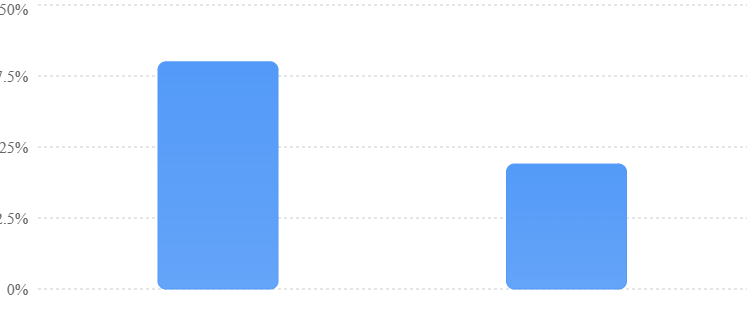
Source: McKinsey, State of AI 2026. Large organizations have annual revenue above $1 billion. The percentages describe surveyed organizations, not startup counts.
This result is important for two reasons. First, AI agents have moved beyond a small collection of demonstrations. Some organizations are now deploying them as part of regular business operations.
Second, scaling is not the same as autonomy. A company might deploy an AI coding assistant across its engineering department while continuing to run sales, finance, customer support, and management in traditional ways. That does not make the company AI-run.
The startups attracting attention in San Francisco are trying to close that gap. Their goal is not simply to add AI to existing departments, but to change how the work inside those departments gets completed.
What Is an AI-Run Company?
An AI-run company is a business in which AI systems carry out a meaningful share of everyday operations with limited step-by-step human direction. People continue to own the company, make major decisions, define standards, and oversee the results, but software takes responsibility for completing more of the work between those decisions.
There is no widely accepted industry definition of an AI-run company. For this analysis, we use a practical definition based on how work actually moves through an organization.
A business begins moving toward this model when it can assign an AI system a defined outcome, give it access to the tools and information it needs, allow it to complete approved actions, and check whether the desired result was achieved.
The Difference Between AI-Assisted and AI-Run Operations
| Business activity | AI-assisted company | AI-run operating model |
|---|---|---|
| Sales | AI drafts outreach emails | AI researches leads, runs approved outreach, and updates records |
| Customer support | AI suggests replies | AI resolves eligible requests and records outcomes |
| Finance | AI extracts invoice information | AI matches records, follows up, and prepares exceptions for review |
| Software | AI recommends code | AI builds tested changes for review and deployment |
| Marketing | AI generates content | AI prepares and runs approved campaigns within spending limits |
| Management | AI summarizes reports | AI monitors operating targets and flags required decisions |
The right-hand column describes an operating model, not proof that every capability is reliable or fully deployed in today’s companies. The distinction matters because marketing language often places early prototypes and mature business systems in the same category.
A company that uses AI to write 100 emails is still responsible for deciding who receives them, checking their accuracy, and making sure the outreach follows the rules. A more automated company builds those requirements into a controlled workflow so that routine decisions can happen without someone approving every sentence.
Why AI-Run Does Not Mean Human-Free
Some founders imagine businesses that produce substantial revenue with only one or two employees. AI makes that ambition more plausible for certain digital products, especially those with simple operations and repeatable customer needs.
However, running a company involves obligations that do not disappear when work is automated. Customers need someone accountable for service failures. Financial reports must be correct. Contracts require legal responsibility. Sensitive information must be protected, and important business decisions still need human judgment.
A better way to understand the opportunity is that a small team may be able to manage a much larger amount of work. The aim is to remove unnecessary manual steps, not pretend that software can replace ownership, trust, or accountability.
Why San Francisco Is Becoming the Center of This Shift
San Francisco has a rare mix of AI talent, early-stage capital, startup customers, research organizations, and founders willing to test new business models. These advantages make it easier to build an AI product, find early users, observe failures, and improve the product without waiting through a long sales cycle.
The city’s startup community also has an unusually strong habit of sharing technical ideas. Founders compare products, engineers move between companies, and investors help introduce emerging startups to potential customers. That creates a fast learning environment for tools that still require extensive real-world testing.
San Francisco Has a Large Supply of AI Startups
Y Combinator’s San Francisco AI directory listed 989 companies when accessed for this October 2026 analysis. This is a directory count, not the total number of AI startups in the city, and it includes companies working on much more than autonomous agents.
Y Combinator
Even with that limitation, the directory illustrates the breadth of the local ecosystem. Companies are developing AI tools for coding, accounting, customer support, finance, manufacturing, sales, and other business activities.
The more important point is how these companies connect. An AI-run business does not necessarily need to develop its own AI models, customer support system, accounting engine, and sales software. It can combine services from different suppliers and focus its own engineering work on the tasks that make its business special.
Startup Density Creates Faster Product Feedback
Imagine a founder developing an AI agent that handles complicated customer billing questions. The product must work with payment systems, customer records, help-desk software, and internal policies.
In a concentrated startup market, the founder may be able to reach early customers, technical partners, and experienced operators through a relatively small professional network. These connections do not guarantee success, but they can shorten the time between discovering a product problem and testing a solution.
That matters because AI agents often fail for reasons that are difficult to discover in a controlled demonstration. They may misunderstand an unusual request, use outdated information, select the wrong account, or take action before all conditions have been checked.
Real customers expose these problems. The startups that learn from them can develop more dependable products, while companies that rely on impressive demonstrations may struggle to keep customers.
San Francisco Also Has a Strong Market for Small Teams
The economics of building software have started to change. AI coding tools can help teams produce working prototypes, tests, and internal applications faster than traditional processes in some situations.
McKinsey’s 2026 survey reported that 32% of respondents said their organizations had chosen not to buy at least one software product or feature because they could build the functionality internally using AI coding agents. This was a reported purchasing decision, not a verified measure of money saved.
McKinsey & Company
For San Francisco startups, the implication is significant. A small business may need fewer separate software purchases when it can create simple internal tools itself.
However, companies must still pay for hosting, maintenance, security, testing, and future changes. Building software faster is useful only when the resulting product remains dependable and affordable to operate.
Original Research: What 12 San Francisco AI Startups Reveal About the Future of AI-Run Companies
To understand where this market is heading, SFTechScene created a small, structured research dataset based on public startup profiles. Instead of selecting companies because of funding announcements or media attention, we focused on what their products are designed to do.
This approach helps answer a more useful question: Which parts of a business are AI startups trying to operate, and what does that reveal about the future structure of companies?
Research Methodology: How We Built the Dataset
Our research uses publicly accessible Y Combinator company profiles and directory descriptions available as of October 12, 2026. We selected 12 companies with a stated San Francisco location and a product description explicitly focused on AI workers, agents, or software that performs operational tasks.
The sample was purposive, not random. We selected companies across several business functions to compare different approaches to automation. We did not attempt to estimate the total number of San Francisco agent startups, their combined revenue, or their actual market share.
For each company, we recorded its primary business function, the type of work described in its public profile, and whether its product was designed around a specific department or multiple business functions.
A company was classified by its main advertised use case, even if its product could support other tasks. This prevented one company from being counted repeatedly across different categories. Where a business promoted AI employees covering many roles, we used a separate cross-functional category.
These classifications are SFTechScene’s original analysis of public product descriptions. They are not independently verified measurements of deployed capabilities, customer outcomes, or the degree of automation inside each startup itself.
The 12 Companies in Our Research Sample
| Startup | Primary function | Work its product is designed to perform |
|---|---|---|
| Cignara | Customer operations | Voice and chat sales or support workflows |
| Parahelp | Customer operations | Support ticket resolution and connected actions |
| Dialogus | Customer operations | Voice-based operational workflows |
| Artisan | Sales | Outreach, inbound sales, and account work |
| Nex | Sales | High-volume sales and customer acquisition workflows |
| Truewind | Finance | Accounting records, documents, and follow-ups |
| Alder | Finance | Receivables, reconciliation, and collections support |
| RamAIn | Cross-functional | Computer-based business tasks across systems |
| Jarmin | Cross-functional | AI workers for multiple professional roles |
| Unisson | Implementation | Customer onboarding and software implementation |
| Socratix AI | Risk and compliance | Fraud alert investigation and review |
| Mica AI | Data operations | Investigation and repair of data pipeline problems |
Source: SFTechScene classification of public Y Combinator descriptions. Company information is drawn from the YC customer-support, sales, and operations directories and company profiles.
Y Combinator
+11
The sample includes companies established in different startup batches, with different products and levels of maturity. It should be understood as a comparison of approaches, not a ranking of the best startups.
It also deliberately excludes companies whose primary product is simply a general chatbot or a tool for creating text and images. The focus is on systems intended to perform business work.
Original Finding #1: Customer Operations, Sales, and Finance Account for Most of the Sample
Where sampled San Francisco AI startups focus
Original classification of 12 startups; each company appears in one category.
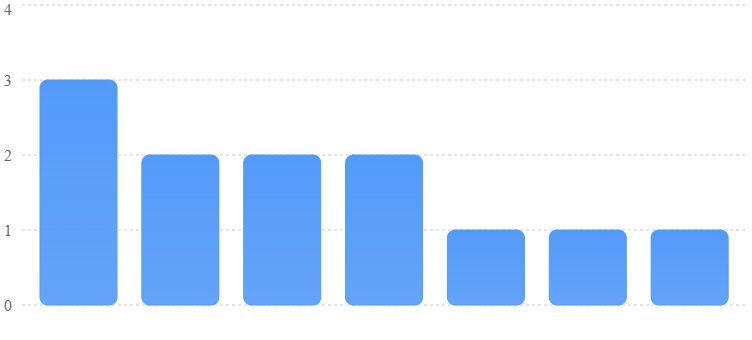
Source: SFTechScene original analysis, October 2026. Sample size: 12 companies. Counts are not market-wide estimates.
Seven of the 12 companies focus primarily on customer operations, sales, or finance. That represents 58.3% of the selected sample.
These functions share an important feature: Much of their work involves information entering a business system, someone deciding what it means, and then taking a series of relatively predictable actions.
Consider an unpaid invoice. The finance team checks the record, confirms the amount, sends a reminder, records the response, and follows up if necessary. A well-designed AI workflow can perform some of these steps automatically while sending exceptions to an employee.
Customer support works in a similar way. A request arrives, the system finds the customer’s account, checks the relevant policy, determines an eligible action, and responds.
Sales includes tasks such as researching accounts, finding relevant contacts, preparing messages, and recording replies. These activities often cross several tools but follow patterns that can be defined and checked.
What This Means for Founders
The most attractive opportunities are not necessarily the jobs that require the least skill. They are the workflows where an outcome can be clearly defined, the required information is accessible, and mistakes can be detected before they cause serious harm.
A founder should look for processes that occur frequently enough to justify automation but do not require a fresh strategic judgment at every step.
This explains why a narrow AI product can be commercially valuable. An agent that reliably handles thousands of account updates may create more measurable value than a general assistant that can discuss almost any business topic but rarely completes a task.
Original Finding #2: Most Sampled Products Start With a Defined Business Function
Product focus in the 12-company sample
■ Cross-functional
■ Function-specific
83.3%
Function-specific products
10 of 12 sampled startups
16.7%
2 of 12 target work across multiple functions
This is one of the clearest patterns in our research. Although the market frequently discusses general-purpose AI employees, 10 of the 12 sampled startups begin with a specific business function.
Artisan starts with sales roles. Alder starts with accounts receivable. Truewind focuses on accounting. Socratix AI works on fraud and compliance processes.
The remaining two, Jarmin and RamAIn, describe broader AI workers that can operate across different kinds of professional or computer-based tasks.

The distribution does not prove that narrow products are more successful. Our selection deliberately covers several functions, and a larger representative dataset might produce a different result.
Still, the pattern offers a useful product strategy. Building an AI worker for one clearly defined job is easier to test and sell than promising software that can operate an entire business.
Why Narrow Workflows Are Easier to Commercialize
A finance manager knows the cost of preparing monthly records and following up on missing information. A customer support leader can measure resolution time and complaint rates. A sales manager can track qualified meetings and deals.
These buyers can compare the AI product with an existing workflow. They can also detect when it is underperforming.
By contrast, a general AI executive assistant might promise to improve dozens of activities without providing a clear way to calculate its impact. That makes adoption decisions harder.
For founders, the practical lesson is to begin with a narrow job that customers already understand, measure its performance, and expand only after the product proves reliable.
Original Finding #3: The Real Market Is Forming Around Business Actions, Not Chat Conversations
The descriptions in our sample repeatedly emphasize actions inside business systems. They refer to resolving tickets, updating records, following up with customers, reconciling transactions, investigating alerts, and completing implementation work.
This is different from the first wave of workplace AI products, which primarily helped users find information or generate content.
The new products are being designed to move work forward.
Parahelp’s public description discusses connecting support agents to tools such as Stripe so they can resolve certain billing and refund requests. Truewind describes AI agents that follow up on outstanding accounting items. Alder describes software that processes documents and works through receivables while leaving approvals and oversight with people.
Y Combinator
+2
These examples reveal a critical technical requirement: AI needs permission to interact with the software where actual business records live.
A support agent that knows the refund policy but cannot access the payment system may only be able to explain what a human should do. An agent that can verify eligibility and complete an approved refund becomes part of the operating process.
The second product is potentially much more valuable. It also creates greater risk if account information, permissions, or policies are wrong.
The Importance of Connected Systems
Most businesses already rely on several different applications. Customer records may live in a sales platform, billing details in accounting software, conversations in email, and product information in an internal database.
An AI agent needs the correct information from all relevant sources. It must also know which source should be trusted when records conflict.
This is why integration is central to the future of AI-run companies. The difficult work is often not producing an intelligent sentence, but safely connecting the systems that make business decisions possible.
Original Finding #4: Small Teams May Gain the Most From Cross-Functional Automation
A small startup cannot afford to hire a specialist for every recurring business task. Founders often handle sales, support, product work, finance, and administration themselves.
Cross-functional AI workers are especially appealing in this environment because they can potentially reduce the amount of routine coordination needed across departments.
RamAIn describes AI employees that use computers to perform business tasks across existing systems. Jarmin promotes AI workers for roles ranging from sales to finance and technical work. These are descriptions of the companies’ intended products, not proof that every advertised role performs at human level.
Y Combinator
+1
For small businesses, the opportunity is to automate the movement of information and routine tasks between functions.
For example, when a new customer signs up, an AI workflow could help create the account, prepare onboarding material, send approved instructions, and notify the responsible employee if there is a billing or technical issue.
Without automation, that process might require several manual updates, even when each update is simple.
The savings are not limited to employee time. Faster handoffs can improve customer experience and reduce the chance that a task gets forgotten.
What Our Original Research Does—and Does Not—Prove
Our sample supports the observation that San Francisco startups are developing AI products for many specific operating functions. It also shows that cross-functional AI employees are being developed alongside narrower tools.
It does not establish that 58.3% of all local AI agent startups target sales, customer operations, and finance. Nor does it prove that 83.3% of the broader market prefers function-specific products.
Those percentages describe only the 12 deliberately selected companies.
A rigorous market-wide study would require a defined population, a reproducible way to collect every eligible company, checks for missing businesses, consistent classification rules, and preferably more than one independent reviewer.
It would also require customer-level evidence to determine whether the advertised products actually perform work without human intervention.
Our analysis is therefore best treated as an original, transparent study of product design patterns rather than a census of the San Francisco market.
The Startups Showing How AI Can Operate Different Parts of a Business
The next step is to examine what these products reveal about how future companies may be organized. Several local businesses provide useful examples of the shift from standalone AI features toward software designed around completing work.
Sierra: Making Customer Service an Operating Function for AI
San Francisco-based Sierra is one of the better-known examples of AI being built for direct customer interactions.
Its platform is designed to let businesses provide conversational AI agents that can respond to customers and take actions connected to business processes. The company has positioned these agents as an important part of the customer experience rather than simply another support channel.
In September 2025, Sierra announced $350 million in additional funding at a $10 billion valuation. It also reported serving hundreds of customers across industries including healthcare, telecommunications, financial services, and retail. These were company-reported figures.
Sierra
The strategic significance is the attempt to move customer support from a model based primarily on staffing conversations to one centered on completed customer outcomes.
For a business leader, the essential question is not whether an AI voice sounds natural. It is whether the system can solve the customer’s problem correctly, follow company rules, and provide a smooth handoff when human judgment is needed.
Artisan: Turning Sales Work Into a Repeatable AI Process
Artisan demonstrates a different approach. Its product family includes AI workers designed for outbound sales, inbound lead handling, and account-related activities.
The company’s public Y Combinator profile identifies Ava, Aaron, and Aria as AI workers covering different parts of the sales process.
Y Combinator
The business opportunity is clear because sales teams spend substantial time collecting information, updating records, preparing outreach, and performing follow-ups.
However, automating these activities should not be confused with automating the entire sales relationship.
A system might identify a prospect and prepare a message, but it still needs to respect customer preferences, outreach rules, and the company’s reputation. Weak personalization can turn a technically efficient system into an expensive source of unwanted messages.
The companies that succeed with AI-driven sales will likely be those that combine automation with careful targeting, accurate records, and human involvement in important conversations.
Truewind: Building an AI Accounting Workforce
Truewind represents one of the more practical applications of AI workers.
Accounting often involves collecting supporting documents, classifying transactions, comparing records, and identifying missing information. Much of this work follows established procedures, but unusual transactions still require professional judgment.
Truewind describes an AI-powered digital staff accountant that can help with data categorization, document collection, and follow-up tasks. Its public profile also identifies accounting firms and growing businesses among its customers.
Y Combinator
The lesson is that companies do not need to begin with the most difficult finance decisions. They can automate record preparation and routine follow-up while accountants retain control over review, reporting, and important adjustments.
For a small startup, that could mean cleaner books and faster monthly reporting without expanding administrative work at the same rate as transaction volume.
Parahelp: Moving Support From Answers to Resolutions
Parahelp focuses on AI support agents that can work across connected systems.
Its public profile describes agents that can use external software tools to investigate and resolve support tickets, including tasks involving billing systems.
Y Combinator
This is an important example because customer support is often measured using misleading indicators.
An AI system can answer thousands of messages without actually solving the underlying problems. If customers still need human help, the business may be increasing the number of interactions instead of reducing them.
A better measure is the share of eligible requests that reach a correct and lasting resolution.
Founders should also measure repeat contacts, customer complaints, policy violations, and the time required for human employees to repair mistakes.
Alder: Giving Finance Teams More Operational Capacity
Alder focuses on finance work, beginning with accounts receivable.
The company describes AI workers that process documents, follow up on open items, reconcile records, and send exceptions to people for oversight.
Y Combinator
This reflects a useful division of responsibilities.
AI can help identify overdue accounts, gather supporting information, and prepare appropriate follow-up. People can retain authority over disputed charges, unusual payment arrangements, sensitive customer relationships, and major adjustments.
A founder evaluating a product like this should pay close attention to the quality of the financial records it uses. An agent cannot make a poor billing system trustworthy merely by working faster.
Socratix AI: Automating Investigation Rather Than Just Data Entry
Fraud and compliance work shows another important direction for AI-run operations.
Socratix AI develops AI coworkers for teams dealing with fraud alerts and risk reviews. Its Y Combinator description emphasizes investigating alerts using information gathered from multiple systems.
Y Combinator
The underlying problem is that analysts often spend substantial time collecting evidence before they can make a decision.
An AI system can potentially prepare a structured investigation, connect relevant records, identify missing evidence, and recommend the next step. That may let an experienced analyst review more cases without sacrificing attention to complicated issues.
However, financial and compliance decisions are especially sensitive to errors. False accusations, missed fraud, biased outcomes, and weak evidence can all create substantial harm.
For that reason, these systems need careful testing, a clear record of the evidence used, and human review for high-impact decisions.
Unisson: Automating Work After a Sale
Sales automation attracts attention because revenue is easy to understand. But much of the work required to keep a software business healthy happens after the customer signs a contract.
Unisson develops agents for customer implementation and technical customer success. Its public profile describes support for requirements gathering, onboarding, administration, and integrations.
Y Combinator
This matters because onboarding delays can make a new customer regret a purchase before the product has delivered any value.
A growing software company might automate the collection of setup information, prepare configuration steps, and monitor whether customers have completed important tasks.
Human implementation specialists could then focus on more difficult customer needs, technical decisions, and relationship management.
This is a good example of how AI might allow a business to expand without adding administrative work in direct proportion to its customer count.
Original Finding #5: The Economics of AI-Run Companies Depend More on Reliability Than on AI Usage Costs
One of the strongest claims surrounding AI-run companies is that they can operate at a fraction of the cost of traditional businesses. That may be true for certain workflows, but the size of the saving depends on how many tasks are actually completed correctly.
A cheap AI agent is not necessarily an efficient one. If an agent repeatedly makes mistakes, requires human intervention, or creates work that someone must repair, its apparent savings can disappear.
To examine this more carefully, SFTechScene developed a simple operating-cost model using explicit assumptions.
Original Cost Model: What Happens When a Company Automates 10,000 Monthly Tasks?
Consider a growing software company that handles 10,000 routine operational tasks each month. These might include customer record updates, standard support requests, invoice follow-ups, or other work with a clear completion rule.
For the model, we assume a traditional task takes six minutes of staff time and the fully loaded labor cost is $36 per hour. We then compare that baseline with three hypothetical AI workflows.
The assumptions are illustrative, not observed pricing or performance data from San Francisco startups.
| Metric | Traditional | Basic AI | Improved AI | Mature AI |
|---|---|---|---|---|
| Tasks each month | 10,000 | 10,000 | 10,000 | 10,000 |
| Correctly completed without human help | 0% | 60% | 80% | 95% |
| Labor time for exceptions | 6 min/task | 6 min/task | 6 min/task | 6 min/task |
| AI cost per attempted task | $0 | $0.20 | $0.20 | $0.20 |
| Monthly labor cost | $36,000 | $14,400 | $7,200 | $1,800 |
| Monthly AI cost | $0 | $2,000 | $2,000 | $2,000 |
| Total monthly variable cost | $36,000 | $16,400 | $9,200 | $3,800 |
The model assumes that tasks not completed autonomously are passed to employees, each requiring the same six minutes as the traditional process. It does not include setup costs, quality review, error repair, software integration, or fixed monitoring expenses.
Illustrative monthly task-processing cost
10,000 tasks per month under the stated assumptions. USD.
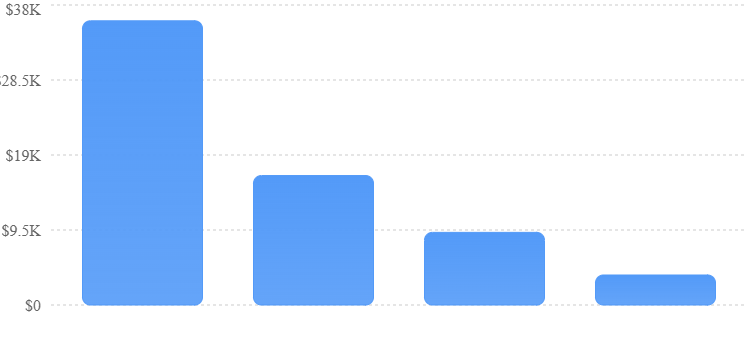
Under these assumptions, the basic AI workflow reduces monthly variable costs by about 54%. The improved version reduces costs by approximately 74%, while the mature version reaches roughly 89%.
The more interesting result is that all three AI scenarios use the same assumed $2,000 monthly AI processing budget. Most of the cost difference comes from how much work the system completes without requiring a person to intervene.
Why Reliability Changes the Business Model
This illustrates a central economic principle for AI-run companies. Once the cost of processing a task becomes relatively low, the remaining human work and the cost of errors often determine whether automation is financially useful.
A founder deciding between two AI systems should therefore avoid comparing model prices alone.
Suppose one tool costs $0.10 per request and another costs $0.30. The cheaper tool may appear superior until testing reveals that it creates more unresolved tasks, incorrect customer updates, or missed follow-ups.
The more expensive tool could still provide better economics if it completes substantially more work correctly.
A More Useful Formula for Measuring AI Automation
For a simple process, businesses can estimate automation costs using the following formula:
\[ C = NA + N(1-r)H + F + E \]
Where:
- \(N\) is the number of attempted tasks.
- \(A\) is the AI cost per attempted task.
- \(r\) is the share completed correctly without human help.
- \(H\) is the human cost of handling an unresolved task.
- \(F\) is the fixed cost of operating and maintaining the system.
- \(E\) is the expected cost of detecting and correcting errors not covered by normal handling.
This framework forces companies to include costs that are often ignored in early AI demonstrations.
It also helps explain why improving the successful completion rate may be more important than negotiating a slightly lower model price.
The Cost of Errors Must Be Measured Separately
An incorrectly resolved billing complaint may lead to another support request. A mistake in a financial record might take hours to investigate. An inaccurate sales message might damage a valuable customer relationship.
These consequences differ greatly by function.
For example, a marketing research task may tolerate a mistake that is caught during editing. A payment instruction cannot tolerate the same level of uncertainty.
Founders should therefore establish different reliability requirements for different tasks instead of applying a single company-wide automation target.
The Architecture of an AI-Run Company: How the Parts Fit Together
The practical structure of an AI-run company is less mysterious than it may sound. Most businesses already have software for their main activities. The change is that an additional layer can read information, decide what to do next, and carry out approved steps.
A dependable system generally needs several connected components.
Business goals and human policies
Targets, priorities, approved actions, spending limits
AI coordination and decision layer
Understands requests, selects tools, checks task state
Sales and CRM
Finance
Support
Product
Data
Operations
Results, monitoring, and human review
Completed tasks, error records, approvals, corrective actions
Conceptual operating architecture for an AI-run company. This is a recommended design, not a diagram of any named startup.
The AI Coordination Layer
The coordination layer determines which task needs attention, gathers relevant information, and sends instructions to the appropriate tool or agent.
For example, a new customer order may trigger billing, account setup, and onboarding activities. The coordination system tracks which steps have been completed and which require additional information.
This is more complex than a chatbot responding to a question because the system must manage changes that happen over time.
A task might take minutes, hours, or days. The software needs to remember its progress, avoid repeating completed actions, and recover when something fails.
The Business Data Layer
AI cannot operate reliably without trustworthy information.
Customer details, contracts, payment history, product settings, and internal policies must be accessible in a controlled way. Each agent should receive only the information necessary to perform its assigned work.
This is also where many AI projects encounter unexpected difficulties. Businesses frequently have duplicated customer records, inconsistent names, outdated procedures, and important information buried in messages.
When these problems are ignored, an AI system may act confidently using incomplete information.
A practical starting point is to identify the source of truth for each important record. The company should know which system controls customer status, billing information, product permissions, and financial totals.
The Execution Layer
The execution layer is where the AI interacts with business systems.
Some actions can happen through software connections designed for that purpose. Others may require operating a graphical interface, much as an employee would.
Direct software connections are often easier to validate because permitted actions and expected responses can be defined clearly.
Computer-use agents can be useful when no suitable connection exists, but changing screens, unexpected pop-ups, and confusing interface states can make them less dependable.
The right choice depends on the application, the sensitivity of the action, and the cost of failure.
The Human Approval Layer
Even a heavily automated company needs a mechanism for stopping risky actions before they occur.
An AI agent might be allowed to update a low-risk customer note without approval. Issuing a large refund, deleting important records, changing payroll information, or signing a contract should normally require stronger controls.
These rules should be based on the possible consequences of an action rather than whether a system describes itself as autonomous.
The Monitoring Layer
A completed API request is not necessarily a completed business task.
Suppose an AI support system submits a refund request successfully. That does not prove the refund reached the correct customer or that the original problem is resolved.
The monitoring layer checks the business outcome. It records what happened, identifies failures, and provides evidence that employees can review.
This is where AI-run companies may build their most valuable internal operating knowledge. Each failure can reveal a missing policy, unreliable integration, unclear instruction, or problem in the underlying business process.
How San Francisco Founders Can Build an AI-Run Company in 90 Days
The best starting point is not to automate every department at once. A founder should choose a single workflow, prove that AI can handle it safely, and use the results to decide what to automate next.
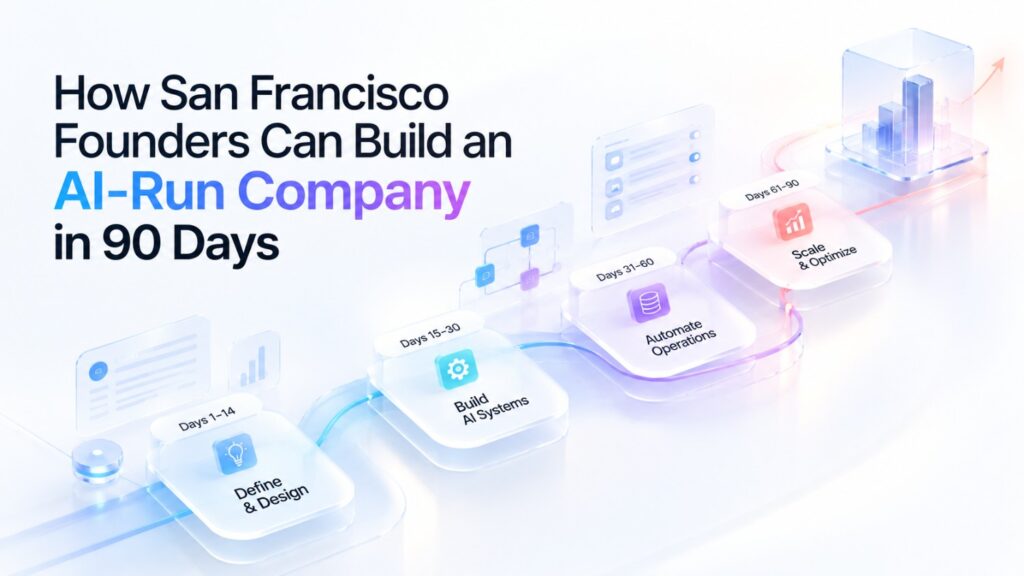
A 90-day plan creates enough structure to produce useful evidence without turning the entire company into an uncontrolled experiment.
Days 1–15: Map the Work Before Buying AI Tools
Start by examining the actual work completed over a normal two-week period.
Record each recurring task, how often it happens, the systems involved, the time it takes, and the consequences of an error. Include activities such as responding to customer questions, entering invoices, preparing sales research, and updating records.
Do not begin with job titles. A person might perform 20 different tasks, only six of which are suitable for reliable automation.
Focus on the underlying actions rather than making broad assumptions about replacing an entire role.
Build a Simple Workflow Inventory
| Workflow | Monthly volume | Current time per task | Error risk | Initial suitability |
|---|---|---|---|---|
| Standard support requests | 1,000 | 5 minutes | Low to medium | High |
| Customer record updates | 500 | 4 minutes | Low to medium | High |
| Invoice matching | 300 | 8 minutes | Medium | Medium |
| Sales account research | 400 | 10 minutes | Medium | Medium |
| Contract approval | 30 | 45 minutes | High | Low |
| Major pricing decisions | 5 | 2 hours | High | Low |
Illustrative workflow inventory for a hypothetical startup. Volumes and durations are assumptions, not observed company data.
This process often reveals that the most useful automation opportunity is a routine task that receives little executive attention.
For example, a business may spend many hours each month checking missing customer details even though the work is relatively simple.
Days 16–30: Establish a Baseline
Before deploying an agent, measure how the existing process performs.
Track the average time required to complete a task, the number of errors, the volume of work, the cost of handling exceptions, and the share of tasks requiring approval.
These measurements provide a reference point for evaluating the AI system.
Without a baseline, a founder may believe that automation is successful because the product appears fast, even when employees are spending additional time correcting its work.
Days 31–45: Test AI Without Giving It Full Control
Begin with a test environment or a review-only process.
Let the agent examine real or properly protected historical tasks, propose actions, and explain the evidence it used. Compare its proposed results with verified outcomes.
For example, an AI accounting assistant can classify sample transactions while an accountant independently checks the results.
The purpose is to discover the failure patterns before allowing the system to make changes to live business records.
Testing should include incomplete information, unusual requests, conflicting records, and attempts to make the agent perform actions outside its permitted role.
Days 46–60: Introduce Limited Automation
Once a workflow performs reliably in testing, allow the agent to complete a carefully defined set of low-risk tasks.
Keep higher-risk actions behind human approvals.
A support agent might answer routine questions and update non-sensitive records. Refunds above a specified amount or requests involving account ownership could be routed to a human.
At this stage, the company should measure correct task completion rather than the number of messages produced or actions attempted.
Days 61–75: Measure the Full Business Impact
Review all labor, software, and monitoring costs.
Examine whether customers receive faster service, whether employees are spending less time on repetitive work, and whether errors have increased or decreased.
Look closely at the exceptions. If the AI handles easy cases but creates a large backlog of difficult ones, employees may still be overwhelmed.
This is also the right stage to improve the underlying process. Sometimes the fastest way to improve an agent is to simplify the workflow or clean up the information it uses.
Days 76–90: Decide Whether to Expand
Use the evidence from the first deployment to select the next workflow.
Ideally, the second process should connect naturally with the first. A company that has automated part of customer support may next improve account updates or onboarding, rather than jumping immediately into payroll or legal approvals.
This lets the company reuse tested integrations, monitoring systems, and approval policies.
By the end of 90 days, the goal should be to have a reliable operating process with measurable results, not an impressive demonstration claiming that the entire business runs itself.
The Five Metrics Every AI-Run Startup Should Track
As companies automate more work, traditional productivity measurements become less useful. Counting employee hours or the number of AI interactions tells founders little about whether the business is performing better.
An AI-run company needs measures that connect automation to actual outcomes.
1. Verified Autonomous Completion Rate
This measures the percentage of assigned tasks completed correctly without human intervention.
\[ \text{Completion Rate}=\frac{\text{Verified autonomous completions}}{\text{Total assigned tasks}}\times100 \]
The word verified is essential. A system should not receive credit for successfully completing a task simply because it reported success.
For customer support, verification might include checking whether the requested account change occurred and whether the customer contacted support again about the same problem.
2. Human Intervention Time
Measure how much employee time is still required per task, including approvals, exception handling, monitoring, and corrections.
This is more useful than counting how many employees use the AI tool.
An agent that completes 80% of tasks but requires constant supervision may save less time than one that completes 65% reliably with little oversight.
3. Cost per Correctly Completed Task
Calculate the total operational cost divided by the number of tasks completed correctly.
Include software usage, infrastructure, monitoring, human review, and error correction.
This measurement prevents a company from optimizing for low AI processing prices while ignoring the cost of failures.
4. Error Severity
Not every error has the same business impact.
Sending a poorly written internal summary is different from transferring money incorrectly or exposing customer information.
Businesses should classify errors according to their consequences, track the frequency of each category, and establish clear conditions for stopping an automated workflow.
5. Time to Business Outcome
Measure how long it takes for work to reach its intended result.
For a support request, the outcome is a resolved issue. For sales, it might be a qualified meeting. For finance, it could be a reconciled transaction or an overdue balance correctly handled.
This metric captures one of the biggest potential advantages of AI-run operations: Work may continue moving even when employees are occupied with other responsibilities.
Original Finding #6: The Greatest Advantage May Be Faster Business Decisions, Not Fewer Employees
The discussion around AI-run startups often focuses on how many workers a company might avoid hiring. That is an incomplete way to measure the opportunity.
A more important advantage may be reducing the time information sits idle between business steps.
Consider a company where a customer request arrives in the evening, waits until the next working day, is transferred between departments, and is eventually resolved after several manual updates.
AI automation may reduce those delays even when the actual task requires only a few minutes of labor.
An Illustrative Workflow-Speed Model
To examine this, consider a process involving four stages. Each stage requires eight minutes of active work and, under the traditional process, waits an average of two hours before someone begins.
| Measurement | Traditional workflow | Hypothetical AI workflow |
|---|---|---|
| Stages | 4 | 4 |
| Active processing time | 32 minutes | 8 minutes |
| Waiting time between stages | 6 hours | 3 minutes |
| Total completion time | 6 hr 32 min | 11 minutes |
Original illustrative model. The AI scenario assumes two minutes of processing per stage and one minute of waiting between consecutive stages. It is not an observed performance benchmark.
How automation could change workflow completion time
Illustrative assumptions for a four-stage process; total time in minutes.
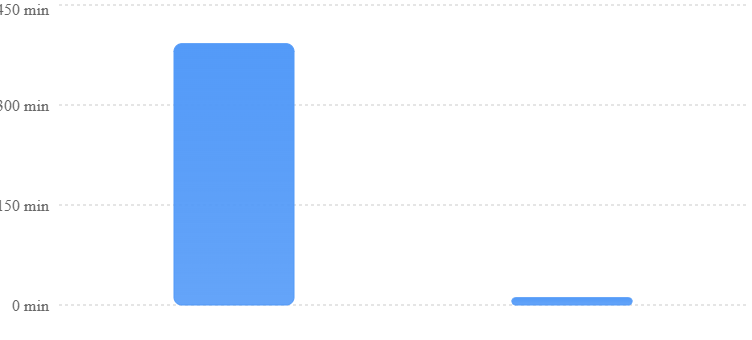
Under these assumptions, elapsed completion time falls by approximately 97%.
That is a striking result, but it should not be presented as a prediction of real-world performance. The improvement comes largely from assumed reductions in waiting time, and many workflows cannot remove those delays because they depend on customers, banks, suppliers, or human approvals.
The model nevertheless reveals an important business opportunity.
Speed Can Improve Revenue and Customer Experience
When customers receive useful answers sooner, they may be less likely to abandon a purchase or cancel a service. When sales teams respond quickly to genuine interest, they may have a better chance of starting a conversation.
When accounting records are updated promptly, business leaders can make decisions using more current information.
These benefits are harder to measure than employee hours, but they can be strategically more important.
San Francisco founders should therefore evaluate automation through two questions: How much work does it remove, and how much faster does it allow the business to respond?
The Biggest Mistakes Founders Make When Building AI-Run Companies
The most dangerous mistake is assuming that because an AI system can perform a task once, it can perform that task reliably thousands of times.
Business operations contain unusual cases, incomplete information, and conflicting instructions. A product that works well during a demonstration can still fail when exposed to the full variety of real customer situations.
Mistake #1: Automating a Broken Process
If a company has inconsistent policies, outdated records, and unclear responsibilities, automation may make existing problems happen faster.
Before assigning a task to AI, founders should simplify the process and decide what a correct outcome looks like.
A good workflow has a clear beginning, a defined result, known exceptions, and an identified person responsible for resolving problems.
Mistake #2: Giving Agents Too Much Access
An agent that can read a customer record does not necessarily need permission to change bank details, issue unlimited refunds, or delete an account.
Permissions should be restricted according to the task. Sensitive actions should require additional checks, and access should be removed when no longer necessary.
Companies should also protect agents against malicious or misleading instructions that may appear in emails, documents, support tickets, or external websites.
Mistake #3: Measuring Activity Instead of Results
A sales system might send thousands of messages without generating meaningful business opportunities. A support agent might answer many questions while customers continue reopening the same cases.
The volume of AI activity is not evidence of success.
Founders should measure completed tasks, qualified sales outcomes, resolved issues, customer satisfaction, and verified improvements in cost or speed.
Mistake #4: Removing Human Expertise Too Early
Employees often understand exceptions that are not written into company procedures.
A billing specialist may recognize an unusual contract condition. A customer support employee may notice that a frustrated customer needs a more careful response. An experienced engineer may identify a system risk that automated tests do not cover.
Removing these employees before their knowledge is reflected in the process can make automation less reliable.
A more effective approach is to involve experienced workers in designing and evaluating the AI system.
Mistake #5: Ignoring the Cost of Maintaining AI Workflows
AI systems require ongoing attention.
Software connections change, business policies evolve, model behavior can change, and new customer requests expose previously unseen cases.
A company must assign clear ownership for monitoring performance, updating instructions, testing changes, and investigating failures.
Automation reduces some recurring work, but it creates a new responsibility: maintaining the systems that now perform that work.
Will AI-Run Companies Replace Traditional Startups?
AI is likely to change how many startups are organized, but the effect will differ across industries.
Businesses selling digital products with predictable support and delivery processes may automate a large share of their operations. Companies that rely heavily on physical services, regulated decisions, complex relationships, or customized professional work may require more human involvement.
The distinction is not simply between technology businesses and traditional businesses. It depends on how repeatable the work is and how safely software can carry it out.
The Rise of the Small, High-Output Startup
A small startup might use AI agents to support software development, marketing research, customer onboarding, and basic administrative operations.
That could allow founders to spend more time understanding customers and improving their products.
However, smaller headcount should not automatically be treated as a sign of a better business.
A startup that uses AI extensively but cannot retain customers, maintain quality, or generate healthy margins is not stronger than a traditional company with a larger workforce.
The real advantage comes when automation helps a company provide more value without a matching increase in complexity and cost.
The Competitive Advantage May Shift Toward Better Processes
Access to powerful AI models is becoming more widespread. As more businesses use similar underlying technology, simply offering AI features may become less distinctive.
Companies may need to compete through superior workflows, better proprietary data, deeper customer relationships, and more dependable execution.
An AI agent that works well within a specific business environment can become more valuable as it learns from properly recorded outcomes and recurring exceptions.
But this improvement is not automatic. Companies need systems for collecting useful feedback, testing changes, and ensuring that new behavior does not introduce additional errors.
Why Existing Software Companies Are Also Part of the Story
AI-run businesses will not necessarily replace every application they currently use.
Accounting platforms, payment systems, customer databases, and other business applications still provide important records, security controls, and ways to complete transactions.
What may change is the interface between employees and these systems.
Instead of navigating several applications to finish one task, a worker may describe the desired outcome to an AI agent that coordinates the approved steps.
This suggests that the next generation of software competition could center on which products own business records, which systems control workflow decisions, and which tools deliver reliable outcomes.
What San Francisco Investors Should Watch Through 2027
The first wave of AI agent funding has helped companies develop products across many industries. The next challenge is demonstrating durable value after early experimentation.
Investors evaluating AI-run company infrastructure should pay attention to customer retention, operating costs, implementation effort, and evidence of successful task completion.
A product can grow quickly during a period of intense curiosity, but sustainable demand depends on whether customers continue using it after the novelty fades.
Look for Repeated Use, Not Just Impressive Demonstrations
A startup with a narrow product and deeply engaged customers may have stronger long-term prospects than a business promising automation across every department.
Repeated use indicates that the product is connected to work customers genuinely need completed.
Investors should ask how many tasks the software handles in production, what share requires intervention, and whether customer usage grows after implementation.
Examine the Cost of Serving Each Customer
Some AI applications consume substantial computing resources or require intensive engineering support during onboarding.
These costs matter when calculating whether revenue growth will translate into a profitable business.
A startup should be able to explain how its costs change as customers, task volumes, and workflow complexity increase.
Measure the Strength of the Human Oversight Model
Reliable oversight should be treated as a product advantage, not a weakness.
Businesses need confidence that AI systems respect permissions, provide useful records, and escalate important decisions to the right employees.
Products that make this easy may become more attractive to larger customers, especially in industries with strict security and compliance requirements.
What This Means for San Francisco Businesses That Are Not AI Startups
A company does not need to sell AI software to benefit from the AI-run operating model.
A consulting business can automate parts of research and client onboarding. A retailer can improve support workflows and inventory updates. A software company can simplify technical support and internal reporting.
The opportunity is to improve one business process at a time.
Managers should begin by identifying repetitive work that employees already perform according to clear rules. They should then estimate the cost of the current process, test possible tools, and compare actual results against that baseline.
They should also resist the temptation to automate tasks simply because the technology is available.
The most useful question is whether automation makes the business more reliable, responsive, or profitable.
A Practical Decision Framework
| Question | Positive signal | Warning signal |
|---|---|---|
| Is the work repeatable? | Most tasks follow a known process | Each case requires a unique judgment |
| Can success be verified? | Outcomes can be checked against records | Results are difficult to measure |
| Is the required data accessible? | Systems contain trustworthy information | Data is incomplete or scattered |
| Can errors be controlled? | Mistakes can be detected and reversed | Mistakes create serious harm |
| Is the workload meaningful? | High volume or costly delays | Very rare tasks with little impact |
| Can employees supervise exceptions? | Ownership and escalation are defined | Nobody is responsible for failures |
The strongest initial opportunities satisfy most of these conditions.
A business should not begin with the most technically impressive task. It should begin with the process where success can be measured and the downside of failure can be controlled.
Final Takeaway: San Francisco’s First AI-Run Companies Will Win by Completing Work Reliably
The emergence of AI-run companies is changing the relationship between people, software, and business operations. San Francisco startups are helping drive that change by creating agents that can work across customer support, sales, accounting, compliance, implementation, and other important functions.
Our original analysis of 12 local startups shows how broad this movement has become. Seven of the sampled businesses focus on customer operations, sales, or finance, while 10 target a defined business function rather than general work across an entire company. These are patterns within our selected sample, not estimates of the whole market, but they reveal where practical product development is taking place.
The supporting economics also point to an important conclusion. The biggest gains may come not from purchasing cheaper AI, but from increasing the share of work completed correctly, reducing waiting time between steps, and helping employees focus on difficult decisions.
At the same time, AI-run does not mean risk-free or fully autonomous. The most dependable systems will require trustworthy information, careful permissions, consistent testing, and clear human accountability.
For founders, the path forward is practical. Choose an important workflow, understand how it currently works, test automation against real outcomes, and expand only when the evidence justifies it.
The first generation of successful AI-run companies may not look like organizations with no employees. They may look like small, highly capable teams supported by software that performs routine work reliably and keeps the business moving.
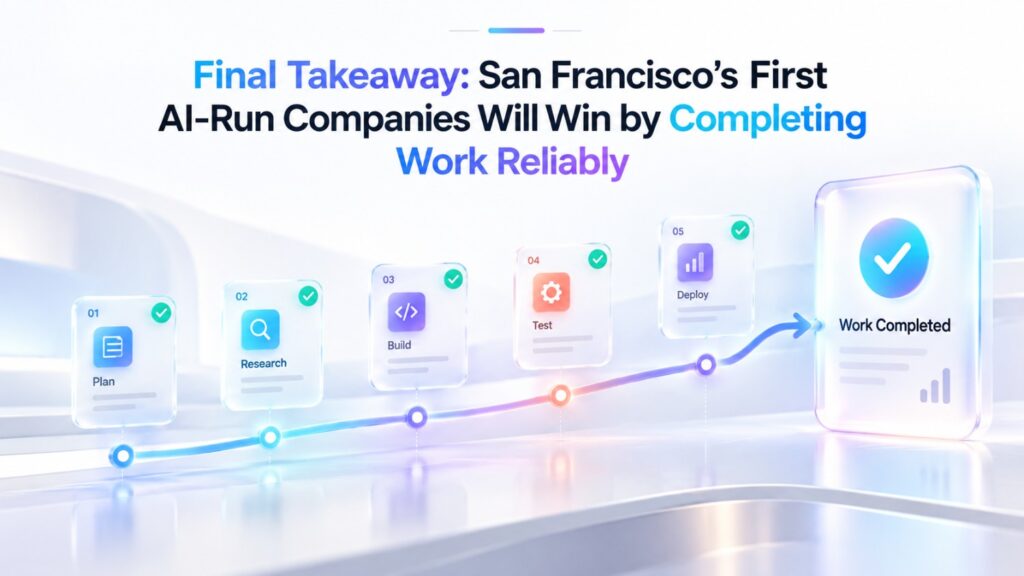
That is the opportunity taking shape in San Francisco: not merely creating AI that can answer questions, but building companies in which intelligent software can help get real work done.
Research Sources and Methodology Notes
This article uses public sources available through October 12, 2026. The primary materials are the Y Combinator San Francisco startup directory, individual Y Combinator company descriptions, Sierra’s September 2025 announcement, and McKinsey’s August 2026 State of AI research.
The original 12-company dataset was manually classified into seven primary operating functions. Each company was counted once. Percentages use the 12 selected companies as their denominator, and rounding may affect displayed totals.
The cost and workflow-speed analyses are original hypothetical models with all principal assumptions disclosed in their respective sections. They are designed to demonstrate business economics and should not be confused with measured financial performance or verified automation outcomes.
The dataset is not a random or comprehensive sample. Product descriptions are evidence of what startups say they are building, not independent verification of actual autonomy, reliability, or commercial adoption. No customer-level production logs, audited financial results, or privately reported operating metrics were available for the sampled companies.
For businesses making investment or purchasing decisions, the most important next step is to request verified task-level performance data, customer references, full operating costs, and records of how each system handles errors.
The larger story is still developing, but the direction is becoming clearer. The companies that turn AI capabilities into dependable business operations will be better positioned to capture lasting value than those that simply automate impressive-looking demonstrations.