
An original SFTechScene research report | October 2026 | 2027 Business Outlook
San Francisco’s next big AI opportunity may not be another chatbot, writing assistant, or coding tool. It could be an entirely different way to run a business, where software does much of the daily work, people oversee the important decisions, and companies are built around completed tasks rather than endless meetings and manual processes.
This is the idea behind the agentic enterprise. Instead of using AI only to answer questions, businesses give AI systems specific goals, access to approved tools, and permission to carry out real work. An AI agent might resolve a customer complaint, update a sales record, prepare a financial report, or complete a software task without needing someone to guide every step.
For San Francisco, the stakes are especially high. The city has a dense network of AI companies, experienced software engineers, investors, and enterprise customers. Startups developing autonomous systems could reshape how businesses buy software, manage employees, handle customers, and compete with much larger rivals.
But there is a major difference between an AI agent that can complete a task and a business that can safely depend on hundreds of agents every day.
That difference will help define the winners and losers of 2027.
According to McKinsey’s August 2026 State of AI survey, 40% of respondents at companies with more than $1 billion in annual revenue reported scaling AI agents in at least one business function, compared with 22% at smaller organizations. The same research found that only 6% of respondents met its criteria for AI high performers, which included significant value and an operating-profit impact of at least 5%.
McKinsey & Company
The message is clear: AI adoption is growing much faster than proven company-wide financial success.
This article examines what that gap means for the next generation of San Francisco businesses. It also presents original SFTechScene calculations using publicly available employment figures, AI adoption surveys, independent performance benchmarks, and clearly stated business scenarios.
The goal is not to predict that AI will replace entire companies by 2027. It is to identify where agentic systems could create measurable value, what might prevent that value, and how San Francisco founders and business leaders can prepare.
The Short Version: The Agentic Enterprise Could Become the Next Major Shift in How Businesses Operate
By 2027, the most important change in business software may be a move from tools that help employees do work to systems that can complete parts of that work themselves.
A traditional business application stores information and provides features. An agentic application goes further. It can understand a request, collect information, use connected software, take approved actions, and check whether the intended result happened.
This creates a new opportunity for businesses. Instead of buying a separate tool for every small task, a company could use connected AI agents to manage parts of a complete process.
The change will not happen equally across every industry or job. Tasks with clear rules, reliable information, and measurable outcomes are much easier to automate than work involving uncertain decisions, sensitive personal matters, or major financial risks.
Large enterprises scaling AI agents
40%
McKinsey, 2026
Smaller organizations scaling agents
22%
McKinsey, 2026
Top OSWorld agent score
66.3%
Stanford AI Index 2026
SF metro computer jobs share
6.6%
Versus 3.4% nationally, BLS 2025
Sources: McKinsey 2026 State of AI, Stanford AI Index 2026, and Bureau of Labor Statistics May 2025 occupational data. The figures describe different populations and should not be treated as one combined survey.
McKinsey & Company
+2
Three findings stand out.
First, large companies are moving beyond experiments, but smaller businesses have not caught up. This leaves room for startups to develop simpler and more affordable systems.
Second, AI agents are becoming more capable, but reliability remains a major limit. Even impressive benchmark results do not prove an agent can safely run an important business process without supervision.
Third, San Francisco has an unusually high concentration of technical and business workers. That makes the wider metropolitan economy an especially interesting place to study how AI changes the cost and structure of knowledge work.
For 2027, the strongest business opportunity may be turning AI capability into dependable, affordable, and measurable completed work.
What Is an Agentic Enterprise, and How Is It Different From a Normal AI-Powered Company?
An agentic enterprise is a business where AI agents take part in carrying out ongoing operations, rather than simply assisting people when asked.
The key distinction is responsibility for completing a process.
Consider a company that receives an invoice from a supplier. In a traditional business, an employee checks the invoice, compares it with the purchase order, sends it for approval, records it in accounting software, and arranges payment.
A company using basic AI might ask a chatbot to extract the invoice details. This saves some typing but leaves most of the process unchanged.
An agentic enterprise could let an AI system receive the invoice, compare records, identify missing information, prepare the accounting entry, request approval, and update the payment status. A human would still authorize actions that carry financial risk.
From software tools to software workers
The move toward agentic operations can be understood through four stages.
| Stage | What the technology does | Human responsibility |
|---|---|---|
| Traditional software | Stores information and supports tasks | Performs nearly every step |
| AI assistant | Drafts, summarizes, and recommends | Directs and executes work |
| AI agent | Completes approved tasks using tools | Reviews exceptions and outcomes |
| Agentic enterprise | Coordinates agents across business processes | Sets goals, rules, budgets, and accountability |
The final stage is not simply a company with more chatbots. It requires a different way of designing operations.
When a customer requests a refund, an agent needs more than language skills. It must know the return policy, check the order, understand available payment options, verify that the request is allowed, and record the final decision.
The business must also know what happens when any part of that process fails.
The operating system of an agentic business
A dependable agentic enterprise needs several connected parts.
Business goals and operating rules
What the company wants, who may approve actions, and spending limits
Choose tools, assign tasks, and decide when to ask for help
Business data
Connected software
Specialist agents
Verified business outcomes
Completed tasks, human approvals, logs, quality checks, and error recovery
SFTechScene conceptual framework for agentic enterprise operations. This is an architecture illustration, not a diagram of a specific company’s deployed system.
The most important part is the last one: verification.
A system that completes 10,000 actions but makes costly mistakes is not necessarily useful. Businesses need to know how many tasks were completed correctly, how often employees had to intervene, and whether the benefits exceeded the costs.
Why 2027 could be an important turning point
The technology has already moved beyond the earliest testing phase. The question is whether improvements in reliability, integration, and business operations will make agents practical across more everyday processes.
Salesforce’s 2026 Agentic Enterprise Index examined a selected group of businesses that had agents in production throughout its February 2025–April 2026 observation period. Average activated agents per organization rose from five to 13, while average agent creation time fell by 53%.
Salesforce
These are meaningful signs of growing use, but they are not evidence that the average business already operates with 13 agents. Salesforce’s sample specifically included continuing production users of its platform.
The more useful lesson is that creating agents is becoming easier. The next challenge is making the work they do more valuable.
Why San Francisco Is Positioned to Shape the Agentic Enterprise
San Francisco has several advantages in the race to build software that performs business work.
Its technology ecosystem includes AI model developers, enterprise software companies, infrastructure startups, venture capital firms, and experienced business customers. Founders can test ideas with other technology companies before selling them into more traditional industries.
The city also has a strong base of companies working on problems that matter to enterprises: security, software development, customer service, legal work, business data, and workflow management.
San Francisco has a strong concentration of high-value knowledge work
The Bureau of Labor Statistics provides a useful way to measure this advantage.
According to its May 2025 occupational estimates, released in July 2026, computer and mathematical occupations represented 6.6% of employment in the San Francisco-Oakland-Fremont metropolitan area, compared with 3.4% nationally.
Management occupations also accounted for a larger local share, as did business and financial operations roles.
Bureau of Labor Statistics
These fields matter because many early AI agent applications focus on work involving software, records, reports, planning, and digital communication.
However, the metropolitan area includes San Francisco, Alameda, Contra Costa, Marin, and San Mateo counties. The figures should not be presented as employment data for San Francisco city alone.
Original SFTechScene Research #1: Measuring the Region’s Agentic Enterprise Opportunity
To understand the area’s potential, SFTechScene compared the concentration of three major occupational groups with their national employment shares.
The analysis uses public BLS figures rather than estimates of how many jobs AI will replace.
Methodology
We selected three occupational groups commonly involved in digital business operations: computer and mathematical, management, and business and financial operations.
For each group, we divided the San Francisco metropolitan employment share by its national employment share.
A result above 1.0 shows that the region has a higher concentration of that type of work than the country as a whole. It does not measure automation exposure or AI adoption.
| Occupational group | SF metro job share | U.S. job share | Regional concentration |
|---|---|---|---|
| Computer and mathematical | 6.6% | 3.4% | 1.94× |
| Management | 9.4% | 7.2% | 1.31× |
| Business and financial operations | 8.7% | 6.8% | 1.28× |
SFTechScene calculations from BLS May 2025 occupational estimates. Each concentration ratio equals the regional employment share divided by the corresponding U.S. share. Ratios are rounded to two decimal places.
Bureau of Labor Statistics
Concentration of Key Business Occupations
San Francisco metro share divided by U.S. share. A value of 1.0 represents the national average.
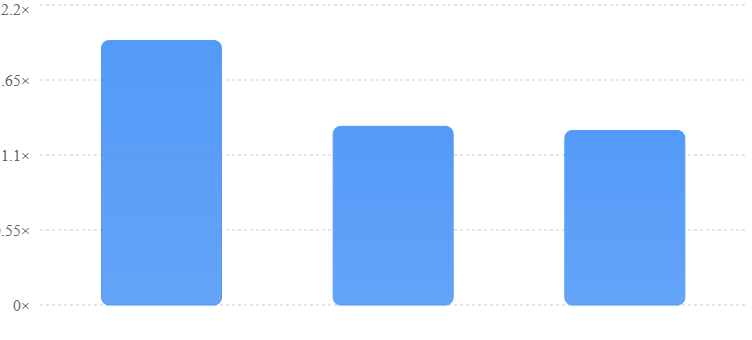
The strongest difference appears in technical occupations. Computer and mathematical work accounts for nearly twice the national share of local employment.
This matters for two reasons.
First, the region has a large pool of people capable of building, testing, and managing advanced AI systems.
Second, local businesses have strong incentives to improve digital work because many of the employees involved are expensive to hire and difficult to replace.
The region’s high wages make this second point worth examining.
Original SFTechScene Research #2: Why Local Labor Costs Could Strengthen the Business Case
The same BLS dataset provides mean hourly wages for major occupational groups.
SFTechScene compared the San Francisco metropolitan wage figures with national figures for four groups involved in common enterprise workflows.
| Occupational group | SF metro hourly wage | U.S. hourly wage | SF wage premium |
|---|---|---|---|
| Computer and mathematical | $80.51 | $57.73 | 39.5% |
| Management | $93.71 | $69.84 | 34.2% |
| Business and financial operations | $60.95 | $45.78 | 33.1% |
| Office and administrative support | $32.96 | $24.79 | 33.0% |
SFTechScene calculations using BLS May 2025 mean hourly wages. Premium = (regional wage ÷ national wage − 1) × 100. Rounded to one decimal place.
Bureau of Labor Statistics
Mean Hourly Wages: San Francisco Metro vs. U.S.
May 2025 wages in U.S. dollars.
■ SF metro
■ United States
Original Finding #1: The economics of automation may be especially attractive for San Francisco’s high-cost digital workflows
An hour of repetitive work has a higher wage-based opportunity cost in San Francisco than in many other parts of the country.
That does not mean a company automatically saves the equivalent wage whenever an AI tool saves an hour. Real savings depend on whether the time is put to productive use, overtime is avoided, future hiring is reduced, or actual operating costs fall.
Nevertheless, the comparison suggests a meaningful opportunity.
A local business that reduces routine processing time may be able to serve more customers without increasing staffing at the same rate. An AI startup offering reliable automation could therefore be attractive even when the product does not directly eliminate a position.
This is a better way to think about the agentic enterprise than assuming every automated task means one fewer employee.
The San Francisco AI Startups Building the Pieces of Tomorrow’s Enterprise
The agentic enterprise will not be created by one company or one type of product. Several different technology layers are needed, and San Francisco companies are competing across those layers.
Some focus on customer conversations. Others help companies build agents, connect them to software, or monitor whether they are behaving correctly.
Enterprise AI platforms: Writer
Writer focuses on helping organizations apply AI to their own business processes.
Its role in the agentic enterprise is important because large businesses usually need more than a general-purpose model. They need systems that can work with internal knowledge, company rules, approval processes, and security requirements.
Writer lists San Francisco as its headquarters and describes its focus on enterprise AI.
Founders, leadership, and values
For 2027, platforms in this category could benefit if businesses stop buying isolated AI features and begin asking for systems that connect several departments.
But the challenge is significant. Every enterprise has different data, software, and operating rules. A platform must make these differences manageable without requiring a costly custom project for every customer.
Customer service agents: Decagon
Decagon represents another important part of the market: AI systems that handle customer interactions.
Its San Francisco operations include roles focused on deploying agents, designing customer experiences, and improving agent performance.
Decagon
Customer support is a promising area because businesses can often measure outcomes directly. They know how many conversations were handled, how many required human assistance, how long customers waited, and whether problems were resolved.
These measurements make it easier to test the financial value of an agent.
The danger is confusing automation with customer satisfaction. A company may reduce the number of human conversations while increasing repeat contacts, refund mistakes, or customer frustration.
The winners in 2027 will need to show that customers receive better results, not merely faster automated responses.
Legal and professional work: Harvey
Harvey illustrates how AI could change specialist work.
The company is building enterprise AI for legal and professional services, where research, document review, drafting, and analysis are central parts of daily operations. Its San Francisco-based teams include engineering and legal specialists.
Harvey
Legal work is particularly interesting because professional time is costly, but mistakes can also be expensive.
An agent that helps organize evidence or prepare a first draft can create value. An agent allowed to make unchecked legal judgments creates a different risk.
This suggests that some of the strongest enterprise products will combine powerful automation with clear human review requirements.
Agent infrastructure: LangChain
LangChain provides technology for building and managing AI applications.
Its products include LangGraph for controlling agent workflows and LangSmith for testing, monitoring, and improving agent behavior. The company identifies San Francisco as its headquarters.
LangChain
Infrastructure like this could become increasingly important as businesses deploy more agents.
A company using five simple agents may be able to inspect most problems manually. A company running hundreds of processes needs reliable logs, automatic tests, permissions, and a way to identify failures quickly.
The opportunity is not only building agents. It is building the tools that make agents safe enough to operate at scale.
Where these companies fit
| Market layer | Example company | Problem addressed | Key 2027 test |
|---|---|---|---|
| Enterprise AI platform | Writer | Applying AI across business operations | Reliable integration and control |
| Customer experience | Decagon | Handling customer conversations and requests | Verified resolution and satisfaction |
| Professional workflows | Harvey | Research and document-heavy specialist work | Accuracy with appropriate human review |
| Agent infrastructure | LangChain | Building, testing, and monitoring agents | Production reliability at scale |
The comparison is based on publicly described product focus, not a ranking of company performance. It should not be read as evidence that any provider has achieved full enterprise autonomy.
Original Finding #2: San Francisco’s agent economy could reward specialized platforms more than general-purpose automation claims
There is an important pattern across these categories.
Customer support, legal work, and enterprise operations have different rules, different risks, and different definitions of success. A system that works well in one area cannot automatically be trusted in another.
This creates room for specialized companies.
A startup may not need to outperform the best general AI model. It may only need to understand a difficult business process better, connect the right tools, and produce more dependable outcomes.
For founders, that changes the competitive question.
Instead of asking, “How intelligent is our agent?” the more useful question becomes, “Which important business process can our system complete more reliably than the alternatives?”
Original SFTechScene Research #3: Why Agent Reliability Could Decide the Entire 2027 Market
The biggest problem facing the agentic enterprise is not whether AI can perform impressive tasks.
It is whether businesses can trust AI to complete a long process correctly, repeatedly, and within clear limits.
Stanford’s 2026 AI Index provides useful evidence of both progress and remaining problems. It reports that performance on OSWorld, a benchmark testing how AI agents use computers, reached 66.3% in 2025, compared with a reported human baseline of 72.35%.
That is a major improvement over earlier results. It also means agents still failed approximately one-third of attempts in that particular benchmark.
Stanford HAI

OSWorld is not a measurement of enterprise workflow success. Real company tasks may be easier or harder depending on the software, available information, and required actions.
Still, the benchmark highlights an important issue: strong performance on individual tasks does not guarantee dependable operation across a long process.
How errors can multiply across a business workflow
Consider a customer service agent handling a complex request.
The agent might need to identify the customer, verify the order, check a policy, inspect payment information, update a record, send a confirmation, and close the case.
Suppose each step succeeds with 95% probability.
That sounds reasonably reliable. But if every step must succeed for the full workflow to succeed, errors can accumulate.
For this analysis, SFTechScene modeled workflows containing four, eight, or 12 required steps.
We tested three hypothetical per-step success probabilities: 95%, 98%, and 99%.
The model assumes that every step has the same success probability, that success or failure is independent between steps, and that there are no retries or human corrections.
These conditions are simplifying assumptions, not measured characteristics of real agents.
The formula is:
\[ P(\text{complete success})=p^n \]
Here, \(p\) is the probability that one step succeeds, and \(n\) is the number of required steps.
Results: Small errors can become large workflow problems
| Required steps | 95% reliable per step | 98% reliable per step | 99% reliable per step |
|---|---|---|---|
| 4 | 81.5% | 92.2% | 96.1% |
| 8 | 66.3% | 85.1% | 92.3% |
| 12 | 54.0% | 78.5% | 88.6% |
Original SFTechScene probability model. All per-step success rates are hypothetical. Values are calculated as p raised to the number of steps and rounded to one decimal place.
How End-to-End Reliability Changes With Workflow Length
Illustrative independent-step model; values are not observed enterprise success rates.
■ 95% per step
■ 98% per step
■ 99% per step
The results are revealing.
An agent that succeeds at 95% of individual steps has only about a 54% chance of completing all 12 steps correctly under these assumptions.
Even a 99% per-step success rate does not produce 99% reliability across a longer process.
For an eight-step workflow to achieve 99% end-to-end success without retries, each independent step would need a success probability of approximately 99.87%.
That is an extremely demanding standard.
What this means for business leaders
The calculation does not prove that long AI workflows will always fail. Real systems can use retries, checks, correction steps, and human intervention to improve outcomes. Failures can also be correlated, making real performance either better or worse than the simplified model.
The finding is about system design.
A company should not connect eight agents together and assume that high individual performance will automatically produce a dependable operation.
It needs a plan for what happens when something goes wrong.
Original Finding #3: Short, verifiable workflows may create more value than fully autonomous departments
One practical strategy is to divide complicated business processes into smaller tasks with clear checkpoints.
An accounts payable agent might collect invoice data and compare it with a purchase order. If everything matches, it prepares the next step. If something does not match, it sends the issue to a human reviewer.
This approach limits the damage caused by a mistake and makes the process easier to test.
A business can also define different levels of permission. Reading information might be allowed automatically, while transferring money requires explicit approval.
The important goal is not maximum independence. It is reliable completion at a cost that makes business sense.
What to measure before trusting an agent
A useful reliability report should distinguish between several outcomes.
| Metric | What it answers | Why it matters |
|---|---|---|
| Correct completion rate | Did the agent finish the entire task correctly? | Measures the actual result |
| Human intervention rate | How often did someone need to help? | Reveals hidden labor |
| Serious error rate | How often could a mistake cause meaningful harm? | Measures operating risk |
| Retry rate | How frequently did the system need another attempt? | Exposes wasted work |
| Recovery time | How quickly can the company fix a failure? | Measures operational resilience |
| Cost per correct completion | What did a successful task actually cost? | Connects reliability with ROI |
These measurements should be recorded by workflow, not simply averaged across every agent.
A 95% success rate may be acceptable for organizing internal notes. It may be unacceptable for issuing payments or changing important customer records.
The business risk must determine the required reliability.
Original SFTechScene Research #4: What Could an AI-Powered Business Actually Save in San Francisco?
The financial case for an agentic enterprise often sounds simple: automate expensive work and save money.
But this leaves out several important costs.
Agents require software access, testing, support, monitoring, human oversight, and recovery when things go wrong. Some companies may also need employees to redesign their processes before automation becomes useful.
To show how these factors interact, SFTechScene developed an illustrative operating model for a San Francisco business processing 10,000 routine administrative requests per month.
This is a scenario analysis using published local wage data and explicitly chosen operating assumptions. It is not an observed customer deployment or a published estimate of the average AI agent’s cost.
The business scenario
Assume that a company handles 10,000 requests each month.
Each request takes an employee eight minutes to complete manually. The work might involve checking a record, making a routine update, and recording the outcome.
For the wage reference, we use the BLS May 2025 mean hourly wage of $32.96 for office and administrative support occupations in the San Francisco metropolitan area.
Bureau of Labor Statistics
We then assume the business introduces an AI agent under the following conditions.
| Model input | Assumption |
|---|---|
| Monthly task volume | 10,000 |
| Manual time per task | 8 minutes |
| Wage reference | $32.96/hour |
| Correctly completed by AI without rework | 70% |
| Human review time per successful AI task | 2 minutes |
| Agent operating cost per attempted task | $0.45 |
| Monthly fixed platform and support cost | $2,500 |
| Failed task handling | Full original manual time |
| Additional rework and transition costs | Excluded |
A 70% correct completion rate is a hypothetical scenario input, not a finding from a benchmark. Likewise, the $0.45 cost is an illustrative all-in variable operating assumption, not a quoted price from a provider.
Step 1: Calculate manual workload
At eight minutes per request, 10,000 requests require:
\[ 10,000 \times 8 \div 60 =1,333.3\text{ hours} \]
At $32.96 per hour, the wage-based value of that work is approximately $43,947 each month.
This is not the company’s total labor cost. It excludes benefits, payroll costs, equipment, management, and other overhead.
Step 2: Calculate the workload handled by AI
If the agent completes 70% of requests successfully, it finishes 7,000 requests.
Those requests would otherwise require approximately 933.3 hours of manual work.
However, employees still review each successful AI task for two minutes.
That review requires 233.3 hours, leaving a net reduction of approximately 700 hours.
The remaining 3,000 requests are assumed to require the same manual effort as before. The model does not give the agent credit for partial work on failed requests.
Step 3: Calculate operating costs and net value
The 700 hours of net time released are worth approximately $23,072 at the selected hourly wage.
The agent’s variable operating cost is $4,500 per month, and the fixed cost is $2,500.
That produces a modeled monthly net value of approximately $16,072.
ILLUSTRATIVE SAN FRANCISCO BUSINESS CASE
700
Net labor hours released per month
$23,072
Monthly wage-based value of those hours
$7,000
Assumed total monthly AI expense
$16,072
Modeled net monthly value
This represents potential capacity value, not verified cash savings, profit, or a guaranteed return. The estimate assumes released time is economically useful and excludes several possible costs.
What happens if the agent is less reliable?
The most important variable may be the share of tasks completed correctly.
We therefore held the other assumptions constant and tested three different completion rates.
Modeled Monthly Net Value at Different Completion Rates
10,000 tasks per month; $32.96/hour wage reference; fixed and variable AI operating expenses totaling $7,000.

| AI correct completion | Net hours released | Monthly net value | Annualized net value |
|---|---|---|---|
| 50% | 500 | $9,480 | $113,760 |
| 70% | 700 | $16,072 | $192,864 |
| 90% | 900 | $22,664 | $271,968 |
SFTechScene scenario calculations. Annualized values equal 12 times the modeled monthly value; they are not forecasts. Assumptions include constant volume, wage, review time, and costs, and no additional expense for errors, deployment, or rework.
The difference between a 50% and 90% correct completion rate is worth $13,184 a month in this example.
That happens without changing the number of tasks or the wage reference.
Improving reliability can therefore be just as valuable as reducing the price of the AI system.
Calculate the economics for your own business
Agentic Enterprise ROI Calculator
Change the assumptions to explore potential monthly capacity value. This is a simplified model, not an ROI guarantee.Tasks per monthMinutes per manual taskHourly labor value ($)Human review minutesCost per AI attempt ($)Other monthly costs ($)Correct completion rate
70%
ESTIMATED MONTHLY NET VALUE
$16,072
Net hours released
700 hours
Wage-based value
$23,072
AI operating expense
$7,000
Reset to research scenarioThe model assumes every unsuccessful attempt falls back to the full original manual process. It excludes extra failed-attempt review, implementation costs, and the cost of error recovery. Human review time may exceed original manual task time, producing negative hours released.
Original Finding #4: The best AI vendor may not be the cheapest one
The model suggests an important change in software purchasing.
Traditional software is often compared by subscription price. AI agents should also be compared by how much correct work they produce, how much human oversight they require, and how much it costs to recover from mistakes.
Imagine two vendors.
The first charges very little but frequently sends tasks back to employees. The second charges more but finishes a much higher percentage correctly.
The second provider could create greater net value even with a higher software bill.
This leads to a useful purchasing metric:
\[ \text{Cost per verified completion} = \frac{\text{Total operating and oversight cost}} {\text{Correctly completed tasks}} \]
For a fair comparison, businesses should define whether the denominator includes tasks completed with human help. An agent that requires several minutes of review for every completion is not equivalent to an agent that finishes independently.
The strongest enterprise AI companies in 2027 may be those that can explain these costs clearly and prove them through customer results.
How Agentic AI Could Change the Main Functions of a Business
Not every department will adopt AI agents in the same way.
Some functions already depend on well-structured software and repeatable processes. Others involve judgment, negotiation, personal relationships, or rapidly changing information.
The difference will shape which enterprise products grow fastest.
Customer service: From answering questions to resolving problems
Customer service is one of the clearest early opportunities.
A basic chatbot provides information. A more advanced agent can use approved tools to inspect an order, verify a customer, update an account, or prepare a return.
This changes the value being sold.
A company might stop measuring only the number of conversations handled by AI and begin measuring how many customer problems were solved without repeated contact.
What a strong deployment should look like
An online retailer could start with order tracking, shipping status, and standard return requests.
These tasks have relatively clear rules. The company can identify the correct result and check whether the customer received it.
More complicated requests, such as disputed payments or unusual refund demands, should be sent to employees.
By 2027, customer experience companies could compete on end-to-end resolution, but only if the resulting customer satisfaction and error rates support the claimed benefit.
Sales: AI agents could manage much of the work around selling
Sales teams spend time researching prospects, updating customer records, arranging meetings, and preparing follow-up messages.
AI agents could reduce some of that administrative workload.
A sales agent might gather information about a target company, organize it into a customer profile, suggest an appropriate message, and prepare the next action for approval.
When a prospect responds, the system could update the sales record and alert the account owner.
The highest-value opportunity may not be replacing salespeople. It may be letting them spend more time on conversations, discovery, negotiation, and relationships.
Why sales automation needs strict limits
Sales agents can also create problems.
They may contact the wrong person, repeat inaccurate claims, misuse private information, or send messages that damage a company’s reputation.
Businesses need controls for who agents can contact, what information they can use, which claims they may make, and when a human must approve outreach.
A sales process that produces more messages but fewer qualified opportunities is not an improvement.
Marketing: AI agents could become campaign operators
Marketing involves many connected tasks.
Teams research audiences, prepare campaigns, create materials, manage publishing schedules, analyze results, and adjust spending.
Agents could help connect these activities.
For example, a marketing agent might identify a drop in campaign performance, compare results with an approved target, prepare a proposed adjustment, and create a report explaining the change.
That is more valuable than simply producing another advertisement or blog draft.
For San Francisco marketing teams, the real opportunity is to reduce the time between noticing a problem and taking an appropriate action.
However, businesses should avoid giving an untested agent unrestricted control over advertising budgets or public communications. Campaign approvals, brand rules, and spending limits remain important.
Finance: AI agents could improve routine operations before handling major decisions
Finance teams deal with invoices, expenses, account records, payments, and reporting.
Many of these processes contain repeatable steps.
Agents could gather documents, compare records, flag differences, and prepare reports for review.
But the risk rises sharply when an agent can move money, alter financial records, or approve transactions.
A well-designed finance agent should work within strict rules. It might prepare a payment, but authorization should remain with an approved person or separately controlled system.
The strongest products could reduce processing time without weakening financial accountability.
Software development: Agents could change the economics of building internal tools
Software development is already one of the most active areas for agentic AI.
Coding agents can help engineers inspect code, write tests, suggest fixes, and perform limited development tasks.
McKinsey’s August 2026 survey found that 32% of respondents said their organizations had decided against purchasing at least one software product or feature because they could build the functionality internally using agentic coding tools.
McKinsey & Company
This is an important signal for enterprise software.
If companies can develop certain simple tools more cheaply, they may become less willing to pay for every small application.
The effect will not be the same for complex products with security, compliance, support, and demanding reliability needs. Writing the first version of software is only one part of owning it.
For 2027, the question may increasingly become whether a business should buy a product, build an internal tool with AI assistance, or use an agent connected to existing software.
Human resources: Better administration without automated judgment
Human resources departments deal with onboarding, employee questions, internal policies, benefits information, and document preparation.
Agents could help employees find answers and complete standard administrative steps.
For example, an onboarding agent might explain a company’s procedures, prepare access requests, and guide a new employee through required documentation.
But employment decisions require much greater care.
AI should not be treated as an independent authority for hiring, performance reviews, disciplinary actions, or other decisions with major consequences for individuals.
The value of HR agents is strongest when they reduce administration while keeping people responsible for sensitive judgments.
Original SFTechScene Research #5: Which Business Functions Are Best Suited to Agentic AI in 2027?
The next question is where a business should begin.
To answer it, SFTechScene developed a transparent planning framework for comparing five common enterprise workflows.
This framework is an original analytical model, not a survey of real-world deployments.
It assigns scores from one to five across four categories: how repeatable the task is, how easily the result can be checked, how readily it can connect to existing software, and how manageable the consequences of a mistake are.
Higher scores represent better suitability for a narrowly scoped, supervised AI agent.
The framework gives each category equal weight. It is intended to help founders form testing priorities, not to produce a scientifically validated ranking of occupations or industries.
The scoring framework
| Workflow | Repeatability | Easy to verify | Software connectivity | Manageable error risk | Total /20 |
|---|---|---|---|---|---|
| Internal knowledge requests | 5 | 4 | 4 | 4 | 17 |
| Routine customer order updates | 5 | 5 | 4 | 3 | 17 |
| Standard invoice preparation | 5 | 5 | 4 | 2 | 16 |
| Sales research and CRM updates | 4 | 4 | 4 | 3 | 15 |
| Complex contract negotiation | 2 | 2 | 3 | 1 | 8 |
Original SFTechScene editorial scoring, October 2026. Scores are judgments based on the stated framework, not observed success rates. They assume human approval for sensitive actions and may change significantly with the process, company, industry, and data quality.
Illustrative AI Agent Suitability Scores
SFTechScene four-factor framework, maximum 20 points. Higher means more promising for initial supervised testing.

Why knowledge requests score well
Internal knowledge requests often have a relatively narrow goal.
An employee asks where to find a policy, how to complete an internal procedure, or which system contains specific information.
The result can often be checked against an approved source.
These requests still require careful permissions and up-to-date information, but the risks can be easier to manage than those associated with spending money or making legal decisions.
Why routine customer actions score well
Order status and similar customer operations often depend on structured information.
An agent can check an existing record and take a limited action within a defined policy.
The workflow becomes more attractive when the business can confirm the outcome automatically.
However, account security and customer identity checks are essential. An incorrect account update can still cause significant harm.
Why invoice preparation is promising but sensitive
Invoice preparation is highly repeatable, and many results can be checked against existing records.
But financial errors can create meaningful losses.
That is why the model gives invoice preparation a lower error-risk score.
The distinction between preparing and approving a payment matters. A business may automate the former while keeping the latter under strict human control.
Original Finding #5: The best starting points are often boring but measurable
The scoring exercise suggests that exciting demos are not always the best first business applications.
Routine knowledge requests, customer record updates, and document preparation may offer clearer paths to reliable deployment than open-ended decision-making.
For startups, this is a strategic advantage.
A narrowly focused product can collect better performance data, improve faster, and explain its business value more clearly.
It may also face fewer integration and trust problems than an agent claiming to operate an entire department.
This gives smaller San Francisco startups a practical route into the market without competing head-to-head on general AI intelligence.
Why Traditional Business Software Could Look Very Different by 2027
The agentic enterprise could change more than employee productivity. It may also change what businesses expect from their software vendors.
Today, companies often buy software designed around a specific department. Sales teams use customer management systems. Finance teams use accounting products. Support teams use ticketing platforms.
These products remain valuable because they store records, enforce business rules, and help companies manage important information.
AI agents introduce a new possibility: businesses may increasingly interact with those systems through goals and actions rather than through their traditional interfaces.
Software could become the foundation, while agents become the interface
Imagine a sales manager asking an agent to identify high-priority opportunities that have not received attention.
Instead of opening several dashboards, the manager receives a list of accounts, the evidence behind the recommendations, and proposed next steps.
After approval, the agent updates the appropriate systems.
The original software still matters. It remains the place where customer information, permissions, and records are managed.
But the employee spends less time navigating applications.
This suggests that agentic software may not replace every existing enterprise platform. Much of its value could come from making current systems easier to use together.
Traditional SaaS companies have important advantages
Established software vendors already have customers, stored business information, and trusted relationships with enterprise buyers.
They can add agent capabilities to systems customers already use.
For startups, this creates a difficult competitive environment.
A new company offering basic automation may struggle if an established platform provides similar features within its current subscription.
Startups need a clearer advantage, such as better performance in a particular industry, stronger connections across multiple products, or a more useful way to charge for completed work.
The pricing model could change
Traditional software companies frequently charge by employee seat.
Agentic systems can create a different pattern of usage. A business may have fewer employees directly operating an application but a growing number of AI tasks running through it.
This could encourage vendors to charge by completed work, usage, or a combination of subscription fees and outcomes.
The problem is defining what counts as a successful result.
For customer support, a resolved issue might be a reasonable unit. For finance, a correctly processed invoice could be measurable. For complex professional advice, the value may be harder to define.
The strongest pricing approaches will likely depend on the type of work being performed.
The Biggest Risks Facing Agentic Enterprises in 2027
The agentic enterprise will create new opportunities, but it also introduces operating risks that ordinary software does not face in exactly the same way.

An application that stores information can cause problems if it contains incorrect data. An agent with permission to act on that information may turn the error into a real-world decision.
That makes governance a central business requirement.
Security: Agents need limits on what they can access and do
AI agents may interact with sensitive customer records, financial systems, internal documents, and connected applications.
A compromised or misdirected agent could expose information or perform an unauthorized action.
In December 2025, OWASP published its Top 10 for Agentic Applications, highlighting risks such as agent goal hijacking, tool misuse, identity and permission abuse, and weaknesses in connected agent components.
OWASP Gen AI Security Project
These risks are not theoretical categories that businesses can safely ignore.
A company should give each agent only the permissions it needs to perform its assigned tasks.
An agent preparing invoices does not automatically need permission to authorize bank transfers. A marketing agent researching campaign results should not have unrestricted access to employee records.
Data quality: Poor information produces poor decisions
Agents rely on business data to complete work.
If customer records are duplicated, operating policies are outdated, or financial documents are inconsistent, an agent may make incorrect decisions even when its reasoning appears sensible.
This makes data management an important part of enterprise AI adoption.
Businesses should identify the trusted source for each important piece of information and establish how changes are recorded.
A useful agent should also be able to recognize uncertainty.
When the necessary information is missing, asking for help is often the correct result.
Compliance: Responsibility remains with the business
Using AI does not remove a company’s obligations to customers, employees, or regulators.
Financial services, healthcare, legal work, and other regulated activities may require special controls depending on the jurisdiction and the specific action.
Companies should review applicable rules before giving agents access to sensitive workflows.
The appropriate approach is to make human approval and recordkeeping part of the process from the beginning, not add them after a problem occurs.
Vendor dependence could become a serious strategic issue
An enterprise that builds important operations around one AI provider may face problems if that provider changes prices, product access, technical capabilities, or terms.
A business should understand which parts of its system can be moved to another provider and which cannot.
This includes ownership of operating records, prompts, workflow definitions, testing data, and integrations.
The goal is not necessarily to avoid outside vendors. It is to prevent the business from losing control of its own operations.
How the Agentic Enterprise Could Change Jobs in San Francisco
One of the biggest questions surrounding agentic AI is what it means for workers.
Some people expect AI agents to remove entire job categories. Others believe they will mostly help employees become more productive.
The available evidence does not support one universal outcome.
AI systems are improving rapidly, but their capabilities remain uneven across different tasks.
Research from METR measures AI performance using the length of software-related tasks that human experts would need to complete. The researchers caution that these measures do not represent the number of hours AI can independently operate in a typical workplace.
METR
That distinction matters when discussing employment.
A system that performs well on a technical benchmark may still struggle with incomplete customer information, changing business priorities, or decisions requiring professional judgment.
Job tasks may change before job titles disappear
A software engineer could spend less time on basic coding and more time reviewing systems, evaluating AI-generated changes, and solving difficult problems.
A finance professional might spend less time entering routine information and more time investigating unusual transactions.
A customer service employee could handle fewer standard questions and more complicated customer situations.
These changes could increase productivity without immediately eliminating every affected position.
However, automation could also reduce demand for some forms of routine work, especially if businesses can handle rising volumes without expanding their teams.
Entry-level work requires particular attention
Many junior employees learn by performing relatively straightforward tasks.
If agents begin handling much of that work, companies may need new ways to train future specialists.
For example, a junior developer traditionally gains experience by fixing small bugs and writing simple features. As AI takes on more of these activities, employers will need to consider how newer employees build the judgment needed for larger assignments.
The same issue may arise in legal services, finance, marketing, and business operations.
A sensible workforce strategy should therefore include training, not only automation.
New roles may emerge around agent operations
As organizations depend more heavily on AI agents, they may need people who can manage these systems.
Possible responsibilities include agent performance testing, workflow design, permissions management, incident investigation, and business process improvement.
Some of these duties will become parts of existing jobs rather than entirely new positions.
For San Francisco workers, understanding how to evaluate and supervise AI systems could become increasingly valuable.
How San Francisco Businesses Can Build an Agentic Enterprise in 90 Days
A company does not need to automate an entire department to begin preparing for 2027.
A more effective approach is to select one measurable workflow, establish its current performance, test an agent with limited access, and expand only after the results justify it.
The following plan is designed for a business with an identifiable process owner, available operating data, and the ability to connect an approved AI system to its software.
Days 1–15: Find the most useful workflow
Start by identifying where employees spend time on repeatable digital tasks.
Do not begin by asking which AI model looks most impressive. Begin with a business problem.
A good candidate has clear inputs, a repeatable process, a measurable result, and manageable consequences if something goes wrong.
Examples include internal policy questions, order status requests, sales record updates, and document preparation.
Measure current task volume, average handling time, error rates, and the cost of the existing process.
Without this baseline, the business will struggle to prove whether automation creates value.
Days 16–30: Define what success means
Write down the exact result the agent must produce.
For an invoice preparation workflow, success might mean extracting the correct information, matching it to the approved purchase order, and preparing an accurate record without authorizing payment.
Create a collection of historical examples for testing.
The examples should include routine cases, incomplete information, unusual requests, and situations where the correct action is to stop and ask a person.
Decide in advance which mistakes are acceptable, which require escalation, and which must never occur.
Days 31–45: Build a limited pilot
Connect the agent only to the systems needed for the chosen task.
Start with read-only permissions wherever practical. Add the ability to make changes only after the process has passed suitable checks.
The initial test can run in a simulated environment or in a mode where the agent proposes actions without executing them.
Record the agent’s decisions and compare them with the expected results.
The purpose is to discover weak points before they affect customers or financial records.
Days 46–60: Test reliability and real costs
Run a representative set of cases and calculate correct completion rates.
Measure how often human reviewers need to intervene and how much time they spend doing so.
Include the costs of software, monitoring, review, and failure recovery.
If the agent appears inexpensive but employees spend substantial time fixing its work, the pilot has not yet demonstrated a financial advantage.
Review serious errors separately from routine failures. Even a small number of high-impact mistakes may make a workflow unsuitable for greater autonomy.
Days 61–75: Introduce controlled production use
Move the agent into a limited live workflow once it meets the business’s predefined safety and quality requirements.
Keep clear boundaries around allowed actions.
For example, a customer service agent might be allowed to provide order information automatically but require approval for unusual refunds.
Ensure employees know how to stop the system, correct records, and take over a task when necessary.
Monitor performance by day and by task type so new problems can be identified quickly.
Days 76–90: Decide whether to expand
At the end of the pilot, compare performance against the original baseline.
The decision should consider correct completion, customer or employee experience, total cost, and operational risk.
The outcome may be to expand the agent, improve it, restrict it to a narrower workflow, or stop the deployment.
All four decisions can be reasonable.
A failed pilot that identifies an unsuitable process can still prevent a much more expensive mistake.
A practical 90-day operating scorecard
| Measure | Baseline | Pilot result | Expansion decision |
|---|---|---|---|
| Monthly task volume | Record actual | Record actual | Is there enough volume? |
| Average task time | Measure manually | Include agent and review time | Is work faster overall? |
| Correct completion | Existing error rate | Independently verified rate | Does it meet required quality? |
| Human intervention | Existing effort | Escalations and review time | Is oversight manageable? |
| Cost per correct task | Current cost | Full AI-assisted cost | Is value demonstrated? |
| Serious incidents | Current record | Pilot incidents | Is risk acceptable? |
| User satisfaction | Current feedback | Pilot feedback | Has the experience improved? |
The scorecard should be owned by the department responsible for the business process, not only by the technology team.
This keeps attention on business outcomes rather than technical demonstrations.
What San Francisco AI Founders Should Build for the 2027 Market
The market for AI agents is becoming crowded.
Founders need more than a claim that their product can automate work.
A strong new company should solve a specific, costly problem and have a convincing way to demonstrate results.
Focus on difficult workflows with clear business value
Look for processes that consume significant time, repeat frequently, and have measurable outcomes.
The strongest opportunities may exist where businesses already spend heavily on people or software but still struggle with slow processes.
Founders should speak directly with employees responsible for the work.
They need to understand exceptions, approval requirements, missing information, and the reasons current software does not solve the problem.
Those details often determine whether an agent is useful.
Design around the customer’s existing tools
Most established businesses cannot replace their software systems simply to adopt an AI agent.
Products that work with existing systems may face less resistance.
This means startup teams should treat integrations, permissions, and data handling as central parts of the product.
An agent with excellent language skills but poor access to the right information will produce disappointing results.
Build the evaluation system before scaling
Founders should create a repeatable way to test their product using realistic customer tasks.
Every major product change should be checked against this test set.
The company should know whether the new version improves correct completion, reduces cost, or introduces unexpected failures.
This becomes particularly important when a startup changes its underlying AI models.
Without consistent testing, teams may mistake better-looking responses for better business performance.
Make customer ROI easy to verify
Enterprise buyers are increasingly interested in measurable results.
A startup should be able to show how its product changes the cost of completing a business task, how much human work remains, and what happens when the system makes a mistake.
Customer case studies should separate actual cost reductions from employee time that could be used elsewhere.
This makes the business case more credible and helps buyers understand where value will appear.
Treat trust as a product feature
Security, approval controls, audit records, and clear error handling should not be viewed merely as obstacles to adoption.
They can become competitive advantages.
A business choosing between two capable agents may prefer the one it can supervise and control more easily.
For many enterprise customers, confidence in the system will matter as much as raw technical capability.
Three Scenarios for the Agentic Enterprise in 2027
Forecasting AI adoption is difficult because technical capabilities, costs, buyer behavior, and regulation can all change quickly.
A useful forecast should therefore examine different possible outcomes rather than presenting one certain future.
These scenarios are qualitative interpretations of the available 2026 evidence. They are not statistical forecasts with assigned probabilities.
Scenario 1: Controlled adoption
Conservative
AI agents continue improving, but companies limit them to narrow, supervised tasks. High integration costs, security concerns, and inconsistent results slow wider deployment.
Likely winners: Products that solve specific problems with low implementation effort and strong quality controls.
Scenario 2: Connected business workflows
Base case
More organizations connect agents to established software and allow them to complete larger parts of routine processes. Humans continue supervising sensitive actions, while firms measure cost per correct task more carefully.
Likely winners: Specialized workflow providers, integration platforms, and tools for monitoring agent quality.
Scenario 3: Rapid enterprise redesign
Accelerated
Improvements in reliability and costs make broader automation attractive. Some companies redesign operations around agents, reduce the need for repetitive manual work, and launch new services with relatively small teams.
Likely winners: Companies providing trusted end-to-end automation and strong operational controls.
Which scenario appears most defensible?
The connected-workflow scenario is a reasonable planning assumption given the evidence available in October 2026.
McKinsey reports growing enterprise use, and Salesforce’s selected production-user data suggests that organizations are deploying more agents. At the same time, independent benchmarks and enterprise surveys show that reliability and measurable financial outcomes remain substantial challenges.
McKinsey & Company
+2
That combination points toward gradual expansion of useful automation rather than immediate replacement of entire businesses.
However, the pace could change if agents become more reliable, substantially cheaper to operate, or easier to connect to existing systems.
The Five Signals SFTechScene Will Watch in 2027
To evaluate whether the agentic enterprise is becoming a lasting business shift, five indicators deserve close attention.
First is the share of companies moving from pilots to scaled deployments. Growth in experiments is useful, but production use reveals whether businesses believe the technology creates sustained value.
Second is correct completion across real workflows. Companies need evidence that agents can perform entire processes, not just isolated benchmark tasks.
Third is the total cost of completing work. Lower model prices matter, but the bigger improvement may come from reducing human review, repeated attempts, and error recovery.
Fourth is the speed of enterprise integration. If companies can connect agents safely to their existing software in days rather than months, adoption becomes easier.
Fifth is the effect on revenue, operating margins, customer experience, and employee productivity. These outcomes determine whether agentic AI is a real business advantage or another expensive technology initiative.
Together, these measures provide a much stronger view of the market than the number of agents announced or the size of startup funding rounds.
Research Methodology, Sources, and Limitations
This SFTechScene report combines public evidence with original calculations and planning models prepared for this article in October 2026.
The research uses four distinct methods.
Regional concentration analysis: BLS May 2025 occupational employment shares for the San Francisco-Oakland-Fremont metropolitan area were divided by corresponding U.S. shares. The results describe occupational concentration, not automation risk, startup density, or the likelihood of job losses.
Regional wage comparison: Published mean hourly wages for selected occupations were compared with national figures. These are cross-sectional comparisons, not a causal estimate of the effect of AI on pay.
Workflow reliability analysis: Hypothetical independent-step probabilities were multiplied across four-, eight-, and 12-step processes. This demonstrates a mathematical effect under specified assumptions. It is not an empirical evaluation of deployed business agents.
Enterprise ROI scenario: A synthetic 10,000-task monthly workload was combined with published local wages and explicitly assumed completion rates, processing times, and software costs. The results are sensitivity estimates, not observed customer savings. The calculation excludes implementation costs, benefits, tax effects, extra failure handling, and the time required for organizational change.
The workflow suitability scores are a separate editorial planning tool. They should not be treated as independently validated measurements.
Important limitations
The San Francisco metropolitan area is larger than San Francisco city. Regional employment and wage figures cannot establish city-specific AI adoption or startup behavior.
The public enterprise surveys cover different respondents and use different definitions of AI deployment. They should not be combined as though they represent one consistent sample.
AI benchmarks measure selected tasks under test conditions. They do not establish real-world reliability across all industries or business processes.
Finally, 2027 remains in the future as of publication. All statements about how companies could operate next year are scenarios and forecasts, not confirmed developments.
Primary research sources
| Source | Research used |
|---|---|
| Bureau of Labor Statistics, San Francisco Occupational Employment and Wages | Regional employment shares and mean wages |
| McKinsey, The State of AI in 2026 | Enterprise adoption, agent scaling, and reported business impact |
| Stanford AI Index 2026: Technical Performance | AI capabilities and computer-use benchmark performance |
| METR, Task-Completion Time Horizons | Independent agent performance research and benchmark limitations |
| Salesforce Agentic Enterprise Index, Second Edition | Observed usage trends for a selected cohort of production users |
| OWASP Top 10 for Agentic Applications | Security risks and control considerations |
Final Takeaway: The Agentic Enterprise of 2027 Will Be Built Around Reliable Work, Not Just Intelligent Software
The agentic enterprise could become one of the biggest changes in how businesses operate over the next several years.
San Francisco is positioned to influence that shift because of its concentration of technical talent, enterprise software companies, AI startups, and high-value knowledge work.
The region’s business environment also creates strong incentives to improve productivity.
SFTechScene’s original analysis found that computer and mathematical occupations account for roughly 1.94 times the national employment share in the San Francisco metropolitan area. Wage comparisons also show substantially higher local pay across several major business occupations.
Those conditions create an attractive market for software that can reliably reduce repetitive work.
But the research also highlights the limits of simple automation claims.
Our reliability model demonstrates how small error rates can accumulate across longer processes. Our financial scenario shows that correct completion and human review can matter as much as software pricing. Our workflow framework suggests that narrowly defined, measurable tasks may be more practical starting points than broad promises of business autonomy.
For startups, the opportunity is to build AI systems that solve real operational problems while making quality, costs, and risks visible.
For business leaders, the opportunity is to redesign carefully chosen workflows rather than simply adding agents to every department.
And for employees, the priority is to develop the judgment and skills needed to work effectively with increasingly capable software.
The companies that lead in 2027 may not be the ones running the most AI agents. They may be the ones that can prove their agents complete valuable work correctly, consistently, and at a cost that makes sense.
That is what will turn the agentic enterprise from an ambitious idea into a durable business model.