

San Francisco has spent decades building some of the world’s most successful technology companies. The usual formula was easy to understand. A founder raised money, hired engineers, built a product, recruited salespeople, created a marketing team, and kept adding employees as the business grew.
Artificial intelligence is beginning to challenge that formula.
A startup that once needed ten people to build and sell software can now use AI tools to write code, test features, answer customer questions, research buyers, create marketing material, and handle parts of daily operations. Some founders are beginning to ask whether they need large teams at all.
The question is no longer whether one person can launch a software business. That has been possible for years. The more interesting question is whether a company with two or three employees can reach millions of dollars in annual revenue without following the traditional hiring path.
For San Francisco, the stakes are particularly high. The city has a strong network of AI developers, investors, business customers, and experienced founders. It also has some of the country’s highest labor costs. Together, these conditions make it an important place to examine whether small AI-powered teams can compete with much larger businesses.
But there is a major difference between using AI to perform work and building a company that operates reliably with almost no employees. AI-generated code still needs testing. Customers still need someone who can solve difficult problems. Financial decisions still require accountability, and a business that automates the wrong process can make mistakes faster than a traditional company.
To understand what is changing, SFTechScene analyzed publicly available founder data, San Francisco-area wage statistics, published AI cost research, and evidence on AI productivity. We also developed original financial and operating models to examine how team size, automation reliability, and human review affect the economics of small startups.
The results suggest that AI-native companies have a real opportunity to operate with fewer employees. However, the biggest advantage may not come from eliminating workers completely. It may come from building businesses where every employee can support far more revenue without giving up product quality, customer trust, or financial control.
The Short Version: AI-Native Startups Are Changing the Relationship Between Revenue and Headcount
An AI-native company is a business that uses artificial intelligence as a core part of how it operates. Instead of adding AI features to existing processes, it designs many of those processes around AI from the beginning.
A traditional software startup may hire employees to perform research, write first drafts, handle routine support requests, and maintain internal reports. An AI-native startup may have software perform much of that work while a smaller human team makes decisions, checks important results, and handles problems that require judgment.
That difference could change how companies grow.
Solo-founder share
36%
Of startups formed on Carta in 2025
SF-area hourly pay
$48.19
Mean across occupations, May 2025
AI inference cost decline
280×+
At a fixed benchmark level, Nov. 2022–Oct. 2024
Modeled break-even ARR
$594K
Two-person illustrative startup scenario
Sources: Carta Founder Ownership Report 2026, U.S. Bureau of Labor Statistics, Stanford AI Index 2025. The break-even estimate is SFTechScene’s own scenario calculation, not an observed startup result.
Carta
+2
The available evidence points to several important changes.
First, more businesses are being started by individuals rather than groups of co-founders. Carta reported that around 36% of companies founded on its platform during 2025 had a solo founder. That does not mean these companies have no employees, but it does show that starting a company alone has become more common.
Carta
+1
Second, AI tools are getting cheaper for many kinds of work. Stanford’s 2025 AI Index found that the cost of running a model at a particular earlier performance level had fallen by more than 280 times between November 2022 and October 2024. This is one reason small founders can now access capabilities that previously required much larger technology budgets.
Stanford HAI
+1
Third, the financial value of automation depends on more than subscription prices. A company must account for errors, monitoring, security, human review, and the cost of maintaining automated workflows as products and customer needs change.
Finally, successful companies may keep hiring even when automation works well. They may choose to spend their gains on better engineering, stronger relationships, or expansion into new markets rather than permanently limiting headcount.
The important change is that hiring becomes more of a choice tied to business results, rather than the automatic response to every increase in workload.
What Exactly Is an AI-Native Company?
AI-native is not the same as AI-powered
Many companies use AI without being AI-native. A business that purchases an AI writing tool for its marketing department is using AI, but its basic structure may remain unchanged.
An AI-native startup starts by asking a different question: What if most repeatable work could be handled by software, with people responsible for the decisions that matter most?
This changes how its product is designed, how information moves through the business, and how work gets assigned.
Imagine two companies selling software that helps local businesses manage appointments.
The first hires support representatives to answer scheduling questions, marketers to write emails, and operations staff to review customer accounts. It may introduce AI tools over time, but its core processes still depend on people moving information between systems.
The second builds appointment handling, common support questions, billing checks, reminders, and internal reporting around automated workflows from its first day. Humans review exceptions, investigate customer complaints, approve sensitive decisions, and improve the product.
Both companies may deliver a useful service. However, the second may be able to support a larger customer base before hiring more employees.
The three layers of an AI-native business
A useful way to understand this model is to divide the business into three connected layers.
Human direction and accountability
Strategy, important approvals, relationships, product decisions, and risk management
AI agents and automated workflows
Research, drafting, coding, routing, classification, monitoring, and routine actions
Business systems and trusted data
Customer records, product databases, billing, access controls, and activity logs
SFTechScene conceptual model: automation works between human decision-makers and the systems that hold business information.
The first layer is the human team. It decides which customers to serve, what the product should accomplish, how much risk the business can accept, and when automated work needs approval.
The second layer is the automation system. This is where AI agents may gather information, classify requests, create drafts, update approved records, and complete bounded tasks. A single agent might work on one process, while several agents can coordinate different stages.
The third layer contains the systems that make the business function. These include customer databases, payment systems, code repositories, reporting tools, and security controls. If the information in these systems is wrong, the AI workflows using it can also produce wrong results.
Why the connection between these layers matters
The biggest risk is designing the middle layer without connecting it properly to the other two.
For example, a customer support agent might answer questions very well in a demonstration. But if it cannot reliably check a customer’s subscription status, it may give incorrect billing advice. If it can change subscriptions without limits, it may create an even bigger problem.
An AI-native company therefore needs more than capable models. It needs clear rules about what AI can do, which information it can access, how its actions are recorded, and when a person must step in.
These operating decisions are what make a smaller team possible.
Why San Francisco Is an Important Testing Ground for Smaller AI Companies
The city’s labor costs make efficient teams more valuable
San Francisco’s technology economy has long attracted highly paid engineers, designers, managers, and business specialists. That talent is valuable, but employing large teams creates significant financial pressure on young companies.
The U.S. Bureau of Labor Statistics reported an average hourly wage of $48.19 across occupations in the San Francisco-Oakland-Fremont metropolitan area in May 2025, compared with $33.54 nationally. The average local wage in computer and mathematical occupations was $80.51 per hour. The figures were published in July 2026.
Bureau of Labor Statistics
These are regional averages, not startup salary offers. They do, however, show why a business that can operate with fewer employees might have a meaningful cost advantage.
Mean hourly wages: San Francisco metro vs. United States
May 2025 BLS data, USD per hour. Geographic coverage is the San Francisco-Oakland-Fremont metro, not San Francisco city alone.
■ SF metro
■ United States
Source: BLS, May 2025 Occupational Employment and Wage Statistics.
Bureau of Labor Statistics
For founders, the question is not whether an AI subscription is cheaper than a full-time employee. It usually is. The important question is whether a combination of AI software, human oversight, and technical maintenance can complete a defined workload at a lower total cost.
A company paying for automation that fails frequently may spend more on corrections than it saves in wages. A company that automates a stable, high-volume process may achieve meaningful savings while improving service speed.
Founders have access to a dense network of AI expertise
San Francisco also offers advantages that are difficult to capture in a simple financial model.
Founders can meet engineers who understand current AI systems, investors who follow emerging software businesses, and potential customers willing to test new products. The city offers direct access to people who have built and operated automation products under real business conditions.
This can help a small team test ideas quickly and discover problems before investing heavily in expansion.
The benefit is especially strong for business-to-business software. A founder selling to technology companies can often learn about customer needs through direct conversations, product trials, and discussions with experienced operators.
However, proximity alone does not produce a successful business. A startup still needs a customer problem serious enough to justify paying for a solution. Access to other founders can accelerate learning, but it cannot replace customer demand.
High competition creates pressure to build efficiently
San Francisco founders also face intense competition for attention, capital, and customers. Many AI products can now be built quickly, and a useful feature may be copied by competitors.
This creates pressure to keep costs low while finding a clear reason for customers to stay.
A small AI-native company may benefit from making decisions without several management layers. It can change its product, revise its pricing, and test a new market with fewer internal approvals.
But the same small team can become overwhelmed when customers begin expecting greater reliability, stronger security, and more personal service. This is why operating with few employees requires careful design rather than simply avoiding hiring.
Original Research: Are Startups Actually Becoming More Founder-Led?
What we analyzed
For this analysis, SFTechScene compared public founder data from Carta’s 2025 and 2026 reports, including its research on solo-founded companies. The reports cover U.S. startups on Carta’s platform, rather than a complete count of San Francisco startups.
We focused on three questions: whether solo founders are becoming more common, whether they receive a comparable share of venture funding, and whether starting alone also means remaining without employees.
This distinction is essential. Founding a company alone describes ownership and the initial founding team. It does not describe how many employees the company has after several years.
Original Finding #1: Solo Founders Are Becoming More Common, but This Does Not Prove Companies Are Becoming Employee-Free
Carta’s December 2025 solo-founder report found that the share of newly formed startups with one founder increased from 23.7% in 2019 to 36.3% in the first half of 2025. Its March 2026 founder ownership report separately reported that about 36% of startups founded on Carta during the full year of 2025 were solo-founded.
Carta
+1
Solo-founded startups are taking a larger share
Shares of new companies in the Carta sample. H1 2025 is a partial-year cohort, not a full-year number.
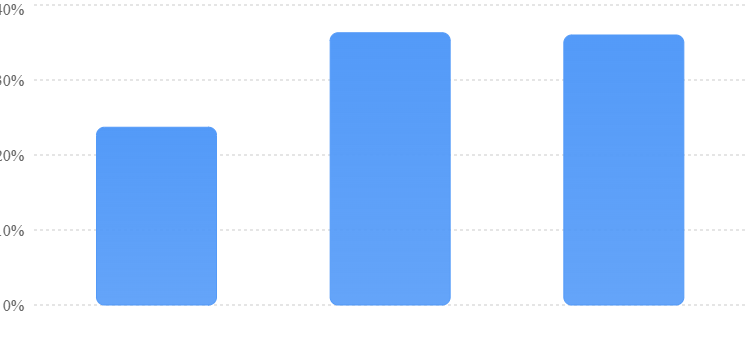
Using the 2019 and first-half 2025 observations, the increase was 12.6 percentage points. Relative to the starting value, that represents growth of approximately 53.2%.
The relative increase is calculated by dividing the 12.6-point gain by the original 23.7% share. This comparison uses the same published Carta solo-founder study for both endpoints. We have kept the full-year 2025 observation separate because it comes from another report and covers a different period.
What does this mean for San Francisco?
It suggests the traditional assumption that every technology company needs two or three co-founders is becoming less reliable. Individuals have more tools for prototyping, operating, and selling products without assembling a founding group first.
However, it does not establish that AI caused the increase. Changes in funding conditions, founder preferences, business types, and the companies included in Carta’s data could all contribute.
It also does not show that these startups employ fewer people throughout their lives.
Original Finding #2: Solo Founders Remain Underrepresented in Venture Fundraising
Carta’s June 2026 analysis found that approximately 36% of startups formed on its platform in 2025 had a single founder, but solo-founded companies accounted for only 20% of the funding rounds closed that year. Two-founder startups represented about 36% of newly formed companies and 36% of closed rounds.
Carta
SFTechScene calculated a simple representation ratio by dividing each group’s share of funding rounds by its share of newly formed companies.
| Founder structure | Share of new companies | Share of funding rounds | Representation ratio |
|---|---|---|---|
| One founder | 36% | 20% | 0.56 |
| Two founders | 36% | 36% | 1.00 |
SFTechScene calculations using rounded Carta 2025 figures. The ratio is a descriptive comparison between two different distributions, not a probability of raising funding.
Carta
A value of 1.00 means a group’s share of funding rounds matches its share of newly formed companies. A value below 1.00 means it accounts for a smaller portion of rounds than its share of new formations.
The solo-founder ratio of approximately 0.56 shows a meaningful gap in representation.
This does not mean a solo founder has a 56% chance of raising capital relative to a two-person team. Funded companies may have been founded in earlier years, companies may close multiple rounds, and the denominators are different.
The finding is still useful. Being able to launch a business with one person does not mean investors will automatically support that structure at the same rate as larger founding teams.
For San Francisco founders, this creates a practical decision. If the business can reach paying customers and fund its own growth with a small team, it may have less need for traditional venture funding. If it requires large amounts of capital, the founder must show that the small-team model does not create unacceptable technical, customer, or leadership risks.
Original Finding #3: Solo Founders May Hire Sooner Than Multi-Founder Teams
Another result from Carta’s December 2025 research complicates the employee-free company story.
The study reported that the median time from incorporation to first hire was 399 days for solo founders, compared with 480 days for companies started by multiple founders.
Carta
That is an 81-day difference, or approximately 16.9% less time relative to the multi-founder figure.
Median days from incorporation to first hire
Carta Solo Founders Report 2025. Lower values mean an earlier first hire, not better performance.
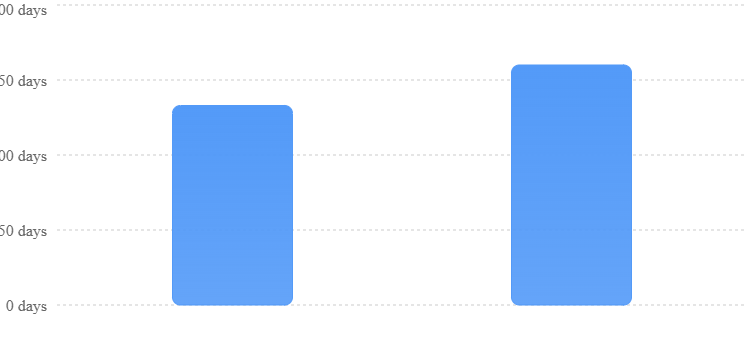
This finding challenges a popular assumption: a business started by one person will necessarily avoid hiring for longer.
A solo founder may actually reach the limit of personal capacity sooner. A founding team with two or three people can divide responsibilities before hiring an outside employee, while a solo founder must carry those responsibilities alone.
There are other possible explanations, including differences in funding, company type, and when founders decide to incorporate. The published comparison does not establish why the timing differs.

The useful lesson is that starting alone and remaining small are separate business decisions. An AI-native startup must build its operations deliberately if its goal is to grow revenue without a matching increase in employees.
The Economics of an AI-Native Startup: How Much Revenue Can a Tiny Team Support?
The strongest case for a small AI-native company is financial. Fewer employees can mean lower fixed costs, more flexibility, and less pressure to raise capital before finding customers.
But it is easy to overstate the advantage by comparing a worker’s salary with the cheapest AI subscription available.
A fair comparison must include the full operating system.
Original research methodology: A San Francisco startup cost model
SFTechScene developed three illustrative annual operating scenarios for a software business with two, five, or ten paid team members. These are financial models, not reported results from actual startups.
Each scenario assumes an average annual cost of $200,000 per paid team member, including cash compensation, benefits, employer costs, and an allowance for the wider cost of employment. This is a planning assumption, not a figure directly taken from BLS data.
For comparison, the BLS May 2025 mean hourly wage of $80.51 for computer and mathematical occupations in the San Francisco metro equals approximately $167,461 over a 2,080-hour working year, before employer costs and benefits. The $200,000 modeling assumption is therefore a plausible round-number scenario, but actual employee costs vary considerably by role and company.
Bureau of Labor Statistics
We then assigned different levels of annual fixed operating expenses for each team size. These cover AI subscriptions, software, cloud infrastructure not directly charged per customer, accounting, security, insurance, and other operating expenses.
Finally, the model assumes that direct costs of serving customers consume 20% of revenue. This leaves an 80% contribution margin to cover annual fixed costs.
The model excludes financing costs, income taxes, depreciation, unusual legal expenses, and stock-based compensation. It also assumes all people working in the business, including founders, receive the same modeled employer-cost allowance. A founder taking no salary might reduce immediate cash burn, but that would not make the underlying labor free.
Original Finding #4: A Two-Person Company Can Have a Much Lower Break-Even Revenue Target
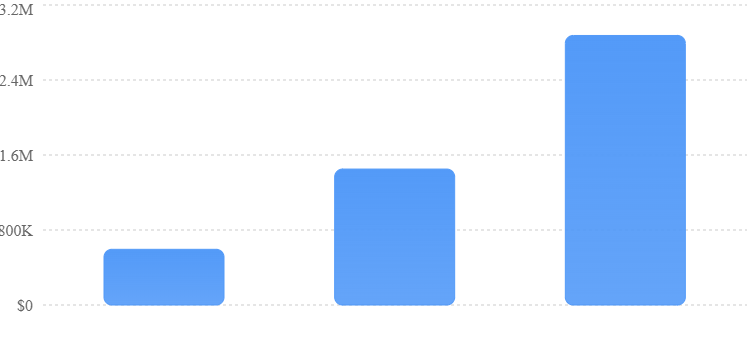
| Annual expense | 2-person company | 5-person company | 10-person company |
|---|---|---|---|
| People, fully loaded | $400,000 | $1,000,000 | $2,000,000 |
| Fixed nonpayroll costs | $75,000 | $160,000 | $300,000 |
| Total fixed cost | $475,000 | $1,160,000 | $2,300,000 |
| Assumed contribution margin | 80% | 80% | 80% |
| Break-even annual revenue | $593,750 | $1,450,000 | $2,875,000 |
Source: SFTechScene original scenario model. These are illustrative calculations, not observed startup averages or forecasts.
Under these assumptions, the two-person company needs approximately $594,000 in annual revenue to cover its modeled costs. The five-person business needs $1.45 million, while the ten-person business needs $2.875 million.
Modeled annual revenue needed to break even
SFTechScene scenarios, USD millions. All three assume an 80% contribution margin.
The calculation is straightforward.
For the two-person business, total fixed costs are $475,000. Dividing by a contribution margin of 0.80 gives $593,750.
This is not evidence that AI allows two people to perform ten people’s work. It shows the financial advantage a smaller team could have if it can serve a comparable market reliably.
That condition matters. If the two-person company cannot deliver the service customers need, the lower cost structure offers little value.
Why revenue per employee matters more than headcount alone
A company with two employees and $2 million in annual revenue generates $1 million in revenue per employee. A company with ten employees and the same revenue generates $200,000 per employee.
The first business looks more productive by that measure, but the comparison is incomplete.
One company might have higher customer acquisition costs, expensive cloud computing, significant contractor spending, or founders who are working unsustainable hours. Another might employ more people but serve customers with stronger retention and much lower risk.
Revenue per employee is therefore a useful starting measure rather than a complete score of business quality.
Founders should examine it alongside gross profit, customer retention, cash flow, contractor costs, product reliability, and the amount of work that still requires human intervention.
Original Finding #5: A Small-Team Advantage Survives Even When AI Infrastructure Costs Rise, but the Gap Narrows
AI-native companies depend on computing infrastructure. As more tasks become automated, cloud and model bills can increase.
To test the effect, SFTechScene held the two-person company’s annual fixed cost at $475,000 and changed the contribution margin from 90% down to 60%. This represents situations where direct service expenses consume a larger share of revenue.
| Contribution margin | Break-even revenue |
|---|---|
| 90% | $527,778 |
| 80% | $593,750 |
| 70% | $678,571 |
| 60% | $791,667 |
SFTechScene sensitivity calculation: $475,000 of annual fixed costs divided by each contribution-margin assumption.
At a 90% contribution margin, the company needs about $528,000 in revenue to break even. At a 60% contribution margin, it needs approximately $792,000.
That is roughly a 50% increase in required revenue, even though headcount remains unchanged.
This is why AI-native founders should track the cost of serving each customer from the beginning. A company can grow revenue while losing efficiency if customers trigger expensive automated tasks, repeated retries, and long processing jobs.
Low headcount does not guarantee high profit. A startup must control both payroll costs and the cost of completing the work customers actually buy.
What Can a Two-Person AI-Native Startup Actually Automate?
The financial model shows why running a business with a small team is attractive. The next question is whether two people can manage the work that customers, investors, and regulators expect a serious company to perform.
The answer depends heavily on the type of business.
A software company selling a simple digital product may automate a large part of its daily operations. A company manufacturing medical equipment, managing physical deliveries, or providing highly regulated financial services faces a very different situation.
For San Francisco founders, the most practical approach is to examine each business function separately instead of assuming that AI can replace entire departments.
Software development: AI can reduce repetitive engineering work
Software development is one of the clearest areas where AI can help small companies move faster. Founders can use coding agents to create first versions of features, write tests, explain unfamiliar code, find errors, and generate technical documentation.
This changes the early stages of building a product. A founder who understands the problem and has basic technical knowledge may be able to produce a working prototype without immediately hiring several engineers.
However, writing code is only one part of building reliable software.
Someone must decide how the product should work, protect sensitive information, review security risks, design its infrastructure, and ensure that new features do not break existing ones. AI can assist with these activities, but using it without proper review can introduce serious problems.
A 2025 randomized study by METR found that experienced open-source developers working on familiar repositories took 19% longer when using the AI tools available in that study. The result applied to a specific group, task setting, and period, rather than every coding system or developer. Still, it demonstrated why founders should measure actual productivity rather than assume every AI tool saves time.
METR
The better way to use coding agents
Start with tasks whose results can be checked clearly. Examples include writing unit tests, improving documentation, creating simple interfaces, and generating small pieces of code against detailed requirements.
Track the time needed to complete the task, including review and corrections. Compare the result against a similar task completed without AI.
As results improve, increase the complexity of the work gradually. Keep production releases, security-sensitive changes, and major design choices under human control until the company has strong evidence that its automated process is reliable.
Customer support: Automation can handle volume, but people still handle trust
Customer support is another promising area for small AI-native startups. Many questions are repetitive, especially when customers need help with account settings, product instructions, billing dates, or common technical problems.
A well-designed support agent can search approved documentation, identify the customer’s issue, suggest a solution, and send requests to the right team when it cannot solve the problem.
This may allow a small company to serve more customers before hiring a dedicated support department.
The biggest mistake is treating every answered message as a resolved customer problem.
An AI agent might produce a convincing response that fails to solve the issue. It might misunderstand a refund request, give outdated instructions, or incorrectly classify an urgent complaint.
Founders should therefore track whether the problem was actually resolved, whether the customer needed to contact the company again, and whether the agent’s response created additional work.
Start with low-risk support requests
The first stage should cover common questions with clear answers. Account setup instructions, feature explanations, and basic troubleshooting usually provide better starting points than disputes involving money or sensitive information.
The system should also make it easy for customers to reach a person. Requiring customers to argue with an automated assistant before receiving help can damage trust, even when the technology handles most ordinary requests correctly.
A useful goal is not to prevent all human contact. It is to let humans concentrate on cases where their attention makes a real difference.
Sales: AI can handle preparation, but customer understanding remains essential
Sales teams spend a significant amount of time researching prospects, preparing messages, recording conversations, and updating customer records.
These activities are good candidates for automation because many have defined inputs and outputs.
An AI agent can research a company’s publicly available information, prepare a short account summary, organize notes from a sales call, and draft a follow-up message for review.
It can also identify accounts that fit the company’s target customer profile, provided it uses legitimate data and respects privacy and communication rules.
But finding a potential customer is not the same as winning a sale.
A founder must still understand why someone would buy the product, which problems matter most, what objections prevent adoption, and whether the customer receives enough value to continue paying.
For an early-stage San Francisco startup, the founder should remain close to sales conversations. These discussions provide information that shapes the product itself.
Automating all sales interactions too early can remove one of the most important sources of customer learning.
Marketing: AI can produce content, but it cannot create a clear market position
Marketing is often presented as an easy function to automate because AI can write articles, produce images, generate advertisements, and suggest campaign ideas.
The work becomes more difficult when the goal shifts from producing material to attracting paying customers.
A startup needs to know who its buyers are, why they care, which competing products they already use, and what makes its offering different.
AI can help organize research, draft landing pages, summarize customer interviews, test message variations, and analyze campaign results.
However, producing large amounts of generic content is unlikely to create a lasting advantage. Competitors have access to similar tools, and customers increasingly expect evidence that a company understands their specific needs.
A small AI-native team should use automation to support original thinking rather than replace it.
Finance and operations: Automate recordkeeping before important decisions
Accounting, reporting, scheduling, and internal operations contain many tasks that can be standardized.
AI may help classify expenses, prepare financial summaries, organize receipts, identify unusual transactions, and draft monthly operating reports.
The company can use these tools to reduce administrative workload while retaining professional accounting, tax, and legal support when necessary.
Financial transfers, payroll changes, sensitive contract decisions, and access to customer payment information require much tighter controls.
The safest starting point is to let AI prepare information while people approve important actions.
Original Finding #6: Automation Quality Matters More Than the Percentage of Work Given to AI
Many companies measure automation using a simple percentage. They might report that AI handles 80% of customer requests or processes thousands of tasks each month.
That measure can be misleading.
If an automated system handles a request but creates a problem that a person must correct later, the company may not save as much time as expected.
To explore this, SFTechScene developed a workload model for a startup processing 10,000 tasks per month.
Methodology: Comparing successful automation with human review
The model assumes that each task costs $0.12 in AI processing expenses. It also assumes a fully loaded human review cost of $65 per hour and five minutes of review for every task the automation cannot finish successfully.
These values are illustrative assumptions, not measured prices across AI providers or observed failure rates from a real company.
We tested four successful-completion rates: 70%, 80%, 90%, and 95%. An unsuccessful task is assumed to need one five-minute human review, with no extra rework beyond that review.
| Successful completion | Tasks needing review | AI processing cost | Human review cost | Total monthly cost |
|---|---|---|---|---|
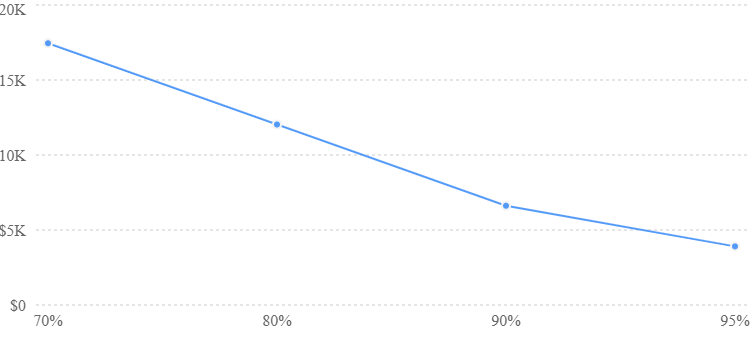
| 70% | 3,000 | $1,200 | $16,250 | $17,450 |
| 80% | 2,000 | $1,200 | $10,833 | $12,033 |
| 90% | 1,000 | $1,200 | $5,417 | $6,617 |
| 95% | 500 | $1,200 | $2,708 | $3,908 |
SFTechScene original operating model. Figures rounded to the nearest dollar. Review time is charged only for tasks that fail automated completion.
Monthly operating cost falls as automation reliability improves
10,000 tasks per month under SFTechScene’s illustrative task-cost and review-time assumptions.
The difference is substantial.
Improving successful completion from 70% to 95% reduces modeled monthly operating costs by approximately 77.6%. The software processes the same number of tasks in every scenario, and the underlying AI processing bill remains unchanged.
The savings come from needing far fewer human reviews.
Why small changes in reliability can matter so much
At 70% successful completion, the company must review 3,000 tasks each month. Five minutes per review creates 250 hours of human work.
At 95%, only 500 tasks need review. That creates approximately 41.7 hours of human work.
The difference is more than 208 hours per month. That is roughly 1.3 full-time-equivalent monthly workloads, using 160 hours as a planning assumption.
This result illustrates why a founder should not judge automation by the number of actions an agent performs. The business needs to measure how often the work is completed correctly without requiring additional attention.
The model is deliberately simplified. Real tasks may need multiple reviews, some errors may never be detected, and a failed high-risk action can create costs far above a few minutes of labor.
Nevertheless, it demonstrates an important economic principle: improving reliability can reduce operating expenses even without making the underlying AI model cheaper.
When is automation actually cheaper than manual work?
A startup can use a simple cost comparison to decide whether a workflow is worth automating.
Monthly automation economics
\[ C_{\text{AI}} = NV + N(1-s)TH + F \]
N = monthly tasks; V = AI cost per task; s = successful completion rate; T = review hours per unsuccessful task; H = hourly review cost; F = fixed monthly automation costs.
\[ C_{\text{manual}} = NMH \]
M = manual hours required per task. Automation is financially attractive when its fully counted cost is below manual cost for comparable quality.
For example, if completing a task manually takes ten minutes and human labor costs $65 per hour, 10,000 tasks would require approximately $108,333 in monthly labor.
Under the 90%-success scenario above, the modeled AI and exception-review cost is approximately $6,617 before fixed costs, quality assurance, implementation, and overhead.
That is a large theoretical difference, but it is not a documented real-world saving. The task must truly be suitable for automation, the two approaches must deliver comparable outcomes, and the organization must be able to reduce or redeploy the manual workload.
A company should never assume that removing ten minutes of activity automatically creates ten minutes of cash savings. Some work is performed by salaried employees whose compensation does not change when a single task becomes faster.
Which Businesses Are Most Likely to Operate With Almost No Employees?
Not every startup can become a three-person company, even with advanced AI.
The strongest candidates usually sell digital products, have repeatable customer needs, and can deliver their services without large amounts of physical work.
Vertical software for a narrow industry
Vertical software focuses on the needs of one type of customer, such as dental offices, property managers, or independent insurance agencies.
A small startup can often build a useful product by solving one frustrating workflow extremely well.
For example, software that helps property managers process maintenance requests could classify incoming messages, gather missing details, and route approved work to service providers.
The company would still need people to improve the product, maintain customer relationships, and handle unusual issues. But its core customer workload could be highly automated.
The opportunity is strongest when buyers already spend considerable time on repetitive work and can clearly measure the value of reducing it.
Developer tools and software infrastructure
Developer tools can be suitable for lean companies because customers often discover, test, and purchase products online.
A startup selling an API, testing tool, or software monitoring service may acquire customers through useful documentation, a clear trial experience, and recommendations within developer communities.
That reduces the need for a large sales team during the early stages.
However, infrastructure businesses can face severe technical requirements. A small company supporting important customer systems must be prepared for outages, security incidents, and urgent requests outside normal working hours.
The more important the product becomes to customers, the more difficult it may be for a tiny team to provide dependable coverage.
AI-powered research and information services
Some businesses turn public information or licensed data into valuable reports, alerts, and analysis.
An AI-native startup might monitor changes in a particular industry, organize relevant information, and provide customers with useful summaries.
This model can work with a small team when the information sources are stable and the service has a narrow purpose.
The challenge is accuracy.
Customers paying for financial, legal, scientific, or competitive intelligence may make important decisions based on the results. An AI-generated summary that misrepresents a source can create significant business harm.
A successful research company therefore needs strong source tracking, review standards, and a clear explanation of how its findings were produced.
Businesses that are harder to operate with tiny teams
Physical operations create different challenges.
A company delivering products needs logistics, supplier management, and physical handling. A healthcare service may require licensed professionals. A cybersecurity provider responding to serious incidents may need people available around the clock.
AI can improve efficiency in all these industries, but it does not eliminate the work that must be performed in the physical world or the duties assigned to qualified people.
Founders should choose their operating model based on the actual requirements of the business, rather than trying to force every industry into the same headcount target.
Original Finding #7: The Best AI-Native Business Models Have Four Shared Characteristics
SFTechScene developed a practical screening framework for comparing potential AI-native startup ideas.
This is a structured editorial assessment, not a survey-based statistical study. We selected four operating characteristics based on the cost and reliability mechanisms described in our earlier models.
The characteristics are how much work can be delivered digitally, how repeatable the tasks are, how easily results can be checked, and how much human intervention the business requires.
Each category is rated from one to five, with five representing a more favorable condition for a very small team. Scores are illustrative judgments based on the broad business models described, not measurements of specific companies.
| Business model | Digital delivery | Repeatable work | Easy to verify | Low human intervention | Total / 20 |
|---|---|---|---|---|---|
| Simple developer utility | 5 | 5 | 5 | 4 | 19 |
| Narrow workflow SaaS | 5 | 5 | 4 | 4 | 18 |
| Automated reporting service | 5 | 4 | 3 | 4 | 16 |
| AI marketing agency | 4 | 3 | 3 | 2 | 12 |
| Regulated advisory service | 4 | 2 | 2 | 1 | 9 |
| Physical delivery business | 1 | 3 | 4 | 1 | 9 |
SFTechScene original qualitative scoring framework. Equal weighting is used for transparency. Scores are hypotheses for founder screening, not empirical sector performance rankings.
The framework suggests that narrow developer tools and repeatable workflow products are strong starting points for entrepreneurs seeking to run very small companies.
They are delivered digitally, often handle similar requests repeatedly, and can produce outputs that are relatively easy to test.
By comparison, an AI marketing agency may automate content creation but still need substantial client communication, creative direction, and account management.
A regulated advisory service may have digital workflows, but professional responsibility and case-specific judgment limit the amount of work that can safely be handled without people.
How founders should use this framework
A founder can score their own idea and then investigate the weakest category.
If the business involves highly repeatable work but results are difficult to verify, the company may need to invest in better testing before automating more tasks.
If results are easy to verify but every customer requires a customized implementation, the company may struggle to grow without hiring service personnel.
The score should guide questions, not decide whether a business is worth building.
A company with a lower score may still be highly profitable. It simply may not fit the goal of operating with almost no employees.
Why the One-Person Unicorn Is Still an Unproven Business Model
A one-person unicorn would be a privately held company valued at $1 billion while being operated by a single founder without a traditional employee base.
The idea attracts attention because AI makes it possible for individuals to perform work that previously required teams.
However, valuation, revenue, profitability, and operating capacity are different measures.
A business might receive a high valuation because investors expect significant future growth. That does not establish whether the company is profitable or whether one person can continue managing it over time.
Building a product is easier than operating a large company
A founder may be able to create the first version of a software product using AI coding tools. That is a meaningful improvement in the cost of experimentation.
But a successful product creates new responsibilities.
Customers expect problems to be fixed, security issues to be investigated, payments to work correctly, and service to continue during unexpected events.
As revenue grows, the founder may also face more complex contracts, accounting requirements, compliance obligations, and requests for custom features.
AI can support these activities, but the founder remains accountable for the decisions and the results.
One person creates a serious continuity risk
Consider a profitable software business operated by one individual.
What happens if that person becomes unavailable for two weeks? Who can investigate a production outage, respond to a payment provider, or restore access to an important system?
A company can use automated monitoring and external service providers to reduce these risks. However, it still needs a clear process for emergencies.
This is one reason a two- or three-person company may be more durable than a strictly one-person operation.
The additional people can provide complementary skills, divide responsibility, and protect the business from depending entirely on one individual.
Staying small should serve the business, not become its identity
A founder may decide that remaining small is an important personal goal. That is reasonable, particularly when the business can generate strong profits without rapid expansion.
But a strict commitment to never hire can create problems when customers require more support or when a new employee could help the company grow profitably.
The better objective is to avoid unnecessary hiring.
An AI-native business should add people when their contribution is greater than their full cost and when the work cannot be handled reliably through a better process.
The Hidden Costs That Can Undermine AI-Native Startups
AI bills are only one part of automation spending
AI services may charge based on the amount of text processed, the number of requests, computing time, or other usage measures.
An agent that performs several research steps may trigger multiple model calls, searches, database requests, and software actions before finishing a single customer task.
If its instructions are unclear, it might repeat work or use expensive models where a simpler system would have been sufficient.
Founders should track the full cost of each completed workflow, not just the published price of the AI model.
A useful metric is cost per successfully completed customer task. This combines the expense of processing with the actual result achieved.
Security becomes more important when software can take actions
An AI agent that only drafts internal notes has limited authority. An agent that can access customer records, change subscriptions, or modify production code carries much greater risk.
The startup must define which systems an agent can access and what actions it can perform.
Permissions should be limited to what each workflow actually needs. Sensitive changes should require additional approval, and important actions should leave a record that can be reviewed.
The U.S. National Institute of Standards and Technology provides an AI Risk Management Framework and a generative AI profile to help organizations identify and manage AI-related risks. The framework is voluntary, but its focus on testing, oversight, and risk management is especially relevant to companies using automated systems in daily operations.
NIST
+1
Vendor dependence can create unexpected problems
A small startup may depend on outside AI providers for several core functions.
This can reduce the work needed to build the product, but it also exposes the company to changes in prices, service availability, performance, and usage rules.
A founder should know which workflows would stop working if an AI provider became unavailable.
Important processes need clear fallback options. In some cases, the company can switch to another model. In others, a human may need to complete the task temporarily.
The most valuable preparation is often good software design. Keeping workflow instructions, business rules, and customer information separate from a single provider makes it easier to change technology later.
How San Francisco Founders Can Build a Lean AI-Native Company in 90 Days
The first 90 days should focus on proving that a useful product can be delivered through a dependable operating process.
Trying to automate an entire company before confirming customer demand is usually a poor use of time.
The following plan is intended for a small digital software business with one or two founders. It is a practical operating framework, not a guarantee that a product can reach profitability within three months.
Days 1–15: Find a specific problem people will pay to solve
Start by selecting a narrow customer group and one expensive or frustrating workflow.
A founder might focus on customer onboarding for small software companies, reporting for independent agencies, or appointment administration for a specific professional service.
Speak with potential customers and understand how they currently complete the work.
Ask what triggers the task, how frequently it occurs, how long it takes, what mistakes are most common, and what happens when it is delayed.
Look for problems with a clear financial cost or an obvious effect on customer service.
The goal is to identify a workflow where the buyer can explain why the problem matters without needing a long demonstration of AI technology.
Days 16–30: Build a working product around one workflow
Create a basic version that completes the main task from beginning to end.
Avoid adding several agents simply because the technology supports them. A single well-designed process is often easier to test and maintain.
Connect the product to the minimum information sources it needs. Build in clear records of what the system does, what information it uses, and where it fails.
At this stage, the founder should manually inspect outputs and learn which types of requests are difficult.
The most important result is not a polished demonstration. It is a working service that produces useful outcomes repeatedly.
Days 31–45: Test the product with real users
Introduce the product to a small group of customers who understand that it is an early version.
Measure whether tasks are completed correctly, how long they take, and how much founder attention is required.
Every failed attempt should be classified.
Was the customer request unclear? Was the necessary information missing? Did the AI misunderstand the instructions? Did an outside system return an error?
Different failure types need different solutions.
Changing the AI model may solve some problems, but better instructions, cleaner data, and simpler workflows may solve others more cheaply.
Days 46–60: Improve reliability before expanding automation
Use the failures collected during the first customer trials to improve the operating process.
Create a standard set of test cases that covers common requests, unusual requests, missing information, and situations where the system must refuse an action.
Run those tests whenever a major change is made.
Add human approvals for sensitive actions and ensure customers have a clear way to report mistakes.
Measure the successful-completion rate rather than relying on whether an AI response sounds convincing.
A product that performs one task with high reliability is a stronger foundation than a product that attempts ten tasks inconsistently.
Days 61–75: Build a repeatable customer acquisition process
Once the product is dependable enough for continued use, create a simple marketing and sales system.
Develop a clear explanation of the problem solved, the results customers can expect, and the limits of the product.
Publish useful examples based on actual work. Explain how customers measure value and which situations are not a good fit.
Use AI to help with research, message preparation, and follow-up organization, but keep the founder involved in important sales conversations.
These discussions should continue to guide product development.
Days 76–90: Decide what to automate, outsource, and hire for
By the final stage, the founder should have a clearer view of where time is being spent.
Some work may be ready for additional automation. Other activities may be better handled by specialized contractors, professional service providers, or a new employee.
The decision should depend on cost, quality, and risk.
A useful rule is to hire when a recurring need cannot be handled safely and economically through the current operating system, and when the expected business value supports the full cost.
90-day operating checklist
Interactive
0 of 9 completed
0%Interview customers and document the target workflowBuild an end-to-end working productRecord baseline task time and qualityTest with real customer requestsCreate repeatable failure and safety testsMeasure full cost per completed taskBuild a repeatable sales processDocument fallback and escalation proceduresReview hiring and outsourcing needs
Copy checklist
How to Measure Whether Your Company Is Truly Becoming AI-Native
Founders should use a small set of operating measures that connect AI activity to business results.
Tracking the number of prompts or agents in use does not reveal whether the company is improving.
| Metric | How to measure it | Why it matters |
|---|---|---|
| Revenue per paid team member | Annual revenue ÷ paid team members | Shows labor productivity |
| Gross margin | Revenue minus direct service costs, divided by revenue | Shows cost efficiency |
| Successful automation rate | Tasks completed correctly without intervention ÷ eligible tasks | Shows actual automation quality |
| Cost per completed task | Full workflow cost ÷ successfully completed tasks | Measures automation economics |
| Human review hours | Monthly time spent checking and correcting AI work | Reveals hidden labor |
| Repeat contact rate | Requests requiring another customer contact ÷ completed requests | Helps assess support quality |
| Customer retention | Customers retained over a defined period | Shows lasting product value |
The company should review these numbers together.
A rising successful-automation rate is positive only when customers continue receiving good results. A higher revenue-per-employee figure is positive only when the workload remains sustainable and the service remains dependable.
Establish the baseline before using AI
A common mistake is introducing automation without measuring the original process.
If founders do not know how much time a task required before automation, it becomes difficult to calculate the improvement.
For each important workflow, record the typical completion time, error rate, human labor involved, and direct operating costs.
After introducing AI, compare the same measures using similar task types and customer conditions.
For more reliable evidence, assign comparable tasks to AI-assisted and manual processes during the same period when possible. This reduces the risk that changes in customer volume, task difficulty, or seasonality distort the results.
Measure total work, not only visible work
AI often reduces the time needed to produce an initial result. But someone may still need to correct the result, confirm its accuracy, or explain it to a customer.
The business should measure the total time required to reach an acceptable outcome.
This is particularly important for coding, research, financial reporting, and customer service, where a result can appear complete before its problems become visible.
Treat reliability as a business asset
A company with dependable automation can take on more customer demand without immediately adding employees.
That capacity is valuable because it improves flexibility. The founders can invest more in product development, customer relationships, or new opportunities.
Reliability also creates trust.
Customers do not usually care how many AI agents operate behind a product. They care whether the service works, protects their information, and solves their problem.
The Future of Hiring in San Francisco’s AI Startup Ecosystem
The growth of AI-native companies does not necessarily mean that San Francisco will stop creating technology jobs.
It could change the types of work that startups hire people to perform.
Smaller teams may seek broader skills
Traditional startups often divide work across specialized departments. Engineers build software, salespeople acquire customers, marketers generate demand, and operations staff coordinate internal processes.
AI-native startups may need employees who can work across several functions.
An engineer might also design automated customer support workflows. A product manager may work closely with coding agents and customer data. A founder might handle sales while using AI to support research and reporting.
This does not mean expertise becomes unimportant. It means employees may need to understand how their decisions affect more parts of the business.
Human judgment may become more valuable, not less
As software performs more routine work, companies still need people who can decide what should be built, understand customer needs, manage difficult situations, and recognize when automated results are unreliable.
These skills are especially important when mistakes have significant consequences.
A small startup cannot afford to lose customer trust because its automated systems make decisions without proper oversight.
The best employees in an AI-native company may therefore be those who combine strong subject knowledge with the ability to design, evaluate, and improve automated workflows.
Headcount may grow more slowly than revenue
The more important long-term possibility is a change in the relationship between company growth and hiring.
A traditional startup might increase its support team as customer requests rise. An AI-native startup could invest in better automation and hire only when the complexity of customer problems increases.
The same pattern could occur in marketing, internal reporting, and parts of engineering.
This would not eliminate the need for employees, but it could allow successful companies to reach important revenue milestones with smaller teams.
The scale of that change remains uncertain. Public founder data does not yet establish how many San Francisco AI-native companies can sustain very high revenue with only a few employees across multiple years.
What Investors Should Look for in AI-Native Startups
Investors evaluating small AI-powered companies should look beyond demonstrations and headline claims about productivity.
A useful demonstration shows that the product can work. A strong operating business shows that it works repeatedly, customers will pay for it, and the costs remain manageable as usage increases.
Revenue quality matters more than novelty
A startup may build an impressive AI workflow without creating a product customers need regularly.
Investors should examine whether customers continue using the service, whether they renew their subscriptions, and whether demand comes from a real operating problem.
Recurring revenue is especially valuable when the product becomes part of a customer’s normal business process.
A small team with stable revenue and good retention may be more financially attractive than a larger company with rapid customer turnover.
High automation does not remove execution risk
A founder may claim that AI performs most of the company’s work.
Investors should ask how that percentage is measured.
Does it include tasks requiring manual corrections? Are security checks counted? What happens during service outages? Who handles difficult customer complaints?
The strongest companies will be able to show clear operating data rather than relying on descriptions of what their agents are capable of doing.
The most efficient company is not always the best investment
A business that generates $3 million in annual revenue with three employees might be highly profitable.
Another company with 30 employees and $10 million in revenue might be building a larger market opportunity.
Which is more attractive depends on profitability, growth, competitive position, capital needs, and the investor’s goals.
Headcount efficiency should improve an investment thesis, not replace the need for one.
What Our Research Can and Cannot Tell Us
The evidence in this article supports a clear direction of change, but there are important limits to the conclusions.
The Carta figures describe companies represented in its datasets. They should not be treated as a complete count of San Francisco startups or as direct proof that AI caused changes in founding patterns.
The BLS wage statistics cover the wider San Francisco metropolitan area, not only employees inside San Francisco city limits. They also measure occupational wages rather than total compensation at AI startups.
The Stanford AI cost data concerns particular performance levels and model benchmarks. It does not mean every business automation process has become 280 times cheaper.
SFTechScene’s financial models, automation calculations, and business-model scores are original analytical exercises using stated assumptions. They are reproducible, but they have not been validated against a representative sample of actual AI-native startups.
We did not collect confidential company payroll records, run experiments inside San Francisco startups, or establish causal links between AI adoption and employee counts.
That distinction matters because the question is not whether small teams can perform isolated tasks using AI. The harder question is whether they can operate successful companies for years while maintaining service quality, security, customer relationships, and sustainable workloads.
To answer that question with greater certainty, future research would need company-level longitudinal data showing headcount, revenue, AI spending, contractor costs, profitability, and customer retention for comparable AI-native and traditional startups.
Such a dataset would make it possible to test whether AI-native companies consistently generate more revenue or gross profit per employee, rather than simply comparing a few unusually successful businesses.
Final Takeaway: The Future of San Francisco Startups May Be Smaller, but the Best Companies Will Not Be Defined by Having No Employees
The future of AI-native companies is not simply a story about replacing people with software. It is a change in how founders organize work, spend money, and build products.
For San Francisco startups, the opportunity is significant.
Public data shows that solo founding has become more common. AI tools have become more accessible, and the city’s high labor costs create strong incentives to build efficiently. Our financial scenarios show how smaller teams can have much lower break-even revenue requirements, while the automation model demonstrates how reliability can sharply reduce the need for human review.
But the evidence also points to important limits.
Solo-founded companies still hire employees. AI tools do not always improve productivity, and automated workflows can become expensive when they require frequent corrections. Businesses also need people who understand customers, manage risk, make difficult decisions, and take responsibility when something goes wrong.
The strongest AI-native startups will likely be those that use AI to increase the amount of valuable work each employee can support.
Some may operate profitably with one or two founders. Others may grow into teams of five, ten, or more people while supporting revenue that would once have required much larger organizations.
Both outcomes can represent success.
For founders, the practical goal should be to build a company that delivers reliable results at a sustainable cost. That means choosing a narrow customer problem, automating repeatable work, measuring performance carefully, and adding people when they create more value than they cost.

San Francisco’s next generation of successful startups may well be smaller than the companies that came before them. But the companies that last will be defined less by how few employees they have and more by how effectively they turn technology, human judgment, and customer trust into a business that works.
Research note: This article uses publicly available research released through October 13, 2026, alongside original SFTechScene calculations. All scenario results are illustrative and should not be presented as verified financial performance of named startups.