
Silicon Valley has spent years building smarter artificial intelligence. Now, a different question is starting to shape the next generation of AI startups: What happens when several AI agents work together instead of making one AI system do everything?
Imagine asking an AI assistant to research five competitors, study their prices, review customer feedback, identify market gaps, and build a business plan. A single AI agent might handle those tasks one after another. A multi-agent AI system can divide the work among several specialized agents, let some of them work at the same time, and bring their findings together.
This shift matters because businesses rarely operate through one simple task. A customer refund may involve customer support, payments, fraud checks, and accounting. A software release may involve planning, writing code, testing, and reviewing security. A sales campaign may require research, personalization, outreach, and customer record updates.
Silicon Valley startups are increasingly building AI systems around these connected tasks. Instead of creating one powerful chatbot, they are developing software in which multiple AI agents can coordinate, share information, and complete different parts of a larger job.
Companies including Anthropic, OpenAI, CrewAI, and LangChain are helping developers explore different approaches to multi-agent systems. Their work points toward a future in which business software does more than answer questions. It can organize work, decide which tools to use, and move tasks forward with less human involvement.
However, there is an important catch. More AI agents do not automatically create better results. Every additional agent introduces costs, communication needs, and new ways for a process to fail. Some tasks become much faster when several agents work together, while others become slower, more expensive, or less accurate.
Research published by Google in January 2026 provides strong evidence of this trade-off. Across 180 agent configurations, researchers found major gains for certain tasks that could be divided into independent pieces. Yet multi-agent designs reduced performance by 39% to 70% on the sequential reasoning tasks they tested.
Google Research
For San Francisco founders, enterprise buyers, and business leaders, this creates a more useful question than whether multi-agent AI is the future. The real question is which business problems benefit from teams of AI agents, how those systems should be designed, and when the extra complexity is worth paying for.
This guide explains how multi-agent AI works, the Silicon Valley companies building it, the architecture choices businesses face, and the security and reliability problems that must be solved. It also includes original SFTechScene calculations based on published research and transparent business scenarios, showing when multi-agent AI may create measurable value and when a simpler approach is likely to win.
The Short Version: AI Is Moving From Individual Assistants to Coordinated Teams
Multi-agent AI systems use several AI agents to complete different parts of a larger task. Each agent can have its own instructions, tools, information, and responsibilities. A coordinating system decides how the work moves between them and when the final result is ready.
The easiest way to understand this is to compare one AI assistant with a small business team. One employee could research a product, write advertising copy, analyze customer data, and review the final campaign. But a team with a researcher, analyst, writer, and reviewer could divide those responsibilities and, when the tasks are independent, complete some of them at the same time.
Multi-agent AI follows a similar idea, although AI agents are not employees and should not be treated as reliable human experts. They are software systems that use AI models to make decisions and call tools within rules set by developers. Their ability to act independently depends on the permissions, instructions, and controls built into the application.
The biggest benefit is not simply having more intelligence. It is being able to divide complex work into smaller parts, provide each part with the right information, and coordinate the results.
How a multi-agent AI team works
Business request
Analyze competitors and create a market-entry plan
Coordinator agent
Plans tasks, assigns work and tracks results
Research agent
Finds sources
Analysis agent
Studies data
Strategy agent
Builds options
Review and final output
Combines findings, checks evidence and requests approval where needed
Illustrative architecture. The coordinator can be another AI agent or ordinary software code.
This arrangement can help a business manage more complicated requests without putting every instruction and piece of information into one enormous conversation.
It also creates opportunities for parallel processing. When several agents can work independently, a company may finish a complex job faster even if the total amount of computing work increases.
But the most successful systems are unlikely to give agents unlimited freedom. They will combine specialist AI agents with predictable software rules, careful access controls, checks on important outputs, and human approval for sensitive actions.
What Is a Multi-Agent AI System?
A multi-agent AI system is a software application in which two or more AI agents work together toward a shared goal or handle different parts of a connected process.
An AI agent usually combines a language model with instructions, access to tools, and a process for deciding what to do next. Unlike a basic chatbot that generates a response, an agent may search a database, read a document, use software, write a file, or send a request to another service.
When several agents become part of the same application, developers must decide how they communicate and who controls the process.
An AI Agent Is More Than a Chatbot
A traditional chatbot typically receives a message and produces an answer. Even when it can access information, the basic interaction often remains centered on responding to a user.
An AI agent can go further by choosing actions needed to reach a goal. For example, an agent asked to prepare a sales report might retrieve information from a customer database, calculate changes in revenue, identify missing values, and prepare a draft.
The distinction is not always clear because modern chat assistants can also use tools. What matters is the application’s ability to move through several steps and make limited decisions while working toward an outcome.
Multi-Agent Systems Give Different Agents Different Jobs
Consider a San Francisco software company trying to understand why customers cancel subscriptions.
A research agent could read cancellation messages and organize the reasons customers provide. A data agent could examine billing records and identify patterns across customer groups. A product agent could connect those findings to particular features, while a review agent checks whether the conclusions are actually supported by the data.
A coordinator would collect the results and prepare recommendations for the company’s product team. If information is missing, it could send a focused request back to the relevant specialist rather than restarting the entire analysis.
This approach can be useful when the underlying work genuinely requires different tools, knowledge, or access permissions.
Not Every Multi-Step AI Workflow Is a Multi-Agent System
A company might create a process that retrieves customer data, summarizes it, and saves a report. If each step is performed by ordinary software or one AI model following fixed instructions, the application does not necessarily need multiple autonomous agents.
This difference matters because businesses sometimes use the term multi-agent AI to describe any automation that contains several AI calls.
A more useful definition asks whether separate AI-driven components have distinct responsibilities and can make decisions within those responsibilities.
For companies buying software, the label matters less than the actual capabilities. A reliable single-agent workflow can be more valuable than a complicated application advertised as an autonomous AI workforce.
Why Silicon Valley Startups Are Moving Toward Multi-Agent AI
Silicon Valley’s interest in multi-agent systems comes from several practical limits businesses encounter when using AI for larger projects.
A single AI agent may work well when answering a question or completing a narrow task. But its performance can become harder to manage when the request involves many tools, unrelated areas of knowledge, and several decisions that depend on earlier results.
One Agent Cannot Manage Every Tool Equally Well
Imagine an enterprise AI assistant connected to a customer relationship system, financial software, internal documents, support tickets, project management tools, and security records.
The assistant must decide which tool to use for each request, understand the correct permissions, and avoid mixing information from unrelated areas.
Developers can divide those responsibilities among specialists. A finance agent might only use approved accounting tools, while a support agent has access to customer conversations and help articles. This creates clearer boundaries and makes testing easier.
LangChain’s January 2026 analysis identifies context management and independent development across teams as two major reasons companies adopt multi-agent architectures. It also argues that businesses should begin with simpler agents and add multi-agent systems only when those limits become real.
LangChain
Parallel Work Can Reduce Completion Time
Suppose an investment research request requires investigating four unrelated companies. One agent might examine them one after another, while four agents could research different companies simultaneously.
The total amount of processing may be higher because the application must assign tasks and combine results. Still, the user could receive the finished report faster.
That distinction is central to multi-agent economics. Businesses should measure both the total computing cost and the time it takes to complete the job.
A system that uses more resources but delivers an important answer much sooner can be valuable. A system that consumes more resources without improving the outcome is simply more expensive.
Different Agents Can Use Different Models
Not every task needs the most capable or expensive AI model.
A coordinator might use a stronger reasoning model to plan complex work, while a classification agent uses a smaller model to sort messages. Another specialist could use a model designed for coding, document processing, or analysis.
This allows developers to choose models according to the work being performed rather than applying one model to everything.
The possible benefit is lower cost for individual parts of a workflow. However, that advantage can disappear if coordination introduces too many additional model calls or excessive repetition.
AI Applications Become Easier to Maintain
When a business has one enormous agent handling dozens of tasks, changes to its instructions may affect unrelated features.
Separating responsibilities can make development more manageable. The team responsible for payments can improve its agent without rewriting the research agent, while the security team can control which tools each component is allowed to use.
For larger San Francisco startups selling AI to enterprise customers, this separation could become especially important. Enterprise software must support different teams, changing business rules, and customers with very different operating needs.
The Main Types of Multi-Agent AI Architectures
There is no single design that works best for every business problem. Developers use several approaches depending on whether they need parallel work, step-by-step coordination, shared information, or direct user interaction.
OpenAI and LangChain both describe patterns that allow specialist agents to work under a central manager or receive control through a handoff. The right choice depends on who should own the next action and how much information should pass between components.
OpenAI Agents SDK
+1
Supervisor Architecture: One Agent Manages the Team
In a supervisor system, one main agent receives the user’s request and decides which specialist should handle each part.
The supervisor might ask a research agent to gather information, an analysis agent to calculate results, and a writing agent to prepare an explanation. The specialists report back to the supervisor, which remains responsible for producing the final answer.
This design makes it easier to keep decisions under one central point of control. The trade-off is that the supervisor adds work and can become a bottleneck when many agents need its attention.
Sequential Architecture: Agents Work in a Fixed Order
A sequential system moves work from one agent to another according to a planned order.
For example, a coding agent might write software, a testing agent might check it, and a review agent might examine the results. The testing stage cannot begin until there is code to test.
This approach fits processes where one step depends on the previous step. It is often easier to understand and audit than a system that allows every agent to communicate freely.
However, developers should check whether each step really requires an autonomous agent. Some stages may be handled more cheaply and reliably by ordinary software.
Parallel Architecture: Several Agents Work at Once
Parallel systems divide a task into independent pieces and run them at the same time.
A research system may examine several industries simultaneously. A financial analysis application might investigate revenue, expenses, customer groups, and market conditions through separate specialists.
The advantage is shorter completion time when independent work represents a large share of the process. The limitation is that the system still needs to combine the results and resolve disagreements.
Handoff Architecture: Control Moves Between Specialists
A handoff happens when one agent passes responsibility to another.
A customer support agent might determine that a request concerns billing and transfer the conversation to a billing specialist. That agent can then handle the issue using its own instructions and tools.
OpenAI’s Agents SDK supports this design, including ways to pass selected information during a handoff and limit which specialists are available. These controls help developers avoid passing unnecessary context or granting broad access.
OpenAI Agents SDK
Shared-Workspace Architecture: Agents Collaborate Through Common Data
Some systems allow agents to read and update a shared workspace rather than sending everything through one manager.
A research agent could save source documents, while an analysis agent adds findings and a review agent marks questionable claims. Each component can see the information it needs without repeating the entire conversation.
This approach can be effective for work that develops over many steps. It also introduces challenges around conflicting updates, outdated information, and deciding which agent can change important records.
Which Architecture Should a Business Choose?
| Architecture | Strongest use case | Main advantage | Main risk |
|---|---|---|---|
| Supervisor | Complex business analysis | Central control | Extra coordination |
| Sequential | Approvals and ordered workflows | Predictable steps | Limited speed gains |
| Parallel | Research and independent analysis | Faster completion | More total processing |
| Handoff | Customer support and routing | Focused specialists | Lost or incorrect context |
| Shared workspace | Long-running collaborative work | Common information | Conflicting updates |
The best architecture is usually the simplest one that solves the actual business problem. Adding more agents should follow evidence that the current design has reached a limit, not a desire to make the system appear more advanced.
The Silicon Valley Companies Building Multi-Agent AI Infrastructure
The multi-agent AI market is not one single product category. Some companies provide tools for developers to create agent systems, while others build applications that use multiple agents to complete specific business tasks.
A useful way to understand the market is to examine how companies approach coordination, testing, tools, and control. These choices reveal more about the future of enterprise AI than the number of agents a product claims to support.
Anthropic: Showing How Parallel AI Research Can Work
San Francisco-based Anthropic provides one of the clearest public examples of a multi-agent application used for demanding research.
In June 2025, the company explained how its research system uses a lead agent to divide a question into smaller investigations. Specialist agents explore different directions, gather information, and return their findings to the lead agent.
Anthropic reported that its multi-agent design, using Claude Opus 4 as the lead and Claude Sonnet 4 subagents, performed 90.2% better than its single-agent comparison on an internal research evaluation.
That result is impressive, but it needs context. The company was evaluating a specific research application with a specific set of models and tasks. It does not establish that a multi-agent architecture improves every type of business work by the same amount.
Anthropic also reported that its multi-agent systems used roughly 15 times as many tokens as ordinary chat interactions. The result highlights why businesses must examine cost alongside improved performance.
Anthropic
OpenAI: Making Agent Handoffs and Coordination Easier to Build
OpenAI provides developer tools that support agents with specialized instructions, tools, and handoffs.
One supported approach lets a manager agent call other agents as tools while retaining control of the final response. Another allows a specialist to take over after a handoff, which can be useful when a customer moves from general support to a specific billing or technical problem.
Developers can also define parts of the workflow through ordinary code. That matters because not every routing or approval decision should depend on an AI model deciding what happens next.
The company’s Agents SDK includes tools for building these patterns, managing agent runs, and adding controls around actions. For startups, the appeal is the ability to build custom applications without having to create every part of the underlying agent system from scratch.
OpenAI API
+1
CrewAI: Turning Specialized Agents Into Teams
CrewAI is focused on helping developers organize AI agents into groups with different roles and responsibilities.
Its framework distinguishes between Crews, which bring agents together to solve tasks, and Flows, which define how a larger application moves from one step to another.
This distinction is important for enterprise use. A company may want AI agents to investigate an open-ended problem, but it may also need strict rules about when the process advances, which information gets saved, and when a person must approve the next action.
CrewAI’s approach allows developers to combine these two needs. The surrounding workflow can remain controlled while specialist agents tackle selected tasks.
GitHub
LangChain and LangGraph: Giving Developers More Control Over Agent Workflows
LangChain’s tools support applications that combine AI models, business information, and external systems. LangGraph gives developers ways to build workflows with branches, shared state, loops, and controlled execution.
These capabilities are useful when an agent system must continue for many steps or move between different specialists while keeping track of what has already happened.
LangChain’s guidance also makes an important point about system design: a multi-agent architecture is not always the right starting point.
Its January 2026 analysis recommends beginning with a single agent and well-designed tools, then moving to more complex patterns only when needed. That advice challenges the idea that adding agents is automatically a sign of technical progress.
LangChain
+1
Microsoft: Combining AI Agents With Structured Enterprise Workflows
Microsoft has also been developing infrastructure for applications where agents and ordinary software workflows operate together.
Its Agent Framework combines capabilities for agents, workflow design, managing information across steps, and monitoring system behavior.
Microsoft’s documentation makes a useful distinction between flexible agents and workflows with well-defined steps. When a process follows a predictable sequence, a controlled workflow may be better than allowing AI to decide every action.
Microsoft Learn
The older AutoGen framework, which helped popularize multi-agent development, is now described by Microsoft as being in maintenance mode. New users are directed toward Microsoft Agent Framework, while existing users are encouraged to migrate.
GitHub
For San Francisco startups choosing a technology stack, this illustrates another practical concern. The AI tooling market changes quickly, so founders should evaluate support, upgrade paths, and the ability to move their application without a complete rebuild.
What the Research Actually Says About Multi-Agent Performance
The strongest argument for multi-agent AI is not that it imitates a company full of employees. It is that dividing work can improve results under certain conditions.
But the research also suggests that there are clear limits to this approach.
Google’s 2026 Study Found Both Major Gains and Serious Performance Losses
Google researchers published a study in January 2026 examining how different agent architectures perform across tasks.
The study evaluated 180 agent configurations and found that the type of task had a major effect on whether using multiple agents helped.
In parallel tasks, a centrally coordinated multi-agent design achieved an 80.9% relative performance improvement in one financial reasoning evaluation. For sequential reasoning tasks, however, the tested multi-agent approaches reduced performance by 39% to 70%.
The researchers also found that independent agents could amplify errors by as much as 17.2 times under their measured conditions, compared with 4.4 times for centralized coordination. Their architecture-selection method identified the preferred configuration in 87% of held-out cases.
Google Research
+1
Published research: multi-agent gains and penalties
Source: Google Research, January 2026. Relative performance changes from different benchmark settings; not universal business forecasts.
These findings have an important implication for enterprise buyers. A business should not evaluate a multi-agent platform based only on how sophisticated the demonstration looks.
It should test the exact type of work it wants to automate, using the same information, tools, and approval requirements that employees face in daily operations.
A September 2026 Benchmark Shows That Collaboration Remains Difficult
A more recent study, AgentWorld, introduced a benchmark designed to test long-running cooperation among AI agents.
The benchmark includes 100 human-annotated tasks and 100 augmented variants. Its tasks require between three and twenty agents to coordinate over extended interactions, often across more than 50 rounds.
The researchers tested several major model families and reported that the strongest tested model achieved only 52% task success. They identified problems including communication failures, confusion about responsibilities, and difficulty keeping plans consistent across many interactions.
arXiv
This does not mean commercial agent systems have a 52% success rate. AgentWorld is a research benchmark with its own environment and difficult collaboration requirements.
What it demonstrates is that cooperation between AI agents remains a separate technical challenge from the intelligence of any individual model.
A group of strong agents can still fail when they share incorrect information, misunderstand the goal, or cannot coordinate their next actions.
Original SFTechScene Research: When Do Multiple Agents Become Worth the Cost?
To understand the business value of multi-agent AI, SFTechScene developed a set of independent calculations combining published research with transparent operating assumptions.
The goal is to answer questions that matter to San Francisco startups: How much coordination overhead can a workflow afford? When does increased accuracy justify higher costs? How much can parallel work improve completion time? And what happens when several agents must all perform correctly?
These calculations are original to this article. They are not claims that SFTechScene tested commercial systems or collected private company operating data.
Research Methodology: What We Measured and What We Did Not
We use two types of evidence.
The first is published technical research and documented architecture examples from Google Research, Anthropic, and LangChain. These sources provide measured benchmark findings or documented model-call counts.
The second is mathematical scenario analysis. Here, we set explicit assumptions, apply the same formulas to competing designs, and calculate the conditions under which one option becomes more attractive.
The distinction is essential. Public benchmark results are empirical evidence about tested systems. Our business calculations are models that show what would happen under specified assumptions.
We do not present simulated operating costs as observed San Francisco startup expenses, and we do not treat results from separate academic benchmarks as though they came from one controlled experiment.
The research is organized around four questions: the cost of coordination, the business value of improved accuracy, the reliability of longer agent chains, and the potential speed gains from parallel work.
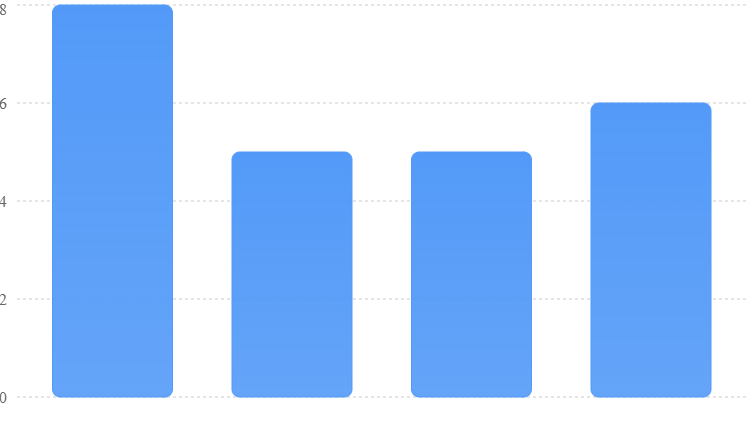
Original Finding #1: Coordination Overhead Can Make a Multi-Agent System More Expensive Before It Does Any Useful Work
LangChain’s January 2026 architecture analysis includes representative examples of how many model calls different approaches may require.
In its simple one-shot example, a supervisor-based subagent approach needs four model calls, compared with three for other patterns.
For a repeated request, the differences grow because some approaches can reuse earlier information more efficiently.
We reproduced those published counts and calculated the additional call burden relative to the lowest-call approach in each scenario.
LangChain
| Architecture | One request | Two repeated requests | Additional calls vs. lowest total |
|---|---|---|---|
| Supervisor with subagents | 4 | 8 | 60% |
| Skills-based agent | 3 | 5 | 0% |
| Handoff | 3 | 5 | 0% |
| Router | 3 | 6 | 20% |
Source data: LangChain’s representative architecture examples. SFTechScene calculations use (architecture calls ÷ minimum calls − 1) × 100. These are example call counts, not independently measured costs or general performance rankings. Skills-based agents are included as a simpler alternative, not classified here as multi-agent systems.
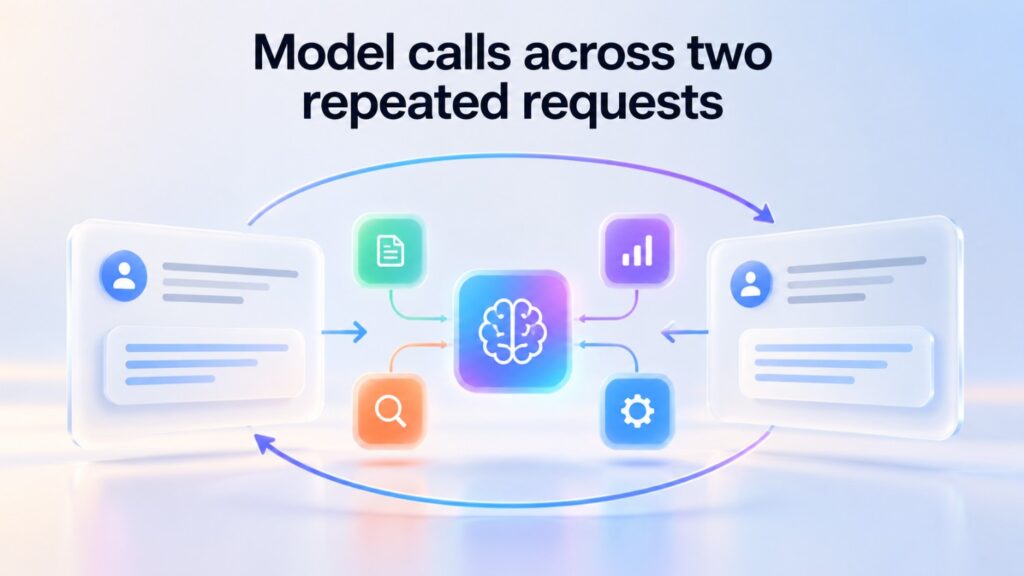
Model calls across two repeated requests
Recalculated from LangChain’s published illustrative example. The chart compares call counts, not output quality, tokens, or actual API bills.
The supervisor architecture requires 60% more model calls than the most call-efficient options in this example.
That does not mean it is 60% more expensive in practice. Individual calls may differ greatly in model choice, token use, and tool requirements.
Still, the result highlights a cost that founders can easily overlook. Coordination itself consumes resources before the application delivers any additional business value.
What This Means for San Francisco SaaS Startups
A startup serving thousands of customers should examine how often its application performs simple, repeated tasks.
If most requests only require one specialist, routing them through a sophisticated supervisor may introduce unnecessary expense.
A better design might classify the request using simple software or a lightweight model and send it directly to the relevant specialist.
The more frequently a workflow repeats, the more valuable it becomes to eliminate model calls that do not improve outcomes.
Original Finding #2: Better Accuracy Can Justify Higher AI Costs, but Only When Errors Are Expensive
One of the most important questions for AI buyers is whether an improved completion rate is worth paying more for.
We modeled two hypothetical systems processing the same 1,000 business tasks. The single-agent design costs $0.10 per attempt and succeeds 70% of the time. The multi-agent design costs $0.28 and succeeds 85% of the time.
These success rates and costs are illustrative assumptions, not measured results from commercial products.
Single-agent scenario
70%
Success rate
$0.10 per attempt
Multi-agent scenario
85%
Success rate
$0.28 per attempt
At first glance, the multi-agent system looks much more expensive. Its direct processing cost is 2.8 times the single-agent cost.
However, the comparison changes when mistakes create additional work.
Suppose every unsuccessful task requires a person or another system to resolve the issue at an average cost of $5.
| Metric per 1,000 attempts | Single agent | Multi-agent system |
|---|---|---|
| AI processing cost | $100 | $280 |
| Expected successful tasks | 700 | 850 |
| Expected failed tasks | 300 | 150 |
| Failure handling at $5 each | $1,500 | $750 |
| Total expected cost | $1,600 | $1,030 |
Under these assumptions, the multi-agent approach costs $570 less per 1,000 attempts, despite its higher AI processing bill.
The reason is simple. It costs more to run, but it generates fewer failures that need fixing.
That makes accuracy economically important even when the software is more expensive.
The Break-Even Point Is Surprisingly Low in This Scenario
We can calculate the cost of fixing a failed task at which the two systems become equally attractive.
The extra AI expense is $0.18 per attempt, while the modeled improvement in success rate is 15 percentage points.
Dividing $0.18 by 0.15 gives a break-even failure-handling cost of $1.20.
If each avoided failure is worth more than $1.20, the higher-cost multi-agent system wins under the assumptions in this model. If the failure costs less, the single-agent option is cheaper.
Interactive analysis: Cost of getting work right
Change the cost of resolving one failed task to see how the choice changes across 1,000 attempts.
Cost per failed task
$5.00
Single-agent total
$1,600
Multi-agent total
$1,030
Multi-agent is less costly in this scenario
Shorter bar represents the lower cost as a share of the higher cost. Assumed success rates and AI costs remain fixed.
The practical lesson is that businesses should not compare AI tools only on their API charges.
They need to understand the full cost of an unsuccessful task, including staff time, customer complaints, delays, missed sales, and correction work.
At the same time, companies should avoid assuming that multi-agent AI will automatically improve accuracy by 15 percentage points. That improvement must be demonstrated through testing with real tasks.
Original Finding #3: Longer Chains of Agents Can Create a Hidden Reliability Problem
More agents can help by dividing complicated work. But if every agent in a sequence must produce a correct result, the system introduces several chances for something to go wrong.
To illustrate this, SFTechScene modeled a workflow in which each required stage succeeds independently with a probability of 98%.
The probability that all stages succeed is:
\[ P(\text{complete success})=0.98^n \]
Here, \(n\) represents the number of required stages.
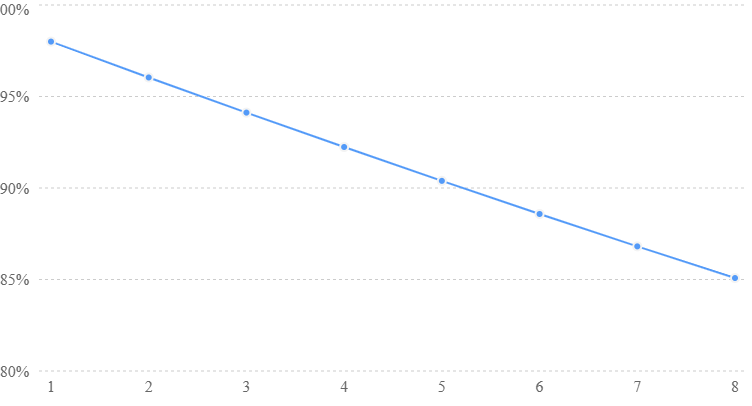
SFTechScene mathematical scenario. Assumes each required stage succeeds independently with a fixed 98% probability.
| Required stages | Chance every stage succeeds |
|---|---|
| 1 | 98.00% |
| 2 | 96.04% |
| 3 | 94.12% |
| 5 | 90.39% |
| 8 | 85.08% |
The outcome is striking. Even with a 98% success probability at every stage, a process requiring eight successful stages has only an 85.08% chance of completing without any stage failing.
This is not a forecast of real multi-agent reliability. Actual agent failures may be connected rather than independent, and real systems can use retries, checks, and recovery steps. Those features can improve results, sometimes significantly.
The calculation nevertheless reveals an important design problem. A system made from individually reliable components can still produce a much less reliable end-to-end process.
What This Means for AI Product Design
Founders should avoid adding a new agent for every small activity.
When possible, combine tightly connected operations, remove unnecessary handoffs, and use predictable software for simple validation.
A well-designed system should also identify which failures can be retried safely, which require a different approach, and which need a person to intervene.
For customer-facing applications, the most important reliability measure is not whether each agent produced a plausible answer. It is whether the complete business task was finished correctly.
Original Finding #4: Parallel AI Work Has a Speed Advantage, but Coordination Determines How Much of It Survives
Parallel processing is one of the strongest reasons to use multi-agent AI, especially for research and analysis.
We modeled a task containing four independent investigations, each requiring 30 seconds.
If one agent completes them sequentially, the work takes 120 seconds. If four agents handle them simultaneously and each finishes in 30 seconds, the independent work takes only 30 seconds.
However, the system also needs time to plan, coordinate, combine the results, and validate the final output.
Interactive analysis: The speed advantage of parallel agents
Four independent tasks of 30 seconds each. Adjust the total coordination overhead to estimate the benefit of working in parallel.
Coordination overhead
20 sec
Sequential
120 sec
Parallel
50 sec
Relative speed
2.40×
Time saved
70 sec
A simplified timing model, not a live model benchmark. It assumes full parallel execution and no competition for shared resources.
With 20 seconds of coordination overhead, the parallel design finishes in 50 seconds rather than 120 seconds, making it 2.4 times as fast.
If overhead rises to 90 seconds, the parallel system takes 120 seconds and loses its advantage. Beyond that point, it becomes slower than the sequential design.
The important insight is that the number of agents matters less than the relationship between independent work and coordination overhead.
San Francisco startups building research agents, marketing analysis tools, or enterprise intelligence platforms should pay particular attention to this calculation. A system that spends too much time planning, exchanging messages, or repeating searches can lose the speed benefit it was designed to create.
Original Finding #5: The Best Multi-Agent Opportunities Have Three Features in Common
Taken together, the published research and SFTechScene’s calculations suggest three characteristics that make a business process more suitable for multi-agent AI.
The first is independent work. Different agents must be able to complete meaningful portions of the task without constantly asking one another for information.
The second is valuable outcomes. The business must gain enough from improved accuracy, faster completion, or better coverage to justify the extra processing and coordination.
The third is clear boundaries. Each agent should have a defined responsibility, access to the necessary tools, and a result that other components can check.
A process that lacks these characteristics is more likely to benefit from a simpler design.
This is a reasoned decision framework based on the evidence discussed above, not a statistically validated score or an industry-wide ranking.
For a San Francisco startup, the framework can help identify which use cases deserve early testing rather than spending months building a complicated platform around an unsuitable process.
Where Multi-Agent AI Could Create the Most Value for San Francisco Businesses
Multi-agent systems are especially interesting for companies whose operations span several connected departments or information sources.
The opportunities are not limited to large enterprises. Small businesses can also benefit when they deal with complicated tasks that consume valuable employee time.
However, the best applications usually begin with a narrow problem that the business can measure.
Software Development: Multiple Agents Building and Reviewing Code
Software development is a natural area for experimentation because applications require planning, coding, testing, documentation, and security reviews.
A startup could assign one agent to analyze a feature request, another to produce code, and another to create tests. A separate review process could inspect the changes before any code is merged into the main product.
This arrangement may help teams manage routine tasks, investigate several bugs, or divide independent software components.
The challenge is that much of software development is tightly connected. Changes in one file may affect another, while two agents editing shared code can introduce conflicts.
Anthropic’s engineering discussion specifically notes that coding tasks often contain fewer independent parts than broad research tasks. This helps explain why companies should be cautious about assuming that additional coding agents will always improve speed.
Anthropic
For San Francisco software startups, an effective starting point is to use multiple agents for separate tasks with clear tests, rather than allowing a large team of agents to rewrite a complex application without supervision.
Customer Support: Coordinating Knowledge, Billing, and Technical Help
Customer support often requires information from several systems.
A customer might report that a subscription payment went through but a premium feature remains unavailable. Solving the issue could require examining the payment record, checking the account’s access permissions, and reviewing the service’s current status.
A multi-agent system can divide those responsibilities among specialized components.
The billing agent verifies the payment status. The account agent checks whether the subscription is active. A technical agent examines whether a service problem explains the missing feature.
A coordinator can then combine the information and recommend the correct resolution.
This approach becomes particularly useful when different specialists require separate access permissions. The billing agent should not automatically receive access to every customer conversation, and the technical agent may not need financial records.
Businesses should measure the percentage of issues fully resolved, the rate of incorrect changes, and the number of cases transferred to human support. The number of automated conversations alone does not reveal whether customers receive better service.
Financial Operations: Connecting Accounting, Payments, and Analysis
Finance teams perform many tasks that involve multiple sources of information.
A company may need to match vendor invoices with purchase orders, verify payment details, explain spending changes, and prepare cash flow forecasts.
A multi-agent system could assign document extraction, transaction comparison, and exception analysis to different specialists.
However, the final authority to release money should remain under strict controls. A model’s recommendation is not sufficient proof that a payment is authorized or correct.
For San Francisco businesses handling financial information, a strong design would separate identifying possible errors from taking actions that change financial records.
The initial value may come from finding missing documents, highlighting mismatched figures, and preparing reports for finance employees. Those tasks can save time without giving an AI system unrestricted control over company funds.
Marketing and Sales: Creating More Complete Customer Intelligence
Marketing teams frequently combine market research, customer analysis, campaign planning, writing, and performance measurement.
Multi-agent AI can be useful when these activities require different information sources and different kinds of analysis.
A research agent could monitor competitors’ published offers. A customer analysis agent could study patterns in approved customer data. A content agent could prepare campaign drafts, while a review agent checks whether claims match approved sources.
The final output could include recommendations for customer groups, campaign themes, and experiments.
For San Francisco startups selling to other businesses, this approach could help small marketing teams investigate new markets without hiring specialists for every research task.
The main risk is producing large amounts of convincing but weakly supported content. Good systems must verify factual claims, distinguish source evidence from assumptions, and measure whether campaigns actually improve results.
Cybersecurity: Separating Investigation From Action
Cybersecurity teams often receive large numbers of alerts that require investigation.
An agent might examine an unusual login, another might analyze related network activity, and another could compare the event with known security policies.
A coordinator could combine these findings into a report for an analyst.
This division may help security teams examine several sources of evidence simultaneously. But allowing agents to block accounts, change security settings, or delete files creates additional risk.
A sensible early deployment would use multi-agent systems to investigate and explain possible threats while keeping sensitive enforcement actions under approved rules or human control.
Legal and Compliance Work: Research With Clear Approval Boundaries
Legal and compliance teams regularly compare contracts, policies, regulations, and internal records.
A multi-agent workflow could assign document retrieval to one specialist, clause comparison to another, and completeness checks to a third.
The value would come from finding relevant information and identifying differences that employees can review.
However, legal interpretation depends heavily on context and professional judgment. An AI agent should not be treated as a substitute for legal review, especially when agreements, reporting obligations, or regulatory consequences are involved.
For startups operating in regulated markets, the most useful application may be improving preparation and document checking rather than automating final legal decisions.
How San Francisco Startups Can Build Their First Multi-Agent AI System in 90 Days
For founders and business leaders, the best way to understand multi-agent AI is to test it on one measurable workflow.
Starting with an entire AI workforce creates too many moving parts. A narrower pilot makes it easier to understand whether separate agents provide value.
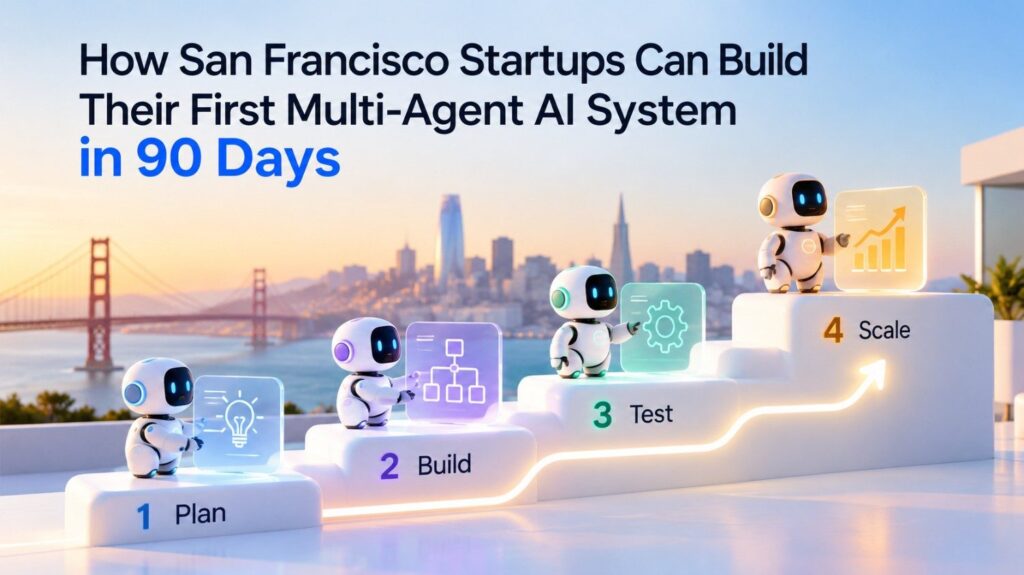
The following 90-day plan is designed for startups with access to their own business data, a developer or technical partner, and a clear process they want to improve.
Days 1–15: Choose One Workflow With a Measurable Problem
Begin by identifying a business process that regularly takes too much time or produces costly mistakes.
Good candidates include preparing competitive research, checking customer support records, reviewing documents, or investigating recurring software problems.
The workflow should have a clear starting point and a result that can be checked.
For example, a company might choose the task of examining incoming enterprise customer requests and preparing a complete response for employee approval.
Before building anything, collect at least 50 representative historical tasks if available. Include straightforward cases, complicated examples, missing information, and situations where the correct response is to stop and ask a person for help.
A balanced test set helps prevent the team from optimizing only for easy examples.
Days 16–30: Build a Single-Agent Baseline
Create the simplest practical solution first.
Use one agent with the necessary tools, clear instructions, and appropriate access limits. If ordinary software can handle a step reliably, use it instead of adding another AI model.
Measure how often the system completes the task correctly, how long it takes, how much it costs, and how frequently it requires intervention.
This baseline gives the company something meaningful to compare against.
Without it, founders may build a larger multi-agent application and have no way to prove that its extra complexity created value.
Days 31–45: Divide Work Where There Is a Real Need
Examine the failures and delays in the baseline system.
If the agent regularly confuses billing information with technical issues, specialized components may help. If it spends most of its time researching unrelated topics in sequence, parallel agents may improve speed.
Create two or three specialists with clear responsibilities.
Each agent should receive only the information required for its task. Define what it must return, which tools it can use, and what it should do when evidence is missing.
Avoid creating extra agents simply to imitate departments in a human company.
Days 46–60: Add Coordination and Safety Controls
Decide how the agents should communicate and who controls the final output.
For many startups, a supervisor or a structured workflow will provide enough flexibility without requiring unrestricted communication between every agent.
Introduce shared records where necessary, but keep them organized and controlled.
The application should record important actions, prevent unauthorized tool use, and stop when a requested operation exceeds its permissions.
High-risk actions such as transferring money, deleting customer records, granting access, or publishing sensitive information should require explicit authorization.
Days 61–75: Run Controlled Comparisons
Now test the single-agent baseline and the multi-agent design using the same task set.
Evaluate both systems under comparable conditions. Use the same source information, tool permissions, evaluation rules, and business requirements.
Repeat tests where randomness may affect results. If possible, compare several runs per task rather than relying on one successful demonstration.
A practical evaluation table might look like this:
| Measurement | What to record | Why it matters |
|---|---|---|
| Task success rate | Correctly completed tasks ÷ attempted tasks | Measures useful outcomes |
| Completion time | Median and slowest typical cases | Reveals real user delays |
| Cost per task | Model, tool, and infrastructure costs | Tests economic viability |
| Human intervention | Share of tasks requiring employees | Shows remaining workload |
| Error severity | Minor mistakes vs. harmful actions | Reveals business risk |
| Tool-call count | Number of calls per task | Exposes coordination overhead |
| Recovery rate | Failed tasks successfully corrected | Measures resilience |
Do not rely on a single average. A system that works well on simple tasks but fails on urgent or complicated requests may create more problems than it solves.
Days 76–90: Expand Only Where the Evidence Supports It
Use the final two weeks to decide whether the multi-agent system should move beyond the pilot.
The business case should be based on outcomes rather than technical demonstrations.
If the multi-agent version improves accuracy but doubles operating costs, calculate whether the reduction in mistakes is valuable enough to justify the difference.
If parallel execution reduces completion time, determine whether customers or employees actually benefit from receiving results sooner.
If no meaningful improvement appears, simplify the system or return to the single-agent design.
A successful pilot does not need to produce a large team of autonomous agents. It needs to produce a more reliable or economical way of completing a business task.
The Biggest Problems Multi-Agent AI Startups Still Need to Solve
Building a demonstration with several agents is much easier than operating a dependable system for enterprise customers.
Real business environments contain incomplete records, conflicting instructions, changing permissions, unreliable external tools, and requests that cannot be resolved automatically.
Multi-agent systems must handle those problems while adding their own coordination challenges.
Agents Can Pass Incorrect Information to One Another
Consider a research agent that incorrectly identifies a competitor’s pricing plan.
If an analysis agent accepts that information without checking it, the final market report may contain a convincing but inaccurate comparison.
Adding a review agent does not automatically solve this problem. The reviewer might rely on the same incorrect source or accept the earlier agent’s summary without verification.
A stronger system records the original evidence and allows important claims to be checked against their sources.
Where possible, businesses should use independent verification rather than asking several agents to repeat the same unsupported conclusion.
Shared Information Can Become Confusing
When multiple agents work on the same project, they may operate using different versions of the available information.
One agent may update a customer’s status while another continues working with an older record.
If the system does not manage these changes carefully, it can produce contradictory decisions.
Developers should define which records are authoritative, how updates are approved, and when agents must retrieve current information again.
These are familiar software engineering problems, but autonomous decision-making can make their consequences harder to predict.
Too Much Communication Can Destroy the Productivity Gain
A badly designed multi-agent system can spend more time coordinating work than performing it.
Agents may repeatedly ask one another for updates, duplicate investigations, or produce long summaries that the next agent must process.
Each additional message can consume tokens and increase delay.
The solution is to give agents clear assignments, specific output formats, limits on repeated work, and rules for deciding when a task is complete.
The goal should be useful coordination, not constant communication.
Security Becomes More Complicated as Agents Gain Tools
An AI agent connected to internal software may be able to read documents, search records, or perform actions.
When several agents share information, developers must prevent one agent from passing sensitive information to another that lacks permission to access it.
Another risk is prompt injection. A malicious instruction hidden inside an email, document, or web page might attempt to convince an agent to ignore its rules or misuse a connected tool.
Multi-agent applications need strict separation between trusted instructions and untrusted source content.
They also need limited permissions, checks before sensitive actions, secure handling of credentials, and logs that make important decisions traceable.
A coordinator should not be able to override a security restriction simply because another agent recommends doing so.
Testing Must Cover Complete Workflows
Testing individual agents is necessary, but it is not enough.
A billing agent might correctly identify a payment issue. A support agent might correctly explain a subscription plan. Yet the full workflow could still fail because information was passed incorrectly between them.
Developers need tests for handoffs, failed tools, incomplete records, repeated requests, conflicting outputs, and unexpected user behavior.
For enterprise applications, the most useful question is whether the system can complete the entire requested task safely under realistic conditions.
Research into multi-agent systems increasingly supports this focus on coordination quality rather than simply counting agents or measuring individual model performance.
How Much Autonomy Should Businesses Actually Give AI Agents?
Autonomy is not a single feature that a company either enables or disables.
It can be introduced gradually, depending on the consequences of the task.
An agent preparing an internal research summary may need permission to search approved documents and produce a draft. An agent changing customer billing information needs much tighter controls.
The level of autonomy should reflect the cost of mistakes, the possibility of reversing an action, and whether a person can review the result before harm occurs.
Low-Risk Work Can Be More Automated
Internal summaries, draft reports, information sorting, and routine analysis are often reasonable starting points.
These tasks can still produce mistakes, but the consequences are usually easier to manage when outputs remain drafts and users review them.
Multi-agent systems can perform useful work here without needing unrestricted access to company operations.
High-Risk Actions Need Strong Approval Rules
Payments, customer account changes, security enforcement, contract decisions, and other sensitive actions should operate under strict controls.
In many cases, the AI system should prepare a recommendation and supporting evidence rather than taking the final action.
Where automatic actions are permitted, their scope should be narrow and supported by reliable authorization checks outside the AI model.
For San Francisco startups selling to enterprises, these safeguards are not simply technical details. They directly affect whether customers will trust the product enough to deploy it.
What Multi-Agent AI Means for the Future of SaaS
Traditional software products often organize work around separate screens, dashboards, and applications.
Employees move between systems, retrieve information, interpret it, and decide what to do next.
Multi-agent AI creates the possibility of software that coordinates some of those activities on behalf of the user.
A business owner might eventually request a weekly operating review and receive an assembled report covering revenue, support issues, product performance, and outstanding tasks.
Behind that report, different agents could access approved systems, examine relevant information, and return findings to a central coordinator.
The user would still need visibility into the sources, assumptions, and actions involved.
Business Software Could Become More Outcome-Focused
Instead of selling only tools for people to operate, software companies may increasingly sell capabilities tied to completed work.
A customer support product might focus on correctly resolved cases. A financial operations platform might measure verified exceptions identified and corrected. A research application might measure evidence-backed reports completed within a required deadline.
This shift could change product design, pricing, and customer expectations.
However, it also makes accurate measurement more important. Businesses should not pay for an AI workflow merely because several agents participated.
They should pay for work that was completed correctly and created meaningful value.
The Winning Companies May Not Have the Largest Agent Teams
A startup with 20 agents is not necessarily more advanced than one using three well-designed specialists.
The smaller system may be faster, easier to test, less expensive, and more reliable.
As companies gain experience, they may discover that many tasks need only one agent with strong tools, while genuinely complex processes benefit from a carefully coordinated group.
The likely direction is not unlimited agent creation. It is better decisions about when to introduce specialized AI components and when to keep the process simple.
What San Francisco Founders Should Watch Through 2027
Several developments could shape how quickly multi-agent AI moves from experimentation into everyday business operations.
One is better testing. Companies need ways to measure complete workflows, identify coordination failures, and compare architecture choices under realistic conditions.
Another is improved communication between tools and agents. Shared standards can make integration easier, although they do not automatically solve questions of security, authorization, or reliability.
A third is cost management. As startups develop more complex systems, tracking token use, tool calls, retries, and infrastructure expenses will become increasingly important.
The fourth is specialized enterprise software. Rather than selling general-purpose agent teams, startups may find stronger opportunities in defined business processes where they can prove measurable results.
Finally, companies will need better controls for long-running tasks. An AI system working across many steps must remember the correct information, recover from failures, and explain what happened without losing track of its original goal.
These capabilities are likely to matter more to enterprise buyers than demonstrations of agents having conversations with one another.
Final Takeaway: The Future of Multi-Agent AI Is Better Coordination, Not More Agents
Silicon Valley’s interest in multi-agent AI reflects a meaningful change in how software is being designed.
Instead of treating AI as one assistant that must understand every task, developers can create specialized agents with different responsibilities and connect them through controlled workflows.
That approach has genuine potential. Research has already shown that multi-agent systems can improve performance on suitable tasks, especially when work can be divided into independent parts and completed in parallel.
But the evidence also reveals important limits.
Extra agents increase coordination costs. Longer workflows create more opportunities for failure. Tasks requiring tightly connected reasoning may perform worse when divided among multiple agents.
SFTechScene’s original calculations reinforce these findings. A more expensive system can become cheaper overall when it prevents costly errors, but only if its accuracy advantage is real. Parallel agents can dramatically shorten completion times, but the advantage disappears when coordination becomes too costly. Even individually reliable stages can form a less reliable overall process when every stage must succeed.
For San Francisco founders, the most valuable strategy is to begin with a measurable business problem, establish a simple baseline, and introduce additional agents only where they improve outcomes.
The next generation of successful AI companies may look very different from today’s software businesses. Some will automate complex research, others will coordinate customer operations, and others will help employees manage work across several systems.
What connects the strongest opportunities is not the promise of replacing entire teams with artificial employees.
It is the ability to combine specialized AI capabilities into systems that complete useful work accurately, efficiently, and safely.
The companies that win the multi-agent AI market will not necessarily be those that build the most autonomous agents. They will be the ones that learn how to make agents work together reliably enough for businesses to trust the results.
Research Sources and Methodology Notes
This article’s external evidence is drawn from publicly available engineering documentation, industry research, and academic publications available by October 16, 2026. The main sources include:
- Google Research: Towards a Science of Scaling Agent Systems (January 28, 2026), covering 180 configurations, parallel and sequential performance, and coordination failures.
Google Research
- Anthropic: How We Built Our Multi-Agent Research System (June 13, 2025), explaining its architecture, internal evaluation, token use, and development lessons.
Anthropic
- LangChain: Choosing the Right Multi-Agent Architecture (January 14, 2026), describing architecture trade-offs and representative model-call counts.
LangChain
- AgentWorld: Benchmarking Long-Horizon Collaboration of Multi-agent LLMs (September 2026), examining extended coordination challenges.
arXiv
- Official developer documentation: OpenAI Agents SDK, CrewAI, and Microsoft Agent Framework, used to describe currently documented implementation approaches.
OpenAI API+2
The article’s original calculations use directly stated formulas and assumptions. The coordination comparison derives percentages from LangChain’s published example model-call counts. The economic comparison models expected processing costs and failure-handling costs. The reliability calculation uses independent-event probabilities, while the speed comparison models sequential and parallel task completion with variable coordination overhead.
These analyses are reproducible mathematical scenarios, not new measurements of production AI systems. A full empirical study of San Francisco deployments would additionally require task-level execution logs, verified outcomes, operating costs, repeated tests, and a representative sample of actual businesses.
This distinction matters because trustworthy analysis should make clear what has been measured, what has been calculated, and what remains a hypothesis for future testing.