
San Francisco’s technology industry is going through a major change. For years, businesses have used software to help employees work faster, answer questions, manage customers, and organize information. Now, a new generation of artificial intelligence is moving beyond helping people complete tasks. It is beginning to complete entire pieces of work itself.
This shift is being driven by agentic AI, a type of artificial intelligence that can understand a goal, decide what steps are needed, use business tools, and take action with limited human help. Instead of simply answering a customer’s question about an order, an AI agent might check the order, identify a shipping problem, arrange an approved replacement, update the customer record, and send a confirmation.
That difference may sound small, but it changes what businesses can expect from software.
A traditional chatbot provides information. An AI copilot helps an employee do something. An AI agent can carry out a task, check what happened, and decide whether it needs to take another step. The term digital employee describes this broader role, although AI agents are still software systems, not independent workers with human judgment or legal responsibility.
San Francisco is becoming an important center of this transition. Companies such as Salesforce, Sierra, and Decagon are building products that automate customer interactions and business processes. Meanwhile, organizations developing AI models and tools are making it easier for other companies to create their own agents.
But there is a problem with much of the discussion surrounding agentic AI. Businesses often hear about how many jobs AI might replace, how much money it could save, or how quickly it will transform entire industries. They hear far less about the practical questions that determine whether an AI agent actually works.
What happens when an agent misunderstands a customer? How much should a business spend on automation? Which tasks should remain under human control? How can a company tell whether an agent is delivering real value rather than simply producing more activity?
To answer these questions, SFTechScene examined publicly available research, company product information, and San Francisco labor-market data. We also conducted an original analysis of occupational wages and job concentrations using the latest verified 2025 figures from the U.S. Bureau of Labor Statistics.
The findings suggest something more useful than the idea that AI will simply replace employees. San Francisco’s biggest near-term opportunity may come from changing how work is divided between people, software, and AI agents.
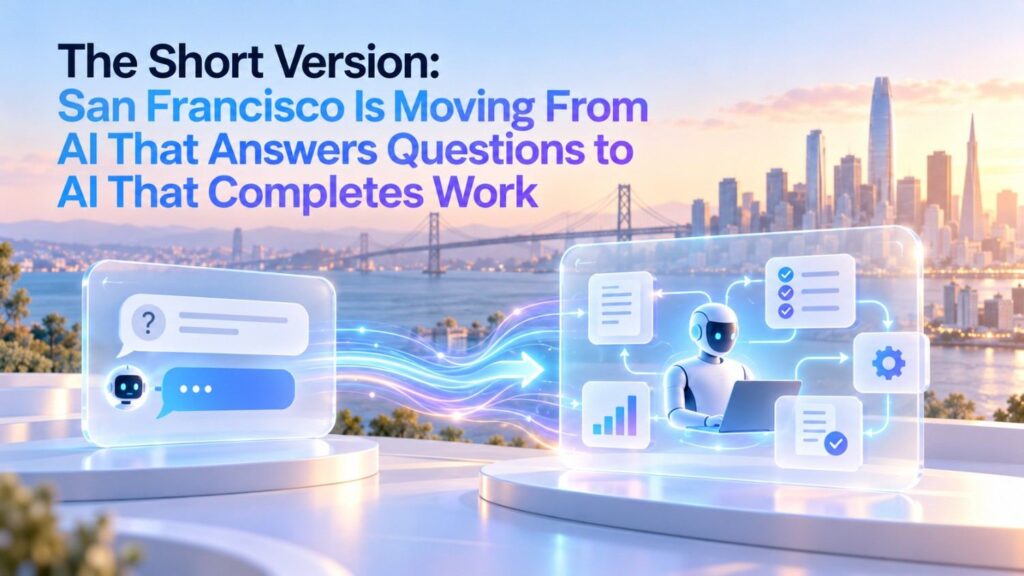
The Short Version: San Francisco Is Moving From AI That Answers Questions to AI That Completes Work
The first wave of generative AI made it easier to create content, summarize information, write computer code, and answer complicated questions. Businesses quickly began adding AI chatbots to websites, employee tools, and customer service systems.
Agentic AI builds on those capabilities but adds something important: the ability to act.
A customer service agent can retrieve account information, apply an approved refund, or reschedule an appointment. A sales agent can research a prospect, prepare a personalized message, update a sales database, and arrange a follow-up. A software engineering agent can examine a code problem, propose changes, run tests, and submit the result for review.
These systems are not equally independent. Some work within carefully defined steps, while others can choose their own sequence of actions. The more freedom an agent receives, the more important monitoring, permissions, testing, and human oversight become.
The wider AI market is already moving in this direction. McKinsey’s November 2025 global survey reported that 88% of respondents said their organizations regularly used AI in at least one business function. However, only 23% reported scaling an agentic AI system somewhere within their organizations, while another 39% were experimenting with agents.
McKinsey & Company
Global AI adoption, McKinsey 2025 survey
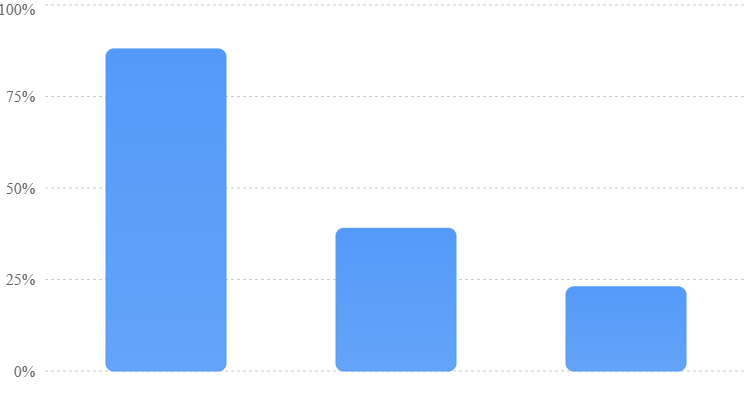
Percent of survey respondents. Categories overlap and should not be added together.
Source: McKinsey, The State of AI in 2025. These are global, self-reported figures, not San Francisco-specific adoption rates.
This gap matters. It shows that having access to AI is not the same as operating a successful AI-powered business.
The companies that benefit most will not necessarily be those that launch the largest number of agents. They will be those that identify useful tasks, connect agents to reliable data, restrict risky actions, and measure whether customers and employees are better served.
For San Francisco startups, this creates room to build products that solve specific business problems. For established companies, it creates an opportunity to improve operations without replacing every existing system. For employees, it creates a growing need to understand how to supervise, improve, and work alongside automated tools.
The next stage of agentic AI will be decided less by impressive demonstrations and more by dependable results.
What Is Agentic AI, and Why Is It Different From a Chatbot?
Traditional Chatbots Are Built to Respond
A traditional chatbot usually follows a simple pattern. A person asks something, and the system returns an answer based on a set of rules, stored information, or a language model.
Imagine a customer visiting an online clothing store because a delivery has not arrived. A basic chatbot might provide a link to the shipping policy or explain how to contact support.
A more advanced chatbot might understand the question and provide an answer based on the customer’s order details. However, it may still leave the customer to solve the problem.
That limitation becomes frustrating when a customer needs an action rather than an explanation.
AI Copilots Help People Complete Tasks
AI copilots go further by helping someone perform part of their job. A salesperson might use a copilot to summarize customer calls, write follow-up emails, or suggest the next sales opportunity.
The employee usually remains responsible for deciding what to do and completing important actions.
This model can deliver value because people spend considerable time reading, writing, searching, and organizing information. However, the copilot remains an assistant rather than the main operator of the process.
AI Agents Can Carry Out Multiple Steps
An AI agent receives a goal and can use available tools to complete a sequence of actions.
For the missing-package example, an authorized agent could identify the customer, retrieve the order, check the carrier’s latest tracking information, compare the situation against company policy, and offer an appropriate solution.
If company rules allow it, the agent could then issue a replacement and update the order record. If the situation involves a suspected fraud attempt or an exception outside its authority, it should transfer the case to a human.
The important change is that the agent connects understanding to execution.
| Capability | Traditional chatbot | AI copilot | AI agent |
|---|---|---|---|
| Answer questions | Yes | Yes | Yes |
| Use business information | Sometimes | Usually | Usually |
| Choose several next steps | Limited | Suggests steps | Can select steps |
| Update external systems | Usually limited | Often with user action | With permissions |
| Complete a business task | Rarely | Assists completion | Can complete defined tasks |
| Need human oversight | Yes | Yes | Yes, especially for risky actions |
| Main business value | Faster answers | Higher employee productivity | Completed work |
Digital Employees Are a Business Model, Not a Technical Guarantee
The phrase digital employee is becoming popular because businesses increasingly want to purchase completed work rather than another software tool.
For example, a company might pay for successful customer support resolutions instead of merely paying for access to an AI chatbot. A finance department might pay for correctly processed expense reports rather than buying another system that employees must operate.
This sounds similar to hiring someone for a defined responsibility. But an AI agent cannot replace the broader judgment, accountability, empathy, and flexibility that human employment often involves.
A useful digital employee is therefore best understood as a software-based worker for a clearly defined process, operating under rules established by people.
That distinction protects businesses from making unrealistic promises and helps them design automation that can be trusted.
Why San Francisco Is at the Center of the Agentic AI Shift
The City Connects AI Builders With Business Customers
San Francisco has several advantages in the race to develop practical AI agents.
The city has AI model developers, software companies, startup investors, experienced engineers, and a large market for business technology. Many founders can build a product, speak with potential customers, recruit specialists, and meet investors within the same region.
This concentration matters because AI agents are difficult to improve without learning how real businesses operate.
A model might be able to write a convincing customer support response, but that does not mean it understands a retailer’s return policy. A sales agent might draft strong emails but struggle when a company’s customer database contains old or conflicting information.
Solving these problems requires close contact with customers, real workflows, and operational feedback.
San Francisco’s enterprise software community gives AI startups access to those learning opportunities.
Existing Software Companies Already Control Important Workflows
One of the biggest advantages belongs to companies that are already connected to business operations.
Salesforce provides customer relationship management software that stores and organizes information about customers, sales opportunities, service requests, and business activity. Its Agentforce products are designed to let AI agents work with relevant data and perform approved actions across enterprise workflows.
In June 2025, Salesforce introduced Agentforce 3 with stronger monitoring, interoperability, and controls for managing agents. In October 2025, the company announced general availability of Agentforce 360, extending its vision of connected human and AI workflows.
Salesforce
+1
This illustrates an important market trend. The future of business AI may not require companies to abandon their current software. Instead, agents may become an operating layer that works across existing systems.
For startups building new agent products, that creates both an opportunity and a challenge. They can automate tasks that older software handles poorly, but they must also work smoothly with the systems customers already use.
High Local Wages Make Productive Automation Economically Interesting
San Francisco employers often face high labor costs, particularly in technology, management, finance, and specialized professional services.
The Bureau of Labor Statistics reported that the San Francisco-Oakland-Fremont metropolitan area’s average hourly wage was $48.19 in May 2025, compared with $33.54 nationally. That represents a regional premium of about 43.7%.
Bureau of Labor Statistics
This does not mean AI can replace every hour of paid work. It means that saving time in a high-cost professional workflow can potentially create substantial business value.
If an agent helps a skilled employee recover several hours each week, a company may use that time to serve more customers, complete projects sooner, or reduce administrative delays.
The crucial question is whether those hours translate into actual economic benefits.
An hour saved on paper is not automatically an hour of payroll saved. Businesses must measure how recovered time affects costs, capacity, revenue, and service quality.
Original Research: What San Francisco’s Labor Market Reveals About Agentic AI Opportunities
One way to understand the potential market for AI agents is to examine the work being performed in the San Francisco region.
Instead of relying on vendor claims about the number of jobs AI could replace, SFTechScene developed an original labor-market analysis using occupational employment and wage figures published by the U.S. Bureau of Labor Statistics in July 2026.
The purpose of this analysis is not to predict job losses. It is to identify where San Francisco has unusually high concentrations of workers, where wages differ substantially from national averages, and where businesses may have a strong reason to investigate useful forms of automation.
Research Methodology: How We Built the San Francisco Agentic AI Opportunity Analysis
We used the May 2025 Occupational Employment and Wage Statistics for the San Francisco-Oakland-Fremont metropolitan area, published on July 9, 2026.
The BLS reports the employment share and mean hourly wage of 22 major occupational groups for both the metropolitan area and the United States. We used these figures to calculate two primary measures.
The first is the regional employment concentration ratio. This compares the share of local employment in an occupation with the same occupation’s share of national employment.
\[ \text{Employment concentration}=\frac{\text{SF employment share}}{\text{US employment share}} \]
A ratio of 1.50 means the occupation’s share of total employment is 50% higher in the San Francisco region than it is nationally.
The second measure is the local wage premium.
\[ \text{Wage premium}=\left(\frac{\text{SF hourly wage}}{\text{US hourly wage}}-1\right)\times100 \]
This measures the percentage difference between the local and national mean hourly wages for each occupation.
We used the BLS’s published values and rounded the resulting ratios to two decimal places and percentages to one decimal place. These calculations can be reproduced from Table A of the original BLS release.
Bureau of Labor Statistics
Importantly, these two measures are only indicators of labor-market structure. They do not establish which jobs are technically suitable for AI, how many tasks agents can complete, or how many employees might be displaced.
Original Finding #1: San Francisco’s Computer and Mathematical Workforce Is Nearly Twice as Concentrated as the National Average
SFTechScene analysis of selected occupations — May 2025
| Occupational group | SF job share | US job share | Concentration |
|---|---|---|---|
| Computer and mathematical | 6.6% | 3.4% | 1.94× |
| Life, physical and social science | 1.7% | 0.9% | 1.89× |
| Legal | 1.2% | 0.8% | 1.50× |
| Management | 9.4% | 7.2% | 1.31× |
| Architecture and engineering | 2.2% | 1.7% | 1.29× |
| Business and financial operations | 8.7% | 6.8% | 1.28× |
| Office and administrative support | 9.5% | 11.4% | 0.83× |
| Sales and related | 7.5% | 8.6% | 0.87× |
Original calculations by SFTechScene from BLS May 2025 data. Ratios use rounded employment shares; they may differ slightly from BLS location quotients calculated using unrounded employment figures.
Employment concentration in the San Francisco region
US national employment share = 1.00×. Selected occupational groups.
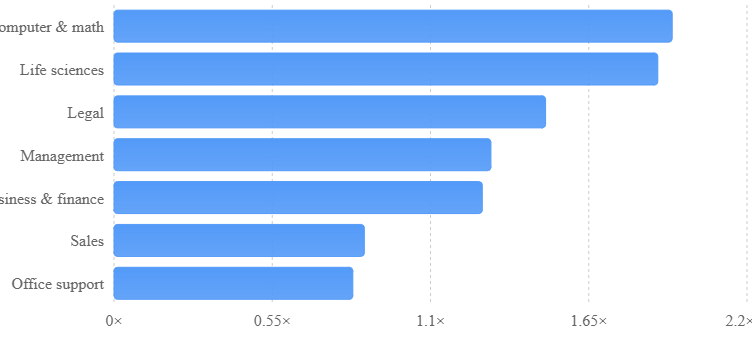
The first finding is that the San Francisco region is not merely a high-wage labor market. It has a particularly high share of employment in specialized knowledge work.
Computer and mathematical occupations account for 6.6% of regional employment, compared with 3.4% nationally. The region also has a substantially higher concentration of life science and legal occupations.
This is relevant to agentic AI because many specialized workers spend time moving between information systems, reviewing documents, preparing reports, and coordinating decisions.
However, these professions also involve substantial expert judgment. An AI agent that helps a lawyer organize research or assists an engineer with code testing is not equivalent to replacing that professional.
The practical opportunity is to separate tasks that require deep expertise from the routine work surrounding those tasks.
For example, a legal team may still need attorneys to interpret law, advise clients, and make decisions. Yet an agent could help collect approved documents, identify missing information, prepare review materials, and manage routine status updates.
Similarly, a software engineering team might use agents to run tests, document changes, or investigate routine errors while engineers retain control over system design and releases.
The concentration of these industries suggests a large local market for specialized tools that support expert work.
Original Finding #2: San Francisco Has a Significant Wage Premium Across Several AI-Relevant Occupations
Employment concentration tells us where certain kinds of work are common. Wages provide a separate view of the value of time in those occupations.
Our analysis found that the regional wage premium exceeds 30% across all eight selected groups below, although the actual savings from automation depend on the task and the business model.
| Occupational group | SF mean hourly wage | US mean hourly wage | SF wage premium |
|---|---|---|---|
| Life, physical and social science | $66.90 | $45.48 | +47.1% |
| Computer and mathematical | $80.51 | $57.73 | +39.5% |
| Sales and related | $36.06 | $26.43 | +36.4% |
| Legal | $91.11 | $67.07 | +35.8% |
| Management | $93.71 | $69.84 | +34.2% |
| Business and financial operations | $60.95 | $45.78 | +33.1% |
| Office and administrative support | $32.96 | $24.79 | +33.0% |
| Architecture and engineering | $67.39 | $51.36 | +31.2% |
Source: BLS May 2025 occupational wages. Wage premiums calculated by SFTechScene and rounded to one decimal place.
San Francisco wage premium over the US average
Selected occupations, May 2025.
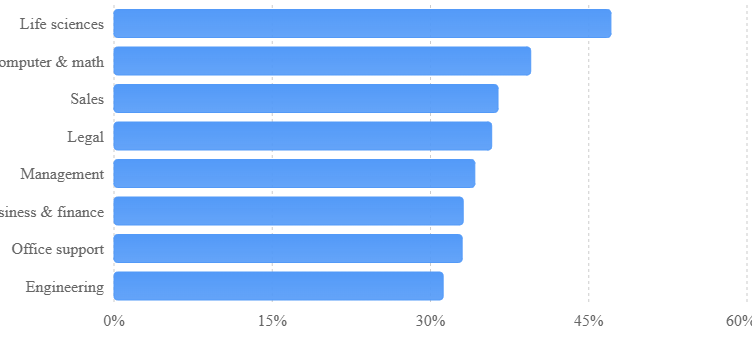
The most interesting result is that specialized technical work is not the only area where time may be economically valuable.
Office and administrative support workers earn an average of $32.96 per hour in the region. Business and financial operations workers earn $60.95, while management workers average $93.71.
These categories cover very different jobs, so their average wages should not be used as direct prices for particular tasks. Nevertheless, they illustrate why reducing avoidable administrative work may matter economically.
A manager spending time manually preparing standard weekly updates is not necessarily delivering work that requires management-level judgment. A financial analyst copying information between systems is not always doing work that requires advanced financial expertise.
An agent that reliably completes these supporting tasks could release time for more valuable activities.
For businesses, the strategic lesson is to look for expensive interruptions and repeated tasks, not simply expensive job titles.
Original Finding #3: The Best Agentic AI Opportunities May Cross Several Departments
One of the most important patterns in the BLS data is that San Francisco has sizable employment shares in management, business and financial operations, and office support.
Together, those three major occupational groups account for 27.6% of regional employment, based on the published rounded shares.
That does not mean 27.6% of workers can be automated. It means these broad groups contain a substantial portion of local employment and may be worth studying for repetitive information work.
The most useful AI agent may not belong to any one department.
Consider a company receiving a request from a new business customer. A salesperson records the request, a manager approves the proposed terms, finance verifies the billing details, and an operations employee prepares the account.
A traditional software tool might help one employee complete one part of this process.
A carefully designed AI agent could coordinate several steps, collect missing information, prepare documents, update connected records, and request human approval when needed.
That is a different type of automation opportunity. Its value comes from reducing delays between departments, not just speeding up an individual employee.
Why Cross-Department Work Matters
Many business processes become slow because information must move between people and systems.
A customer request might sit in an email inbox before someone identifies the correct department. A sales agreement might wait because the finance team needs information that already exists in another system.
An AI agent connected to approved tools could gather the relevant information and route the task to the right person.
However, cross-department agents also have access to more sensitive data and a larger number of potential actions. Businesses should introduce them only after demonstrating that simpler agents can work reliably.
Original Finding #4: High-Wage Work Does Not Automatically Produce the Best AI Return
A common mistake is to choose automation opportunities based entirely on salaries.
Our research suggests a more careful approach.
Legal occupations have one of the highest local mean hourly wages in the selected groups, at $91.11. Office and administrative support occupations have a much lower average, at $32.96.
Yet a simple administrative process may be easier to automate safely than complicated legal work.
Suppose an administrative agent handles routine appointment confirmations with high accuracy and clear rules. Its actions are easy to check, and mistakes can often be corrected quickly.
Now consider an agent preparing advice about a complicated legal dispute. The consequences of misunderstanding a single fact may be far greater. Expert review could also consume much of the time supposedly saved.
The difference is not just wage level. It is the cost of errors, the clarity of the task, the quality of the available data, and the amount of human review required.
Businesses should therefore evaluate potential agents using several factors together: how often the task occurs, how much time it takes, whether the steps can be defined, how easily the result can be verified, and what happens when the agent makes a mistake.
Research Limitations: What These Findings Can and Cannot Prove
The BLS data covers the entire San Francisco-Oakland-Fremont metropolitan area, not the city of San Francisco alone. It also describes broad occupational categories rather than specific tasks within individual jobs.
Employment shares and wages are estimates from a public statistical program. Our derived ratios inherit those estimates’ sampling limits and rounding.
We did not measure actual AI use among the workers in these occupations. We also did not conduct employer interviews, observe AI agents performing these jobs, or estimate the share of work that could technically be automated.
Accordingly, the findings should be read as a labor-market opportunity map, not an estimate of AI-driven job displacement, market revenue, or realized productivity gains.
That distinction matters because rigorous original research should show where the data ends and interpretation begins.
The San Francisco Companies Turning AI Agents Into Practical Business Products
San Francisco’s agentic AI market is developing along several paths. Some companies are focused on customer service, others are building tools for developers, and established software providers are introducing agents into business systems that already have large customer bases.
These approaches are different, but they share an important business goal: helping software move from providing information to completing measurable tasks.
Sierra: Turning Customer Service Into Completed Customer Outcomes
Sierra is one of the clearest examples of the transition from chatbots to digital workers.
The company builds AI agents for customer experiences, allowing businesses to offer automated assistance through conversational interfaces. Its products go beyond basic question-answering and can carry out approved account and service actions.
For instance, Sierra describes agents that can help with appointments, service requests, account management, and customer engagement. Its customer examples span retail, financial services, telecommunications, healthcare, and other industries.
Sierra
+2
The strategic value is easy to understand. A company does not necessarily benefit when a chatbot answers 1,000 questions. It benefits when customers solve their problems, receive accurate information, and remain satisfied with the service.
Sierra’s approach reflects that shift toward customer outcomes.
What Businesses Can Learn From Sierra
The first lesson is to measure whether the customer’s problem is actually solved.
A chatbot that responds to a refund request but tells the customer to call support may have successfully generated an answer. It has not resolved the request.
Businesses should measure completed resolutions, repeat contacts, escalation rates, and customer satisfaction rather than relying only on the number of conversations handled automatically.
The second lesson is to preserve human access. Customers facing complicated, urgent, or emotionally difficult problems must still have a clear way to reach a person.
Sierra’s own published customer material emphasizes human escalation alongside automated assistance.
Decagon: Building AI Agents That Operate Across Customer Channels
Decagon is another prominent company developing AI-powered customer experiences.
Its platform is designed to support customer conversations across channels such as voice, chat, and email. The company’s products aim to help enterprises deliver personalized service while automating approved customer support actions.
In June 2025, Decagon announced a $131 million Series C financing at a $1.5 billion valuation. The announcement reflected investor interest in customer-facing AI agents, although a funding valuation is not proof of product profitability or long-term market leadership.
Decagon
+1
Decagon’s approach highlights a major weakness in traditional customer service automation.
Customers do not think about whether their problem belongs in a chatbot, email system, phone service, or account management platform. They simply want the problem solved.
An AI agent that remembers relevant context across authorized interactions can reduce the need for customers to repeat the same information.
Why Operating Procedures Matter More Than Clever Conversations
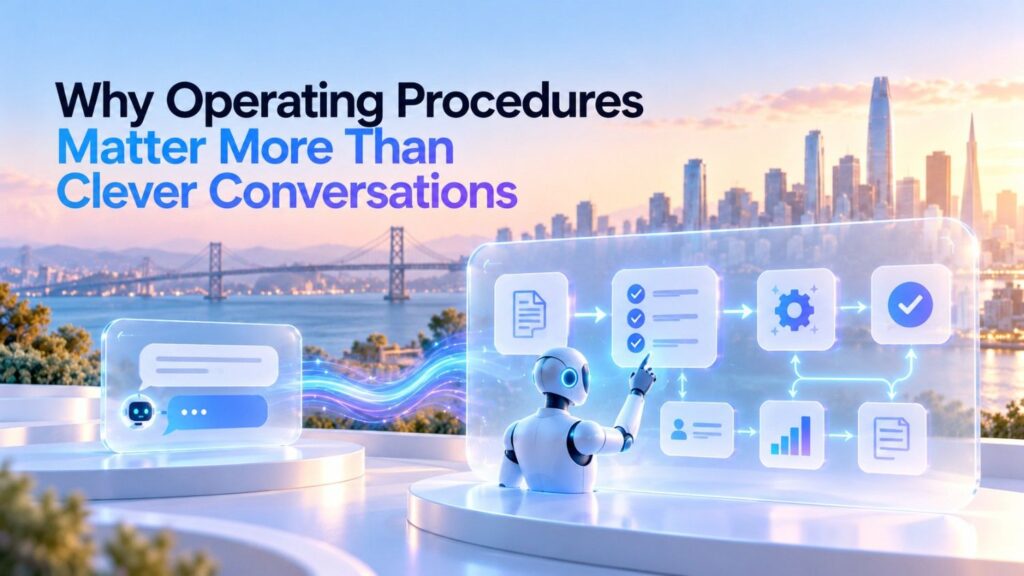
Decagon has described its approach to defining agent behavior through operating procedures that connect business instructions with agent actions.
This points to a lesson that extends well beyond customer support.
Successful automation requires clear business rules. An agent must know what information it can use, which actions it can take, when it needs confirmation, and when to stop.
Without these boundaries, greater independence can create greater operational risk.
A San Francisco ecommerce company deploying an AI returns agent, for example, should define refund limits, eligible products, fraud warnings, and approval conditions before granting access to payment or order systems.
The quality of those operating rules may matter as much as the quality of the underlying AI model.
Salesforce: Bringing AI Agents Into Existing Enterprise Software
Salesforce represents a different competitive strategy.
Rather than building AI agents only for one business function, the company is connecting agent capabilities to customer data and enterprise workflows through Agentforce.
The advantage is that many businesses already use Salesforce to manage sales, service, marketing, and customer information.
An agent operating inside that environment may have access to relevant records and approved actions without requiring an entirely new software system.
Salesforce has also invested in monitoring and interoperability, recognizing that enterprises need to understand what agents do and how they behave when connected to other business systems.
Salesforce
+1
The Important Lesson for Startups
New AI companies should not assume that customers want to replace existing enterprise systems.
A startup may deliver more value by improving a specific workflow inside an established system.
For example, an agent that helps a customer success team identify unresolved onboarding tasks, prepare follow-ups, and update records may be easier to adopt than an entirely new customer management platform.
This creates opportunities for specialized startups that understand one problem extremely well.
OpenAI: Providing Building Blocks for Agentic Software
OpenAI’s role in the agentic AI market extends beyond consumer chat interfaces.
In March 2025, OpenAI introduced the Responses API and an Agents SDK, along with tools designed to support web search, file search, computer use, and agent workflow tracing.
These technologies were introduced to make it easier for developers to build applications that complete multi-step tasks using AI models and external tools.
OpenAI
For developers in San Francisco, this changes the cost and complexity of building a first agent product.
A startup no longer needs to create its own language model to begin automating a business process. It can build around available AI capabilities, connect them to business systems, and focus its engineering effort on reliability, security, and customer experience.
However, access to powerful models also reduces technical barriers for competitors.
That means startups need advantages that are harder to copy, such as deep workflow knowledge, strong customer relationships, reliable integrations, or unusually effective evaluation systems.
Glean: Making Company Knowledge Useful to Agents
Glean approaches agentic AI through workplace information and enterprise search.
Businesses often store essential knowledge across documents, messaging systems, project management tools, and internal applications. Employees waste time finding the correct information, especially when several teams contribute to the same process.
In May 2025, Glean announced the broader availability of its agent platform, emphasizing access to enterprise information, interoperability, workflow automation, and governance.
Glean Press
This approach matters because agents require accurate context.
An agent cannot safely complete a business process if it relies on outdated instructions, lacks permission to view necessary records, or confuses information from different customers.
Glean is based in Palo Alto and belongs to the wider Bay Area AI ecosystem rather than San Francisco city proper. Its inclusion helps illustrate the close relationship between the region’s workplace software market and its agentic AI development.
What These Companies Reveal About the Market
| Company | Main agentic AI focus | Business problem | Strategic lesson |
|---|---|---|---|
| Sierra | Customer experience | Handling and resolving customer needs | Sell completed outcomes |
| Decagon | Multichannel customer support | Connecting service across channels | Build clear operating rules |
| Salesforce | Enterprise workflow agents | Acting across business applications | Work with existing systems |
| OpenAI | Agent development tools | Helping developers build capable agents | Build on reusable infrastructure |
| Glean | Enterprise knowledge and agents | Finding and using internal information | Data access and permissions matter |
Qualitative SFTechScene comparison of publicly documented product directions, not an independent performance ranking. Glean is included as a Bay Area company.
The common theme is that the model itself is only one part of the product.
A commercially useful agent must understand the business, access appropriate information, perform valid actions, recover from problems, and produce a result that someone can verify.
Companies that solve these surrounding problems may build stronger long-term businesses than those that focus only on generating impressive AI responses.
Original Finding #5: Measuring Completed Work Changes the Economics of AI Agents
One of the most useful ways to study agentic AI is to move beyond the cost of generating an AI response.
A model might answer a customer question for a fraction of the cost of a human interaction. But if the answer is wrong, the customer contacts support again, and an employee must fix the problem, the business may not save anything.
For this reason, SFTechScene developed a scenario model that calculates the potential economics of an AI support agent based on completed work rather than conversation volume.
The calculations below are original scenario analysis, not observed financial results from a San Francisco company.
How the Scenario Model Works
We assume a business receives 20,000 customer support requests each month. Before automation, each request costs an average of $6 to handle.
That establishes a monthly baseline of $120,000 for the modeled workload.
Next, we test different AI resolution rates. A resolution occurs only when the agent completes the customer’s problem without requiring a human to finish the same request.
For simplicity, we assume every request incurs an AI operating cost of $0.50 and every unresolved request still requires the original $6 in human handling costs.
The formula is:
\[ \text{Monthly AI-era cost}=N[(1-r)H+A] \]
Here, \(N\) is the monthly request volume, \(r\) is the true autonomous resolution rate, \(H\) is the average human handling cost, and \(A\) is the AI cost per incoming request.
The assumptions deliberately exclude one-time implementation costs and additional costs from errors, disputes, management, or system changes. Those must be added before making an actual investment decision.
Scenario Results: Why Resolution Rates Matter
| True AI resolution rate | Requests completed by AI | Monthly modeled cost | Monthly modeled savings |
|---|---|---|---|
| 0% | 0 | $130,000 | -$10,000 |
| 20% | 4,000 | $106,000 | $14,000 |
| 40% | 8,000 | $82,000 | $38,000 |
| 60% | 12,000 | $58,000 | $62,000 |
| 80% | 16,000 | $34,000 | $86,000 |
SFTechScene illustrative model: 20,000 monthly requests, $6 average human handling cost, and $0.50 AI cost per request. Negative savings mean higher spending than the original baseline.
Modeled monthly savings as resolution rates improve
Illustrative 20,000-request support operation. Not actual company results.
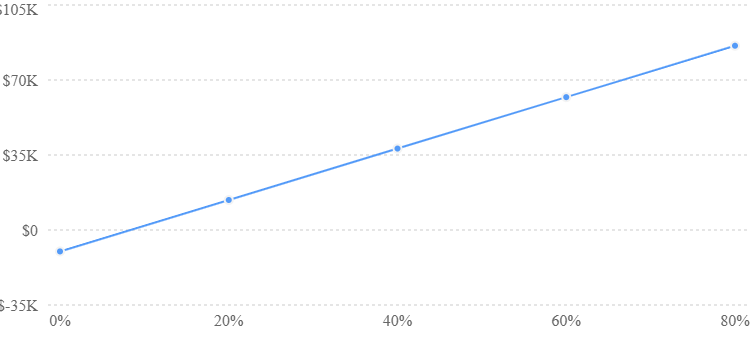
The results illustrate why measuring completed work is so important.
At a 20% resolution rate, the business produces $14,000 in monthly modeled savings before implementation and other costs. At 60%, the same incoming workload produces $62,000 in modeled savings.
However, simply installing an AI system creates additional cost if it completes no requests. At a 0% resolution rate, the organization spends an extra $10,000 each month under these assumptions.
The model also reveals an important break-even point.
With $6 in avoided handling cost for each fully resolved request and $0.50 in AI cost for every incoming request, the system needs to resolve more than about 8.3% of requests just to offset its modeled running expense.
That is a narrow operating-cost break-even point, not full investment break-even.
The Hidden Costs Businesses Must Include
Real AI deployments involve several costs that the basic scenario leaves out.
A company may need software integration, data cleanup, security reviews, monitoring, testing, employee training, and ongoing updates. Difficult customer situations may require human review even when the agent completes most of the task.
An inaccurate agent can also create new expenses by issuing improper refunds, changing the wrong account, or giving customers misleading information.
Those costs should be measured rather than assumed away.
For example, if the modeled agent resolves 40% of requests, producing $38,000 in monthly gross operating savings, but integration support, quality review, and corrective work cost another $25,000 monthly, the benefit falls to $13,000.
If the additional costs exceed $38,000, the deployment produces no net savings even though thousands of requests were automated.
Why Customer Satisfaction Must Remain Part of the Equation
A business can reduce service costs while damaging customer relationships.
An agent might classify a complaint as resolved after giving an answer that does not actually help. It might discourage customers from reaching a human, causing some customers to abandon the support process.
This is why resolution quality matters as much as the resolution rate.
Zendesk has explicitly moved toward automated resolution measures intended to reflect whether customer issues are actually addressed, rather than relying only on technical events within a conversation.
Advanced – Zendesk help
Businesses should also monitor repeat contacts, correction rates, complaint volume, customer satisfaction, and the percentage of people who give up before receiving help.
The economic goal is not maximum automation at any price. It is the lowest reliable cost of delivering a satisfactory outcome.
How Agentic AI Is Changing Customer Service in San Francisco
Customer service is an obvious starting point for agentic AI because the work includes large volumes of conversations, recurring requests, and measurable outcomes.
Many customer support questions follow familiar patterns. Customers want to track orders, change appointments, update accounts, troubleshoot services, or understand billing issues.
These requests often involve information that already exists inside a company’s systems.
Moving From Answering Questions to Resolving Problems
The greatest improvement comes when an AI agent can complete the action behind a customer’s request.
Imagine a customer contacting an online retailer about a delayed shipment. A traditional chatbot may explain the expected delivery time or provide a tracking link.
An AI agent could check the shipping status, verify the delivery promise, look up replacement rules, and offer an approved next step.
If the package is confirmed lost, the agent may have permission to create a replacement order. If the situation is unclear, it should transfer the case to a person with the relevant information.
This approach can reduce repeated customer contacts while allowing employees to focus on situations that genuinely require judgment.
Why Voice Agents Are Becoming Important
Customer support is not limited to websites.
Businesses in healthcare, hospitality, home services, banking, and retail still receive many phone calls. Traditional automated phone systems often force callers through complicated menus that do not fit their actual problems.
Voice agents can understand natural language and help callers navigate services more directly.
A customer could ask to change a reservation, confirm an appointment, or check whether a payment was received without selecting several menu options.
However, spoken conversations create additional challenges. Background noise, interrupted speech, different accents, identity verification, and unclear instructions can all affect performance.
Businesses should therefore evaluate voice agents using actual recorded and consented test scenarios, not only demonstrations in quiet environments.
What Customer Support Teams Should Measure
The strongest metrics focus on customer outcomes and operational quality.
A company should know what percentage of incoming requests agents complete, what percentage require human help, and how often customers return because the first resolution failed.
It should also track how long customers wait, how quickly problems are resolved, and whether customers are more satisfied with the new service.
For sensitive processes such as payment changes, identity verification, and account recovery, businesses should use stricter approval rules than for simple information requests.
An AI agent’s speed is valuable only when the outcome is correct.
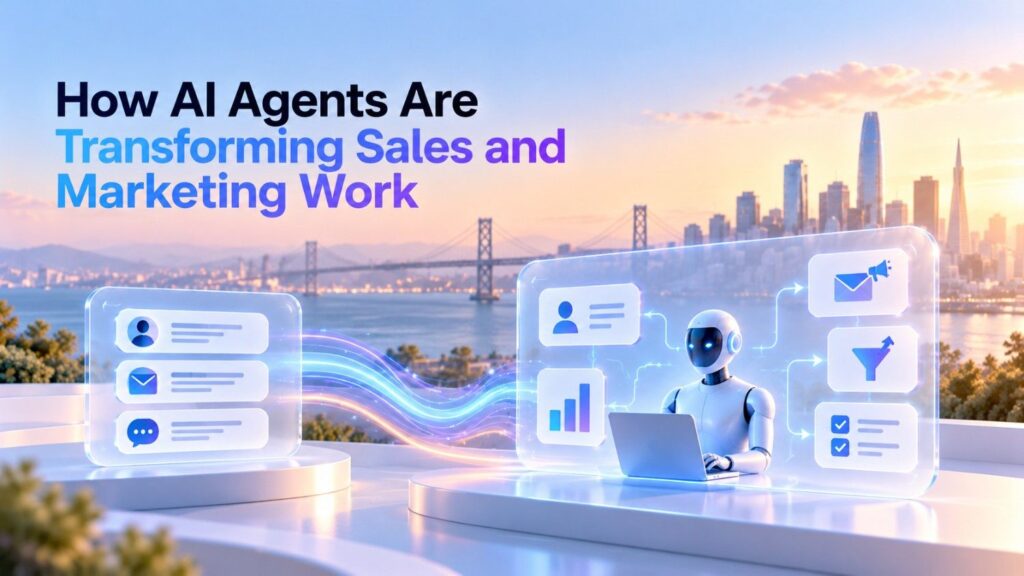
How AI Agents Are Transforming Sales and Marketing Work
Sales and marketing teams are another important market for agentic AI because much of their daily work involves research, coordination, writing, and recordkeeping.
Yet these activities are not all equally suitable for automation.
AI Sales Agents Can Reduce Work Around the Sales Process
A salesperson may spend significant time researching prospective customers, preparing meeting notes, updating a customer database, and organizing follow-up tasks.
An agent connected to approved research sources and a customer management system could assist with many of these activities.
For example, an agent might examine a prospect’s publicly available company information, compare it with the seller’s ideal customer profile, prepare a relevant outreach draft, and suggest an appropriate next step.
After a sales conversation, it could summarize the discussion and prepare updates for the salesperson to review.
This allows the human seller to focus on understanding customer needs and building relationships.
Automated Outreach Creates Risks When Quality Is Ignored
It is tempting to use agents to send large numbers of personalized messages.
However, increasing message volume does not guarantee better sales performance.
If an agent contacts people who are not relevant, invents details about prospects, or sends messages without following consent and privacy requirements, the result can damage a company’s reputation.
Businesses should focus on qualified opportunities and meaningful conversations rather than treating outbound message volume as the main measure of success.
For many companies, an agent that prepares ten excellent, carefully reviewed outreach messages may be more valuable than one that automatically sends hundreds of weak messages.
Marketing Agents Can Help Manage Campaign Operations
Marketing teams frequently work across advertising systems, analytics platforms, content tools, customer databases, and project management applications.
An agent could gather campaign results, compare performance with targets, identify tracking problems, and prepare recommendations.
For example, it might identify that a paid advertising campaign is generating leads but that the leads are not moving into sales conversations.
Instead of merely reporting clicks and impressions, the agent could connect the data to actual business outcomes and flag the problem.
However, an agent should not automatically increase advertising spending or change important campaign settings without approved limits.
The strongest early use cases involve analysis, reporting, quality checks, and recommendations. Financial actions should receive stricter controls.
The Rise of AI Software Engineering Agents
Software development is one of the most visible areas of change because AI can already read, write, and explain code.
The move from coding assistants to engineering agents adds the ability to work across several steps of a development task.
Coding Agents Are Moving Beyond Autocomplete
Traditional coding assistants suggest lines of code or help programmers understand a function.
More capable coding agents can examine a problem, inspect relevant files, propose changes, run tests, and prepare the results for review.
A developer might assign an agent to investigate why a specific automated test is failing. The agent could read the error message, inspect the relevant code, and attempt a fix in a controlled development environment.
The value comes from completing a small workflow instead of merely generating a code suggestion.
Why Human Review Remains Essential
Code that looks correct can still contain security problems, hidden errors, or changes that affect other parts of a product.
An agent may pass a limited test while introducing a bug that appears under different conditions.
For this reason, engineering teams should define which changes agents can make, what tests must pass, and who is responsible for approving deployment.
Low-risk tasks such as documentation updates and test preparation may be suitable for greater independence.
Changes affecting authentication, payments, sensitive data, or core production systems require stronger review.
Anthropic’s engineering guidance recommends beginning with simple agent patterns and adding complexity only when necessary. The guidance also explains that more independent agents can introduce additional cost, time, and unpredictability compared with fixed workflows.
Anthropic
The New Skill Is Managing AI-Generated Work
As coding agents become more capable, engineers may spend less time on certain repetitive edits and more time defining requirements, reviewing designs, testing results, and investigating difficult problems.
This does not remove the need to understand software engineering.
In fact, reviewing large amounts of automatically generated code without understanding its behavior can create serious technical problems.
For San Francisco startups, the opportunity is to shorten development cycles while maintaining high software quality.
The goal should be faster delivery of dependable products, not simply more code.
AI Agents in Finance, Legal Services, and Business Operations
Customer support and coding receive much of the attention, but some of the most useful agentic AI opportunities may occur in less visible departments.
These teams manage information-heavy processes that often involve numerous approvals, documents, and business rules.
Finance Teams Can Automate Routine Preparation and Checks
A finance department may handle invoices, expense reports, payment requests, account reconciliation, and recurring financial reports.
An AI agent could read an invoice, match it with the correct purchase order, identify missing information, and prepare it for approval.
When differences appear, the agent could flag the issue instead of silently changing financial records.
This creates a useful division of work. Software handles routine checks, while people retain responsibility for exceptions, approvals, and important financial decisions.
An early finance agent should generally have read-only access or limited authority. Automatic payments and changes to financial records should require strong identity checks, approval controls, and detailed activity logs.
Legal Teams Can Reduce Time Spent Preparing Documents
Legal work contains many tasks that involve searching, comparing, organizing, and reviewing information.
An AI agent might collect relevant contract documents, identify missing signatures, compare selected clauses against approved templates, or prepare a summary for legal review.
These activities can be useful because much of the surrounding work is repetitive.
However, legal advice, complex interpretation, and final decisions require qualified professionals.
An AI agent should not be presented as a substitute for licensed legal counsel, and its outputs should be checked carefully before they affect clients or legal rights.
Internal Operations May Offer Some of the Simplest Early Wins
Business operations often include less visible tasks that consume substantial employee time.
New employee onboarding, internal access requests, routine purchasing, project status updates, and customer account setup may involve many manual steps.
An agent could collect required information, check which approvals are missing, send reminders, and create tasks in the correct systems.
These workflows can be attractive because businesses often have clear rules and can measure whether the task was completed.
Still, access decisions and sensitive employee information should remain under carefully controlled processes.
Original Finding #6: The Best Early AI Agents May Be Those With the Lowest Cost of Failure
The labor-market analysis highlights the potential value of automating work. The business scenario shows how savings depend on actual resolution rates.
Together, these findings suggest that choosing the right first workflow is more important than maximizing technical ambition.
SFTechScene developed a practical scoring framework to illustrate this selection process.
The framework evaluates each task across five dimensions: request frequency, clarity of the procedure, ease of checking results, potential business value, and safety.
Each dimension receives a score from one to five, with five representing a more favorable condition for an initial deployment. The total ranges from five to 25.
These are editorial example scores, not measurements from companies or a validated scientific ranking.
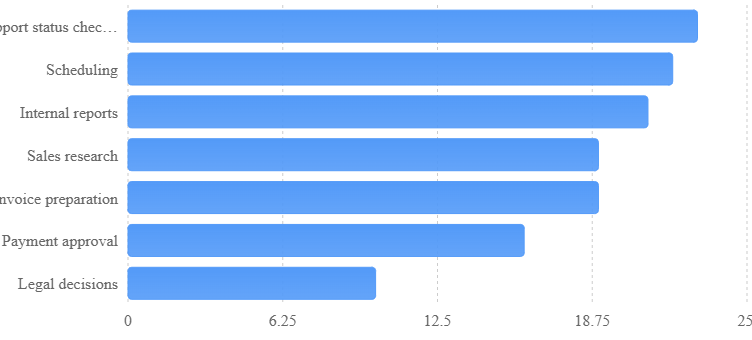
| Example workflow | Frequency | Rule clarity | Easy to verify | Value | Safety | Total / 25 |
|---|---|---|---|---|---|---|
| Routine support status checks | 5 | 5 | 5 | 3 | 5 | 23 |
| Meeting and scheduling assistance | 4 | 5 | 5 | 3 | 5 | 22 |
| Internal report preparation | 4 | 4 | 4 | 4 | 5 | 21 |
| Sales research and draft preparation | 4 | 3 | 4 | 4 | 4 | 19 |
| Invoice preparation for review | 4 | 4 | 4 | 4 | 3 | 19 |
| Automatic payment approval | 4 | 3 | 3 | 5 | 1 | 16 |
| Complex legal decision-making | 2 | 1 | 1 | 5 | 1 | 10 |
Illustrative SFTechScene framework. Equal weights are used for simplicity; organizations should set stricter safety thresholds for high-risk tasks.
Illustrative agent deployment suitability
Higher scores indicate potentially easier starting points, not verified AI performance.
Why Simple Workflows Often Make Better Starting Points
A routine support status check may not sound revolutionary. But it can happen thousands of times, often follows clear procedures, and produces results that are easy to confirm.
Complex legal decisions may involve far higher hourly labor costs, but they also involve uncertainty, professional responsibility, and substantial consequences when something goes wrong.
This makes the first workflow easier to test and scale responsibly.
Businesses can use the scoring framework to create a shortlist of opportunities, but the score should never override basic safety requirements.
A workflow that involves transferring money, disclosing private information, or making high-impact decisions should receive additional review regardless of its numerical score.
The Strategic Advantage of Learning From Reliable Tasks
Starting small does not mean thinking small.
A company that successfully automates account status checks learns how to connect AI with business systems, test answers, monitor actions, and manage customer expectations.
Those capabilities can later support more complicated work.
The process is similar to building a reliable operations team. Businesses improve performance by creating clear procedures, tracking results, and learning from mistakes.
The difference is that AI agents may require frequent testing because their behavior can change when models, instructions, or connected systems are updated.
The best deployment strategy builds institutional knowledge with each new workflow.
Why Reliability Is Becoming the Biggest Competitive Advantage in Agentic AI
The ability to build an AI agent is becoming more widely available. The ability to operate one reliably across thousands of real customer interactions remains much harder.
This difference is likely to shape competition in San Francisco’s agentic AI industry.
A Successful Demonstration Is Not the Same as a Reliable Product
AI demonstrations usually show a carefully selected example with a clear starting point and an expected result.
Real business environments are more complicated.
Customers provide incomplete information. Company policies change. Connected applications experience outages. Employees make mistakes when entering data. Sometimes several different systems contain conflicting information about the same account.
An agent must handle these situations without creating larger problems.
For example, an AI travel service might correctly change a straightforward reservation during a demonstration. But what happens when a traveler has multiple bookings, different payment methods, a canceled flight, and a refund policy that depends on local regulations?
The system needs more than the ability to understand a conversation. It needs clear permissions, reliable records, exception handling, and a way to involve a human.
Every Additional Action Creates Another Opportunity for Error
Agent workflows often involve several steps, and mistakes can accumulate.
To understand why, consider a simplified probability model.
Suppose an agent has a 98% chance of correctly completing each step of a workflow, and the steps succeed independently. The probability of completing the entire workflow correctly falls as the number of steps increases.
\[ \text{Workflow success probability}=p^n \]
Here, \(p\) is the probability of success on one step, and \(n\) is the number of steps.
| Workflow length | Success probability at 98% per step |
|---|---|
| 1 step | 98.0% |
| 3 steps | 94.1% |
| 5 steps | 90.4% |
| 10 steps | 81.7% |
| 20 steps | 66.8% |
SFTechScene mathematical illustration. Assumes independent steps with an identical 98% success rate. Actual agent errors may be correlated, and verification or retries can change these results.
Why long agent workflows need checkpoints
Illustrative end-to-end success probability with 98% independent reliability per step.
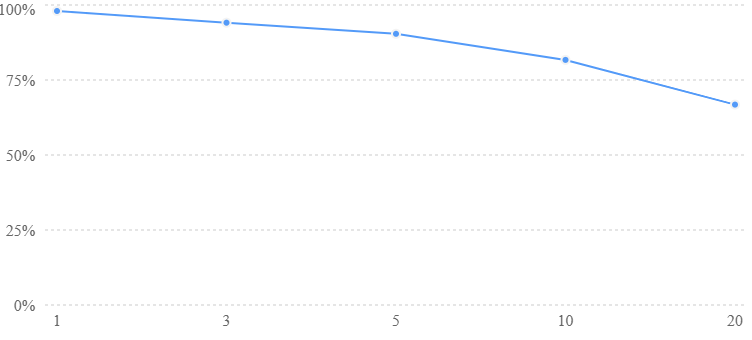
This simplified example explains why companies need to pay attention to workflow length and error recovery.
An agent that performs one task correctly most of the time may still struggle to complete a complicated process involving twenty actions.
The solution is not necessarily to use a larger AI model. Businesses can introduce verification checkpoints, confirm important information before acting, and break difficult work into smaller sections.
When a step fails, the system should be able to retry safely, pause, or request human help without repeating actions that have already succeeded.
The Importance of Testing Agents Against Real Situations
Businesses should evaluate agents using examples that reflect the problems their employees encounter.
A customer service agent should be tested with unclear questions, incorrect account details, policy exceptions, and customers who change their requests midway through a conversation.
A finance agent should be tested with duplicate invoices, missing purchase orders, unusual payment instructions, and records containing conflicting information.
A coding agent should be tested against realistic codebases, incomplete requirements, and existing software failures.
The tests should measure completed outcomes, unauthorized actions, correction rates, and the amount of human work needed.
Why Failed Attempts Are Valuable Data
When an AI agent fails, the failure often reveals something useful about the business process.
Perhaps the company has conflicting instructions. Maybe important customer data is missing. The system may lack permission to perform an essential action, or the task may require judgment that should remain with a person.
Businesses should classify these failures rather than treating them as random technical problems.
Over time, the resulting dataset can show which workflows are ready for broader automation and which still need better procedures.
This operational knowledge may become a competitive advantage, especially for startups serving specialized industries.
How San Francisco Businesses Can Build Their First AI Agent in 90 Days
Building an AI agent does not need to begin with a large engineering project. A smaller, carefully selected workflow can provide meaningful information about whether automation is worth expanding.

The following 90-day plan is designed for a business that already uses digital systems and wants to automate a repetitive process.
Days 1–15: Find a Business Problem Worth Solving
The first step is to identify a task that employees perform frequently and that follows a reasonably clear procedure.
Customer support requests, scheduling, reporting, document preparation, and routine account updates can provide useful starting points.
The business should collect a representative sample of recent cases and examine how employees completed them.
It should measure how many requests arrive, how much human time they consume, how often problems occur, and what a successful result looks like.
Identify the Actual Work, Not Just the Conversation
A company should avoid choosing a workflow simply because customers ask questions about it.
The important issue is what the business must do after receiving the question.
If customers repeatedly ask about order status, the company should examine how employees retrieve tracking information and resolve missing deliveries.
If employees repeatedly request expense approval updates, the business should investigate which systems contain the necessary information and who is authorized to approve expenses.
A clear description of the existing work becomes the foundation for a useful agent.
Establish a Baseline Before Using AI
Businesses need reliable measurements of their current operations.
A customer service team might calculate average handling time, resolution rate, repeat-contact rate, and customer satisfaction.
A finance team might measure the time required to prepare an invoice for approval and the percentage of invoices needing corrections.
Without this baseline, businesses may struggle to determine whether the new agent actually improves performance.
Days 16–30: Build a Controlled Prototype
Once the company identifies a workflow, the next step is to create a limited prototype.
The prototype should have access only to the information and tools required for the selected task.
For example, an order-support agent may need to read order status and shipping information. It should not automatically receive permission to change payment settings or issue unlimited refunds.
Start With Read-Only Actions
Early prototypes should generally begin with information retrieval and preparation.
The agent can look up records, summarize information, prepare a proposed response, or recommend the next step.
An employee then checks the recommendation and performs any important action.
This allows the team to evaluate the agent’s understanding without immediately introducing the risks associated with autonomous changes.
Create Clear Escalation Rules
The prototype should also know when to stop.
A useful escalation rule might require human review when a customer requests a refund above a defined amount, identity verification fails, or the relevant records disagree.
The rules should reflect the company’s actual procedures and risk requirements.
An agent that knows when to ask for help can be more valuable than one that attempts to complete every task independently.
Days 31–45: Test the Agent Before Giving It More Control
The next stage is controlled testing with realistic cases.
The business should prepare examples of straightforward requests, unusual requests, incomplete information, and situations in which the correct action is to refuse or escalate.
Every test should have a clearly defined expected outcome.
For example, a scheduling agent might receive a request to change an appointment to an unavailable time. The correct behavior is to explain the constraint or offer valid alternatives, not invent an available slot.
Measure More Than Answer Accuracy
A response can be grammatically correct and still fail the business task.
Testing should focus on whether the agent identified the right customer, retrieved valid information, followed the appropriate rule, and selected an authorized action.
The business should also examine how much employee time is required to check each result.
If an agent saves three minutes but requires five minutes of review, it has not improved productivity.
Days 46–60: Launch a Limited Pilot With Human Oversight
After the agent passes its initial tests, the business can introduce it to a restricted set of real workflows.
The pilot might cover a single customer request type, one internal team, or a limited share of incoming requests.
People should remain able to inspect what the agent is doing and intervene when necessary.
The company should maintain activity records that show which information was used, what actions were attempted, and whether the outcome was successful.
Compare the Pilot Against the Existing Process
The most useful evaluation compares agent-assisted work with the company’s established method.
Businesses should account for both successful automation and the time required to correct errors.
Where practical, similar requests can be assigned to a control group and an agent-assisted group. Random assignment helps reduce the risk that the agent receives easier cases than human employees.
A pilot should not be declared successful simply because the AI system handles a large number of interactions.
It should demonstrate measurable improvement in cost, quality, speed, or customer experience.
Days 61–75: Improve Weak Points and Expand Permissions Carefully
By this stage, the company should have enough pilot data to identify common problems.
Perhaps the agent fails when customers provide incomplete order numbers. It may struggle with special pricing rules or misunderstand certain service requests.
The team should improve the relevant instructions, data connections, or workflow design and retest the affected cases.
Successful performance may justify granting permission for a limited set of reversible actions.
For example, a scheduling agent might be allowed to book appointments within approved conditions while still requiring human review for cancellations involving fees.
The company’s permissions should grow with demonstrated reliability, not with expectations about what the model might be able to do.
Days 76–90: Decide Whether to Scale, Redesign, or Stop
At the end of the pilot, leaders should have enough evidence to make an informed decision.
The evaluation should compare completed work, total operating costs, error rates, staff review time, and customer outcomes.
If the agent performs well, the business can expand to additional requests or teams.
If performance is inconsistent, the company should identify whether the problem comes from poor data, unclear procedures, technical limitations, or an unsuitable workflow.
Stopping an unsuccessful pilot is not necessarily a failure. It can prevent a much larger investment in automation that does not deliver value.
A Practical 90-Day Scorecard
| Period | Main objective | Evidence required |
|---|---|---|
| Days 1–15 | Select workflow | Volume, cost, baseline quality |
| Days 16–30 | Create prototype | Controlled tool access and escalation rules |
| Days 31–45 | Test reliability | Verified results across normal and difficult cases |
| Days 46–60 | Run limited pilot | Real-world performance with human oversight |
| Days 61–75 | Improve and retest | Lower error and intervention rates |
| Days 76–90 | Make scaling decision | Demonstrated net business value |
The goal of the first 90 days is not to build a fully autonomous company. It is to establish a repeatable method for deciding which business processes should use AI agents and how those agents should be managed.
How Agentic AI Is Changing the Economics of Software Companies
The rise of digital workers could also change how software companies charge customers.
Traditional business software is commonly sold through user subscriptions, usage-based fees, or enterprise agreements.
Agentic AI introduces the possibility of charging for completed work.
From Paying for Software Seats to Paying for Results
Consider a business that currently pays for customer support software based on the number of employees who use it.
An AI agent product could offer a different pricing structure based on the number of successfully resolved customer requests.
This creates a closer link between what the customer pays and the result the software delivers.
However, outcome-based pricing creates new questions.
The vendor and the customer must agree on what counts as a completed task, how corrections are handled, and who pays when an agent makes a mistake.
A customer service provider might claim that an issue is resolved when the conversation ends. The customer may disagree if the original problem remains.
Clear measurement becomes an essential part of the business contract.
Why AI-Native Startups May Have Different Cost Structures
first wave of ai chatbots can sometimes operate with smaller teams because agents help employees perform research, customer support, software development, and routine administration.
A founder may use AI tools to prepare marketing materials, review product feedback, investigate technical issues, and manage internal information.
That can reduce the need to hire for certain repetitive tasks during the early stages of a company.
But smaller teams do not eliminate the need for customer relationships, product decisions, security, legal compliance, or operational responsibility.
Successful companies must still manage the costs of AI usage, infrastructure, data access, customer acquisition, and product maintenance.
The economic benefit depends on whether the company can serve more customers without increasing these costs at the same rate.
The New Software Competitive Advantage
For many AI startups, basic access to a strong language model is no longer enough to create a lasting advantage.
Competitors may be able to use similar models and development tools.
A more durable advantage may come from excellent workflow design, customer trust, access to valuable authorized data, careful testing, and dependable integrations.
For example, a startup that understands the detailed claims process of a particular insurance market may build a more useful agent than a general-purpose tool.
Its advantage comes from knowing the business problem and proving it can deliver the right result.
What Agentic AI Means for San Francisco’s Workforce
The shift from chatbots to digital employees raises important questions about work and employment.
Some tasks that previously required substantial human effort may become easier to automate. Other activities may become more valuable because people must guide, review, and manage automated systems.
The long-term effects will vary by industry, occupation, company, and the pace of deployment.
Jobs Contain Different Types of Tasks
It is misleading to treat an occupation as a single activity.
A customer service employee may answer routine questions, investigate complicated complaints, reassure frustrated customers, and identify emerging product problems.
An AI agent might perform well on routine account requests while struggling with emotionally sensitive conversations or unusual situations.
A financial analyst may gather information, update reports, interpret results, and advise business leaders. AI agents may reduce time spent preparing reports without replacing the need for analysis and judgment.
This is why task-level analysis is more useful than broad predictions about entire job categories.
Human Oversight Will Become Part of More Roles
As companies introduce agents, employees may spend more time reviewing outputs, managing exceptions, improving workflows, and checking whether automated systems operate as intended.
For some workers, this may create opportunities to move toward higher-value work.
For others, automation may reduce demand for specific tasks or change staffing requirements. Employers should not assume that every affected employee can move easily into a different position.
Training, job redesign, transparent communication, and realistic workforce planning will matter.
The 2025 McKinsey survey found differing expectations about employment effects, with 32% of respondents anticipating workforce decreases related to AI over the following year, 43% expecting no change, and 13% expecting increases. These are expectations reported in a global survey, not measured employment outcomes for San Francisco.
McKinsey & Company
The Skills That Could Become More Valuable
Employees who understand how business processes work may become important contributors to AI deployment.
For example, an experienced customer support manager knows which requests are routine, which require special handling, and where company policies are unclear.
That knowledge can help engineers create agents that follow the right rules.
Similarly, finance, operations, sales, and engineering professionals can help define safe automation boundaries and verify whether agent outputs are useful.
The strongest workers may combine domain expertise with the ability to supervise and improve AI tools.
What Business Leaders Should Do for Employees
Companies should explain what their agents will do before introducing them into important workflows.
Employees need to understand how automation affects their responsibilities, what performance measures will change, and how to report system errors.
Leaders should involve experienced workers in designing and testing agents because those employees often understand operational problems that are not documented anywhere.
Where automation reduces routine work, businesses should consider retraining and internal movement before assuming that workforce cuts are the only path to value.
A thoughtful deployment strategy can improve operations while reducing uncertainty and resistance among employees.
The Biggest Risks San Francisco Companies Must Manage
Agentic AI changes the nature of software risk because systems are increasingly able to take action.
A wrong chatbot answer can mislead someone. An agent with business permissions may also change records, send messages, transfer information, or trigger transactions.
This makes responsible system design essential.
Unauthorized Actions and Excessive Permissions
Agents should have access only to the systems and actions needed for their assigned responsibilities.
An internal reporting agent does not need permission to transfer funds. A customer support agent answering order questions should not have unrestricted access to all customer accounts.
Businesses should separate information access from action permissions and require additional approval for sensitive operations.
Inaccurate Information and Conflicting Records
An agent may produce a confident answer even when the available information is incomplete or contradictory.
This is particularly dangerous when the agent can act on that answer.
Companies should give agents access to authoritative sources, identify outdated documents, and require confirmation before consequential changes.
The system should be able to say that it cannot verify something instead of inventing an explanation.
Malicious Instructions Hidden in Business Data
An agent may encounter instructions inside websites, documents, emails, or other material that it is supposed to read as data.
Some of those instructions may attempt to redirect the agent into performing an unauthorized action.
This is known as prompt injection.
Businesses should treat external and lower-trust information as data, not as a source of authority over the agent. Sensitive actions should be controlled through permissions and independent checks rather than relying only on written instructions.
Privacy and Regulatory Responsibilities
Agents often need access to customer information, employee records, and internal business documents.
That access can create privacy and compliance obligations.
Companies should establish rules for what data can be collected, how long records are retained, which service providers can access them, and how sensitive information is protected.
Organizations operating in healthcare, financial services, or other regulated industries may require additional legal and technical review.
Accountability When an Agent Makes a Mistake
A business cannot avoid responsibility for an action simply because an AI agent performed it.
Customers and regulators will still expect the company to address incorrect transactions, misleading communications, security failures, and other problems.
Every production deployment should have a clear human owner responsible for reviewing performance and addressing incidents.
Businesses should also have a practical way to pause an agent, revoke permissions, and recover from errors.
What San Francisco Founders Should Build Next
The agentic AI market creates opportunities beyond general-purpose assistants.
The most promising openings may lie in business processes that remain difficult to automate because they involve fragmented information, complicated rules, or systems that do not communicate well.
Vertical AI Agents Built Around One Industry
A vertical AI agent focuses on the needs of a specific industry.
An agent for dental practices might help manage patient scheduling, appointment reminders, and routine administrative questions under appropriate privacy controls.
An agent for property managers could organize maintenance requests, identify missing information, and coordinate approved service appointments.
An agent for logistics companies might track shipments, detect routine delivery exceptions, and prepare updates for customers.
These products can become valuable when they reflect the actual rules and procedures of the industry.
Founders should begin by interviewing potential customers and studying real workflows rather than selecting a sector simply because it appears attractive.
Agent Monitoring and Quality Assurance
As businesses deploy more agents, they will need better ways to see what those systems are doing.
Monitoring products can record actions, identify unusual behavior, detect repeated failures, and help teams understand why a task was not completed.
Testing platforms can evaluate whether an agent follows company policies and performs consistently across difficult situations.
Salesforce’s expansion of agent monitoring capabilities is one example of the industry’s recognition that visibility and control are essential for broader deployment.
Salesforce
This could create opportunities for startups that build specialized evaluation, security, and operations tools.
Secure Connections Between AI Agents and Business Systems
Many companies rely on software that was not originally designed for autonomous agents.
Connecting these systems safely can require significant engineering work.
Startups may find opportunities in creating reliable integrations, permission systems, approval workflows, and transaction controls.
A useful integration should make it easier for an agent to complete approved actions while preventing it from accessing information or tools outside its responsibility.
AI Agents That Improve Other AI Agents
Businesses also need to review agent performance and identify recurring problems.
An evaluation system could examine failed requests, group them by cause, identify changes in performance, and recommend where human teams should investigate.
Such systems should support human review rather than silently modifying production agents without controls.
The business value comes from shortening the time between discovering a problem and fixing it.
What Business Leaders Should Watch Through 2027
Several developments will help determine whether agentic AI becomes a dependable part of business operations.
The first is whether companies can demonstrate sustained improvements in completed work rather than reporting only conversation volume or AI usage.
The second is whether agents become easier to connect to business systems without creating excessive security risk.
The third is whether organizations develop better methods for evaluating agents before and after deployment.
Another important signal will be the way software vendors price their products. If pricing increasingly reflects verified outcomes, customers may gain clearer ways to compare alternatives.
Finally, businesses should watch how employees’ roles evolve as agents take over selected workflows.
These are indicators to monitor, not certain predictions about what will happen by 2027.
The market could develop more slowly if reliability problems, regulatory requirements, integration costs, or customer resistance make broad deployment difficult.
It could also develop unevenly, with some narrowly defined tasks becoming highly automated while complicated professional work continues to require substantial human involvement.
The most useful approach is to evaluate what agents actually accomplish rather than assuming that all industries will change at the same speed.
Final Takeaway: San Francisco’s Agentic AI Future Will Be Built Around Reliable Digital Work
San Francisco’s technology industry is moving beyond the first wave of AI chatbots.
The new direction is toward software that can understand business goals, retrieve relevant information, perform approved actions, and complete defined tasks with less direct human involvement.
Companies such as Sierra, Decagon, Salesforce, OpenAI, and Glean illustrate different parts of this emerging market. Some focus on customer-facing work, others on developer tools, workplace information, and enterprise operations.
The biggest opportunity is not simply making conversations with computers sound more natural. It is improving the way businesses operate.
SFTechScene’s original labor-market analysis shows that the San Francisco region has unusually high concentrations of workers in technical, scientific, legal, and other specialized fields. It also reveals significant local wage premiums across many professional and administrative occupations.
These conditions make productive automation economically interesting, but they do not prove that entire jobs can or should be automated.
The more practical question is how much repetitive work can be completed safely while allowing people to focus on decisions, relationships, and difficult problems.
Our scenario analysis reinforces that point. An AI agent creates business value when it completes work reliably and does so at a total cost below the existing process. A system that merely generates more activity can create additional expenses.
For San Francisco founders, the opportunity is to build agents that understand real business processes and deliver measurable results.
For established companies, the next step is to choose a narrow workflow, establish clear performance measures, test carefully, and expand only when there is evidence of value.
For employees, the shift creates an important reason to develop skills in managing, checking, and improving AI-supported work.
The future may include more digital employees, but successful businesses will still need people who understand customers, make difficult decisions, and remain responsible for the results.
The winners in San Francisco’s agentic AI economy will not simply be the companies with the most autonomous software. They will be the companies that make automated work dependable, useful, and worth paying for.
Research Sources and Methodology Notes
This article was prepared using publicly available information available through October 13, 2026. The original analysis and illustrative models were developed for SFTechScene.
The principal sources include the U.S. Bureau of Labor Statistics, May 2025 San Francisco Occupational Employment and Wages release, published July 9, 2026; McKinsey’s State of AI in 2025 survey; official product and company materials from Salesforce, Sierra, Decagon, OpenAI, and Glean; and Anthropic’s engineering guidance on building effective agents.
The article contains three kinds of evidence that should be distinguished. Published occupational statistics and survey results are sourced findings. Employment concentration and wage premiums are original calculations derived from published BLS figures. The financial scenarios, deployment rankings, and reliability calculations are original analytical illustrations based on explicitly stated assumptions.
These analyses provide reproducible ways to evaluate agentic AI opportunities. They are not estimates of observed San Francisco AI adoption, independently tested vendor performance, guaranteed savings, or future employment changes.