


SFTechScene | Silicon Valley AI Investment Research | October 2026
Silicon Valley has seen several major technology booms. Personal computers changed how people worked. The internet changed how businesses reached customers. Smartphones created entirely new industries, while cloud software transformed how companies bought and used technology.
Now, venture capital firms are placing enormous bets on another shift. They believe artificial intelligence could change not just the software businesses use, but how much of their daily work gets done without a person handling every step.
The technology driving this change is the AI agent.
Unlike a basic chatbot that answers questions, an AI agent can use software, collect information, make decisions within set rules, and complete tasks. A customer service agent might check an order, update a delivery address, issue an approved refund, and send the customer a confirmation. A sales agent might research a potential customer, prepare a personalized message, update a sales database, and schedule a meeting.
That difference matters because businesses spend far more money getting work done than they spend buying software.
For investors in San Francisco, Palo Alto, Menlo Park, and the wider Bay Area, this creates an unusually large business opportunity. If software can perform work that previously needed hours of human effort, the market could eventually extend beyond traditional software budgets into much larger operating budgets.
But there is an important question behind the excitement.
Can AI agents create a trillion-dollar market, or are investors putting trillion-dollar expectations on technology that is still learning how to work reliably?
The answer requires looking beyond startup valuations and funding announcements. It means examining actual customer spending, where investment money is going, how quickly companies are adopting AI, and how much value agents can realistically produce.
For this article, SFTechScene examines public research from Stanford University, Menlo Ventures, PitchBook, company funding announcements, and independent AI testing organizations. We also develop original calculations that explore the size of the opportunity, the economics of AI automation, and the conditions needed for agent businesses to become sustainable.
The findings reveal a market with real growth, unusually strong investor interest, and major barriers that investors cannot afford to ignore.
The Short Version: AI Agents Could Turn Software From a Tool Into a Workforce
The biggest reason investors are excited about AI agents is simple. Traditional software helps employees complete work, while agent-based software can potentially complete parts of that work itself.
Consider a company paying $100 each month for software that helps an employee manage customer requests. The software makes the employee more productive, but the employee still has to complete most of the job.
Now imagine software that can successfully handle hundreds of those requests each month. The company may be willing to pay substantially more because it is buying completed work rather than just access to a tool.
This creates a different way to price technology. Instead of charging only per employee or software account, businesses can charge for completed tasks, successful customer resolutions, processed documents, or other measurable results.
Investors see the possibility of building businesses that grow as customers give AI more work to do.
The available data already shows that companies are spending serious money on AI, although agent-specific spending is much smaller than the broad AI market.
Enterprise generative AI spending, 2025
$37B
Menlo Ventures estimate
Global AI venture investment, 2025
$243.9B
PitchBook figures
US private AI investment, 2025
$285.9B
Stanford AI Index
Organizations using AI, 2025
88%
Stanford AI Index, surveyed organizations
These measures describe different populations and activities. They should not be added together or treated as AI-agent revenue. Sources: Menlo Ventures, PitchBook, Stanford AI Index 2026.
Menlo Ventures
+2
An important difference sits behind these numbers. Enterprise spending measures purchases of AI products and services. Venture investment measures capital going into companies. Adoption measures whether organizations use AI, which does not prove that their agents can handle important work on their own.
These are three very different signs of market development.
Our central finding is that the AI agent opportunity is real, but the trillion-dollar claim is still an investment thesis rather than a measured market size. The strongest companies are likely to be those that connect advanced AI capabilities with trustworthy business processes and a clear financial return.
Why Investors Believe AI Agents Could Become Bigger Than Traditional Software
Software has traditionally sold access, not completed work
Most business software has been sold through subscriptions, licenses, or usage charges. A company purchases tools for accounting, sales, project management, customer support, or human resources.
Those tools are valuable because they make employees more productive. But much of the work still requires people to review information, make decisions, and perform actions.
This creates a natural limit on how much companies are willing to pay for many software products. A tool needs to deliver enough value to justify its subscription, but its price is often tied to the number of employees using it.
Agents change this relationship.
An AI agent that completes an entire business process can potentially be measured against the cost of getting that work done. That cost includes employee time, outsourcing fees, delays, mistakes, and the extra effort required to manage work across several systems.
For an investor, the exciting part is not that an agent can produce text faster. It is that software might eventually take responsibility for a larger share of business operations.
The potential customer budget is much larger
Imagine two companies selling technology to an insurance provider.
The first sells a document management tool used by 100 employees. At $100 per employee per month, its annual revenue from that customer is $120,000.
The second sells an AI system that can process certain insurance documents from start to finish, while sending difficult cases to employees. If the insurer processes 500,000 eligible documents annually, the vendor can potentially charge according to processing volume and quality.
At $1 per successfully processed document, that contract could generate $500,000 annually.
These are illustrative prices, not observed market averages. The point is that one product earns revenue based on how many people use the tool, while the other earns revenue based on how much work it successfully delivers.
The second model can grow without the customer creating additional employee accounts.
That is one reason investors believe AI agents could reshape the economics of business software.
AI agents can expand an existing customer relationship
A company may begin using an agent for one narrow task, such as answering questions about order status. Once the system proves reliable, it might receive permission to process returns, update subscriptions, and manage certain payment problems.
Each new task creates a chance for the vendor to earn additional revenue.
This expansion can be attractive because acquiring a new enterprise customer is expensive. Vendors need to complete security reviews, connect systems, train staff, and prove that their technology is trustworthy.
Once those connections exist, the cost of introducing another closely related workflow may be lower than finding an entirely new customer.
However, the advantage depends on whether the vendor can reuse its existing technology and support systems. An agent that requires months of custom engineering for every new task may not scale nearly as well as investors expect.
Original Research #1: Enterprise AI Spending Grew Fast, but Agents Still Represent a Small Share
To understand whether agent investment is getting ahead of real demand, we need to look at where businesses are spending money.
Menlo Ventures estimated that enterprise generative AI spending reached $37 billion in 2025, compared with $11.5 billion in 2024. Its research also broke down spending between applications and the infrastructure powering those applications.
This provides a useful starting point for examining the agent opportunity, although it does not capture every possible form of agent-related spending.
Our methodology
SFTechScene uses the 2024 and 2025 enterprise spending estimates that Menlo Ventures presents on a comparable basis in its 2025 research. We calculate the annual growth rate and examine the 2025 allocation between applications, infrastructure, general-purpose copilots, and identified agent platforms.
We avoid mixing Menlo’s older 2024 headline figures with its revised comparison series, because changes in category definitions can produce misleading growth calculations.
Enterprise generative AI spending
US$ billions; 2024–2025, Menlo Ventures comparable series

The increase was $25.5 billion in a single year. Dividing that increase by the 2024 estimate gives an annual growth rate of approximately 222%.
In other words, estimated enterprise generative AI spending more than tripled in one year.
That is a strong sign of growing commercial demand. It is not proof that agent-only businesses grew at the same rate, because the total includes models, infrastructure, copilots, and other AI applications.
Menlo Ventures
+1
Where the $37 billion went
Menlo estimated approximately $19 billion of enterprise spending on AI applications and $18 billion on AI infrastructure in 2025.
Within the application market, its estimates covered products used across departments, industry-specific tools, and general-purpose software.
2025 enterprise generative AI spending by major category
US$ billions; reported category figures are rounded
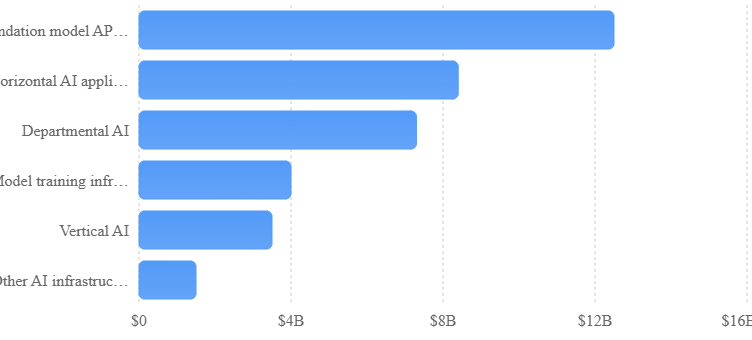
Source: Menlo Ventures, 2025: The State of Generative AI in the Enterprise. Category estimates are rounded and may not sum exactly to the headline total.
Menlo Ventures
The critical finding appears inside the horizontal AI category.
Menlo estimated that copilots represented around $7.2 billion of this market, while agent platforms accounted for approximately $750 million. These agent platforms included products such as Salesforce Agentforce, Writer, and Glean.
That puts the reported agent platform segment at around 8.9% of the $8.4 billion horizontal AI category and roughly 2% of total enterprise generative AI spending.
These percentages are SFTechScene calculations using Menlo’s rounded figures.
SFTechScene calculation: The reported agent platform share
8.9%
Share of horizontal AI spending
2.0%
Share of total generative AI spending
Calculation
$0.75B ÷ $8.4B = 8.93% $0.75B ÷ $37B = 2.03%
These are shares for Menlo’s identified horizontal agent platform segment, not the entire agent economy. Agent capabilities may also appear in vertical and departmental products.
Menlo Ventures
What this reveals about the market
The data shows a large gap between how much attention AI agents receive and how much spending can already be clearly identified with agent platforms.
That gap has two possible explanations.
The optimistic interpretation is that agents are at the beginning of a much larger adoption cycle. Copilots have introduced businesses to AI, and agents may become the next stage as companies grow more comfortable letting software take actions.
The cautious interpretation is that deploying an agent is much harder than using an assistant. An employee can review a suggested email before sending it. An agent that changes a customer’s payment information or approves a refund needs stronger controls, deeper connections, and more reliable results.
Both explanations can be true.
For investors, the opportunity lies in closing this gap. The companies that move customers from experimentation into dependable automated work can potentially capture spending that has not yet developed into a mature market.
Original Research #2: How Large Would a Trillion-Dollar AI Agent Market Actually Need to Be?
The phrase trillion-dollar opportunity is often used without explaining what it means.
It could describe annual market revenue, total economic value created, a collection of company valuations, or the value of work that could potentially be automated.
These measures are not interchangeable.
A market creating $1 trillion in economic value does not necessarily produce $1 trillion in revenue for AI vendors. Customers may retain most of the savings, and some benefits may never result in an additional technology purchase.

To test the claim, SFTechScene built two simple models using transparent assumptions.
Model A: What would $1 trillion in annual agent revenue require?
We begin with the number of paying units and calculate the average monthly revenue needed to reach $1 trillion annually.
The formula is:
\[ \text{Annual revenue}=\text{Paying units}\times\text{Monthly revenue per unit}\times12 \]
A paying unit could be a customer account, an agent deployment, or a contracted bundle of tasks. The scenarios are mathematical examples rather than forecasts of how many customers will exist.
| Paying units worldwide | Monthly revenue needed per unit | Annual market revenue |
|---|---|---|
| 10 million | $8,333 | $1 trillion |
| 50 million | $1,667 | $1 trillion |
| 100 million | $833 | $1 trillion |
| 250 million | $333 | $1 trillion |
| 500 million | $167 | $1 trillion |
SFTechScene original scenario analysis. Monthly figures are rounded to the nearest dollar; totals use the unrounded calculations.
The results highlight an important point.
A trillion-dollar annual market would require either very large numbers of paying customers, high-value contracts, or a combination of both.
For instance, an agent product charging $100 monthly would need approximately 833 million continuously paying units to generate $1 trillion per year. At $1,000 monthly, it would need about 83.3 million.
That is why many investors are more interested in agents that complete expensive business processes than in simple consumer assistants.
A business may be willing to pay thousands of dollars each month for technology that reliably handles a costly workflow. It will be much harder to convince ordinary consumers to spend similar amounts on basic digital assistance.
Model B: How much business value could agents create?
Revenue is only part of the story. The other question is how much labor time AI agents might make available for other work.
We built a model using three inputs: the number of workers affected, the monthly hours of useful work saved per worker, and the economic value assigned to each hour.
This produces an estimate of potential gross annual labor-time value.
Interactive AI agent value model
Change the assumptions to estimate gross annual labor-time value and how much a vendor might capture. This is a scenario calculator, not a market forecast.Workers affected
50 millionUseful hours saved per worker per month
10 hoursValue per hour
$40Vendor share of value created
20%
Gross annual value
$240B
Possible vendor revenue
$48B
Reset assumptions
Our default example assumes 50 million workers experience 10 useful hours saved each month, with each hour worth $40.
This gives $240 billion in theoretical gross annual labor-time value. If vendors captured 20% of that amount, they would generate $48 billion in annual revenue under the model.
That is substantial, but it is nowhere near $1 trillion in annual vendor revenue.
The larger lesson is that the labor opportunity can be enormous without every dollar turning into sales for AI companies.
Why the model needs caution
Saving employee time is not automatically the same as saving money.
If an agent makes an employee’s job easier but the company continues paying the same salary, the benefit may appear as faster service, extra capacity, or improved quality rather than lower expenses.
Likewise, the value of an hour depends on the work. Ten hours saved in a high-value legal process may be worth more than ten hours saved on routine internal reporting.
Our calculation also assumes that the time saved is genuinely useful. It excludes time spent reviewing agent errors, maintaining integrations, correcting mistakes, and managing security risks.
A credible business case must subtract those costs before estimating net economic value.
This is why startups promising huge labor savings need strong customer evidence. Investors should ask whether customers can actually measure financial improvements rather than relying on broad claims about productivity.
Original Research #3: Silicon Valley’s AI Investment Boom Is Much Larger Than the Agent Market Itself
The venture capital market provides another way to understand why investors are placing such aggressive bets.
According to PitchBook, global AI venture investment reached approximately $243.9 billion in 2025. AI accounted for roughly half of worldwide venture deal value that year.
Stanford’s 2026 AI Index provides another view. It estimates that US private AI investment rose from about $109.1 billion in 2024 to $285.9 billion in 2025.
These are different measures, with different geographic boundaries and investment definitions. They should not be combined into a single funding total.
Both, however, point toward the same broad development: AI has become an extraordinary focus of private capital.
PitchBook
+2
What the US investment numbers reveal
Using Stanford’s reported figures, SFTechScene calculated the change in US private AI investment between 2024 and 2025.
US private AI investment
US$ billions; Stanford AI Index

The increase was approximately $176.8 billion, representing growth of about 162%.
That is an enormous rise in a single year.
However, the figure includes investment across AI, not just autonomous agents. Funding also supports model development, data centers, AI infrastructure, robotics, research, and other applications.
This matters because money invested in AI does not immediately turn into customer demand for agent products.
Why capital concentration matters
When an industry captures a large share of venture investment, two things can happen simultaneously.
Strong companies may receive the funding needed to solve hard technical problems and build products at a scale that would otherwise be impossible. At the same time, large funding rounds can encourage investors to pay very high prices for companies whose future earnings are uncertain.
PitchBook’s 2025 figures show that AI accounted for approximately 50% of global venture deal value and close to 30% of deal count. This suggests that AI companies attracted a disproportionately large share of investment dollars relative to their share of transactions.
PitchBook
That difference is especially important for smaller startups in San Francisco.
A company with a strong product might still struggle to compete for engineering talent, customer attention, and access to powerful AI models against startups that have raised hundreds of millions of dollars.
But larger funding does not guarantee a better product.
An enterprise customer ultimately cares whether the system completes work accurately, follows its rules, and delivers enough financial value to justify the price.
Those customer requirements can create openings for smaller, more focused companies.
The San Francisco Startups Showing Investors What an Agent Business Could Become
Silicon Valley’s AI investment story is no longer limited to model developers.
Some of the most interesting companies are building products that connect AI to real business work. Their approaches vary, but they share a common goal: moving beyond simple assistance toward completing valuable tasks.
Sierra: The opportunity in customer relationships
Sierra has become one of the clearest examples of investor interest in customer-facing agents.
Founded by Bret Taylor and Clay Bavor, the San Francisco company builds AI agents that businesses can use to support customers and carry out service-related tasks.
In May 2026, Sierra announced a $950 million funding round at a valuation above $15 billion. The company said its platform was being used by more than 40% of the Fortune 50 and handling billions of customer interactions. These are company-reported operating figures, not independently audited measures of successful task completion.
Sierra
The investment thesis is straightforward.
Customer service is a regular operating expense for organizations across banking, travel, retail, telecommunications, insurance, and many other industries.
If agents can resolve meaningful portions of those interactions safely and accurately, businesses may be willing to pay for outcomes instead of simply buying software to help service employees.
That opportunity becomes more attractive when the same platform can expand into new customer workflows.
A retail company might first use an agent to answer delivery questions. Later, it may allow the agent to change orders, recommend products, or handle approved returns.
Every additional task increases the potential value of the platform to the customer.
What founders can learn from Sierra
The most valuable agent may not be the one that can answer the widest range of questions.
It may be the one that can complete a smaller set of economically important tasks with predictable quality.
Startups entering customer service should choose a narrow process, measure successful resolutions, and understand the cost of handling exceptions.
They should also distinguish genuine automation from interactions that simply route customers to employees. Both can be useful, but they generate different financial benefits.
Decagon: Making customer support more useful
San Francisco-based Decagon is another example of the investment opportunity.
In January 2026, Decagon announced a $250 million funding round that valued the company at $4.5 billion. The company said it had added more than 100 global enterprise customers during its previous fiscal year.
Decagon
Decagon focuses on AI-based customer interactions and services designed to help companies respond to customer needs.
Its business model illustrates why investors are interested in specialized agents rather than only general-purpose AI tools.
Companies already have systems for orders, payments, subscriptions, and customer records. The hard part is often connecting those systems in a way that lets AI complete work correctly.
A customer might ask to change a hotel booking, for example. The agent needs to identify the reservation, understand the booking rules, check availability, make the permitted change, and explain any price difference.
A polished answer is not enough. The actual booking must be correct.
That makes integration, testing, and reliable execution central parts of the product.
Harvey: Why specialized industry knowledge is valuable
Harvey shows a different path.
Rather than trying to automate every business function, Harvey focuses on legal work. Its tools help lawyers and legal teams use AI for research, document analysis, drafting, and increasingly complex workflows.
In September 2026, Harvey announced a $550 million funding round at a $15.5 billion valuation. The company also reported that 80% of Am Law 100 firms used its technology.
Harvey
For investors, the appeal is that legal work has high economic value and complex industry requirements.
A system that can accurately review documents, identify contract issues, or prepare useful legal research can save expensive professional time.
The potential revenue per customer may therefore be much higher than for a simple AI writing assistant.
But specialized markets also create responsibilities.
Legal AI must account for confidentiality, source accuracy, professional review, and the consequences of incorrect conclusions.
Startups that understand these requirements may build stronger customer relationships than companies that simply attach a general language model to a basic user interface.
LangChain: The infrastructure needed to build reliable agents
Not every company in the agent economy sells an agent directly to businesses.
Some provide the underlying tools used to build, test, monitor, and improve agents.
LangChain is a prominent example.
In October 2025, the company announced a $125 million funding round at a $1.25 billion valuation. Its products include tools for developing agent workflows and understanding how those systems behave.
LangChain
The opportunity resembles parts of earlier software infrastructure markets.
When businesses build more complex systems, they often need products that help developers understand failures, monitor performance, control costs, and improve reliability.
An agent that sends thousands of requests across business systems creates more things that can go wrong than a simple chatbot.
That complexity creates demand for monitoring and testing tools.
However, infrastructure companies also face a risk: major model providers and cloud platforms may offer similar features as part of their core products.
The strongest independent vendors will need to provide capabilities that customers consider meaningfully better or more flexible than bundled alternatives.
Salesforce: Established software companies are joining the race
The agent opportunity is not reserved for venture-backed startups.
San Francisco-based Salesforce is using its existing enterprise relationships and business software products to expand into agents.
In its fiscal 2027 second-quarter results, Salesforce reported Agentforce annual recurring revenue above $1.5 billion, with growth exceeding 240% year over year.
The company also reported 7 billion cumulative Agentic Work Units across Agentforce and Slack, including 3.2 billion during that quarter. Salesforce defines and reports these units under its own measurement system. They should not automatically be interpreted as 7 billion fully completed business tasks.
Salesforce
+1
This is important for the investment market.
Existing software companies often have advantages that startups must build from scratch. They already hold customer data, support business workflows, operate trusted security systems, and have long-standing relationships with large organizations.
A startup may build a better AI interface, but an established provider can sometimes place agent functions directly inside the software employees already use.
That may reduce the effort needed to adopt the technology.
For investors, the central question is whether independent agent startups will replace parts of existing software or whether established vendors will capture much of the market themselves.
The answer will likely differ by industry and workflow.
Original Research #4: What Selected AI Agent Company Valuations Tell Us About Investor Expectations
To make Silicon Valley’s investment interest easier to understand, SFTechScene compared publicly announced funding and valuation figures for selected companies participating in the agent economy.
This is a deliberately small, illustrative sample. It is not a ranking of the largest AI-agent companies or a complete study of Silicon Valley funding.
The companies were included because their disclosures offer clearly identified financing dates and because they represent different parts of the agent market.
| Company | Focus | Announced round | Valuation at announcement |
|---|---|---|---|
| Sierra | Customer-facing AI agents | $950M, May 2026 | Over $15B |
| Harvey | Legal AI and agents | $550M, September 2026 | $15.5B |
| Decagon | Customer support agents | $250M, January 2026 | $4.5B |
| LangChain | Agent development tools | $125M, October 2025 | $1.25B |
Sources: official funding announcements from Sierra, Harvey, Decagon, and LangChain. These are valuations at different dates, and the companies have different business models.

Sierra
+3
What the valuation distribution shows
For the following illustration, Sierra is shown at a $15 billion floor because its announced valuation exceeded that amount.
Selected announced valuations in the AI agent economy
US$ billions; company funding announcements, October 2025–September 2026

Adding the four figures produces a combined announced valuation floor of $36.25 billion.
This does not mean investors invested $36.25 billion in those companies. Valuation is an estimate of what each entire business is worth in a funding transaction, while funding raised is the actual capital invested in a particular round.
It also does not represent the market value of all AI-agent businesses.
The useful conclusion is narrower.
Investors have shown a willingness to assign multibillion-dollar valuations to companies that operate in different parts of the AI-agent market, even though the industry is still developing.
Why the sample cannot prove that agent startups are overvalued
A high valuation can be reasonable when a business has strong growth, a large potential market, durable customer relationships, and a path toward attractive profits.
But we cannot determine whether these valuations are justified from funding announcements alone.
A proper valuation study would require comparable revenue, gross margins, customer retention, sales costs, growth rates, cash consumption, and financing terms.
Those details are not consistently available across private companies.
Therefore, our research treats the valuations as evidence of investor expectations, not proof of future returns.
What founders should take away
The funding figures suggest that investors are willing to back multiple business models.
Customer service agents, legal workflows, and agent infrastructure have all attracted substantial funding.
That does not mean a new startup should build a direct competitor to the best-funded companies.
In many cases, a narrower market with fewer established vendors may offer a better opening.
A company focusing on a specialized insurance workflow, a complex logistics process, or a particular financial reporting task may be able to create measurable customer value without trying to compete across an entire industry.
The strongest startup opportunity is often where the cost of an unsolved problem is high and existing products handle it poorly.
Why Silicon Valley Has a Special Advantage in the Agent Economy
San Francisco and the surrounding Bay Area have several advantages that make them important to the development of AI agents.
The first is the concentration of AI research, startups, engineering talent, venture capital firms, and experienced software founders.
The second is access to major enterprise software companies and customers willing to experiment with new technology.
The third is the area’s history of building software businesses that sell products around the world.
A concentrated network of investors and founders
Silicon Valley investors such as Andreessen Horowitz, Sequoia Capital, Menlo Ventures, and Kleiner Perkins have long invested in enterprise technology.
AI agents fit into that tradition because they address problems companies are already willing to spend money solving.
A startup in San Francisco can potentially recruit developers with experience building language models, connect with investors who understand enterprise software, and find advisers who have previously helped startups sell to large organizations.
These connections are valuable, although they do not guarantee success.
A founder still needs to identify a problem, build a product that works, and convince customers that it is worth paying for.
Proximity to AI model companies
Much of the modern AI ecosystem is connected to companies such as OpenAI and Anthropic.
Agent startups can build products using advanced models instead of developing all the underlying AI technology themselves.
This reduces the initial work needed to create useful applications.
However, it also means competitors may have access to similar model capabilities.
A startup cannot assume that using an advanced model creates a lasting advantage. Its strength may need to come from customer relationships, specialized data, reliable integrations, or a better understanding of a difficult industry.
The Bay Area’s enterprise software experience
San Francisco has a deep history of building business software.
That matters because deploying agents is not simply a question of generating accurate text. Companies need systems that connect with existing databases, respect user permissions, track actions, and operate without interrupting critical business processes.
Founders who have built enterprise software understand many of these requirements.
The next generation of successful agent companies may combine knowledge of advanced AI with the operational discipline needed to serve large, demanding customers.
The Five Business Models Investors Are Betting On
AI agents can generate revenue in several ways. Each model has different strengths, costs, and risks.
| Business model | How customers pay | Main opportunity | Main risk |
|---|---|---|---|
| Per employee | Monthly subscription per seat | Easy purchasing and predictable billing | Revenue may depend on employee count |
| Per agent | Fixed fee for each deployed agent | Clear packaging for business teams | Agent workloads vary widely |
| Usage-based | Per call, minute, document, or task | Revenue increases with activity | Activity does not guarantee useful results |
| Outcome-based | Per qualified or completed result | Strong link between price and business value | Defining and verifying success is difficult |
| Platform-based | Subscription plus usage and add-ons | Revenue from multiple workflows | Customers may prefer established platforms |
Outcome-based pricing could change how software is valued
Outcome-based pricing is particularly interesting because it allows the vendor and customer to focus on the result rather than the number of actions the software performs.
A business might pay for each customer request resolved correctly, each document processed under agreed rules, or each appointment that meets defined standards.
In theory, this gives the vendor a strong reason to improve reliability and efficiency.
If the agent wastes time, makes unnecessary model calls, or repeatedly performs unsuccessful actions, the vendor bears more of that cost.
But outcome pricing is difficult to design.
Consider a sales agent that helps book meetings. A meeting with someone who has no interest in buying should not necessarily have the same value as a meeting with a qualified customer.
Businesses and vendors must agree on what counts as success and how to prevent inflated performance reporting.
Hybrid pricing may be more practical
Many companies may prefer a model that combines predictable subscriptions with charges for activity or results.
The fixed portion can support development, security, customer service, and dedicated infrastructure.
The variable portion can grow as customers send more work to the system.
For startups, this approach can create a more stable revenue base while still allowing contracts to expand as agents become more useful.
The right model depends on how accurately the work can be measured and how much cost the vendor carries.
Original Research #5: The Economics of an AI Agent Depend More on Successful Work Than on Cheap AI
Investors often focus on how quickly the cost of running AI models is changing.
Lower model costs can help agent businesses, but they are only one part of the economics.
An agent may also incur phone charges, software integration costs, storage expenses, monitoring fees, security costs, human review, and customer support.
More importantly, unsuccessful actions can create additional costs.
To show how this works, SFTechScene built a workflow-level financial model for a hypothetical customer service agent.
The starting assumptions
Suppose a company receives 100,000 eligible customer requests each month.
The current average human handling cost is $5 per request. That gives the company a baseline monthly handling expense of $500,000 for the selected request volume.
Now suppose the company introduces an agent with these costs:
| Model input | Assumption |
|---|---|
| Monthly eligible requests | 100,000 |
| Baseline handling cost | $5 per request |
| AI processing and service cost | $0.80 per attempt |
| Human handling after unsuccessful AI attempt | $5 |
| Monthly fixed platform and oversight cost | $20,000 |
| Successful AI resolution rate | Variable |
SFTechScene original hypothetical scenario. None of these inputs is presented as an observed industry average.
Under this model, every request incurs the AI processing cost. Requests not successfully completed by AI still need human handling at the baseline cost.
We assume that successful AI resolutions are accurate and need no further handling. In real deployments, companies would also need to measure later complaints, corrections, refunds, and rework.
What happens as the successful resolution rate increases?
Monthly net savings at different successful AI resolution rates
US$ thousands; 100,000 monthly requests under stated assumptions
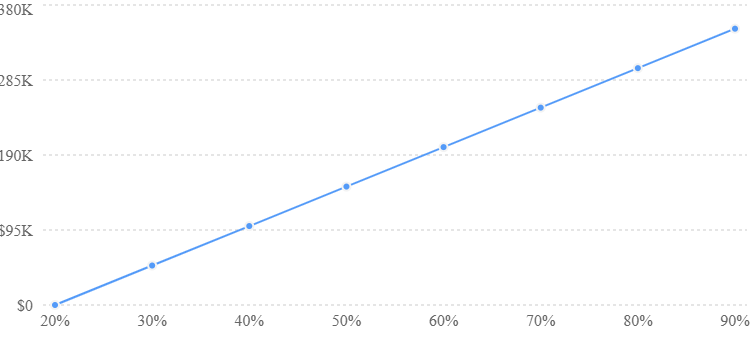
Under these assumptions, the monthly cost of operating the AI system is:
\[ 100{,}000 \times \$0.80 + \$20{,}000 = \$100{,}000 \]
The company then saves $5 for each customer request that AI successfully resolves without further human work.
The net savings formula becomes:
\[ \text{Net savings}=(100{,}000\times r\times\$5)-\$100{,}000 \]
Here, \(r\) is the successful resolution rate.
At 20%, the system reaches operating break-even under this simplified model. At 50%, the company saves $150,000 monthly, while 80% successful resolution produces $300,000 in monthly net savings.
This does not include one-time setup expenses, taxes, or the financial effects of errors that become visible later.
The critical threshold: Successful resolution, not call deflection
A system may answer 90% of incoming calls but successfully resolve only 40% of the underlying problems.
That distinction is essential.
An AI agent could keep a customer busy for several minutes before transferring the conversation to an employee. The interaction counts as AI-handled activity, but it may not have eliminated meaningful work.
A company should instead track whether the customer got the correct result, whether additional human work was needed, and whether the problem returned.
The strongest agent vendors will make those results easy to measure.
Original Research #6: A Small Decline in Reliability Can Have a Large Financial Impact
The previous model also shows why reliability deserves more investor attention than flashy demonstrations.
At a volume of 100,000 monthly requests, every one-percentage-point change in successful resolution represents 1,000 requests.
If each completed request avoids $5 in human handling costs, that one-point difference changes monthly savings by $5,000, assuming all other costs remain unchanged.
That becomes $60,000 annually.
For a large deployment, the difference between 65% and 75% successful resolution is therefore much more than a product-quality statistic.
It can represent a significant financial result.
65% success
$225K
Monthly savings
70% success
$250K
Monthly savings
75% success
$275K
Monthly savings
SFTechScene scenario results based on the preceding hypothetical cost model.
Moving from 65% to 75% successful resolution improves annual savings by $600,000.
That is why a vendor that improves reliability may have more room to raise prices or expand customer contracts than one that simply produces cheaper AI responses.
Why high-risk tasks require a different standard
Not all successful resolutions are equally valuable, and not all mistakes carry the same cost.
A wrong restaurant recommendation may cause mild inconvenience.
An incorrect financial transaction, insurance decision, or medical instruction can create much more serious consequences.
For those workflows, an agent that succeeds most of the time may still be unacceptable if the remaining errors are expensive or difficult to reverse.
The business case must therefore account for both routine performance and rare but costly failures.
A high-quality investor review should examine how the agent behaves when it is uncertain, encounters contradictory information, or receives a request outside its approved responsibilities.
Reliable escalation to a person may be more valuable than forcing the agent to complete every task independently.
Why Most Companies Are Still Early in Their AI Agent Adoption
A large amount of enterprise AI spending does not mean companies are ready to hand over important business operations.
Stanford’s 2026 AI Index reported that 88% of surveyed organizations used AI in at least one business function during 2025.
However, it also found that AI agent deployment remained in the single digits across nearly all business functions.
This gap is one of the most important findings for investors.
Stanford HAI
Companies are interested in AI, and many employees are already using it. But moving from assistance to autonomous action requires additional trust and stronger systems.
Using AI is much easier than allowing it to act
An employee can ask AI to summarize a report without giving the system permission to change company data.
An autonomous finance agent may need access to invoices, bank details, accounting records, and approval systems.
That creates a different set of security and operational concerns.
Businesses must decide what information an agent can see, what actions it can take, when it needs approval, and who is responsible if something goes wrong.
These are not minor technical details. They affect whether companies can use the technology in everyday operations.
Existing processes are often harder to automate than they appear
Many business tasks look simple when described in a presentation.
A sales team might say it wants an agent to follow up with interested customers.
But the real process could involve understanding which customers should receive messages, checking whether someone already contacted them, finding correct pricing information, following communication rules, and updating several systems.
Employees often handle these exceptions through experience.
An agent needs explicit rules, reliable information, and a way to recognize when a situation falls outside its abilities.
That preparation can account for a substantial part of the cost of deploying AI.
Better models do not eliminate the need for good business data
Even an advanced AI system can make poor decisions when the information it receives is outdated, incomplete, or inconsistent.
An agent may give an incorrect delivery estimate because two company databases contain different dates.
It may offer a discount that is no longer valid because the pricing system was not updated.
These problems cannot always be fixed by choosing a more powerful model.
They require companies to improve how information is organized and shared across systems.
This creates another business opportunity for startups providing data connections, monitoring, and workflow management.
Why Agent Security Could Become a Major Investment Category
Giving AI agents permission to take actions creates new security risks.
Traditional software generally follows clearly defined instructions. Agents may interpret natural-language requests, read information from outside sources, and choose actions based on the content they encounter.
That flexibility makes agents useful, but it also creates ways for attackers to influence their behavior.

The US National Institute of Standards and Technology has highlighted concerns involving malicious instructions hidden in external information, insecure models, unauthorized actions, and weak controls over the systems agents can access.
NIST
+1
The danger of giving an agent too much access
Imagine a purchasing agent designed to compare supplier prices and prepare orders.
The agent needs access to product catalogs, approved supplier information, company purchasing rules, and perhaps an ordering system.
If it also receives unrestricted authority to change bank details, send sensitive documents, or approve large payments, a single compromised workflow could cause significant damage.
Security should therefore be part of the initial product design rather than an afterthought.
Companies need permission limits, approval requirements, activity records, and controls that restrict what agents can do.
Why investors see opportunity in trust and monitoring
As agent deployments expand, companies will need ways to answer difficult questions.
Which agent changed this customer record? What information did it use? Was that action permitted? Can the change be reversed? Who approved it?
A business managing hundreds of agents cannot rely on employees manually reviewing every action.
This creates room for products that monitor agent behavior, manage permissions, detect suspicious requests, and maintain reliable records.
The business model may resemble security and monitoring software, but it will need to address the unusual behavior of AI systems.
For investors, this category has a useful characteristic: demand could increase as agents become more capable and receive more responsibility.
The Biggest Threat to AI Agent Startups: The Models May Become the Product
The AI agent economy also faces a difficult competitive question.
What happens when general-purpose AI models become powerful enough to perform many of the tasks specialized agent startups currently sell?
A company that builds only a thin interface around a model may find its features copied by a larger provider.
This is especially dangerous when the startup has little unique data, few meaningful integrations, and no special understanding of the customer’s work.
A strong product needs more than an impressive demonstration
Investors should look for advantages that are difficult to reproduce.
These might include trusted access to industry systems, permission to operate within regulated workflows, unique customer relationships, better evaluation methods, or a large collection of verified task results.
A startup that understands the details of commercial insurance claims may have an advantage over a general AI tool when those details determine whether a claim is processed correctly.
But that advantage must be demonstrated.
Specialized knowledge is useful only when it results in better outcomes, lower costs, or a more dependable customer experience.
The strongest competitive position may come from workflow ownership
An agent vendor becomes more deeply involved in a business when it manages an entire process.
For example, software that only drafts an invoice competes with many AI writing products.
Software that gathers approved billing information, checks contract terms, prepares invoices, sends them through the correct system, tracks payment status, and handles exceptions becomes more closely connected to the customer’s operations.
Replacing it may require changing how employees work and reconnecting important systems.
That can create stronger customer retention.
However, the same complexity can also slow sales and increase support costs. Investors need to examine whether the added customer value is greater than the expense of building and maintaining these connections.
How Silicon Valley Investors Should Evaluate AI Agent Startups
The most important question for investors is not whether a startup uses the latest model or has an impressive agent demonstration.
It is whether the company can reliably turn AI capabilities into a product that customers continue paying for.
We developed a practical evaluation framework based on the main business and technical risks identified in the preceding research.
The SFTechScene AI Agent Investment Scorecard
This framework assigns 100 possible points across eight categories.
It is an editorial decision tool, not a statistically validated predictor of investment returns. The weights reflect our judgment about the relative importance of each factor.
| Evaluation category | Points | What investors should examine |
|---|---|---|
| Proven customer demand | 20 | Paid customers, renewals, and expansion |
| Reliable task completion | 20 | Verified success rates and error recovery |
| Customer financial value | 15 | Net savings or additional revenue |
| Sustainable operating costs | 15 | Gross margin after AI and support costs |
| Competitive advantage | 10 | Unique data, workflow depth, and customer relationships |
| Security and controls | 10 | Permissions, audit records, and human approvals |
| Ease of deployment | 5 | Integration time and onboarding effort |
| Team execution | 5 | Customer delivery and product development record |
| Total | 100 |
A company should not receive a high score simply because it claims impressive performance.
Investors should request supporting evidence.
For example, a reported 80% resolution rate is much more useful when the company can explain which tasks were included, how results were verified, and how often customers returned because their original problem was not solved.
Why customer retention is particularly important
Startups can attract early buyers through excitement around new technology.
The harder test comes when those customers renew their contracts.
A customer that expands usage after six months offers stronger evidence of value than one that signs a large experimental contract and later stops using the product.
Investors should examine how many customers remain active, how spending changes over time, and whether new contracts require heavy customization.
A company with moderate initial contract sizes and strong expansion may ultimately have a better business than one relying on a handful of enormous experimental agreements.
A Practical 90-Day Strategy for San Francisco Founders Building AI Agent Companies
The size of the market can make the opportunity seem overwhelming.
Founders may believe they need a broad platform, a large engineering team, and substantial venture funding before they can compete.
For many business workflows, a narrower starting point is more practical.
Days 1–30: Find an expensive problem that companies already pay to solve
Begin with a single industry and a clearly defined business process.
Interview people responsible for getting that work done. Understand how frequently the task occurs, what it costs, which mistakes matter, and which systems employees use.
The objective is not simply to identify work that AI can perform.
It is to find work that creates enough economic value for a company to purchase a dependable solution.
A useful opportunity should have measurable outcomes, a clear buyer, and a manageable initial level of risk.
For example, a startup might focus on gathering missing documents for a loan application rather than attempting to automate the entire lending decision.
That narrower task may be easier to test and deploy while still reducing meaningful manual work.
Days 31–60: Build and test a narrow agent
Connect the product to the minimum systems necessary to complete the selected task.
Create test cases representing normal requests, missing information, conflicting records, unusual customer behavior, and attempts to make the agent perform unauthorized actions.
Set rules for when the agent must stop and ask for human assistance.
Do not rely only on a live demonstration.
Run the agent against a controlled set of cases with known expected results. Track successful completions, incorrect actions, unnecessary escalations, processing costs, and response times.
The quality of this testing matters because an agent can appear impressive while making subtle errors that become expensive in production.
Days 61–90: Prove the economics with real customers
Select a small number of customers willing to test the system on an approved workflow.
Agree in advance on how results will be measured.
Record the baseline cost of completing the work without AI. Compare that figure with the total cost of operating the new system, including human review, software charges, setup expenses, and corrected mistakes.
Review customer satisfaction alongside financial results.
A cheaper process is not a real improvement if customers become frustrated or the business needs to spend more time fixing errors.
At the end of the pilot, founders should be able to explain exactly how much work the system completed, what it cost, and what changed for the customer.
Those figures create a stronger foundation for fundraising than broad claims about automating an entire industry.
Which AI Agent Markets Could Produce the Biggest Opportunities?
The largest markets may not be the ones attracting the most online attention.
Many valuable business tasks are repetitive, complex, and largely invisible to consumers.
Healthcare administration
Healthcare organizations manage appointments, patient communications, insurance information, claims, billing records, and large amounts of documentation.
Agents could help with carefully limited administrative tasks, especially where rules are clear and people can review important decisions.
But healthcare requires strong protections for patient information and careful handling of errors.
An agent that speeds up paperwork may create genuine value. One that makes unsupported decisions about treatment or eligibility could create serious risks.
Financial services and insurance
Financial institutions process large numbers of documents, customer requests, account updates, and compliance-related tasks.
These processes offer opportunities because they often require employees to move information between multiple systems.
However, companies must protect sensitive financial information and maintain clear records of decisions.
A strong agent product needs to be useful without receiving more authority than its task requires.
Software engineering
AI coding tools have already become a major area of enterprise spending.
Menlo estimated $4 billion in enterprise spending on coding-related AI during 2025. This makes software development an important early market for AI-enabled work.
Menlo Ventures
The next opportunity involves helping teams manage more of the development process, including testing, fixing issues, preparing updates, and reviewing changes.
However, generating code is not the same as delivering secure, dependable software.
Companies still need testing, oversight, and responsibility for what reaches production.
Legal services
Legal work offers opportunities in document preparation, research, contract review, and information management.
The value of professional time can make useful tools economically attractive.
But customer trust, confidentiality, and accuracy remain essential.
The strongest legal AI companies may be those that combine specialized knowledge with controls that help professionals review and verify the system’s work.
Logistics and supply chain operations
Logistics companies coordinate shipments, suppliers, warehouses, schedules, and customer communications.
Much of this work involves gathering information, checking conditions, and making repeated decisions under business rules.
Agents could assist with shipment updates, document preparation, exception management, and routine coordination.
The challenge is that real-world logistics systems change constantly.
A delayed shipment, missing document, or incorrect delivery instruction can have consequences that software must recognize rather than ignore.
What Would Need to Happen for AI Agents to Become a Trillion-Dollar Market?
The data suggests that the path toward a trillion-dollar market depends on several conditions.
First, agents must become reliable enough to complete a wider range of business tasks without creating unacceptable error rates.
Second, deployment must become easier. Businesses cannot afford to spend months rebuilding their information systems every time they introduce another agent.
Third, vendors must prove that customers receive financial value after accounting for software, computing, monitoring, and human review costs.
Fourth, pricing models must evolve so businesses can purchase useful outcomes without facing unpredictable bills.
Finally, customers must become comfortable giving AI carefully controlled authority to act.
These changes would support a much larger market.
But the speed of progress will vary by industry.
The technical progress is promising, but reliability remains uneven
Independent research from METR has examined the length of technical tasks that advanced AI systems can complete at different success rates.
Its research shows that AI capabilities have improved rapidly on the evaluated tasks. However, METR also explains that these results should not be interpreted as proof that agents can perform complete human jobs.
Its tests are heavily concentrated in fields such as software engineering and other technical work, while real business environments contain more uncertainty and harder-to-measure outcomes.
METR
+1
That distinction matters for market forecasts.
An agent that can complete a difficult coding task under test conditions may still struggle to manage an unpredictable customer problem involving incomplete data, conflicting instructions, and multiple departments.
Investors should therefore measure progress in real customer environments rather than assuming that improvements in model benchmarks translate directly into equivalent gains in business automation.
What San Francisco Businesses Should Do Before Buying AI Agents
For businesses, the investment boom creates both opportunity and confusion.
Companies have more agent products to choose from, but vendor claims are not always easy to compare.
A sensible buying process begins with the problem rather than the technology.
Identify a workflow that causes delays, consumes substantial employee time, or creates costly errors. Establish how the process performs today and what a meaningful improvement would look like.
Then test whether an agent can deliver that improvement under realistic conditions.
Ask vendors to demonstrate actual task completion
A strong demonstration should show the agent completing work in a realistic setting.
For customer support, that might include identifying the customer, checking relevant information, making an approved change, and confirming the result.
For finance, it could involve extracting invoice details, checking them against purchase records, and sending exceptions to the right employee.
A demonstration that only shows natural conversation provides limited evidence of operational value.
Understand the full cost
The price advertised on a vendor’s website may not reflect the total cost of using the product.
Businesses should consider implementation, integration, AI usage, monitoring, human review, support, and ongoing maintenance.
They should also ask what happens when workloads increase or when the agent needs several attempts to complete a task.
Predictable costs make it easier to evaluate whether automation will remain attractive as usage grows.
Keep people involved where the consequences are serious
Agents should have clear limits.
When a task involves sensitive information, large payments, legal commitments, or significant customer harm, approval requirements may be necessary.
Human involvement does not make automation a failure.
A system that completes routine work and reliably identifies cases needing judgment may be more valuable than one that attempts to do everything independently.
Research Methodology, Sources, and Limitations
This article combines published third-party data with original SFTechScene calculations. To make the analysis reproducible, it is important to separate observed figures from assumptions.
Public datasets used
| Source | Data used | Main limitation |
|---|---|---|
| Stanford AI Index 2025 and 2026 | Private AI investment, enterprise adoption | AI-wide statistics, not agent-only figures |
| Menlo Ventures 2025 enterprise AI report | Enterprise spending and software categories | Survey-based estimates with category definitions |
| PitchBook AI investment reporting | Global AI venture funding and deal concentration | Venture activity does not equal customer revenue |
| Company funding announcements | Selected rounds and valuations | Private-company disclosures are not uniform |
| Salesforce investor disclosures | Agentforce annual recurring revenue and activity | Vendor-defined categories and performance measures |
| METR research | AI task-completion capabilities | Technical tests do not represent all workplace tasks |
| NIST publications | Security and authorization risks | Risk guidance, not estimates of agent market revenue |
The main publicly available research sources include the Stanford AI Index 2026, Menlo Ventures enterprise AI report, PitchBook’s AI investment overview, and METR’s task-completion research.
How SFTechScene calculated the original findings
The original calculations in this article use the following procedures.
- Enterprise spending growth: Subtract 2024 spending from 2025 spending, then divide by the 2024 value.
- Agent platform market share: Divide Menlo’s estimated agent platform spending by the relevant horizontal AI or total enterprise generative AI spending.
- Trillion-dollar scenarios: Divide $1 trillion in annual revenue by the number of paying units and 12 months.
- Labor-time value: Multiply the number of affected workers by monthly hours saved, hourly value, and 12 months.
- Vendor revenue potential: Multiply theoretical gross value by an assumed vendor capture percentage.
- Company valuation comparison: Use the publicly announced valuation associated with each selected company’s funding round.
- Workflow economics: Calculate avoided human handling costs and subtract agent processing, platform, and oversight costs.
All scenario assumptions are shown alongside the results.
What the research does not establish
The analysis does not provide a verified dollar estimate for the current worldwide AI-agent market because the available public datasets define agents differently and cover different spending categories.
It also does not establish Silicon Valley’s precise percentage of global AI-agent venture funding. Doing that rigorously would require a comprehensive company-level financing dataset, consistent headquarters definitions, and reliable classification of which businesses primarily sell agent products.
The company sample should not be interpreted as representative of all agent startups.
Likewise, our hypothetical economic models are not predictions. They show how outcomes change under stated assumptions and help identify the variables that matter most.
No interviews, private financial disclosures, or controlled customer deployments were conducted specifically for this article. Its original contribution consists of transparent secondary-data calculations, scenario modeling, and comparative analysis, rather than newly collected primary market data.
Final Takeaway: The Trillion-Dollar AI Agent Opportunity Is About Work, Not Chatbots
Silicon Valley investors are betting that AI agents will change the relationship between businesses, employees, and software.
The potential opportunity is much larger than making chatbots more useful.
Agents could eventually take responsibility for meaningful parts of customer service, software development, legal operations, finance, logistics, and other business processes.
That would allow software companies to earn revenue from work completed rather than only from tools used.
The existing data gives investors reasons to be optimistic.
Enterprise generative AI spending increased sharply in 2025. US private AI investment reached extraordinary levels. Companies such as Sierra, Decagon, Harvey, and LangChain have attracted substantial capital, while established software businesses such as Salesforce are investing heavily in agent products.
But the evidence also provides reasons for caution.
Agent-specific deployments remain early in many business functions. Security, permissions, data quality, and reliability are major obstacles. The largest valuations do not necessarily identify the best products, and successful demonstrations do not automatically lead to profitable businesses.
Our original analysis points to one conclusion above all others.
The economic value of AI agents will depend on how much useful work they complete correctly, not how many tasks they attempt or how impressive their conversations sound.
That changes what founders should build, what investors should measure, and what customers should buy.

For San Francisco startups, the strongest opportunities may lie in solving narrow, expensive business problems exceptionally well before expanding into larger workflows.
For investors, the winning companies may not be those with the most ambitious claims. They may be the businesses that prove customers can trust their agents, measure the results, and continue receiving value year after year.
A trillion-dollar annual market is not established by today’s data. Reaching that scale would require a much broader base of paying customers, major improvements in reliability, and years of sustained commercial adoption.
Yet the possibility is meaningful because the underlying problem is so large.
Businesses everywhere spend substantial amounts of money coordinating people, information, and processes. If AI agents can take over selected parts of that work safely and economically, they could create an important new category of technology spending.
Silicon Valley investors are paying attention because they see the possibility of software becoming more than a tool people operate.
They see a future in which software can help carry out the work itself.
Whether that future produces a trillion-dollar market will depend less on the excitement surrounding AI and more on the results companies can deliver in the real world.