
A customer calls a business because a delivery never arrived. Instead of hearing a long phone menu, waiting on hold, or explaining the problem to three different people, they speak to an AI voice agent that understands the issue, checks the order, offers a solution, and updates the company’s system.
The entire conversation might take just a few minutes. No human employee needs to handle the call unless something goes wrong or the customer asks for help.
This is no longer just an idea being tested inside Silicon Valley research labs. San Francisco startups are building AI systems that can answer calls, book appointments, qualify sales leads, solve support problems, and complete real business tasks while speaking naturally with customers.
Companies such as Bland AI, Vapi, and Retell AI are turning business phone calls into a major market for artificial intelligence. They are competing on much more than how realistic their voices sound. The real battle is about reliability, cost, speed, customer trust, and whether an AI agent can solve a problem without making the customer call again.
The money flowing into this market shows how seriously investors are taking the opportunity. In June 2026, San Francisco-based Bland announced a $50 million Series C, bringing its reported total funding above $100 million. One month earlier, Vapi announced its own $50 million Series B, bringing its total funding to $72 million. These announcements show that companies building voice AI infrastructure are attracting significant investor attention.
PR Newswire
+1
But funding is only one part of the story. Businesses still need to answer a harder question: can AI voice agents handle calls more effectively and at a lower total cost than existing customer support systems?
To investigate that question, SFTechScene examined publicly available company announcements, platform pricing, telecommunications rates, and relevant regulations. We also built original financial models to understand how voice AI costs change with call volume, how much automation is needed to make a deployment worthwhile, and which business models have the strongest economic case.
The results reveal something important. AI voice agents do not need to replace an entire call center to create value. In certain situations, solving a relatively small share of calls can justify the cost of automation, provided the system is reliable and the company accounts for every expense.
That finding could shape how San Francisco startups build, price, and sell the next generation of business communication software.
The Short Version: San Francisco Is Turning Business Phone Calls Into Automated Workflows
The biggest change in business calling is not that computers can speak with human-like voices. Automated phone systems have existed for decades, and customers have spent years struggling through recorded menus.
What makes the latest AI voice agents different is their ability to understand ordinary conversation, use business information, and take actions while a call is happening.
A customer can explain a problem in their own words. The AI can ask a follow-up question, look up an account, check available options, and carry out an approved task.
That creates opportunities across several industries. A healthcare practice can use AI to manage routine scheduling requests. A home services business can capture calls after working hours. An online retailer can automate order-status questions, while a software company can help customers troubleshoot common problems.
The strongest early use cases are usually repetitive, well-defined conversations where the company already has reliable information and clear rules for solving the problem.
The technology becomes more difficult when calls require judgment, emotional understanding, unusual exceptions, or access to sensitive information. A system that sounds impressive in a demonstration may still struggle when a frustrated customer interrupts repeatedly or asks a question outside its training and approved workflows.
That difference matters because a business should not measure success by how many calls an AI answers. It should measure how many customer problems the AI solves correctly, safely, and without unnecessary extra work.
Our analysis focuses on that distinction.
Why AI Voice Agents Are Becoming a Major Business Opportunity
Phone calls remain important because customers often need immediate answers
Businesses have spent years encouraging customers to use websites, mobile apps, email, and chatbots. These tools are useful, but they have not removed the need for phone calls.
People still call when they need something handled quickly, cannot find an answer online, or want confirmation that someone understands their problem.
A broken heating system, a failed payment, a delayed medical appointment, and an urgent delivery problem all create reasons to reach for the phone.
For businesses, those calls can be expensive to manage. Each call requires time, staffing capacity, and access to the right information. During busy periods, customers may wait longer, abandon calls, or contact the business again because their original issue was not resolved.
AI voice technology offers a different way to manage that demand. Instead of increasing staffing every time call volume rises, companies can build automated systems that handle predictable work and transfer difficult cases to employees.
The business opportunity is especially strong when the volume of routine calls is large enough to justify the setup, testing, and ongoing maintenance.
The real breakthrough is connecting conversation to action
Consider a customer calling a restaurant to change a reservation.
A basic automated phone system might ask the customer to press a number or leave a message. A simple voice chatbot might recognize the request but still be unable to change anything.
A capable AI voice agent can check the reservation system, find the booking, ask for the new time, check availability, and confirm the change.
That final step is what gives the technology business value.
The AI is not simply producing a response. It is completing work inside a business process.
The same pattern applies to insurance inquiries, hotel bookings, delivery updates, appointment scheduling, and technical support. The value increases when the agent can use approved tools to finish the task and record the result accurately.
Why voice is harder than text-based AI
A customer typing into a chat window can wait a few seconds for an answer without thinking much about it. A customer speaking on the phone expects the conversation to move naturally.
Long pauses feel uncomfortable. Talking over someone feels rude. Repeatedly misunderstanding a name or address becomes frustrating.
Voice systems also face background noise, weak connections, unfamiliar accents, interruptions, and people changing their minds halfway through a sentence.
A useful voice agent must manage all these problems while keeping track of the customer’s request and deciding what action to take next.
This helps explain why San Francisco’s voice AI market contains several different types of companies. Some develop the underlying voice technology, some provide tools for building agents, and others sell complete business solutions.
Each part is important, but each solves a different problem.
The San Francisco Startups Leading the AI Voice Agent Shift
Bland AI: Building AI agents for real business conversations
Bland AI has become one of the most closely watched companies in the voice automation market.
Founded in 2023, Bland focuses on voice AI systems that businesses can use to handle inbound and outbound conversations. Its offering includes conversational workflows, integrations, and enterprise controls designed for organizations that need more than a simple voice chatbot.
In June 2026, the company announced that its technology was powering more than 3.5 million complex conversations each week. That figure is a company-reported operating metric, not an independently audited count of successfully resolved customer problems.
PR Newswire
+1


6
Bland’s strategy is important because it focuses on business conversations that can require several steps. An insurance call, for example, may involve identifying the customer, understanding the reason for calling, collecting information, looking up a policy, and deciding whether a human needs to take over.
A system handling that conversation must do more than recognize words accurately. It needs to follow business rules, protect information, and avoid making commitments it cannot fulfill.
Why Bland’s business model matters
Bland offers usage-based pricing alongside plans for larger organizations. Its published pricing page lists a developer-level Start plan at $0.14 per minute and a Build plan at $0.12 per minute plus a $299 monthly platform fee.
The company says its core AI rate includes language-model processing, speech recognition, and voice generation. Telephone carrier costs are separate.
Bland AI
This makes Bland an interesting case for financial analysis because much of its core pricing is publicly available.
Businesses can estimate how their costs change with volume, although real contracts, extra services, transfers, carrier fees, and enterprise requirements may alter the total.
Where Bland could have a strong advantage
Bland is particularly relevant for companies that need repeatable voice workflows across large numbers of calls.
Insurance servicing, account updates, customer support, and administrative work are examples where organizations may want to manage thousands of similar conversations while still allowing exceptions.
However, the strongest evidence of long-term value would be independent measurements of completed customer outcomes, error rates, human intervention, and customer satisfaction. Call volume alone does not establish those results.
Vapi: Giving developers the tools to build voice AI products
Vapi approaches the market from a different direction.
Rather than focusing only on a finished call-center application, Vapi provides infrastructure that developers can use to create and manage their own voice agents.
That approach appeals to startups, software companies, and enterprise engineering teams that want more control over how the system works.
Developers can select technology providers, connect business tools, manage conversation behavior, and customize how agents respond to different situations.
In May 2026, Vapi announced a $50 million Series B after reporting strong growth in enterprise demand. The company also reported reaching one billion calls on its platform. This figure reflects the company’s announcement and should not be treated as proof that one billion customer issues were resolved.
GlobeNewswire


6
A particularly interesting example is Amazon’s Ring business. TechCrunch reported in May 2026 that Ring had chosen Vapi following an evaluation of more than 40 voice AI vendors and was routing its inbound calls through Vapi’s platform.
That is evidence of enterprise adoption at a meaningful level, although routing a call through a platform does not necessarily mean the AI fully resolves every call.
TechCrunch
Why Vapi is important for the startup ecosystem
A San Francisco founder building a voice agent for dental offices may not want to develop speech recognition, conversational software, telephone connections, and system monitoring from the beginning.
Vapi can provide parts of that foundation.
The founder can then focus on the customer problem, such as appointment changes, missed-call recovery, or patient intake.
This creates opportunities for specialized software businesses. Instead of selling general voice AI technology, a startup can sell a complete solution for one industry.
The customer pays for the finished outcome, while the startup uses Vapi as part of the underlying system.
What businesses should understand about Vapi pricing
Vapi’s published self-service pricing lists a $0.05-per-minute hosting charge. Model costs are passed through separately, and telephone transport and other services can add to the bill.
That means the $0.05 figure is not the total cost of running a production voice agent.
Build Advanced Voice AI Agents
A company might also pay for speech recognition, an AI model, voice generation, telephone connections, and additional support or compliance services.
For buyers, this creates more flexibility but also requires careful cost tracking.
Retell AI: Making voice automation accessible to businesses
Retell AI is another important company in San Francisco’s voice AI ecosystem.
Retell offers tools for creating AI phone agents that can handle customer conversations and connect to business systems. Its product focuses on capabilities such as call handling, testing, monitoring, and integration with existing workflows.
Retell is listed by Y Combinator as an active San Francisco company founded in 2023.
The company’s Y Combinator profile describes its mission as building voice agents for sales, support, and customer retention.
Y Combinator


8
Retell is particularly relevant for businesses looking to test voice automation without first committing to a large enterprise contract.
Its public pricing lists AI voice agent costs ranging from $0.07 to $0.31 per minute, depending on the configuration. The platform also provides testing features, transcripts, and call analytics.
Retell AI
The business opportunity behind easier deployment
Many companies have valuable automation opportunities but lack large engineering teams.
A business may receive hundreds of routine calls each week, yet still rely on voicemail or employees who must stop other work to answer the phone.
Voice agent platforms can make it easier to build a first working system.
But easier setup should not be confused with easier operation.
A business still needs to decide which calls the AI can handle, how it verifies information, what permissions it has, when it transfers a call, and how its performance will be measured.
Those decisions determine whether the system creates value after the initial demonstration.
Rime: Building better voices for difficult real-world conversations
Rime operates closer to the underlying voice technology.
The San Francisco-based company develops voice models intended to help businesses create more natural and reliable spoken interactions.
In July 2026, TechCrunch reported that Rime raised a $24 million Series A led by M13 Ventures.
The report described Rime’s approach to recording conversational data and using that information to improve areas such as pronunciation, response timing, and speech quality.
TechCrunch
These improvements matter because even a well-designed business workflow can fail if the agent repeatedly mishears names, speaks awkwardly, or struggles when customers interrupt.
A customer might forgive one short delay. Repeated awkward pauses and incorrect responses can quickly damage confidence.
Rime’s position in the market highlights a major challenge for voice AI companies: better reasoning software is not enough if the spoken experience still feels unnatural.
Why the voice layer could become a competitive advantage
Imagine two AI agents with access to the same reservation system and business information.
Both can technically change a booking. However, one agent regularly mispronounces customer names, talks over callers, and takes too long to answer.
The other responds smoothly, manages interruptions, and confirms details clearly.
The second agent may create a better customer experience even if both use similar underlying language models.
This makes voice quality an important part of the business value chain.
It also means companies building specialized voice technology can remain important even as general AI models improve.
Other companies shaping the market
San Francisco’s voice AI ecosystem includes companies working at different levels of the technology.
Customer service platforms such as Sierra and Decagon compete for enterprise support work, including opportunities that connect voice with other customer channels.
Real-time communication infrastructure and speech technology providers also play important roles behind the scenes.
For businesses, the most useful distinction is not whether every company calls itself a voice AI startup. It is whether the company sells a finished business workflow, a developer platform, or one of the technical components needed to make the workflow possible.
Original Research: How SFTechScene Analyzed the Economics of AI Voice Agents
There is a problem with much of the public discussion around AI calling technology.
Companies frequently publish funding totals, customer names, call volumes, and attractive per-minute prices. Those figures are useful, but they do not answer the complete business question.
A company buying voice AI needs to understand the cost of an actual customer outcome.
That requires a model that includes the AI’s processing cost, telephone charges, fixed platform fees, unsuccessful conversations, and any work that employees still need to perform.
Our research methodology
SFTechScene created an original financial comparison using public pricing information available as of October 14, 2026.
The core source data includes Bland’s published Start and Build plan prices, Vapi’s platform pricing, Retell’s advertised AI voice price range, and Twilio’s published United States telephone rates.
Twilio’s US rate sheet, marked current as of August 2026, lists a standard inbound local call at $0.0085 per minute and an outbound local call at $0.014 per minute.
Twilio
We used these figures to calculate several illustrative scenarios rather than treating marketing claims as proven customer outcomes.
Our original calculations cover four questions: how platform costs change with monthly call minutes, when a lower usage rate offsets a fixed subscription fee, how successful resolution changes financial returns, and how different call lengths affect monthly spending.
All monetary values are in US dollars. Calculations use the published prices cited above and exclude taxes unless otherwise stated.
The study is intentionally limited to publicly visible price inputs. We did not have access to confidential contracts, actual customer invoices, independently audited resolution rates, or complete call-level datasets.
This is therefore a transparent financial modeling study, not a field experiment or independent performance benchmark.
Original Finding #1: A Lower Per-Minute Price Does Not Always Mean a Lower Monthly Bill
Bland’s published pricing provides a useful example.
The Start plan lists a rate of $0.14 per minute without a platform fee. Its Build plan lists $0.12 per minute with a $299 monthly platform fee.
At first glance, the Build plan appears cheaper because its usage rate is two cents lower.
But that conclusion changes when monthly call volume is small.
For this comparison, we add Twilio’s published $0.0085-per-minute inbound local telephone rate to both plans. We exclude phone number rental, transfers, optional features, implementation, and other possible charges.
Under these assumptions:
Start plan cost = $0.1485 × monthly minutes.
Build plan cost = $299 + $0.1285 × monthly minutes.
Original SFTechScene model: Monthly cost by call volume
■ Start plan
■ Build plan
Illustrative USD costs; Bland published plan prices plus Twilio US local inbound rate. Excludes other charges.
| Monthly call minutes | Start plan | Build plan | Lower-cost option |
|---|---|---|---|
| 1,000 | $148.50 | $427.50 | Start |
| 5,000 | $742.50 | $941.50 | Start |
| 10,000 | $1,485.00 | $1,584.00 | Start |
| 15,000 | $2,227.50 | $2,226.50 | Build |
| 30,000 | $4,455.00 | $4,154.00 | Build |
| 50,000 | $7,425.00 | $6,724.00 | Build |
Source: SFTechScene calculations from Bland and Twilio’s published price schedules.
Bland AI
+1
The two plans reach the same modeled monthly cost at 14,950 call minutes.
Below that point, the Start plan is less expensive under our assumptions. Above it, the Build plan becomes less expensive, ignoring other differences between the plans.
ORIGINAL RESEARCH RESULT
14,950 minutes/month
Calculated break-even volume between Bland Start and Build under the stated assumptions.
This is a meaningful finding for startups.
A company running a small pilot should not automatically choose a plan with a lower advertised usage rate. The fixed monthly charge can outweigh the savings until call volume reaches a sufficient level.
The opposite is true once the business scales.
However, the exact break-even figure applies only to this specific price comparison. Different carrier contracts, product features, volume discounts, and enterprise terms can change the decision.
Original Finding #2: Advertised Voice AI Prices Are Not Directly Comparable
Our research also found an important difference in how major voice AI companies present their pricing.
One platform may include multiple technical services in its main usage rate. Another may charge separately for the AI model, voice generation, or telephone connection.
That makes comparisons based only on the headline number misleading.
| Platform | Publicly advertised price | Key pricing detail |
|---|---|---|
| Bland Start | $0.14/min | Core AI processing included; telephony separate |
| Bland Build | $0.12/min + $299/month | Core AI processing included; telephony separate |
| Vapi self-service | $0.05/min hosting | Models, voice services, and transport add costs |
| Retell AI | $0.07–$0.31/min | AI configuration affects price; telephony may add costs |
Sources: Official vendor pricing pages, reviewed for this analysis.
Bland AI
+2
A business looking only at these figures might assume Vapi is the least expensive option.
That conclusion is not supported by the table.
Vapi’s $0.05 is a hosting charge, while Bland’s price includes several AI components. Retell’s published range changes with the model and voice configuration.
The correct comparison needs a fully specified setup for the same task.
For example, a company should test each platform using the same type of customer call, the same expected call length, similar accuracy requirements, and equivalent business integrations.
It should then measure the full cost of completing that conversation.
This matters especially for San Francisco founders building products on top of voice AI platforms.
Their gross margins depend on actual usage costs, not the lowest number advertised on a pricing page.
Original Finding #3: Call Length Can Matter as Much as Call Volume
A business can have a relatively small number of calls but still spend heavily on voice automation if conversations take a long time.
A quick appointment confirmation might take two minutes. A complex insurance inquiry could require several times that amount.
To illustrate the effect, we modeled 10,000 calls per month using the Bland Start plan and the same Twilio local inbound rate.
The table assumes every call lasts the stated number of minutes and is billed at the combined $0.1485 rate.
| Average call duration | Monthly minutes | Modeled monthly cost |
|---|---|---|
| 2 minutes | 20,000 | $2,970 |
| 3 minutes | 30,000 | $4,455 |
| 4 minutes | 40,000 | $5,940 |
| 6 minutes | 60,000 | $8,910 |
| 8 minutes | 80,000 | $11,880 |

Illustrative monthly costs for 10,000 calls, using $0.1485 per minute.
Increasing average call duration from two minutes to eight minutes raises the modeled monthly cost from $2,970 to $11,880.
That is a fourfold increase without any growth in the number of calls.
The finding has a practical implication: improving conversation design can be financially important.
An AI agent that repeatedly asks for the same information, gives long explanations, or struggles to recognize when a task is complete may increase operating costs.
But minimizing call length at all costs is also dangerous.
Customers need enough time to explain problems, confirm important facts, and understand the outcome. A shorter call is valuable only when it still solves the issue correctly.
The goal should be an efficient resolution, not the fewest possible seconds.
Original Finding #4: AI Voice Agents Can Become Financially Useful Before They Resolve Most Calls
One of the biggest mistakes in evaluating voice automation is assuming the AI must resolve nearly every conversation to produce savings.
Our financial model suggests that this is not necessarily true.
To test the idea, we created a hypothetical business support operation where an AI agent answers incoming calls and successfully completes some of them. Calls the AI cannot resolve are transferred to a human employee.
We used these assumptions:
| Model input | Illustrative value |
|---|---|
| Monthly incoming calls | 10,000 |
| Average AI conversation | 4 minutes |
| AI + telephone cost per minute | $0.1485 |
| AI cost per incoming call | $0.594 |
| Human handling cost per call | $3.00 |
| Calls resolved by AI | Variable |
| Human fallback cost | $3.00 per unresolved call |
The $3 human handling cost is an illustrative assumption, not a measured average for San Francisco call centers. It represents a simplified fully loaded handling cost and should be replaced with an organization’s actual labor, overhead, and operating figures.
We assume every incoming call uses four minutes of AI time, and every unresolved call still requires the full $3 of human work. This is deliberately conservative about fallback labor but does not include additional transfer delays, implementation costs, quality review, or errors.
The financial model
Without AI, 10,000 calls at $3 each would cost $30,000.
With AI, the monthly cost becomes:
\[ \text{Total cost} = \$5{,}940 + (1-r)\times \$30{,}000 \]
Here, \(r\) represents the share of calls fully resolved by AI.
■ AI plus human fallback
■ Human-only baseline
| AI resolution rate | Modeled total monthly cost | Savings vs. human-only |
|---|---|---|
| 0% | $35,940 | -$5,940 |
| 10% | $32,940 | -$2,940 |
| 20% | $29,940 | $60 |
| 30% | $26,940 | $3,060 |
| 40% | $23,940 | $6,060 |
| 50% | $20,940 | $9,060 |
| 70% | $14,940 | $15,060 |
| 90% | $8,940 | $21,060 |
The calculated break-even resolution rate is 19.8%.
ORIGINAL RESEARCH RESULT
19.8%
Theoretical AI resolution threshold under this simplified cost model, before deployment and error-related expenses.
This result needs careful interpretation.
It does not mean that resolving 20% of calls is enough for every business to make money from AI. It means that under these specific assumptions, avoided human handling costs begin to offset AI usage charges at that level.
A business may need much higher performance once it includes integration work, supervisors, failed transfers, compliance, ongoing maintenance, and customer dissatisfaction caused by errors.
There is also a practical difference between reducing workload and reducing actual cash spending. A company might save employee time without reducing payroll costs, especially when existing employees remain on staff.
Still, the broader finding is useful: voice automation does not need perfect coverage to create economic value.
Original Finding #5: The Cost of Human Handling Changes the Entire Business Case
The previous model assumes every human-handled call costs $3.
But what happens if the actual handling cost is lower or higher?
To understand that, we kept AI costs fixed at $0.594 per call and changed the assumed cost of a human-handled conversation.
The break-even formula is:
\[ \text{Required resolution rate}=\frac{\text{AI cost per incoming call}}{\text{Human cost per call}} \]
Resolution rate required to cover AI usage costs

SFTechScene sensitivity model. Illustrative assumptions, not observed customer data.
The results reveal why the best business opportunities may not always be the ones with the largest call volumes.
A company whose customer calls are expensive to handle may need a relatively low automation rate to recover AI usage costs. A company whose calls already cost very little may need much better automation performance.
However, costly calls are often complex calls. They may require more customer information, greater accuracy, more human judgment, and stricter controls.
That creates a trade-off.
The most valuable calls to automate financially may also be among the hardest to automate safely.
For founders, the opportunity is to find the middle ground: conversations that cost enough to justify automation but follow clear enough rules for the AI to handle reliably.
Original Finding #6: Choosing the Right Calls Matters More Than Automating Everything
Our financial analysis suggests that broad automation targets can be misleading.
Imagine a company where half its calls involve appointment confirmations, order updates, and straightforward account questions. The remaining calls involve complaints, unusual payment problems, disputes, and difficult exceptions.
The first group may be easier to automate because the company can define a clear correct outcome.

The second group may require deeper investigation or human judgment.
Trying to automate both groups immediately increases risk and makes performance harder to understand.
A smarter approach is to divide call types by how predictable they are, how much they cost, and what happens when the AI makes a mistake.
| Call category | Likely starting priority | Reason |
|---|---|---|
| Business hours and location | High | Simple, stable answers |
| Order status | High | Clear information from existing systems |
| Appointment confirmation | High | Defined task with limited choices |
| Appointment changes | Medium-high | Requires accurate system updates |
| Basic troubleshooting | Medium | Depends on issue complexity |
| Billing explanation | Medium | Requires account verification |
| Refund approval | Lower | Financial rules and exceptions |
| Account security changes | Lower | Sensitive and high-risk actions |
| Serious complaints or disputes | Lower | May require judgment and human care |
This is an editorial assessment of suitability, not an experimentally measured ranking. Individual businesses should assess their own workflows and risks.
The strongest early deployments usually begin with simple tasks and expand only after the organization has enough real performance data to justify greater responsibility.
How AI Voice Agents Are Changing Different Industries in San Francisco
Healthcare: Less administrative work, but strict limits are essential
Healthcare organizations receive large numbers of administrative calls. Patients may want to schedule visits, confirm appointments, request directions, or ask about office procedures.
These tasks can create a heavy workload for front-desk staff who are also helping patients in person.
AI voice agents could handle selected scheduling and administrative requests, especially when they have secure access to current information and clear instructions.
But healthcare introduces serious concerns. Patient information must be protected, identity checks must be appropriate, and clinical decisions cannot be treated like routine booking changes.
An AI agent should never invent medical advice or make unsupported decisions about symptoms and urgency.
For a healthcare provider, the right first deployment is usually narrow. Appointment-related tasks may be suitable, while clinical questions, emergencies, and unusual patient concerns should follow approved human escalation processes.
Home services: Capturing calls that would otherwise be missed
Consider a plumbing company in San Francisco.
A potential customer discovers a leak after business hours and calls for help. If nobody answers, the customer may contact another provider.
A voice agent could answer the call, collect the customer’s location, understand the type of service requested, and create a request for an available technician.
The opportunity here is not necessarily replacing a receptionist.
It may be capturing business that the company would otherwise miss.
That changes the return-on-investment calculation.
Instead of measuring only labor saved, the company can measure the number of additional legitimate leads captured, the percentage converted into appointments, and the profit generated from completed work.
An AI agent that captures a few profitable emergency-service bookings may justify its cost even when call volume is modest.
However, it must not promise immediate service without confirming availability.
Restaurants and hospitality: Handling repetitive booking requests
Restaurants, hotels, and hospitality businesses often receive predictable questions.
Customers ask about opening hours, reservations, cancellation rules, parking, menu information, and availability.
These conversations are good candidates for automation when the information is current and connected to the relevant booking system.
But there is an important distinction between answering a question and changing a reservation.
A useful AI system needs permission to access the booking platform and must confirm that the update was saved.
Otherwise, the customer may believe a reservation has changed when the system still shows the original booking.
Businesses should test these actions carefully before allowing an AI voice agent to handle them without supervision.
Ecommerce: Order questions offer a clear starting point
Online retailers frequently receive calls asking where an order is, when it will arrive, or how to start a return.
When customer records and shipping information are available through reliable systems, these questions can be well suited to AI support.
The agent can verify the customer, retrieve the appropriate record, explain the latest status, and provide approved next steps.
The difficult part starts when the information is missing, the delivery has failed, or the customer wants an exception to company policy.
These situations require more than a polished voice.
The agent needs clear limits on refunds, replacement orders, discounts, and promises about delivery dates.
A retailer should measure whether the AI gives correct information and reduces repeat contacts, not simply whether the phone call ends.
Financial services: A large opportunity with greater responsibility
Banks, insurers, lenders, and financial technology companies often manage high call volumes.
Some requests are repetitive, including basic policy questions, document-status updates, and general account information.
Other requests involve sensitive financial details, disputes, identity verification, and legally important decisions.
Voice AI can create value in both environments, but the amount of autonomy should differ.
In higher-risk situations, the agent may be better used to collect preliminary information, explain a process, and connect the customer to a qualified employee.
Companies should also guard against voice impersonation, unauthorized access, and disclosure of account information to the wrong person.
The financial value of automation is not worth losing customer trust or exposing sensitive data.
The Biggest Technical Challenges Voice AI Startups Still Need to Solve
Response speed needs to feel natural
When people speak, they expect responses at a conversational pace.
An AI system that consistently pauses too long can make customers think the connection has failed. It can also cause callers to repeat themselves, creating further confusion.
Developers need to measure the delay between the end of a customer’s turn and the beginning of the agent’s response.
But average speed is not enough.
A system might respond quickly in ordinary situations while becoming much slower during account lookups or complex requests.
Businesses should test response speed under realistic traffic levels and while connecting to the same systems used in production.
Interruptions are a core part of real conversations
Customers do not always wait for an automated assistant to finish.
They interrupt to correct details, ask another question, or explain that the response is heading in the wrong direction.
A good voice agent must recognize these interruptions and adjust.
If an agent continues reading a long prepared explanation while the customer is trying to speak, the experience can become worse than a traditional phone menu.
Testing should therefore include callers who change their requests, talk at different speeds, and correct information halfway through an exchange.
Names, numbers, and addresses create hidden error risks
A voice agent may sound natural while still mishearing a critical detail.
A single incorrect digit in a phone number can prevent a follow-up. A misunderstood street address can send a technician to the wrong location. A mistaken account number can create a much more serious problem.
These are not minor defects simply because the rest of the conversation sounds smooth.
Businesses should make agents repeat important information, seek confirmation, and verify details against authorized systems.
The more important the action, the stronger the confirmation process should be.
A good voice is not proof of correct reasoning
Voice quality can make a system seem intelligent.
But a confident, friendly response can still be incorrect.
An AI agent might misunderstand a refund policy, invent an appointment slot, or give an inaccurate delivery estimate.
That is why companies should separate conversational quality from task accuracy.
A successful deployment needs evidence that the information was correct, the approved action was performed, and the customer received the expected result.
What San Francisco Businesses Should Measure Before Deploying Voice AI
A useful evaluation process should cover more than one number.
| Metric | What it measures | Why it matters |
|---|---|---|
| Verified resolution rate | Share of calls with completed, correct outcomes | Shows whether AI actually solves problems |
| Human transfer rate | Share of calls passed to employees | Measures remaining workload |
| Repeat contact rate | Customers contacting the business again about the same issue | Reveals incomplete resolutions |
| Cost per verified resolution | Total operating expense divided by successful outcomes | Links spending to results |
| Response delay | Time customers wait for AI replies | Measures conversational speed |
| Critical error rate | Mistakes with financial, privacy, or service consequences | Measures operational risk |
| Customer satisfaction | Caller feedback after interacting with the agent | Shows whether automation is acceptable |
| Service availability | Whether the system works when calls arrive | Measures dependability |
Why verified resolution is the most important metric
Consider two voice AI systems.
The first handles 90% of incoming calls without transferring them to people, but many customers contact the company again because their problems remain unresolved.
The second transfers more calls to employees but gives accurate answers and completes a higher share of customer requests correctly.
The first system may look better on an automation dashboard.
The second may deliver a better business result.
This is why a company should define successful resolution before starting a pilot.
For an appointment-change call, success might require confirmation that the appointment was actually updated in the booking system.
For an order-status inquiry, it might require confirmation that the information provided matched the latest authorized shipping record.
For a support issue, success may require the customer to confirm that the problem is fixed, followed by no repeat contact within a defined period.
How to test AI against human support fairly
Businesses should compare AI performance against real existing operations.
A useful evaluation should include a representative sample of incoming call types, including difficult conversations.
The company should also distinguish calls that were automatically resolved from calls that ended because the customer gave up.
Ideally, reviewers should examine outcomes without being influenced by which system handled the conversation.
For tasks with clear system records, automated checks can confirm whether the expected action occurred.
For complex tasks, human review may still be necessary.
The evaluation should also include both average performance and serious failure cases. A low overall error rate can hide unacceptable mistakes involving private information or financial transactions.
How San Francisco Startups Can Build Their First AI Voice Agent in 90 Days
A startup does not need to automate an entire customer service operation during its first three months.
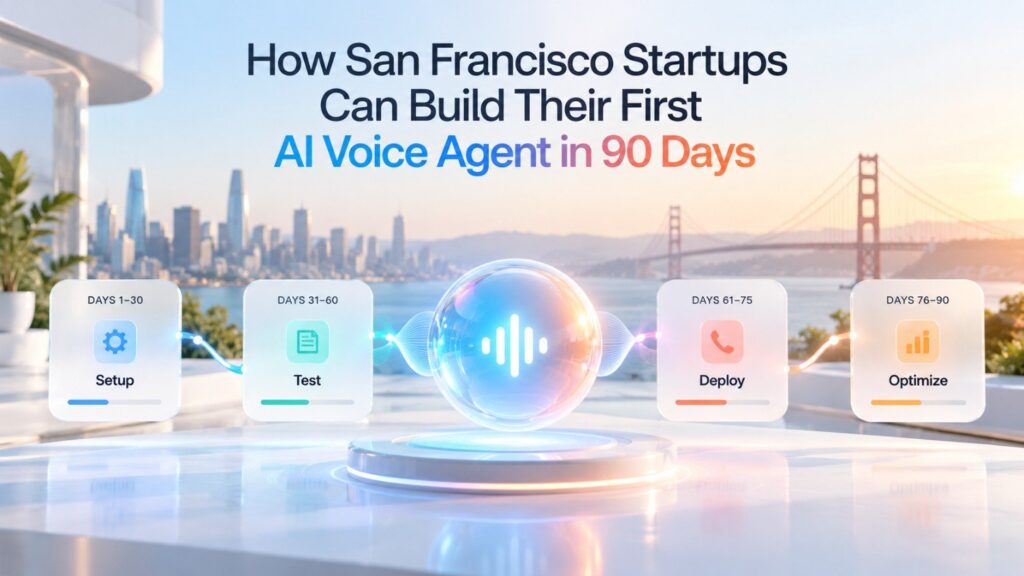
A better approach is to build one reliable workflow, test it with real conditions, and expand based on measured results.
Days 1–15: Find the most suitable business problem
Start with the calls customers already make.
Review historical call reasons, handle times, repeat contacts, and missed calls. Identify which requests are common and have clearly defined outcomes.
A business receiving thousands of calls should not automatically target the category with the highest volume.
It should identify tasks that are both costly enough to matter and simple enough to automate safely.
For example, a medical office might begin with appointment confirmations rather than attempting to answer every patient question.
A property management company might start with routine maintenance request collection rather than complex disputes.
By the end of the first two weeks, the team should have a narrow use case, a definition of success, baseline human performance, and a list of situations requiring immediate escalation.
Days 16–30: Build the workflow and connect the right information
Next, map the conversation from beginning to end.
What does the customer want? What information is needed? Which system contains that information? What action should the agent take, and what should happen if something goes wrong?
The team should build around these questions instead of writing a large collection of impressive-sounding responses.
A reservation agent, for example, should know how to find an existing reservation, check availability, update the booking, and confirm that the change was saved.
It should also know when to stop.
If the booking platform is unavailable, the agent should not pretend that the update succeeded.
If the customer asks for something beyond the approved workflow, it should explain the limit and offer a useful next step.
Days 31–45: Test difficult conversations
The first working version should be tested with more than friendly demonstrations.
Have testers use different speaking styles, background noise, accents, and levels of patience.
Ask them to interrupt the agent, provide incomplete details, change their minds, and request actions the system is not authorized to perform.
Test wrong phone numbers, unavailable appointments, missing account records, and slow external systems.
Every failure should lead to a specific improvement in the workflow, validation rules, or escalation process.
A successful test is not one in which the AI always answers confidently. It is one in which the system either completes the task correctly or recognizes when it cannot.
Days 46–60: Run a controlled pilot
Introduce the agent to a limited group of real customers or a small share of incoming calls.
Keep a dependable human fallback available.
Compare the pilot against baseline performance. Track verified resolutions, repeat contacts, transfers, average handling time, total cost, and critical errors.
Make sure customers can reach a person when needed.
The team should review failed conversations regularly and identify whether the problem came from speech recognition, business information, the AI’s reasoning, or an external system.
These causes require different solutions.
A pronunciation problem is not fixed the same way as an incorrect refund policy.
Days 61–75: Improve outcomes before increasing volume
This stage should focus on repeatable weaknesses.
If customers regularly interrupt, simplify the agent’s responses and improve interruption handling.
If account lookups are slow, examine the connected systems.
If the agent gives incorrect answers about policy, improve the approved source information and restrict unsupported responses.
If transfers are frequent, determine whether the AI lacks permission, information, or ability.
Some calls should continue going directly to employees. Forcing the system to handle work outside its abilities can create more cost than it saves.
Days 76–90: Decide whether to expand
By the final phase, the startup should have enough pilot information to make a more informed decision.
Expansion should depend on verified business outcomes rather than enthusiasm for the technology.
The company should examine actual cost per successful resolution, failure severity, customer feedback, and whether employees are truly saving time.
If the results are positive, the team can expand to more calls or add one related workflow.
If the results are weak, it may be better to narrow the use case, improve the underlying process, or leave that category of calls with human employees.
The strongest deployments will treat the first 90 days as the beginning of ongoing improvement, not the end of the project.
The Legal and Privacy Risks San Francisco Businesses Cannot Ignore
AI-generated voices are subject to calling rules
Businesses cannot assume that using an AI agent makes an outbound phone campaign legally different from other automated calls.
In February 2024, the Federal Communications Commission confirmed that AI-generated voices fall within the Telephone Consumer Protection Act’s restrictions on artificial or prerecorded voice calls.
The exact consent obligations depend on the type of call, recipient, purpose, and other circumstances. Marketing calls can face stricter requirements than certain informational communications.
Federal Communications Commission
Businesses planning outbound AI campaigns should obtain appropriate legal review before placing calls.
California has strict call-recording requirements
California generally requires consent from all parties before recording confidential communications covered by Penal Code Section 632.
That matters because voice AI systems commonly offer transcripts, call recordings, and analytics.
A company should not assume that recording a conversation is permitted simply because the system can do it.
Office of the Attorney General
Call disclosure, consent collection, recording settings, retention periods, and cross-state calling rules should be reviewed carefully.
Even when a specific disclosure is not required by law, clearly telling a customer they are speaking with an AI assistant can help avoid confusion and build trust.
Outbound AI sales calling carries additional risks
Some founders may see voice AI as an inexpensive way to place enormous numbers of sales calls.
That approach can create legal exposure and reputational damage.
The Federal Trade Commission’s Telemarketing Sales Rule places restrictions on deceptive telemarketing, prerecorded sales messages, calling practices, and customer opt-out rights. Businesses must assess applicable FCC rules and federal and state laws together.
Federal Trade Commission
+1
An AI voice platform’s ability to make calls does not establish that a particular campaign is lawful.
A compliant system needs appropriate consent procedures, clear identification, suppression lists, and reliable ways to honor requests not to be called.
Why the Next Big Winners May Be Specialized AI Voice Startups
General voice technology is becoming easier to access
A startup building a voice agent today can use existing infrastructure instead of developing every technical component itself.
This can reduce the effort required to create a working product.
But it also makes basic voice capabilities less distinctive.
If hundreds of businesses can build an agent that answers the phone, simply offering an AI receptionist may not be enough to create a lasting competitive advantage.
The more valuable opportunity is understanding what happens after the customer speaks.
A company serving dental clinics needs to understand scheduling rules, appointment types, insurance-related questions, cancellations, and practice software.
A company serving repair businesses needs to understand service areas, technician availability, urgency, dispatch rules, and job tracking.
That industry knowledge can be more difficult for a competitor to copy than a generic conversational interface.
Deep integrations create greater business value
An AI agent that only answers questions can be useful.
An agent that completes work across the systems a business already uses can become much more valuable.
For example, a home services voice agent could collect an incoming request, check technician availability, create a job, send a confirmation, and update the customer record.
A specialized product that handles this workflow reliably may be worth more to a customer than a general voice platform with a lower per-minute price.
But integration also creates responsibility.
When an AI system can change customer records, approve transactions, or schedule work, mistakes can have real financial consequences.
Strong permissions, testing, audit logs, and easy ways to reverse incorrect actions are essential.
Trust may become a larger advantage than voice quality alone
Voice models are improving, and natural-sounding speech is becoming more widely available.
As that happens, customers may become less impressed by an AI that simply sounds human.
They will care more about whether it is accurate, respectful, easy to interrupt, and capable of completing the requested task.
Businesses will care about those things too, along with cost, reliability, security, and how quickly employees can take over when necessary.
The companies that build dependable systems may be better positioned than those focused mainly on producing the most realistic voice.
What Investors Should Watch in San Francisco’s Voice AI Market
Funding announcements help identify companies attracting attention, but they do not prove that a business model is sustainable.
A voice AI startup may grow quickly while facing high processing costs, demanding enterprise customers, and ongoing engineering work.
Investors should look beyond the number of calls handled.
Revenue quality matters more than raw call volume
A platform processing millions of conversations may have substantial demand.
But investors still need to understand what customers pay, how much it costs to deliver the service, and whether those customers continue using it.
Usage-based revenue can grow rapidly as call volume rises. It can also fall when customers reduce usage or shift to another provider.
The key question is whether a company is becoming an essential part of its customers’ operations.
A voice agent deeply connected to scheduling, billing, and customer support may be harder to replace than a basic phone-answering tool.
Margins depend on the full technology stack
Voice AI services can involve several paid components.
A provider may need telephone connections, speech processing, AI reasoning, voice generation, monitoring, customer support, and specialized infrastructure.
A low selling price does not guarantee a healthy profit margin.
Investors should examine gross margin after variable costs, along with the technical and support costs required to keep large customers satisfied.
A company serving regulated industries may also need expensive security controls, compliance reviews, and dedicated customer engineering.
These expenses can be worthwhile, but they must be reflected in the business model.
Reliability becomes more important at scale
A system that performs well during a small trial may face new challenges when thousands of customers call at once.
Traffic spikes, service interruptions, slow business databases, and model-provider outages can all affect performance.
Enterprise customers may need backup providers, tested failover procedures, clear support commitments, and predictable service levels.
As the market grows, these operational capabilities may become major reasons customers choose one platform over another.
What Businesses Should Ask Before Buying an AI Voice Agent
A well-designed product demonstration can make almost any modern voice agent sound impressive.
The buying decision should focus on what happens during real operations.
Businesses should ask vendors to demonstrate the actual workflows they need, including unusual cases and failed system connections.
They should also insist on a complete cost estimate.
That estimate should include telephone charges, AI processing, fixed platform fees, integrations, quality review, support, security, and expected human fallback.
The vendor should explain how the agent identifies customers, protects data, confirms important details, and transfers a conversation when it cannot safely complete the request.
It is also important to understand what happens if the vendor experiences an outage.
Can calls be routed to employees? Will customers hear a useful message? Can the business recover records and continue operating?
Finally, buyers should request evidence that the platform improves the specific outcomes they care about.
A high automation rate may be attractive, but verified customer resolutions, fewer repeat calls, and dependable service are stronger indicators of business value.
The Future of AI Voice Agents in San Francisco Through 2027
The next phase of voice AI is likely to involve more capable systems that work across phone calls, text messages, chat, and business software.
A customer might start a request by phone and receive a written confirmation with the details already completed.
Another customer might begin with a web chatbot, then switch to a voice conversation without having to explain everything again.
For companies, the opportunity is to create one connected customer service process rather than separate systems that cannot share information.
However, this future depends on reliable identity checks, consistent records, and careful management of what AI systems are allowed to do.
Voice AI may change staffing rather than remove every job
Some routine tasks can be automated, but difficult customer problems still require people.
As AI handles more predictable conversations, human employees may spend a larger share of their time on exceptions, complaints, complex decisions, and relationships.
That can improve the quality of work when companies provide the necessary training and support.
It can also create pressure on staffing levels in roles where repetitive calls make up most of the workload.
The outcome will depend on how individual businesses adopt the technology, how customers respond, and whether automation delivers real operational benefits.
It is too early to assume that every call center will become fully automated.
The strongest products will be judged by completed outcomes
San Francisco’s voice AI companies are helping move business calling away from fixed phone menus and toward conversational systems that can take action.
The market is already large enough to attract major investment and serious enterprise deployments.
But the technology still faces important challenges around accuracy, interruptions, compliance, privacy, and cost.
Our original financial analysis shows why the business opportunity is real. Under clearly stated assumptions, even partial automation can offset AI usage costs, while call length and pricing structure can meaningfully change the economics.
The same analysis also explains why buyers need to be careful. Small differences in assumptions can change the result, and a cheap conversation is not necessarily a successful one.
Final Takeaway: San Francisco’s Voice AI Revolution Will Be Won by Companies That Resolve Calls, Not Just Answer Them
San Francisco startups are changing how businesses communicate with customers over the phone.
Bland is building systems for complex business conversations. Vapi is giving developers the infrastructure to create customized voice agents. Retell is making phone automation more accessible, while Rime is working on the underlying spoken experience.
These companies represent different parts of the same shift: business phone calls are becoming connected software workflows that can understand requests, use information, and complete approved actions.
The financial opportunity is meaningful, but the economics require more careful analysis than a simple price-per-minute comparison.
SFTechScene’s original models show that fixed platform fees can change which pricing plan makes sense, longer conversations can raise costs substantially, and an AI system may create savings before it resolves most incoming calls.
The research also points to a larger lesson.
Businesses should not rush to automate every conversation. They should begin with tasks that are clear, frequent, measurable, and safe. They should connect agents to dependable business systems, make human support easy to reach, and measure whether customer problems are truly solved.
For founders, the strongest opportunity may be building specialized solutions that understand how a particular industry operates.
For investors, the important questions are whether customers continue paying, whether the business has healthy margins, and whether its systems remain dependable as usage grows.
For business leaders, the decision is simpler: does the AI improve customer service and create more value than it costs?
The next generation of successful voice AI companies will not be defined by how many calls their technology can answer or how closely their voices resemble human speech.
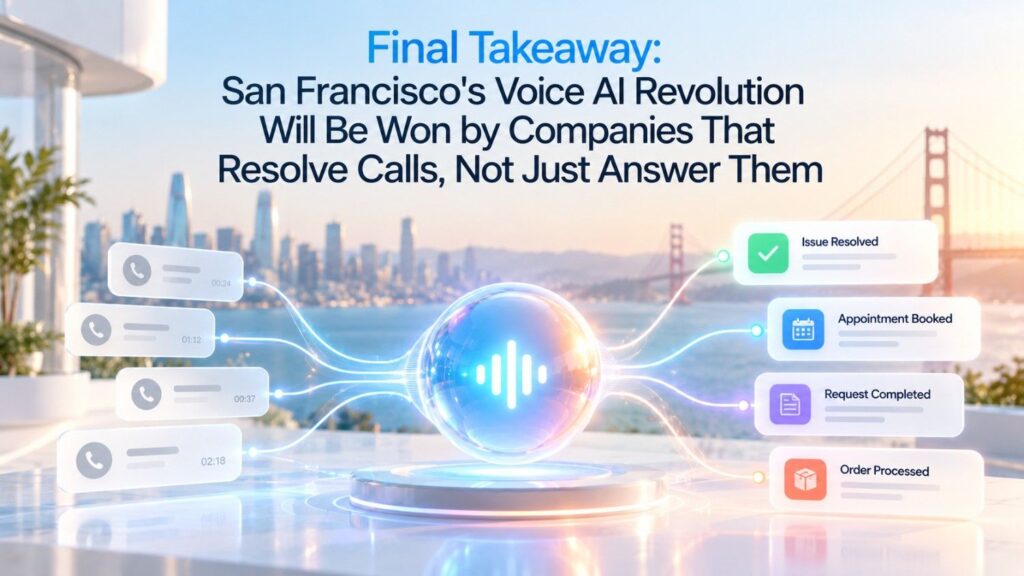
They will be defined by how consistently they can turn a customer conversation into the right business outcome.
That is where San Francisco’s AI voice agent revolution becomes a lasting business transformation rather than another short-lived technology trend.
Research Sources and Methodology Notes
The following public materials were used to ground company developments, pricing, and legal information in this article. SFTechScene’s financial calculations are original analytical models developed from these inputs, not vendor-reported ROI results.
| Source | Information used |
|---|---|
| Bland AI — Official Pricing | Published per-minute rates, fixed fees, and included services |
| Vapi — Official Pricing | Hosting price, model pass-through costs, and plan structure |
| Retell AI — Official Pricing | AI voice agent price range and platform capabilities |
| Twilio — US Voice Pricing | Local inbound and outbound telephone rates |
| Bland — June 2026 Funding Announcement | Series C financing and company-reported conversation volume |
| Vapi — May 2026 Funding Announcement | Series B financing and platform activity |
| TechCrunch — Rime Funding Report | Rime’s funding, technology focus, and enterprise challenges |
| FCC — AI Voice Declaratory Ruling | Federal treatment of AI-generated voices under telephone calling rules |
| FTC — Telemarketing Sales Rule Guidance | Telemarketing disclosure, consent, and operational considerations |
| California Department of Justice — Penal Code 632 | California’s confidential communication recording requirements |
Methodological limitations: All modeled scenarios use stated assumptions and publicly listed prices, not actual enterprise invoices. They exclude some costs such as setup, system integration, quality assurance, fraud losses, and taxes. The modeled results should be recalculated using real operating data before making a purchasing or investment decision. No independent live-call benchmark or private customer dataset was collected for this analysis.