
SFTechScene Research Report | October 30, 2026
What happens when a company no longer needs a human developer to write every line of code, fix every bug, or test every software update?
That question is becoming much more important for San Francisco startups. For years, the biggest challenge in building a software company was finding enough skilled engineers. Today, companies like Cognition AI are trying to change the economics of software development by creating AI systems that can carry out entire coding assignments with limited human help.
Cognition’s autonomous AI software engineer, Devin, can explore a codebase, plan changes, write software, run tests, and prepare work for review. Instead of helping a developer finish individual lines of code, Devin is designed to take responsibility for larger pieces of work.
The business opportunity is enormous. A startup that once needed eight engineers to build and maintain its product might eventually complete the same amount of work with a much smaller team supported by several AI agents. However, producing code and running a reliable software business are two very different challenges.
That difference is what makes Cognition’s story so important.
In September 2026, Cognition announced that it had raised more than $2 billion in a funding round valuing the company at $48 billion. Later that month, it reported crossing $1 billion in annualized revenue run rate, showing how quickly demand for its software engineering products had grown. Both figures come from Cognition’s own announcements, and annualized revenue run rate should not be confused with audited annual revenue. Cognition+1
Yet the most important question for San Francisco founders is not how much Cognition is worth. It is whether tools such as Devin can actually reduce engineering costs, increase output, and help companies build reliable products without expanding their development teams.
To investigate this, SFTechScene examines Cognition’s published results, independent research on AI coding performance, federal software developer wage data, and the changing economics of engineering work.
We also introduce original, reproducible financial models that estimate when autonomous coding becomes profitable, how much human review remains necessary, and why removing an entire development team is far harder than automating individual tasks.
The central finding is clear: autonomous AI engineers can already increase the amount of software work a company can attempt, but their ability to replace human teams depends on reliable completion, human review costs, and the kinds of decisions that cannot be reduced to coding assignments.
The Short Version: Devin Is Changing Software Engineering, but Replacing an Entire Team Is a Much Bigger Challenge
Cognition is building toward a world where software engineers spend less time implementing individual changes and more time planning, supervising, and checking work completed by AI systems. Devin represents one of the clearest commercial attempts to make that model practical.
Unlike older coding assistants, which mainly suggested code inside an editor, autonomous coding agents can operate across several steps. They can inspect files, modify software, execute commands, identify problems, and repeat the process before presenting a result.
This creates a new way for development teams to work. Instead of one engineer manually completing every assignment, a senior developer might oversee several AI agents working on separate tasks at the same time.
However, independent research reveals an important warning.
A 2025 randomized study by METR found that experienced open-source developers using AI tools took 19% longer to complete assigned work than developers working without them. A February 2026 follow-up suggested newer tools might perform better, but the researchers said the newer estimates were too uncertain to establish a reliable productivity gain. Metr+1
This does not mean Devin is ineffective. METR primarily studied different AI coding tools and workflows, not a controlled trial of Devin’s current enterprise product. It does mean that impressive demonstrations are not enough to prove that a business can reduce its engineering workforce.
The following findings frame our analysis.
Cognition’s reported valuation, September 2026
$48B
Company funding announcement
SF metro software developer median wage
$186,640
May 2025 BLS wage data
Independent early-2025 AI productivity finding
19% slower
METR randomized study
Modeled break-even success rate
31.3%
SFTechScene illustrative task-cost model
Sources: Cognition, BLS and METR. The break-even rate is an original calculation under stated assumptions, not a measured Devin success rate. Cognition+2
Three important conclusions emerge from these numbers.
First, the financial pressure to automate engineering is particularly strong in San Francisco because software developer compensation is high. Even modest improvements in engineering productivity can create meaningful economic value.
Second, faster code generation does not automatically lead to faster product development. Companies must consider testing, review, corrections, security, and the time needed to understand a customer’s actual problem.
Third, AI engineering agents are likely to change the structure of development teams before they replace those teams entirely. The strongest near-term business model may involve fewer repetitive assignments for human engineers and more responsibility for technical planning, product quality, and system design.
What Is Cognition AI, and Why Has Devin Attracted So Much Attention?
Cognition was founded in 2024 with the goal of building AI systems that can perform software engineering work. Its most visible product, Devin, helped popularize the idea of an AI software engineer that can handle assignments instead of simply responding to coding questions.
The original Devin launch in March 2024 was important because it presented software development as a complete workflow. The system could set up development environments, explore source code, reproduce bugs, make changes, and run tests. Cognition+1
These capabilities offered something different from autocomplete tools.
A traditional coding assistant might suggest the next function while a developer types. An autonomous agent can receive an instruction such as fixing a payment-processing bug and then attempt to complete the related technical steps.
That shift changes how businesses think about engineering work.
Devin Is Designed to Complete Assignments, Not Just Suggest Code
Consider a San Francisco startup that operates a subscription billing platform.
A customer reports that invoices sometimes display the wrong amount after a plan upgrade. Under a traditional development process, an engineer would investigate the issue, identify the affected code, reproduce the bug, write a fix, add tests, and submit the change for review.
With an autonomous coding agent, the engineer may be able to delegate much of that process.
The agent could search the codebase for the invoice calculation logic, examine related tests, identify a likely cause, create a proposed fix, and prepare the result for human approval.
The difference is not simply that the agent writes code faster. It can reduce the amount of direct attention required from the developer while the task is being investigated and implemented.
This becomes particularly valuable when a company has dozens of well-defined problems waiting in its engineering backlog.
The Difference Between Coding Assistance and Autonomous Engineering
| Capability | Traditional coding assistant | Autonomous AI engineer |
|---|---|---|
| Suggest individual lines | Yes | Yes |
| Explain existing code | Yes | Yes |
| Search multiple files | Often | Yes |
| Plan multi-step changes | With developer guidance | Designed to plan tasks |
| Execute code and tests | Depends on tool | Core workflow |
| Repair failed attempts | Usually developer-led | Can attempt independently |
| Work on delegated tasks | Limited in basic autocomplete | Core use case |
| Decide business priorities | Human | Human approval still needed |
| Own production outcomes | Human | Human organization remains accountable |
These categories describe typical workflows rather than strict product limits. Modern coding assistants have gained agent features, so the difference between the two groups is becoming less clear.
The important distinction is how much work happens without continuous human direction.
An autocomplete tool helps a developer perform an action. An autonomous agent is designed to carry out a sequence of actions after receiving an objective.
Cognition Is Building More Than a Single Coding Agent
Cognition’s July 2025 agreement to acquire Windsurf was another important step in this strategy.
Windsurf focused on AI-assisted development inside the coding environment, while Devin was built around delegated, autonomous work. Combining those approaches gave Cognition a way to serve engineers who want immediate assistance and teams that want tasks completed in the background. Cognition
By September 2026, Cognition was describing a broader software engineering platform. Its announcements highlighted features such as automated incident investigation, security analysis, and workflows that can begin when events occur in tools like GitHub, Slack, and Linear. Cognition
That direction matters because software engineering is not a single activity.
Companies need to discover problems, understand existing systems, write changes, test those changes, respond to failures, and maintain software over time.
If an AI platform can connect more of those activities, it can influence a much larger share of engineering spending than a basic code-writing assistant.
How Devin Works: From a Software Task to a Proposed Solution
Understanding Devin’s business potential requires examining what happens after an engineer assigns it a task.
A successful autonomous workflow generally includes several stages, each creating opportunities for productivity gains and possible failures.
Human engineer defines the taskRequirements, limits and expected result
1. Explore
Read code and dependencies
2. Plan
Choose steps and files
3. Execute
Write and modify code
4. Validate
Run tests and fix errors
Agent proposes a code changeTests, explanation and review material
Human review and release decision
Security, product fit and production safety
Step 1: Understanding the Assignment
An AI agent needs to know what problem it is supposed to solve.
A request such as “improve our application” is too broad to evaluate properly. A request that identifies a specific bug, expected behavior, relevant files, test requirements, and limits on changes creates a much clearer assignment.
This is why the quality of engineering tickets becomes more important as companies adopt AI agents.
A vague ticket forces the agent to make assumptions. When those assumptions are wrong, the system may produce working code that solves the wrong problem.
Step 2: Exploring the Existing Software
Most business software is connected to other systems.
A small change to a customer account page might affect authentication, billing, permissions, database records, and external services. An agent must understand enough of these connections to avoid introducing new problems.
Devin can inspect code and use software development tools to build a picture of the system it is modifying.
However, reading the repository is not the same as understanding every business rule. Some requirements exist only in past decisions, customer conversations, or knowledge held by experienced employees.
That missing context can become one of the biggest limits on autonomy.
Step 3: Writing and Testing Code
Once the agent has a plan, it can make changes and execute tests.
When tests fail, the agent can investigate the results and try another solution. This repeated cycle is one of the features that separates autonomous engineering from basic code generation.
Testing is essential because code can look correct while behaving incorrectly.
A new feature might work for a typical user but fail when a customer has unusual account settings. It might pass a unit test while creating a security issue or increasing the cost of operating the service.
Step 4: Preparing Work for Human Review
The completed change needs to be understood by someone responsible for the software.
Engineers must decide whether the change meets the original requirements, follows the team’s standards, and introduces acceptable risks.
A passing test suite is useful evidence, but it is not a complete guarantee.
A software company must also consider whether a change is desirable, whether it can be maintained, and what happens if it fails after release.
Why Cognition’s 2026 Growth Matters for San Francisco’s AI Industry
Cognition’s commercial growth suggests that autonomous software engineering is moving beyond experimental tools.
In September 2026, the company reported almost $900 million in annualized revenue run rate when announcing its Series E funding. Later that month, it reported reaching $1 billion. These were company-reported run rates, not independent measures of customer productivity. Cognition+1
The distinction matters. Strong sales show that customers are willing to pay for a product. They do not prove that every customer earns a positive return.
Enterprise Adoption Is Becoming a Major Part of the Story
Cognition has announced work with companies operating in finance, manufacturing, professional services, and other industries.
Its September 2026 announcement named customers or deployments involving companies such as NVIDIA, Citi, Mercedes-Benz, and GE Aerospace. Earlier announcements described partnerships with large services firms including Infosys and Cognizant. Cognition+2
These deployments are especially interesting because large enterprises often have complicated existing software.
They may use older programming languages, maintain thousands of internal applications, and operate systems that cannot tolerate frequent failures.
For these companies, automated engineering is not only about building new applications. It can also involve maintaining older systems and completing improvements that employees have postponed for years.
The Mercedes-Benz Example Shows the Potential of Narrowly Defined Work
In April 2026, Cognition reported that Devin helped analyze more than 200,000 lines of COBOL code during a Mercedes-Benz modernization project. Cognition said the work reduced an estimated eight-month effort to eight days. Cognition
This is an important example, but the reported time comparison needs careful interpretation.
The eight-month figure was an estimate, not necessarily the result of running an equivalent human-only project alongside Devin. The public case study also does not establish that an entire engineering team could be eliminated while maintaining the same long-term quality and accountability.
What the example does show is why software modernization may be a strong market for autonomous agents.
Large organizations often have well-defined, expensive technical work that adds limited immediate product differentiation. If AI can perform parts of that work reliably, developers can spend more time on projects that directly help customers.
Why San Francisco Startups Should Watch This Market
San Francisco has a large concentration of software companies, AI researchers, investors, and experienced engineers.
That concentration creates two opposing forces.
On one hand, the region’s high labor costs encourage businesses to automate work. On the other, local companies often build complex products where reliability, security, and technical judgment are critical.
For many startups, the best opportunity may not be replacing every engineer.
It may be giving a small engineering team the ability to handle work that would previously have required a much larger organization.
Original SFTechScene Research #1: Why San Francisco Has a Strong Financial Incentive to Adopt AI Software Engineers
To understand the financial opportunity, we start with public wage data.
The U.S. Bureau of Labor Statistics reported a median annual wage of $186,640 for software developers in the San Francisco-Oakland-Fremont metropolitan area in May 2025. The reported median for the United States was $135,980. Software Developers+1
This creates a measurable regional wage difference.
Research Methodology
Our first analysis uses the BLS Occupational Employment and Wage Statistics data for software developers, occupation code 15-1252.
We compare the published metropolitan median with the national median for the same occupation and survey period. We calculate the difference in dollars and as a share of the national wage.
This is a descriptive analysis of public wage data. It does not measure how much AI improves productivity or how many developers companies will replace.
Finding #1: The San Francisco Wage Premium Is Approximately 37.3%
Median annual software developer wages
BLS May 2025 estimates, USD per year.
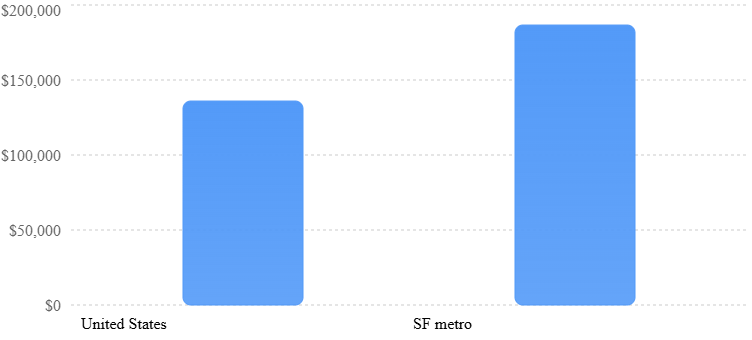
Source: BLS May 2025 Occupational Employment and Wage Statistics, software developers. Software Developers
The difference is $50,660 per year.
Dividing that difference by the national median gives a regional wage premium of approximately 37.3%.
This premium does not mean that every developer in San Francisco earns more than every developer elsewhere. It describes the difference between two regional medians.
Still, it helps explain why software automation has particular financial appeal in the Bay Area.
A company that can eliminate 100 hours of unnecessary engineering work creates more potential dollar savings when those hours are expensive.
Finding #2: Engineering Compensation Creates a Large Cost Base
BLS wage data measures cash wages rather than the full cost of employing someone.
Employers may also pay payroll taxes, health benefits, retirement contributions, equipment costs, and other expenses. To illustrate how these additions could affect financial decisions, we use three assumed employment-cost multipliers.
| Model | Annual cost per developer |
|---|---|
| BLS median wage only | $186,640 |
| Wage plus 20% | $223,968 |
| Wage plus 30% | $242,632 |
| Wage plus 40% | $261,296 |
SFTechScene calculations using the BLS median as a base. The additional percentages are scenarios, not measured regional benefit rates.
A five-developer startup using the 30% illustration would have approximately $1.21 million in annual employment costs for those roles.
A ten-developer team would cost approximately $2.43 million under the same assumptions.
Neither calculation includes recruiting expenses, office costs, management overhead, or infrastructure.
These numbers reveal why even a modest gain in productivity can matter.
If a company can increase useful engineering output by 20% without hiring more developers, the economic benefit could be significant. However, that benefit only becomes real when improved capacity translates into useful work, lower actual costs, additional revenue, or avoided hiring.
Finding #3: The Financial Incentive Is Not the Same as Proof of Replacement
A common mistake in discussions about autonomous AI is comparing an engineer’s annual salary with the monthly price of an AI tool.
The comparison sounds impressive because software subscriptions are usually much cheaper than salaries.
However, one AI subscription is not automatically equal to one full-time software engineer.
A human developer contributes judgment, product understanding, communication, accountability, and experience with the company’s systems. The value of an AI tool depends on which of those responsibilities it can perform and how much human work remains.
The relevant financial measure is therefore not subscription cost divided by salary.
It is the total cost of completing an accepted, useful software task, including the time needed for supervision, review, correction, and release.
That leads to our second original analysis.
Original SFTechScene Research #2: When Does an Autonomous AI Engineer Actually Save Money?
Most AI software engineering discussions focus on how quickly an agent can generate code.
For businesses, this is the wrong starting point.
A company should care about the amount of accepted work it receives and the cost of producing that work. It should not treat every generated code change as an improvement.
To make this distinction measurable, SFTechScene developed a task-level economic model.
Research Question: How Reliable Must an AI Agent Be to Create Positive Value?
Imagine a San Francisco startup with 100 planned engineering tasks.
For the example, assume each task would ordinarily require six hours of human work, and that 60 of the tasks are suitable for AI delegation.
We examine three possible agent success rates: 40%, 70%, and 90%.
These are hypothetical scenarios, not reported Devin success rates.
The Assumptions Behind the Model
| Variable | Illustrative assumption |
|---|---|
| Total engineering tasks | 100 |
| Tasks suitable for delegation | 60 |
| Human effort per task | 6 hours |
| Human labor cost | $120/hour |
| Review time for a successful AI task | 1.2 hours |
| Investigation overhead after a failed attempt | 2 hours |
| Additional AI usage cost per attempt | $15 |
| Number of AI attempts | 60 |
The $120 hourly labor cost is a rounded planning assumption. It is close to the annual cost implied by the BLS median plus our illustrative 30% employment-cost adjustment, divided by approximately 2,020 paid hours.
The $15 agent usage cost is also an assumption, not a published universal Devin price. Actual spending depends on the customer’s plan, included usage, models, task complexity, and any additional charges.
Under the model, a successful AI attempt saves 4.8 human hours because the engineer still spends 1.2 hours reviewing work that would otherwise have required six hours.
A failed attempt creates two hours of extra investigation and review, after which the human must still complete the original six-hour task. The model assumes that the failed attempt produces no reusable work.
Finding #1: Reliability Has an Enormous Effect on Savings
Net human hours saved per 60 delegated tasks
SFTechScene illustrative workload model; higher is better.
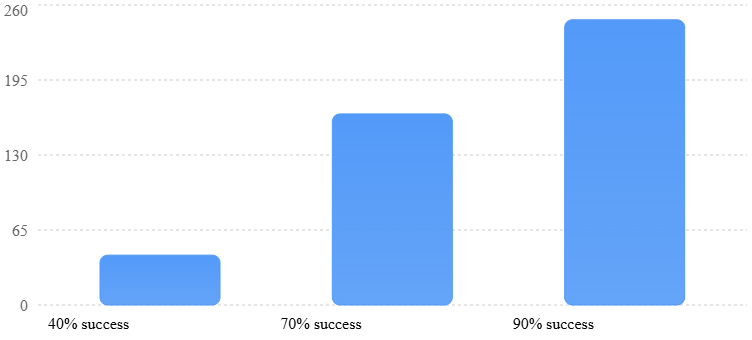
| Agent success rate | Net human hours saved | Labor value | Net value after $900 AI cost |
|---|---|---|---|
| 40% | 43.2 | $5,184 | $4,284 |
| 70% | 165.6 | $19,872 | $18,972 |
| 90% | 247.2 | $29,664 | $28,764 |
These figures are calculated, not observed.
At a 40% success rate, the agent creates relatively modest savings because failed attempts consume human time.
At 90%, the value becomes much greater. The same volume of AI assignments saves over five times as many human hours as the 40% scenario.
This suggests that businesses should prioritize reliable completion over impressive demonstrations of raw coding speed.
Finding #2: The Break-Even Success Rate Is Approximately 31.3%
The model can also identify how frequently an agent must succeed before it becomes economically worthwhile.
Let \(p\) represent the probability that a delegated task succeeds.
The expected human hours saved per attempt are:
\[ 6p-1.2p-2(1-p)=6.8p-2 \]
Across 60 attempts, the labor value is:
\[ 60(6.8p-2)(120) \]
Subtracting the assumed $900 in AI usage costs gives:
\[ \text{Net value}=7{,}200(6.8p-2)-900 \]
Setting net value equal to zero gives:
\[ p=\frac{2.125}{6.8}\approx31.25\% \]
Under these assumptions, the system needs to successfully complete just over 31% of the delegated tasks to create positive direct economic value.
That does not mean companies should accept a 31% success rate in production.
Poor quality can create costs that this simple model does not fully capture, including security failures, customer disruption, damage to trust, and delayed releases.
The break-even result only describes the specific workflow and financial assumptions used here.
Explore the Model With Different Assumptions
AI engineering ROI calculator
60 delegated tasks · 6 human hours per task · 2 hours lost per failed attemptTask success rate
70%Human review time per successful task
1.2 hoursLabor cost per hour
$120AI cost per attempt
$15
Net human hours saved
165.6h
Net modeled financial value
$18,972
Break-even success rate
31.3%
Assumed total AI usage spend
$900
This interactive model is for planning, not a prediction of Devin’s performance. It excludes subscription minimums, integration costs, incident losses, taxes and uncertain downstream effects.Reset assumptions
Finding #3: AI Can Create Value Even Without Replacing a Single Employee
Under the 70% scenario, the model saves 165.6 human hours across 100 planned tasks.
That represents 27.6% of the original 600-hour workload.
However, it does not prove that a company can remove 27.6% of its engineering staff.
The remaining work may be spread across multiple people. Engineers may need to supervise several systems, handle unpredictable incidents, and complete assignments that are difficult to delegate.
For a growing startup, those hours might be used to build more features, reduce a backlog, or improve testing.
For a business with stable demand, the savings might allow management to avoid additional hiring.
The same technical improvement can therefore produce very different financial and employment outcomes.
Original SFTechScene Research #3: What Public AI Coding Benchmarks Actually Tell Us About Replacing Developers
AI coding benchmarks have improved dramatically since Devin was introduced.
However, comparing results across different years, datasets, and testing methods can create a misleading picture of progress.
A model that performs well on a carefully defined software issue may still struggle with a product decision that requires conversations with customers, knowledge of business goals, and an understanding of long-term risks.
Devin’s Original SWE-bench Result Was an Important Starting Point
In its original 2024 technical report, Cognition said Devin completed 79 of 570 selected SWE-bench issues.
That produced a success rate of 13.86%. Cognition evaluated a randomly selected quarter of the original test dataset and compared Devin with earlier coding systems. Cognition
This was meaningful because the agent was attempting to resolve real software issues rather than simply answering coding questions.
However, a 13.86% result from 2024 should not be presented as Devin’s current success rate in October 2026.
Models, tools, workflows, and testing systems have changed substantially.
Newer Coding Models Are Much More Capable
In September 2026, Cognition introduced SWE-2, a model trained for coding-agent tasks.
Cognition reported the following results across several benchmarks. Cognition
| Benchmark | Cognition-reported SWE-2 result |
|---|---|
| FrontierCode 1.1 Main | 50.0% |
| DeepSWE 1.1 | 73.0% |
| Terminal-Bench 2.1 | 92.8% |
| Terminal-Bench 4.0 | 27.3% |
SWE-2 scores vary widely across coding benchmarks
Cognition-reported September 2026 results. These benchmarks evaluate different capabilities.
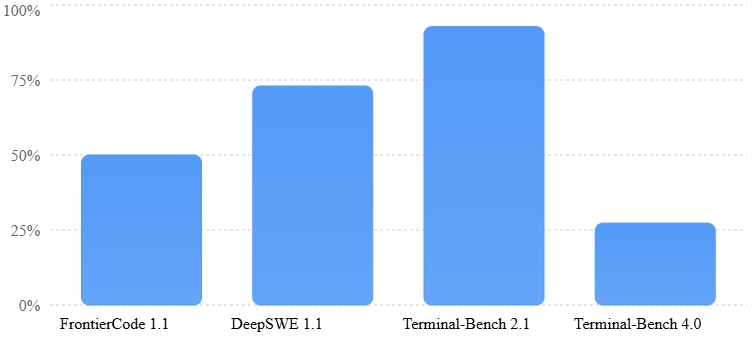
The variation is striking.
SWE-2’s reported result on Terminal-Bench 2.1 was much higher than its result on Terminal-Bench 4.0. This does not mean the model suddenly became worse when moving between the two tests.
It means the evaluations measure different difficulties and cannot be treated as interchangeable measures of overall engineering ability.
For a business deciding whether to adopt Devin, this is critical.
The question is not whether a model can achieve an impressive score on a public benchmark. It is whether it can complete the specific work that the company needs without introducing unacceptable costs or risks.
Independent Results Show Progress, but Not Complete Autonomy
The independent evaluation organization Vals AI reported that Claude Opus 5 reached 97% on SWE-bench Verified as of September 1, 2026.
That is a substantial result on a benchmark of software issue resolution. However, Vals also described SWE-bench Verified as saturated and stopped running it on new model releases. Vals AI
This reveals a growing problem in AI evaluation.
When advanced models become extremely good at a limited set of tasks, the test may stop telling businesses much about their ability to handle more difficult real-world work.
A 97% benchmark score does not mean that an AI agent can replace 97% of a software engineering team.
The benchmark does not cover every responsibility of a developer, product manager, security engineer, technical leader, or operations team.
Cognition’s Own October 2026 Research Highlights the Remaining Problems
On October 27, 2026, Cognition published FrontierCode 2.0, an updated approach to evaluating coding agents.
The company acknowledged that autonomous software engineering still faces major challenges. Its research highlighted problems involving unclear user intentions, unstated requirements, and the long-term consequences of software changes. Cognition
These are exactly the challenges that make replacing complete engineering teams difficult.
A model may be able to fix a bug when the desired behavior is clearly described. It may struggle when the correct behavior depends on an undocumented business decision made six months earlier.
This is a more useful way to understand the future of autonomous engineering.
The industry is moving beyond asking whether agents can write code. The harder question is whether they can make trustworthy engineering decisions when the instructions are incomplete.
Why Benchmark Scores Cannot Be Combined Into a Single Replacement Percentage
One tempting approach would be to average several benchmark results and call that number the share of engineering work AI can replace.
We deliberately avoid doing that.
The benchmarks cover different kinds of problems. They use different scoring rules, test environments, task distributions, and methods of running agents.
A 73% result on one benchmark is not necessarily better evidence of real-world workforce replacement than a 50% result on another.
A rigorous comparison would need the same agents evaluated on the same tasks, under the same cost limits, with the same rules for human help and independent checks of the final results.
Until that evidence is available, claims about replacing entire development teams should be treated as forecasts rather than established results.
Original SFTechScene Research #4: Why a 90% Task Success Rate Still Does Not Mean a Company Can Operate Without Developers
Suppose autonomous coding agents become highly reliable.
Imagine a future system that completes 90% of the engineering tasks assigned to it, with the remaining 10% requiring human intervention.
Would that be enough to operate a software company without developers?
Not necessarily.
The answer depends on whether those remaining failures are isolated, easy to detect, and inexpensive to correct.
Research Methodology: A Multi-Step Reliability Model
For this analysis, we examine what happens when a project requires several separate tasks to succeed.
We model ten required tasks and assume that each one must succeed for the complete project to meet its requirements.
We calculate the probability that all ten succeed under three task-level success rates.
The formula is:
\[ P(\text{all succeed})=p^{10} \]
Here, \(p\) is the success probability for each individual task.
This model assumes the tasks succeed or fail independently, with the same probability of success. Real software failures may be linked, which can produce different results.
Finding #1: High Individual Success Rates Can Still Leave Serious Project Risk
Chance that all 10 tasks succeed on their first attempts
Illustrative independent-task model; no retries or human correction.
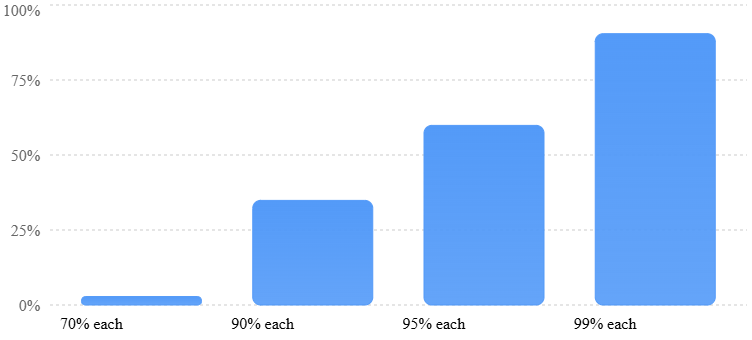
| Individual task success | Probability all 10 succeed |
|---|---|
| 70% | 2.8% |
| 90% | 34.9% |
| 95% | 59.9% |
| 99% | 90.4% |
Even when individual tasks succeed 90% of the time, the chance that all ten succeed on their first attempts is only about 35%.
That does not mean the entire project must fail. Agents can retry, humans can correct mistakes, and software projects often allow some tasks to be delayed.
The result shows why project-level reliability needs to be measured separately from individual task performance.
A system that appears reliable when handling isolated assignments may still need substantial supervision when operating across a larger project.
Finding #2: Failure Detection May Matter as Much as Task Completion
An AI agent that fails openly is often easier to manage than one that confidently produces an incorrect result.
Consider two agents.
The first completes 75% of its assignments correctly and reliably identifies most of the remaining failures. The second completes 85% correctly but often reports incorrect work as finished.
The second agent may appear more capable during demonstrations. However, it could be more dangerous in a production environment if engineers cannot easily distinguish correct results from hidden failures.
This is why companies should track two separate measures.
One is the share of tasks completed correctly. The other is the share of incorrect results detected before deployment.
Human review, automated tests, security checks, and monitoring can improve the second measure.
The business value of an autonomous engineer therefore depends partly on the quality of the systems surrounding it.
Finding #3: Fully Autonomous Operations Require More Than Reliable Code Changes
Even if an AI agent completes nearly every assigned coding task, someone must decide which tasks matter.
A startup might have 200 possible improvements on its roadmap. The correct decision is rarely to build all 200.
The company needs to choose features that solve customer problems, support revenue goals, and fit its available resources.
It must also decide which technical risks are acceptable, how to handle customer complaints, and when to delay a release.
These choices require information that is often outside the codebase.
That makes complete engineering-team replacement a much broader problem than improving task completion rates.
Can Devin Replace Junior Software Developers?
Junior developers are often responsible for smaller coding assignments, basic testing, documentation, and straightforward bug fixes.
Some of those activities are particularly suitable for AI agents because they involve clear instructions and repeatable steps.
This creates real pressure on traditional entry-level development work.
Routine Programming Work Is Becoming Easier to Automate
Consider a junior developer asked to add a field to an internal application.
The task might involve updating a database model, changing a form, adding validation, and writing tests.
If the requirements are clear and the application follows familiar patterns, an autonomous agent may be able to complete much of that work.
Companies may eventually need fewer people working exclusively on basic implementation tasks.
However, junior developers do more than complete simple tickets.
They learn the company’s systems, develop judgment, ask questions, and gradually become experienced engineers who can handle more complex responsibilities.
The Training Problem Could Become a Major Challenge
If startups reduce junior hiring too aggressively, they may create a shortage of experienced engineers in the future.
Senior engineers do not appear fully trained.
They usually develop their abilities by solving increasingly difficult problems, reviewing mistakes, and learning how real products behave.
When AI handles most beginner-level assignments, companies need new ways to develop that experience.
One approach is to give junior engineers responsibility for checking AI-generated work, designing tests, and investigating failures.
This can help them learn, but only if they are encouraged to understand the code rather than simply approve whatever the agent produces.
Junior Engineering Roles May Shift Toward AI Supervision
A junior engineer working with Devin might spend less time writing routine code and more time understanding requirements, reviewing test results, and investigating unexpected behavior.
That could create a faster path toward higher-level engineering responsibilities.
However, it could also weaken technical skills if employees become dependent on AI before understanding how software works.
The outcome will depend on how companies design these roles.
A startup that treats junior engineers as passive AI operators may struggle to build future technical leaders. A company that uses AI to expose junior engineers to more complex projects could create stronger employees.
Can Autonomous AI Replace Senior Software Engineers?
Senior engineers face a different situation.
Their value often comes from decisions that extend beyond individual coding tasks.
They understand why systems were built in particular ways, which failures are most dangerous, and how technical choices affect the business.
Senior Engineers Make Trade-Offs That Are Difficult to Specify
Imagine a San Francisco financial technology startup deciding whether to rebuild its payments system.
The engineering team must consider security, reliability, customer impact, compliance, maintenance costs, and future product requirements.
An AI agent can help research options and implement selected parts of the system.
However, the decision to replace the existing system involves business risks that are not fully captured in code.
An experienced engineer may recommend keeping the current architecture because the migration would introduce more risk than value.
That recommendation might prevent months of unnecessary work.
AI Could Increase the Reach of Strong Technical Leaders
A senior engineer who can supervise several agents may be able to manage more implementation work than before.
Instead of spending hours making repetitive changes, the engineer can review the technical direction, identify dangerous assumptions, and focus on complex problems.
This could make experienced engineers more valuable rather than less.
One highly skilled technical leader working with capable agents might support a startup that would previously have required several implementation-focused developers.
However, supervising more work also creates a new challenge.
When several agents produce changes at once, the human reviewer can become overwhelmed. The company must ensure that review capacity, testing, and system knowledge grow alongside the volume of generated code.
Engineering Leadership Will Become More Important
AI can help execute a strategy, but it does not automatically choose the right strategy.
A company may build features faster while still losing customers because it misunderstands the market.
It may reduce code-writing costs while creating an application that is difficult to maintain.
Senior engineering leaders will increasingly be judged by their ability to manage these risks and convert AI-assisted development into reliable business results.
Which Software Engineering Tasks Are Most Suitable for Devin?
Not every engineering assignment offers the same opportunity for automation.
The strongest early use cases are typically tasks that have clear requirements, measurable results, limited dependencies, and reliable tests.
Tasks involving uncertain goals, sensitive data, or many connected systems may require more supervision.
Practical Task Suitability Assessment
| Engineering task | Typical suitability for early delegation | Main concern |
|---|---|---|
| Add unit tests | High | Whether tests cover the right behavior |
| Update documentation | High | Accuracy and missing context |
| Fix a clearly reproduced bug | High | Hidden side effects |
| Make repeated code changes | High | Consistency across files |
| Upgrade a dependency | Medium to high | Compatibility and security |
| Build a small internal feature | Medium to high | Unclear requirements |
| Migrate older code | Medium | Behavioral differences |
| Improve performance | Medium | Trade-offs and measurement |
| Rewrite payment logic | Lower | Financial and security risk |
| Change access permissions | Lower | Unauthorized access |
| Design core architecture | Lower | Long-term consequences |
| Respond to a major outage | Lower | Time pressure and incomplete evidence |
SFTechScene editorial assessment based on task characteristics. These are not measured Devin success rates and should be validated against each company’s codebase.
Test Generation Is an Attractive Starting Point
Many startups have limited automated test coverage.
Developers often prioritize visible features over tests because customers do not directly see the testing process.
That creates a backlog of useful engineering work.
An autonomous agent may help create tests for existing functions, identify edge cases, and improve coverage.
However, generated tests must be checked carefully. A test that confirms an existing bug is not useful simply because it passes.
Code Modernization Offers Significant Enterprise Potential
Older software systems can be expensive to maintain.
They may use programming languages that fewer developers know or depend on infrastructure that companies want to retire.
Autonomous agents can help teams examine these systems, document their behavior, and perform repeated changes.
Cognition’s published modernization examples suggest why this category has attracted enterprise interest.
Still, businesses need to verify that the new system behaves correctly under real conditions. A successful migration must preserve essential business rules, not merely produce code that runs.
Security Work Is Valuable but Requires Strong Controls
On October 26, 2026, Cognition announced updates to Devin Security, including tools for finding, prioritizing, and helping fix software vulnerabilities. Cognition
This is a natural extension of autonomous coding.
Many security problems require developers to inspect code, understand the source of a weakness, prepare a fix, and test whether it works.
AI agents may help companies handle more of this backlog.
However, security work has a higher cost of failure than ordinary interface changes. Agents should operate with limited permissions, independent checks, and clear rules about deploying changes.
A system that introduces a new vulnerability while fixing an old one has not delivered a successful result.
Original SFTechScene Research #5: Could a Five-Person San Francisco Engineering Team Become a Two-Person Team?
The question of workforce replacement is best examined through capacity rather than salary comparisons.
Imagine a startup with five engineers.
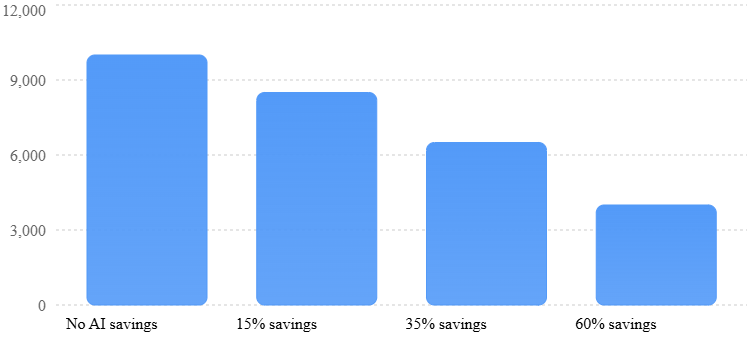
Each engineer contributes 2,000 paid hours annually, creating 10,000 total paid hours. For simplicity, the model treats those hours as a common pool of engineering capacity, although real teams spend time on meetings, support, planning, and other work.
Scenario A: AI Saves 15% of Total Engineering Effort
At a 15% reduction in required human work, the team would need 8,500 human hours to complete the original workload.
That is equivalent to 4.25 full-time positions under this simple model.
The company could potentially avoid some future hiring or redirect available time toward new projects.
It would not necessarily be able to eliminate one entire position because work is not always divided evenly across employees.
Scenario B: AI Saves 35% of Total Engineering Effort
A 35% reduction would leave 6,500 human hours.
That equals 3.25 full-time equivalents.
In this case, the company might consider operating with a smaller core team if its product is stable, remaining tasks are appropriately distributed, and enough technical knowledge is retained.
However, the reduced team would still need to manage emergencies, review changes, and oversee infrastructure.
Scenario C: AI Saves 60% of Total Engineering Effort
A 60% reduction would leave 4,000 human hours.
That is equivalent to two full-time positions.
The mathematical result looks like a five-person team becoming a two-person team. But achieving that outcome safely requires more than saving coding hours.
The remaining two engineers must possess the knowledge and authority needed to cover all critical responsibilities previously shared among five people.
Human engineering hours remaining from a 10,000-hour baseline
Illustrative capacity scenarios, not predictions of Devin adoption.
The Real Constraint Is Coverage, Not Just Capacity
A software company needs people who understand different parts of its operation.
One engineer may specialize in databases. Another may manage cloud infrastructure. A third may understand application security.
Even if AI reduces the total amount of required work, the company cannot assume that any two employees can cover all responsibilities.
This creates a difference between theoretical labor savings and practical team reduction.
A business may have enough work for only two full-time equivalents while still needing access to several kinds of expertise.
For some startups, the solution may involve smaller permanent teams supported by contractors, specialist services, and AI agents.
For others, retaining more engineers may be the safer choice because the cost of losing critical knowledge exceeds the savings.
Why a Smaller Team Might Still Produce More Software
Consider a startup with five engineers and a long product backlog.
If AI reduces the hours needed for routine development, management has several options.
The company could reduce payroll, delay additional hiring, improve existing software, or launch new features.
A fast-growing company may choose the last option because its biggest problem is not excessive staffing. It is the inability to build everything customers want.
This is why autonomous engineering adoption will not translate directly into job losses across every organization.
Some businesses will reduce hiring. Others may use the same team to expand their product offerings.
The effect on employment will depend on customer demand, competitive pressure, and management decisions.
The Biggest Risks Facing Companies That Replace Developers With AI Agents
The economics of autonomous engineering are attractive, but the risks become more serious when companies start depending on agents for essential work.
A tool that occasionally makes mistakes during a small experiment creates limited damage. A system trusted to maintain a company’s most important software can create much larger problems.
AI-Generated Code Can Create Hidden Technical Debt
Technical debt refers to problems that make software more expensive to maintain over time.
An AI agent might produce code that works today but makes future changes harder. It could duplicate existing functions, introduce unnecessary dependencies, or ignore established design patterns.
These problems may not appear in simple tests.
A startup that adopts autonomous coding without strong review standards could initially develop features faster while gradually making its software harder to understand.
The practical solution is to measure long-term quality alongside immediate task completion.
Teams should track how often AI-generated changes need later repairs, whether they increase system complexity, and whether developers can easily understand the results.
Security and Access Controls Become More Important
An autonomous engineer may need access to source code, development tools, internal documentation, and testing environments.
Those permissions create security risks.
A company should avoid giving an agent unrestricted access to production systems merely because it can complete coding assignments.
A safer approach begins with limited repository access, isolated test environments, restricted credentials, and human approval before sensitive changes are released.
Access should expand only after the organization has demonstrated that its controls work.
Incorrect Assumptions Can Spread Across the Product
Software changes frequently depend on one another.
An AI agent might misunderstand how a customer account is supposed to work. If several subsequent changes build on that misunderstanding, the error can spread throughout the application.
This risk becomes greater when multiple agents operate at once.
A company using several autonomous engineers needs shared technical standards and a way to detect conflicting work.
Without those controls, faster implementation may increase the amount of corrective work required later.
Overdependence Can Weaken Internal Engineering Knowledge
If employees stop understanding the systems they maintain, a company becomes more vulnerable when something breaks.
Engineers need enough knowledge to investigate failures even when their AI tools are unavailable or cannot solve a problem.
This is especially important for critical systems.
A startup should regularly test whether its engineers can diagnose and repair important failures without relying entirely on autonomous agents.
AI should expand the team’s capabilities rather than eliminate its ability to operate independently.
The Cost of Review Can Become the New Bottleneck
Suppose five AI agents each generate several proposed code changes every day.
The amount of available code may grow faster than a company’s ability to review it.
Engineers could spend their entire day checking changes, investigating failed tests, and resolving conflicts.
At that point, the company’s bottleneck has shifted from writing code to verifying code.
The solution is not simply adding more agents.
It involves improving test quality, keeping tasks small, reducing unnecessary changes, and making code review more efficient.
How San Francisco Startups Can Adopt Devin Without Damaging Software Quality
A startup should not begin its autonomous engineering strategy by asking how many developers it can remove.
A more useful first question is which engineering tasks can be completed more reliably and economically with AI support.
That creates an evidence-based path toward adoption.
Phase 1: Establish a Human-Only Performance Baseline
Before introducing Devin, measure how the team currently performs.
Choose a representative group of tasks and record the time needed to complete them, including planning, implementation, review, testing, and corrections.
The team should also track whether changes are accepted, whether they cause later defects, and how frequently work must be reopened.
Without this baseline, claims about AI productivity are difficult to verify.
A developer may feel faster because the agent generates code quickly, even when the overall task takes longer due to review and correction.
METR’s 2025 research demonstrated why perceived productivity and measured productivity can differ. METR
Phase 2: Begin With Low-Risk Tasks
The first pilot should focus on work that is easy to define and test.
Good candidates include routine bug fixes, internal documentation, automated testing, and isolated changes to existing features.
Avoid using the initial pilot for critical payment systems, sensitive customer data, or large architecture changes.
The purpose is to learn how the agent performs inside the company’s actual engineering environment.
A small, well-measured pilot is more informative than an impressive demonstration that cannot be repeated.
Phase 3: Compare AI and Human Performance Fairly
For a more rigorous experiment, recruit a set of tasks that are reasonably similar in difficulty.
Randomly assign some to the normal human workflow and others to the AI-assisted workflow. Record the results using the same acceptance standards.
Do not compare only the fastest successful AI assignments against average human work.
The experiment must include unsuccessful attempts, supervision, review, and repairs.
A practical study could use at least 40 to 60 tasks as an initial operational sample, although larger samples may be needed for precise estimates.
The business should report uncertainty rather than assuming that the observed average will remain stable across every type of work.
Phase 4: Measure Accepted Work Rather Than Generated Code
A strong performance scorecard should include both productivity and quality measures.
| Metric | What it reveals |
|---|---|
| Task acceptance rate | Whether assignments meet requirements |
| Total human time per task | Actual labor burden |
| Agent usage cost | Direct AI expense |
| Review time | Supervision required |
| Rework rate | Frequency of corrections |
| Defects after release | Production quality |
| Time to deployment | Overall delivery speed |
| Security findings | New or unresolved risks |
| Developer satisfaction | Whether the workflow is practical |
| Customer outcomes | Whether changes deliver value |
A company should not declare success based on one metric.
For example, a higher task acceptance rate may have limited value if the agent requires unusually long review sessions.
Similarly, lower development costs can be outweighed by an increase in customer-facing defects.
Phase 5: Expand Autonomy Only When Evidence Supports It
After the first pilot, identify the categories where AI performed well.
The company can gradually increase the number of delegated tasks in those categories while maintaining review and security controls.
More sensitive work should remain closely supervised until the organization has evidence that its safeguards are effective.
This approach treats autonomy as something a system earns through performance rather than a feature that should be enabled everywhere.
A 90-Day Implementation Plan for San Francisco Startups
A 90-day plan provides enough structure to move beyond experimentation without making an irreversible workforce decision.
DAYS
1–30
Build the baseline and define safe tasks
Select a limited set of repositories and document normal task completion costs. Establish security permissions, review rules, and clear success criteria before assigning work to an agent.
DAYS
31–60
Run a controlled engineering pilot
Assign comparable tasks to human-only and AI-assisted workflows. Record all human effort, software costs, successful results, failed attempts, defects, and corrections.
DAYS
61–90
Expand proven workflows and establish controls
Increase delegation only where the measured results justify it. Set spending limits, maintain human release authority, and identify which engineering responsibilities must remain directly owned by people.
What Should a Startup Expect After 90 Days?
The goal should be to understand which work benefits from AI and how much supervision the system requires.
A successful pilot may show that some categories of tasks can be completed faster and at lower cost.
It may also reveal that certain assignments are too risky, too complex, or too difficult to describe accurately for autonomous delegation.
Both outcomes are valuable.
A startup that understands where AI fails can make better decisions about where to use it.
When Should a Startup Consider Reducing Its Engineering Team?
Workforce changes should be a later decision, not a starting assumption.
A company needs sustained evidence that AI can handle enough work to reduce human capacity requirements without weakening reliability, security, customer support, or essential system knowledge.
It should also evaluate future development needs.
A startup expecting rapid customer growth may benefit more from retaining its engineers and using AI to deliver additional features.
Reducing headcount too early could save money in the short term while limiting the company’s ability to respond to new opportunities.
Devin Pricing in 2026: What Businesses Should Understand
Pricing matters when comparing AI engineering with human development costs.
However, the cost of using Devin depends on the product tier, usage limits, and workload.
Cognition’s public pricing page, checked in October 2026, lists individual options alongside team and enterprise offerings. The page includes free access, a $20 monthly Pro plan, a $200 monthly Max plan, and team pricing with a base fee plus per-developer seats. Devin
| Public plan | Listed price |
|---|---|
| Free | $0 |
| Pro | $20/month |
| Max | $200/month |
| Teams | $80/month base + $40/month per full developer seat |
| Enterprise | Custom quote |
These prices do not necessarily represent the total cost of running a large autonomous engineering program.
Cognition notes that paid plans include usage allowances and that additional usage may be purchased. Costs can vary by model, task complexity, and the amount of reasoning required.
A company should therefore estimate spending using real assignments, not merely multiply the advertised monthly subscription by the number of employees.
The Most Important Pricing Metric Is Cost per Accepted Task
Imagine that an agent completes 100 tasks, but only 60 pass review.
The business should divide the total cost of those attempts by the 60 accepted results, not by all 100 attempts.
Human review and corrections must also be included.
This provides a more realistic view of the system’s economics.
A seemingly inexpensive AI model may become costly if engineers regularly need to correct its work.
Conversely, a more expensive model may produce better financial results if it completes difficult tasks reliably and requires less human attention.
Devin vs. Cursor vs. Claude Code vs. OpenAI Codex: What Is Different?
is becoming a competitive market.
Companies evaluating Devin may also consider Cursor, Claude Code, and OpenAI Codex.
These products increasingly overlap in their capabilities, so older distinctions between coding assistants and autonomous engineers are becoming less useful.
A better way to compare them is by the workflows a company wants to support.
| Tool | Main consideration for businesses |
|---|---|
| Devin | Delegated engineering work, cloud agents, team workflows, and enterprise automation |
| Cursor | AI-assisted and agent-based development closely integrated with the code editor |
| Claude Code | Agentic coding through developer and automation workflows |
| OpenAI Codex | AI coding tasks across supported development environments and delegated workflows |
These are broad product positions, not a performance ranking.
The best choice depends on a company’s codebase, preferred development process, security requirements, and the kinds of assignments it wants to automate.
Cognition’s own product direction also makes simple comparisons more complicated. With Windsurf, Devin Desktop, SWE-2, and Fusion, the company offers multiple approaches to interactive and delegated engineering. Cognition+1
Why Businesses Should Test More Than One Tool
Different coding agents may perform better on different tasks.
A company maintaining older enterprise software may value automation for large migrations. A startup building a new web application may care more about fast iteration and close interaction with human developers.
There is little value in choosing a product solely because it leads a public benchmark if that benchmark does not reflect the company’s work.
A useful evaluation assigns the same representative tasks to several tools under comparable conditions.
The company should then compare accepted results, total spending, review effort, and production quality.
The Future of Software Engineering: What Development Teams Could Look Like in 2027
The direction of the industry is becoming clearer even though the exact employment effects remain uncertain.
AI coding systems are improving, companies are building tools around them, and engineering organizations are experimenting with new ways to divide work between people and software.
However, the future is unlikely to arrive in the same way for every business.
Small Startups May Operate With Fewer Implementation-Focused Engineers
A founder building a narrow software product may be able to use AI agents to handle more of the early technical work.
Instead of immediately hiring several developers, the company might begin with a technical founder, one experienced engineer, and AI coding tools.
This could reduce the cost of testing a business idea.
However, the startup would still need someone who can judge the quality of the software, handle production problems, and make important architecture decisions.
AI may reduce the number of people required to build an initial product without eliminating the need for technical expertise.
Large Enterprises May Use AI to Reduce Backlogs
Established companies often have years of postponed technical work.
They need to upgrade old systems, repair security problems, improve documentation, and modernize applications.
Autonomous agents may help them handle that work without expanding their engineering organizations at the same rate.
This is consistent with the enterprise use cases Cognition has highlighted publicly.
For these businesses, the main return may come from completing more useful work and reducing technical risks rather than cutting the number of software engineers immediately.
Engineering Managers May Become Managers of Human-AI Teams
A traditional engineering manager coordinates work across human developers.
In a more automated organization, managers may also coordinate multiple coding agents.
That will require new operating practices.
Managers will need to decide which assignments are suitable for autonomy, who is responsible for reviewing results, and how to prevent agents from creating conflicting changes.
They will also need to measure whether the work produces valuable outcomes rather than simply increasing the amount of code generated.
Software Quality Could Become a Greater Competitive Advantage
When code becomes easier to produce, the amount of available software may increase substantially.
That does not guarantee that customers will receive better products.
Businesses will still compete on reliability, usability, security, service, and the ability to solve important problems.
Companies that combine efficient AI development with strong technical judgment may have a meaningful advantage over competitors that focus only on producing code quickly.
The next generation of successful software businesses may be defined less by how much code they create and more by how much dependable value they deliver.
Frequently Asked Questions About Cognition AI and Devin
Is Devin a Real Autonomous AI Software Engineer?
Devin is a commercial AI engineering platform designed to perform multi-step software tasks with limited direct supervision. It can inspect code, make changes, run tests, and prepare results for review, but this does not mean it can reliably manage every aspect of software engineering without human oversight.
Can Devin Replace an Entire Software Development Team?
There is not enough public, independently verified evidence to conclude that Devin can generally replace complete development teams while maintaining the same quality, responsibility, and reliability. It can automate parts of engineering work, and some companies may operate with smaller teams as a result.
How Is Devin Different From ChatGPT?
ChatGPT can explain code, help solve programming problems, and support software development workflows. Devin is specifically designed around an autonomous engineering environment where an agent can carry out connected technical actions on assigned software tasks.
Is Devin Better Than Cursor or Claude Code?
There is no universal winner across all engineering tasks. The best choice depends on the company’s codebase, security needs, operating model, and how much work it wants to delegate.
Will AI Software Engineers Replace Junior Developers First?
Routine coding tasks often performed by junior developers are strong candidates for automation. However, companies still need to develop future engineers, maintain technical knowledge, and train employees to review and understand complex systems.
Can Devin Build a Complete Application?
Devin can contribute to the creation of software applications and complete substantial development assignments. However, a commercially successful application also requires product decisions, testing, security, maintenance, customer understanding, and ongoing responsibility.
Does Devin Eliminate the Need to Know How to Code?
Not for organizations that depend on reliable software. Technical knowledge remains important for checking results, investigating failures, understanding risks, and making architecture decisions.
What Is the Biggest Opportunity for San Francisco Startups?
The biggest near-term opportunity is to increase engineering capacity without increasing payroll at the same rate. Startups that delegate suitable work while preserving technical oversight may be able to launch products faster and make better use of experienced engineers.
Final Takeaway: Devin Could Replace Large Parts of Software Development, but Reliable Products Still Need Human Judgment
Cognition AI is helping reshape how the technology industry thinks about software engineering.
Devin has moved the conversation beyond AI tools that simply suggest code. Its development shows that software systems can increasingly take responsibility for complete technical assignments, work through problems, and prepare changes with less direct human involvement.
Cognition’s rapid commercial growth suggests that businesses see real value in this approach.
However, the economic opportunity should not be confused with proof that entire development teams have become unnecessary.
SFTechScene’s original analysis shows why the distinction matters.
The San Francisco metropolitan area has a meaningful software developer wage premium, making engineering automation financially attractive. Our task-cost model also shows that the value of an autonomous agent depends heavily on its success rate, review requirements, and failure costs.
Our multi-step reliability analysis reveals another challenge: even high success rates on individual tasks do not guarantee that a larger project will succeed without intervention.
These findings point toward a different future from the simple idea of AI replacing all programmers.
More likely, software companies will gradually reorganize around smaller groups of engineers who direct, review, and maintain work completed by increasingly capable AI systems.
Some startups may require fewer developers. Others may retain their teams and use AI to build more software, expand into new markets, and serve customers better.
The companies that benefit most will not necessarily be the ones deploying the largest number of AI agents.
They will be the ones that understand which work should be automated, can measure whether automation improves results, and know when human judgment remains essential.
For San Francisco startups, the winning strategy is not to replace developers as quickly as possible. It is to build a software organization where human expertise and autonomous engineering produce more reliable value together.
SFTechScene Research Methodology and Source Notes
This article combines independently published research, public government wage statistics, Cognition’s company announcements, and original financial modeling.
Our original work consists of calculations and scenario analysis using stated assumptions. It is not a newly conducted field experiment, an independently audited Devin evaluation, or a proprietary survey of San Francisco engineering teams.
Data Sources and Research Approach
| Research component | Source | Method |
|---|---|---|
| SF developer wage premium | BLS May 2025 data | Compare regional and national medians |
| Engineering employment cost | BLS wage with assumed multipliers | Scenario calculations |
| AI task economics | Original hypothetical workload | Expected-value calculations |
| Project reliability | Original probability model | Independent-task probability |
| Engineering team capacity | Original hypothetical staffing model | Hours-to-full-time-equivalent conversion |
| AI productivity evidence | METR studies | Review published research |
| Devin capabilities and commercial claims | Cognition publications | Source review with attribution |
| Coding benchmarks | SWE-bench, Vals AI, Cognition | Compare methodology and limitations |
Key Research Limitations
The SF wage data covers the broader San Francisco-Oakland-Fremont metropolitan area, not only companies inside San Francisco city limits.
Financial models use illustrative assumptions about task length, success rates, review time, and AI costs. They should not be interpreted as measured outcomes for Devin customers.
The task-reliability calculation assumes independent outcomes. Real engineering failures can be related, and retries or human corrections can change final project success rates.
Cognition’s commercial announcements and selected customer results are useful evidence of adoption but do not establish a representative average productivity improvement.
Finally, benchmark results from different test environments and years should not be used as direct substitutes for controlled evaluations of real business workflows.
Selected Primary Research Sources
- U.S. Bureau of Labor Statistics — San Francisco area occupational wages
- METR — 2026 developer productivity experiment update
- Vals AI — SWE-bench Verified independent evaluation
- Cognition — SWE-2 technical benchmark results
- Cognition — FrontierCode 2.0 benchmark methodology
- Cognition — September 2026 funding announcement
- Devin — official pricing and plans
Research and analysis prepared for SFTechScene. Public information reviewed through October 30, 2026.