

Building an app used to mean hiring developers, spending months writing code, and investing thousands of dollars before knowing whether customers wanted the product. Today, AI tools can create working software from a few sentences. A founder can describe an idea, watch an AI system build the first version, and have something ready to test in a single afternoon.
That sounds like a major breakthrough for San Francisco startups. But it raises an important question that rarely gets enough attention: How much does it actually cost to build an app with AI once you include the time, mistakes, hosting, testing, security, and ongoing maintenance?
The answer is much more interesting than the monthly price of an AI coding subscription.
A $25 tool can help create an app that would once have required weeks of development. However, a cheap first version can also become expensive when customers start using it, unexpected problems appear, or the founder discovers that AI-generated code needs major repairs.
For San Francisco entrepreneurs, the difference matters. The city has some of the most expensive technical talent in the country, which makes AI-assisted development especially attractive. Yet the same founders who save money creating software still need to build products that are safe, useful, and profitable.
To understand the real economics, SFTechScene examined publicly available software pricing, federal labor data, and infrastructure costs. We then built original cost models for different types of applications, tested how human labor changes the results, and examined when AI-assisted development is financially better than traditional software development.
The findings suggest that vibe coding can dramatically reduce the cost of testing a business idea. Its savings become less certain when an application needs complex features, strong security, or constant changes.
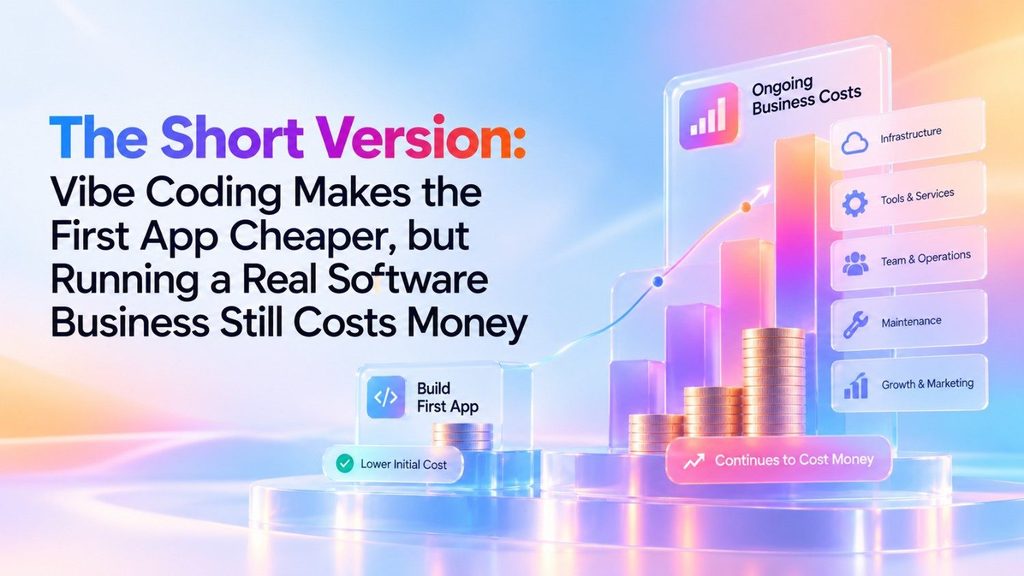
The Short Version: Vibe Coding Makes the First App Cheaper, but Running a Real Software Business Still Costs Money
Vibe coding is changing the cost of software development because founders no longer need to write every line of code themselves. AI tools can handle much of the early work, including creating pages, setting up databases, connecting features, and fixing simple problems.
That can lower the cash needed to test an idea. However, the financial value depends on how much human work remains and whether the finished application actually works.
SFTECHSCENE ORIGINAL COST MODEL · OCTOBER 2026
Basic prototype
$1,405
12 hours of labor
Customer-ready MVP
$9,690
70 hours of labor
More complex app
$31,825
220 hours of labor
Illustrative economic costs, not observed customer invoices or industry averages. The models use a rounded $115 hourly labor-cost benchmark, assumed project hours, published entry-level tool prices, and stated testing allowances. A founder working without pay may spend much less cash while still investing significant time.
Our analysis points to five important conclusions.
- The subscription price is usually only a small part of the total economic cost of an app.
- The number of hours spent guiding, testing, and repairing AI-generated work has a greater effect on cost.
- San Francisco’s high labor costs make genuine time savings particularly valuable.
- Simple applications tend to benefit more than products with complicated business rules or sensitive data.
- The biggest financial advantage may be the ability to test more business ideas before committing to full development.
The figures above are scenario estimates, not a survey of apps built with AI. Their value is that every assumption is visible, allowing a founder to replace our estimates with actual costs.
What Is Vibe Coding, and Why Is It Changing Software Development Economics?
Vibe coding is a way of creating software by telling an AI system what you want rather than manually writing every line of code. The founder describes the desired result in everyday language, and the AI produces code or modifies an existing application.
For example, someone could ask an AI tool to build a simple appointment-booking application for independent fitness trainers. The tool might generate a homepage, booking calendar, customer accounts, and a basic dashboard.
The founder can then ask for changes, such as different colors, payment options, or automatic appointment reminders. This creates a fast cycle in which ideas are turned into software through conversation.
Why the Traditional Cost of Building an App Was So High
Traditional development requires people to convert business ideas into detailed instructions that computers can execute. Developers must create the software, test its behavior, correct mistakes, and maintain the technology behind it.
Even a relatively simple product can involve several kinds of work. Someone must design the user experience, create the interface, connect the database, handle passwords, manage hosting, and make sure the system behaves correctly when something goes wrong.
The cost rises when a company needs experienced engineers. In San Francisco, where technical labor is expensive, a project involving hundreds of development hours can require a substantial investment before the first paying customer arrives.
Vibe coding changes that equation by reducing some of the manual development effort. The important question is how much time it actually saves across the entire project.
Why Generating Code Is Not the Same as Finishing an App
Suppose an AI tool creates an impressive-looking customer dashboard in 20 minutes. That is useful progress, but it does not establish that the dashboard is safe or ready for real customers.
The application may still have problems with data access, slow loading, broken payment flows, or incorrect calculations. Some problems appear only after multiple users start interacting with the system.
This is why measuring the cost of vibe coding by how quickly the first screen appears can be misleading.
A more useful measure is the cost of reaching a specific business milestone. That could mean creating a working demo, accepting the first payment, or operating reliably with 1,000 active customers.
Each milestone requires different levels of work, and each has a different cost.
How Much Do Popular AI App Builders Cost in 2026?
The starting price of AI development tools is remarkably low compared with traditional software labor. Several platforms provide free plans, while paid entry-level options can cost only a few dozen dollars per month.
However, their pricing systems work differently. Some use credits, some charge for AI usage, and others provide subscriptions with limits on the amount of work included.
Comparing Published AI Development Prices
| Platform | Published price | Important cost consideration |
|---|---|---|
| Bolt.new | Free; Pro $25/month | Token limits and available usage |
| Replit | Core $20/month, or $18/month billed annually | Model usage and additional consumption |
| Lovable | Free plan; paid credit-based plans | Different actions consume different numbers of credits |
| Cursor | Free; plan-dependent paid tiers | AI usage pools and model charges |
Sources: official Bolt pricing, Replit pricing, Lovable pricing, and Cursor pricing. Pricing verified against available public pages for October 2026; amounts exclude applicable taxes. Cursor’s public pricing and documentation show differing plan structures, so its current checkout terms should be checked before budgeting. bolt.new+4
These prices show why the concept of building an app for less than $50 is appealing. A founder can purchase access to powerful development tools for less than the cost of a single hour of professional software engineering in many markets.
Yet a subscription does not guarantee that an entire application can be built for the advertised amount.
AI Credits Make Development Costs Harder to Predict
A credit-based system charges for specific actions or groups of actions. The amount consumed can depend on the complexity of a request, the model used, or the work performed.
Lovable’s published documentation provides a useful example. Its sample tasks include changing a button color for 0.5 credits, adding authentication for 1.2 credits, and generating a landing page with images for 1.7 credits. These are examples of task consumption, not fixed dollar prices for every customer. Lovable
This creates an important financial challenge.
A founder may complete the first version of an application with relatively few requests, then use considerably more credits correcting unexpected behavior. As the application grows, small changes can require more detailed work.
The best way to control this cost is to establish a clear scope before prompting the AI.
Instead of asking the platform to keep improving a product without a defined goal, founders should identify the features that are necessary for the first release and separate them from features that can wait.
The Cheapest Subscription Is Not Always the Cheapest Platform
A cheaper platform may require more manual work. Another platform might cost more each month but save several hours by generating cleaner software or providing better deployment tools.
Imagine two platforms. One costs $20 per month but needs six extra hours of troubleshooting, while another costs $60 and saves those hours.
If the founder’s time is worth $50 per hour, the cheaper subscription actually creates $300 in additional labor cost. The $40 monthly subscription difference becomes relatively unimportant.
For this reason, comparing software platforms on subscription price alone is a poor business decision.
A better comparison includes the full cost of delivering the same finished feature at the same quality level.
Original SFTechScene Research #1: Why San Francisco’s Labor Costs Change the Economics of Vibe Coding
San Francisco is one of the most interesting places to study AI-assisted development because software labor is unusually expensive.
The U.S. Bureau of Labor Statistics reported that the San Francisco–Oakland–Fremont metropolitan area had an average hourly wage of $80.51 for computer and mathematical occupations in May 2025. The figure covers a wider group than software developers alone, but it provides a useful public benchmark for technical labor. Bureau of Labor Statistics
The corresponding national figure was $57.73 per hour.
Mean hourly wages for computer and mathematical occupations
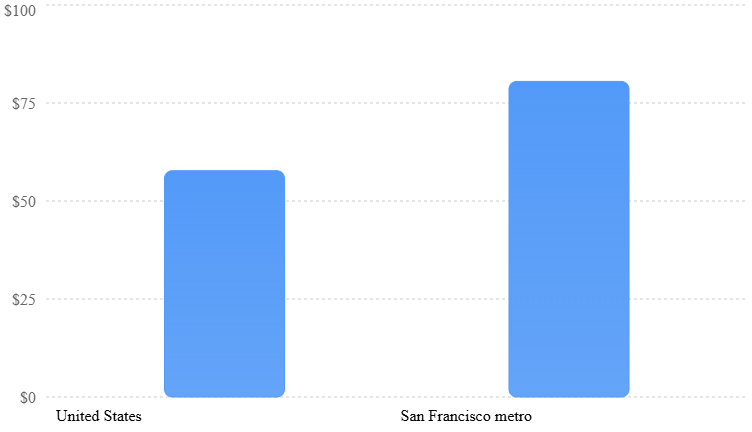
Source: BLS May 2025 occupational wage estimates, released July 9, 2026. These are employee wages, not contractor billing rates or full employer costs. Bureau of Labor Statistics
Our Methodology: Converting Wages Into an Estimated Employer Cost
A company does not only pay an employee’s salary. It may also pay for insurance, retirement benefits, paid leave, payroll taxes, and other benefits.
BLS data for June 2026 shows that wages and salaries accounted for about 70% of total private-industry compensation costs nationwide. We used that share to construct a simple labor-cost estimate. Bureau of Labor Statistics
Our calculation is:
\[ \text{Estimated hourly cost}=\frac{\$80.51}{0.70} \]
\[ =\$115.01 \]
For the rest of the economic analysis, we round this figure to $115 per hour.
This is a modeled benchmark rather than a measured San Francisco software-engineer employer cost. It combines a local occupational wage figure with a national benefits ratio from a different data series. Actual engineering costs can be higher or lower depending on seniority, employer benefits, location, and whether work is performed by an employee or contractor.
The model also excludes recruiting fees, office costs, specialist software, management overhead, and company profit margins. It should not be mistaken for a market quote from an app development agency.
What Happens When AI Saves Development Hours?
Using the $115 benchmark, we can calculate the labor value of different amounts of time saved.
| Development hours avoided | Estimated labor cost avoided |
|---|---|
| 10 hours | $1,150 |
| 25 hours | $2,875 |
| 50 hours | $5,750 |
| 100 hours | $11,500 |
| 250 hours | $28,750 |
| 500 hours | $57,500 |
Original SFTechScene calculations. Hours saved are hypothetical. The figures assume every avoided hour represents a real reduction in paid labor or a valuable redeployment of employee time.
The results explain why even relatively expensive AI tools can be attractive to San Francisco startups.
A founder who genuinely saves 50 hours of costly engineering work could create thousands of dollars in value. But if AI-generated mistakes require another 45 hours to repair, the financial benefit becomes much smaller.
Why Time Saved and Money Saved Are Different
There is another important distinction.
An employee using AI to complete work faster does not automatically reduce payroll expenses. The business may continue paying the same salary while using the freed time for other projects.
That can still create value, but it is not the same as cash savings.
A startup can turn the time benefit into real financial value by delaying a new hire, reducing paid contractor work, shipping a product sooner, or moving engineers onto work that generates more revenue.
For a founder building alone, the calculation is even more complicated. Their unpaid time may not appear on a bank statement, but it still has a cost because those hours could have been spent selling, finding customers, or earning income elsewhere.
The main research finding: San Francisco’s high technical labor costs increase the potential value of vibe coding, but the benefit depends on measurable work avoided—not the number of lines of code generated.
Original SFTechScene Research #2: How Much Does It Really Cost to Build Three Different Types of Apps?
To understand the economics beyond subscriptions, SFTechScene developed three illustrative app-building scenarios.
We separated human labor, AI tooling, hosting and infrastructure, and outside testing or review. That makes it possible to see which expenses dominate the budget.
Research Methodology and Assumptions
The models use a $115 hourly economic cost for technical labor. We assume a $25 monthly AI development budget, based on the published starting price of Bolt’s Pro plan, rather than claiming the scenarios were completed on that specific platform.
For infrastructure, we use hypothetical allowances informed by public hosting and database prices. Vercel lists a Pro plan at $20 per month, and Supabase lists its Pro plan from $25 per month. Actual spending depends on traffic, compute usage, storage, and other services. Vercel+2
We do not assume that each scenario can be completed within the included AI usage of a particular plan. Any overage would increase the total.
The hours, review budgets, and infrastructure allowances are research assumptions chosen to illustrate different workloads. They are not measured outcomes from building and auditing three real applications.
Scenario A: A Basic App Prototype
Imagine a San Francisco founder developing a simple tool that helps freelancers track projects and deadlines.
The first version includes a homepage, a project list, basic task management, and a simple dashboard. It does not require complex payments, regulated data, or advanced integrations.
Our model assumes the founder spends 12 hours planning, guiding the AI, reviewing results, and testing the application. The project uses one month of paid AI tooling and free infrastructure within the available limits.
| Cost component | Estimate |
|---|---|
| Human work: 12 hours × $115 | $1,380 |
| AI development subscription | $25 |
| Hosting and infrastructure | $0 |
| Additional outside review | $0 |
| Total economic cost | $1,405 |
A founder who does the work personally and values their time at zero for cash budgeting could spend only $25 in this simplified case.
But the founder still has to invest 12 hours. In addition, the model excludes a custom domain, paid design assets, taxes, and any unexpected usage charges.
The prototype should be treated as a demonstration or validation tool, not as proof that the same spending can produce a reliable public software business.
Scenario B: A Customer-Ready Minimum Viable Product
Now consider a small appointment and customer-management application for independent service providers.
Customers need to create accounts, book appointments, receive confirmations, and possibly make payments. The business needs a dashboard to manage bookings and customer records.
This is a more demanding project because the software must work consistently for real users.
We assume 70 hours of human work across planning, prompting, feature checks, bug fixes, and deployment. We also assign an outside review budget because an app handling customer data needs stronger checks than a demo.
| Cost component | Estimate |
|---|---|
| Human work: 70 hours × $115 | $8,050 |
| AI tooling: 2 months × $25 | $50 |
| Hosting and related services | $90 |
| Outside technical/security review | $1,500 |
| Total economic cost | $9,690 |
The outside review figure is a hypothetical budget allowance rather than a verified quote. Depending on the system, meaningful security testing could cost substantially more.
This app costs far more than the prototype, despite using inexpensive AI development software.
The difference comes from the hours needed to make the product reliable enough for customers.
Scenario C: A More Complex Commercial Application
Our third example is a software product for small businesses that includes customer accounts, payments, reporting, roles for different staff members, and connections to outside services.
This product has more ways to fail. The team must test which users can access specific records, how payment errors are handled, and whether reports remain correct as data grows.
We assume 220 hours of human work, three months of AI development tooling, higher infrastructure spending, and a larger outside review allowance.
| Cost component | Estimate |
|---|---|
| Human work: 220 hours × $115 | $25,300 |
| AI tooling: 3 months × $25 | $75 |
| Hosting and related services | $450 |
| Outside technical/security review | $6,000 |
| Total economic cost | $31,825 |
This model does not cover every possible cost of building a commercial application. It excludes marketing, sales, legal advice, insurance, ongoing customer support, and later feature development.
It also assumes a limited scope. Software handling medical information, major financial transactions, or complex enterprise systems would need a very different budget.
Comparing the Three Scenarios
■ Human labor
■ AI tools
■ Infrastructure
■ Outside review
Original SFTechScene scenario analysis. The bars show modeled spending categories; they are not measured average prices. Categories should be added to obtain total project costs.
The most striking result is how little of each project’s economic cost comes from the AI subscription.
For the prototype, the $25 subscription represents approximately 1.8% of modeled cost. For the customer-ready MVP, the $50 tooling budget represents about 0.5%.
For the more complex app, AI tooling accounts for just 0.2% of the estimated total.
This does not mean every product can be built within those small subscription budgets. It means that under our stated assumptions, the time and quality work surrounding AI code dominate the economics.
That is the central lesson of the analysis.
A founder who spends hours comparing $20 and $25 AI subscriptions may be focusing on the smallest part of their real development budget.
Original SFTechScene Research #3: Vibe Coding vs. Traditional Development — How Much Money Can AI Actually Save?
The next question is whether AI-assisted development is cheaper than building the same application through a traditional development process.
To examine this, we created a controlled comparison using the same three application types. The models hold the hourly labor rate, infrastructure allowance, and outside review allowance constant.
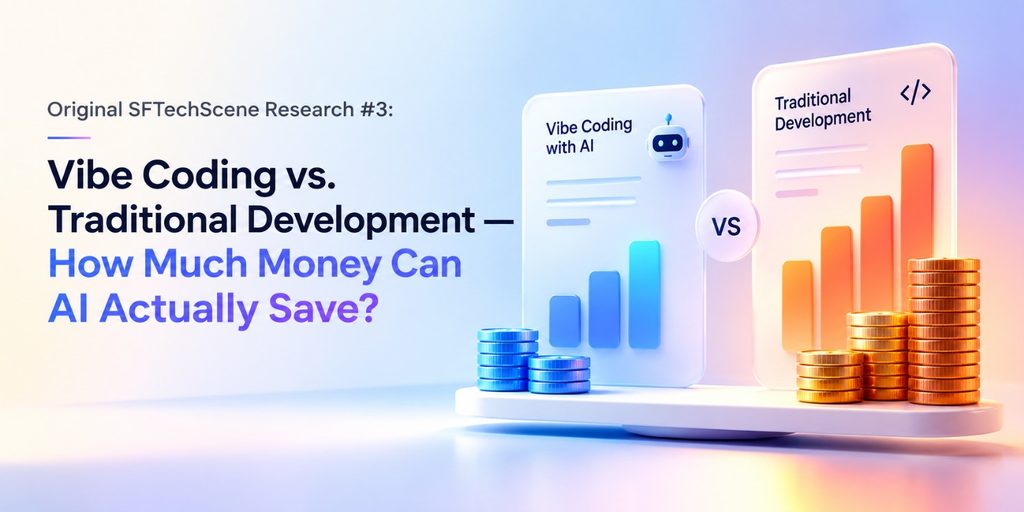
Only the assumed development hours and AI subscription spending change.
This allows us to isolate the value of reducing human development work. However, the comparison depends on an important assumption: both approaches must reach the same final quality and feature requirements.
Comparing Development Hours
We assigned traditional development estimates of 50 hours for a prototype, 250 hours for the MVP, and 700 hours for the more complex application.
These are scenario assumptions, not industry benchmarks. A skilled developer might build a simple prototype much faster, while a complex business application could take considerably longer.
| Application | Traditional hours | AI-assisted hours | Assumed time reduction |
|---|---|---|---|
| Basic prototype | 50 | 12 | 76.0% |
| Customer-ready MVP | 250 | 70 | 72.0% |
| More complex app | 700 | 220 | 68.6% |
We deliberately reduce the assumed percentage of time saved as the software becomes more complicated.
The reasoning is straightforward. AI can generate common screens and standard features quickly, but complex products often require more human decisions, testing, and integration work.
Still, the percentages in this table are hypotheses built into the model. They should not be presented as measured AI productivity gains.
Comparing Total Development Costs
Using the $115 hourly labor benchmark, we calculated the traditional development cost of each project.
The traditional projects use the same hosting and outside review budgets as their AI-assisted counterparts. They do not incur the modeled AI subscription cost.
| Application | Traditional development | AI-assisted development | Modeled savings |
|---|---|---|---|
| Basic prototype | $5,750 | $1,405 | $4,345 |
| Customer-ready MVP | $30,340 | $9,690 | $20,650 |
| More complex app | $86,950 | $31,825 | $55,125 |
Original SFTechScene modeled comparison. Savings reflect the assumed reduction in labor hours and are not observed savings from a controlled experiment.
Illustrative total project cost: traditional vs. AI-assisted development
■ Traditional development
■ AI-assisted development
Costs are calculated under identical quality, scope, labor-rate, and review assumptions. Actual projects may differ substantially.
Where the Savings Come From
In our MVP example, AI-assisted development reduces the assumed human work from 250 hours to 70 hours.
That is 180 fewer hours.
At $115 per hour, the avoided labor cost equals $20,700. After accounting for the additional $50 spent on AI subscriptions, the modeled saving becomes $20,650.
This is a much stronger way to explain vibe coding’s business value than claiming that AI can create a $30,000 application for $25.
The $25 subscription is simply one of the tools that helps reduce the number of human hours needed.
Why These Savings Should Not Be Taken as Guaranteed
There is an important limitation to this comparison.
We did not run parallel teams building identical applications and measure their final outcomes. Instead, we constructed transparent scenarios to show how development economics respond to changes in labor requirements.
If the AI-assisted MVP required 200 hours rather than 70, the savings would be much smaller.
If it needed 300 hours because of serious problems with generated code, it could become more expensive than the traditional option.
The conclusion is not that vibe coding always saves 60% or 70% of development costs. The conclusion is that labor reduction is the main variable that determines whether vibe coding makes financial sense.
Original SFTechScene Research #4: The Hidden Cost of Human Time Is Bigger Than Most Founders Think
Many founders calculate vibe coding costs by looking at their credit card bills.
If they pay $25 for an AI tool and $20 for hosting, they might believe their app cost only $45 to create.
That approach ignores the value of their own time.
For an entrepreneur who has limited capital but plenty of free hours, cash spending may be the most important measure. For a startup trying to allocate its resources efficiently, however, ignoring labor produces an incomplete picture.
How the Value of Founder Time Changes App Economics
We tested the 70-hour MVP scenario using four different values for human time.
In every case, the project has $1,640 in non-labor spending. This includes $50 in AI tooling, $90 in infrastructure, and $1,500 for an outside review.
We then changed only the hourly value assigned to the 70 hours of work.
| Value of founder’s time | Human time cost | Total MVP economic cost |
|---|---|---|
| $0/hour | $0 | $1,640 |
| $40/hour | $2,800 | $4,440 |
| $115/hour | $8,050 | $9,690 |
| $175/hour | $12,250 | $13,890 |
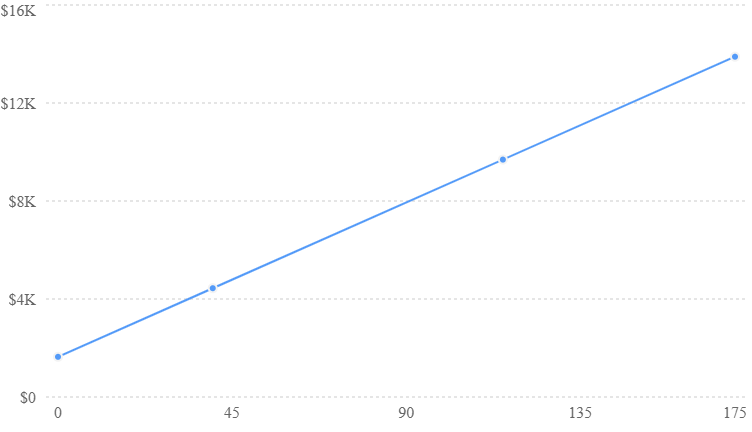
SFTechScene sensitivity analysis. The scenario holds all non-labor costs and working hours constant. Values represent alternative assumptions about the value of time, not wage estimates for particular founder groups.
The results show how two people can build the same application, pay similar invoices, and arrive at very different estimates of its economic cost.
A student working on a personal project might reasonably focus on the $1,640 cash requirement. An experienced founder who could spend those hours closing customers might view the same project as a much larger investment.
Neither calculation is inherently wrong. They answer different questions.
When Should a Founder Include Their Own Time?
Founder time should be included whenever the goal is to compare alternative uses of limited resources.
Suppose a founder has 70 hours available. They can spend those hours developing an application, working with customers, or earning money through consulting.
If building the application prevents them from earning $4,000 elsewhere, the choice has an opportunity cost even if they never pay themselves a salary.
This does not mean every startup should assign its founder a professional engineering salary. It means the founder should use a realistic estimate of what their time could accomplish elsewhere.
The important step is to be consistent when comparing options.
Why Cash Cost and Economic Cost Should Be Reported Separately
A business can be profitable on a cash basis while still using a great deal of unpaid founder labor.
This distinction matters for one-person software companies.
A founder might sell a small application for $1,000 per month while paying only $100 in monthly software bills. That looks highly profitable until the founder reveals that they spend 35 hours per month dealing with bugs, customer questions, and updates.
At $40 per hour, those 35 hours represent $1,400 of time.
The business may still be worth running if it is growing, creating useful experience, or building a valuable asset. But it is not yet a passive business generating $900 of economic profit each month.
Tracking both cash and time costs gives founders a much clearer view of the business.
Original SFTechScene Research #5: How Much Rework Can an AI-Built App Absorb Before the Savings Disappear?
The largest uncertainty in vibe coding is not always the price of AI credits. It is the amount of human work required after the initial code has been generated.
An AI tool may create a feature quickly but introduce problems elsewhere. A founder can then spend hours trying to correct those issues, especially when they do not understand the code.
We modeled how additional rework affects our MVP example.
Rework Sensitivity Analysis
Our starting MVP costs $9,690 and requires 70 hours of human work.
We then added different amounts of unplanned repair and testing time, keeping all other costs unchanged.
| Extra rework hours | Total human hours | New project cost |
|---|---|---|
| 0 | 70 | $9,690 |
| 25 | 95 | $12,565 |
| 50 | 120 | $15,440 |
| 100 | 170 | $21,190 |
| 150 | 220 | $26,940 |
| 180 | 250 | $30,390 |
Original SFTechScene sensitivity model. Each extra hour is valued at $115; no additional AI usage charges or infrastructure costs are assumed.
■ AI-assisted MVP cost
■ Traditional MVP benchmark
The model reveals a useful financial threshold.
Our traditional MVP benchmark costs $30,340. Since the AI-assisted project has $1,640 in non-labor costs, the AI route becomes more expensive when total human hours rise above approximately 249.6 hours.
That means the initial 70-hour MVP can absorb about 179.6 additional human hours before losing its modeled cost advantage.
This is not a prediction that AI-built projects will require that amount of repair work. It is a break-even calculation that founders can adapt to their own circumstances.
Why Rework Risk Grows With App Complexity
A simple landing page is relatively easy to inspect. A founder can check the text, click buttons, and confirm that forms work.
A more complex application has hidden behavior.
A payment might appear successful even though the database was not updated. A user might be able to see another customer’s data. A reporting system might produce incorrect totals only when certain records are missing.
These problems require more than visual inspection.
Developers need to test unusual cases, review access rules, and understand how the application responds when outside systems fail.
A feature that looks complete is not always a feature that is ready to support a business.
A More Useful Way to Measure AI Productivity
Instead of measuring how many screens an AI tool creates per hour, founders should measure the number of accepted features delivered per hour.
An accepted feature is one that meets its requirements, passes the relevant tests, and does not create unacceptable problems elsewhere.
For example, imagine an AI tool generates ten features in one afternoon. If only four are usable and the other six require extensive repairs, the first impression of speed may be misleading.
A more accurate measure is:
\[ \text{Effective delivery rate}= \frac{\text{Accepted features}}{\text{Total human hours}} \]
Founders can also track the total economic cost of each accepted feature. This provides a practical basis for comparing tools without relying entirely on marketing claims.
The Real Cost of Hosting an AI-Built Application
Once an application is live, it needs infrastructure to serve users, store information, and run its features.
Some AI development platforms include hosting. Others allow founders to deploy applications through outside services.
The important distinction is that building software and operating software are separate activities.
Hosting Can Start Cheap but Become Usage-Based
Vercel offers a free Hobby plan for personal, non-commercial use and a Pro plan listed at $20 per month. Supabase offers a free database tier and a Pro plan starting at $25 per month. Vercel+2
These services can make the early cost of running an application manageable.
However, published prices are only the starting point.
Usage charges may depend on server activity, data transfer, database size, storage, or other resources. Some applications remain within included allowances, while others generate additional bills.
A founder should never assume that all usage is unlimited simply because an app launched on a low-cost plan.
What Happens When an App Reaches 1,000 Users?
User counts alone cannot determine hosting costs.
An application with 1,000 people who log in once a month may use fewer resources than an app with 100 people who constantly upload files, generate AI responses, or process large amounts of information.
To understand the cost, founders should estimate how each user behaves.
A scheduling app may require a few database requests per appointment. A document-analysis app might process large files and call expensive AI models repeatedly.
These businesses could have completely different operating costs despite having the same number of customers.
A Simple Infrastructure Budget for Early-Stage Founders
The following is an illustrative planning budget rather than a platform-specific quotation.
| Expense | Lean monthly assumption | Growing app assumption |
|---|---|---|
| App hosting | $20 | $100 |
| Database | $25 | $100 |
| Monitoring and related tools | $10 | $50 |
| Email and messaging | $10 | $75 |
| Backup or additional storage | $10 | $50 |
| Monthly total | $75 | $375 |
This model excludes payment processing, AI features used by customers, taxes, dedicated support, and other services.
The purpose is to give founders a structure for budgeting. A real business should replace every assumption with its expected usage and the relevant provider’s current price schedule.
A founder planning to launch commercially should also review whether any free service is restricted to personal use.
Original SFTechScene Research #6: When Does an AI-Built App Actually Become Profitable?
Lower development costs matter because they reduce the amount of revenue a new business needs to recover its investment.
But the relationship between development cost and profitability is not automatic.
A product also needs paying customers, manageable operating costs, and enough revenue remaining after each sale.
A Revenue Model for a Small Subscription App
Consider our customer-ready MVP, with an estimated initial economic development cost of $9,690.
Suppose the company charges customers $29 per month. For this illustration, we assume $150 in fixed monthly operating costs and $3 in additional variable costs per paying customer.
The $3 is a blended model assumption for usage-related expenses, including any payment-processing allocation. It is not a specific provider’s fee.
At 100 paying customers, the calculation is:
| Monthly item | Amount |
|---|---|
| Revenue: 100 × $29 | $2,900 |
| Variable costs: 100 × $3 | −$300 |
| Fixed operating costs | −$150 |
| Monthly contribution before ongoing labor and tax | $2,450 |
At this level, the app generates $2,450 toward recovering the initial investment, paying for maintenance, and eventually earning a profit.
If all other conditions remain unchanged, it would take approximately four full months at 100 active paying customers to recover the $9,690 initial development cost.
That does not mean the business would become profitable four months after launching. It assumes the company already has 100 paying customers and that they remain subscribed throughout the recovery period.
It also excludes customer acquisition costs and ongoing labor.
How Customer Count Changes the Economics
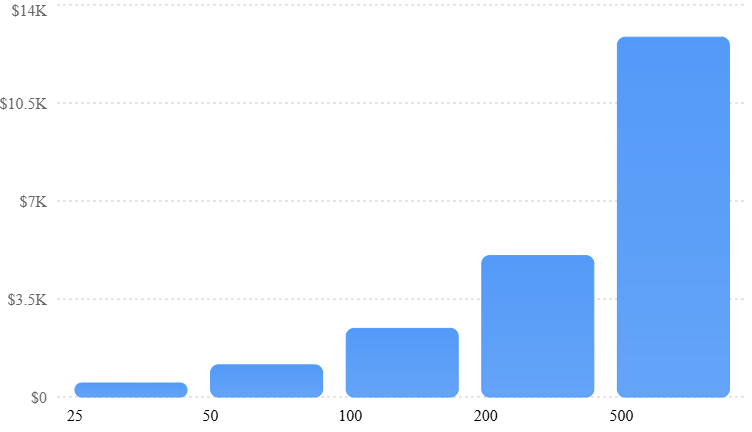
Original SFTechScene model: $29 per paying customer, $3 variable cost per customer, and $150 monthly fixed costs. All values are assumed; customer acquisition, churn, and ongoing labor are excluded.
The chart highlights why customers matter more than the initial coding bill.
At 25 paying customers, the app generates $500 per month before labor and taxes. At 200 customers, the modeled monthly contribution rises to $5,050.
However, this calculation assumes the operating cost structure remains stable. If a product becomes more expensive to run as it grows, contribution may rise more slowly.
How Many Customers Are Needed to Recover the Development Cost?
A simple recovery calculation can help founders set realistic goals.
For our modeled app, each paying customer produces $26 per month after the assumed $3 variable expense.
The company must also cover $150 in fixed monthly costs.
If the founder wants to recover the initial $9,690 investment within 12 months, the business needs enough monthly contribution to cover $807.50 in development-cost recovery and $150 in fixed costs.
\[ \text{Customers needed}= \frac{807.50+150}{26} \]
The result is approximately 36.83, which means at least 37 continuously paying customers under the model’s assumptions.
This threshold applies to a steady-state customer count maintained for 12 months, with no acquisition costs, churn, maintenance labor, taxes, or extra investment. A real launch starts with fewer customers and takes time to grow.
For a more useful plan, founders should model how long it takes to reach each customer milestone rather than assuming they start at their target.
Customer Acquisition Can Cost More Than Building the App
A startup might use vibe coding to reduce initial development spending, then discover that finding customers is its largest expense.
Imagine spending $2,000 on a marketing campaign that brings in 20 new paying users. The customer acquisition cost is $100 per customer.
If each customer contributes $26 per month, the company needs roughly four months of subscription contribution to recover acquisition spending for each customer, assuming they stay subscribed.
Now suppose customers leave after an average of only three paid months. The economics become unfavorable before accounting for overhead.
This is why low software development costs cannot compensate for weak customer demand.
A cheap app with no repeat customers is not necessarily a good investment. A more expensive app with strong retention can create substantially more value.
The Biggest Hidden Costs of Vibe Coding That Founders Often Miss
The first version of an AI-built application can be surprisingly inexpensive. The real financial surprises often appear after the product is launched.

Some costs grow gradually, while others appear suddenly when the company discovers a security problem, needs a feature the AI tool cannot handle easily, or wants to move its software to a different platform.
Security Problems Can Destroy the Savings
Security is one of the most important areas where cheap code can become expensive.
A founder may ask an AI tool to create a customer dashboard with login and password features. The application looks correct, but the system might allow one customer to access another customer’s records.
This is not a minor design mistake. It could expose private information and create serious business consequences.
The OWASP Top 10:2025 lists broken access control as its highest-ranked web application security risk. The guidance emphasizes checking permissions on the server and making sure users cannot access information they do not own. OWASP Top 10+1
Founders should treat security as part of their original development plan rather than a problem to address after growth.
For products that store sensitive information, independent expert review is particularly important. An AI-generated test report cannot replace appropriate human assessment.
Unexpected AI Usage Charges
Some applications use AI only during development. Others continue making AI model requests whenever customers use the product.
These have very different economics.
A scheduling tool that uses AI to create its initial code may have almost no ongoing AI expense. An application that summarizes customer documents could generate a new model charge every time someone uploads a file.
The second business must track AI cost per customer action.
Suppose an AI feature costs an assumed $0.02 per use. A customer who uses it 100 times a month generates $2 in model costs, while someone who uses it 5,000 times creates $100 in expenses.
If both customers pay $29 per month, unlimited usage could make the second customer unprofitable.
This example shows why usage limits, fair-use policies, and carefully chosen pricing plans matter for AI-native software businesses.
Payment Processing and Refunds
When an app starts accepting payments, the company may incur transaction fees.
Stripe’s published standard US pricing lists 2.9% plus $0.30 for successful domestic card transactions. Additional charges may apply to certain payment types and international transactions. Stripe
For a $29 domestic-card payment, the standard fee under that pricing model would be approximately $1.14.
That may sound small, but the cost becomes meaningful across thousands of transactions. Refunds, payment disputes, and failures also need to be considered.
A founder should calculate revenue after payment fees rather than treating every dollar charged to customers as money available to run the business.
Maintenance and Platform Dependence
Software does not remain unchanged after launch.
Browsers update, outside services change their requirements, customers find problems, and new features become necessary. Even a successful application needs regular attention.
A founder who cannot understand the code may depend heavily on the original AI platform or outside developers.
Before committing to a tool, founders should establish whether they can export their source code, access their database, maintain backups, and deploy the application elsewhere.
This makes the business more resilient if prices rise or the platform changes.
Which Types of Apps Are Most Economical to Build With AI?
Not every application offers the same opportunity for cost savings.
The best early projects generally have clear requirements, familiar features, limited security exposure, and a small number of integrations.
| App category | Economic fit for AI-first development | Main concern |
|---|---|---|
| Landing pages and basic websites | Strong | Design quality and conversion |
| Simple internal dashboards | Strong | Data accuracy |
| Appointment-booking tools | Promising | Reliability and notifications |
| Small business workflow apps | Promising | Business rules and integrations |
| Basic customer portals | Conditional | User permissions and security |
| Complex financial software | Higher risk | Accuracy, security, and controls |
| Regulated healthcare applications | Higher risk | Privacy, compliance, and safety |
| Large enterprise platforms | Highly dependent on scope | Integrations, reliability, and governance |
SFTechScene qualitative assessment based on the likely complexity of validation, operating requirements, and potential cost of errors. This is not an empirical ranking of tools or app categories.
Why Small Business Software Offers an Attractive Opportunity
San Francisco entrepreneurs can use vibe coding to serve customers whose software needs are specific but relatively straightforward.
A local service company may need a better way to track appointments, customer requests, or employee schedules. A specialized consulting business might need a dashboard that combines information from several existing systems.
Historically, the cost of building such tools could be difficult to justify for a small customer base.
AI-assisted development may make these narrow markets more attractive by lowering the initial cost of creating and testing a solution.
The business opportunity is not simply to create more applications. It is to solve problems that customers will pay to have fixed.
Why High-Risk Applications Need a Different Budget
Financial and healthcare applications may benefit from AI development tools, but their development costs cannot be estimated using the same assumptions as a simple internal dashboard.
The risks are different.
An incorrect medical recommendation, an exposed customer record, or a financial calculation error can create harm beyond the immediate cost of correcting code.
These products may require specialist engineering, documented testing, legal guidance, compliance work, and independent security assessment.
AI can assist with development, but it does not eliminate those obligations.
How San Francisco Founders Can Build Apps With AI Without Wasting Money
The most effective way to control vibe coding costs is to reduce unnecessary work before development starts.
This requires a clear product plan, careful selection of features, and a way to measure whether the AI is actually saving time.
Step 1: Validate the Business Problem Before Writing Prompts
Start by identifying a specific group of customers and a problem they experience regularly.
For example, a founder might want to help independent San Francisco property managers organize maintenance requests. Before building a platform, they should speak with prospective users and understand how requests are currently handled.
The most useful questions concern actual behavior.
How often does the problem occur? What does it cost the customer? What tools do they already use? Would they pay for a better solution?
If the problem is not painful enough to justify a purchase, cheaper development will not make the business successful.
Step 2: Define the Smallest Useful Product
Once the problem is clear, the founder should identify the minimum features required to solve it.
For a maintenance-request application, those features might include a request form, a dashboard for managers, and status updates.
Features such as detailed analytics, AI-written messages, or complex team permissions may be valuable later, but they should not automatically become part of the first release.
Every extra feature creates development, testing, and maintenance work.
A narrow product helps the founder reach real customers sooner and reduces the number of things that can break.
Step 3: Write Better Instructions Before Using AI
A vague prompt can produce a working-looking application that does not meet the business requirements.
A useful development brief should explain who the users are, what they need to accomplish, which information is stored, and what should happen when something goes wrong.
For example, instead of simply asking for a booking application, a founder can describe the complete booking process.
Customers should be able to select an available time, confirm the appointment, and receive a notification. Two customers should not be able to reserve the same slot, and cancelled appointments should become available again.
Clear requirements reduce the need for repeated changes because the tool has fewer important details to guess.
Step 4: Build and Test One Feature at a Time
Large prompts can generate substantial amounts of code, but they can also make errors harder to identify.
A safer approach is to build the application in small stages.
Create the interface, check its behavior, and then add the next feature. Test customer accounts before adding payments, and verify that data is being stored correctly before creating advanced reports.
For example, when building a multi-user app, create two test accounts and confirm that neither account can see or change the other’s private records.
Testing should cover incorrect inputs and failures, not just successful actions.
This approach may feel slower than asking AI to create everything at once. It can save time by making problems easier to isolate and repair.
Step 5: Set a Maximum Development Budget
A founder should decide how much time and money they are willing to invest before the project has evidence of customer demand.
Consider a simple prototype with a 20-hour development allowance.
The founder could allocate five hours to planning and understanding the workflow, ten hours to building the application, and five hours to testing and customer demonstrations.
If the prototype cannot provide a useful demonstration within that budget, the founder should review the scope before spending another 20 hours.
The right response is not always to buy more AI credits. Sometimes the product is too complicated for its current stage.
Step 6: Track Actual Development Costs
Founders should keep a simple development record from the first day.
| Metric | What to record | Why it matters |
|---|---|---|
| AI subscription spending | Monthly invoices | Measures direct tooling cost |
| AI usage charges | Additional credits or model requests | Identifies expensive workflows |
| Human hours | Planning, prompting, testing, repairs | Reveals true labor effort |
| Accepted features | Features that pass required checks | Measures useful output |
| Repair hours | Time spent correcting mistakes | Shows quality-related costs |
| Hosting expenses | Monthly infrastructure bills | Measures cost to operate |
| Customer feedback | Problems and requested changes | Guides the next investment |
The goal is not to create complicated reporting.
A spreadsheet updated after each development session is often enough to reveal whether the project is progressing efficiently.
Over several weeks, a founder can compare planned work with actual work and identify the features that consume the most resources.
Step 7: Bring in Technical Help Before Risks Become Expensive
Hiring an experienced developer for a focused review can be cheaper than trying to repair a serious problem after launch.
The right time depends on what the application does.
A basic public website may need relatively little technical oversight. A customer portal with sensitive information should receive much more scrutiny before people start using it.
Founders should identify the most serious failure that could occur and decide what level of independent checking is needed to reduce that risk.
AI should reduce routine work, not become an excuse to skip important checks.
A Practical Vibe Coding Budget Calculator for Founders
The most useful cost model is one that can be adjusted for a real project.
The calculator below uses the same approach as the SFTechScene research, but lets founders change the main assumptions.
AI app development cost calculator
Enter your own estimates to compare total economic costs, including the value of human work.AI-assisted human hoursHourly labor value ($)Development monthsAI tools per month ($)Hosting per month ($)One-time outside review ($)Estimated traditional development hours
250 hours
AI-assisted project
$9,690
Traditional project
$30,340
Estimated potential savings
$20,650
Equivalent to 68.1% of the modeled traditional cost. The same hosting duration and outside-review budget are used for both approaches.
Reset to SFTechScene MVP assumptionsPlanning tool only. It does not estimate overage charges, marketing, legal costs, taxes, or post-launch maintenance. Comparisons assume equivalent finished quality and requirements.
A founder can use this model before starting development and update it as the project progresses.
The most important inputs are expected human hours, the value of that time, the likely cost of outside review, and the hours a traditional approach would require.
Once real work begins, replacing estimates with recorded hours makes the calculation more useful.
What the Economics of Vibe Coding Mean for San Francisco Startups in 2027
The biggest change may not be that every startup will become dramatically cheaper to operate. It may be that founders can test more ideas before making large financial commitments.
In a market like San Francisco, this creates an important opportunity.
More Ideas Can Be Tested With Less Initial Capital
Traditionally, a founder might have spent months creating software before learning whether customers wanted it.
With AI-assisted development, some founders can build a basic demonstration much earlier. They can show that version to prospective customers, collect feedback, and decide whether the business deserves further investment.
This changes how startup risk is managed.
Instead of committing a large budget to one unproven product, entrepreneurs can spend smaller amounts testing several narrow problems.
The business advantage comes from learning which problems are worth solving before spending heavily on development.
Engineers May Focus More on Quality and Complex Systems
As AI tools handle more routine coding work, experienced engineers may spend more of their time on difficult problems.
These include designing reliable systems, protecting customer information, improving performance, and understanding complicated business rules.
This does not mean all traditional development work disappears.
It means the financial value of an engineer may increasingly depend on the quality of their decisions and the problems they prevent, rather than the volume of code they write.
For San Francisco startups, combining AI-assisted development with experienced technical judgment may be more effective than treating the two as competing alternatives.
Investors May Pay More Attention to Customer Economics
Cheaper app creation can reduce one barrier to starting a software company. It does not automatically create a lasting competitive advantage.
If many competitors can build similar applications quickly, customers have more choices.
A company will need something beyond inexpensive code to stand out. That advantage might come from a deep understanding of a particular industry, strong customer relationships, better data, trusted service, or reliable performance.
Investors evaluating AI-built startups may therefore place greater weight on customer retention, revenue quality, and the company’s ability to maintain its product.
These are strategic implications of the cost models, not predictions based on a measured investor survey.
Research Methodology: How SFTechScene Calculated the Economics of Vibe Coding
To make the analysis transparent, it is important to distinguish the information we verified from the assumptions used to model hypothetical applications.
Public Data Sources
The research uses published pricing information from AI development platforms and infrastructure providers, together with federal labor and compensation data.
The principal source categories are:
| Research input | Source | How it was used |
|---|---|---|
| San Francisco technical wages | BLS May 2025 regional wage estimates | Local labor-cost benchmark |
| Employer benefit share | BLS June 2026 compensation data | Approximate loaded hourly cost |
| AI tool prices | Bolt, Replit, Lovable, Cursor | Published pricing and billing structures |
| Infrastructure prices | Vercel and Supabase | Reference points for operating costs |
| Payment fees | Stripe US pricing | Example of transaction-level costs |
| Security concerns | OWASP Top 10:2025 | Qualitative assessment of review requirements |
All figures were evaluated for this article as of October 30, 2026. Published subscription prices can change, and fees may differ by region, billing frequency, tax treatment, or usage.
Calculation Framework
The basic project-cost model is:
\[ C=H\times R+M\times S+I+Q \]
Where:
- \(H\) represents total human development hours.
- \(R\) represents the assumed hourly value of human labor.
- \(M\) represents the number of development months.
- \(S\) represents the monthly AI development subscription budget.
- \(I\) represents total development-period infrastructure and related service costs.
- \(Q\) represents the outside review allowance.
For the traditional development comparison, the AI subscription cost is removed, and the hours are replaced with the assumed traditional development workload.
All models use nominal US dollars without inflation adjustments.
Assumptions and Limitations
The study does not claim to measure the average cost of AI-built apps across San Francisco.
We did not collect proprietary invoices from development companies, observe developers building matched applications, or conduct controlled trials of different AI platforms.
The project hours and review costs are deliberately stated assumptions. Therefore, the resulting savings percentages cannot be treated as experimental proof that vibe coding improves productivity by a particular amount.
The wage-based $115 hourly estimate is also a proxy. It combines the San Francisco metro’s computer and mathematical occupational wage with a national private-industry compensation ratio, rather than measuring actual compensation for a specific software development team.
Our original contribution is the structured comparison: translating published costs and transparent workload assumptions into reproducible scenarios, break-even points, and sensitivity models.
A future empirical study could strengthen the findings by assigning identical app specifications to experienced developers and AI-assisted builders, measuring all human time, recording actual model charges, and independently testing the completed applications.
The final applications would also need to meet identical quality standards before their costs could be fairly compared.
Final Takeaway: Vibe Coding Makes Software Cheaper to Create, but the Real Savings Come From Building the Right Product
The economics of vibe coding are far more interesting than the idea of building an application for $25.
AI tools can make it possible to create an early version of a product with very little cash. They can also reduce the hours required for certain kinds of development work, especially when requirements are clear and the software uses familiar features.
For San Francisco founders, where technical labor is costly, those improvements have real financial potential.
Our original models illustrate that potential. A basic prototype has a modeled economic cost of $1,405, a customer-ready MVP costs $9,690, and a more complex application costs $31,825 under the assumptions used in this analysis.
Those numbers are not fixed prices or market averages. They show how quickly total cost increases when a project needs more human work, testing, and oversight.
The biggest lesson is that the price of an AI subscription tells founders very little about the final cost of a software business.
A $25 tool can support a valuable product. It can also generate code that requires thousands of dollars in repairs. The difference depends on the clarity of the requirements, the quality of the generated work, and the founder’s ability to recognize problems before customers encounter them.
The smartest San Francisco startups will use AI to reduce the cost of learning, not simply to produce more software.
They will validate demand before building, keep the first product focused, track development hours, review security carefully, and measure the value delivered to paying customers.
Vibe coding’s greatest economic advantage is not that it makes code nearly free. It is that it can make the journey from an untested idea to a validated business much less expensive.
For entrepreneurs who understand that distinction, AI-assisted development could open the door to profitable software businesses that would previously have been too costly to attempt.