

San Francisco is becoming the center of a major change in software development. For years, developers have used tools that help them write code faster. Now, a new generation of AI startups is building systems that can plan software projects, write code, find bugs, run tests, and help teams release working products.
The change goes far beyond autocomplete. Companies such as Anysphere, Cognition, and Factory are turning AI from a writing assistant into an active part of the engineering team. Smaller San Francisco startups are building the tools needed to manage these AI workers, review their output, and keep development projects under control.
This creates an important question for engineering leaders: if AI can write code quickly, what will actually determine how fast a company can build reliable software?
The answer increasingly comes down to everything around the code. Teams still need to understand customer problems, make technical decisions, check security, test changes, and prevent mistakes from reaching users. AI can help with many of these tasks, but adding more AI-generated code does not automatically make a development team more productive.
For this SFTechScene report, we examined 20 companies with a San Francisco presence, grouped them by their main role in software development, and developed a practical framework for measuring the costs and benefits of AI coding tools. The analysis combines company information, startup directory records, public product descriptions, and software engineering research.
The result is a closer look at which companies are changing the industry, where the biggest opportunities may lie, and what businesses should do before investing heavily in autonomous coding.
The Short Version: San Francisco’s AI Coding Startups Are Reinventing the Entire Software Development Process
20
Companies in the SFTechScene research sample
5
Primary product categories identified
15
Companies selected from YC-listed startups
500
Software tasks in SWE-bench Verified
Research snapshot, October 2026. The first three figures describe the editorial sample, not the entire San Francisco market. The final figure describes an external evaluation dataset.
The most important finding is that AI coding is no longer one product category. The market includes intelligent code editors, independent software engineering agents, automated testing systems, code review platforms, and infrastructure designed to run many AI agents at once.
This division matters because different businesses need different solutions. A small startup trying to build its first product has different needs from a financial institution maintaining millions of lines of software. The best tool depends on what work is causing delays, not simply which AI model can produce the most code.
Our analysis also suggests that an important next stage of competition will take place after code generation. As producing code gets faster, reviewing changes, controlling costs, testing behavior, and coordinating several coding agents could become more valuable.
There is already evidence of this broader shift. In June 2026, Cognition introduced Devin Desktop as the next generation of Windsurf, placing agent management at the center of the development environment. The product reflects a world in which engineers manage multiple agents, review their work, and decide which changes should move forward.
Cognition
Why San Francisco Is Becoming a Major Center for AI Coding
Software development is moving from writing code to managing completed work
Traditional software development is built around people doing most of the work directly. Engineers receive requirements, study the existing system, write code, test it, fix problems, and submit their changes for review.
AI changes the amount of direct work needed at each stage. A developer can describe a feature, ask an agent to inspect an existing project, and have the agent propose changes across several files. In some cases, the agent can also run tests and prepare a pull request, which is a proposed set of changes waiting for approval.
This does not remove the need for engineers. It changes where they spend their time and which skills matter most.
Developers may spend less time writing routine code and more time defining requirements, reviewing proposed solutions, solving difficult problems, and making sure new features work safely with existing systems.
San Francisco has companies building every part of the new process
The local opportunity is not limited to AI model companies. San Francisco has developers building the tools around those models, including work environments, testing systems, code review agents, and cloud infrastructure.
Y Combinator’s San Francisco developer tools directory provides a useful view of this activity. Its listings include companies working on everything from code review to agent coordination and cloud computers for software development.
Y Combinator+1
This creates a business advantage for the wider ecosystem. A startup does not necessarily need to build its own foundation model to compete in AI coding. It can improve one important part of the development process and deliver value using models provided by other companies.
AI performance is improving, but measuring real value remains difficult
One widely used benchmark, SWE-bench Verified, contains 500 human-checked software engineering tasks. It measures whether AI systems can resolve real issues from open-source projects, rather than simply produce convincing answers.
Stanford’s 2026 AI Index reported that leading models had reached roughly the low-to-mid 70% range on SWE-bench Verified by February 2026. However, performance depends heavily on the model, tools, test setup, and evaluation date. These figures should not be treated as real-world productivity gains.
AI INDEX REPORT 2026+1
A company choosing an AI coding product therefore needs to look beyond benchmark headlines. The real test is whether it can deliver reliable software faster, with less total engineering effort.
20 San Francisco AI Coding Startups to Watch in 2026
The following companies are selected for their different approaches to AI-powered software development. They are not ranked by revenue, valuation, funding, or technical performance.
The list focuses on San Francisco-based companies and companies with an identifiable San Francisco operation. It includes established startups and much younger teams, so their product maturity and commercial scale should not be assumed to be equal.
At a Glance: The 20 Companies and Their Main Focus
| Company | Main product focus | Best-fit use case |
|---|---|---|
| 1. Cursor (Anysphere) | AI-native coding editor | Daily development |
| 2. Cognition | Autonomous coding agents | Delegated engineering tasks |
| 3. Factory | Enterprise coding agents | Large engineering organizations |
| 4. Amp | AI coding agent | Multi-file engineering work |
| 5. StackBlitz | AI-powered app development | Rapid prototypes and web apps |
| 6. Greptile | AI code review | Bug detection and pull requests |
| 7. /dev/fast | Code review environment | Human and AI review |
| 8. Simulithic | Automated app testing | Testing AI-built products |
| 9. HumanLayer | Agent control environment | Coordinating coding tasks |
| 10. Proliferate | Background coding agents | Delegating development work |
| 11. cmux | Agent-friendly terminal | Managing parallel sessions |
| 12. Jcode | Multi-agent coding infrastructure | Coding agent swarms |
| 13. Boxes.dev | Cloud environments for agents | Running agents in parallel |
| 14. Zenbu | Agent-focused development editor | Custom coding workflows |
| 15. Maxxwell | Coding session management | Supervising several agents |
| 16. Prized | Cloud development environments | Persistent workspaces |
| 17. machine0 | Cloud computing for agents | Long-running tasks |
| 18. Codag | AI context and cost reduction | Lower-cost agent operations |
| 19. Mentlio | AI development cost management | Engineering AI spending |
| 20. Spacesheep | Collaborative agent outputs | Team review and coordination |
Sources: company materials, Y Combinator’s developer-tools directory and individual startup profiles, and public company records. Categories and use-case descriptions are SFTechScene editorial classifications.
Y Combinator+3
1. Cursor (Anysphere): Turning the Code Editor Into an AI Development Partner

Category: AI-native code editor
Website: cursor.com
Best for: Professional developers working across existing software projects
Cursor has become one of the best-known companies in AI-powered programming. Developed by San Francisco-based Anysphere, it combines a familiar code editor with AI tools that can help developers understand software, generate changes, and work across several files.
Its value comes from connecting AI assistance with the developer’s existing workflow. Instead of switching between a coding editor and a separate chatbot, engineers can work with AI directly inside the environment where they build software.
What makes Cursor important
Writing new code is only one part of programming. Engineers often spend significant time understanding earlier decisions, finding relevant files, and learning how different components work together.
Cursor addresses these problems by making AI assistance available inside the project itself. This can make it useful for developers maintaining existing applications, not just people building new ones.
Where businesses should use it
Cursor is a practical starting point for teams exploring AI-assisted development because it fits closely with familiar engineering work. Developers can use it to create small features, explain unfamiliar code, propose refactoring changes, and develop tests.
The strongest early use cases are clearly defined tasks with results that can be checked. Teams should measure whether Cursor reduces total completion time, including the time spent reviewing and correcting its output.
2. Cognition: Building AI Software Engineers That Can Work on Delegated Tasks

Category: Autonomous software engineering
Website: cognition.com
Best for: Teams delegating well-defined engineering work
Cognition is the company behind Devin, an AI software engineering agent designed to complete programming tasks with less direct human guidance. Instead of assisting with each line of code, Devin can work through larger pieces of a development task.
This difference matters for engineering teams with long backlogs. Some tasks do not require constant attention from a senior developer, but they still take time away from more important work.
Why the Windsurf acquisition matters
Cognition acquired Windsurf in July 2025, bringing an AI-focused development editor into its product portfolio. In June 2026, it introduced Devin Desktop as the next generation of that environment.
Cognition+1
The combined approach reflects a major industry shift. Developers can supervise local and cloud-based agents from one environment, review their progress, and intervene when necessary.
What companies should test first
A business should begin with work that has clear instructions and reliable tests. Updating a library, fixing a well-documented bug, or adding a narrowly defined feature can be easier to validate than asking an agent to redesign an entire application.
The key measure is not how many tasks the AI accepts. It is how many tasks reach production successfully without creating additional problems or excessive human review work.
3. Factory: Building Autonomous Software Development for Large Companies

Category: Enterprise coding agents
Website: factory.com
Best for: Large engineering teams seeking controlled automation
Factory focuses on bringing greater automation to the software development process, particularly for enterprise engineering organizations. Its products aim to help companies develop, review, test, and improve software through AI agents.
The enterprise market creates a different challenge from individual coding assistance. Large companies have complex software systems, internal rules, security requirements, and approval processes that cannot be ignored.
Why Factory is strategically important
Factory’s approach treats software development as a connected process rather than a collection of isolated coding tasks. This matters because a company receives little value from generating code faster if its review and testing systems cannot keep up.
The company describes its platform as supporting software development activities from writing changes through testing and deployment. It also identifies major enterprise customers and significant 2026 fundraising in its public materials.
Factory
What businesses can learn
The important lesson is that AI coding needs to be connected to the systems an organization already trusts. Permissions, audit trails, development standards, and testing rules are essential when agents operate inside important software projects.
Engineering leaders considering enterprise coding agents should evaluate how well each product fits their existing tools. A powerful agent that requires a company to abandon reliable controls may create more risk than value.
4. Amp: Building a Coding Agent for Complex Engineering Work

Category: AI coding agent
Website: ampcode.com
Best for: Developers handling multi-file changes and advanced coding workflows
Amp is an AI coding agent that became an independent company after spinning out of Sourcegraph in December 2025. It focuses on helping software builders make fuller use of advances in AI models and coding agents.
The company describes itself as an independent research lab building tools for a future where AI plays a larger role in software creation.
Amp+1
How Amp differs from simple coding assistants
A traditional coding assistant mainly helps a developer produce or change code. A more advanced agent can work through several steps, use development tools, and make connected changes across a software project.
This approach becomes valuable when a task requires understanding many files rather than producing one isolated function. It also creates a greater need for clear instructions and careful review.
Where to evaluate Amp
Amp is worth examining for engineering teams comfortable with agent-driven development. Good evaluation tasks include code cleanup, creating tests, and implementing small features that touch several parts of an application.
Businesses should compare its completed results against their existing tools using the same tasks. Faster responses or longer agent sessions are not reliable evidence of better outcomes.
5. StackBlitz: Making Application Development More Accessible Through AI

Category: AI-powered application building
Website: bolt.new
Best for: Web application prototypes and early product development
StackBlitz is known for web development tools, including Bolt.new, which allows users to create applications through natural-language instructions. Its approach makes software building more accessible to people who do not want to begin by writing every part of an application manually.
This is an important segment of the AI coding market because not every new software idea starts with a full engineering team. Product managers, designers, and startup founders often need working prototypes before making larger investments.
Why natural-language app development matters
A founder might describe a customer dashboard, request a form for collecting information, and ask for a basic database-backed workflow. AI app builders can help turn that description into an initial working product.
This reduces the cost of exploring ideas, but a working demonstration is not automatically a secure production application. Authentication, data handling, payment security, and long-term maintenance still require attention.
What businesses should do
Use app builders to test user needs quickly, especially for internal tools and early prototypes. Once a product becomes important to customers or employees, review its architecture, data controls, and ongoing maintenance needs before expanding it.
For many businesses, the largest benefit may be reducing the cost of discovering which software is worth building in the first place.
6. Greptile: Using AI to Find Problems Before Code Is Released

Category: AI code review
Website: greptile.com
Best for: Teams with frequent pull requests and complex codebases
Greptile focuses on helping developers review code with a better understanding of the surrounding software system. Its product analyzes proposed changes using context from the codebase rather than treating each change as an isolated block of text.
This addresses a growing problem in AI development. Writing code faster can increase the number of changes that need human attention, making review a new bottleneck.
Why Greptile’s approach matters
A change may look correct when viewed alone but create problems elsewhere in an application. Reviewing code properly often requires knowledge of related functions, data structures, and business rules.
Greptile is designed around this challenge. Its Y Combinator profile describes a code review agent that uses broader project context to identify potential issues.
Y Combinator
How companies should evaluate it
Start by measuring how many useful issues the tool finds before release. Separate serious defects from minor comments that do not improve reliability.
A review tool that produces many low-value warnings can slow developers down. The goal is to catch important problems while reducing unnecessary review work.
7. /dev/fast: Rethinking How Developers Review AI-Generated Code
Category: Code review environment Website: dev.fast
The startup /dev/fast is building tools for a world where developers need to inspect more AI-generated changes. Its Review product focuses on making code review easier to understand and manage.
Rather than treating reviews as plain text discussions, the company is exploring a richer environment that brings proposed changes and agent activity into a more understandable interface. Its YC listing describes Review as an open-source tool designed to improve confidence in code.
Y Combinator
The problem it is trying to solve
When coding agents produce large changes, developers may struggle to understand what happened and why. The challenge becomes more serious when several agents are working on separate parts of a project.
Better review interfaces could help engineers identify important changes quickly. They could also make it easier to understand what an agent attempted before a human approves the results.
Where it may fit
Teams using AI agents heavily should pay attention to the amount of time developers spend inspecting generated work. If that time grows faster than the amount of useful software being delivered, the review process needs improvement.
Products in this category should be tested against normal pull-request review workflows. The main question is whether reviewers can identify real problems more accurately and efficiently.
8. Simulithic: Automating Testing for AI-Generated Applications
Category: Automated application testing Website: Y Combinator company directory
Simulithic addresses a problem that becomes more important as AI generates software faster: applications still need to be tested across browsers, devices, and user conditions.
Its publicly described approach involves using AI-driven users to exercise applications and reduce the need to write and maintain every test manually. The company appears in Y Combinator’s 2026 San Francisco developer tools listings.
Y Combinator
Why testing could become more valuable
Imagine a startup producing several new features each day using coding agents. Even when the code looks reasonable, every feature may create problems with login flows, navigation, payment steps, or existing customer records.
Without better testing, faster code generation can increase the number of bugs reaching customers. This creates an opportunity for products that test behavior rather than only inspect code.
What businesses should measure
The best measure is how many important defects are discovered before release. Businesses should also examine false failures, test maintenance time, and the number of customer problems that escape the testing process.
Automated testing should strengthen engineering controls rather than create a false sense of safety. A tool that passes tests still cannot prove that an entire application is free from defects.
9. HumanLayer: Giving Teams More Control Over Coding Agents
Category: Coding agent orchestration Website: humanlayer.com
HumanLayer is building a development environment for teams using AI coding agents. Its focus includes managing agent sessions, plans, and code changes across different work environments.

The company describes its product as a shared control system for software teams working with background agents. Its YC profile identifies San Francisco as its location and explains its emphasis on coordinated development.
Y Combinator
Why coordination matters
A single developer using one agent may be able to track its progress through a conversation. That becomes much harder when several agents are editing different parts of a software project.
Teams need to know which agent owns a task, what changes it has made, and whether its work conflicts with another agent’s changes. Without clear coordination, parallel development can create confusion rather than speed.
What engineering leaders can learn
The larger opportunity is to manage AI work with the same discipline used for human engineering projects. Agents need clear assignments, shared context, progress checks, and rules for when human approval is required.
HumanLayer represents the growing market for tools that help organizations supervise AI development rather than simply produce more code.
10. Proliferate: Moving Coding Agents Into Background Workflows
Category: Background coding agents Website: Proliferate on GitHub
Proliferate focuses on allowing development teams to delegate tasks to AI agents that can continue working in the background. Its approach includes infrastructure for running agents and tools for people to review their work.
According to its Y Combinator profile, the project supports self-hosting and shared access to agent sessions. The company was founded in 2025 and lists San Francisco as its location.
Y Combinator
Why background execution is important
Much of software development involves tasks that take longer than one conversation. Agents may need to inspect files, install dependencies, run tests, and retry failed work.
Background systems make it possible for developers to continue with other tasks while an agent works. The potential benefit is greater use of engineering time, but only when the agent’s progress can be checked reliably.
What businesses should consider
A team should avoid giving multiple agents unrestricted access to the same codebase. Isolated workspaces, clear task boundaries, and controlled merging are important protections.
The right starting point is a small set of independent tasks that can be completed and reviewed separately.
11. cmux: Building a Better Terminal for Developers Managing AI Agents
Category: Developer terminal and agent workflow Website: cmux.com
cmux is developing an open-source terminal designed to make work with coding agents more manageable. Its product includes features for organizing sessions and identifying when agents need developer attention.
The company is listed by Y Combinator as an active San Francisco developer tools startup. Its terminal is built around the practical needs of engineers who spend much of their day working with command-line tools.
Y Combinator
The problem with multiple agent sessions
When a developer works with several coding agents, each may be completing a different task. Some are running tests, some are waiting for instructions, and others may have encountered errors.
Switching between these sessions creates extra mental work. A developer needs a clear view of progress without repeatedly opening every terminal.
Why this matters
Small improvements in how engineers supervise AI work can become meaningful when repeated throughout the day. The value comes from reducing interruptions and making human attention easier to direct.
cmux is an example of how even familiar development tools are being redesigned around the growth of coding agents.
12. Jcode: Building Infrastructure for Multiple Coding Agents
Category: Multi-agent coding systems Website: Y Combinator company directory
Jcode is building infrastructure designed to support more demanding workflows involving several coding agents. Its public YC description focuses on reducing memory overhead and supporting agent swarms.
This is a different opportunity from building another code editor. The product focuses on the underlying system used to run and coordinate AI development work.
Y Combinator
Why agent systems need better infrastructure
Running many agents at once can consume substantial memory and computing resources. Each agent may need its own tools, project state, and access to relevant files.
Without efficient infrastructure, the cost of running agents can rise quickly. More agents can also create conflicts if they repeatedly work on the same problems or make incompatible changes.
What companies should test
Compare a multi-agent system with a strong single-agent workflow. Use identical tasks and measure successful completion, total cost, time, and human review.
Parallel execution is only valuable when it improves the result enough to justify the added complexity.
13. Boxes.dev: Running Coding Agents Across Cloud Computers
Category: Cloud agent workspaces Website: boxes.dev
Boxes.dev provides cloud environments for running coding agents, including workflows using tools such as Claude Code and Codex. Its aim is to let developers start and manage agent tasks without requiring every process to run on a personal computer.
The San Francisco startup is listed in Y Combinator’s Fall 2026 batch. Its public profile describes support for parallel cloud-based agents and connections with development workflow tools.
Y Combinator
Why cloud workspaces matter
A local computer has limited memory and computing power. Long-running coding tasks can also become inconvenient when a developer needs to close a laptop or switch devices.
Cloud workspaces can separate agent execution from the developer’s local machine. This makes persistent and parallel work more practical.
What to evaluate before adoption
Companies should check how the platform handles source code, secrets, access permissions, and cleanup of unused environments. They should also measure the full cost of running each workspace.
A low-cost coding agent may become expensive if it requires several cloud computers that remain active unnecessarily.
14. Zenbu: A Development Environment Designed Around Agent Workflows
Category: Agent-focused development environment Website: Y Combinator developer tools directory
Zenbu is developing an extensible environment for working with coding agents. Its public description emphasizes allowing developers to shape the editor around their own workflows.
This reflects an important difference between traditional and AI-native development tools. In the past, editors were mainly designed around files, text, and developer actions.
As coding agents take on more work, the interface may need to focus on tasks, agent sessions, pending decisions, and completed changes.
Why customization may be valuable
Different engineering teams work in different ways. Some rely on strict code review procedures, while others move quickly through smaller and more frequent changes.
An extensible environment could help teams adapt AI workflows to existing development practices. Its value will depend on whether the flexibility improves consistency or creates additional complexity.
What buyers should ask
Before adopting a new editor, determine whether it supports the languages, tools, and review processes your team already uses. Also consider how difficult it would be to move back to another tool.
A new interface should solve a measurable problem rather than simply add another layer to the workflow.
15. Maxxwell: Managing Several Coding Agents From One Place
Category: Coding agent session management Source: Y Combinator developer tools directory
Maxxwell focuses on helping developers supervise multiple coding-agent sessions. Its public description highlights the difficulty of tracking agents that are working, waiting for input, or moving in the wrong direction.
The product aims to bring those sessions into one view and identify which problems require human attention. This is particularly relevant when developers use several existing agent tools rather than one unified platform.
Y Combinator
The challenge of supervising parallel work
Imagine an engineer managing ten independent coding tasks. Even if each agent is capable, the engineer still needs to understand what has happened and decide what to approve.
A useful control system should reduce the number of unnecessary interruptions while making important problems visible. This helps preserve the engineer’s ability to focus on difficult work.
Where it fits
Products like Maxxwell are most relevant when teams are already running multiple agents and struggling to supervise them efficiently. A team using only one or two short agent sessions may not need a separate management layer.
The decision should depend on the actual time lost to monitoring and coordination.
16. Prized: Creating Persistent Development Environments in the Cloud
Category: Cloud development infrastructure Source: Y Combinator developer tools directory
Prized is building cloud development environments intended to feel similar to local workspaces. Its listed capabilities include persistent machines, synchronized files, and remote development services.
This type of infrastructure addresses a problem that becomes more important with AI coding: development environments must remain stable while agents perform long-running tasks.
Why persistent environments help
A coding agent may need the correct versions of programming languages, libraries, databases, and operating-system tools. Recreating that environment every time can waste time and produce inconsistent results.
Persistent environments can reduce repeated setup work. They may also make it easier for developers to move between devices while maintaining a consistent project state.
What engineering teams should measure
Track the time required to start a working development environment, the number of setup failures, and the cost of maintaining inactive machines. Also test whether workspaces can be reproduced when a project needs to be rebuilt.
The objective is reliable development infrastructure, not simply moving every local task into the cloud.
17. machine0: Providing Cloud Computing Resources for AI Agents
Category: Agent computing infrastructure Source: Y Combinator developer tools directory
machine0 is building infrastructure that allows agents to create and use cloud computers through development tools. Its YC description focuses on giving agents access to computing resources for longer-running work.
The product serves a market where software agents may need to work for hours rather than complete a task in a brief chat session.
Y Combinator
Why agent compute is a distinct market
Traditional developer tools assume that a person directly manages the computer running a task. Autonomous agents create a different model because the software itself may need to request resources, execute commands, and manage its own environment.
That can be useful for complex testing, building software, and tasks requiring specialized hardware. It can also increase costs if agents allocate more resources than necessary.
What businesses should control
Companies should enforce spending limits, machine size restrictions, automatic shutdown rules, and clear permissions. An agent should not be able to create unlimited computing expenses because a task is difficult.
Cloud infrastructure becomes valuable when it makes development more reliable and efficient, not merely more autonomous.
18. Codag: Reducing the Cost of AI Coding Agents
Category: Agent context and cost optimization Website: codag.ai
Codag focuses on reducing the amount of information that AI agents need to process when using development tools. This includes long outputs from tests, logs, search commands, and other software operations.
Its Y Combinator profile describes methods for compressing tool results while preserving important information. The company also provides visibility into agent tool usage and spending.
Y Combinator
Why the amount of context matters
AI coding agents often receive large quantities of text while working. A single failed test or search command can return thousands of lines, much of which may not help solve the problem.
Processing unnecessary information can increase costs and make it harder for an agent to focus on useful evidence. Reducing this waste could improve both speed and economics.
How businesses should evaluate savings
Do not measure only the reduction in the number of tokens processed. A smaller input is useful only if the agent can still solve the task correctly.
The better comparison is cost per successfully completed task, including retries and any additional work caused by missing information.
19. Mentlio: Measuring the Financial Value of AI-Assisted Development
Category: AI engineering economics Source: Mentlio’s Y Combinator profile
Mentlio built tools for understanding AI usage costs and the relationship between spending and engineering output. Its approach combined cost optimization with measures of software delivery and quality.
There is an important ownership update: Factory acquired Mentlio on October 9, 2026, according to Mentlio’s Y Combinator profile. Mentlio therefore belongs in this report as a San Francisco startup whose technology became part of another selected company, not as a separate independent competitor as of October 28.
Y Combinator
Why this acquisition is important
Coding agents can consume substantial computing and model resources. A business may spend more on AI without knowing whether the extra usage translates into useful work.
Mentlio’s focus on measuring spending alongside engineering results reflects an important business need. Companies must distinguish productive AI usage from expensive activity that does not improve software delivery.
What engineering leaders should learn
The key question is how much value a team receives for each dollar of AI spending. That requires connecting model usage with completed work, quality, and human review costs.
The acquisition also suggests that cost measurement may become part of larger AI development platforms rather than remain a completely separate product category.
20. Spacesheep: Making AI-Generated Work Easier for Teams to Understand
Category: Collaborative agent outputs Website: spacesheep.dev
Spacesheep is building a shared environment where people and AI agents can create, review, and improve work together. Its product allows agents to produce materials that teams can inspect and discuss more easily.
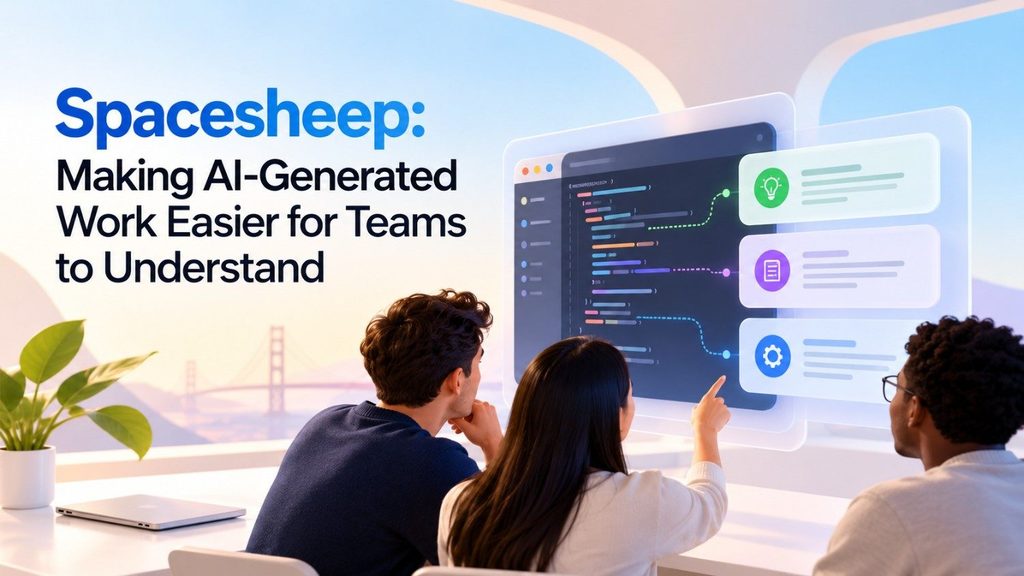
The company is based in San Francisco and appears in Y Combinator’s Fall 2026 batch. Its public description highlights collaborative spaces, version history, and support for outputs from multiple AI tools.
Y Combinator
Why collaboration is becoming an AI coding problem
AI agents can create software changes much faster than people can understand large amounts of generated information. This creates a gap between the speed of production and the speed of review.
Visual explanations, shared workspaces, and clear records of changes can help teams understand what agents have built. The opportunity extends beyond code to design, documentation, and internal applications.
Where businesses could benefit
Teams experimenting with AI-assisted product development may need a better way to share plans, working prototypes, and technical explanations. Tools that improve shared understanding can prevent costly mistakes caused by unclear requirements.
Spacesheep represents a broader category of products built around the collaboration problems created by widespread AI use.
Original SFTechScene Research #1: Where Are San Francisco’s AI Coding Startups Concentrating Their Efforts?
The first part of our analysis examines what the selected companies actually build. Rather than grouping every business under the broad label of AI coding, we assigned each of the 20 company lineages to one primary product category.
This distinction helps reveal which parts of software development are attracting different types of solutions. It also highlights a larger question: is the next opportunity in writing more code or in managing the work created by AI?
Research methodology
The research uses a purposive sample of 20 companies selected for direct relevance to AI-powered software development and an identifiable San Francisco presence. Public sources include Y Combinator profiles, company websites, product announcements, and company descriptions.
Each company was assigned one primary category according to the main problem its product addresses. Some companies operate across several categories, but we counted each company only once to avoid inflating category totals.
For example, Boxes.dev provides cloud environments and helps coordinate agents. We classified it under agent orchestration because its product is presented around running coding agents in parallel. Similarly, Factory provides several development functions, but its main position in this analysis is autonomous software development.
The classification is editorial analysis, not an official industry standard. It also reflects company positioning rather than independently measured product effectiveness.
Original finding #1: More companies in this sample focus on coordinating AI work than on generating code
Primary product focus among 20 selected SF company lineages
Original SFTechScene classification, October 2026
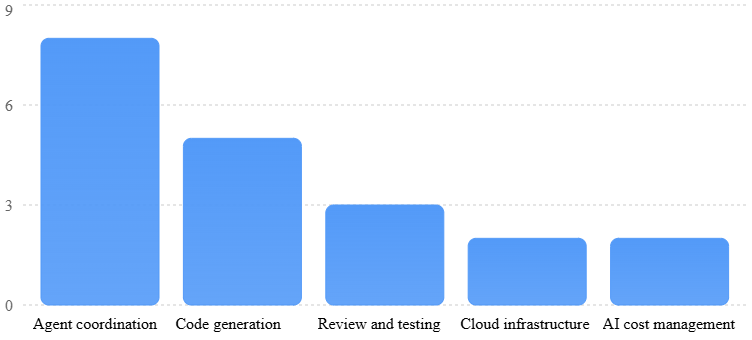
Source: SFTechScene coding of 20 selected company lineages. This is a count within the research sample, not a measure of market share or startup formation across San Francisco.
The largest group in our sample focuses primarily on agent coordination and development workflows. Eight of the 20 companies, or 40%, fall into this category.
Another five companies, representing 25%, focus primarily on generating software or automating engineering tasks. Three concentrate on review and testing, while two each focus on cloud infrastructure and AI cost management.
These results should not be interpreted as evidence that 40% of all San Francisco AI coding startups build coordination tools. The sample was intentionally designed to capture a wide range of products, so its composition is partly shaped by the selection method.
Even with that limitation, the findings highlight an important development opportunity.
Why agent coordination deserves attention
Imagine that an AI coding tool reduces the time required to create a feature from four hours to one hour. At first, the savings appear substantial.
However, if a developer now creates four features in the same period, the team may receive four separate sets of code that require testing, review, and deployment. The bottleneck has moved rather than disappeared.
This creates demand for products that can organize agent tasks, preserve context, prevent conflicts, and make review manageable. Companies such as HumanLayer, cmux, and Maxxwell address different parts of this challenge.
What this means for startup founders
Building another general-purpose coding assistant may require competing directly with well-funded companies and rapidly improving AI models. A narrower product can still succeed if it solves an expensive problem that customers experience repeatedly.
For example, a startup could focus on testing AI-generated financial calculations, reviewing changes in large enterprise databases, or helping teams monitor coding-agent spending. The opportunity comes from solving specific problems that remain after code becomes easier to produce.
The strongest business ideas will have a clear customer, a costly problem, and a measurable result.
Original SFTechScene Research #2: How Much of the Selected Ecosystem Comes From Y Combinator?
San Francisco’s AI coding market includes companies at very different stages. Some have grown into major platforms, while others are still testing their earliest products with customers.
To examine the role of startup accelerators, we identified which companies in our selected list have public Y Combinator company profiles.
Original finding #2: Fifteen of the 20 selected company lineages have YC profiles
Y Combinator representation in the selected sample
■ Other companies
■ YC-listed
75%
Of the selected company lineages have public Y Combinator profiles.
This is a property of the curated research list, not an estimate of Y Combinator’s share of all San Francisco AI coding startups.
The fifteen YC-listed company lineages in the sample include Greptile, HumanLayer, Proliferate, cmux, /dev/fast, Simulithic, Jcode, Boxes.dev, Zenbu, Maxxwell, Prized, machine0, Codag, Mentlio, and Spacesheep.
This figure is especially sensitive to selection bias because the YC directory was used as a discovery source. It should not be used to claim that YC companies dominate the entire San Francisco AI coding industry.
What it does show is that the accelerator’s publicly listed startups cover several different parts of the AI coding workflow, from testing and collaboration to cloud infrastructure and cost management.
Y Combinator+2
Why startup concentration matters for the local economy
A company building an AI code editor may need products for agent execution, software testing, monitoring, and security. Other startups can provide those products without competing with the editor directly.
This creates the potential for partnerships and specialized suppliers. A small team can focus on one part of the development process while other companies handle the underlying models or broader engineering platforms.
There is an important difference between ecosystem activity and commercial success, however. A startup’s presence in a directory does not establish that it has significant revenue, a proven business model, or lasting customer demand.
For investors and customers, startup density is an indicator of experimentation. Actual market strength must be measured through adoption, retention, product quality, and business performance.
Original SFTechScene Research #3: How Much Engineering Time Can AI Really Save After Review and Corrections?
The biggest weakness in many discussions about AI coding productivity is that they measure how fast code is generated instead of how much time it takes to deliver usable software.
A developer might ask an agent to write a feature and receive a result in minutes. That seems impressive until the team spends another hour correcting mistakes and reviewing the changes.
To make this problem easier to understand, we developed a transparent scenario model that includes AI execution time, human review, and correction work.
This is an original sensitivity analysis, not a field experiment. The input assumptions are illustrative and are not presented as observed averages for San Francisco companies.
The research model
We model a batch of 100 comparable engineering tasks. In the baseline workflow, each task takes 40 minutes of human engineering time.
For the AI-assisted workflow, we assume each task requires 12 minutes of active human guidance and handling, plus 8 minutes of human review. A share of tasks also needs 30 minutes of additional correction work.
The model measures human working time. It does not include passive agent runtime, subscription expenses, infrastructure costs, or the financial impact of defects discovered after release.
The baseline is:
\[ T_{\text{baseline}}=N\times t_{\text{manual}} \]
The AI-assisted workload is:
\[ T_{\text{AI}}=N(t_{\text{guidance}}+t_{\text{review}})+Nr\,t_{\text{correction}} \]
Here, \(N\) is the number of tasks and \(r\) is the fraction requiring correction.
Original finding #3: The correction rate can dramatically change productivity
Interactive AI coding productivity model
Change the inputs to explore how review time and correction rates affect theoretical human time savings.Tasks
100Baseline minutes per taskAI guidance minutes per task
12 minReview minutes per task
8 minTasks requiring correction
25%Correction time per affected task
30 min
Baseline human hours
66.7
AI-assisted human hours
45.8
Time saved
31.3%
Baseline time
66.7 hours
AI-assisted human time
45.8 hours
Reset assumptionsIllustrative scenario model developed for this article. Changing task volume alone does not change the percentage saved because the model assumes a constant task mix.
Comparing three correction scenarios
Keeping every other assumption unchanged produces the following results:
| Metric | Low correction | Base case | High correction |
|---|---|---|---|
| Engineering tasks | 100 | 100 | 100 |
| Tasks requiring correction | 10% | 25% | 40% |
| Baseline human hours | 66.7 | 66.7 | 66.7 |
| AI-assisted human hours | 38.3 | 45.8 | 53.3 |
| Human hours saved | 28.3 | 20.8 | 13.3 |
| Time reduction | 42.5% | 31.3% | 20.0% |
Modeled human-time savings at different correction rates
Same 100 tasks, with all other assumptions held constant
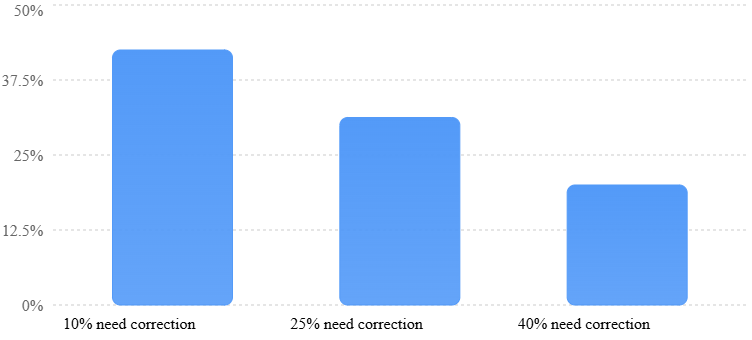
The results show why code generation speed alone is a weak measure of AI productivity. Under these assumptions, moving from a 10% correction rate to a 40% correction rate reduces the estimated human-time saving from 42.5% to 20%.
A team could have a very fast coding agent and still receive disappointing results if too much of its output requires correction.
Why these numbers should not be mistaken for real-world averages
The percentages above are calculated from transparent assumptions. They do not establish that any particular AI coding product saves 20%, 31%, or 42% of engineering time.
Real tasks vary greatly in complexity. Some require only a small code change, while others depend on years of business knowledge and careful decisions about existing systems.
The model also assumes the same amount of work is completed at equivalent quality. It does not account for extra defects discovered later, waiting time, changing requirements, or the financial cost of running AI systems.
A rigorous business test must collect these additional measurements. The purpose of the model is to help decision-makers understand which variables can change the return on their investment.
What San Francisco engineering teams should measure instead
A company running a coding-agent pilot should record the full process from task assignment to an accepted result. That includes time spent preparing instructions, monitoring the agent, reviewing code, correcting mistakes, and completing the deployment process.
It should also record how often tasks fail, how many changes are rejected, and whether customer-facing defects increase after adoption.
The best result is not simply faster coding. It is a reduction in the total cost and effort required to deliver dependable software.
Original SFTechScene Research #4: When Does an AI Coding Agent Actually Save Money?
Time savings do not automatically translate into financial savings. A company may spend less human time on coding while spending more on AI subscriptions, model usage, testing environments, and cloud infrastructure.

To examine the financial side, we extend the previous model with a second illustrative calculation.
The cost model
Assume an engineering organization assigns an internal loaded labor cost of $100 per hour. This is a round modeling assumption rather than a measured average San Francisco engineering cost.
The baseline workflow requires 66.7 human hours to complete 100 tasks, representing approximately $6,667 in labor cost.
The base AI-assisted workflow requires about 45.8 human hours. At the same assumed labor rate, that represents about $4,583 in labor cost before adding AI-related expenses.
The maximum available savings from reduced human time are therefore approximately $2,083 for this task batch.
Original finding #4: AI spending can erase gains from faster coding
| AI operating cost for 100 tasks | Total modeled AI-assisted cost | Net savings vs. baseline |
|---|---|---|
| $250 | $4,833 | $1,833 |
| $500 | $5,083 | $1,583 |
| $1,000 | $5,583 | $1,083 |
| $1,500 | $6,083 | $583 |
| $2,500 | $7,083 | −$417 |
Illustrative financial sensitivity model. Figures are rounded. AI operating cost includes assumed model and infrastructure spending but excludes transition costs and downstream defect losses.
Modeled net savings as AI operating costs increase
100 tasks, base-case human time assumptions, $100/hour loaded labor rate
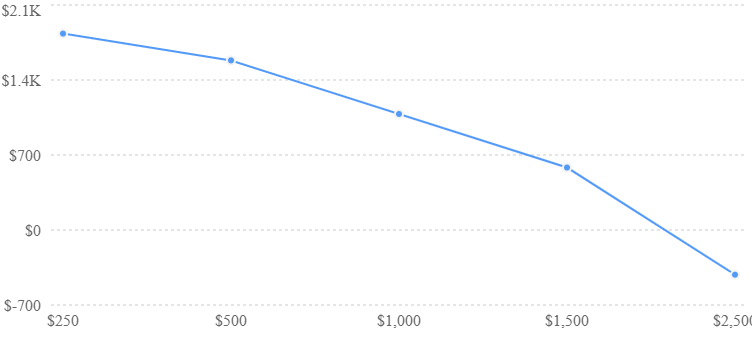
The calculation reveals a useful threshold. Under the base assumptions, AI operating costs above approximately $2,083 per 100 tasks would eliminate the modeled labor savings.
That does not mean the business should reject AI if costs exceed this figure. Improved product quality, faster customer delivery, reduced project delays, and greater development capacity can create additional value.
However, those benefits need to be measured rather than assumed.
Why tools like Codag matter
As AI coding becomes more common, teams may use several models and hundreds of automated tool calls across their development processes. Spending can become difficult to predict.
Products that compress unnecessary context, route tasks to appropriate models, and track AI spending can help manage this complexity.
For example, a company may not need its most expensive AI model to update documentation or make a simple formatting change. Using different models for different kinds of tasks could improve economics without reducing quality, but only if the results are checked.
A better financial measure
Companies should calculate the total cost per accepted engineering task rather than just the subscription cost per user.
That includes human time, AI costs, infrastructure, review, rework, and an allowance for downstream defects. For a fair comparison, the definition of an accepted task must remain consistent across manual and AI-assisted workflows.
This provides a stronger basis for purchasing decisions than a vendor’s claimed productivity percentage.
Original SFTechScene Research #5: Why Testing and Code Review Could Become More Important as AI Coding Grows
The next part of the market analysis concerns software quality. If AI agents make it easier to produce large amounts of code, businesses need ways to ensure that the additional output does not create more problems.
This is where companies such as Greptile, /dev/fast, and Simulithic become relevant. They focus on different parts of the quality process, from examining source code to testing how an application behaves.
AI agents can produce working code without fully understanding business requirements
A program can pass its technical tests and still fail to solve the customer’s problem. For example, an AI agent might build a payment feature that works correctly in normal conditions but handles refunds in a way that violates company policy.
This is not necessarily a coding error. It may be a requirements error, where the software does something different from what the business actually needs.
As AI becomes more capable of writing code, clearly defining desired behavior becomes more important. The team still needs to decide what should happen, how unusual situations should be handled, and which outcomes are unacceptable.
A benchmark score is not the same as reliable software delivery
SWE-bench Verified is useful because it tests AI systems on real software issues. However, it is based on a selected set of tasks and does not represent every type of software development.
The benchmark’s documentation also makes clear that evaluation setups matter. Different agent environments and tools can produce different results even when using similar underlying models.
swebench.com+1
A company should therefore be cautious about using benchmark rankings alone to choose a vendor. A product that performs well on open-source Python issues may not be the best choice for a company’s private systems, programming languages, or security requirements.
The quality measures businesses should track
| Measure | What it tells a business | Why it matters |
|---|---|---|
| First-pass acceptance rate | Share of tasks accepted without correction | Measures initial output quality |
| Review time per task | Human time needed to inspect changes | Reveals review bottlenecks |
| Rework rate | Share of tasks needing corrections | Captures hidden effort |
| Escaped defect rate | Problems found after deployment | Measures software reliability |
| Reverted change rate | Changes that must be undone | Highlights unstable delivery |
| Cost per accepted task | Total spending divided by accepted work | Connects quality and economics |
| Lead time | Time from task start to accepted delivery | Measures overall speed |
A company does not need dozens of new dashboards to begin. It needs a consistent record of task outcomes before and after adopting AI, with enough detail to distinguish simple work from complex work.
The purpose of measurement is to understand whether AI improves the development process as a whole.
Which Types of AI Coding Startups Have the Strongest Business Opportunities?
The companies in this article represent several possible paths for the next stage of AI development. Each category serves different customers and faces different challenges.
AI code editors: A large opportunity with demanding competition
AI-native editors can become part of a developer’s daily work. This creates opportunities for regular engagement, but developers already have many established tools and workflows.
For a new company, competing on general code generation alone may be difficult. A stronger position could come from supporting a specialized programming environment, industry requirement, or development workflow.
Autonomous engineering agents: High potential, but reliability matters
Autonomous coding agents offer an attractive promise: delegate defined work and receive completed engineering results. This could be especially valuable for companies with large maintenance backlogs.
The main challenge is dependable completion. Businesses need to know what an agent has done, whether the result is correct, and how much human effort was required.
Vendors that offer strong task tracking, clear approval controls, and reliable integration with existing development systems may be better positioned for serious enterprise adoption.
Code review and testing: A growing need for quality control
As code becomes easier to produce, more changes may need to be tested and reviewed. This creates a clear opportunity for tools that help teams detect important problems without overwhelming engineers with low-value warnings.
The strongest products will be able to demonstrate that they prevent meaningful defects and reduce the cost of delivering reliable software.
Agent orchestration: Making multiple agents practical
An engineering team may eventually use several coding agents at once, with each handling a different task. This creates the need for shared context, task assignment, progress tracking, and conflict prevention.
Companies such as HumanLayer, cmux, and Boxes.dev approach different parts of this problem. The opportunity is to make parallel AI development easier to control than a collection of disconnected agent sessions.
AI infrastructure and cost management: Supporting sustainable adoption
AI agents need computing resources, stable environments, and access to development tools. They also create new spending patterns that traditional software management systems may not explain clearly.
Infrastructure and cost management products become valuable when they help teams complete more useful work at predictable expense. Their success depends on measurable efficiency improvements rather than the number of agents running.
How San Francisco Businesses Should Choose an AI Coding Startup
Choosing an AI coding product should begin with the company’s development problems, not a list of popular tools. A product that works well for a small startup may be poorly suited to an enterprise with strict security requirements and older software systems.
The following comparison provides a practical starting point.
| Your main problem | Category to evaluate first | Example companies |
|---|---|---|
| Developers spend too much time writing routine code | AI coding editors | Cursor, Amp |
| Engineering backlog contains many defined tasks | Autonomous coding agents | Cognition, Factory |
| Small team needs working prototypes | AI app builders | StackBlitz |
| Pull-request reviews are slowing delivery | AI code review | Greptile, /dev/fast |
| Application testing takes too long | Automated testing | Simulithic |
| Several agents are difficult to supervise | Agent coordination | HumanLayer, cmux, Maxxwell |
| Agent tasks need persistent cloud machines | Cloud infrastructure | Boxes.dev, Prized, machine0 |
| AI development spending is unpredictable | Cost optimization | Codag; Factory’s acquired Mentlio technology |
| AI-generated work is difficult to share | Collaboration tools | Spacesheep |
Start with a specific development bottleneck
An engineering leader should begin by examining where work gets delayed. If developers spend most of their time waiting for code reviews, buying an AI code generator may make the problem worse by producing additional changes.
Similarly, a company struggling with unstable releases should prioritize testing and quality controls before increasing the volume of generated code.
The best AI investment addresses the largest constraint in the existing process.
Evaluate how much control the product provides
An AI coding tool may need access to private source code, development environments, and internal documentation. Some tools may also execute commands or interact with systems outside the code editor.
These capabilities create security and operational concerns. Buyers should determine what the agent can access, which actions require approval, and how the company can investigate unexpected behavior.
For sensitive applications, independent security review and careful permission settings are essential.
Compare tools using the same tasks
Vendor demonstrations often focus on tasks that show a product at its best. A more useful evaluation uses work drawn from the company’s actual engineering backlog.
Every vendor should receive comparable tasks with the same acceptance criteria. The business should record the time, cost, quality, and human effort needed to complete them.
This creates a stronger basis for choosing a product than marketing claims or headline benchmark results.
A Practical 90-Day Plan for Adopting AI Coding Tools
Businesses do not need to redesign their entire engineering organization to begin learning from AI coding. A focused 90-day program can reveal which tasks benefit from automation and which still require substantial human work.
Days 1–30: Establish the Baseline and Choose the First Tools
Identify repeatable development tasks
The first month should focus on understanding existing work. Engineering managers should review recent completed tasks and identify activities that are frequent, measurable, and relatively easy to validate.
Good initial candidates include writing routine tests, making small interface changes, updating documentation, fixing clearly defined bugs, and performing limited code cleanup.
Avoid beginning with projects involving critical payment systems, complex permission changes, or poorly understood business rules. Those tasks may eventually benefit from AI, but they are difficult starting points for an organization that has not established reliable controls.
Establish a measurement process
Before introducing new tools, record how long comparable tasks normally take. Include development time, code review, rework, and any relevant defects discovered after release.
Assign each task a difficulty rating using written rules. Otherwise, a team may accidentally compare easy AI-assisted work with difficult historical work and reach misleading conclusions.
Select a small number of tools
A company should avoid introducing several overlapping coding products at once. Different tools can make it difficult to understand which changes created the results.
A sensible first test might include one general AI coding assistant and one product aimed at an existing quality or workflow bottleneck.
Days 31–60: Run Controlled AI Coding Pilots
Compare similar tasks under similar conditions
During the second month, teams should use selected AI tools on real work. The tasks should have clear success criteria and be suitable for independent review.
Where practical, randomly assign comparable tasks to an AI-assisted workflow or the existing workflow. This reduces the risk that developers give AI only the easiest work.
Task complexity, developer experience, and project conditions should be considered when evaluating the results. An increase in speed is not meaningful if one group receives much simpler tasks.
Record unsuccessful attempts
One common weakness in productivity evaluations is counting successful demonstrations while ignoring failed attempts. A business should record every task that enters the pilot, including work the AI cannot complete.
Failed attempts consume time and money. Excluding them would make productivity appear better than it really is.
Developers should also record when they abandon an AI-generated solution and complete the task manually. That additional effort belongs in the cost of the AI workflow.
Monitor quality throughout the pilot
Do not rely only on whether the final code passes automated tests. Reviewers should check whether the implementation meets the intended requirements and follows engineering standards.
When the company releases AI-assisted changes, it should monitor whether defects or customer complaints increase. A faster workflow that creates more production problems may not be a successful investment.
Days 61–90: Decide What to Scale
Calculate the total cost per accepted task
At the end of the pilot, compare the costs of the AI-assisted and conventional workflows. Include active human time, AI usage fees, cloud infrastructure, review, and rework.
If the AI workflow produces more accepted tasks at equal quality and lower cost, the business has evidence for expanding it. If results are mixed, the team should identify which types of tasks benefit and which do not.
Define clear operating rules
Successful use cases should become part of a documented development process. That includes instructions for assigning tasks, checking results, handling failures, and protecting sensitive systems.
A coding agent should not gain more permissions simply because it has performed well on unrelated tasks. Access should remain tied to the work it needs to perform.
Expand gradually
The final stage should increase the number of participating engineers or eligible task types in controlled steps. Teams should continue measuring outcomes as usage grows.
Early results may not remain stable when more people use the tool or when tasks become more difficult. Ongoing measurement helps businesses detect these changes before they create expensive problems.
How AI Coding Could Change Engineering Jobs in San Francisco
AI coding startups are not only changing software products. They are changing the kind of work engineering teams may need to perform.
The effect is likely to vary by role, organization, and software complexity. Some routine activities may require less direct programming, while new responsibilities may emerge around AI supervision, testing, architecture, and security.
Junior developers may need stronger review and problem-solving skills
Entry-level engineers have traditionally learned by completing smaller programming tasks. If AI handles more of those tasks, companies may need to redesign how new developers gain practical experience.
This creates a training challenge. Engineers still need to understand how software works, even when they do not write every line themselves.
Companies should ensure that junior developers learn debugging, testing, system design, and code review rather than becoming dependent on generated answers they cannot explain.
Senior engineers may spend more time supervising complex work
Experienced developers often understand the history of a software system and the tradeoffs behind important decisions. These skills remain valuable when agents generate code.
Their work may increasingly involve defining requirements, selecting solutions, reviewing agent activity, and resolving difficult failures. The responsibility for reliable software does not disappear simply because AI produces the implementation.
Engineering managers may need to rethink productivity
Traditional management measures can become misleading when AI changes the amount of code developers produce. A team may generate more code without delivering more customer value.
Managers should focus on completed features, software reliability, customer outcomes, and the full cost of delivery. This creates a closer connection between engineering performance and business results.
The Biggest Risks Facing San Francisco’s AI Coding Revolution
Too much code and not enough understanding
AI makes generating software easier, but additional code increases the amount a business must maintain. Features that are never used still create testing, security, and maintenance obligations.
A team should not build functionality simply because AI makes it inexpensive to generate. Every feature should solve a real problem and justify its ongoing cost.
Hidden security problems
Coding agents may introduce unsafe dependencies, expose sensitive information, or make changes outside their intended scope. The risk increases when agents can execute commands and access internal systems.
Companies need limited permissions, secure development environments, source code review, and independent security testing for important applications.
Growing dependence on a single vendor
An engineering team may integrate one coding platform deeply into its daily workflow. That can improve convenience but create problems if pricing, product capabilities, or access conditions change.
Buyers should understand how to export their work, preserve development history, and continue using their software without depending entirely on one AI vendor.
Rising AI operating costs
A development team may increase AI usage faster than it increases completed work. Parallel agents, long-running tasks, and repeated model calls can create difficult-to-predict expenses.
Cost controls should be established early. Businesses should monitor spending by project and task type rather than waiting until bills become a concern.
Weak measurement
Perhaps the most important risk is assuming that adoption equals success. A company can have enthusiastic developers and high AI usage while receiving little measurable improvement in software delivery.
Without baseline measurements and consistent task-level data, the business cannot reliably determine whether its investment is working.
Research Methodology, Data Sources, and Limitations
How the company dataset was constructed
The company analysis was conducted for this article using publicly available information reviewed in October 2026. The sample includes 20 company lineages with San Francisco connections and products relevant to AI-assisted software development.
We used startup directory profiles, company product announcements, and public descriptions to establish each company’s main focus. The five primary product categories were defined by SFTechScene for this analysis, and each lineage was assigned to exactly one category.
The sample is intentionally diverse rather than random. It should be read as a comparison of selected startups, not a complete census of the San Francisco AI coding industry.
How acquisitions and overlapping products were treated
Acquired products were not counted as separate independent competitors when ownership information established that they had joined another company. Mentlio is included as a historical startup lineage and clearly identified as acquired by Factory.
This means the 20 rows should not be interpreted as 20 independent competing businesses on October 28, 2026. The figure represents 20 selected startup lineages and their product contributions.
Similarly, Windsurf was discussed under Cognition rather than counted as an additional company following Cognition’s acquisition and subsequent introduction of Devin Desktop.
How the numerical analysis was produced
The category analysis counts company lineages according to a defined primary product focus. The YC analysis counts selected company lineages with matching public accelerator records.
The productivity and financial analyses are mathematical sensitivity models with explicitly stated assumptions. They are original calculations but do not use observed engineering task records or confidential customer data.
No statistically valid claim about average San Francisco developer productivity can be drawn from those scenarios. A stronger empirical study would require actual task-level outcomes, consistent comparison groups, independent quality checks, and enough observations to estimate uncertainty.
What the research does not establish
This report does not independently rank the 20 companies by code quality, agent accuracy, revenue, financial health, or customer satisfaction. It does not establish their relative market shares or predict which company will become the market leader.
Startup product descriptions are useful for understanding positioning, but they are not independent proof that a product delivers its advertised benefits. Buyers should validate important claims through direct testing and customer references.
These limitations matter because accurate business decisions require separating verified facts, company-reported claims, analytical classifications, and hypothetical calculations.
Public research sources
The key underlying sources include Y Combinator’s San Francisco developer tools directory, the SWE-bench Verified benchmark, Stanford’s Human-Centered AI research, and company-level publications from Cursor, Cognition, Factory, Amp, and the other selected startups.
These sources provide product descriptions, company information, and external benchmark context. The category analysis and scenario calculations are SFTechScene’s own work based on the methodology described above.
Frequently Asked Questions About San Francisco AI Coding Startups
What are the leading AI coding startups in San Francisco?
Some of the most prominent companies include Cursor’s developer Anysphere, Cognition, Factory, Amp, and StackBlitz. Other startups, including Greptile, HumanLayer, and cmux, focus on different parts of the development process, such as code review and managing AI agents.
There is no single objective ranking that covers every use case. The best company depends on whether a customer needs coding assistance, autonomous development, testing, infrastructure, or team coordination.
Can AI coding agents replace software developers?
AI agents can already perform meaningful parts of software development, especially tasks with clear instructions and reliable tests. However, businesses still need people to define requirements, make important decisions, review changes, and manage risks.
The amount of work that can be delegated depends on the software system and the quality standards required. It would be misleading to assume that successful completion of benchmark tasks means an agent can independently manage an entire engineering organization.
What is the difference between an AI code editor and an autonomous coding agent?
An AI code editor helps developers write, understand, and modify software within their normal development environment. An autonomous coding agent is designed to work through a larger task with less direct involvement from a person.
The categories increasingly overlap as editors add more agent capabilities. Buyers should compare what the products can actually do instead of relying only on category labels.
How should a business measure AI coding productivity?
A business should compare total human time, AI operating costs, accepted tasks, rework, and software defects. The most useful measure is often the cost per successfully completed task at a consistent quality standard.
Code generated, prompts submitted, and number of active agents are activity measures. They do not, by themselves, establish meaningful productivity gains.
What is the biggest opportunity for new AI coding startups?
One promising area is improving the reliability and control of AI-generated software. Tools for testing, review, agent coordination, and cost management can address problems that become more important as code generation accelerates.
However, identifying an attractive problem is not the same as establishing a successful business. Startups still need to prove customer demand, product effectiveness, and sustainable economics.
Final Takeaway: The Future of AI Coding in San Francisco Is About Delivering Reliable Software, Not Just Generating More Code
San Francisco’s AI coding startups are helping redefine how software is created. Companies such as Cursor, Cognition, Factory, and Amp are expanding what developers can delegate to AI, while newer businesses are building tools for testing, coordination, infrastructure, and financial control.
The central lesson from our research is that software development consists of much more than producing code. Businesses also need to understand requirements, review changes, manage costs, protect sensitive systems, and ensure that applications work properly after release.
Our 20-company analysis illustrates how many different product opportunities exist around that broader process. The scenario models also show why the benefits of AI depend heavily on review effort, correction rates, and operating expenses.
For San Francisco businesses, the best strategy is to begin with a measurable engineering problem, test AI tools against real work, and expand only when the results justify it. The most valuable systems will be those that improve the full journey from a business requirement to reliable software in production.
The next stage of AI coding will not be defined only by which startup can write code fastest. It will be defined by which companies help engineering teams deliver useful, secure, and dependable software with less total effort.