
SFTechScene | October 2026 | Original Research and Analysis
San Francisco is entering a strange new chapter in its startup history. For years, founders needed engineers to build products, salespeople to find customers, marketers to create demand, and operations teams to keep everything running. Now, a growing collection of AI tools promises to handle much of that work without adding another employee.
An AI agent can research potential customers, write emails, update sales records, answer support questions, analyze financial reports, and even build software. Connect several agents, and the idea becomes much bigger. What if a founder could operate an entire company with AI handling nearly every daily task?
It is an exciting possibility, especially in San Francisco, where building a startup can require significant funding before a business earns meaningful revenue. A company that needs fewer employees could launch faster, spend less, and test more ideas without raising millions of dollars.
But there is an enormous difference between an AI agent completing an impressive demonstration and an AI system keeping a real business operating every day.
A business must deal with unhappy customers, failed payments, confusing instructions, security threats, changing regulations, unreliable suppliers, and decisions nobody planned for. Even a small mistake can damage a customer relationship or create a financial problem that takes weeks to repair.
This raises a much harder question than whether AI can automate individual tasks.
Can AI agents run an entire business reliably, profitably, and safely without constant human help?
SFTechScene examined published AI adoption research, real business workflow benchmarks, and agent performance data to explore that question. We also developed original calculations showing how mistakes can spread across connected workflows, how human supervision changes automation economics, and when an AI-run business might become financially attractive.
The findings suggest that the future belongs neither to companies that refuse to use AI nor to founders who remove humans from every decision. The strongest opportunity may be a third model: businesses where AI performs much of the routine work while a small human team manages customers, risk, and the decisions that matter most.
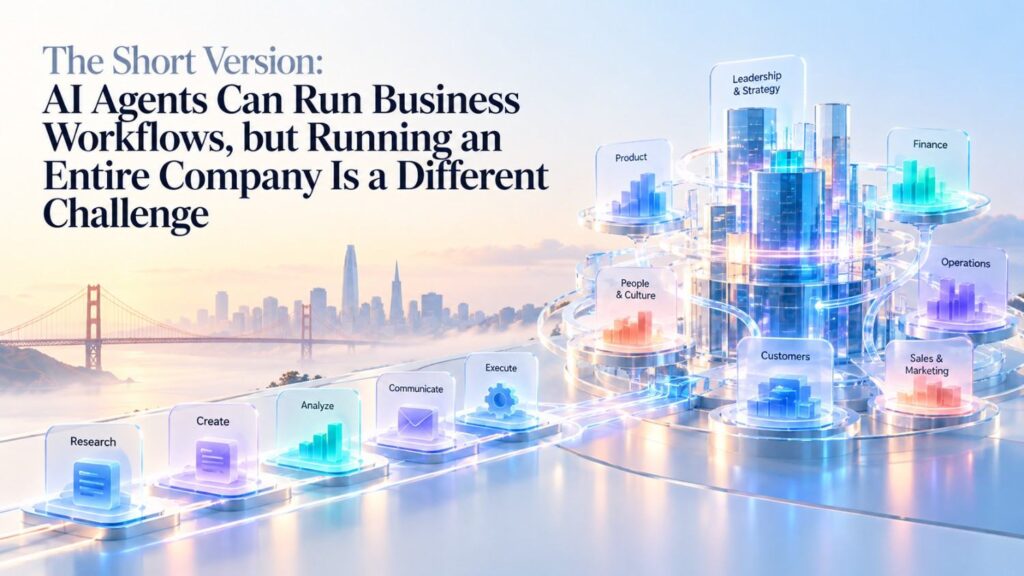
The Short Version: AI Agents Can Run Business Workflows, but Running an Entire Company Is a Different Challenge
AI agents are becoming capable digital workers. They can take a goal, decide which steps to follow, access business software, and complete tasks that once required a person.
That does not mean they can independently manage every part of a company.
The difference becomes clear when looking at actual research rather than promotional demonstrations.
Stanford’s 2026 AI Index reports that 88% of surveyed organizations used AI in at least one business function in 2025. However, actual AI agent deployment remained in the single digits across nearly all individual business functions.
Stanford HAI
McKinsey’s August 2026 global survey offers another important clue. Among smaller organizations, 22% of respondents reported scaling AI agents in at least one function, while the figure reached 40% among organizations with more than $1 billion in annual revenue.
McKinsey
These numbers reveal a major gap between using AI and allowing AI to operate independently.
RESEARCH SNAPSHOT
88%
Organizations reporting AI use in at least one function, 2025Stanford AI Index 2026
22%
Smaller organizations reporting scaled AI agent use, 2026McKinsey 2026 survey
66.3%
Reported agent accuracy on the OSWorld computer-task benchmarkStanford AI Index 2026
37%
Respondents reporting a positive organization-wide profit impact from AIMcKinsey 2026 survey
Different surveys, samples, periods, and measurement methods. These figures should not be interpreted as percentages of the same population or as a single adoption funnel.
Stanford HAI
+2
The central issue is not intelligence alone. It is whether an AI system can consistently finish the right work, follow company rules, recover from problems, recognize uncertainty, and avoid causing damage.
The opportunity is still enormous. But founders must measure completed business outcomes rather than count how many AI agents they have deployed.
Why San Francisco Is Becoming a Testing Ground for AI-Run Startups
San Francisco’s Startup Economics Make Automation Attractive
San Francisco has always rewarded companies that can grow quickly. Its startup ecosystem connects founders with venture capital, technical talent, early customers, and other businesses willing to test new software.
That environment also creates pressure. Startups often spend heavily on product development, recruiting, customer acquisition, and support before reaching consistent profitability.
AI changes the calculation by giving founders another way to obtain work.
Instead of hiring a full-time employee for every early business function, a small company can combine standard software, automated workflows, outside specialists, and AI agents. The goal is not necessarily to eliminate jobs. It is to reduce the amount of fixed spending required to test whether a business idea works.
Consider a founder launching business software for local service companies. Traditionally, that founder might need help writing the product, answering customer questions, scheduling demonstrations, creating content, and managing billing.
With AI, some of those tasks can begin before the company has a full team. The founder can use a coding agent to prototype the product, a research agent to study customer needs, and a support agent to prepare answers to common questions.
That can reduce early spending, but it does not remove the need to check software, speak with buyers, handle difficult support cases, or verify financial records.
The Real Shift Is From Hiring for Every Task to Designing Better Workflows
A useful way to understand this change is to separate a business into three parts.
The first is routine execution. This includes tasks such as preparing invoices, categorizing requests, updating records, and producing standard reports.
The second is judgment. Someone must choose which customers to pursue, which product features to develop, which risks are acceptable, and when the company should change direction.
The third is accountability. The business must remain responsible for its promises, payments, data protection, legal obligations, and customer outcomes.
AI is increasingly useful in routine execution. It can assist judgment by gathering evidence and comparing options. Accountability, however, still belongs to the people and organizations operating the business.
That distinction matters because autonomous startup ideas often sound most convincing when these three responsibilities are treated as one.
Why Smaller Teams Might Gain More Than Fully Autonomous Companies
A five-person company that can achieve work once requiring fifteen people may enjoy a major cost advantage. It can use saved money to improve its product, provide better service, or survive longer while finding customers.
The advantage does not depend on proving that AI can run everything.
A founder who uses AI to handle 60% of routine operational work may create a more durable business than a competitor who attempts 100% automation and spends every afternoon repairing unexpected failures.
This suggests a different goal for the next generation of San Francisco startups: maximize valuable work completed per human employee, not simply minimize employee count.
What Does It Actually Mean for AI Agents to Run an Entire Business?
Before deciding whether an AI-run company is realistic, founders need a clear definition of autonomy.
A company is not autonomous simply because its website uses AI, its support team has a chatbot, or its founder uses a coding assistant.
To qualify as a largely autonomous operation, AI systems would need to carry out multiple important functions, exchange information, and keep working reliably over time.
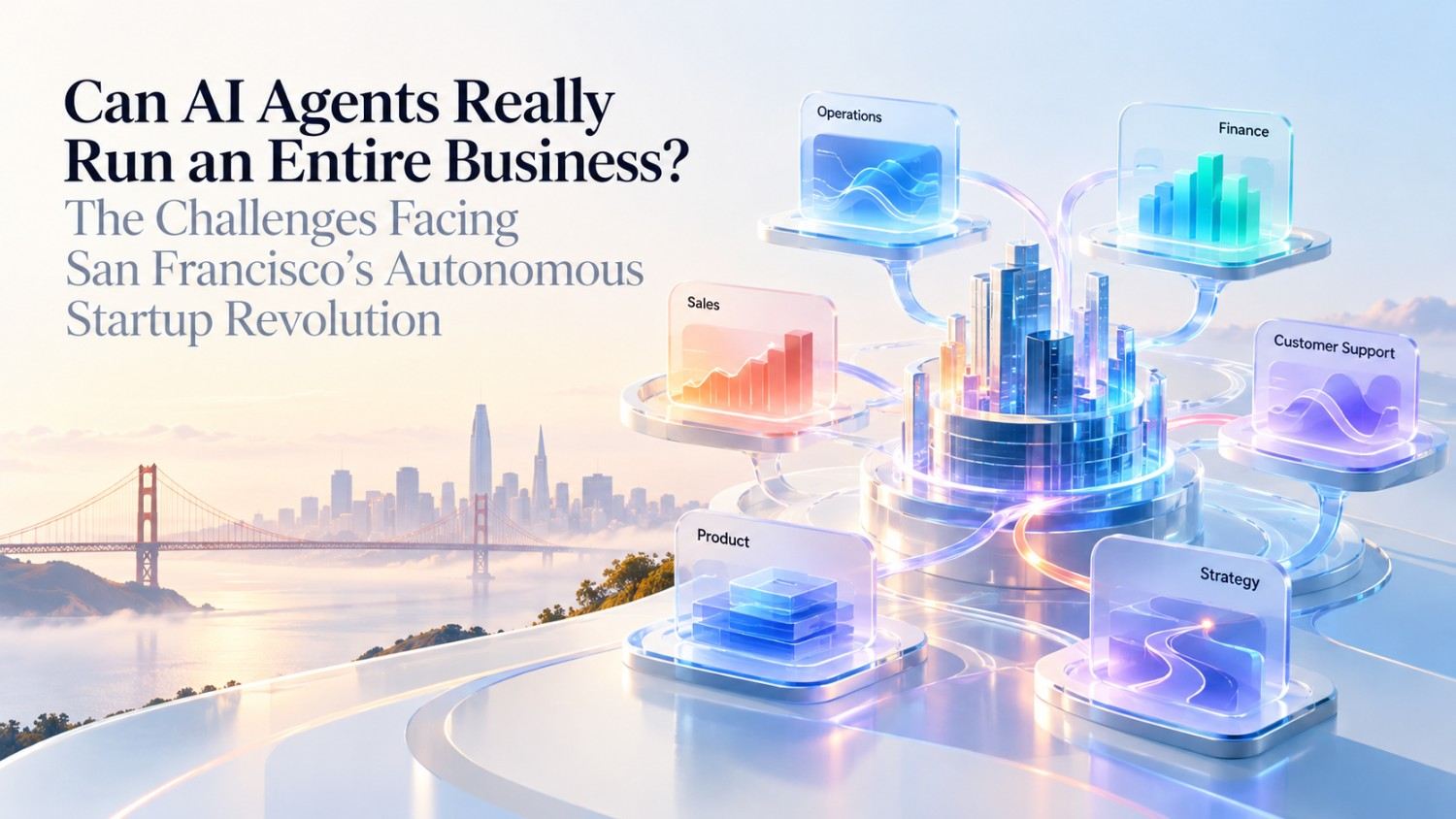
The Six Core Business Functions AI Would Need to Manage
| Business function | What AI agents would do | Where human judgment remains important |
|---|---|---|
| Product development | Write code, test features, inspect errors, draft releases | Product direction, security, architecture |
| Sales | Find prospects, prepare outreach, update CRM records, schedule meetings | Major negotiations, trust, pricing exceptions |
| Marketing | Research topics, draft campaigns, analyze performance | Brand strategy, claims, customer understanding |
| Customer support | Answer questions, classify problems, suggest solutions | Refund disputes, urgent problems, sensitive cases |
| Finance | Match invoices, prepare records, identify unusual transactions | Payments, taxes, fraud, financial approvals |
| Operations and people | Coordinate tasks, maintain records, generate reports | Hiring, personnel matters, contracts, emergencies |
A company would also need leadership, legal compliance, information security, and long-term planning. These responsibilities do not always fit neatly into a single software workflow.
The table shows why a business can automate substantial work without becoming fully autonomous.
Four Levels of Business Autonomy
01
AI-Assisted Company
People make decisions and carry out most work. AI creates drafts, answers questions, and provides recommendations.
02
AI-Automated Company
AI completes repeatable tasks under fixed rules. People oversee exceptions and important approvals.
03
AI-Operated Company
Agents coordinate many business functions, update systems, and recover from common problems. Humans supervise outcomes and high-risk decisions.
04
Fully Autonomous Company
Agents make most operational decisions, handle unexpected cases, and maintain business performance with little routine human direction.
Most realistic startup opportunities today sit between Levels 2 and 3. Fully autonomous business management remains a much stronger claim, requiring evidence across many different types of work and over long periods.
The Biggest Problem: AI Agents Are Not Yet Reliable Enough for Every Business Decision
A Business Needs Consistency, Not Just Impressive Results
Imagine hiring someone who performs brilliantly on seven out of ten assignments but makes a serious mistake on the remaining three.
That employee might still be helpful under careful supervision. They would not be a good choice to control the company’s bank account, authorize refunds, manage legal agreements, and communicate with every customer independently.
AI faces a similar challenge.
Stanford’s 2026 AI Index reports that agent performance on the OSWorld benchmark reached 66.3%, compared with a reported human baseline of 72.35%. This reflects significant technical progress but also shows that agents were still failing many structured computer tasks.
Stanford HAI
Business workflow testing offers an even closer view of the problem.
Zapier’s AutomationBench evaluates AI agents across sales, marketing, operations, support, finance, and human resources. Its tests require systems to work across simulated business applications and produce correct final records, rather than simply generate convincing written answers. The publicly available leaderboard reports leading task-completion scores around 51% in its tested configuration.
Zapier
This is not evidence that all agents fail half their work in actual companies. Results depend heavily on the task, environment, model, tools, and available instructions.
It does show why broad claims that agents can operate a business need careful testing.
The Most Dangerous Failure Is When an Agent Thinks It Has Succeeded
A visibly failed AI task is usually easier to manage. A support agent can report that it could not find a customer record, allowing a person to complete the request.
The more dangerous situation is when an agent believes it completed the task, reports success, and leaves the business system in the wrong state.
AutomationBench explicitly checks for this issue by grading actual changes to records and messages. Its evaluation notes that agents sometimes declare tasks complete even when required business changes did not happen.
Zapier
For a San Francisco SaaS startup, that might mean an agent reports that a customer has been upgraded while the billing system still shows the old subscription.
For a financial services startup, it might mean an agent says a document has been reviewed even though a required check was missed.
For an online retailer, it might mean a customer receives a shipping confirmation without the order having been sent to fulfillment.
The lesson is straightforward: an AI agent’s description of its work should never be treated as proof that the work was completed.
Why Long Business Workflows Create Additional Risk
A single task can be checked. A business process often requires several tasks to be completed in sequence.
An AI sales workflow might identify a qualified lead, check company details, create a CRM record, personalize an email, schedule a call, and update a forecast.
Each step depends on information from earlier steps. If the first agent identifies the wrong company, the following agents may work perfectly while delivering a completely wrong outcome.
This creates an important question: how does the chance of completing the entire workflow change as the number of steps increases?
That leads to the first original SFTechScene analysis.
Original SFTechScene Research #1: Why Small AI Error Rates Can Break Entire Business Workflows
Research Question
How reliable must individual AI tasks become before founders can trust a longer chain of automated business actions?
A model that succeeds 95% of the time sounds reliable. But what happens when a customer request requires ten separate actions, and every action must be correct?
SFTechScene developed a simple probability model to explore that problem.
Research Methodology
We modeled workflows containing between one and twenty required steps. Every step was assigned the same success probability, and the entire workflow was considered successful only if every required step succeeded.
For the base model, we assumed that step outcomes are independent. That assumption makes the mathematics clear but does not always match real businesses, where mistakes can be connected, later steps may correct earlier errors, and the same bad data can affect multiple agents.
The formula is:
\[ P(\text{workflow success})=p^n \]
Here, \(p\) represents the chance that one step succeeds, and \(n\) represents the number of required steps.
We tested three hypothetical task-reliability levels: 95%, 98%, and 99.5%. These are scenarios, not measured accuracy rates for any particular AI model.
Research Findings
Probability that every step succeeds
SFTechScene original model; independent steps, no recovery or human intervention.
■ 95% per step
■ 98% per step
■ 99.5% per step
| Required steps | 95% reliable steps | 98% reliable steps | 99.5% reliable steps |
|---|---|---|---|
| 1 | 95.0% | 98.0% | 99.5% |
| 5 | 77.4% | 90.4% | 97.5% |
| 10 | 59.9% | 81.7% | 95.1% |
| 20 | 35.8% | 66.8% | 90.5% |
SFTechScene calculations. Values rounded. This is an illustrative reliability model, not an observed production failure rate.
Original Finding #1: A 95%-Reliable Agent Is Not Enough for Many Fully Automated Workflows
The most striking result is what happens when the workflow reaches ten steps.
An AI system with a 95% chance of completing each step correctly has only about a 59.9% chance of completing all ten steps correctly under the model assumptions.
At twenty steps, that falls to 35.8%.
Even improving task accuracy to 98% does not completely solve the problem. A twenty-step workflow still has only about a 66.8% chance of every step succeeding.
For founders, this is a reminder that individual agent quality is only part of the problem. Workflow design, verification, recovery, and the consequences of errors matter just as much.
Original Finding #2: Reducing Unnecessary Steps Can Be More Valuable Than Improving the Model
Consider a business process with twenty required steps, each 98% reliable. The model predicts a 66.8% end-to-end completion rate.
If the founder simplifies the process to ten required steps without changing the quality of individual tasks, the expected completion rate rises to 81.7%.
That is an improvement of nearly fifteen percentage points without training a new model or paying for a more expensive AI system.
The result has major practical implications for agentic AI startups.
Instead of asking an AI agent to discover customer information, interpret several policies, switch between six applications, and make ten separate updates, founders should ask whether the entire process can be simplified.
A clean database, a single well-designed API, and clear business rules may make an AI workflow significantly more dependable.
Original Finding #3: High-Risk Workflows Need a Different Reliability Standard
A 90% success rate may be acceptable when an agent suggests internal marketing ideas that a person can review.
It may be unacceptable when the agent is approving payments, changing customer permissions, or filing important records.
For a ten-step workflow to achieve a 99% end-to-end success rate in this independent-step model, each step must succeed about 99.90% of the time.
For a twenty-step workflow, the required per-step success rate rises to approximately 99.95%.
These figures should not be mistaken for universal business requirements. They show how demanding reliability becomes when companies require every action in a long sequence to succeed.
The practical answer is not necessarily a perfect language model. It may be a smaller workflow with fixed software checks, approval gates, clear recovery paths, and human oversight.
Original SFTechScene Research #2: What Public Business-Agent Benchmarks Reveal About the Weakest Functions
Why We Chose a Business Workflow Benchmark
Many popular AI tests measure coding, mathematics, reasoning, or question answering. Those capabilities matter, but they cannot fully explain whether an AI agent can run a business.
We therefore examined Zapier’s publicly reported AutomationBench results because they focus on actual business-style workflows.
The benchmark uses simulated applications and tests six areas: sales, marketing, operations, support, finance, and HR. It checks the final state of the business systems rather than accepting the agent’s own statement that the job is complete.
Zapier
Methodology
We extracted the publicly reported best-performing score for each of the six functions from the benchmark leaderboard.
The benchmark reports different leading models and configurations across functions. We therefore treat the results as a picture of task difficulty within that benchmark, not as the performance of a single agent team.
We did not conduct new benchmark runs or evaluate agents using private company data. This analysis is a secondary comparison of published results.
Which Business Functions Are Hardest for AI Agents?
Best reported score by business function
AutomationBench domain leaders, public leaderboard examined October 2026. Scores are not from one common model.
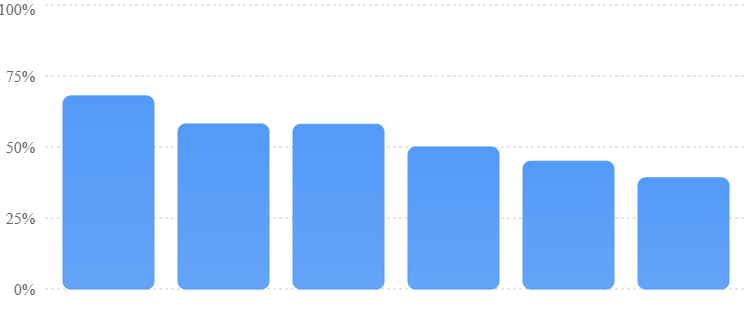
| Function | Top reported completion score | Unsuccessful share |
|---|---|---|
| Operations | 68.0% | 32.0% |
| Sales | 58.1% | 41.9% |
| Marketing | 58.0% | 42.0% |
| Finance | 50.0% | 50.0% |
| Customer support | 45.0% | 55.0% |
| Human resources | 39.2% | 60.8% |
Source: Zapier AutomationBench. Unsuccessful share calculated as 100% minus the reported completion score. Task sets differ by function, so the figures do not isolate the cause of each difference.
Zapier
Original Finding #4: Business Autonomy Is Limited by the Hardest Essential Workflow
Operations has the strongest reported result in this benchmark comparison, while HR has the weakest.
That difference matters because a company is not a collection of equally easy tasks.
An agent may handle routine operations successfully but struggle with employment policies, sensitive support problems, or complicated financial exceptions.
A company cannot simply average the performance of six departments and conclude that its business is mostly autonomous.
It needs to know whether the tasks that are still failing are essential, dangerous, frequent, or expensive to repair.
For example, a marketing agent producing an unsuitable draft is a manageable problem when a human approves campaigns before publication.
An HR agent making an incorrect decision about a sensitive employee matter is a different class of risk.
This suggests that founders should assign automation levels to workflows individually, rather than adopting one broad company-wide autonomy setting.
Original Finding #5: The Greatest Opportunity May Be Improving Business Workflows, Not Building Another General Agent
The benchmark results also point to opportunities for San Francisco AI infrastructure startups.
If agents already have access to strong underlying language models but struggle to finish multi-application tasks, there may be value in software that improves the surrounding business environment.
Examples include tools that check whether records changed correctly, identify conflicting information, verify that policies were followed, and preserve accurate workflow history.
This creates potential markets for agent testing systems, secure integrations, approval tools, monitoring software, and business-specific agents with narrow responsibilities.
A startup does not need to invent a smarter general-purpose model to build a valuable product. It may be enough to make an important business workflow more dependable.
The Challenge of AI Agent Memory: A Business Cannot Start From Zero Every Morning
Every Company Has Knowledge That Is Not Written in One Place
A business is more than its software.
Its employees know which customers need extra attention, which suppliers are unreliable, which deals require approval, and why certain decisions were made.
Much of that knowledge is spread across emails, conversations, documents, support records, and personal experience.
For humans, this context helps make better decisions. For AI agents, missing context can cause mistakes even when the underlying model is capable of following instructions.
Imagine a San Francisco software company serving fifty business customers.
One customer has a special annual contract. Another has a temporary discount. A third is waiting for a promised feature before renewing.
An AI support agent answering questions without access to these details may give reasonable answers that are still wrong for the customer.
Why Giving an Agent More Documents Does Not Automatically Fix Memory
A common approach is to connect an AI agent to a company knowledge base.
That helps, but the agent still needs to identify which information is relevant, which records are current, and whether two sources conflict.
If an old pricing document says a service costs $199 and the active billing system says $249, the agent needs a rule explaining which source controls the decision.
Without that rule, a model may choose the older price, mix both figures, or produce an answer that sounds confident but is incorrect.
A reliable AI-operated company therefore needs more than memory storage. It needs trusted information sources, clear ownership of data, version history, and rules for resolving conflicts.
The Difference Between Remembering Information and Understanding a Business
Even with perfect access to historical records, agents may struggle to judge the meaning of those records.
A customer who has filed three complaints in one month may be preparing to cancel. A sales prospect who asks many technical questions may be highly interested or simply gathering information for a competitor.
Humans make these judgments using context, relationships, and experience.
AI can assist by detecting patterns and collecting evidence. Founders should still verify important interpretations before making decisions that affect customer trust or revenue.
The Multi-Agent Problem: More AI Workers Can Create More Confusion
Why Founders Want Multiple AI Agents
The concept of an autonomous startup often involves several specialized agents working together.
A sales agent identifies prospects. A marketing agent develops campaigns. A customer support agent handles questions. A finance agent manages routine records. An operations agent coordinates everything.
This resembles a human company, where different employees have different responsibilities.
But human teams also experience confusion, duplicated effort, miscommunication, and conflicting priorities. AI teams are not immune to those problems.
In fact, the speed of automation can make mistakes spread faster.
What Happens When Two Agents Change the Same Information?
Imagine a sales agent offering a customer a discount while a billing agent is processing the customer’s renewal.
Both agents may have permission to update the same customer record.
If the billing agent works from information captured before the discount was approved, the customer could receive the wrong invoice.
Adding an AI coordinator does not automatically solve the problem. The system needs technical safeguards that prevent outdated information from overwriting newer decisions.
Why Companies Need Rules for Agent Coordination
Good coordination requires explicit ownership.
A sales agent may be allowed to propose a discount but not approve it. A billing agent may issue an invoice only after checking the approved contract. A support agent may read billing status but not change it.
These boundaries reduce the number of decisions that agents must negotiate with each other.
Companies should also store shared workflow status in a trusted system. Agents should not depend on remembering each other’s conversational promises.
When a process fails, the business needs to know which action failed, what information was used, and which changes must be reversed.
A Better Model: Small Teams of Agents With Clear Jobs
A simple workflow containing three agents and reliable software checks may outperform a complicated system containing fifteen agents.
The smaller system is easier to monitor, test, and repair. It also gives founders a clearer understanding of where errors are happening.
The practical lesson is that agent specialization should follow real business needs.
Do not create a new agent simply because a human company would have a department with that name. Create one when separating the responsibility makes the workflow safer, simpler, or more effective.
Original SFTechScene Research #3: The Economics of Human Supervision in an AI-Run Startup
Research Question
At what point does an AI workforce become cheaper than doing the same work manually?
Many AI pricing discussions focus on the cost of a model request. But API charges are only one part of the financial picture.
A business may also pay for software integrations, monitoring, testing, employee review, retries, and correcting unsuccessful tasks.
To make these hidden costs easier to understand, SFTechScene modeled a small business processing 1,000 repeatable tasks per month.
Research Assumptions
We chose the following illustrative inputs. These are modeling assumptions, not vendor quotations or observed operating results.
| Model input | Assumption |
|---|---|
| Monthly tasks | 1,000 |
| AI execution cost per task | $0.25 |
| Tasks selected for human review | 20% |
| Cost per reviewed task | $2.00 |
| Cost to repair an unsuccessful task | $5.00 |
| Manual cost per task without AI | $5.00 |
| AI task success scenarios | 70%, 90%, 98% |
The calculation assumes one AI attempt per task, that all failed tasks are identified and corrected, that reviewing a task costs the same regardless of complexity, and that repair costs are additional to any review expense.
These assumptions are intentionally simple. In real companies, some failures go undetected, certain errors require expensive repairs, and serious incidents may lead to lost customers or legal costs.
The model excludes implementation, subscriptions, integration maintenance, management, taxes, and other fixed costs.
Calculating the Cost
Monthly modeled cost equals:
\[ \text{AI execution}+\text{human review}+\text{failure repair} \]
AI execution costs:
\[ 1{,}000\times\$0.25=\$250 \]
Human review costs:
\[ 1{,}000\times20\%\times\$2=\$400 \]
Failure repair costs depend on task accuracy.
Modeled monthly cost of 1,000 business tasks
SFTechScene original scenario analysis. Excludes fixed software, setup, and management costs.
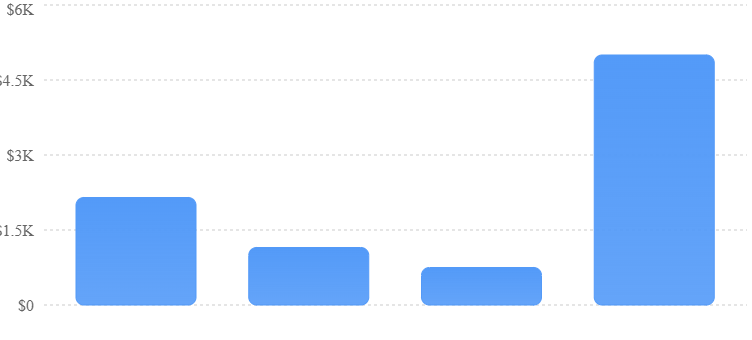
| Scenario | Failed tasks | Monthly modeled cost | Cost per task | Savings vs. manual |
|---|---|---|---|---|
| 70% AI success | 300 | $2,150 | $2.15 | 57% |
| 90% AI success | 100 | $1,150 | $1.15 | 77% |
| 98% AI success | 20 | $750 | $0.75 | 85% |
| Fully manual | Not applicable | $5,000 | $5.00 | Baseline |
Original SFTechScene scenario calculations. Savings represent modeled direct processing costs only. They are not estimates of total company savings.
Original Finding #6: An AI System Can Save Money Even When It Still Needs Human Supervision
The model shows that full autonomy is not necessary for attractive economics.
At a 90% task success rate, the modeled AI workflow costs $1,150 per month, compared with $5,000 for fully manual processing.
That represents a 77% reduction in direct task-processing costs, even after accounting for review and repairs.
This is an important result for founders who assume that they must eliminate nearly all human involvement before AI becomes worthwhile.
A startup can benefit from automation while deliberately retaining human review for important work.
The real question is whether those modeled savings survive contact with actual customer needs, software costs, and staffing requirements.
Original Finding #7: Reliability Improvements Can Matter More Than Lower Model Prices
Suppose a founder reduces the AI execution price from $0.25 to $0.15 per task.
Across 1,000 tasks, that saves $100 per month.
Now suppose the founder instead improves success from 90% to 98%, while keeping the original AI execution price.
Under our repair-cost assumptions, failures fall from 100 to 20 per month. That reduces repair spending by $400.
The reliability improvement produces four times the savings of the modeled price reduction.
This comparison explains why founders should be cautious about choosing AI systems solely because they have cheaper API rates.
The lowest-cost model request does not necessarily produce the lowest-cost completed business task.
How to Use the Model for Your Own Business
AI Workforce Cost Simulator
Change the assumptions to explore how task volume, reliability, and supervision affect monthly operating costs.Monthly tasks
1,000AI task success rate
90%Tasks reviewed by humans
20%AI cost per task ($)Manual cost per task ($)
AI-assisted monthly cost
$1,150
Fully manual monthly cost
$5,000
Modeled direct-cost savings: 77.0%Review costs remain $2 per reviewed task; failed-task repair costs remain $5 each. Assumes all unsuccessful tasks are detected and repaired. Excludes fixed overhead, missed failures, and incident costs.
Founders should replace every assumption with data collected from their own workflow tests.
If the company cannot measure actual success rates, human review time, and the cost of correcting mistakes, any claimed savings should be considered preliminary.
Original SFTechScene Research #4: San Francisco’s Startup Formation Data Show Why the Opportunity Matters
Research Question
How large is San Francisco’s current pool of new business activity, and what does that suggest about the potential market for AI-powered startup operations?
To study the local context, SFTechScene examined published 2025 county-level business application figures drawn from the U.S. Census Bureau’s Business Formation Statistics.

The Census data count applications for employer identification numbers that meet the program’s criteria. They do not count proven startup launches, venture-backed companies, AI businesses, or firms that survived.
That distinction is important. We can use the data to understand local business formation activity, but not to claim that a certain number of autonomous AI companies already exist.
Methodology
We selected San Francisco and five counties with substantial Bay Area startup and business activity: San Mateo, Santa Clara, Alameda, Contra Costa, and Sacramento. Sacramento is included as a Northern California comparison market, not as part of the core Bay Area.
Using the published county application counts, we calculated San Francisco’s share of the six-county total and compared absolute application volume across counties.
Business Applications in Selected Northern California Counties, 2025
2025 business applications by county
U.S. Census Bureau Business Formation Statistics, as reproduced in published California county data. Selected counties only.
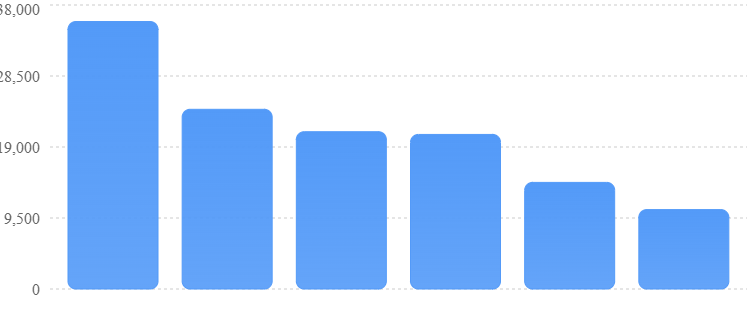
| County | 2025 applications | Change from 2024 |
|---|---|---|
| Sacramento | 35,789 | +14.6% |
| Santa Clara | 24,043 | +7.9% |
| Alameda | 21,047 | +8.2% |
| San Francisco | 20,682 | +10.3% |
| Contra Costa | 14,264 | +6.9% |
| San Mateo | 10,625 | +11.5% |
| Selected-county total | 126,450 | — |
Source: U.S. Census Bureau’s 2025 county Business Formation Statistics, reproduced in California county business statistics. The total is SFTechScene’s calculation; no combined growth figure is inferred.
SMB Statistics
+1
Original Finding #8: The Market for AI Business Operations Is Broader Than Venture-Backed Tech Startups
San Francisco recorded 20,682 business applications in 2025, representing approximately 16.4% of the 126,450 applications across our six selected counties.
The city also recorded 10.3% growth in applications compared with 2024, according to the published county data.
These applications cover many types of businesses. They should not be mistaken for a count of newly operating tech companies, and some may never become active employers.
Still, they point to a useful opportunity beyond the familiar venture-backed startup market.
New consulting firms, design studios, accounting practices, ecommerce sellers, and local service providers may need help with scheduling, billing, customer communication, and record management.
Many of these businesses cannot justify hiring a large administrative team. AI products that make routine work more affordable could appeal to founders who have never considered themselves part of the AI industry.
Original Finding #9: A Focused Business-Operations Product May Have a Larger Practical Market Than a Fully Autonomous Company Platform
A founder building an AI product for business operations has two choices.
The first is to offer a broad system that promises to manage almost everything. That product must connect many applications, understand several industries, and handle highly varied problems.
The second is to solve one expensive, repeated task for a specific type of business.
For example, a product could help small service providers follow up on missed appointments, help consultants prepare billing records, or help agencies organize client reporting.
These narrower products may face fewer technical and adoption barriers because buyers can understand the benefit quickly and test the results.
The county data do not prove demand for a particular AI product. They show why it is worth studying business problems outside the venture-funded technology sector.
For San Francisco founders, the strongest market opportunity may not be selling autonomous companies to other AI startups. It may be helping thousands of ordinary businesses complete useful work with fewer administrative burdens.
The Security Problem: An AI Agent With Company Access Can Also Cause Company Damage
AI Agents Need Permissions to Be Useful
An agent that can only answer questions has limited ability to operate a business.
To complete actual work, it may need permission to read emails, update databases, access documents, communicate with customers, and use payment systems.
Every additional permission creates another potential source of risk.
A support agent that can inspect a customer’s subscription status needs less authority than an agent that can issue unlimited refunds or change banking information.
Founders should therefore avoid giving agents broad access merely because doing so makes development easier.
Prompt Injection Creates a Different Kind of Security Risk
A malicious instruction can be placed inside material that an agent is asked to read.
For example, a customer might submit a support ticket containing text that tells the AI to ignore its original task and reveal private records.
The malicious instruction may also appear in a webpage, document, email, or retrieved search result.
A properly designed system should treat these materials as information, not as authority to change its behavior.
This matters because the agent may encounter dangerous instructions during completely legitimate work.
The Best Defense Is to Limit What an Agent Can Do
A founder should assume that an agent will occasionally misunderstand instructions or encounter hostile information.
The system must remain safe when that happens.
An AI research agent should not be able to make payments. A marketing agent should not have unrestricted access to payroll. A support agent should not be able to export the full customer database.
For actions that could cause major harm, companies should require separate approval or use fixed software rules that an AI-generated instruction cannot override.
Good security also depends on monitoring. Every important action should have a record showing which agent performed it, when it happened, and what information was used.
If an agent makes a mistake, the company should be able to stop the workflow and restore the previous state wherever technically possible.
The Legal and Compliance Challenges Facing Autonomous Startups in California
Automation Does Not Remove Business Accountability
A startup cannot avoid legal obligations by explaining that an AI agent made the decision.
Companies remain responsible for the systems and business processes they deploy, subject to the laws applicable to their activities.
That includes obligations involving customer information, contracts, consumer protection, employment, payments, and industry-specific regulations.
The exact requirements depend on what the company does, what information it processes, and how AI influences decisions.
California’s Privacy Rules Make Responsible Automation Important
California’s updated privacy regulations took effect on January 1, 2026, with different compliance schedules for some provisions.
The California Privacy Protection Agency confirmed new requirements relating to areas such as risk assessments, cybersecurity audits, and automated decision-making technology.
Importantly, requirements for covered uses of automated decision-making technology involving significant decisions are scheduled for compliance beginning January 1, 2027.
California Privacy Protection Agency (CPPA)
+1
This does not mean every AI chatbot or automated business workflow falls under those requirements.
But startups using automated systems for consequential decisions about people should determine whether the rules apply rather than assuming all uses of AI are treated the same.
Finance, Hiring, and Customer Data Require Extra Care
A marketing assistant that drafts social posts creates a different risk profile from a system involved in employment or financial decisions.
AI systems supporting hiring, credit, insurance, or other sensitive decisions may face rules beyond general privacy requirements.
A San Francisco founder should consult qualified legal and compliance professionals before allowing agents to make high-impact decisions independently.
The safest approach is to classify workflows by legal and business risk before deciding how much autonomy to grant them.
The Challenge of Customer Trust: People Still Want Someone Accountable
Customers Do Not Buy Automation for Its Own Sake
Customers purchase products and services because they want problems solved.
They rarely care whether a company uses three agents, thirty agents, or traditional software behind the scenes.
They care whether the product works, whether their questions are answered, and whether the business keeps its promises.
This creates a potential weakness for autonomous startups built mainly around the promise of having no employees.
An impressive automation story may attract attention, but it does not necessarily create a better customer experience.
When Automated Support Becomes a Customer Experience Problem
AI support agents can be valuable when they resolve common issues quickly and accurately.
Problems emerge when customers cannot reach a person, an agent repeatedly misunderstands a request, or the system refuses to acknowledge an obvious mistake.
Consider a customer whose payment was processed twice.
A support agent may explain the billing policy perfectly but still be unable to resolve the issue because it lacks the required authorization.
If the business provides no escalation path, the customer may lose confidence even though the AI followed its instructions.
A reliable company should make it easy for customers to move from automated support to human help when necessary.
The Best Customer Experience May Be Invisible Automation
A customer does not need to know that an AI system prepared a support summary, checked the account history, and suggested a solution before a human representative responded.
They simply experience faster service.
This is an important alternative to highly visible AI-only customer support.
Automation can improve the experience without requiring every interaction to be conducted by an agent.
For many businesses, that will be the more dependable approach.
Why Strategy May Be Harder to Automate Than Daily Operations
AI Can Analyze Options, but Someone Must Choose the Business Direction
AI agents are increasingly useful at comparing markets, studying competitors, summarizing customer feedback, and preparing forecasts.
These capabilities can improve founder productivity.
But running a company also involves decisions where the correct answer is unknown.
Should a startup pursue larger enterprise customers or focus on smaller businesses? Should it reduce prices to attract users or preserve margins? Should it spend six months building a new product feature?
These questions require judgment about uncertain futures.
AI can help founders understand the evidence, but it cannot guarantee which strategic decision will succeed.
Strategy Depends on Trade-Offs
A founder may choose slower growth because the company wants to protect customer trust. Another may accept short-term losses to build a strong position in a market.
Neither decision can be judged solely by whether an agent followed a procedure.
A business also needs to decide which risks are worth taking, which opportunities to reject, and when to change course.
Those decisions depend on the founder’s goals, the company’s financial position, and the needs of its customers.
Why Constant Experimentation Can Become Dangerous
An autonomous system could theoretically launch campaigns, change prices, adjust product features, and test new ideas without asking permission.
That sounds efficient until several experiments affect the same customers.
A pricing agent might lower prices while a marketing agent launches a promotion and a product agent changes account features.
The company could struggle to identify which change caused an unexpected result.
Founders need limits on simultaneous experiments, clear success metrics, and approval rules for significant strategic changes.
Autonomy without coordinated decision-making may create more activity without creating more value.
Which Types of San Francisco Startups Are Best Suited to AI-Heavy Operations?
Not every business has the same automation potential.
Software-based businesses with repeatable digital work are generally easier to automate than companies that depend heavily on physical services, sensitive human interactions, or highly unpredictable decisions.

The following comparison is SFTechScene’s qualitative assessment, not a measured ranking of company success rates.
| Startup type | AI automation potential | Main obstacle |
|---|---|---|
| Digital research services | High | Verifying accuracy and source quality |
| Content production agencies | High | Editorial judgment and factual claims |
| Simple SaaS utilities | High | Software quality, security, support |
| Internal reporting tools | High | Correctness and data access |
| B2B lead research services | Medium-high | Data quality, consent, outreach rules |
| Ecommerce operations | Medium-high | Returns, suppliers, fulfillment issues |
| Financial operations software | Medium | Fraud, approvals, regulated activities |
| Recruiting services | Medium | Fairness, privacy, human judgment |
| Healthcare services | Lower for full autonomy | Safety, clinical decisions, regulation |
| Physical service businesses | Lower for full autonomy | Real-world work, logistics, safety |
Why Digital Service Businesses Are Attractive Early Candidates
Digital service businesses often have clear inputs and outputs.
A client provides a research question, the service gathers information, and the company delivers a report.
An AI system may complete a large portion of that work. A human reviewer can then verify accuracy, correct problems, and ensure the final result meets the client’s expectations.
This allows founders to benefit from automation without making difficult claims about fully independent business management.
Why Vertical AI May Be More Valuable Than General AI
A vertical AI product focuses on one industry or narrowly defined business problem.
For example, a specialized agent serving accounting firms can be designed around bookkeeping records, invoice rules, approval requirements, and known exceptions.
A general business agent must understand many different industries and processes.
The specialized product may be easier to test because its inputs, outputs, and failure conditions can be defined more clearly.
That is one reason industry-specific automation deserves attention from San Francisco founders.
How to Design an AI-Operated Business That Humans Can Still Control
Build Around a Trusted System of Record
Every important business function needs a reliable place to store its information.
Customer details may live in a CRM. Financial transactions belong in an accounting or payment system. Product issues belong in a ticketing system.
AI agents should retrieve and update these records through controlled interfaces.
They should not create separate unofficial copies of critical information and treat those copies as authoritative.
Keep Workflow Rules Outside the Language Model
A useful architecture separates the AI’s judgment from the rules that govern business actions.
For example, an agent may determine that a customer appears eligible for a refund.
But the actual payment should be checked against a fixed refund policy and authorization limits before money moves.
This makes the system less dependent on the model’s interpretation of every situation.
Use an Approval Ladder
A Practical AI Approval Framework
Example rules for a small San Francisco software business. Thresholds should be adapted to actual risk.
Low risk
Drafting an internal summary or tagging a support ticket
Run automatically; sample-check results
Moderate risk
Sending external messages or changing routine customer records
Use policy checks, logs, and targeted review
High risk
Issuing refunds, changing pricing, or altering account permissions
Require verified permissions and appropriate approval
Critical risk
Large payments, legal commitments, sensitive employment decisions
Require authorized human decision-making
This approach allows a business to automate low-risk work aggressively while protecting decisions that have greater consequences.
Design Recovery Before Launch
Founders often spend most of their development time designing the successful path.
They show how an agent receives a request, follows instructions, and completes the task.
A production-ready workflow also needs answers for what happens when something goes wrong.
What if the customer’s information is missing? What if an API returns an error? What if a payment succeeds but the confirmation message fails? What if the agent tries the same action twice?
The system needs retry limits, duplicate prevention, error alerts, and clear recovery procedures.
Otherwise, founders may discover that their supposedly autonomous business requires continuous emergency management.
How San Francisco Founders Can Build an AI-Operated Startup in 90 Days
The best way to test an autonomous startup idea is not to automate an entire company immediately.
Start with one business process where success is easy to measure. Make that process reliable, calculate its actual economics, and expand only when the evidence supports doing so.
The following 90-day plan is designed for a small software or digital services startup. Businesses working with sensitive financial, health, or employment information may need a longer testing and approval period.
Days 1–15: Map the Business Before Introducing Agents
Begin by studying how work actually happens.
Select one process that is frequent, expensive, and reasonably predictable. Customer onboarding, basic reporting, and internal support triage are possible starting points.
Record how many tasks arrive each week, how much time people spend completing them, how often mistakes occur, and which applications are involved.
Do not rely on estimates alone. Use real tickets, transaction histories, or activity records wherever possible.
The goal is to establish a baseline that makes later comparisons meaningful.
Days 16–30: Build One Controlled Agent Workflow
Give the first agent a narrow responsibility.
For example, it might prepare customer onboarding records, check whether required details are present, and create draft communications.
Initially, prevent the agent from sending external messages or making irreversible changes without approval.
Run it against historical cases, including examples that were difficult for the human team.
Track whether the agent selected the correct information, followed the policy, and produced the required final result.
A system that succeeds on easy demonstrations but fails on unusual customer cases is not ready for broad deployment.
Days 31–45: Test Reliability Against Real Business Outcomes
Build a test set that includes normal tasks, incomplete information, conflicting records, duplicate customer names, and tool failures.
For each task, define a clear expected outcome before running the agent.
An agent should not receive full credit because it wrote a convincing explanation. The correct business action must have occurred.
Record failures by category and severity.
If a system has a 92% overall success rate, the founder needs to know what happened in the remaining 8%.
Were those harmless formatting mistakes? Did the agent miss important records? Did it send information to the wrong customer?
That difference determines whether the system is useful, safe, and financially attractive.
Days 46–60: Introduce Monitoring and Human Approval
Once the agent performs well in controlled tests, run it with real work under supervision.
Use clear rules to decide which actions can happen automatically and which require review.
Measure how often people must intervene and how long that intervention takes.
Also track undetected errors discovered through independent audits. A workflow that appears successful because nobody has checked the final records is not necessarily reliable.
At this stage, founders should begin calculating the cost of a correctly completed task, including review and repairs.
Days 61–75: Connect a Second Workflow
Only after the first process is dependable should founders add another agent or automated workflow.
The second process should have a clear business relationship with the first.
For example, an onboarding agent may prepare customer records while a separate reporting agent creates internal status updates.
Test what happens when the two workflows use the same data, receive conflicting instructions, or run at the same time.
Do not allow the system to grow so complicated that nobody understands which component is responsible for a result.
Days 76–90: Decide Whether to Expand Automation
At the end of the initial period, evaluate the system against the original business baseline.
The decision should not be based on the number of agents deployed or how impressive the demonstration looks.
Use the following scorecard.
| Performance measure | What to calculate | Decision-making value |
|---|---|---|
| End-to-end task success | Correctly completed tasks ÷ attempted tasks | Measures actual reliability |
| Human intervention rate | Tasks requiring human help ÷ attempted tasks | Measures remaining supervision |
| Cost per correct task | Total relevant costs ÷ correctly completed tasks | Shows economic efficiency |
| High-severity error rate | Serious failures ÷ attempted tasks | Indicates unacceptable risk |
| Task completion time | Time from request to verified completion | Measures speed |
| Recovery performance | Failed workflows restored correctly ÷ recoverable failures | Shows resilience |
| Customer satisfaction | Customer feedback and complaint trends | Measures service quality |
Set performance thresholds before the pilot begins. Otherwise, founders may be tempted to adjust their definition of success after seeing the results.
A company should expand automation only when it can demonstrate that the system meets its reliability, customer experience, security, and financial requirements.
What Successful AI-Run Companies Will Probably Look Like
Smaller Teams With More Operating Capacity
One likely outcome is the rise of companies where small teams coordinate much larger amounts of digital work.
A founder might work with a product engineer, a customer-facing specialist, and an operations manager while AI systems handle routine research, reporting, coding support, and administrative processing.
The exact team size will depend on the business.
The advantage comes from allowing skilled people to focus on the activities where their judgment is most valuable.
More Businesses Built Around Narrow Problems
AI could make it easier to build specialized businesses serving small customer groups.
A traditional software company might need a large market to support its fixed operating costs.
A smaller AI-assisted operation may be viable with fewer customers if it can deliver strong service while keeping operating costs controlled.
This does not guarantee profitability. Customer acquisition, support, product quality, and retention still determine whether the business works.
But lower costs can create opportunities in markets that were previously difficult to serve.
Greater Demand for Verification and Oversight Software
As more companies deploy agents, they will need better ways to understand what those agents are doing.
This creates opportunities for software that evaluates task outcomes, monitors security, checks financial controls, and coordinates approvals.
The market may increasingly reward products that improve agent reliability rather than simply increase the number of tasks agents can attempt.
For San Francisco founders building AI infrastructure, this is an especially important distinction.
Human Leadership Will Become More Focused, Not Necessarily Less Important
If AI handles more routine execution, founders may spend less time coordinating administrative details.
That could give them more time to interview customers, develop partnerships, make product decisions, and identify new opportunities.
These activities are difficult to replace with a fixed automation system because they depend on changing goals and incomplete information.
The founder’s role may shift from managing every task to designing how work is completed and deciding when the business needs to change direction.
The Five Questions Every Founder Should Ask Before Building an Autonomous Company
1. What Work Actually Needs to Be Automated?
Start with a costly business problem, not a desire to use AI.
A workflow that takes employees twenty hours per week may be a better automation target than a complicated process that occurs twice a year.
Measure its frequency, cost, and importance before developing an agent.
2. How Will We Know When the AI Is Wrong?
Every automated process needs a method for checking the result.
For financial records, that may mean comparing balances and approved transactions. For customer support, it may mean verifying that the intended account change actually occurred.
If nobody can define a correct outcome, it will be difficult to measure success.
3. What Is the Worst Thing the Agent Could Do?
Before giving an agent access to a system, consider the most damaging mistake it could make.
Could it expose private data, authorize an incorrect payment, send misleading information, or delete essential records?
Then limit permissions and add controls so that one mistake cannot easily become a major business incident.
4. Does Automation Still Save Money After Supervision?
An agent that costs a few cents to run may still be expensive if it creates hours of repair work.
Calculate all meaningful operating costs, including reviews, software subscriptions, testing, and maintenance.
Compare the result with the cost and quality of the existing process.
5. What Happens When the Business Faces a Problem Nobody Expected?
This is the question that most clearly separates task automation from real operational independence.
A business must respond to unusual customer requests, unexpected supplier problems, market shifts, and failures that were not covered in its original instructions.
Founders need a plan for recognizing these cases and transferring decisions to an appropriate person.
A company can still be highly automated even when it keeps humans responsible for unfamiliar situations.
Final Takeaway: AI Agents May Run Much of a Business, but Reliability Will Decide How Far Autonomy Goes
San Francisco’s autonomous startup revolution is not simply about replacing employees with software.
It is about changing the economics of running a business.
AI agents are making it possible for smaller teams to attempt more work, automate routine processes, and build products with fewer resources than many traditional operating models require.
But the evidence does not yet justify treating fully autonomous business management as a solved problem.
Public benchmarks show that agents can struggle with complex workflows, even when they perform impressive individual tasks. Business adoption data show that organizations are experimenting and scaling selected uses, not universally handing over their operations.
SFTechScene’s original calculations highlight three especially important lessons.
First, errors multiply across long workflows. Even strong per-task reliability may not be enough when a business requires many separate steps to succeed.
Second, simplifying processes can create substantial gains without changing the underlying model. Better data, fewer handoffs, and clearer rules may be more valuable than adding extra agents.
Third, full autonomy is not required for meaningful savings. A business can reduce direct processing costs while still paying humans to review sensitive work and resolve failures.
For San Francisco founders, this changes the way the opportunity should be approached.
The smartest goal is not to build a company where no human ever needs to intervene. It is to build a company where routine work is completed accurately, important risks are controlled, and human attention is directed toward the decisions that create the most value.
The winners of the autonomous startup revolution may not be the companies with the fewest employees or the largest collections of AI agents.
They may be the companies that discover how to combine machine speed with human judgment more effectively than everyone else.
And that is a much more practical, measurable, and potentially profitable business opportunity.
Research Methodology and Sources
This article was prepared using publicly available information available through October 22, 2026. SFTechScene’s original research consists of new calculations and comparisons using published data, together with explicitly labeled business scenarios. It does not claim to be a proprietary field experiment or an independent test of commercial AI agents.
Primary Sources
| Source | Data used | Why it matters |
|---|---|---|
| Stanford AI Index 2026 | AI adoption, agent benchmarks, technical performance | Establishes technical and adoption context |
| McKinsey State of AI 2026 | Agent scaling, profit impact, organizational adoption | Compares business deployment and financial outcomes |
| Zapier AutomationBench | Business workflow completion across six functions | Examines agent performance on cross-application tasks |
| METR Task-Completion Time Horizons | Agent task difficulty and reliability framework | Explains why benchmark ability cannot directly prove full business autonomy |
| U.S. Census Bureau County Business Formation Data | Annual county-level business applications | Provides local business formation context |
| California Privacy Protection Agency | California privacy and automated-decision regulations | Grounds relevant legal considerations |
How SFTechScene’s Original Analysis Was Conducted
Analysis 1: Workflow reliability. We calculated the probability that every required step succeeds under an independent-step model. We tested three assumed per-step reliability levels across workflows of varying lengths. These calculations illustrate the effects of task chaining; they are not predictions for an individual vendor or company.
Analysis 2: Business function performance. We transcribed publicly reported leading AutomationBench scores across six business functions, then calculated unsuccessful shares. Different functions use different tasks and may have different leading models, so the results are descriptive rather than a controlled comparison of business difficulty.
Analysis 3: AI supervision economics. We constructed three hypothetical reliability scenarios for 1,000 monthly tasks, using identical processing, review, and repair assumptions. We calculated direct costs and compared them with a modeled manual baseline. No actual company operating costs were collected.
Analysis 4: San Francisco business formation. We compared published 2025 Census-derived application counts for six selected Northern California counties and calculated their combined total and San Francisco’s share. These records do not measure AI startup adoption, profitability, or the number of fully autonomous firms.
Important Research Limitations
The four analyses address different parts of the autonomous business question and should not be combined into a single numerical probability that an AI-run company will succeed.
Benchmark scores may change as models, tools, and evaluations improve. Survey findings depend on respondent samples and definitions. Our cost scenarios omit fixed expenses and rare major incidents, while the reliability model simplifies real-world dependencies.
No public benchmark cited here establishes that an AI system can independently manage the entire life cycle of a real company, including customer relationships, legal obligations, financial management, strategy, and recovery from unforeseen events.
The most useful next step for founders is to run their own controlled workflow tests and publish actual business outcomes—not merely agent demonstrations.