

SFTechScene | October 2026 | Original Research & Startup Strategy
San Francisco has spent decades building a particular kind of company. A founder comes up with an idea, finds a co-founder, raises money, hires engineers, builds a product, and then hires more people to sell it, support customers, and keep the business running. Success usually means a bigger team, a larger office, and another round of funding.
Artificial intelligence is starting to challenge that model.
A founder can now use AI to write software, prepare sales messages, handle common customer questions, examine business data, create marketing content, and carry out parts of daily operations. Tasks that once required several employees or outside agencies can increasingly be managed through a combination of software, AI agents, and careful human review.
This has created a new possibility: a business with one founder, paying customers, real revenue, and very few employees.
The idea is attracting attention across San Francisco because it changes more than the cost of starting a company. It changes how founders choose markets, how they spend money, how quickly they can test ideas, and how much ownership they may be able to keep.
But there is an important difference between a company that uses AI and a company that can operate largely on its own. Most AI tools still make mistakes, need supervision, and struggle when work becomes complex. A founder who replaces employees with unreliable systems may simply exchange payroll costs for customer problems, security risks, and constant troubleshooting.
So how realistic is the one-person AI company in 2026? Which business models are most likely to work? What does the public data actually tell us about solo founders? And how should someone in San Francisco build a business that can grow without adding employees at the same rate?
To answer these questions, SFTechScene examines published startup data, San Francisco business statistics, AI cost trends, and research on what AI agents can reliably do. We also develop original calculations to test the economics of small, AI-powered companies, including their revenue needs, operating costs, funding position, and exposure to automation failures.
The result is a more practical view of one-person companies, one that looks beyond the excitement and focuses on how these businesses could actually make money.
The Short Version: AI Is Making It Easier to Start Alone, but Running Alone Is a Different Challenge
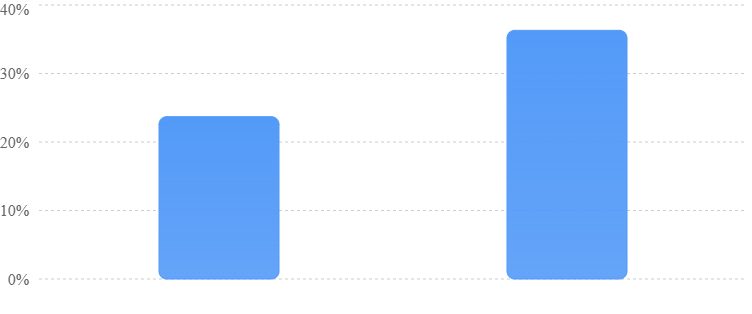
The rise of solo founders is already visible in the data. According to Carta’s December 2025 Solo Founders Report, the share of new startups formed by a single founder increased from 23.7% in 2019 to 36.3% in the first half of 2025. Carta used data from tens of thousands of U.S. companies, making this a useful measure of how the venture startup market is changing.
Carta
That does not mean more than one-third of startups are completely operated by one person. A solo founder can hire employees, use contractors, or raise money to build a large team. In fact, Carta found that solo-founded startups reached their first hire sooner than companies with multiple founders, based on the median time from incorporation to hiring.
However, the change in founding teams matters because one of the oldest assumptions in Silicon Valley is becoming less reliable. Founders no longer necessarily need a technical partner, a marketing partner, and an operations partner before they can begin building a serious business.

AI makes it easier for one person to cover several early roles. It does not make that person an expert in every field, but it reduces the amount of work they must perform manually.
RESEARCH SNAPSHOT
36.3%
Solo-founder share of new Carta startups, H1 2025
280×+
Drop in cost of equivalent AI model performance, 2022–24
87,009
San Francisco nonemployer establishments, 2023
14.7%
Share of 2024 priced-round dollars raised by solo-founded startups in Carta’s 2025 report
Sources: Carta, Stanford HAI, and U.S. Census Bureau. Figures cover different populations and years and should not be treated as one dataset.
Carta
+2
Three changes explain why this is happening.
First, the cost of useful AI has fallen sharply. Stanford’s 2025 AI Index found that the price of using a model with roughly GPT-3.5-level performance fell by more than 280 times between November 2022 and October 2024. This does not mean every modern AI task became 280 times cheaper, but it shows how quickly access to a useful level of machine intelligence became more affordable.
Stanford HAI
Second, AI is moving beyond answering questions. Agents can work with tools, interact with software, use company information, and attempt a sequence of steps toward a defined result. This allows founders to automate parts of a business process instead of creating every output themselves.
Third, small businesses can reach customers without building large internal departments. A specialized software product can be sold online, delivered through the cloud, paid for through automated billing, and supported through a mix of help articles and AI-assisted service.
These developments make the one-person company more practical. The strongest opportunities will usually be businesses with clear products, repeated customer needs, low physical operating requirements, and tasks that can be checked before mistakes reach customers.
The central question for San Francisco founders is no longer simply whether one person can launch a company.
It is how much reliable business activity one person can manage before the costs of oversight, customer support, sales, and risk become too high.
What Is a One-Person AI Company?
A one-person AI company is a business in which one individual owns and manages most of the important decisions while AI systems and other software perform a meaningful share of the work.
The founder still chooses the market, makes promises to customers, manages money, and takes responsibility when something goes wrong. AI helps with execution, and some tasks may run automatically after the founder has defined the rules.
This is different from freelancing with AI tools. A freelancer typically sells their own time or output. A one-person AI company aims to build a repeatable system that can serve additional customers without requiring the founder to spend the same amount of additional time.
The three types of solo AI businesses
Not every solo business that uses AI has the same level of automation.
| Business model | How it works | Main limit |
|---|---|---|
| AI-assisted solo business | Founder performs most work, using AI to move faster | Founder’s available time |
| AI-operated business | Software completes repeated tasks, with founder oversight | Reliability and exceptions |
| Highly autonomous business | Connected systems handle much of delivery, billing, and routine service | Complex judgment, trust, and risk |
The first type is already common. A designer who uses AI to prepare concepts, a consultant who uses it for research, or a developer who uses coding agents may produce more with the same amount of time.
The second type is a more interesting business opportunity. Instead of completing every task manually, the founder builds a system that performs a repeated customer job. An accounting assistant could collect documents, organize transactions, flag missing information, and prepare reports for review.
The third type is the long-term ambition. It involves a company where daily operations continue with limited founder involvement. However, even a highly automated company needs controls for problems involving payments, legal responsibilities, customer trust, and unexpected events.
Why autonomous does not mean unattended
The word autonomous can make AI sound more independent than it really is.
A customer service agent may answer hundreds of common questions, but it can also misunderstand a refund rule. A coding agent may produce a useful feature, but that feature can contain security problems. A sales agent may find potential customers, but it can also send inaccurate claims if nobody checks its output.
The practical goal is not to remove human responsibility. It is to reduce the amount of human work needed for each successful business outcome.
For a solo founder, that distinction is essential. A system that completes 95% of tasks but consumes several hours every day fixing the remaining 5% may not be as valuable as a simpler system that handles fewer tasks with greater reliability.
Why San Francisco Is a Natural Testing Ground for One-Person AI Companies
San Francisco has several advantages for this new business model. It has a deep supply of technical knowledge, a strong startup network, experienced early customers, and unusually close contact between AI developers and the businesses experimenting with their products.
These conditions make it easier to learn quickly. A founder can speak with potential customers, find people familiar with AI tools, test a product with local businesses, and change direction based on feedback without first building a large organization.
However, being close to advanced technology is not enough. The strongest solo founders will be those who understand a customer problem that remains valuable even when AI tools become cheaper and easier to copy.
San Francisco already has a large base of businesses without employees
The U.S. Census Bureau reports 87,009 nonemployer establishments in San Francisco County in 2023. A nonemployer establishment is generally a business without paid employees, although an establishment count does not directly measure the number of individual owners.
Census.gov
These businesses are not necessarily technology startups. They can include independent professionals, contractors, property-related businesses, and many other forms of self-employment.
That difference matters. It would be incorrect to describe all 87,009 establishments as AI companies or even as ambitious startups.
Still, the statistic provides an important local starting point. Operating without a traditional employee base is not a new idea in San Francisco. AI may expand the range of activities that such businesses can manage.
San Francisco combines expensive talent with access to powerful tools
Hiring strong engineers, marketers, designers, and salespeople can be difficult for an early-stage company. Salaries are only part of the cost. Founders must also deal with recruitment, benefits, management, office needs, and the possibility that early employees leave before the company establishes a stable business.
AI offers an alternative for some early work.
A founder may now build a working product before hiring a full development team. The same person can create a website, write onboarding messages, build simple reporting features, and prepare customer education material with AI assistance.
This does not eliminate the value of experienced workers. It changes the order in which founders may need to hire them.
Rather than hiring several specialists before learning whether customers will pay, a founder can test demand first and bring in experts when the business has a clear reason to do so.
Local customers can help founders discover narrow problems
San Francisco’s technology community is useful, but its wider business community may be just as important.
Professional service firms, property businesses, small retailers, recruiters, and specialized business consultants all deal with repeated administrative work. Some of that work follows clear rules and can be supported by AI.
A founder who understands a specific workflow may find a better opportunity in these everyday business problems than in building another general AI assistant.
For example, a broad product promising to automate every business task must compete with major AI platforms. A focused service that helps a particular group prepare a difficult weekly report has a clearer way to show its value.
The local advantage comes from learning what customers need, not simply from using the same technology as everyone else.
Original Research: What the Data Reveals About the Solo-Founder Shift
Most discussions about one-person AI companies focus on striking predictions. Some imagine a future where a single founder builds a billion-dollar business. Others suggest that AI will make traditional startup teams unnecessary.
These ideas are interesting, but they are not reliable business plans.
For this article, SFTechScene’s original analysis focuses on questions that can be tested using public evidence and clearly stated assumptions.
We examine how quickly solo founding has grown, whether solo founders receive a proportional share of startup funding, how San Francisco’s existing business base compares with its employer business base, and what level of automation a small company would need to remain profitable.
Research methodology: How SFTechScene built the analysis
The research uses three distinct kinds of evidence.
The first is published observational data from Carta, the U.S. Census Bureau, and Stanford’s AI Index. These sources describe measured activity among businesses, startups, and AI systems.
The second is published experimental research examining the performance and limits of AI. Research from the National Bureau of Economic Research and METR helps explain why software automation can be useful without proving that entire companies can operate independently.
The third is SFTechScene’s original scenario modeling. We combine selected public figures with transparent business assumptions to calculate funding comparisons, operating margins, break-even points, and reliability risks.
These calculations are original to this article. They are not a newly collected survey, a sample of verified San Francisco AI companies, or a causal study of AI’s effect on business formation.
Because company-level operating data for genuinely one-person autonomous businesses is not widely disclosed, scenario modeling is more defensible than presenting imagined startup performance as observed fact.
| Research question | Evidence | Method |
|---|---|---|
| Are solo founders becoming more common? | Carta Solo Founders Report 2025 | Compare reported founding shares |
| Do solo founders attract proportional funding? | Carta 2024 founding and funding figures | Normalize funding share by startup share |
| How large is San Francisco’s nonemployer business base? | U.S. Census business counts | Compare establishment counts |
| Can a small AI business support its founder? | Explicit hypothetical operating costs | Revenue and break-even model |
| How does automation reliability affect risk? | METR findings and modeled probabilities | Multi-step success calculations |
| What changes the hiring decision? | Modeled costs and customer workload | Capacity and margin sensitivity |
The data is best understood as a set of connected findings, not as proof that all solo founders are adopting AI. Differences between publication dates, startup populations, and business definitions remain important throughout the analysis.
Original Finding #1: Solo Founding Is Growing Faster Than the Old Startup Playbook Suggests
Carta’s 2025 report shows that solo founders represented 23.7% of new startups in 2019 and 36.3% in the first half of 2025.
Carta
SFTechScene calculates that this represents a 12.6-percentage-point increase, or approximately 53.2% growth relative to the 2019 share.
Solo founders as a share of new Carta startups
Two reported observations, not an annual time series. H1 2025 is a partial-year cohort.
Source: Carta Solo Founders Report 2025; SFTechScene calculations.
The change is large enough to matter even without assuming that AI caused it. More founders are choosing to start businesses without splitting the founding role among two or three people.
However, the trend began before modern generative AI tools became widely available. Carta also identifies other possible factors, including lower startup costs and founders wanting greater control over their businesses.
That means the data supports a clear conclusion about founding behavior, but not a precise claim about how much of the increase AI caused.
What the increase means for founders
A larger solo-founder share suggests that starting without a co-founder is becoming a more accepted approach within the startup ecosystem.
This can change how founders make their first decisions. Instead of spending months looking for a technical co-founder, someone with strong industry knowledge may be able to build a simple product and test it with customers.
That is particularly useful for founders who understand a problem but lack some traditional startup skills.
Consider a former property manager who understands why commercial tenants struggle to track service requests. The founder may not know how to build a full software product from scratch. However, AI-assisted development tools can make a limited first version easier to create.
The founder can then test whether property managers will pay for better request handling before spending heavily on development.
The opportunity is not that technical skill has stopped mattering. It is that founders can test more ideas before they need a complete founding team.
Why a solo founder still may need employees
One especially important finding from Carta’s report is that solo-founded startups hire their first employee sooner than startups with multiple founders.
The reported median is 399 days from incorporation to first hire for solo-founded companies, compared with 480 days for companies with multiple founders.
Carta
That is an 81-day difference.
It suggests that starting alone does not necessarily mean staying alone. When a business grows, the missing skills and available time that would otherwise be shared among co-founders may create pressure to hire.
For the one-person AI company model to work over time, AI must do more than help the founder launch. It must reduce the amount of additional human labor the company needs as customers increase.
Original Finding #2: Solo Founders Represent a Large Share of Startups but a Smaller Share of Venture Funding
The funding data reveals another important difference.
Carta’s 2025 Solo Founders Report says solo-founded companies accounted for 30% of startups founded in 2024 within the report’s population, but received 14.7% of cash raised in priced equity rounds that year.
Carta
These numbers cover different measures: a share of companies versus a share of funding dollars. They cannot tell us the probability of a solo founder receiving investment.
However, comparing them shows how strongly funding is distributed relative to each group’s share of startups.
SFTechScene’s funding representation analysis
We divide each group’s funding share by its startup share.
For solo-founded startups:
\[ \frac{14.7}{30}=0.49 \]
For startups with multiple founders:
\[ \frac{85.3}{70}\approx1.22 \]
2024 founding share versus priced-round dollar share
Shares reported in Carta’s December 2025 Solo Founders Report.
■ Share of startups
■ Share of priced-round cash
Source: Carta; SFTechScene normalization of published percentages.
The results show that solo-founded businesses received approximately 49 cents of priced-round funding share for each percentage point of startup share. Multi-founder businesses received approximately $1.22 on the same normalized basis.
Put another way, solo founders’ funding representation was about 40% of the multi-founder level.
This is a comparison of aggregate shares, not an estimate of the average amount raised by each funded company. It also does not control for sector, company age, business performance, or the percentage of companies seeking investment.
Why this finding matters in San Francisco
A solo founder who wants to build a traditional venture-backed company may still face fundraising challenges.
Investors may worry about what happens if the founder becomes unavailable, whether a single person can manage fast growth, and whether the business can attract enough expertise. Some companies also need large teams because their products require complex engineering, regulatory work, or customer relationships.
But the shift toward AI-operated businesses creates another option.
A founder who can reach paying customers with modest costs may not need venture capital immediately. Instead of raising money to hire a large team, the company can use customer revenue to improve its product and fund gradual growth.
This changes the choice founders face.
Rather than automatically asking how much money they need to raise, founders can ask how little money they need to prove customers will pay.
The hidden advantage of delaying fundraising
Suppose a company raises funding before its product has meaningful revenue. The founder may have money to hire people, but investors typically receive a share of ownership.
If the same founder can build and test the product using personal savings and early customer payments, the decision about outside funding can be delayed.
Delaying fundraising does not guarantee a better outcome. A company may grow more slowly, and the founder may personally carry more financial risk.
However, it gives the founder another choice: raise money only when additional capital has a clear use and a credible path to increasing the company’s value.
For a business that can grow through software rather than a rapidly expanding payroll, that flexibility can be especially valuable.
Original Finding #3: San Francisco’s Nonemployer Business Base Is Already Much Larger Than Its Employer Establishment Count
The Census figures offer a different perspective on small business activity in San Francisco.
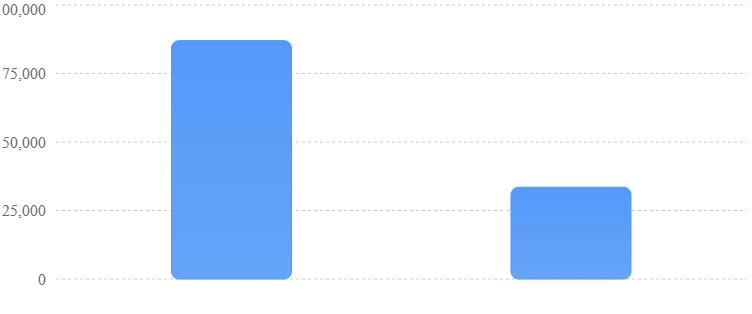
The Census Bureau reports 87,009 nonemployer establishments in San Francisco County in 2023 and 33,513 employer establishments in 2022.
Census.gov
SFTechScene calculates that the nonemployer count was approximately 2.60 times the employer count.
San Francisco County business establishments
Different Census establishment series and reference years; descriptive size comparison only.
Source: U.S. Census Bureau QuickFacts, San Francisco County.
The figures should not be combined into a single-year business market estimate because they come from different reference years. The two Census categories also measure establishments rather than unique founders or AI adoption.
Nevertheless, the comparison makes one point clear: small-scale business activity without paid employees is already a major part of San Francisco’s economy.
What AI could change about this existing market
Historically, many businesses without employees have faced a growth problem.
An independent consultant may have strong demand but only enough time for a limited number of clients. A specialized service provider may struggle to manage administration while also completing paid work.
AI can help reduce that conflict if the founder turns repeated work into a system.
A consultant might create software that produces the first version of a recurring analysis. A marketing specialist might build a reporting product that customers access directly. A former recruiter might develop a narrowly focused screening and scheduling tool, with appropriate privacy controls and human review of hiring decisions.
These businesses would still require expertise. But each additional customer might require less founder time than a traditional service arrangement.
The strongest opportunity may be to help existing small business owners move from selling hours to selling repeatable results.
Why this is more useful than predicting a flood of one-person unicorns
Billion-dollar companies operated by one person would be an extraordinary outcome. They are not necessary for the economic change to be meaningful.
A business earning $300,000 a year with one full-time owner can already be substantial for that individual. If its recurring costs are low and the service is valuable, the founder may prefer that business to a larger company with many employees and investors.
Thousands of modest, sustainable businesses could create a bigger change in entrepreneurship than a single famous one-person startup.
The market opportunity should therefore be measured not only by company valuations but also by how many founders can build lasting businesses with fewer resources.
Original Finding #4: The Economics of a One-Person AI Business Can Work at Modest Customer Numbers
The next question is the most practical one.
How many paying customers does a solo AI company need before it becomes financially useful to its founder?
Public data cannot provide one universal answer. Software businesses have very different pricing, operating costs, customer needs, and sales processes.
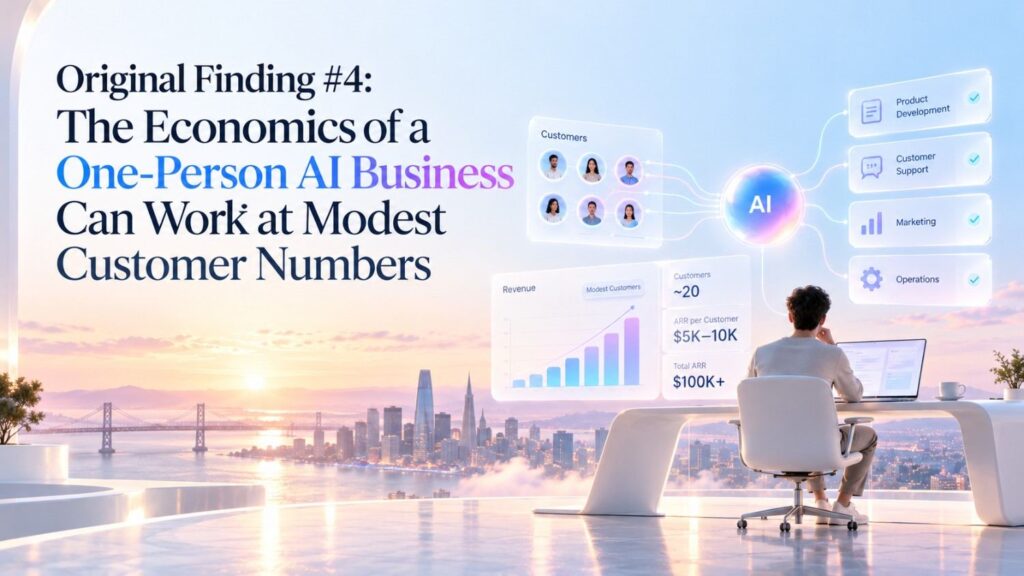
SFTechScene therefore built a transparent scenario for a hypothetical San Francisco-based company selling a recurring business software service.
This is not a forecast for an existing startup. It is a model that founders can adjust using their own costs and prices.
The hypothetical business
Assume a solo founder sells a specialized AI-powered reporting tool to small businesses. Customers connect approved data sources, and the tool creates a regular operational report, points out missing information, and helps prepare follow-up actions.
The founder charges $250 per customer per month.
The model assumes monthly fixed operating costs of $2,500, covering software subscriptions, basic cloud services, insurance and administration reserves, and other fixed business expenses. It does not include the founder’s pay.
Additional operating costs are estimated separately for each customer.
| Model input | Monthly assumption |
|---|---|
| Subscription price per customer | $250.00 |
| AI processing per customer | $1.50 |
| Other variable service costs per customer | $12.00 |
| Payment processing, 3% of price | $7.50 |
| Total variable cost per customer | $21.00 |
| Contribution per customer | $229.00 |
| Fixed business operating costs | $2,500.00 |
These numbers are illustrative assumptions, not observed market averages. Actual AI costs can be much higher depending on the number of tasks, model chosen, data size, retries, and tool use.
The contribution per customer is the amount left after the model’s variable costs:
\[ \$250-\$21=\$229 \]
That $229 helps pay fixed expenses, the founder, taxes, and any profit retained by the company.
How revenue and operating surplus change with customers
Modeled monthly economics of a solo AI software company
Assumes $250/month per customer, $21 variable costs per customer, and $2,500 monthly fixed costs.
■ Revenue
■ Operating surplus
SFTechScene original illustrative model. Surplus excludes founder compensation, taxes, and growth investment.
| Paying customers | Monthly revenue | Monthly surplus before founder pay |
|---|---|---|
| 20 | $5,000 | $2,080 |
| 50 | $12,500 | $8,950 |
| 100 | $25,000 | $20,400 |
| 150 | $37,500 | $31,850 |
| 200 | $50,000 | $43,300 |
The model reveals that even a relatively small customer base can create a meaningful business when the price is high enough and the cost of serving each customer remains low.
With 50 customers, the business produces $12,500 in monthly revenue and $8,950 in operating surplus before the founder is paid.
With 100 customers, monthly revenue reaches $25,000. That is equivalent to $300,000 in annual revenue if sustained for 12 months.
The important word is sustained. The company must retain customers, maintain its product, provide support, replace lost customers, and pay the founder. The table also assumes fixed costs remain unchanged as the business grows, which may not hold in practice.
Where the economics become less attractive
The model assumes that the founder can serve additional customers without sharply increasing support costs.
That may not be realistic for every product.
If customers need frequent personal help, complex onboarding, customized reports, or repeated corrections, the founder’s available time can become the main limit on growth.
The same is true when AI processing costs rise unexpectedly. A product that charges a fixed subscription but allows unlimited expensive tasks may earn less from its heaviest users.
Founders must therefore measure actual cost per customer rather than relying on an attractive model built before they have paying users.
Original Finding #5: The Break-Even Point Matters More Than a Headline Revenue Number
Startup founders often celebrate revenue milestones. Reaching $10,000 or $20,000 in monthly revenue sounds impressive, especially for a one-person business.
But revenue alone does not reveal whether the business can support its founder.
A company could earn $20,000 each month and spend nearly all of it on advertising, software, outside help, and customer support. Another business might generate half as much revenue while keeping most of it after expenses.
For solo founders, the better starting point is calculating the number of customers needed to cover both business expenses and a reasonable amount of founder compensation.
Calculating the basic operating break-even point
Using the previous model, monthly fixed costs are $2,500 and each customer contributes $229.
\[ \text{Break-even customers}= \frac{\$2,500}{\$229} \]
The result is approximately 10.9 customers, meaning the company needs at least 11 paying customers to cover the modeled operating expenses.
However, that does not mean the founder has earned a living.
If the founder wants $8,000 per month before personal taxes and business-level taxes, the calculation becomes:
\[ \frac{\$2,500+\$8,000}{\$229} \approx45.85 \]
The business would need at least 46 paying customers to cover those costs and that level of founder pay.
Sensitivity analysis: What happens when customer economics change?
Solo AI Business Break-Even Calculator
Change the assumptions to see how many customers a one-person company would need to cover operating expenses and desired founder pay.Monthly price
$250
Variable cost per customer
$21
Monthly fixed expenses
$2,500
Founder monthly pay target
$8,000
46 customers
Required to cover modeled expenses and pay target
Required monthly revenue: $11,500
Illustrative calculation only. Excludes taxes, customer acquisition, startup investment, and unexpected expenses unless included in the entered costs.
The calculator shows why pricing and service costs are often more important than the founder’s ability to generate large amounts of content or build features quickly.
A product priced at $50 per month may need hundreds of customers to cover a founder’s income. A product priced at $500 per month could reach the same financial result with fewer customers, provided the higher price reflects value customers are willing to pay for.
That is why San Francisco founders should not automatically chase the largest possible audience.
A smaller group of businesses with a recurring, expensive problem may be better customers than a broad audience that expects an AI product to be almost free.
Why high prices must be supported by real value
Charging more is not a solution by itself.
A product priced at $500 per month must solve a problem worth substantially more than that price to its customers. It might save several hours of staff time, reduce errors, speed up billing, or help the customer capture revenue that would otherwise be lost.
The founder should be able to explain that value in specific terms.
For example, if an accounting firm spends ten hours every month preparing information for a repeated client process, a reliable system that removes much of that preparation may have a measurable benefit.
However, a generic tool that simply summarizes information customers can already access for free may struggle to justify a premium subscription.
The best pricing power comes from solving an important problem, not from branding a product as AI-powered.
Original Finding #6: Reliability Could Become the Biggest Limit on One-Person Companies
The ability of AI to perform a task is not the same as its ability to perform that task correctly every time.
This is especially important for businesses that want AI to complete work without constant human supervision.
A founder might build an agent that reads customer requests, checks account records, decides what action is needed, updates a database, and sends a confirmation.
That process looks simple when described in one sentence. In reality, it may involve several separate decisions and software actions. Each creates another opportunity for something to go wrong.
What published research says about AI autonomy
Research organization METR has studied how reliably AI agents complete software-related tasks of different lengths.
Its work measures the duration a human expert would typically need for a task and compares that with the probability that an AI agent completes it successfully.
The research has shown rapid progress in agents’ ability to handle longer tasks. However, METR stresses that its findings apply mainly to its tested software, machine learning, and cybersecurity tasks, not to every type of business activity. Its September 2026 update also warns that some longer-task measurements remain unreliable because of limitations in the test set.
METR
That distinction matters for founders.
An AI system that successfully completes a difficult programming task may still struggle with an unclear customer complaint, an unusual contract term, or a decision that requires understanding the history of a business relationship.
Founders should therefore test the actual work they want to automate rather than assume that strong AI benchmark results guarantee business reliability.
SFTechScene’s multi-step reliability model
To illustrate the problem, we modeled workflows containing 5, 10, and 20 steps.
For simplicity, we assume each step has the same probability of being correct and that errors occur independently. Under those assumptions, the probability that every step succeeds is the individual step success rate multiplied by itself for the number of steps.
\[ P(\text{all steps succeed})=p^n \]
Here, \(p\) is the success probability of one step and \(n\) is the number of steps.
Modeled chance of completing every workflow step correctly
Mathematical sensitivity test, not observed AI performance. Assumes independent step outcomes.
■ 95% success per step
■ 98% success per step
■ 99% success per step
SFTechScene original calculations: overall success = per-step success raised to the number of steps.
| Success at each step | 5-step workflow | 10-step workflow | 20-step workflow |
|---|---|---|---|
| 95% | 77.4% | 59.9% | 35.8% |
| 98% | 90.4% | 81.7% | 66.8% |
| 99% | 95.1% | 90.4% | 81.8% |
The results highlight an important risk.
Even when every step is 98% reliable, a 20-step process has only about a 66.8% chance of completing every step correctly under the model’s assumptions.
This does not mean real AI systems have these precise failure rates. Real errors may be related, some mistakes can be corrected automatically, and not every step has equal importance.
But the calculation explains why businesses cannot judge an automated workflow solely by how well its individual parts perform.
Why simple workflows can outperform impressive agents
Imagine two solo founders building products for accounting firms.
The first creates an AI system that collects financial documents, categorizes transactions, prepares statements, identifies tax issues, recommends decisions, and sends final reports without human review.
The second creates a system that collects documents, checks whether required files are present, flags unusual records, and prepares organized information for an accountant.
The first product offers more automation. It also faces more opportunities for expensive mistakes.
The second product has a narrower job. Its output can be checked more easily, and the accountant retains control over important decisions.
For a solo founder, the narrower product may be easier to sell, support, and operate.
This is one reason the most profitable AI businesses may not be the ones advertising the highest possible autonomy. They may be the ones that complete a carefully chosen task with the fewest costly failures.
Why the recovery process matters more than the demo
A product demonstration normally shows a successful task. A real business must also handle unsuccessful tasks.
Suppose an AI system prepares 1,000 customer reports each month. If 3% require manual review, the founder faces 30 exceptions.
If each exception takes 20 minutes to investigate and resolve, that creates ten hours of additional work every month.
The workload remains manageable at that scale, but the problem becomes larger as the company grows. At 10,000 monthly reports, the same failure rate creates 300 exceptions and 100 hours of review.
The founder must therefore measure the time spent on exceptions as carefully as the time saved by automation.
A useful test is not simply whether the AI finishes a task. It is whether the business can identify a failure, stop harmful actions, explain what happened, and recover without spending more than the task is worth.
Original Finding #7: The Real Limit May Be Founder Attention, Not AI Processing Cost
AI processing costs receive a great deal of attention because they are easy to measure. Providers charge for model usage, and a founder can estimate how much each task costs.
But the founder’s attention can be a much more serious constraint.

Every customer may generate questions, complaints, requests, unusual cases, and work that cannot be handled automatically.
A company can have inexpensive AI processing and still be impossible for one person to manage.
Modeling the founder’s monthly customer workload
Consider a product that requires an average of 30 minutes of founder attention per customer each month. That might include onboarding, manual review, customer communication, and occasional corrections.
At 100 customers, the founder spends 50 hours per month on customer-specific work.
At 200 customers, the workload reaches 100 hours.
Those hours do not include product development, sales, bookkeeping, security reviews, or other management responsibilities.
How customer support and review time limits a solo founder
Illustrative customer workload under three human-attention assumptions.
■ 10 minutes/customer
■ 30 minutes/customer
■ 60 minutes/customer
SFTechScene original scenario calculations; assumes a 160-hour full-time work month for reference.
This analysis suggests a practical way to think about automation.
A company with 200 customers requiring only 10 minutes of founder attention per customer each month creates about 33 hours of customer-specific work. That leaves considerably more time for product development and growth.
The same customer count at one hour per customer creates 200 hours of work before the founder performs any other business duties.
The number of customers is identical. The business model is not.
How to reduce the amount of attention each customer needs
Founders should begin by identifying why customers need help.
Some questions arise because the product is confusing. Others come from poor onboarding, missing features, unclear billing, or mistakes in the automated process.
Each cause requires a different solution.
If customers repeatedly ask where to find a report, the product may need a clearer interface. If they struggle to connect data, the onboarding process may need to change. If AI reports frequently contain errors, the company needs better checking, not simply more automated customer replies.
The goal is to remove the cause of repeated work.
An AI chatbot that answers the same complaint every week may reduce support time while leaving the underlying product problem unsolved.
When hiring becomes the better decision
A founder should not treat having no employees as a permanent rule.
Suppose the business produces $25,000 in monthly revenue, but the founder spends most of the week handling customer issues. If hiring a support specialist improves customer retention and creates time for product development, that employee may create more value than maintaining the one-person label.
Hiring can also be important for quality and safety. Legal work, sensitive financial decisions, and complex security tasks may require specialized human expertise.
The goal should be to build a profitable and resilient business. A company with one founder and two well-chosen employees may be much stronger than a company whose owner is overwhelmed by trying to automate everything.
Why AI Coding Agents Are Changing Who Can Become a Founder
Software development has traditionally been one of the largest barriers facing nontechnical founders.
Someone could understand an industry problem very well but still struggle to turn that knowledge into working software. Hiring a development team before testing the idea could require more money than the founder could reasonably risk.
AI-assisted coding changes parts of this process.
Tools can help write code, explain unfamiliar systems, create basic user interfaces, prepare tests, and find some types of errors. They can also help experienced developers work through routine implementation tasks more quickly.
However, writing code is only one part of creating a reliable software product.
Building a prototype is becoming easier than building a business
A founder can use AI to create a working demonstration in a relatively short period. That demonstration might collect information, generate reports, accept payments, or interact with a third-party service.
The danger is mistaking a working demonstration for a product that can safely support paying customers.
Real software must deal with account permissions, failed payments, incorrect data, changing customer needs, access controls, backups, and unexpected user behavior.
These problems become more important when software starts making decisions or changing records on a customer’s behalf.
A nontechnical founder can still make meaningful progress with AI tools, but should budget for experienced reviews when security, privacy, payments, or critical customer processes are involved.
The new advantage is knowing what to build
As development becomes more accessible, understanding the customer problem becomes more important.
Two founders may have access to the same AI tools. The first creates a general productivity product with dozens of features. The second has spent years working in commercial real estate and understands one painful reporting process in detail.
The second founder may have a stronger business opportunity even with less programming experience.
That founder knows how customers describe the problem, which exceptions cause trouble, who has authority to buy software, and how much the problem costs today.
AI can help produce code. It cannot automatically supply years of firsthand customer understanding.
This shift could create opportunities for experienced professionals who previously saw software entrepreneurship as too expensive or too technical.
The One-Person AI Business Models Most Likely to Work in San Francisco
Not every market is suitable for a solo AI company.
The most promising opportunities generally have recurring customer needs, clear results, manageable risk, and tasks that can be handled through existing software systems.
A business becomes harder to operate alone when it needs physical labor, large amounts of personal service, complex approvals, or constant custom development.
Vertical AI software for specialized industries
Vertical AI software is built for a particular industry or customer group.
Instead of creating a general assistant that promises to help everyone, the founder solves a specific recurring problem for a defined kind of business.
In San Francisco, potential markets include professional service firms, real estate operators, specialized recruiters, small healthcare businesses, and local business service providers.
For example, a product might help commercial property managers collect monthly operating information from multiple sources and prepare consistent owner reports.
Another might help small consulting firms organize client documents, track project deadlines, and prepare status updates.
These products can become valuable when they reduce a repeated administrative burden and integrate with tools the customer already uses.
The main challenge is learning the industry’s rules and exceptions. A founder must understand not only the typical process but also the unusual cases that cause expensive mistakes.
AI-powered information and reporting products
Many businesses need regular information about customers, competitors, prices, suppliers, and market changes.
A solo founder can build a subscription service that collects approved public information, organizes it, identifies meaningful changes, and delivers reports.
The value comes from choosing useful information and presenting it accurately.
For instance, a business serving independent retailers might track publicly listed competitor promotions and provide a weekly comparison. Another might monitor public planning documents or permit information for a particular kind of commercial service provider.
The founder must make sure the service has lawful access to data and respects website restrictions, licensing terms, and customer privacy.
Products built mainly on copying third-party content without permission can face both legal and commercial problems.
Workflow automation for small businesses
Many small businesses operate through a collection of disconnected software tools.
They may use one system for customer messages, another for payments, another for scheduling, and spreadsheets for reporting.
This creates opportunities for founders who can connect the tools and automate repeated steps.
A narrow product might collect new customer requests, check whether required fields are complete, create draft records in a management system, and notify the owner when action is needed.
A more complex service might connect billing records with project information and flag overdue accounts for review.
The best products do not require customers to abandon every system they already use. Instead, they improve the work that happens between those systems.
AI-assisted specialized research services
Some businesses pay for research that is difficult, slow, or highly repetitive.
A solo founder with real industry experience may be able to build a service that combines AI-supported information gathering with human judgment.
For example, a market researcher might provide detailed monthly analysis for a narrow business sector. An operations consultant might offer recurring process reviews using software that collects and organizes customer data.
This model can be a useful starting point because the founder can sell the service before building a complete software product.
The risk is that too much work remains manual.
To develop a scalable business, the founder must gradually standardize delivery, reduce custom requests, and create a process that works across customers.
AI products for other AI businesses
San Francisco’s AI ecosystem also creates demand for supporting tools.
Companies building AI agents need ways to test outputs, track failures, manage access permissions, compare costs, and understand why automated actions did not work.
A small founder-led company may be able to solve one narrow problem for these developers.
For example, a product could help teams review agent activity logs and identify repeated failure patterns. Another could focus on testing a specific type of software integration before it reaches production.
These markets can be attractive because customers already understand the value of reliable automation.
However, the technology changes quickly. Major AI platforms may add similar features, and a small founder needs a reason for customers to continue choosing a separate product.
Original Finding #8: Business Model Selection Matters More Than Maximum Automation
To compare possible opportunities, SFTechScene developed a simple screening framework using five business characteristics.
The framework examines recurring demand, how easily the work can be standardized, how easy it is to check the result, how much human attention is likely to remain, and how serious an error could be.
These are practical screening dimensions, not measured performance scores.
The table below applies a qualitative assessment to illustrative business models. It should be used to guide further customer research, not as a claim that one market has been statistically proven more profitable than another.
| Business opportunity | Repeated demand | Easy to check output | Solo operating difficulty |
|---|---|---|---|
| Narrow business reporting tool | High | Often high | Low to medium |
| Document collection and organization | High | Often high | Low to medium |
| Customer service for standard questions | High | Medium | Medium |
| Custom AI development agency | Variable | Medium | High |
| Automated financial decision system | Potentially high | Often difficult | Very high |
| Broad AI assistant for all businesses | Uncertain | Highly variable | High |
Why narrow recurring problems are attractive
A reporting tool may produce a similar output every month. A founder can define the required information, create checks, test common problems, and improve the process over time.
That makes the work easier to standardize.
A broad AI assistant faces a very different challenge. One customer might ask it to create a sales forecast, another might ask for legal analysis, and another might expect it to manage customer accounts.
The range of tasks makes performance harder to measure and support.
For a one-person business, a narrow market is often an advantage because it limits both the product’s complexity and the number of ways it can fail.
Why some highly valuable problems are poor solo opportunities
A problem can be important and profitable for a large company while remaining unsuitable for a solo founder.
For example, businesses may spend substantial money managing complex financial decisions. However, software making those decisions can face high regulatory, security, and professional responsibility requirements.
An individual founder may not have the resources to manage those obligations alone.
A better first product might automate preparation, organization, or checking while leaving final decisions to qualified people.
This approach captures some of the value of AI without forcing the startup to handle every risk of the full process.
How San Francisco Founders Can Build a One-Person AI Company in 90 Days
A practical launch should begin with a customer problem, not a collection of AI tools.
The first 90 days should answer three questions: Do customers have an expensive recurring problem? Can the founder deliver a useful solution? And can the business serve additional customers without creating an unmanageable workload?
The purpose is not to build a perfect autonomous company in three months. It is to establish whether a small, focused business has a credible path to becoming one.
Days 1–15: Find a problem customers already pay to solve
Begin with one customer group.
That might be independent recruiters, boutique accounting firms, commercial property managers, or a specific kind of business consultant.
Interview approximately 15 to 20 potential customers as an initial discovery target. The interviews should focus on what people do today, not on whether they like AI.
Ask them to explain a real recent example of the problem, how often it occurs, which tools they use, and what happens when the process fails.
The most useful discovery questions are practical.
What information do they collect? Who checks the work? Which mistakes require correction? How much time does the process take? And what would need to change before they trusted an outside tool to help?
Look for problems where several customers describe similar steps and where the cost of the problem is clear.
A vague complaint such as spending too much time on administration is not yet a product opportunity. A repeated process involving two hours of document review every Friday is much more specific.
Days 16–30: Sell a limited result before building a full platform
Once the problem is clear, define one result the business can deliver.
For example, the offer might be a weekly report that identifies missing customer documents and prepares a follow-up list.
The first version could be produced partly by hand, using AI to support the work.
This approach helps the founder learn which parts are predictable and which require judgment before spending weeks building software.
Try to secure a small group of paying pilot customers. Three to five paid pilots can provide more useful evidence than dozens of people who say they would consider trying a free product.
However, early payments are not proof of lasting demand. Customers must continue receiving value after the novelty wears off.
Days 31–45: Build a narrow automated workflow
Use the lessons from the paid pilots to create the first repeatable process.
Begin with a defined input, a limited set of actions, and an output that can be checked.
For example, the system could receive a document, extract required fields, compare them with a customer-defined checklist, and prepare a draft report.
Avoid giving the system permission to make payments, delete important records, change sensitive account details, or contact external parties without appropriate controls.
Store the inputs, outputs, checks, and relevant process records so the founder can investigate failures.
The objective is to create a dependable workflow, not to display as many AI features as possible.
Days 46–60: Measure failures before adding more customers
Create a test set based on real customer examples where permitted and appropriately protected.
The tests should include normal requests, incomplete information, unusual formats, missing data, and attempts to make the system take actions outside its approved role.
Measure successful completion, errors caught by the system, errors found by the founder, and the average time needed for manual correction.
Do not combine every result into one impressive accuracy percentage.
A formatting mistake is different from exposing private information. A missed field is different from sending an unauthorized refund.
Track serious failures separately, and require human approval for high-impact actions.
Days 61–75: Build a repeatable sales and onboarding system
Once the product works reliably enough for a limited customer group, the next challenge is finding additional customers.
Create a simple website explaining who the product serves, which problem it solves, and what customers receive.
Use a clear example of the output. If a sample report explains the value more effectively than a long product description, make that report central to the sales process.
Develop a repeatable demonstration and an onboarding checklist.
AI can help prepare drafts of outreach messages, organize customer information, and summarize meetings, but the founder should review factual claims and respect applicable marketing and privacy rules.
The aim is to avoid spending several hours preparing a custom sales process for every potential customer.
Days 76–90: Test whether the business is becoming less dependent on founder time
By the end of 90 days, the founder should have enough operating experience to examine the business more carefully.
Measure revenue, variable cost per customer, monthly fixed expenses, customer-specific work hours, reliability, cancellations, and the time required to acquire each new customer.
Compare these numbers with the assumptions made before launch.
If customers are paying but every account needs extensive personal attention, the business may be a useful service company rather than a scalable AI-operated software business.
That can still be a good outcome, but the founder should understand the difference before making growth plans.
If the product delivers consistent results with limited manual work, the next step is to improve retention and carefully expand the customer base.
| Period | Main objective | Evidence to collect |
|---|---|---|
| Days 1–15 | Identify a recurring problem | Customer interviews and current costs |
| Days 16–30 | Validate willingness to pay | Paid pilot agreements |
| Days 31–45 | Create a repeatable workflow | Working product and recorded test results |
| Days 46–60 | Establish reliable operation | Error and recovery measurements |
| Days 61–75 | Standardize customer acquisition | Sales and onboarding results |
| Days 76–90 | Test business economics | Revenue, cost, retention, and founder hours |
The most important decision at day 90 is not whether to raise money. It is whether the product has enough customer value and operating discipline to justify further investment.
The Biggest Mistakes Founders Make When Building Autonomous Businesses
The appeal of a one-person AI company can push founders toward decisions that look efficient in a demonstration but create serious problems in daily operations.
Most of these mistakes come from treating automation as the goal rather than a way to deliver a better service.
Mistake #1: Automating before finding paying customers
AI makes it tempting to build a large product before speaking with potential buyers.
A founder can spend weeks creating agents, dashboards, integrations, and automated processes while learning very little about whether customers need them.
The safer approach is to validate the problem first. A simple paid service with limited automation is a better starting point than an impressive platform nobody wants to buy.
Founders should identify the smallest useful result they can sell and then automate the repeated work behind that result.
Mistake #2: Using several agents when one clear process would work
A company does not need a collection of agents with different job titles to become AI-powered.
Founders sometimes create separate research agents, marketing agents, management agents, and reporting agents before they have identified how those systems will work together.
Every additional system creates more instructions, permissions, costs, and opportunities for failure.
A simpler design may use ordinary software rules for predictable actions and AI only where the task requires understanding language or handling varied information.
This also makes the business easier to maintain when an AI provider changes its models or pricing.
Mistake #3: Ignoring the cost of getting customers
A business can have excellent operating margins and still struggle to grow.
Suppose a founder earns $229 per customer each month before fixed costs. That sounds attractive until customer acquisition requires hundreds of dollars in advertising, repeated sales calls, and custom demonstrations.
The founder must measure how much it costs to acquire a paying customer and how long that customer is likely to remain subscribed.
If acquisition costs are high and customers leave quickly, a profitable-looking software product may consume cash faster than it generates it.
This is why narrow markets with clear customer problems can be valuable. The founder can create more focused marketing, develop relevant examples, and reach buyers with messages that address a known need.
Mistake #4: Giving AI unnecessary access to customer systems
Automation becomes more powerful when it can interact with business software. It also becomes more dangerous.
An agent that only drafts a response has limited ability to cause harm. An agent that can access financial records, change permissions, delete information, or send messages to customers has much greater power.
Founders should apply the principle of giving each system only the access it needs.
Keep sensitive actions behind human approval. Record important actions, test for unexpected behavior, and make it possible to stop or reverse a process.
These controls are part of building a trustworthy company, not unnecessary work that slows down innovation.
Mistake #5: Confusing low headcount with high profit
A one-person company is not automatically a profitable company.
The founder may avoid employee salaries while spending heavily on AI tools, contractors, advertising, hosting, and repeated customer support.
The business may also depend entirely on the founder being available every day.
That creates a concentration of risk. If the founder becomes ill, takes time away, or cannot resolve an urgent problem, customers may have nobody else to contact.
A sustainable business needs documented processes, reasonable financial reserves, and a plan for handling emergencies.
The best founders will focus on efficient operations rather than treating employee count as a competition.
What Existing AI Productivity Research Suggests About the Future
One reason to take small AI-powered companies seriously is that AI has already shown measurable value in professional work.
But that evidence must be interpreted carefully.
A study by Erik Brynjolfsson, Danielle Li, and Lindsey Raymond examined the introduction of an AI assistant among thousands of customer support workers. The research found an average productivity increase of approximately 14%, with particularly large gains among less experienced workers. The study was later published in The Quarterly Journal of Economics.
NBER
This is meaningful evidence that AI assistance can improve some types of work.
It is not evidence that AI can replace an entire customer support organization or run a company independently.
Why productivity gains do not translate directly into job replacement
A worker’s day includes more than completing individual tasks.
Employees coordinate with colleagues, handle unusual situations, make decisions when information is incomplete, and take responsibility for customer relationships.
AI may make one part of the job faster while leaving the rest unchanged.
For example, if AI reduces document preparation time from one hour to 30 minutes, the founder saves time on that task. But if the customer still needs a lengthy consultation, several revisions, and personal follow-up, the total service process may not improve nearly as much.
Founders should measure the entire process from request to completed customer outcome.
The difference between helping a worker and operating a company
Stanford’s 2025 AI Index reported that organizational use of AI increased significantly during 2024, with 78% of surveyed organizations reporting AI use compared with 55% in 2023.
However, reported financial improvements were often relatively modest. Among organizations reporting savings from AI use in particular functions, many estimated savings below 10%.
Stanford HAI
This suggests that adopting AI is easier than turning AI into large, measurable financial gains.
For one-person companies, the lesson is especially relevant.
Using AI in marketing, coding, and customer service may improve productivity. But building a business that can serve hundreds of customers with little human intervention requires reliable processes across all those areas.
The greatest opportunity comes from redesigning how work happens, not simply adding AI to the existing process.
How Venture Capital Could Change as Solo AI Businesses Grow
San Francisco’s venture capital system has traditionally favored companies with the potential to grow very quickly and become large.
That model has helped fund important technology businesses. It also creates pressure to hire, spend, and expand rapidly.
One-person AI businesses may create a different set of choices.
A founder selling specialized software to a few hundred customers may be able to finance development from recurring revenue. Such a company might not need large outside investment to become financially successful.
Smaller businesses can still create substantial founder wealth
Consider two different business paths.
The first company raises millions of dollars, hires aggressively, and aims for a very large market. Its founder may own a smaller share over time, but the business has the capital to pursue opportunities that would otherwise be out of reach.
The second company grows more slowly with a small team and limited outside investment. The founder retains more ownership and focuses on profitability.
Neither path is automatically better.
A market that rewards rapid expansion may justify outside capital. A narrow software market with predictable demand may reward steady growth and financial control.
The important change is that AI may reduce the minimum resources needed for some companies to test whether they have a viable business.
Why investors may still prefer teams
A solo founder can create a business, but investors must also consider its ability to survive unexpected events.
Who maintains the product if the founder is unavailable? Who makes security decisions? Who handles important enterprise customers? Who challenges the founder’s assumptions?
AI can assist with tasks, but it cannot automatically provide the independent accountability of experienced business partners.
Solo founders seeking investment may need to demonstrate stronger operating systems, clear external support relationships, and evidence that the company can continue serving customers during disruptions.
Showing that most routine work is automated may help. Proving that customers remain satisfied and the business is resilient will matter more.
What One-Person AI Companies Mean for San Francisco Workers
The rise of AI-operated companies raises difficult questions about employment.
If founders can build useful products without hiring the teams that startups once needed, some traditional early-stage jobs may become less common.
At the same time, lower startup costs may allow more people to start businesses that would never have existed under the old model.
It is too early to calculate the net employment effect from the evidence in this article.
Routine tasks may face greater pressure
Jobs built around repeated information handling may see substantial changes.
Basic report preparation, administrative coordination, first-draft writing, simple software implementation, and standard customer responses are all areas where AI can assist or automate portions of the work.
However, the value of experienced workers does not disappear simply because software can complete part of their tasks.
A strong accountant understands financial responsibility and unusual cases. A good customer service specialist understands people and difficult situations. An experienced engineer can evaluate architecture, security, and long-term reliability.
Businesses still need those forms of judgment.
More professionals may become business owners
The other side of the employment question is entrepreneurship.
A specialist who previously needed a technical co-founder or expensive development help may now be able to test a product independently.
That could open new paths for experienced industry workers, independent consultants, and people who have identified valuable business problems through their careers.
The main barrier may shift from being able to build software toward being able to find customers and deliver a trustworthy result.
This creates a strong reason for workers to develop skills in customer research, business operations, process design, and the evaluation of AI output.
People who understand both an industry and the limits of AI may be particularly well positioned to create useful small businesses.
What San Francisco Founders Should Watch Through 2027
The next stage of the one-person AI company story will depend on whether AI systems become easier to trust in normal business conditions.
Lower processing costs will help, but they will not solve every problem. Reliable automation, customer acquisition, and business continuity are likely to matter just as much.
Watch whether agents can recover from their own errors
Current systems can often complete straightforward tasks, especially when instructions and success conditions are clear.
The larger challenge is handling unexpected cases.
Founders should watch for improvements in agents’ ability to recognize uncertainty, check their work, request approval, correct mistakes, and resume a task safely.
These capabilities could make more complex workflows practical without requiring constant supervision.
Watch the cost of serving each additional customer
AI model prices may continue changing, but the cheapest model is not necessarily the best business choice.
A more expensive model that completes work correctly on the first attempt may cost less overall than a cheaper model that requires repeated retries and manual corrections.
Founders should compare the complete cost of a successful outcome.
That includes processing, software tools, supervision, error recovery, and customer support.
Watch whether AI tools become built-in features of major software platforms
A startup may build a product around an automation feature that larger software providers later include in their existing products.
This creates a serious risk for small AI companies.
A founder relying entirely on one generic feature may struggle when customers receive something similar through software they already pay for.
The safer position is to develop deeper customer understanding, useful workflow connections, proprietary process knowledge where lawfully obtained, and consistently better outcomes for a defined audience.
Watch whether founder time continues falling as revenue grows
The clearest evidence of a successful autonomous business will not be its number of agents.
It will be the relationship between revenue and human operating work.
A company that doubles revenue while keeping founder workload almost unchanged has achieved something meaningful.
A company that doubles revenue and doubles its founder’s workload has mainly created a larger job.
Both may be profitable, but only the first is demonstrating the operating advantage promised by autonomous software.
Final Takeaway: The Next Great San Francisco Startup May Be Smaller Than Anyone Expects
The traditional Silicon Valley success story involves building a company that becomes much bigger over time.
More customers lead to more funding. More funding leads to more employees. More employees allow the business to serve additional customers and expand into new markets.
AI is creating room for a different kind of growth.
A founder can now build software with less initial help, test ideas at lower cost, automate repeated work, and serve customers through systems that need less manual attention.
Carta’s data confirms that solo founding has become more common. Stanford’s research shows that useful AI capabilities have become much more affordable. Published productivity studies demonstrate that AI can improve certain work activities.
SFTechScene’s original analysis adds an important business lesson: the financial appeal of a one-person company depends less on how many tasks AI can attempt and more on how reliably those tasks are completed, how much attention customers require, and whether the founder earns enough from each customer after real operating costs.
A one-person company with 50 satisfied customers paying $250 per month can already be a meaningful business under favorable cost assumptions. It does not need millions of users or a billion-dollar valuation.
But the model only works when customers stay, the software delivers dependable results, and the founder’s workload remains manageable.

That is why the smartest San Francisco founders will not begin by asking how to replace an entire company with AI agents.
They will begin with a smaller, more useful question: what valuable business problem can one person solve repeatedly, safely, and profitably using the tools now available?
The founders who answer that question well may create a new generation of technology businesses. Some will eventually hire large teams. Others may remain deliberately small.
Both outcomes can represent success.
The most important change is that the size of a company’s workforce may become a less useful measure of its ability to create value.
For San Francisco, a city known for companies that changed the world by growing rapidly, the next important shift may come from founders proving how much a carefully designed business can accomplish while remaining remarkably small.
Research Notes and Source Methodology
This article combines public datasets with original calculations. The primary sources and their roles are summarized below for editorial verification and future updates.
| Source | Data used | Limitations |
|---|---|---|
| Carta Solo Founders Report 2025 | Solo-founder shares, funding distribution, first-hire timing | Carta startup population, not all U.S. businesses; solo founder does not mean sole worker |
| Carta Founder Ownership Report 2025 | Additional evidence on founding teams and ownership | Different sampling and cohort definitions from the later solo-founder report |
| U.S. Census San Francisco QuickFacts | Nonemployer and employer establishment counts | Different reference years; not AI-specific |
| Stanford AI Index 2025 | AI costs and business adoption | Historical benchmarks and survey estimates, not solo-business profit measures |
| METR Task-Completion Time Horizons | Evidence on AI task capability and limitations | Mainly tested technical tasks; cannot directly predict business autonomy |
| NBER Generative AI at Work | Measured productivity effects in customer support | Task and workplace-specific, not a study of autonomous companies |
Original analysis: Reproduction guide
SFTechScene’s derived statistics use the following formulas:
- Solo-founder share growth: (36.3 − 23.7) / 23.7 = approximately 53.2% relative growth.
- Funding representation index: Group share of priced-round cash divided by group share of startups. Solo = 14.7 / 30 = 0.49; multi-founder = 85.3 / 70 ≈ 1.219.
- San Francisco establishment count ratio: 87,009 / 33,513 ≈ 2.60, using different Census reference years.
- Monthly operating surplus: Customers × (monthly price − variable cost per customer) − monthly fixed expenses.
- Founder-pay break-even: Round up (fixed expenses + desired founder pay) / contribution per customer.
- Modeled end-to-end workflow success: Individual step success probability raised to the number of steps, assuming independent outcomes and no error recovery.
- Monthly customer-specific founder hours: Customers × average minutes of human work per customer / 60.
The model uses deterministic assumptions rather than estimated population parameters, so its scenario figures do not have statistical confidence intervals. They should be tested against real customer and operating data before use in a business plan.
No causal claim is made that AI produced the observed rise in solo founders, and no reported figure should be interpreted as the measured number of autonomous AI companies in San Francisco. These distinctions are essential to keeping the analysis rigorous as the market develops.