
Software development is going through one of its biggest changes in years. Building an application no longer always means hiring a team of developers, writing thousands of lines of code, and spending months preparing a product for launch. Today, founders can describe an idea to an AI tool, build an application with visual components, or combine ready-made software tools with their own code.
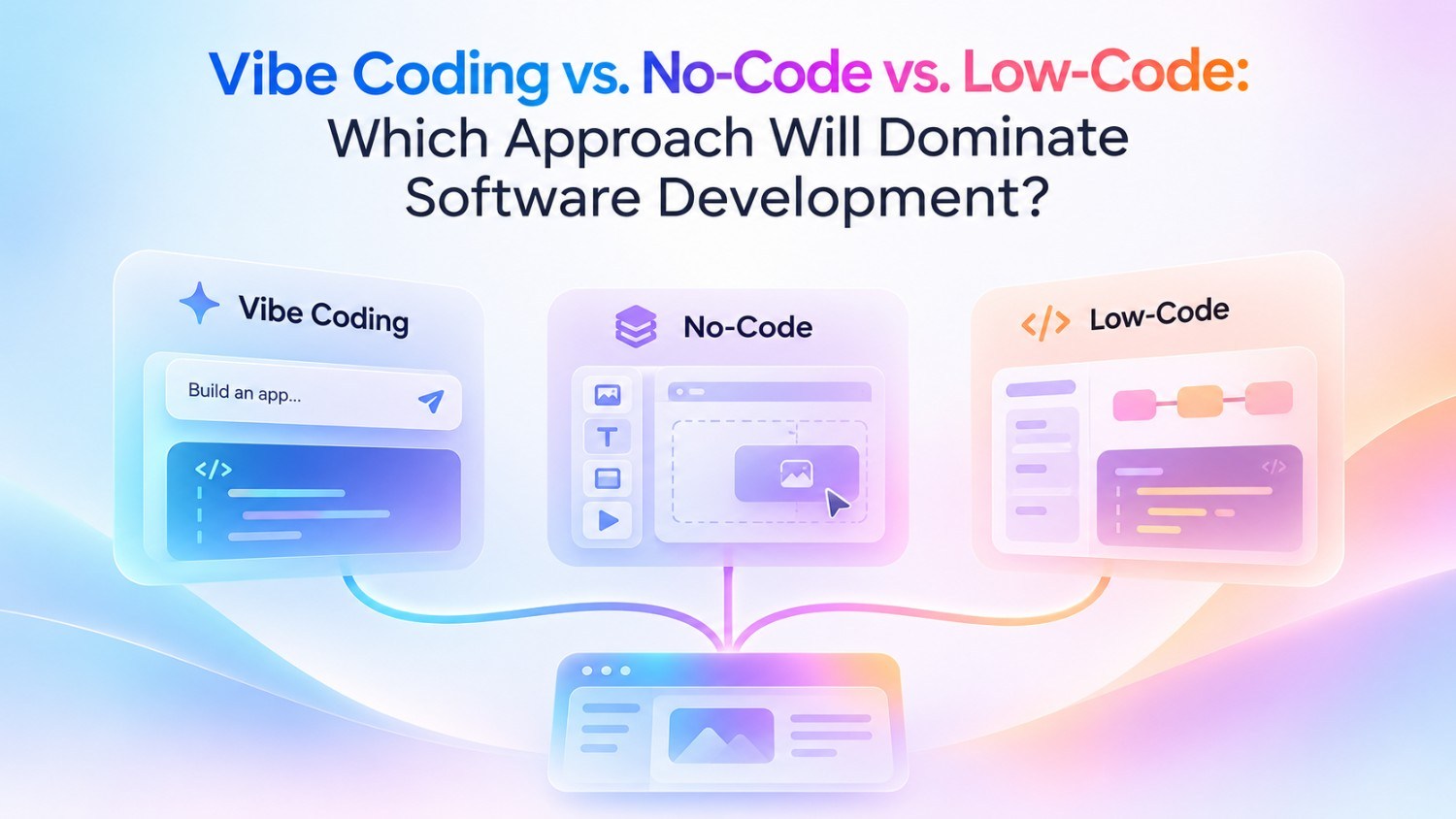
Three approaches are competing to make software development faster and more accessible: vibe coding, no-code, and low-code development. Each promises to reduce the work needed to turn an idea into a working product. However, they solve different problems, and choosing the wrong approach can create expensive problems as a business grows.
For San Francisco startups, this choice matters more than ever. A founder who can build a working product without hiring five engineers may be able to test a business idea much faster. Yet a company that chooses an easy development platform without thinking about security, growth, or future changes could end up rebuilding its entire application.
So, which approach will dominate software development over the next few years?
The answer is more interesting than simply choosing the newest technology. AI-generated coding is gaining ground, no-code platforms are becoming more capable, and low-code tools are adding AI features of their own. The real competition is shifting from who can build an application fastest to who can build reliable software at the lowest total cost.
This SFTechScene analysis examines the differences, public market data, pricing models, and practical business uses of all three approaches. It also introduces original financial models to show how development costs can change depending on the complexity of a product, the work required after launch, and the experience of the team building it.
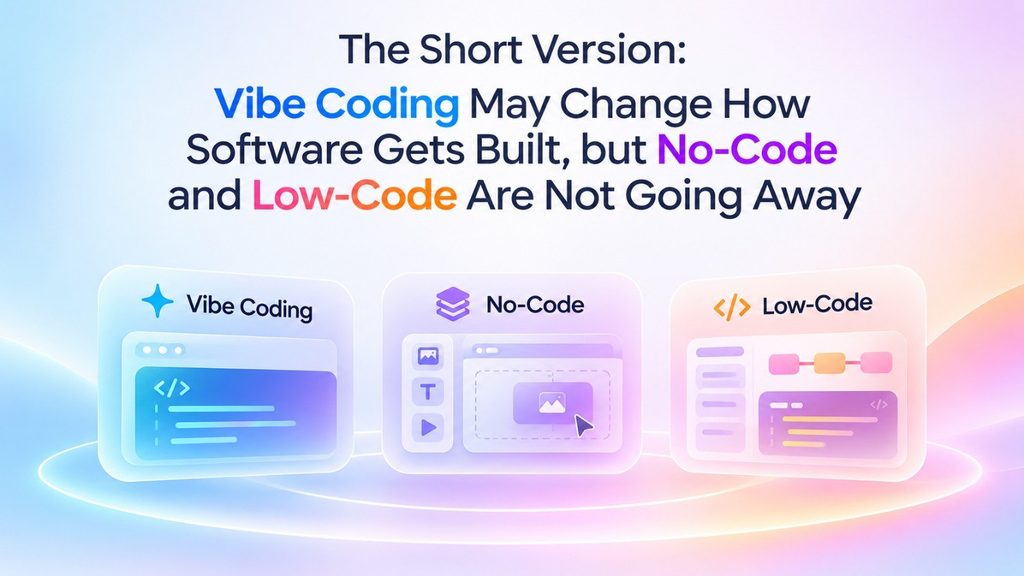
The Short Version: Vibe Coding May Change How Software Gets Built, but No-Code and Low-Code Are Not Going Away
Vibe coding is making it easier to create custom applications with natural-language instructions. Instead of building every feature by hand, users explain what they want, and AI tools generate much of the software. This opens the door for founders, marketers, designers, and other professionals who previously needed developers to turn their ideas into working products.
No-code platforms offer a different advantage. They give users visual tools, ready-made components, and managed systems that make common applications easier to build. Businesses can create websites, internal dashboards, booking systems, and simple customer applications without managing every technical detail.
Low-code development sits between these approaches and traditional software engineering. It combines visual development with the ability to add custom code, connect complex business systems, and manage applications across larger organizations.
The evidence suggests that AI-assisted development will become an increasingly important part of software creation. However, that does not automatically mean every company will abandon visual builders or structured development platforms.
The 2026 Stack Overflow Developer Survey reports that 65.9% of respondents use AI coding assistants or coding agents at work, while 26.2% use AI agents or automated workflows. These categories overlap, and AI-assisted coding is broader than vibe coding, but the figures show how quickly AI has become part of developers’ everyday work. Stack Overflow Developer Survey+1
2026 DEVELOPER SURVEY · REPORTED AI TOOL USAGE AT WORK
The categories overlap, so the percentages should not be added together.
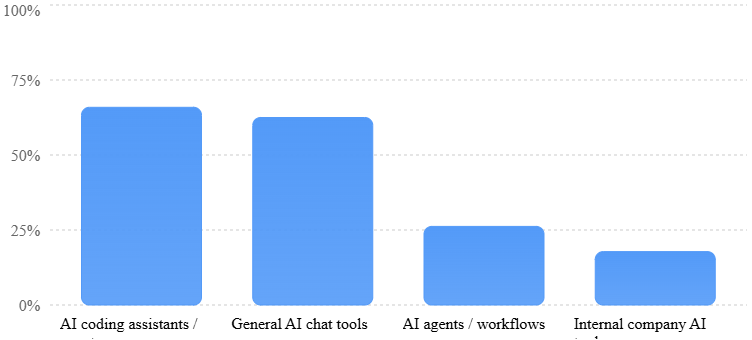
Source: Stack Overflow 2026 Developer Survey, AI usage section. Results represent survey respondents, not the entire software industry.
The strongest long-term approach may combine the benefits of all three. AI can produce custom code, no-code systems can simplify common tasks, and low-code platforms can provide the structure needed to operate serious business applications.
For San Francisco founders, the best choice will depend on three questions: How quickly must the product launch? How much custom behavior does it need? And how difficult will it be to maintain once real customers start using it?
What Is Vibe Coding, and Why Is It Changing Software Development?
Vibe coding turns written instructions into working software
Vibe coding is a way of building software by describing what an application should do rather than writing every line of code manually. A user might ask an AI development tool to create a customer management dashboard, add user accounts, connect a database, and build a payment page.
The AI tool then generates code and, depending on its capabilities, can run the application, identify problems, and make changes. The user can continue improving the product by giving instructions in ordinary language.
Consider a San Francisco founder who wants to build software for independent fitness studios. The application needs customer profiles, class bookings, membership payments, and attendance reports.
With traditional development, the founder would usually work with developers to plan and build these features. With vibe coding, the founder could begin by describing the application and allowing an AI tool to create an initial version.
This can reduce the effort required to produce a prototype. However, it does not guarantee that the finished application will be secure, reliable, or ready for paying customers.
Popular vibe coding tools in 2026
Lovable
A prompt-first tool for creating websites and web applications. It supports rapid visual changes and uses credits for building, hosting, and certain AI features.
Replit Review 2026: AI App Builder Tested | No Code MBA
Replit
A browser-based development environment with AI agents, code editing, application hosting, and tools for working on full software projects.
What Is Cursor IDE? Features, Agents, and Limits – Verdent Guides
Cursor
An AI-powered code editor designed for developers who want assistance generating, reviewing, changing, and understanding code.
Use GitHub Copilot Agent Mode to create a Copilot Chat application in 5 minutes
GitHub Copilot
An AI coding assistant integrated into developer workflows. It is better described as AI-assisted development than pure vibe coding when engineers actively inspect and control the code.
These tools do not work in exactly the same way. Some are designed to let non-programmers build applications from prompts, while others help experienced developers manage complex software projects.
That difference matters because generating an application is only one part of software development. Keeping it working, protecting customer information, and making changes safely can require skills that a prompt alone cannot replace.
Where vibe coding creates the most value
Vibe coding is especially useful when a business needs to test an idea before investing heavily in development. A founder can build an early version of a product, show it to potential customers, and learn which features people actually want.
It can also help small engineering teams move faster by generating routine code, creating tests, and improving existing features. The time saved depends on how much review and repair the generated code needs.
The biggest advantage is flexibility. A custom-coded application can potentially support features that are difficult to create inside a fixed visual platform, provided the team understands and maintains the generated software.
What Is No-Code Development, and Why Do Businesses Still Use It?
No-code replaces manual programming with visual tools
No-code platforms allow users to build applications through visual editors, templates, settings, and connected services. Instead of writing the instructions that make each button or workflow function, users configure components supplied by the platform.
A small company might create a booking system, customer portal, or internal reporting application by connecting forms, databases, tables, and automated workflows.
The platform usually handles much of the underlying technical work. This can include hosting, user interfaces, database operations, and some security controls.
For business owners who do not want to manage code, this is a major benefit. The goal is not maximum freedom over every technical detail. It is getting a useful business application running with fewer things to maintain.
Leading no-code platforms
The Definitive Bubble Review: A Flexible No Code App Builder Growing Over 50%
Bubble
Offers a visual editor for creating web and mobile applications, including workflows, databases, user accounts, and integrations.
Best Webflow Review 2026 | Is It a Reliable Website Builder?
Webflow
Focuses on website design, publishing, content management, and related web experiences. It is particularly useful for marketing and content-led websites.
Adalo
Helps users design and publish mobile and web applications with visual components, data, and built-in features.
The strongest no-code platforms have also started introducing AI features. This means the divide between AI-generated software and visual development is already becoming less clear.
A founder may soon use natural-language instructions to create an application and then use a visual editor to refine the design and behavior. In some platforms, that combined workflow is already available.
Why no-code will remain important
No-code offers something that pure AI-generated development does not always provide: a more limited and predictable building environment. Users work within a known set of components and platform rules.
This can make routine applications easier to manage, especially when the business does not have an experienced developer available. There are fewer decisions about servers, software packages, and the structure of the application.
However, this simplicity comes with tradeoffs. Custom features may be difficult to build, platform usage can become expensive, and moving to another provider may require substantial rebuilding.
What Is Low-Code Development, and How Is It Different?
Low-code combines visual building with traditional programming
Low-code platforms allow developers and business users to build applications with visual tools while still supporting custom code when needed. They often provide ready-made connections to databases, business systems, user management, and approval workflows.
The approach is particularly useful when software must work with existing company systems. A business may already use customer management software, accounting tools, and internal databases, and it needs new applications that connect those systems.
Low-code development can help teams avoid rebuilding common features while keeping more control over the parts that require special logic.
Unlike strict no-code development, low-code assumes that technical expertise may still be necessary. Developers can write custom logic when the platform’s built-in features are not enough.
Where low-code platforms fit
3: Building a low-code prototype – Power Apps | Microsoft Learn
Microsoft Power Apps
Supports business applications, data connections, workflows, and integration with Microsoft services and enterprise systems.
Retool Blog | Templates for building the top internal tools
Retool
Designed for building internal tools, operational dashboards, and workflows that connect to company databases and services.
OutSystems
Focuses on building and managing business applications that need more structured development, testing, and operational controls.
Why larger companies often prefer low-code
A large organization has different priorities from a founder testing an idea. It must consider who can access business information, how software changes are approved, and how applications connect to systems that may have been running for years.
Low-code platforms can reduce the amount of custom code needed while giving organizations a more structured way to manage applications.
Their biggest advantage is not always launch speed. It is the ability to deliver repeated business workflows with shared controls, especially when many employees and departments use the same systems.
Vibe Coding vs. No-Code vs. Low-Code: The Complete Comparison
| Factor | Vibe coding | No-code | Low-code |
|---|---|---|---|
| Main building method | Natural-language prompts and generated code | Visual components and settings | Visual components plus custom code |
| Coding knowledge | Helpful, often important after launch | Usually less necessary | Often needed for complex work |
| Prototype speed | Often very fast | Fast for supported features | Fast for familiar workflows |
| Customization | Potentially high | Limited by platform capabilities | Moderate to high |
| Maintenance | Depends on code quality and team skills | Largely platform-managed | Shared between platform and team |
| Security | Requires code review and good setup | Depends on platform and configuration | Often has structured controls |
| Migration flexibility | Depends on source access and dependencies | Can be difficult | Depends on platform architecture |
| Best suited for | Custom products and rapid experiments | Common apps and workflows | Internal systems and business operations |
| Main risk | Unverified or difficult-to-maintain code | Platform limits and dependence | Licensing costs and platform complexity |
No approach is best in every category. The important distinction is between creating a working application and keeping that application reliable as its needs change.
A no-code application may be the fastest option for a simple workflow. An AI coding agent may be better for a custom product with unusual features. A low-code platform may reduce risk when several existing business systems must work together.
The decision becomes clearer when founders compare the full cost of building and running each option rather than focusing only on how quickly the first version appears.
Original SFTechScene Research #1: What Does the Latest Developer Data Tell Us About the Future of Vibe Coding?
The first question is whether AI-assisted software development is becoming a normal part of work or remains something that people mostly use for experiments.
To examine this, SFTechScene analyzed published results from the 2026 Stack Overflow Developer Survey. Rather than treating all AI usage as vibe coding, we separated coding tasks, software operations, and trust in generated results.

This distinction is important. A developer who uses AI to write a small function is not necessarily using vibe coding to build an entire application.
Research methodology
Our analysis uses three publicly available sections of the 2026 survey: AI usage, AI development workflows, and trust in AI tools. We selected measures directly related to creating, changing, testing, and operating software.
The published survey includes different respondent counts for different questions. Therefore, we compare percentages within each question and do not combine the samples into a single estimated population.
The research measures adoption among survey respondents. It does not establish market share for vibe coding, no-code, or low-code products, and it should not be interpreted as a representative San Francisco developer survey.
Finding #1: AI is most widely used for tasks that produce checkable results
SHARE OF RESPONDENTS CURRENTLY USING AI FOR DEVELOPMENT TASKS · 2026
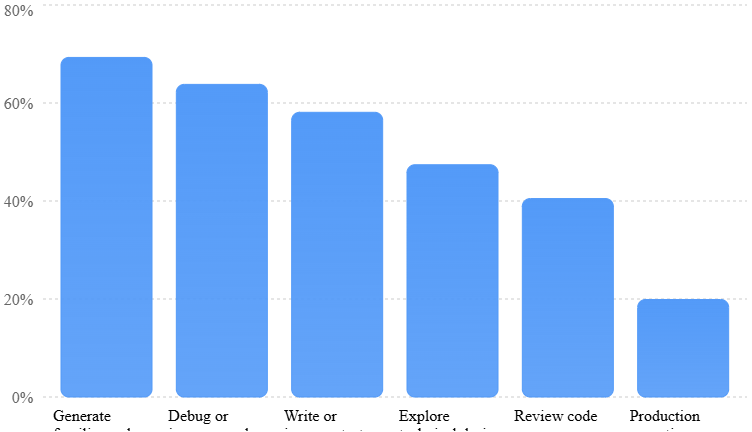
Source: Stack Overflow Developer Survey 2026, AI workflow data. Task percentages can overlap and should not be summed. Stack Overflow Developer Survey+1
The pattern is clear. AI use is highest for generating familiar code, debugging, and testing, where people can often check the output against an expected result.
Usage is much lower for production operations, where a mistake can affect real customers or important business systems.
SFTechScene’s interpretation is that AI has already established a strong role in helping people write software, but the evidence for completely handing over software operations is much weaker.
This distinction creates an opportunity for both low-code and no-code providers. They can use AI to make development faster while continuing to offer managed infrastructure and operational controls.
Finding #2: Developers trust AI much more when they can verify its work
The 2026 survey asked respondents how much they trust AI output in their workflows. We grouped the answers into practical trust categories to understand how developers evaluate the technology.
DEVELOPER TRUST IN AI OUTPUT · 2026
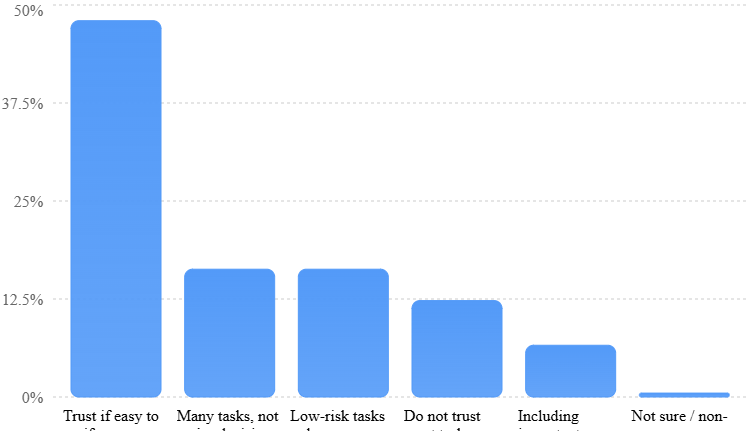
Source: Stack Exchange Inc. (2026), Stack Overflow Developer Survey, “Trust in AI tools,” n=14,304. Data licensed under ODbL 1.0. Stack Overflow Developer Survey+1
Only 6.6% of respondents selected the option saying they trust AI for many tasks, including important work decisions. By contrast, 48% trust the technology when they can easily verify what it produces.
The difference is substantial. The first group represents users comfortable extending trust to high-stakes work, while the second group places clear limits on that trust.
This suggests that the next phase of AI development tools will depend heavily on testing, visibility, and control.
Finding #3: The gap between writing code and operating software remains large
SFTechScene calculated a simple adoption gap using two measures from the same workflow question.
Current use of AI to generate code in familiar areas was 69.3%, compared with 19.9% for deploying, operating, or troubleshooting production systems.
ADOPTION GAP
49.4
Percentage points
RELATIVE USAGE
3.5×
Code generation vs. production operations
SFTechScene calculations: 69.3 − 19.9 = 49.4 percentage points; 69.3 ÷ 19.9 ≈ 3.48. These are differences in reported usage, not productivity or performance measures.
This gap supports a useful business hypothesis: tools that generate software and tools that safely operate software may remain separate products or layers, even as they become more closely connected.
A San Francisco startup might use AI agents to generate application features while relying on established hosting providers, managed databases, and structured testing tools to operate them.
That combination could become more common than fully autonomous software development.
Original SFTechScene Research #2: Which Development Approach Has the Lowest Total Cost?
Many comparisons focus on subscription prices. A vibe coding tool might cost a few dozen dollars per month, making it appear much cheaper than hiring engineers.
However, subscription prices rarely tell the full story. Building a product takes time, and maintaining it after launch can require more work than creating the first version.
SFTechScene developed a 12-month financial model to compare the three development approaches across different software projects.
Research methodology: A transparent 12-month cost model
This is an original scenario analysis, not a study of completed projects. We have not run identical applications through all three approaches or measured actual engineering hours.
Instead, the model uses explicitly defined assumptions to show how differences in development and maintenance work can change the economic outcome. The scenarios are designed around situations that San Francisco startups and businesses commonly face, but the figures are hypothetical rather than observed SF company data.
We use the following formula:
\[ \text{Year-one cost} = (\text{Build hours}+\text{Annual maintenance hours}) \times \text{Hourly labor cost} +\text{Annual platform cost} \]
We apply a common labor rate of $100 per hour across all approaches. This is a modeling assumption for the value of developer, founder, or technical contractor time, not a measured San Francisco wage or a quoted contractor rate.
We also use illustrative monthly platform budgets of $50 for vibe coding, $100 for no-code, and $200 for low-code. These are category-level planning allowances, not prices for any specific product.
The model excludes taxes, transaction fees, customer support, large-scale infrastructure, and major product redesigns. These costs would need to be added during a real purchasing decision.
Scenario A: A simple internal business application
Imagine a small San Francisco business wants a dashboard to track customer requests, assignments, and completed work. The application has a limited number of users, a few forms, and basic reporting.
We assume no-code can build this type of application with fewer hours because the requirements fit standard visual components.
| Cost assumption | Vibe coding | No-code | Low-code |
|---|---|---|---|
| Initial build hours | 30 | 22 | 45 |
| Maintenance hours/month | 3 | 2 | 3 |
| Total labor hours/year | 66 | 46 | 81 |
| Labor cost | $6,600 | $4,600 | $8,100 |
| Annual platform budget | $600 | $1,200 | $2,400 |
| Year-one total | $7,200 | $5,800 | $10,500 |
MODELED YEAR-ONE COST · SIMPLE INTERNAL APP
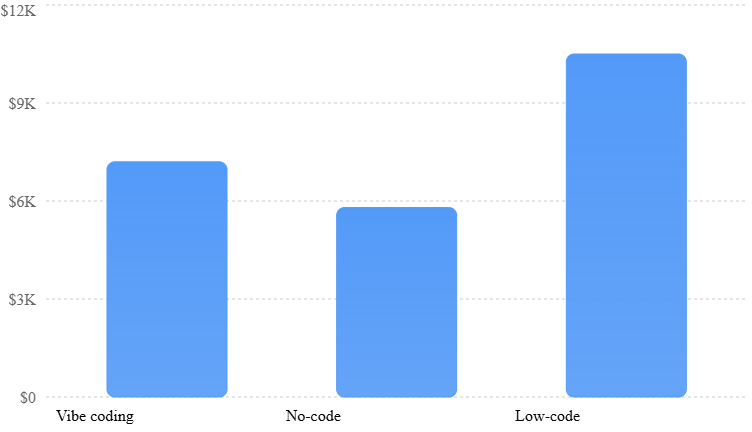
Original SFTechScene scenario model. Illustrative assumptions, not observed market costs.
Under these assumptions, no-code has the lowest total cost. It costs $1,400 less than vibe coding and $4,700 less than low-code development in the first year.
The important point is not the exact dollar amount. It is that reducing maintenance work can outweigh the cost of a more expensive software subscription.
For a simple application that fits a visual platform, no-code may provide better financial value than building custom software with AI.
Scenario B: A customer-facing SaaS product
Now consider a startup building a subscription-based application for small businesses. The product requires customer accounts, payments, dashboards, and several custom features.
In this scenario, we assume vibe coding accelerates the first build, but generated code requires additional maintenance. Low-code requires more setup than vibe coding while reducing some ongoing work through managed components.
| Cost assumption | Vibe coding | No-code | Low-code |
|---|---|---|---|
| Initial build hours | 90 | 115 | 95 |
| Maintenance hours/month | 10 | 12 | 7 |
| Total labor hours/year | 210 | 259 | 179 |
| Labor cost | $21,000 | $25,900 | $17,900 |
| Annual platform budget | $600 | $1,200 | $2,400 |
| Year-one total | $21,600 | $27,100 | $20,300 |
MODELED YEAR-ONE COST · CUSTOMER-FACING SAAS
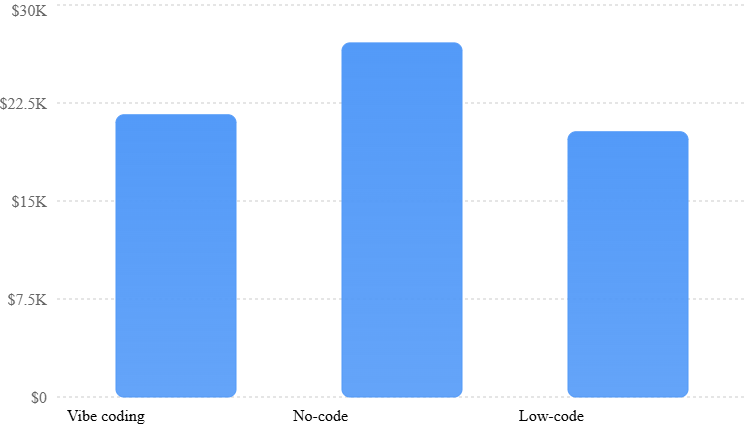
Original SFTechScene scenario model. Assumes equal labor rates but different development and maintenance effort.
Low-code has the lowest modeled cost, but vibe coding is close behind. The difference between them is $1,300, or about 6.4% of the low-code total.
A startup that needs unusually custom features might reasonably choose vibe coding even if the modeled cost is somewhat higher. The extra flexibility could be valuable if the business changes direction frequently.
However, the result depends on the assumed maintenance hours. A small increase in debugging or security work could make the AI-generated approach less attractive.
Scenario C: A complex business application
The third scenario involves a company building software that manages important customer information, approval workflows, and several connected systems.
We assume low-code has an advantage because the application can reuse managed business components and structured integrations.
| Cost assumption | Vibe coding | No-code | Low-code |
|---|---|---|---|
| Initial build hours | 240 | 360 | 210 |
| Maintenance hours/month | 24 | 35 | 18 |
| Total labor hours/year | 528 | 780 | 426 |
| Labor cost | $52,800 | $78,000 | $42,600 |
| Annual platform budget | $600 | $1,200 | $2,400 |
| Year-one total | $53,400 | $79,200 | $45,000 |
MODELED YEAR-ONE COST · COMPLEX BUSINESS APP
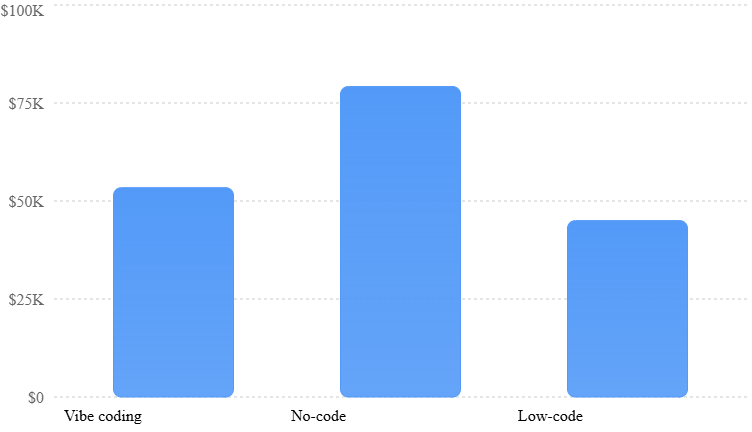
Original SFTechScene scenario model. Complexity and effort assumptions are illustrative and require project-specific validation.
In this case, low-code is the least expensive approach under the model’s assumptions. It costs $8,400 less than vibe coding and $34,200 less than no-code over the first year.
This does not prove that low-code is always best for complex software. A custom-coded product could be cheaper if the team already has reusable code, strong AI development skills, or special requirements that are expensive to implement in a low-code system.
It does show why launch speed is not enough to determine the economics of software development.
The overall cost comparison
ORIGINAL SFTECHSCENE MODEL · THREE PROJECT TYPES
■ Vibe coding
■ No-code
■ Low-code
Modeled year-one costs in USD. The results are conditional on the stated labor, platform, and maintenance assumptions; they are not performance benchmarks.
The central finding is that no single development approach wins across all three modeled situations.
No-code performs best in the simple internal application scenario. Low-code performs best in the two more complex examples, while vibe coding becomes more competitive when customization and fast changes are valuable.
The economic winner depends less on the label attached to the development method and more on the amount of work required to build, maintain, and change the product.
Original SFTechScene Research #3: How Much Maintenance Work Can Vibe Coding Afford Before Its Cost Advantage Disappears?
The previous model gives a useful starting point, but founders also need to understand what happens when their assumptions are wrong.
Maintenance is one of the hardest things to predict before launching software. A product might need only a few hours of support each month, or unexpected bugs and customer requests might create a much larger workload.
SFTechScene therefore calculated the break-even point at which vibe coding and low-code have the same estimated first-year cost for the customer-facing SaaS example.
Calculating the break-even point
In the model, vibe coding requires 90 build hours and a monthly platform allowance of $50. Low-code requires 95 build hours, seven maintenance hours each month, and a $200 monthly platform allowance.
Using a $100 hourly labor rate, the low-code total is $20,300.
For vibe coding, the equation becomes:
\[ 100(90+12m)+600=20{,}300 \]
Here, \(m\) represents monthly maintenance hours.
Solving the equation gives a break-even level of approximately 8.4 maintenance hours per month.
Under these assumptions, vibe coding is cheaper when its monthly maintenance effort stays below roughly 8.4 hours. When it rises above that level, low-code becomes cheaper.
BREAK-EVEN SENSITIVITY · CUSTOMER-FACING SAAS
■ Vibe coding annual cost
■ Low-code annual cost
Original SFTechScene calculation. Low-code maintenance is held at seven hours per month; vibe coding maintenance varies. The lines intersect at approximately 8.42 hours.
This is a more useful way to evaluate a development platform than simply comparing monthly subscription prices.
A founder should ask whether the team can realistically keep maintenance below the break-even point. That requires looking at how many bugs appear, how often features change, and how difficult the generated code is to understand.
Why this finding matters for San Francisco startups
Early-stage startups often focus on getting to market quickly. That makes sense because founders need customer feedback before investing heavily in a product.
However, a startup that gains customers must eventually spend more time keeping the application stable. Payments must process correctly, customer accounts must remain secure, and important features must work every day.
The financial advantage of faster software generation can shrink if the engineering team spends too much time repairing the result.
This creates a clear business case for reliable AI-generated code, automated testing, and good application design.
The most valuable AI development tools may not be those that generate the most code. They may be the ones that minimize the amount of human work required after the code is generated.
How Much Do Vibe Coding, No-Code, and Low-Code Tools Cost in 2026?
The financial models above use planning assumptions rather than real subscription prices. To add market context, SFTechScene separately reviewed public vendor pricing pages available in November 2026.
These prices should not be treated as directly equivalent. Some platforms charge for application usage, others charge for users, and AI tools may bill for credits or computing resources.
| Platform | Category | Public pricing example | Important consideration |
|---|---|---|---|
| Lovable | AI app builder | Pro: $25/month, 100 monthly credits | Credit use varies with tasks |
| Replit | AI development | Core: $20/month, or $18/month billed annually | Model usage and paid consumption matter |
| Bubble | No-code | Starter: $59/month billed annually | Usage measured with workload units |
| Webflow | Visual website building | Basic: $15/month billed annually | Site and workspace needs vary |
| Retool | Low-code | Team: $10/builder and $5/internal user monthly, billed annually | User roles affect cost |
Sources: Official pricing pages for Lovable, Replit, Bubble, Webflow, and Retool. Prices and plan features may change. Lovable+4
Why subscription prices can mislead founders
A $25 monthly subscription does not necessarily mean an AI-generated SaaS application costs $25 per month to operate.
A startup may also need databases, hosting, email services, payment processing, file storage, security monitoring, and additional AI usage. Some of those costs may be included in a platform plan, while others are charged separately.
Similarly, a low-code system with a modest starting fee can become expensive when hundreds of employees need access.
For example, Retool’s Team plan lists separate prices for builders and internal users. An organization with five builders and 100 internal users would have a modeled subscription of $550 per month at the published annual-billing rates, before extra services or usage costs.
The correct comparison should always include the number of people using the application and the services required to run it.
A better way to compare software costs
Founders should calculate the full cost over at least 12 months, and ideally over 24 or 36 months.
That estimate should include development time, subscriptions, hosting, maintenance, security work, integration costs, and the likely expense of adding major features.
It should also include the cost of moving away from the platform. A service that is inexpensive today may be difficult to replace when the application has thousands of customers.
Original SFTechScene Research #4: The Biggest Risk of AI Coding Is Not Always the Code It Generates
AI development tools are improving quickly, but speed creates a new problem. Teams can produce more software than they have time to review properly.
A founder might generate five new features in a day without fully understanding how those features interact with existing code. A small mistake in one part of the application can affect payments, account permissions, or customer information elsewhere.
To understand the scale of this problem, SFTechScene examined the 2026 Stack Overflow Developer Survey’s data on AI-related mistakes that cost teams time.
What developers say is causing problems
AI MISTAKES THAT COST TEAMS TIME · 2026
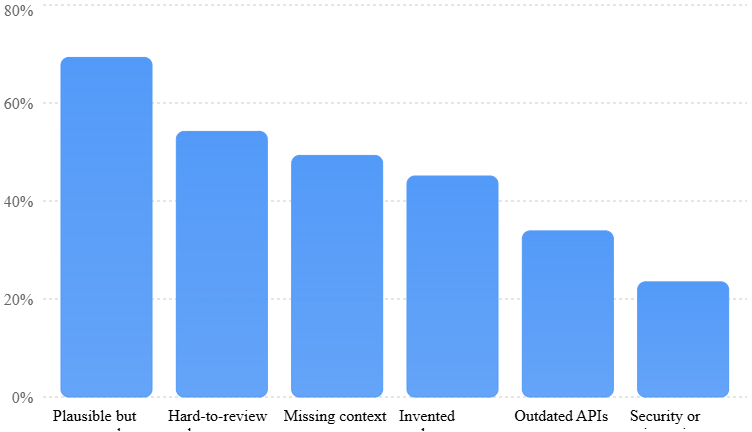
Source: Stack Overflow Developer Survey 2026, technology and AI mistakes data, n=13,648. Respondents could select multiple answers. Stack Overflow Developer Survey
The most frequently reported problem is code that appears correct but is actually wrong. This matters because a working interface can create a false sense of confidence.
A user might successfully create an account, complete a purchase, and open a dashboard while important security or data-handling problems remain hidden.
The second major issue is code that is difficult to review. Even when AI writes software quickly, the team still needs to understand what was built.
The verification gap creates a new business opportunity
SFTechScene’s analysis suggests that one of the biggest opportunities in software development is reducing the work required to check AI-generated applications.
The 2026 survey also found that 76.5% of respondents run AI-generated answers locally before using them, while 53% inspect testing or security implications. Only 9.6% reported using such answers as-is. Stack Overflow Developer Survey
These responses show why development platforms need more than powerful code generation. They also need ways to make quality checks routine.
For San Francisco startups, that could create demand for tools that automatically test applications, monitor changes, check access permissions, and explain problems in language that non-programmers can understand.
The opportunity is not limited to vibe coding vendors. No-code and low-code providers can also benefit by adding stronger AI capabilities within managed systems.
Which Approach Works Best for Different Types of San Francisco Startups?
The right development approach depends heavily on the type of business being built. A startup creating a customer-facing AI application has different needs from a local company building an internal booking system.
Rather than choosing a platform because it is popular, founders should begin with the type of software they need and the risks they can reasonably manage.
AI SaaS startups: Vibe coding can be a strong starting point
A startup building a custom AI-powered product may benefit from an AI coding environment that produces editable source code. It can experiment with unusual features, connect external services, and change the product as customers provide feedback.
However, the team should be prepared to manage the application as a real software project. Code review, automated tests, user permissions, and secure data handling are still necessary.
A sensible approach is to use AI to accelerate the first version, then introduce more structured engineering practices as the product gains users.
Local service businesses: No-code can reduce unnecessary complexity
A small business creating an appointment system, employee dashboard, or simple client portal may not need a custom software stack.
If an established no-code platform already supports the required workflow, using its built-in components can save time and reduce maintenance.
This is particularly valuable when the company has no dedicated engineering team. The business can concentrate on serving customers rather than maintaining custom software.
B2B startups with complex integrations: Low-code deserves serious consideration
A company selling software to larger organizations may need to connect with existing databases, approval processes, and internal tools.
Low-code platforms can simplify many of these connections while offering structured environments for managing business applications.
The main caution is that not every low-code platform is designed to power an independent, customer-facing SaaS business. Some are best suited to internal applications, making licensing and deployment requirements especially important.
Consumer mobile startups: Test publishing and platform limits early
Consumer mobile applications have special requirements, including app-store publishing, device features, notifications, and performance across different phones.
Both AI coding tools and visual mobile builders can create early applications, but founders should test the complete publishing process before making a platform decision.
A working preview in a browser does not guarantee that the product will behave correctly on mobile devices or satisfy app-store requirements.
A practical selection guide
| Business need | Recommended starting approach | Reason |
|---|---|---|
| Marketing website | No-code | Visual editing and publishing |
| Small internal dashboard | No-code | Ready-made components |
| Custom AI SaaS | Vibe coding with engineering review | Flexible custom features |
| Enterprise approval system | Low-code | Business integrations and controls |
| Rapid startup prototype | Vibe coding or no-code | Fast customer validation |
| Complex internal data tool | Low-code | Database and workflow integration |
| Highly specialized software | AI-assisted custom development | Greater control over architecture |
These are starting recommendations rather than fixed rules. The quality of the chosen platform, the team’s experience, and the application’s requirements can change the outcome.
The Biggest Risks of Vibe Coding, No-Code, and Low-Code Development
Vibe coding can create software that is difficult to maintain
The main risk of vibe coding is allowing AI to generate more code than the team can reasonably understand.
An application might work well during a demonstration but contain hidden errors, weak security rules, or confusing dependencies.
Founders can reduce this risk by maintaining a source repository, testing important customer journeys, reviewing access controls, and keeping reliable backups.
For applications that process payments or sensitive information, experienced technical review should happen before launch.
No-code can create dependence on a single platform
No-code tools can make development easier by hiding much of the underlying software. However, that also means users may depend heavily on the provider.
If pricing changes, important features are removed, or the application outgrows the platform’s capabilities, switching providers may require rebuilding substantial parts of the product.
Before choosing a no-code platform, founders should examine data export options, integration limits, usage pricing, and the ability to migrate to another system.
Low-code can become expensive as organizations grow
Low-code platforms often use licensing models based on builders, users, environments, or application usage.
A system that is affordable for ten employees may become much more expensive when the whole organization needs access.
Businesses should test costs under realistic growth assumptions rather than relying on introductory prices.
All three approaches can hide long-term maintenance costs
The common mistake is assuming that reducing manual coding automatically reduces the total cost of software ownership.
An application still needs customer support, security updates, monitoring, and adjustments when external services change.
The best development process is the one that keeps these responsibilities manageable, not simply the one that creates the first version fastest.
How San Francisco Founders Can Choose the Right Development Approach in 30 Days
Founders do not need to make a permanent platform decision before testing their options. A short, structured evaluation can reveal which approach fits their product.
The goal should be to compare real outcomes using the same requirements, rather than relying on promotional demonstrations.
Week 1: Define the product before choosing the technology
Start by identifying the five most important things the application must do.
For example, a customer management product might need account creation, contact records, task assignments, reports, and automatic notifications.
Write down what counts as success for each feature. This gives every development approach the same target and makes the results easier to compare.
Also identify the most serious risks. Customer data security, payment accuracy, and availability may matter much more than visual design.
Week 2: Build the same small product using different approaches
Choose a representative part of the application and build it using two or three candidate platforms.
Keep the requirements consistent. If one version includes user accounts, data storage, and reporting, the others should attempt the same features.
Track the actual hours required to build each version. Include time spent writing prompts, configuring components, correcting errors, and connecting services.
This small experiment provides more useful information than comparing advertised development speeds.
Week 3: Test the applications under realistic conditions
Ask several people unfamiliar with the application to complete the same tasks.
Measure how often they succeed, where they get confused, and whether the software behaves correctly when they make mistakes.
Check account permissions, data accuracy, failed transactions, and the behavior of connected services.
Then ask someone other than the original builder to make a small change. This reveals whether the application can be maintained by another team member.
Week 4: Compare costs and choose a development path
Use the results from the first three weeks to estimate the cost of a complete application.
Include the hours required for development, expected monthly maintenance, platform subscriptions, and likely growth costs.
Document the decision and the conditions that would justify changing it later.
A founder might choose no-code initially but plan to adopt custom development when specific platform limits become a problem. Another startup might begin with AI-generated code and add more formal engineering checks as customer usage increases.
The scorecard founders should actually use
Interactive development approach scorecard
Rate each approach from 1 (poor) to 5 (excellent), based on your own prototype tests. The weights reflect an illustrative startup decision framework.
Time to a working version
20% weightVibe coding
RateNo-code
RateLow-code
Rate
Required features work correctly
25% weightVibe coding
RateNo-code
RateLow-code
Rate
Security and data handling
20% weightVibe coding
RateNo-code
RateLow-code
Rate
Ease of future changes
15% weightVibe coding
RateNo-code
RateLow-code
Rate
Expected 12-month cost
15% weightVibe coding
RateNo-code
RateLow-code
Rate
Ability to move or export
5% weightVibe coding
RateNo-code
RateLow-code
Rate
Weighted results
Vibe coding
0.00 / 5
No-code
0.00 / 5
Low-code
0.00 / 5
Unrated criteria count as zero until scored.Reset
The scoring method gives more weight to working features and security than to the initial cost of a subscription.
This reflects an important reality for startups: a cheap application that fails during customer use may be much more expensive than a reliable application with a higher monthly fee.
The strongest approach is the one that performs well on the factors that actually matter to the business.
Will Vibe Coding Replace No-Code and Low-Code by 2030?
Vibe coding has the potential to change how many people create software. Natural-language instructions make custom development more accessible, and increasingly capable coding agents may take on larger parts of the development process.
However, predicting that vibe coding will eliminate no-code or low-code platforms assumes that all three approaches will remain separate categories.
That seems unlikely.
No-code platforms are becoming AI-powered
Visual development platforms can add AI features that turn written instructions into forms, layouts, workflows, and databases.
This lets users move between natural-language instructions and visual editing rather than choosing one method exclusively.
For many business users, that combination may be more useful than managing a custom codebase.
Low-code platforms are incorporating AI development
Low-code providers have similar incentives. AI can help people create applications faster, while the platform supplies established connections, permissions, and management controls.
A company could use natural language to describe a new business workflow and then review the resulting application in a structured development environment.
This may give enterprise teams a practical way to adopt AI without abandoning their existing software systems.
Vibe coding tools are becoming more structured
AI coding platforms are also moving beyond simple prompt-based generation.
As applications become more complex, users need source control, tests, databases, deployment tools, team permissions, and ways to inspect what AI changed.
These requirements push AI development products toward many of the capabilities already offered by traditional software development environments.
The result is a growing overlap between the three approaches.
SFTechScene’s outlook for 2027–2030
The following table presents editorial forecasts rather than measured adoption rates.
| Development area | Likely direction | Confidence in outlook |
|---|---|---|
| Startup prototypes | More AI-generated applications | Moderate |
| Marketing websites | Visual builders with stronger AI features | Moderate |
| Internal business applications | Continued no-code and low-code use | Moderate |
| Custom SaaS products | Greater use of AI-assisted coding | Moderate |
| Enterprise workflows | AI-enhanced low-code platforms | Moderate |
| Complex critical systems | AI support with human engineering oversight | Higher |
| Fully autonomous development | Progress, but uncertain reliability and adoption | Low |
These forecasts are based on the current product capabilities, adoption data, and operational challenges discussed in this article. They are not statistically derived market-share predictions.
The strongest prediction is not that one category will disappear. It is that AI assistance will become a common feature across more kinds of software development.
Founders may increasingly choose platforms based on reliability, flexibility, and total cost rather than whether the provider describes itself as vibe coding, no-code, or low-code.
Final Takeaway: The Future of Software Development Will Be Hybrid, but Reliability Will Decide Who Wins
Vibe coding is making custom software development faster and more accessible. For San Francisco startups, this can reduce the resources required to test ideas, develop prototypes, and introduce new features.
No-code platforms remain valuable because they make common applications easier to create and maintain without requiring businesses to manage every technical detail. Low-code platforms offer a strong option for organizations that need structured workflows, data connections, and more control over complicated business systems.
The original SFTechScene cost models show why these approaches should not be judged by initial development speed alone. In the modeled scenarios, no-code offered the lowest cost for a simple internal application, while low-code performed better for more complex business software. Vibe coding became especially competitive when customization mattered and ongoing maintenance remained manageable.
These are conditional findings, not universal rankings. Actual results will depend on the application, team skills, platform choices, security requirements, and amount of work needed after launch.
The broader lesson for founders is simple: building the first version of an application is becoming easier, but building software people can depend on remains difficult.
The companies that benefit most from AI development will not necessarily be those generating the largest amount of code. They will be those using automation to create useful products while keeping errors, maintenance, and long-term costs under control.
By 2030, the winning approach may not be vibe coding, no-code, or low-code as separate categories. It may be a hybrid development model that combines AI-generated code, visual building tools, and reliable engineering controls.
For San Francisco startups, that is the opportunity worth preparing for.
Research Sources and Methodology Notes
This article combines independently calculated SFTechScene scenario models with publicly available research and official product information.
Public datasets: The 2026 Stack Overflow Developer Survey provides the adoption, workflow, trust, and software quality data used in this analysis. The source publishes question-level respondent counts and downloadable structured data. Some survey questions allow multiple answers, and their percentages must not be summed. Survey data is attributed to Stack Exchange Inc. under the ODbL 1.0 license.
Financial analysis: SFTechScene’s original models calculate 12-month development costs using stated assumptions about build hours, maintenance, labor value, and platform budgets. The scenarios are hypothetical and have not been validated through controlled product builds. They illustrate cost sensitivity rather than measured vendor performance.
Pricing review: Published vendor prices were checked in November 2026. The pricing examples are not a standardized purchasing comparison because platforms use different usage limits, licensing terms, and billing structures.
Geographic limitation: The financial examples are designed to inform San Francisco startup decisions, but they do not use a representative sample of San Francisco businesses or independently measured local project costs. No SF-specific market share or savings rate is claimed.
For readers who want to check the evidence, the primary sources are the 2026 Stack Overflow Developer Survey, its AI workflow dataset, its AI trust dataset, and the official platform pricing pages linked above.