

San Francisco has a strange problem in 2026. Companies have more powerful software development tools than ever before, yet many young programmers are finding it harder to get their first engineering job.
AI coding tools can now write software, fix bugs, create tests, and help developers build working applications much faster. A small team can finish projects that once needed several engineers. For startups trying to keep costs low, this looks like a major advantage.
But there is another side to this shift. When companies need fewer people to handle basic coding work, they may also need fewer junior software engineers. That creates a serious question for San Francisco’s technology industry: How will the next generation of senior engineers gain experience if fewer companies are willing to hire beginners?
The latest hiring data suggests that this is becoming a real problem.
SignalFire’s June 2026 technology talent report found that entry-level hiring was roughly 65% below its 2019 level at major technology companies and approximately 76% below that level at early-stage startups. Yet engineering hiring overall was holding up much better, showing that the pressure is not falling equally on all software developers. 2026+1
Stanford researchers have also identified a growing employment gap for young workers in occupations exposed to artificial intelligence. Their August 2026 research found that employment among workers aged 22–25 in highly AI-exposed occupations was 19% below the level expected if it had followed the same path as less-exposed workers. Stanford Digital Economy Lab
These findings point toward a major change in how San Francisco companies build engineering teams.
The future may not belong to companies that simply replace junior engineers with AI. It may belong to companies that figure out how to use AI to turn beginners into productive engineers faster, without removing the training and experience that make good software developers valuable.
For this article, SFTechScene has also conducted an original analysis of public hiring, employment, and developer survey data. The results reveal why the entry-level hiring problem is becoming more serious, what it means for San Francisco startups, and how employers and young engineers can respond.
The Short Version: Junior Software Engineering Is Not Disappearing, but the Traditional Entry-Level Job Is Changing
The biggest mistake in the discussion about AI and software jobs is treating all engineers as though they do the same work.
A junior developer working on simple website updates has a very different job from a senior engineer responsible for security, customer data, payments, and a large software system. AI may help both employees, but the business impact is not the same.
In the past, companies hired junior engineers to handle smaller tasks while learning from experienced colleagues. They might write simple functions, fix minor bugs, update documentation, or build basic interface features. These tasks helped them develop skills before moving into more complex work.
Today, AI coding tools can handle much of that routine work. Companies can give experienced engineers more responsibility while hiring fewer beginners.
However, building reliable software still requires people who can understand business problems, identify mistakes, test applications, and make good technical decisions.
The 2026 Stack Overflow Developer Survey shows why this distinction matters. Although AI use has become common, 48% of respondents said they trust AI output when they can easily verify it, while only 6.6% said they trust it for many tasks, including important work decisions. Stack Overflow Developer Survey
This creates an opportunity for a new kind of junior engineer: someone who can work with AI, understand the code it produces, and prove that the software actually works.
THE 2026 HIRING PICTURE
-65%
Entry-level hiring at major tech companies vs. 2019
-76%
Entry-level hiring at early-stage startups vs. 2019
-19%
Relative employment gap for young workers in AI-exposed occupations
10%
Projected U.S. developer, QA, and tester employment growth, 2025–2035
Sources: SignalFire 2026, Stanford Digital Economy Lab August 2026, and U.S. Bureau of Labor Statistics. These figures cover different populations and should not be interpreted as one combined estimate. 2026+2
The central lesson is that the software engineering profession can continue growing even while the route into that profession becomes harder.
That is the challenge facing San Francisco’s next generation of technology workers.
Why San Francisco’s Junior Software Engineering Market Is Changing
AI coding tools are reducing the value of routine programming work
Software development has always involved more than writing code. Engineers also need to understand customer needs, plan systems, test changes, and keep applications running.
Nevertheless, writing code used to consume a large share of development time.
A developer building a website might spend hours creating forms, writing database queries, connecting APIs, and fixing small errors. These activities were common assignments for junior employees because they were relatively easy to review.
Tools such as Cursor, Claude Code, and OpenAI Codex are changing this process.
An experienced engineer can explain a task, ask an AI assistant to propose changes, review the output, and run tests. This can reduce the amount of manual work needed for some assignments.
However, faster code generation does not mean that the entire development process becomes automatic.
A payment system can contain code that looks correct but charges customers incorrectly. An AI-generated database change can work in testing while causing problems when real customers use it.
The difference between producing code and delivering dependable software is becoming more important.
Startups are becoming more interested in smaller, experienced teams
For San Francisco founders, hiring decisions are closely linked to cash.
A startup with limited funding must decide how many employees it can afford, what skills it needs, and how much time experienced workers can spend training new hires.
If one experienced engineer using AI can complete work that previously required several people, founders have a financial reason to consider smaller teams.
SignalFire’s 2026 report found that hiring at early-stage startups was only 4% below its 2019 level overall, while their entry-level hiring was approximately 76% lower. This suggests that the startup hiring recovery has not translated into a comparable recovery for beginners. 2026
That distinction matters.
Startups are still hiring people, but they are changing the types of employees they want.
Senior engineers are becoming more valuable
An experienced engineer brings knowledge that AI coding tools do not automatically provide.
They understand why past technical decisions were made, which parts of an application are fragile, and what can happen when a seemingly harmless change reaches customers.
They also know when an AI-generated solution is too complicated, insecure, or poorly suited to the business.
As AI makes implementation faster, reviewing work and making sound decisions can become bigger parts of the engineering job.
SignalFire found that software engineers represented 55% of hiring at the major technology companies in its dataset in 2026, compared with 46% in 2019. This does not mean engineering hiring was booming; it means engineering held up better than many other functions. 2026
For junior developers, the message is clear. Learning to generate code is useful, but learning to judge and improve code is likely to create more lasting career value.
Original SFTechScene Research #1: How Much Has the Entry-Level Hiring Pipeline Shrunk Compared With Overall Engineering Hiring?
Research question and methodology
The first question is whether technology companies are reducing all engineering hiring at roughly the same rate, or cutting entry-level opportunities much faster.
To investigate, SFTechScene used the June 22, 2026, SignalFire State of Tech Talent report and compared three hiring measures against their 2019 baselines: total hiring, overall engineering hiring, and new-graduate or entry-level hiring.
We converted each measure into an index where 2019 equals 100.
For example, a 65% decline produces a hiring index of 35. An 11% decline produces an index of 89.
This allows different hiring categories to be compared without assuming they originally employed the same number of people.
The analysis is a new calculation using published source figures, not a new employer survey or independent count of job postings. SignalFire’s employer groups are not limited to San Francisco, so these findings describe the broader technology labor market that influences local employers.
Research finding: Junior hiring has fallen much faster than engineering hiring
2026 hiring relative to 2019
Original SFTechScene re-indexing of SignalFire data. Index: 2019 = 100. Lower values indicate larger declines.
■ Major tech companies
■ Early-stage startups
Source figures: SignalFire State of Tech Talent, June 2026. SFTechScene calculated the index values. Startup engineering hiring includes a reported 7% increase against 2019. 2026
| Hiring category | Major tech firms | Early-stage startups |
|---|---|---|
| All hiring index | 75 | 96 |
| Engineering hiring index | 89 | 107 |
| Entry-level hiring index | 35 | 24 |
| Entry-level index relative to engineering index | 39.3% | 22.4% |
The last row is the most revealing.
At major technology companies, the entry-level hiring index is only 39.3% of the overall engineering hiring index. At startups, it is just 22.4%.
These percentages are ratios of normalized indexes. They are not the percentage of engineering vacancies offered to graduates.
Nevertheless, they show how differently the two hiring measures have moved since 2019.
Original finding: Entry-level hiring is being squeezed even where engineering remains strong
At major technology companies, the overall engineering hiring index has fallen from 100 to 89, while the entry-level index has fallen to 35.
At startups, the contrast is sharper. Overall engineering hiring has risen to an index of 107, but entry-level hiring has fallen to 24.
The resulting relative index calculations are:
\[ \text{Major tech}=\frac{35}{89}\times100=39.3 \]
\[ \text{Startups}=\frac{24}{107}\times100=22.4 \]
Compared with the 2019 relationship, the entry-level index has weakened by approximately 60.7% relative to the engineering index at major technology companies and 77.6% at startups.
These are derived measures of relative change, not direct measurements of the share of junior engineers on payroll.
The finding challenges a common assumption: more engineering hiring does not necessarily produce more opportunities for new engineers.
A startup market can increase its overall engineering recruitment while leaving its beginner hiring pipeline much smaller than before.
What this means for San Francisco startups
For a founder, an experienced engineering team may deliver fast results. But for the wider San Francisco economy, an industry that depends heavily on experienced engineers needs a reliable way to create them.
Today’s senior developers were once beginners.
If too few young engineers gain production experience, companies may face a shortage of employees ready for senior responsibilities in future years.
That risk is not proven by current hiring data, but the size of the entry-level contraction makes it important to investigate.
Original SFTechScene Research #2: Why San Francisco Has More at Stake in the Junior Engineering Hiring Shift
Measuring San Francisco’s dependence on technical employment
San Francisco is not an average American labor market.
The region contains a large concentration of technology companies, venture-backed startups, engineering teams, and businesses that rely on software.
To measure that difference, SFTechScene examined May 2025 occupational employment data from the U.S. Bureau of Labor Statistics, published in July 2026.
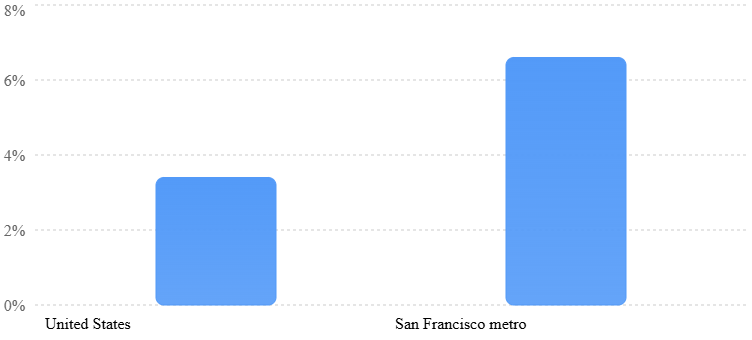
The BLS reported that computer and mathematical occupations accounted for 6.6% of employment in the San Francisco-Oakland-Fremont metropolitan area, compared with 3.4% nationally. Bureau of Labor Statistics
The metropolitan area includes San Francisco, San Mateo, Alameda, Contra Costa, and Marin counties. It is broader than the city of San Francisco and should not be confused with the entire Bay Area.
Original finding: The SF region has nearly twice the national concentration of computer and mathematical jobs
We calculated a simple local concentration ratio:
\[ \text{Concentration ratio}=\frac{6.6}{3.4}=1.94 \]
Computer and mathematical occupations as a share of all jobs
May 2025 employment shares. Original comparison calculated from BLS figures.
Source: U.S. Bureau of Labor Statistics, May 2025 occupational employment estimates, released July 9, 2026. Bureau of Labor Statistics
This means computer and mathematical occupations account for about 1.94 times the share of total employment in the San Francisco metro area that they do nationally.
The result does not establish that San Francisco has suffered a larger decline in junior hiring. The BLS measure includes many technical occupations and all experience levels.
It does show that changes in technical career opportunities are especially relevant to the regional economy.
San Francisco also has a strong financial reason to adopt AI
The same BLS data shows that the mean hourly wage for computer and mathematical occupations in the San Francisco metropolitan area was $80.51, compared with $57.73 nationally.
Mean hourly wage in computer and mathematical occupations
BLS May 2025 estimates, USD per hour.
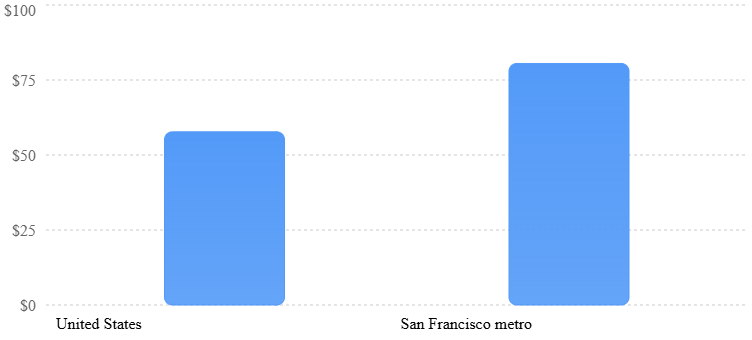
Using these published values, SFTechScene calculates a local wage premium of approximately 39.5%.
\[ \frac{80.51-57.73}{57.73}\times100=39.5\% \]
For employers, that creates a strong incentive to find tools that reduce time spent on routine work.
However, the figures are occupational averages, not junior developer salaries. They cannot be used to estimate what a new graduate should earn or how much replacing a junior hire would save.
Why the local talent pipeline matters
San Francisco’s strength comes partly from its concentration of experienced people who understand how to build technology companies.
Young engineers learn from those people. They gain experience with real customers, difficult technical problems, and the decisions that determine whether software succeeds.
If fewer graduates can enter the profession, some may move to other industries, take different roles, or build companies themselves.
Others may struggle to gain the experience that employers expect.
The regional challenge is therefore larger than the number of open junior developer positions. It involves maintaining the flow of people who can eventually lead complex engineering projects.
Original SFTechScene Research #3: What Does the Latest Evidence Say About AI and Young Workers?
Stanford’s 2026 research points to fewer opportunities for beginners
A major question is whether the decline in junior hiring is simply part of the technology industry’s normal boom-and-bust cycle.
Companies hired aggressively during the pandemic, then reduced recruiting as interest rates rose and growth slowed. Those changes affected experienced workers as well as new graduates.
To understand whether AI could be contributing to a different pattern, researchers need to compare workers whose jobs are highly exposed to AI with workers in occupations that are less exposed.
Stanford’s Digital Economy Lab took this approach using payroll records from ADP.
Its August 2026 working paper examined employment among millions of U.S. workers through June 2026. The researchers found that young employees in the most AI-exposed occupations had fallen behind comparable workers in less-exposed occupations.
The estimated relative employment gap had reached 19% for workers aged 22–25.
Importantly, the researchers found that the gap was largely associated with reduced hiring rather than increased employee departures. They also reported that experienced workers did not show a comparable gap. Stanford Digital Economy Lab
This is an important distinction for the junior software engineering market.
A company does not need to lay off large numbers of existing engineers to reduce opportunities for young workers. It can simply hire fewer new graduates when employees leave or new projects begin.
Original analysis: Separating hiring evidence from the AI explanation
SFTechScene compared three separate indicators to see whether they describe a consistent pattern.
| Indicator | Published finding | What it measures |
|---|---|---|
| SignalFire, 2026 | Entry-level hiring down roughly 65% at tech majors | Recruiting compared with 2019 |
| SignalFire, 2026 | Entry-level hiring down approximately 76% at startups | Recruiting compared with 2019 |
| Stanford, August 2026 | 19% relative employment gap for young workers in AI-exposed jobs | Employment compared with less-exposed occupations |
| Stack Overflow, 2026 | 48% trust AI when its output is easy to verify | Developer attitudes toward AI reliability |
These figures cannot be added together or used as direct proof that AI caused a particular percentage of hiring losses.
They come from different datasets, populations, and research methods.
However, they support a useful interpretation: entry-level recruitment has weakened considerably, younger workers in AI-exposed jobs face growing difficulties, and employers still need technical workers who can verify AI output.
That combination helps explain why basic coding ability may no longer be enough to secure an entry-level engineering position.
A crucial limitation: AI is not the only possible cause
The Stanford researchers explicitly describe their findings as early, descriptive evidence rather than a proven causal estimate.
They found that some differences between worker groups existed before generative AI became widely available. They also noted that education differences and the choice of employment dataset affect the estimates. Stanford Digital Economy Lab
That means it would be inaccurate to say that AI alone eliminated 19% of young workers’ jobs.
Interest rates, changes in venture funding, employer caution, outsourcing, and the unusually large number of experienced job seekers could all influence recruiting.
The stronger conclusion is that AI is changing the value of certain tasks at the same time that young workers are facing a difficult hiring market.
For San Francisco employers, understanding that distinction is essential. It prevents companies from making long-term workforce decisions based on an oversimplified explanation.
Original SFTechScene Research #4: The AI Trust Gap Could Become the Biggest Opportunity for Junior Engineers
The question is no longer whether AI can write code
The more useful question is whether a company can trust the software that AI produces.
To examine this problem, SFTechScene analyzed the published response counts from the 2026 Stack Overflow Developer Survey.
The trust question received 14,304 responses. Participants were asked how much they trusted the output of AI tools or agents in their work. Stack Overflow Developer Survey
We grouped the responses based on whether trust was limited to certain circumstances.
How developers decide whether to trust AI output
2026 Stack Overflow survey. Percent of respondents.
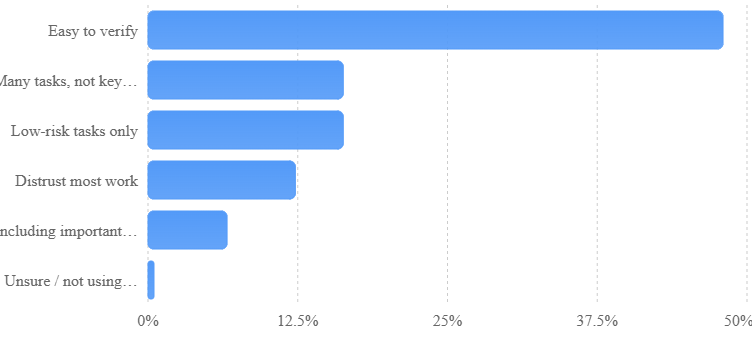
Source: Stack Exchange Inc., Stack Overflow Developer Survey 2026, AI trust question, n=14,304, ODbL 1.0. Percentages are published rounded values. Stack Overflow Developer Survey
Original finding: Conditional trust is much more common than broad trust
SFTechScene combined the three response categories describing limited or conditional trust.
\[ 48.0+16.3+16.3=80.6\% \]
Approximately 80.6% of respondents selected one of these three positions: trust AI when output is easy to verify, trust it for many tasks but not major decisions, or trust it only for low-risk work.
Only 6.6% selected the option expressing trust across many tasks, including important work decisions.
These categories do not represent a direct test of AI accuracy. They measure what survey respondents believe.
Nevertheless, the contrast is significant for software hiring.
Companies may be able to produce code faster, but they still need people who can check whether that code meets requirements.
This creates a potential role for junior engineers who develop strong testing, debugging, and code review skills.
Why the ability to verify AI code matters
Imagine a San Francisco startup building software that helps small businesses manage customer appointments.
An AI coding agent generates a booking system. It creates the website interface, stores appointment information, and sends confirmation emails.
At first glance, everything works.
But what happens if two customers try to book the same appointment at the same time? What happens when a customer changes time zones? Can one business see another business’s appointment records?
These questions require more than code generation.
A junior engineer who understands how to test unusual cases can find problems before they reach customers.
A developer who simply accepts whatever the AI produces may miss them.
The new junior engineer could become a software quality multiplier
Instead of measuring beginners only by how much code they write, employers could measure how well they help the team deliver correct software.
For example, a junior engineer might use AI to create a feature, then build automated tests, examine error logs, and check whether the feature behaves correctly with real data.
This role combines coding with verification.
It can create value even when AI handles much of the first draft.
The opportunity is especially relevant for smaller startups, where a serious software failure can damage customer trust or require expensive repairs.
Which Junior Software Engineering Tasks Are Most Likely to Change?
AI is not equally useful for every development activity. Some tasks follow clear patterns, while others require business knowledge, careful planning, and responsibility for difficult decisions.
The following table is an editorial assessment of task exposure, not a statistical forecast of job losses. It is designed to help employers decide where human review and training remain important.
| Engineering task | Potential for AI assistance | Skill junior engineers should build |
|---|---|---|
| Writing simple functions | High | Understanding and testing code |
| Creating basic website layouts | High | Accessibility and user experience |
| Writing routine unit tests | High | Identifying missing test cases |
| Updating documentation | High | Checking technical accuracy |
| Fixing simple syntax errors | High | Finding the root cause |
| Connecting standard APIs | Medium–high | Handling failures and permissions |
| Investigating unusual bugs | Medium | Debugging and system knowledge |
| Improving database performance | Medium | Measuring real performance |
| Reviewing security risks | AI can assist, human review critical | Security judgment |
| Planning large software systems | AI can support planning | Design decisions and trade-offs |
| Responding to production failures | AI can assist diagnosis | Incident handling and accountability |
Basic feature development will become faster
A developer no longer needs to write every line of a simple application by hand.
AI can generate common interfaces, database connections, and standard features from written instructions.
That changes how companies measure the value of beginner work.
An employee who takes several days to complete a routine task may have less advantage if an experienced colleague can finish and review the same task much faster with AI.
But a beginner who understands the feature, tests it carefully, and identifies weaknesses can still contribute.
Debugging will remain an important skill
AI tools can suggest fixes for errors, but a suggested fix is not necessarily the correct one.
A developer needs to understand why the problem happened and whether the proposed solution could create another problem.
For example, an application may be slow because of poor database queries rather than inefficient interface code.
An AI assistant might suggest a change that improves one part of the system while leaving the real cause untouched.
The engineer who can reproduce the problem, measure its effect, and verify the solution is doing work that matters.
Security and customer data will require careful judgment
Security is especially important for startups serving businesses.
An AI-generated application may include weak access controls, unsafe database operations, or mistakes in how customer information is stored.
Junior engineers do not need to become security experts immediately. They do need to understand common risks and know when a more experienced engineer must review a change.
This combination of technical skill and sound judgment will become increasingly valuable as AI helps teams produce more code.
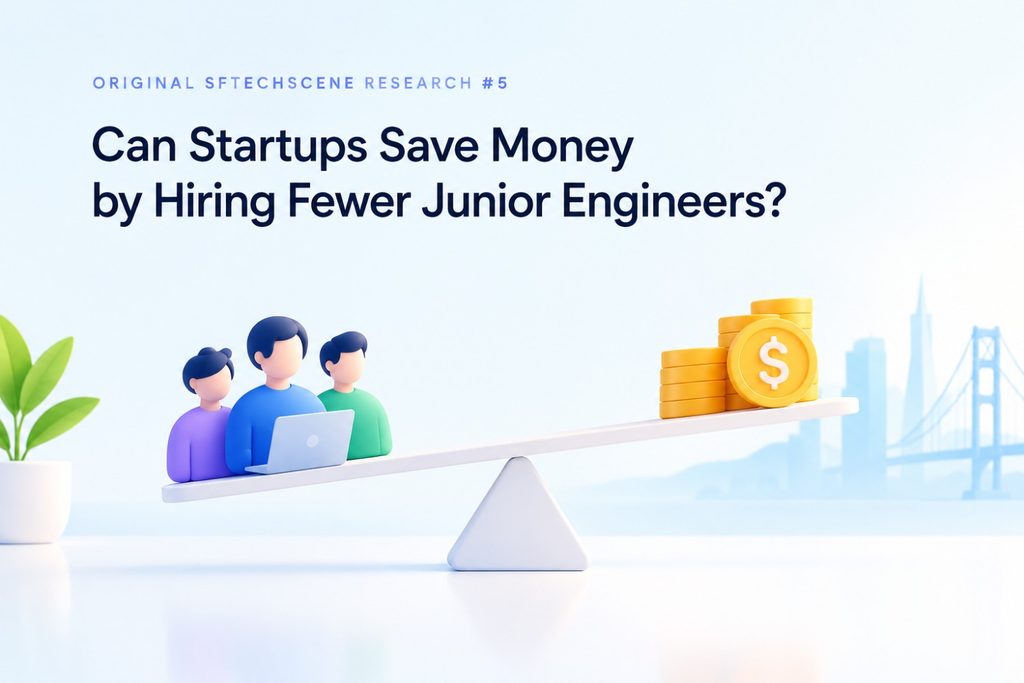
Original SFTechScene Research #5: Can Startups Save Money by Hiring Fewer Junior Engineers?
Building a transparent hiring and training model
The argument for reducing junior hiring often comes down to economics.
A company may believe that hiring an experienced developer and providing AI coding tools is cheaper than hiring several beginners who need support.
But this comparison is incomplete unless it includes the value of junior work, training time, future hiring needs, and the cost of reviewing software.
To examine the decision, SFTechScene created a simple financial model for a hypothetical San Francisco startup.
This is a scenario analysis, not a measurement of what local companies actually pay or how much their engineers produce.
The model uses these illustrative assumptions:
| Input | Example assumption |
|---|---|
| Junior engineer annual compensation and employment cost | $140,000 |
| Senior engineer annual compensation and employment cost | $260,000 |
| Senior review and mentoring time | 4 hours per week |
| Paid working hours per year | 2,080 |
| First-year junior productive output | 50%–100% of a fully productive employee |
| AI benefit | Included in the output scenarios |
These costs are hypothetical. Actual San Francisco compensation depends on the company, experience level, benefits, and equity structure.
The cost of mentoring a junior engineer
At a hypothetical annual employment cost of $260,000, a senior engineer costs approximately $125 per paid working hour.
If that engineer spends four hours per week mentoring a beginner over 48 working weeks, the annual allocated mentoring cost becomes:
\[ 4\times48\times125=\$24,000 \]
Adding that to the junior engineer’s hypothetical $140,000 employment cost produces a first-year investment of approximately $164,000.
This is not necessarily an additional cash expense. If the senior employee is already on payroll, it represents the estimated opportunity cost of time spent mentoring instead of doing other work.
The comparison also assumes mentoring time has no separate long-term benefit for the senior engineer or team.
Comparing three productivity scenarios
To make the model more useful, we calculate the cost per unit of productive engineering capacity.
One unit is defined as the annual output of a fully productive engineer within this hypothetical model.
Illustrative first-year cost per unit of productive output
SFTechScene scenario model. Includes $164,000 first-year junior investment. Not observed market data.
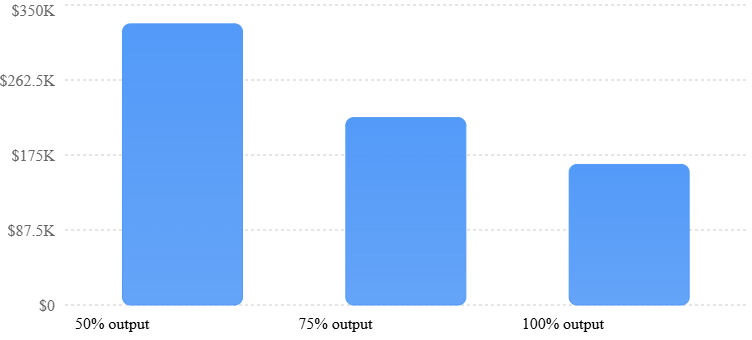
| First-year productivity | Productive output units | Cost per output unit |
|---|---|---|
| 50% | 0.50 | $328,000 |
| 75% | 0.75 | $218,667 |
| 100% | 1.00 | $164,000 |
The formula is:
\[ \text{Cost per output unit}=\frac{\$164,000}{\text{Productivity factor}} \]
These scenarios are not productivity predictions. They show how strongly the financial result depends on how quickly a beginner becomes useful.
At 50% productivity, the first-year cost per unit of output is high. At 100% productivity, that cost falls by half.
The implication is that training quality, suitable assignments, and effective AI assistance can materially change the business case for hiring beginners.
Why the first-year comparison can be misleading
A company that hires only experienced engineers may look more productive in the short term.
But a junior engineer is also an investment in future skills.
If the employee becomes significantly more productive in the second and third years, the initial training expense may produce long-term value.
The opposite can also happen. If an employee leaves soon after training, the company may not recover its investment.
This means founders should evaluate junior hiring across several years rather than considering only the first six months.
A useful internal measure is the time required for a new engineer to become productive enough that their output justifies their compensation and mentoring costs.
Companies should then compare that figure across hiring cohorts while also tracking software quality and employee retention.
The Biggest Risk: San Francisco Could Create a Senior Engineering Talent Shortage
The most important long-term issue is not whether AI can complete beginner tasks.
It is whether companies will continue creating opportunities for people to develop advanced engineering skills.
Senior engineers cannot appear without experience
A strong software engineer learns through real projects.
They experience product launches, difficult bugs, system failures, customer feedback, and changing business requirements.
They learn which shortcuts are safe and which shortcuts create expensive problems.
An AI assistant can help someone study these topics, but reading an explanation is not the same as being responsible for a real production system.
If companies stop giving beginners meaningful technical responsibilities, they could weaken the future supply of experienced developers.
The talent problem may take years to become visible
A startup that reduces junior hiring today might not experience an immediate problem.
Its experienced engineers may remain productive, and AI tools may help the team deliver software quickly.
The problem could appear later when those employees leave, move into leadership positions, or become too expensive to hire.
A company that has not developed its own engineers may then need to compete for experienced talent in an already expensive market.
This is particularly relevant in San Francisco, where many businesses compete for similar technical skills.
Universities and bootcamps may need to change their training approach
Traditional software education often focuses on programming languages, algorithms, and application development.
These subjects remain important, but graduates also need experience reviewing AI-generated code and working with real software systems.
A student who can produce a working application with AI has demonstrated one useful skill.
A student who can explain the application’s design, identify its weaknesses, test its behavior, and maintain it has demonstrated much more.
Schools could respond by giving students projects with changing requirements, existing codebases, and realistic technical problems.
Students should also learn to work without AI assistance on selected exercises, so they can build the knowledge needed to catch AI mistakes.
How San Francisco Startups Should Rethink Junior Software Engineering Hiring
The solution is not to abandon AI or return to the old hiring model.
Companies can use AI to improve productivity while creating better ways for beginners to gain experience.
The important change is to stop treating junior engineers as inexpensive people who write simple code.
Instead, employers should hire them to develop into reliable problem-solvers who use AI responsibly.
Hire for reasoning, not just coding speed
Traditional technical interviews often ask candidates to solve programming problems under time pressure.
These exercises can reveal useful skills, but they do not always show how someone performs in a modern engineering team.
A stronger interview could give candidates a small, unfamiliar application with a real problem.
Candidates could use AI tools to investigate the code, suggest a fix, and explain how they would test it.
The interviewer should examine the candidate’s reasoning rather than simply checking whether the final code runs.
A practical 90-minute junior engineering assessment
| Stage | Time | What to evaluate |
|---|---|---|
| Understand an existing application | 15 minutes | Code reading and questions |
| Find and fix a bug with AI assistance | 30 minutes | Problem-solving approach |
| Write tests for the change | 20 minutes | Verification skills |
| Review an AI-generated solution | 15 minutes | Ability to identify risks |
| Explain decisions | 10 minutes | Communication and understanding |
This assessment should use a small, self-contained application that candidates can reasonably understand within the available time.
Companies should provide the same AI tools and instructions to every candidate. They should also make clear what information must not be shared with external AI services.
Create an AI-assisted engineering apprenticeship
One practical approach is to hire junior engineers into a structured training program lasting several months.
During the first month, beginners could focus on understanding the company’s software, reviewing changes, learning testing practices, and fixing small issues.
During the second month, they could take responsibility for a narrow feature, with an experienced engineer reviewing their work.
By the third month, they could begin owning a defined part of the product, including its tests, documentation, and routine maintenance.
The goal is not simply to make beginners write more code.
It is to help them become dependable contributors faster.
Measure productivity without rewarding bad software
A common mistake is measuring developers by how many lines of code they produce.
This becomes especially misleading when AI tools can generate thousands of lines quickly.
More code can create more maintenance problems.
A better measurement system should focus on working features, software defects, customer impact, and how independently engineers can solve problems.
| Metric | What it reveals |
|---|---|
| Time to first useful contribution | Speed of onboarding |
| Time to independently own a small feature | Growth in engineering skill |
| Defects found after release | Quality of work |
| Changes requiring major rework | Understanding of requirements |
| Test coverage of important behavior | Ability to verify software |
| Senior review hours per task | Mentoring requirements |
| Customer-facing issues resolved | Practical business contribution |
Companies should measure these results over time rather than using them to punish beginners for needing help.
A junior engineer who asks good questions and catches serious mistakes may be more valuable than someone who completes assignments quickly but introduces defects.
How Junior Software Engineers Can Get Hired in San Francisco in 2026
The changing market does not mean beginners should give up on software engineering.
It means they need to show employers evidence that they can contribute beyond basic code generation.
Build a portfolio that proves you can deliver reliable software
A collection of simple applications is no longer enough to stand out.
An AI coding assistant can help almost anyone create a basic dashboard, landing page, or task manager.
Employers need stronger evidence of technical understanding.
A candidate could build one useful application and document how it works, which problems appeared, and how those problems were solved.
For example, a developer building a booking application could demonstrate how it handles duplicate requests, unavailable time slots, incorrect user inputs, and service failures.
The project should include automated tests, deployment instructions, and a short explanation of important design decisions.
That makes the portfolio more useful than a collection of attractive screenshots.
Learn to use AI without becoming dependent on it
AI coding tools should become part of a junior engineer’s workflow.
However, developers need to understand the programming concepts behind the generated code.
If an AI assistant creates a database query, the engineer should know what information it retrieves and whether it could expose private records.
If the assistant writes an automated test, the engineer should know what behavior the test proves.
Strong candidates will be able to explain both what AI helped them accomplish and what they independently checked.
Develop skills that remain useful across tools
Programming tools will continue changing, and today’s popular AI coding assistant may not remain the best choice.
Skills that are useful across software projects are less likely to lose their value when tools improve.
These include understanding data structures, reading unfamiliar code, debugging, database design, API development, security basics, software testing, and clear technical communication.
Junior developers should also learn how software reaches customers.
Understanding deployment, monitoring, and customer support gives beginners a broader view of the engineering process.
Look beyond traditional junior developer titles
Some employers may advertise fewer positions called “Junior Software Engineer” while still needing people who can build and maintain software.
Candidates can examine related roles such as application engineer, implementation engineer, solutions engineer, QA automation engineer, and technical support engineer.
These jobs have different requirements, and not every position offers a direct route into software development.
However, roles involving real code, customer systems, debugging, and production responsibility can provide valuable experience.
Candidates should prioritize positions where they can work with experienced engineers and take ownership of technical problems.
A 90-Day Action Plan for Aspiring San Francisco Software Engineers
A focused preparation plan can help beginners demonstrate the skills that employers increasingly value.
Interactive 90-day preparation checklist
Track your progress
0 of 9 tasks completed
0%
Days 1–30: Build the technical foundationChoose one programming language and learn its core concepts.Build a small application with a database and user accounts.Write tests for key features and fix problems without relying entirely on AI.
Days 31–60: Build proof of real engineering abilityAdd error handling, security checks, and basic monitoring.Use an AI coding tool and review every important change.Deploy the application and document its design and limitations.
Days 61–90: Turn the project into job opportunitiesPublish the project, test results, and clear technical notes.Practice explaining bugs, design choices, and trade-offs.Apply to suitable roles and seek feedback from working engineers.
The aim of this plan is not to master every area of software engineering in three months.
It is to produce evidence that a candidate can take a real problem, build a solution, test it, and explain the decisions involved.
For employers, that evidence may be more useful than a resume listing a large number of frameworks and AI tools.
Will AI Coding Agents Replace Junior Software Engineers Completely?
The strongest evidence points to a changing job, not the end of the profession
There are reasons to be concerned about entry-level opportunities.
The hiring decline reported by SignalFire is substantial, and Stanford’s research suggests that young workers in AI-exposed occupations are experiencing a different employment pattern from many experienced workers.
However, the broader software engineering profession is not projected to disappear.
The U.S. Bureau of Labor Statistics projects that employment of software developers, quality assurance analysts, and testers will grow 10% between 2025 and 2035, with approximately 106,100 job openings per year on average. Bureau of Labor Statistics
These are national occupational projections, not forecasts for junior positions in San Francisco.
They nevertheless help explain why two seemingly opposing trends can happen together: software engineering employment can grow while entry-level hiring remains difficult.
The more likely outcome is a higher entry-level standard
A new graduate may be expected to demonstrate more practical ability than previous generations of candidates.
Employers may want beginners who can use AI tools, understand existing applications, test software, and communicate with nontechnical colleagues.
That creates a higher standard for entry-level hiring.
But companies should be careful not to confuse potential with years of experience.
A person with little professional experience can still be a strong candidate if they demonstrate sound reasoning, curiosity, responsibility, and the ability to learn quickly.
What the San Francisco Tech Hiring Market Could Look Like in 2027
The next year may bring several different outcomes.
AI coding tools could become more reliable, allowing smaller teams to deliver increasingly complex software. Employers could continue favoring experienced engineers who manage AI-assisted development.
Alternatively, companies could discover that AI makes it cheaper to train junior developers, helping beginners become productive sooner.
These outcomes are not mutually exclusive.
Some startups may operate with very small senior teams, while others build structured programs to develop early-career engineers.
The important question is whether companies begin measuring the long-term results of these decisions.
A startup that cuts entry-level hiring may save money immediately, but the decision should be judged against future recruiting costs, employee retention, product quality, and the availability of experienced workers.
Three indicators worth watching
| Indicator | Why it matters | What an improvement could signal |
|---|---|---|
| New-graduate hiring as a share of all hiring | Measures access to first jobs | Employers reopening entry-level pathways |
| Early-career employment relative to experienced workers | Reveals unequal labor market changes | Narrowing of the experience gap |
| Time for junior engineers to become productive | Measures effectiveness of training | Better AI-assisted onboarding |
These measures should be tracked with consistent definitions and across multiple periods.
A single quarter of stronger hiring would not prove that the underlying market has recovered.
Likewise, continued AI adoption would not automatically mean that junior engineering jobs must decline.
Frequently Asked Questions About Junior Software Engineering Careers
Is junior software engineering still a good career in 2026?
It can still be a valuable career, but entering the profession has become more competitive. National employment projections remain positive, while recent hiring data shows considerable pressure on new graduates.
Beginners should focus on practical engineering skills, including debugging, testing, understanding existing code, and using AI responsibly.
Will AI replace entry-level programming jobs?
AI can automate or speed up many tasks traditionally given to beginner programmers. That may reduce demand for certain types of routine work, but it does not establish that every junior engineering role will disappear.
Companies still need people who understand software requirements, identify problems, and verify results.
What AI coding skills should new graduates learn?
New engineers should learn how to write clear instructions for AI tools, review generated code, create tests, and check for security problems. They should also understand the programming language and systems they work with.
The goal is to use AI to become a better engineer, not to avoid learning engineering fundamentals.
Are San Francisco startups still hiring software engineers?
Yes, although opportunities vary considerably by company and experience level. SignalFire’s 2026 report found that overall engineering hiring at early-stage startups had risen relative to 2019, while entry-level hiring remained far below that baseline.
This means candidates should not assume that stronger engineering recruitment automatically translates into more openings for beginners.
Should a new graduate start a company instead of looking for a job?
Starting a company can provide valuable experience with customers, software development, and business decisions. However, building a product does not guarantee revenue or a sustainable business.
Graduates should evaluate entrepreneurship as a separate career choice rather than assuming it is an easy replacement for employment.
Final Takeaway: AI Is Changing the First Step Into Software Engineering, but San Francisco Still Needs Its Next Generation of Builders
The future of junior software engineers will not be decided simply by how much code AI can produce.
It will be decided by how companies use that technology, how they train beginners, and whether young developers can demonstrate skills that go beyond writing routine programs.
The latest evidence shows a real challenge.
Entry-level hiring has fallen much faster than overall engineering recruitment at major technology companies and startups. Young workers in AI-exposed occupations are also experiencing weaker employment outcomes than comparable workers in less-exposed jobs.
But these findings do not mean the software engineering profession is ending.
AI creates opportunities to build software faster, reduce repetitive tasks, and help beginners learn difficult technical concepts. Those gains could make junior engineers more productive if companies invest in the right training and review processes.
For San Francisco startups, the smartest long-term strategy may be to combine experienced engineering leadership with carefully designed opportunities for younger developers.
For graduates, the strongest path forward is to become someone who understands code, can use AI well, and knows how to deliver software that works reliably.
San Francisco’s next generation of engineers may write fewer lines of code by hand. What matters is whether they learn to build better software and take responsibility for the results.
SFTechScene Original Research: Methodology, Data Sources, and Limitations
The article contains five original analytical sections. They are original calculations, comparisons, and scenario models prepared from public source material, rather than claims of newly collected employer data.
| Study | Source | SFTechScene contribution | Main limitation |
|---|---|---|---|
| #1: Entry-level hiring pipeline | SignalFire, June 2026 | Re-indexed three hiring measures and calculated relative entry-level contraction | National technology employer samples, not SF-only |
| #2: SF technology concentration | BLS, May 2025 | Calculated the 1.94 concentration ratio and 39.5% wage premium | Broad occupational category; not junior-specific |
| #3: Young workers and AI | Stanford, August 2026; SignalFire; Stack Overflow | Compared independent indicators and their implications | Not a causal analysis or pooled statistical estimate |
| #4: Developer trust | Stack Overflow, 2026 | Combined conditional trust response categories to obtain 80.6% | Self-reported attitudes, not observed AI accuracy |
| #5: Junior training economics | Explicit hypothetical assumptions | Calculated mentoring costs and first-year productivity scenarios | Illustrative financial model, not measured company performance |
Research standards and interpretation
All percentage changes are based on published source values. Because some original figures were reported approximately or rounded, calculated ratios should be understood as approximate.
The original analysis does not claim access to raw SignalFire employment records, individual ADP payroll records, private San Francisco company data, or a verified census of local job postings.
The five research sections therefore should not be presented as five independent field studies.
The strongest contributions are the normalized hiring comparisons, the regional occupational concentration calculation, the transparent survey response grouping, and the reproducible hiring-cost scenarios.
Public sources for fact-checking and further research
- SignalFire — State of Tech Talent Report 2026. Published June 22, 2026. Main source for engineering and entry-level hiring comparisons.
- Stanford Digital Economy Lab — Canaries in the Coal Mine. Revised August 12, 2026. Main source for early-career employment findings.
- U.S. Bureau of Labor Statistics — San Francisco Occupational Employment and Wages. Published July 9, 2026, using May 2025 data.
- Stack Overflow Developer Survey 2026 — AI Trust Data. Source for published developer trust counts and percentages, licensed under ODbL 1.0.
- U.S. Bureau of Labor Statistics — Software Developer Occupational Outlook. Source for national employment projections for 2025–2035.
Research cutoff: November 2, 2026. Original analysis by SFTechScene, using the publicly reported figures and assumptions identified above.