


Silicon Valley venture capitalists are pouring billions of dollars into startups that help people build software with artificial intelligence. Companies such as Cursor, Cognition, and Replit are attracting enormous investments, while newer platforms are changing how developers, founders, and everyday business owners create applications.
The money is moving at a remarkable speed. In November 2025, Cursor announced a $2.3 billion funding round at a $29.3 billion valuation. In September 2026, San Francisco-based Cognition announced more than $2 billion in new funding at a $48 billion valuation. Replit raised another $400 million in March 2026, while Sweden-based Lovable secured $400 million in August 2026 at a $13.3 billion valuation. Cursor+3
These investments raise a question that matters far beyond Silicon Valley. Why are investors willing to put so much money into companies that help people write code, especially when larger technology companies already offer powerful AI coding tools?
The answer goes beyond making programmers faster.
Investors believe AI coding tools could change who builds software, how businesses buy technology, how much new applications cost to create, and which companies control the next generation of software development.
For San Francisco startups, this creates an unusual opportunity. A small company may be able to build products that once required large engineering teams, but getting software built is only the first part of creating a successful business.
To understand what is really happening, SFTechScene examined publicly disclosed funding announcements, compared valuations across four major AI coding companies, analyzed developer adoption data, and built financial models to test the economics behind the investment boom.
The findings suggest that venture capitalists are betting on something much larger than automated programming. They are trying to own the platforms through which future software businesses will be created.
The Short Version: Venture Capitalists Are Betting on a New Way to Build Software
AI coding startups have become one of the most important investment categories in the technology industry because they sit at the center of several changes happening at once.
Software is becoming easier to create. AI agents can handle increasingly complex development tasks. Businesses want to deliver new products faster, while founders without engineering backgrounds are gaining access to tools that can turn ideas into working applications.
The demand is no longer limited to early experiments. In its October 2026 Developer Survey, Stack Overflow found that approximately 66% of respondents used AI coding assistants or coding agents at work. Among those using these tools, 73% reported using them daily. Stack Overflow+2

That matters because tools used every day can become a permanent part of how businesses operate. Investors are looking for companies that can turn that daily use into recurring revenue, stronger customer relationships, and long-term competitive advantages.
THE AI CODING INVESTMENT LANDSCAPE
$8.18B+
Selected disclosed funding, 2025–2026, in our four-company sample
$99.6B
Sum of latest verified disclosed valuations in the sample
65.9%
2026 Stack Overflow respondents using AI coding tools at work
48%
Respondents who trust AI output when they can easily verify it
SFTechScene calculations from company announcements and the 2026 Stack Overflow Developer Survey. Funding is a selected, non-marketwide sample; valuations are from different disclosure dates. The $8.18 billion figure is a lower bound.
Three important forces explain the investment boom.
First, AI coding tools are moving beyond simple code suggestions. They can increasingly understand a project, modify several files, write tests, and help complete tasks that once required many separate steps.
Second, the potential market is expanding beyond professional programmers. Founders, marketers, product managers, and small business owners are gaining ways to build useful software without starting from a blank screen.
Third, venture capitalists believe the companies that control software creation may eventually influence other major markets, including cloud hosting, application security, databases, testing, deployment, and business automation.
However, there is a serious catch. AI coding products still face problems with reliability, security, costs, and customer trust. Large funding rounds do not prove these problems have been solved.
The biggest winners may not be the companies that generate the most code. They may be the ones that help customers create reliable software at a lower total cost.
Why AI Coding Startups Have Suddenly Become So Valuable
Software Development Has Always Been Expensive
Building business software requires more than typing instructions into a computer.
A company needs to understand customer needs, design the product, create the application, connect its systems, test everything, fix problems, and maintain the software after release.
Each stage requires time and judgment. Even a relatively small application can become expensive when it needs strong security, reliable performance, and support for real customers.
This creates a natural business opportunity.
When a new technology reduces the cost of an expensive activity, customers often become willing to pay for it. If the same technology also makes the activity available to more people, the opportunity can become even larger.
AI coding startups are attempting to achieve both outcomes.
Investors Are Looking Beyond Developer Productivity
The earliest generation of AI coding assistants mainly helped developers write code more quickly.
More recent products are trying to take responsibility for larger tasks. A developer might ask an agent to investigate a bug, propose a fix, write tests, and prepare the changes for review.
Other tools allow users to describe an application in plain language. The system then generates much of the code and interface needed to create an initial working version.
These are different business models, but both could become valuable.
One sells more productive engineering work to existing development teams. The other makes software creation available to people who previously could not build applications themselves.
Investors are interested in both markets because they can grow together rather than simply replace each other.
Software Creation Could Become a Daily Business Activity
Consider how a small San Francisco company normally solves an operational problem.
A sales team might need a tool for tracking customer requests. A marketing manager might need a dashboard that combines data from several services. An operations employee might want a simple application to manage approvals.
Historically, these projects often required buying software, hiring developers, or waiting for an internal engineering team.
AI-powered application builders could make some of these projects much easier to attempt.
That does not mean every employee should be allowed to create and deploy business software without oversight. It means the first working version of a tool may become cheaper and faster to produce.
If that change leads to more applications being built, the total market for software creation tools could expand even as the cost of individual projects falls.
Original SFTechScene Research #1: How Much Money Is Really Flowing Into AI Coding Startups?
The first step in understanding the investment boom is separating actual funding from company valuations.
A startup valued at $30 billion has not necessarily received $30 billion from investors. Its valuation is an estimated ownership value based on a financing deal, while the amount raised is the capital investors committed during that round.
Confusing those figures can make funding trends look much larger than they really are.
Research Methodology
SFTechScene constructed a focused dataset of four prominent AI coding companies: Cursor, Cognition, Replit, and Lovable.
The sample includes companies with products directly involved in AI-assisted coding, autonomous development, or application creation. We selected them because their funding announcements include clear dates, disclosed amounts, and substantial public information.
Our research uses the following rules:
- Include announced equity funding rounds dated January 1, 2025, through October 30, 2026.
- Prefer official company announcements and use funding trackers to cross-check details.
- Count each round once, even if several websites report it.
- Treat statements such as “over $2 billion” as minimum values, not exact figures.
- Exclude acquisition prices, rumored financing, debt without clearly disclosed terms, and investments in general-purpose AI model companies.
- Distinguish Bay Area companies from international companies backed by Silicon Valley investors.
This is a selected transaction study, not a complete census of global AI coding venture investment. The companies were deliberately chosen for their publicly verifiable funding history, so the results cannot be used to estimate the market share of all startups.
The Funding Dataset
| Company | Year | Selected disclosed rounds | Funding counted |
|---|---|---|---|
| Cursor / Anysphere | 2025 | $900M Series C; $2.3B Series D | $3.20B |
| Cognition | 2025 | $400M financing | $0.40B |
| Replit | 2025 | $250M Series C | $0.25B |
| Lovable | 2025 | $200M Series A; $330M Series B | $0.53B |
| Cognition | 2026 | Over $1B Series D; over $2B Series E | $3.00B+ |
| Replit | 2026 | $400M financing | $0.40B |
| Lovable | 2026 | $400M Series C | $0.40B |
The underlying announcements come from Cursor, Cognition, Replit, and Lovable, with third-party checks for historical rounds. Forge+8
Selected AI coding funding by company and year
USD billions. Cognition’s 2026 figure is a lower bound; only specified disclosed rounds are included.
■ 2025
■ 2026 minimum
Original SFTechScene aggregation, as of October 30, 2026. A zero indicates no included disclosed round in that company-year, not proof that the company raised no other capital. Cognition’s 2026 figure represents the published minimum.
Finding #1: The Selected Companies Raised at Least $8.18 Billion
The seven company-year totals produce a combined funding figure of at least $8.18 billion across 2025 and 2026.
Of that amount, $4.38 billion comes from the included 2025 rounds, while at least $3.80 billion comes from the included 2026 rounds.
The important distinction is that this is not a claim that the entire industry raised $8.18 billion. It is the amount we can account for from the selected transactions under our stated rules.
The real market total includes many other companies and financing events.
Nevertheless, the number establishes something important: a small group of companies has been able to attract several billion dollars in a short period.
Finding #2: Funding Is Highly Concentrated
In the selected 2025 dataset, Cursor accounts for approximately 73.1% of capital raised.
In the selected 2026 dataset, Cognition accounts for at least $3 billion out of the $3.8 billion minimum. Using those published lower bounds, Cognition represents approximately 78.9% of the year’s counted capital.
Because Cognition’s disclosures say “over” the stated amounts, its actual share could differ. The calculation describes the reported minimum dataset rather than an exact final ownership share of capital.
Concentration of selected announced funding
Share based on the stated sample and lower-bound amounts, not all venture funding.
■ Largest company share
■ Other companies
This concentration suggests that investors are not treating every AI coding startup as equally valuable.
The largest rounds are going to companies that have shown strong commercial progress or have convinced investors they can control a major part of the market.
That creates a difficult environment for smaller competitors. They may need to compete against companies with more capital for engineers, computing resources, distribution, and enterprise sales.
For founders, the lesson is not that raising billions should be the goal. It is that a startup needs a clear reason why customers will choose it over better-funded alternatives.
Finding #3: Silicon Valley Money Is Funding a Global Market
Lovable is a useful example because it is not a San Francisco startup. It is a Sweden-based company that has attracted investors with strong connections to Silicon Valley and the global technology industry.
Its funding illustrates how the AI coding investment boom crosses geographic borders.
Investors are not only searching for companies founded in the Bay Area. They are searching for products that can become important parts of how software is built worldwide.
This creates both an advantage and a challenge for San Francisco.
The region has exceptional access to venture capital, customers, and technical talent. However, startups also face serious competition from companies that can be built and operated elsewhere.
The result is a global investment race with Silicon Valley playing a central role.
Original SFTechScene Research #2: How Much Have AI Coding Startup Valuations Increased?
Funding tells us how much investors are committing. Valuations reveal how much future business value they expect those companies to create.
The difference matters because fast-growing startups can receive valuations that reflect years of expected expansion, rather than their current profits.
AI coding startups offer some of the clearest examples of this pattern.
The Latest Disclosed Valuations in Our Sample
| Company | Latest verified funding valuation used | Date | Main product category |
|---|---|---|---|
| Cognition | $48.0B | September 2026 | Autonomous software engineering |
| Cursor | $29.3B | November 2025 | AI-powered code editor and agents |
| Lovable | $13.3B | August 2026 | AI application creation |
| Replit | $9.0B | March 2026 | AI-powered application development |
| Combined | $99.6B | Mixed dates | Four selected companies |
Sources: company announcements. The combined value is an arithmetic sum of private-company financing valuations at different dates, not a single-day market capitalization or an estimate of their combined sale price. Cognition+3
Latest verified disclosed funding valuations
USD billions, using the dated transactions listed above. Figures are not simultaneous.
Original SFTechScene comparison from the listed company disclosures. Newer undisclosed financing discussions and estimated secondary-market prices are excluded.
Finding #1: Four Companies Have Reached Nearly $100 Billion in Combined Funding Valuations
The latest disclosed financing valuations add up to $99.6 billion.
This does not mean investors have invested $99.6 billion into those companies. Nor does it mean they could all be sold immediately for those amounts.
Private valuations depend on the specific terms of each financing deal, including the rights investors receive and the ownership percentages being purchased.
Still, the comparison shows how seriously investors are taking the AI coding market.
Four companies focused on helping people build software have attracted valuations that collectively approach $100 billion.
Finding #2: Cognition’s Valuation Increased 24 Times in Roughly Two and a Half Years
Cognition’s financing history provides a particularly striking example.
In April 2024, the company raised funding at a reported valuation of approximately $2 billion. By September 2025, its valuation had reached about $10.2 billion. It subsequently announced a $26 billion valuation in May 2026 and a $48 billion valuation in September 2026. Sacra+2
Cognition’s disclosed valuation growth
Selected financing valuations, USD billions.
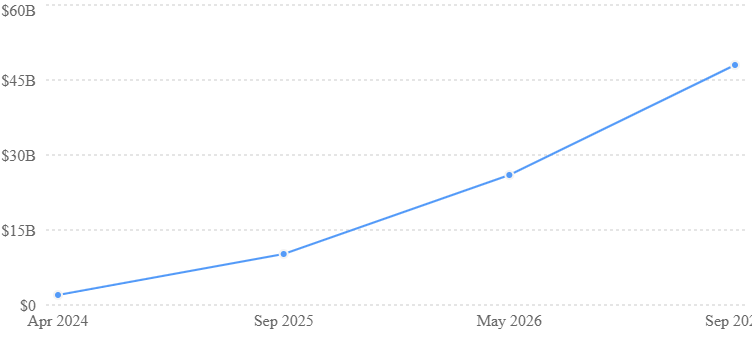
From the April 2024 valuation of $2 billion to the September 2026 valuation of $48 billion, the increase is approximately 24 times.
That is an extraordinary rise for a young company.
However, it is important to understand what investors are buying at each stage.
A startup valued at $2 billion might still be trying to prove that customers want its product. A company valued at $48 billion is being judged on its ability to become a very large, lasting business.
Its future growth expectations are therefore much higher.
Finding #3: Replit and Lovable Show That Coding Is No Longer the Only Market
Replit raised money at a $3 billion valuation in September 2025 and at a $9 billion valuation in March 2026. That represents a threefold increase between the two announced rounds. Replit+1
Lovable moved from a $1.8 billion valuation in July 2025 to $6.6 billion in December 2025, then to $13.3 billion in August 2026. Lovable+2
These companies are important because they aim to expand software creation beyond people who already know how to program.
Their potential customers include small businesses, individual founders, designers, product managers, and other professionals.
That changes the investment story.
Instead of selling only to existing development teams, an AI software platform may eventually serve a much wider group of people who want to create applications.
The size of that opportunity is uncertain. But it helps explain why investors are willing to fund different kinds of AI coding companies at the same time.
Why Silicon Valley Venture Capitalists See AI Coding as a Massive Opportunity
AI Coding Tools Sit at the Beginning of the Software Economy
Every software company has to create, improve, and maintain software.
That makes development tools unusually important. They are used before a company can sell its product, serve customers, or build new digital services.
If an AI coding platform becomes a central part of this process, it gains access to a valuable and repeated business activity.

A tool that developers use occasionally is useful. A platform that a business depends on every day can become much harder to replace.
Investors are searching for companies that could become these central platforms.
Why Daily Use Matters More Than Downloads
Downloads, free accounts, and website visits can make a startup appear popular, but they do not necessarily produce a sustainable business.
Regular use is different.
When developers depend on a product throughout their workday, the company has more opportunities to build paid features, offer team plans, and expand into larger organizations.
Recurring use also creates opportunities to learn which tasks customers struggle with, where tools fail, and what additional services people might pay for.
The business becomes more valuable if those insights lead to better products and long-term customer retention.
AI Coding Could Expand the Number of Software Buyers
Traditional developer tools mainly serve people who build software professionally.
AI application builders are attempting to reach people who need software but do not have the skills or resources to create it.
Imagine a local business owner who wants a simple booking system.
Previously, that person might have hired a developer or purchased software that only partially matched the business’s needs. With an AI builder, they may be able to create an initial custom tool and test whether it solves the problem.
The owner may still need expert help for payments, customer data, security, and ongoing maintenance. But the cost of exploring the idea could fall considerably.
That creates additional demand.
Instead of dividing the existing software development market among more providers, the industry could attract customers who previously spent very little money on software creation.
Investors Want Exposure to Every Layer of the Development Process
AI coding companies can expand into several related markets.
A tool that begins by generating code may later offer testing, hosting, database connections, security scanning, monitoring, and maintenance.
Each additional service creates a possible revenue stream.
For investors, the most attractive businesses may be those that grow from a single useful product into a broader platform.
However, expansion is not automatically a good thing.
A company that tries to offer everything can become expensive, confusing, and difficult to maintain. The best platforms will need to balance broad capabilities with dependable results.
Original SFTechScene Research #3: The Developer Adoption Data Explain the Investment Boom
A large funding round tells us what investors expect. Developer behavior tells us whether customers are actually using the technology.
To examine that difference, SFTechScene analyzed published results from the 2026 Stack Overflow Developer Survey, released in October 2026.
The survey includes responses from thousands of technology professionals and provides separate figures for AI coding assistants, general-purpose chatbots, and automated workflows.
This distinction is important because using ChatGPT to answer a question is not the same thing as relying on an AI coding agent to complete development work.
Finding #1: AI Coding Has Become a Mainstream Work Tool
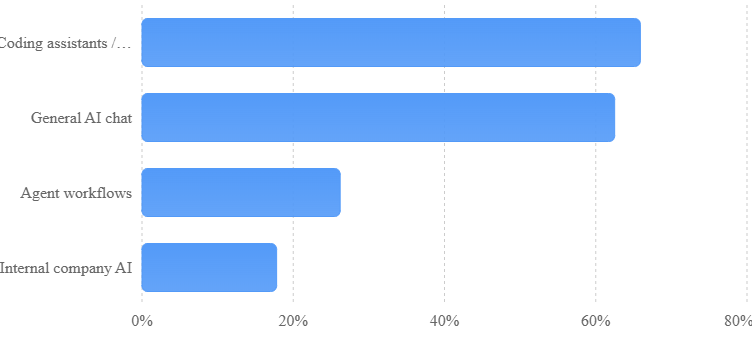
The survey reports that 65.9% of respondents use AI coding assistants or coding agents at work.
General-purpose AI chat tools are used by 62.5%, while 26.2% use AI agents or automated workflows. Some respondents use multiple categories, so these percentages should not be added together. Stack Overflow Developer Survey+1
AI tools used at work: 2026 developer survey
Percent of respondents. Multiple selections were allowed; n = 17,464.
SFTechScene visualization of Stack Exchange Inc., 2026 Developer Survey, AI tool usage. Survey data licensed under ODbL 1.0.
The result helps explain why investors see coding as an attractive place to build an AI business.
Coding is not just another possible use for artificial intelligence. Among these survey respondents, coding assistants are the most commonly selected AI tool category.
There is also a natural reason for this popularity.
Software development produces outputs that can often be tested. A program either passes a test or fails it, an application either loads or breaks, and a bug fix either solves the reported problem or does not.
That makes coding a promising area for AI assistance because results can be checked more directly than many other forms of work.
Finding #2: Coding Assistant Users Report Very Frequent Use
Among respondents who use AI coding assistants or agents, 73% say they use them daily.
Another 20.1% report weekly use, while 6.2% report monthly or infrequent use. The small remaining difference reflects the published survey categories and rounding. Stack Overflow Developer Survey
How often AI coding assistant users use their tools
Percent of coding-assistant users in the Stack Overflow 2026 survey.
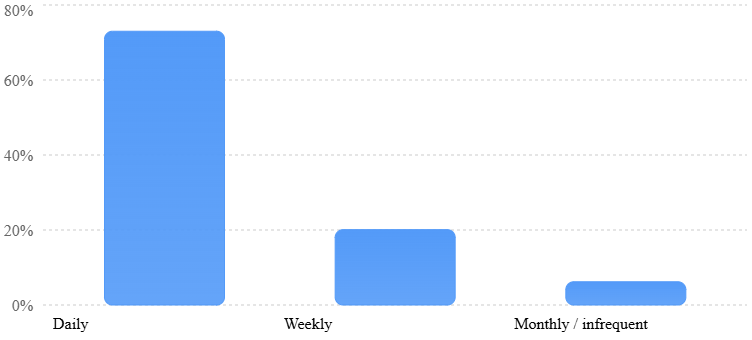
This is a strong signal of regular use.
Venture capitalists generally prefer software products that become part of normal operations because such products have more opportunities to generate recurring revenue.
However, frequency alone does not establish whether users pay, whether an individual vendor can retain them, or whether the product makes customers more productive.
Those questions require separate evidence.
Finding #3: Adoption Does Not Mean One Startup Will Win
The 2026 survey also asked respondents which coding agents or assistants they had used in the past year.
Among respondents to that question, Claude Code had been used by 65.5%, GitHub Copilot by 58.7%, OpenAI Codex by 29.5%, and Cursor by 25.5%. Stack Overflow Developer Survey
Selected AI coding tools used in the past year
2026 survey respondents answering the coding-tool question; n = 12,255. Multiple selections were permitted.
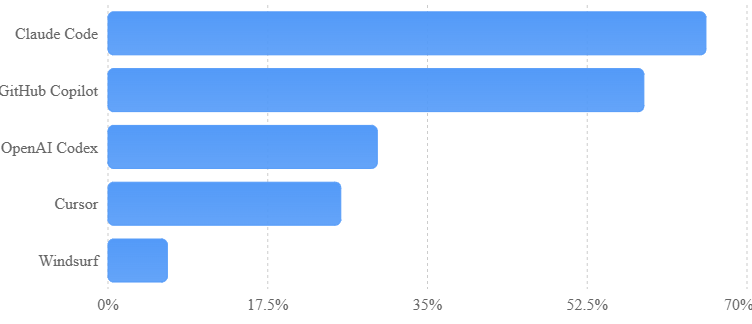
SFTechScene visualization of Stack Exchange Inc., 2026 Developer Survey, AI coding agents. Tool-use figures are overlapping, self-reported survey responses, not exclusive market shares.
This introduces an important problem for venture-backed AI coding companies.
A company can have strong customer demand and still face intense competition.
Anthropic, Microsoft, OpenAI, and Google have major resources and existing customer relationships. Smaller companies must compete through product quality, workflow design, customer experience, specialized capabilities, or better business economics.
That means venture capitalists are not simply betting that AI coding will become popular.
They are betting that particular startups can retain enough customers and earn enough revenue despite competition from some of the largest technology companies in the world.
The Five Business Models Investors Are Funding
Not every AI coding startup is trying to build the same company.
Understanding these different approaches helps explain why multiple startups can attract large investments at the same time.
| Business model | What customers buy | Main value | Main business risk |
|---|---|---|---|
| AI code editors | Developer subscriptions | Faster everyday programming | Competing editors and assistants |
| Autonomous coding agents | Completed or assisted engineering work | Less time spent on selected tasks | Reliability and review costs |
| AI app builders | Software creation and deployment | Access for non-programmers | Poor production quality or low retention |
| Enterprise coding platforms | Team access, controls, and support | Secure company-wide adoption | Long sales cycles and competition |
| Specialized development tools | Help with one difficult workflow | Strong results in a narrow task | Limited market size |
1. AI Code Editors: Competing for the Developer’s Daily Workspace
Cursor is one of the clearest examples of this category.
The idea is to make the code editor more capable by building AI assistance directly into the development process.
A developer can ask questions about a project, generate changes, and work with AI while reviewing the code.
The advantage is that professional developers already spend a large part of their day inside development tools.
If the AI editor becomes the main place where work happens, it may gain a strong position in the customer’s workflow.
But there is an obvious challenge.
Developers can switch between tools, and competing products are improving quickly. A code editor must provide enough lasting value to justify its cost and keep customers returning.
2. Autonomous Coding Agents: Selling Completed Work
Cognition, the company behind Devin, is pursuing a related but different opportunity.
Instead of focusing only on helping developers type code, autonomous coding agents attempt to handle larger development tasks.
These might include updating older systems, investigating problems, creating code changes, and carrying out repetitive engineering work.
Cognition’s business case is partly based on the amount of development work organizations struggle to complete with existing teams.
In May 2026, the company reported a $492 million annualized revenue run rate and strong enterprise usage growth. That figure was a company-reported run rate, not audited annual revenue or profit. Cognition+1
If companies can reliably delegate certain tasks to AI agents, they may be willing to pay based on the value of completed work rather than simply the number of employees using the software.
However, this model creates a difficult measurement problem.
A coding agent that produces work quickly but requires extensive human correction may not save much money.
Customers need to evaluate the final result, including review, testing, and rework.
3. AI Application Builders: Expanding Software Creation Beyond Developers
Replit and Lovable are important examples of AI-powered application creation.
Their products aim to help users move from an idea to a working application with less manual programming.
This can be attractive for founders who want to test a business idea before hiring a full engineering team.
It can also help existing companies build prototypes, internal tools, and small applications.
The long-term commercial opportunity may extend beyond the first version of the application.
A platform can potentially earn revenue when users build, host, maintain, and improve software over time.
The challenge is that early excitement does not always turn into durable customer relationships.
A user may build one application and never return. Another may create a prototype but move the final product to a different platform.
Investors will want evidence that customers continue to build and operate valuable software.
4. Enterprise Development Platforms: Competing for Large Contracts
Large businesses have different requirements from individual programmers.
They need access controls, security policies, purchasing approval, usage reporting, and support for complex development systems.
A startup that successfully meets those needs can potentially sign larger contracts.
It may also become more deeply connected to the customer’s engineering operations.
However, enterprise sales can require substantial investment.
The startup may need dedicated security teams, customer support, product integrations, and technical assistance before it can serve large organizations reliably.
This can make the business attractive but expensive to grow.
5. Specialized AI Coding Tools: Solving Problems the Giants Overlook
Not every successful AI coding startup needs to become a general-purpose platform.
Some companies may build better products for specific tasks, such as testing, database migrations, security checks, or maintaining older applications.
A narrow product can be valuable if it solves an expensive problem more reliably than general AI coding tools.
For example, a bank may value a system that safely updates older software more than a tool that creates impressive demos.
Specialized companies can also be easier for customers to evaluate.
Instead of promising to transform the entire engineering department, they can demonstrate measurable improvement in one workflow.
For smaller San Francisco startups, this may offer a more realistic entry point than attempting to compete with the broadest AI coding platforms immediately.
Original SFTechScene Research #4: Are AI Coding Startups Becoming Too Expensive?
One of the biggest questions facing investors is whether the expected future profits can support today’s high valuations.
A fast-growing company may justify a high valuation if it can continue expanding revenue while improving its margins.

But rapid growth is not enough on its own.
Investors must also consider customer retention, competition, computing costs, and the amount of money needed to operate the business.
Comparing Valuation With Annualized Revenue
Cursor provides a useful public example.
In November 2025, the company announced that it had crossed $1 billion in annualized revenue while raising money at a $29.3 billion valuation. Cursor
Using the disclosed valuation and a $1 billion revenue reference point gives a ratio of 29.3 times annualized revenue.
Because Cursor said its revenue had crossed $1 billion rather than equaled exactly $1 billion, 29.3 is an upper-bound approximation based on that announcement. It should not be treated as an exact valuation multiple.
Cognition offers another comparison.
In May 2026, it reported annualized run-rate revenue of $492 million alongside a $26 billion financing valuation. Dividing those figures produces a ratio of approximately 52.8 times annualized revenue. TechCrunch
| Company and date | Reported annualized revenue | Valuation | Implied valuation/revenue |
|---|---|---|---|
| Cursor, November 2025 | More than $1B | $29.3B | Below 29.3× |
| Cognition, May 2026 | $492M | $26B | Approximately 52.8× |
These ratios are snapshots based on company-reported run rates. They do not measure profits, use matching accounting periods, or show what either company is worth today.
Finding #1: Investors Are Paying for Expected Future Growth
A company valued at more than 50 times its current annualized revenue faces enormous growth expectations.
Investors may believe revenue will increase sharply over the next several years, making today’s valuation appear more reasonable over time.
But that future is not guaranteed.
The company could grow more slowly than expected, face price pressure, experience rising computing costs, or lose customers to competitors.
The key question is not whether an AI coding product can become popular. It is whether the company can eventually generate enough lasting cash flow to justify the capital invested.
Finding #2: Revenue Quality Matters as Much as Revenue Growth
Two startups may report the same annualized revenue but have very different business economics.
One might earn predictable subscription revenue from customers who renew every year.
Another might earn revenue from users who make occasional large purchases when building applications.
The second company could grow quickly but experience more unpredictable demand.
Companies also differ in how much computing work each customer consumes.
A customer paying $100 per month might be very profitable if the service costs $10 to deliver. The same customer could generate almost no gross profit if their usage costs $95.
Investors therefore need to understand how revenue is earned, how stable it is, and what remains after the direct costs of serving customers.
Original SFTechScene Financial Model: What Must a $10 Billion Startup Earn?
We built a simplified valuation model to understand what a hypothetical AI coding startup valued at $10 billion might need to produce.
This is not a forecast for Cursor, Cognition, Replit, or Lovable. It is a scenario analysis that shows how different future revenue levels affect the valuation multiple investors would be paying.
| Future annual revenue | Valuation / revenue at $10B | What it implies |
|---|---|---|
| $250M | 40.0× | Very high growth expectations |
| $500M | 20.0× | Strong future growth still needed |
| $1B | 10.0× | A substantial business is established |
| $2B | 5.0× | Valuation becomes easier to support |
| $5B | 2.0× | Much less revenue-multiple pressure |
How revenue growth changes a fixed $10B valuation multiple
Illustrative financial scenario, not an investment forecast.
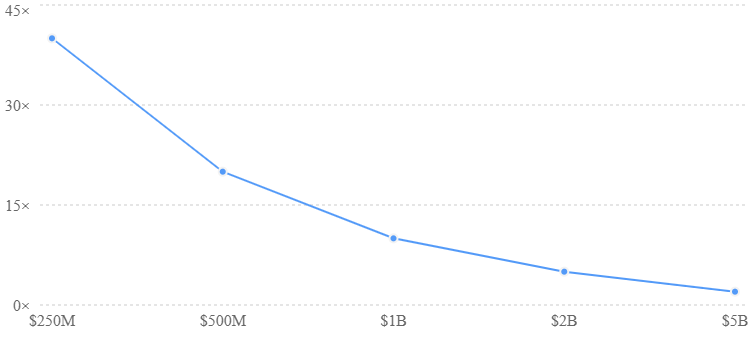
The model illustrates why investors are so interested in companies that could build large recurring revenue streams.
At $250 million in annual revenue, a $10 billion valuation represents 40 times revenue.
At $2 billion in annual revenue, the same valuation represents just five times revenue.
If the business grows while maintaining healthy margins, its valuation can become easier to justify.
However, investors also need to consider how long that growth takes and how much additional capital is required to achieve it.
A company that grows revenue tenfold but spends enormous amounts of money along the way may still disappoint investors.
Original SFTechScene Research #5: The Trust Gap May Be the Biggest Opportunity in AI Coding
One of the most important findings in the 2026 developer data is that AI adoption is growing faster than unrestricted trust.
Stack Overflow’s survey found that 48% of respondents trust AI output when they can easily verify it, but only 6.6% trust AI for many tasks including important work decisions. Stack Overflow Developer Survey
This is more than a technical concern.
It helps explain why some AI coding companies may eventually build strong businesses around testing, verification, and safety rather than code generation alone.
What Developers Say About Trust
What developers say about trusting AI output
Stack Overflow Developer Survey 2026; n = 14,304.
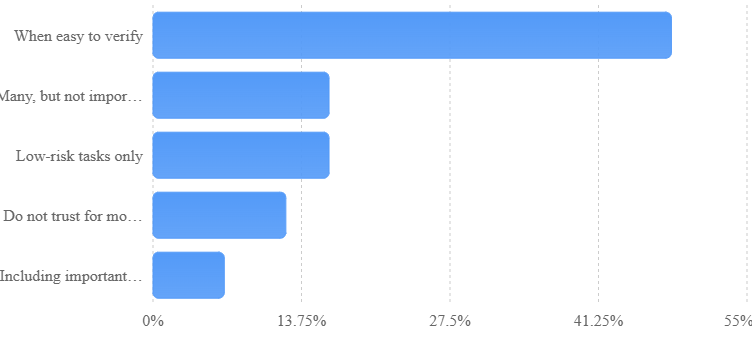
SFTechScene visualization of Stack Exchange Inc., 2026 Developer Survey, AI trust data, licensed under ODbL 1.0. The small omitted ‘not sure’ category accounts for approximately 0.5%.
Finding #1: Easy Verification Could Become a Competitive Advantage
The survey results suggest that many developers are comfortable using AI when they can inspect the results.
That creates an opportunity for products that make code easier to review, test, and understand.
An AI coding platform could become more valuable by showing users what it changed, why it made those changes, and what tests passed.
It could also help developers identify areas that still need attention.
This is particularly important for companies building software that handles sensitive information, payments, or essential business operations.
For those customers, a tool that produces slightly less code but makes review easier may be more useful than one that generates large amounts of code quickly.
Finding #2: More Generated Code Can Create More Work
Writing code is only one part of software development.
Teams must understand the code, confirm that it works, maintain it, and deal with unexpected problems.
If AI generates more code than developers can review, companies may end up with larger maintenance burdens.
An earlier study from METR illustrates why this concern deserves attention.
In a randomized study published in July 2025, experienced open-source developers working on familiar projects took 19% longer when allowed to use the AI tools available during the study period. The researchers made clear that this result did not establish that AI slows developers in every environment. METR
The result was specific to the tools, developers, tasks, and time period studied.
It does not prove that current AI coding systems are slower, but it shows why companies should measure actual completed work instead of assuming AI always improves productivity.
For investors, this creates an interesting possibility.
The strongest products may be those that help organizations finish reliable work faster, even when that means generating less code.
Finding #3: Enterprise Trust Could Support Higher-Value Products
Individual developers may be willing to try a new tool simply because it feels useful.
Large businesses generally require more evidence.
They need to understand how their code is handled, whether customer information is protected, and who is responsible when an AI system makes a mistake.
Products that address these concerns may gain access to customers with larger budgets.
This can make reliability and governance commercially valuable.
However, such features also cost money to build and maintain.
Startups need to determine whether customers will pay enough for the additional safety and control to make the investment worthwhile.
Original SFTechScene Research #6: When Does an AI Coding Agent Actually Save Money?
The most useful way for a San Francisco company to evaluate AI coding tools is to compare the cost of completed, accepted work.
A subscription price alone does not tell the whole story.
The company should also count employee time, testing, debugging, and the cost of mistakes.
We built an illustrative model for a small engineering team to show how this works.
Research Methodology
Our model assumes a company has 10 developers and pays a fully loaded labor cost of $120 per working hour.
That cost is a planning assumption, not a verified San Francisco salary average. It represents the combined cost of compensation, benefits, and other employment expenses for this hypothetical team.
We assume 160 paid working hours per developer each month, creating a baseline of 1,600 developer hours.
We then compare three scenarios using the following assumptions:
| Input | Assumption |
|---|---|
| Developers | 10 |
| Monthly hours per developer | 160 |
| Fully loaded labor cost | $120/hour |
| Monthly baseline developer cost | $192,000 |
| Work hours potentially saved by AI | 10%, 20%, or 30% |
| Monthly AI tool spending | $5,000 |
| Extra review and correction time | 40, 100, or 200 hours |
The model measures the value of developer time freed after subtracting added review time and AI spending. It does not assume that payroll is automatically reduced.
Scenario Results
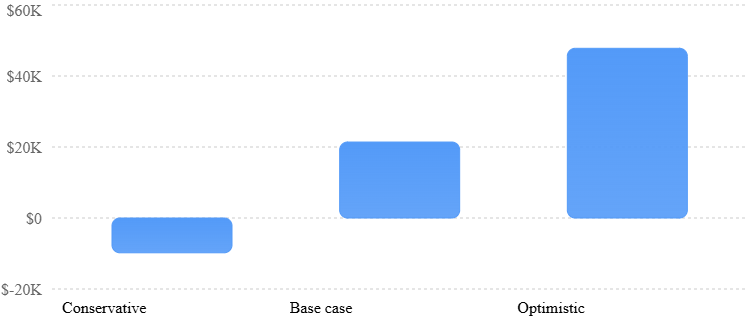
| Scenario | Gross hours saved | Extra review hours | Net hours freed | Net monthly capacity value |
|---|---|---|---|---|
| Conservative | 160 | 200 | -40 | -$9,800 |
| Base case | 320 | 100 | 220 | $21,400 |
| Optimistic | 480 | 40 | 440 | $47,800 |
The calculation is:
Net monthly capacity value = (gross hours saved − extra review hours) × $120 − $5,000.
Illustrative monthly net value from AI coding
10 developers, $120 per fully loaded hour, $5,000 AI spending per month. Negative value indicates more cost than capacity gained.
Finding #1: Review Time Can Completely Change the Result
In the conservative scenario, AI saves 160 hours of initial work but creates 200 additional hours of review and correction.
The team loses 40 hours overall.
After accounting for the AI tool cost, the net monthly capacity value is negative $9,800.
This is why businesses should be cautious about promises of large productivity gains.
The amount of code generated is not a reliable measure of the amount of work completed.
Finding #2: The Base Case Creates More Than $250,000 in Annual Capacity Value
In the base case, the team frees 220 net hours per month.
At $120 per hour, that represents $26,400 of developer capacity.
After subtracting the $5,000 tool expense, the monthly value is $21,400.
Over 12 months, that equals $256,800 in potential annual capacity value.
But that is not the same as $256,800 in cash savings.
If the company retains all employees and cannot use the freed time productively, the financial benefit may be much smaller.
The team needs to turn that extra capacity into valuable results, such as faster releases, fewer customer problems, or work that would otherwise require new hires.
Finding #3: The Break-Even Point Is Surprisingly Simple
With AI tools costing $5,000 per month and developer time valued at $120 per hour, the company needs to free approximately 41.7 net developer hours per month to cover the direct AI spending.
That represents about 2.6% of the team’s assumed 1,600 monthly developer hours.
The threshold is relatively low in this illustration.
However, it depends heavily on whether the hours are genuinely saved and whether those hours have usable business value.
A company should therefore measure work completed, human review, defect rates, and customer outcomes before scaling its AI spending.
What San Francisco Startups Should Learn From This Model
The smartest question is not whether AI coding tools are cheaper than hiring developers.
It is whether a particular tool makes a particular workflow more valuable.
A company that struggles with repetitive software maintenance may see strong results from an autonomous coding agent.
Another company building a highly sensitive financial system may need extensive human review, reducing its savings.
A third company may benefit most from AI-assisted prototyping rather than production development.
The right choice depends on the work, the risks, and the team’s ability to review the results.
Why San Francisco Has an Advantage in the AI Coding Investment Race
Silicon Valley’s position in AI coding is not simply the result of having more venture capital firms.
The region brings together investors, AI researchers, enterprise customers, startup founders, and experienced software engineers.

That combination can make it easier for promising companies to develop products, find early customers, and raise money.
However, those advantages come with costs.
Access to Customers Can Be More Valuable Than Access to Capital
A young AI coding company needs feedback from developers who work on difficult, real-world projects.
San Francisco and the broader Bay Area have many businesses that build complicated software.
These customers can expose problems that simple product demos do not reveal.
For example, an agent might perform well when asked to create a small application but struggle with a large codebase that has years of changes, unusual dependencies, and strict security requirements.
Working with demanding customers can help startups identify these problems early.
That feedback may create a lasting advantage if the company uses it to build more reliable products.
Silicon Valley Investors Understand Developer Tools
The Bay Area has a long history of supporting software infrastructure businesses.
Many venture investors have experience with cloud services, cybersecurity, databases, developer platforms, and enterprise software.
They understand that products used by developers can become important business systems.
This knowledge may make investors more willing to fund a company before its market is fully established.
It can also help founders find early customers and senior employees.
But access to experienced investors does not guarantee success. Startups still need a product that solves a real problem at a price customers will continue paying.
The Biggest Costs Can Also Be Higher
The same competition that makes Silicon Valley attractive can make it expensive.
AI coding startups compete for researchers, engineers, enterprise sales specialists, and computing resources.
A heavily funded competitor can attract employees with compensation packages that smaller companies struggle to match.
This creates pressure to raise money even when a startup could otherwise operate with a smaller team.
Founders should not assume that following the largest companies’ spending patterns is necessary.
A focused startup can sometimes build a better business by serving a narrow market with a smaller operation and lower fixed costs.
Why Venture Capitalists Are Willing to Accept Such Large Risks
Venture capital is built around the idea that a small number of exceptional investments may produce much of a fund’s returns.
An investor does not need every startup to become a major winner.
They need enough ownership in businesses that create enormous value to compensate for investments that fail or underperform.
AI coding fits this approach because the possible upside is large, even though the probability of achieving it is uncertain.
Investors Are Competing for Potential Market Leaders
Once a startup demonstrates strong customer demand, multiple investors may want to participate in its next funding round.
That competition can push valuations higher.
Investors may also believe that waiting is dangerous. If a company becomes the dominant platform in a major software category, buying a meaningful ownership stake later could become much more expensive.
This helps explain why some financing rounds happen before long-term profitability is established.
The investors are trying to secure exposure to future growth.
However, the same behavior creates risk.
If expectations become too optimistic, investors may pay prices that are difficult to justify even when the company builds a successful business.
Strategic Investors May Have Other Reasons to Participate
Some AI coding companies attract investment from established technology businesses.
Those businesses may be interested in more than financial returns.
An AI coding company could become a customer for cloud infrastructure, a distribution partner, or a source of valuable technical expertise.
For example, Cursor’s November 2025 funding announcement named NVIDIA and Google among its new partners. Cursor
Strategic relationships can create opportunities for both companies, but an announced investment does not by itself prove preferential product access, exclusive partnerships, or commercial benefits.
Founders and investors should examine the actual relationship rather than assuming those benefits exist.
Investors Are Betting on the Next Major Software Platform
The largest opportunity may be control over the place where software is created.
In the past, important technology platforms have emerged around operating systems, cloud infrastructure, mobile applications, and business software.
AI coding could become another important layer.
If people increasingly create software by describing goals to AI agents, the companies that provide those systems may influence how applications are built, tested, hosted, and maintained.
That is a much larger opportunity than selling a simple code-completion tool.
It is also why the competition is so intense.
The Biggest Risks Facing Venture-Backed AI Coding Startups
Large financing rounds can create the impression that the industry’s future is already settled.
It is not.
Several risks could change which companies succeed and how much their businesses are eventually worth.
Risk #1: AI Models May Become Too Similar
Many coding products depend on powerful underlying AI models.
When several companies use models with similar abilities, customers may struggle to see meaningful differences between their products.
That can create price competition.
Startups need advantages beyond access to a capable model.
These might include better workflows, strong enterprise relationships, reliable testing, specialized knowledge, or a product that fits naturally into existing development environments.
Risk #2: Computing Costs Could Reduce Profitability
AI coding agents may perform many operations to complete a single task.
They can read files, run searches, generate code, test changes, and repeat unsuccessful attempts.
Every operation can consume computing resources.
If customers use the product heavily, the cost of delivering the service may become significant.
Companies that charge fixed subscription fees need to understand how much expensive usage customers can generate.
Otherwise, rapid customer growth may be accompanied by disappointing profit margins.
Risk #3: Large Technology Companies Can Bundle Competing Features
Microsoft, Google, OpenAI, and Anthropic already have access to substantial technical resources and customers.
Some also control important development platforms, cloud services, or AI models.
They can add coding features to products customers already use.
That creates a serious challenge for independent startups.
A smaller company must offer an experience or result that is valuable enough to justify a separate purchase.
Risk #4: Customers May Switch Between Tools Frequently
Developers often test multiple AI coding products.
A new model or feature can quickly change which tool feels most useful.
If switching is easy, customer loyalty may be weaker than investors expect.
This makes retention especially important.
Companies need to measure whether customers continue paying after the excitement of their first few projects fades.
Risk #5: More Software Could Mean More Maintenance Problems
AI may make it cheaper to create an application.
However, the application still needs updates, security, customer support, and ongoing maintenance.
A poorly built product can become expensive later.
Businesses may discover that generating the first version was the easiest part of the project.
AI coding platforms that help customers maintain software, rather than simply create it, may have a stronger long-term commercial position.
How San Francisco AI Coding Startups Can Stand Out Without Raising Billions
The recent funding rounds might make it seem that startups need enormous amounts of money to compete.
That is not necessarily true.
A company that solves a specific, expensive problem may have a viable business even without trying to become the next Cursor or Cognition.
Start With an Expensive Workflow
Founders should look for software development problems that repeatedly consume skilled employee time.
Examples include updating older applications, writing reliable tests, fixing recurring integration problems, or managing routine changes across multiple projects.
The ideal problem is frequent, measurable, and expensive.
It should also be narrow enough that the startup can demonstrate better results than a general-purpose coding assistant.
A broad promise to make all software development faster is difficult to prove. A promise to reduce the review time for a defined kind of code change is much easier to test.
Build Around Customer Results
The product should be judged by what customers accomplish.
That means measuring completed tasks, accepted changes, time saved, and problems avoided.
For example, an AI testing startup could measure how many real defects it identifies, how many false alerts it produces, and how much time engineers spend investigating its findings.
An autonomous maintenance tool could track how many updates pass review without additional correction.
These metrics can help founders demonstrate value to customers and investors.
Design for Human Review From the Beginning
The 2026 developer trust data suggest that verification remains a major factor in AI adoption.
Founders can use that insight when designing products.
A tool should make it easy to see what the AI changed, understand why, run checks, and reverse unwanted actions.
For high-risk changes, human approval should remain part of the process.
This is not simply a safety measure. It can be a selling point for customers who need confidence before allowing AI to work on important systems.
Find a Specific Customer Group
A startup serving every possible developer may face direct competition from much larger companies.
A focused product can avoid some of that pressure.
For example, a company could specialize in software maintenance for healthcare providers, testing for financial applications, or development tools for a specific business platform.
Specialization can make sales easier because the company understands its customers’ needs.
It can also support more useful product features.
The goal is to become exceptionally valuable to a defined customer group before expanding.
A Practical 90-Day Plan for Founders Building an AI Coding Startup
A startup does not need to spend its first three months chasing a large funding round.
It needs evidence that customers care about the problem and that the proposed product can solve it.
Days 1–30: Prove the Problem Is Worth Solving
During the first month, founders should interview potential customers and study how they currently complete the target task.
The interviews should focus on actual work rather than opinions about AI.
Ask customers to show recent examples of the problem, explain how long the work took, and describe what happened when something went wrong.
Collect enough evidence to estimate the business cost.
By the end of the month, the team should be able to explain who experiences the problem, how frequently it happens, and what customers currently spend to address it.
Days 31–60: Test a Narrow Product
The second month should focus on building a product that solves one clearly defined problem.
Use real customer tasks where permission and security requirements allow it.
Compare the product against the customer’s existing process.
Measure the full amount of work involved, including corrections and review.
Avoid relying on demonstrations designed to show the product at its best.
A successful test should produce evidence that the tool improves a meaningful business outcome.
Days 61–90: Test Whether Customers Will Pay
The final month should focus on commercial proof.
Offer a paid pilot with clear success measures, a defined scope, and an agreed evaluation period.
Track whether customers actually use the product, whether it performs reliably, and whether the results justify the price.
Pay attention to the customers who return after the first successful demonstration.
Repeated use is usually more informative than initial excitement.
A startup that can show customers receiving measurable value has a much stronger position when approaching investors.
What Venture Capitalists Should Measure Before Investing in AI Coding Startups
Venture investors also need to adapt their evaluation methods.
Traditional software metrics remain useful, but AI products introduce additional questions about computing costs, output quality, and the real value of automation.
| Investment question | Metric to examine | Why it matters |
|---|---|---|
| Do customers keep using it? | Paid customer retention | Shows whether value continues |
| Is usage growing? | Active paid teams and useful tasks completed | Measures commercial adoption |
| Does the product work reliably? | Accepted task completion rate | Measures real work delivered |
| Is it economically attractive? | Gross profit after computing costs | Shows whether revenue scales profitably |
| Does it save customer time? | Net hours saved after review | Tests the value proposition |
| Can it win against larger companies? | Competitive win rate and customer reasons | Tests differentiation |
| Are customers willing to expand? | Revenue growth from existing customers | Indicates deeper business value |
| Can the product serve enterprises? | Security and compliance readiness | Supports large customer contracts |
Completed Work Is More Valuable Than Generated Tokens
An AI coding tool can generate an enormous amount of text without creating a useful product.
Investors should therefore prioritize metrics connected to finished work.
For autonomous coding agents, an important measure is how many tasks are completed correctly and accepted by the customer.
For application builders, useful measures include how many applications remain active, how many reach production, and whether customers continue paying to operate them.
The best metrics depend on the business model.
A single industry-wide definition of productivity would be misleading because different tools solve different problems.
Sustainable Margins Matter
Investors should also examine how the cost of delivering AI services changes as customers use more of the product.
A company may generate impressive revenue growth while its computing expenses rise almost as quickly.
That business can be difficult to scale profitably.
Better models, efficient software, sensible usage limits, and carefully designed pricing can improve the economics.
Companies with strong margins may have more freedom to invest in research, customer support, and new products.
What Happens to AI Coding Investment Over the Next Few Years?
There are several plausible ways the market could develop.
No single outcome is guaranteed, and today’s financing valuations should not be treated as predictions of future market value.
Scenario 1: A Few Large Platforms Capture Most of the Market
In this scenario, AI coding becomes a major part of everyday software development, but a small number of providers attract most customers.
Companies with strong products, large distribution networks, and significant computing resources gain an advantage.
Smaller startups struggle to compete in broad categories.
The market still grows, but investor returns become concentrated among a few winners.
Scenario 2: Specialized AI Coding Companies Build Valuable Businesses
Here, general-purpose tools become widely available, but businesses continue to need specialized software development solutions.
Startups succeed by focusing on security, testing, maintenance, regulated industries, or complex enterprise workflows.
The market supports a wider range of companies.
Some may never reach enormous valuations, but they could become profitable businesses serving loyal customers.
Scenario 3: Strong Adoption Leads to Lower Prices
AI coding becomes increasingly common, but competing products grow more similar.
Customers gain access to powerful features at lower prices.
The technology delivers value to businesses, while individual providers face pressure on profit margins.
In this scenario, customers may benefit more than investors.
It is an important reminder that a rapidly growing technology category does not automatically produce exceptional returns for every company in it.
Scenario 4: Reliability Becomes the Main Competitive Advantage
AI agents become capable of completing larger tasks, but organizations remain cautious about letting them make uncontrolled changes.
Platforms that make AI work easy to inspect, test, and manage become especially valuable.
The winning products combine automation with dependable oversight.
This scenario is consistent with the trust concerns visible in the 2026 developer survey, although the survey does not establish that it will occur.
Frequently Asked Questions About Venture Capital Investment in AI Coding Startups
Why are venture capitalists investing so much in AI coding companies?
Investors believe AI coding tools could lower the cost of building software, increase developer productivity, and make application creation available to many more people.
They are also interested in companies that could become major platforms for software development, testing, hosting, and maintenance.
Which AI coding startups have attracted the largest funding rounds?
Cursor and Cognition are among the most prominent examples in the selected publicly disclosed transactions reviewed by SFTechScene.
Cursor announced a $2.3 billion funding round in November 2025, while Cognition announced more than $2 billion in September 2026. These figures represent individual financing rounds, not the companies’ total valuations. Cursor+1
Is AI coding venture funding mainly happening in San Francisco?
San Francisco and the broader Bay Area are important centers for AI coding investment, with companies such as Cognition and Replit located in the region.
However, the industry is global. Lovable, for example, is based in Sweden and has attracted major international investors, including venture firms with strong Silicon Valley connections.
Will AI coding startups replace traditional software companies?
AI coding could change how traditional software companies operate and make it easier for new competitors to enter the market.
However, software businesses still need to solve customer problems, protect information, maintain applications, and provide reliable services.
AI-generated code alone does not replace those responsibilities.
Are AI coding startups overvalued?
Some valuations reflect very high future growth expectations, and those expectations create risk.
Whether a particular company is overvalued depends on its future revenue, profitability, customer retention, competition, and financing terms.
Large funding valuations should be assessed alongside business performance rather than treated as proof of value.
Can a small startup compete with Cursor, Cognition, and Replit?
Yes, especially when it focuses on a specific problem that general-purpose platforms do not solve well.
A small company can compete through specialization, customer service, deeper workflow support, or measurable reliability.
Trying to match the spending and product breadth of the largest companies may be a less effective strategy.
Final Takeaway: Silicon Valley Is Investing in the Future of Software Creation, Not Just Faster Coding
The billions flowing into AI coding startups reflect a major shift in investor expectations about the software industry.
Venture capitalists believe AI could change how applications are created, how engineering teams work, and how people without programming experience build useful products.
The public funding announcements provide strong evidence of investor interest. Our selected dataset identifies at least $8.18 billion in disclosed funding across four companies during 2025 and 2026, while the latest verified funding valuations for those companies add up to $99.6 billion.
The developer data also show that AI coding has become a regular part of work for many respondents.
But the same research reveals a crucial limitation.
People may use AI coding tools frequently without trusting them to make important decisions independently. Businesses still need to evaluate whether the technology produces reliable software and creates more value than it costs.
For Silicon Valley investors, the opportunity is enormous, but the outcome remains uncertain.
For San Francisco founders, the lesson is more practical. The best opportunity may not be to build another general-purpose AI coding platform. It may be to solve a specific problem better than anyone else, prove the value with real customer results, and create a business that grows because customers keep using it.
The next stage of AI coding will not be decided by which startup raises the most money or produces the most impressive demo.
It will be decided by which companies turn AI-generated work into software that people can trust, maintain, and profitably use.

Research note: Original SFTechScene analyses in this article are desk-based calculations using publicly available company disclosures and published survey data, current through October 30, 2026. Financial scenarios are illustrative assumptions, not observed company performance. The selected funding sample is not a comprehensive market total, the valuation comparisons use different dates, and the survey results do not establish causal relationships or San Francisco-specific adoption rates.