

San Francisco has spent decades building technology companies around a familiar idea: find a big opportunity, raise money, hire talented engineers, and build something faster than everyone else.
That model is starting to change. A growing number of entrepreneurs are discovering that they can build working software, launch products, and serve paying customers without hiring an entire development team.
The change is being driven by artificial intelligence and a new approach to software development called vibe coding. Instead of writing every line of code, founders describe what they want to build, ask AI tools to create it, and improve the result through repeated instructions and testing.
This is making one-person software companies much more realistic. A founder who once needed several engineers to build an early product can now complete parts of that work alone, although security, reliability, and ongoing maintenance still require care.
The shift is particularly important in San Francisco, where engineering talent is expensive, investors expect rapid progress, and competition between startups is intense.
But does cheaper software development actually make it easier to build a profitable company? Can solo founders reach $1 million in annual revenue without building traditional teams? And what does the available evidence tell us about the future of Silicon Valley entrepreneurship?
To investigate, SFTechScene examined public findings from Carta, GitHub, Stack Overflow, CBRE, and San Francisco business registration records. We then developed original calculations covering founder growth, funding access, AI adoption, local business opportunities, software economics, and the revenue needed to support a small company.
The results reveal an important distinction: AI is making software easier to create, but building a successful software business remains a much harder problem.
The Short Version: One-Person Software Companies Are Becoming a Serious Business Model
The idea of a one-person software company is no longer limited to freelancers building small websites or independent developers selling simple apps.
Today’s solo founders can use AI to create subscription software, internal business tools, customer portals, online services, automated reports, and specialized products for industries they understand.
Some of these businesses may remain small and profitable. Others could eventually become much larger organizations, even if they begin with only one founder.
The public data provides several reasons to take this change seriously.
36.3%
New startups with solo foundersH1 2025, Carta sample
40%+
GitHub pull requests started by agentsSeptember 2026
$195K
Average Bay Area tech worker salaryCBRE 2026 report
12,246
New SF business registrations2025, city records analysis
Sources: Carta, GitHub Octoverse 2026, CBRE, and SF Center for Economic Development. Measures cover different populations and periods; they should not be interpreted as one combined survey. Carta+3
Carta’s research found that the share of new startups with a solo founder increased from 23.7% in 2019 to 36.3% in the first half of 2025. Meanwhile, GitHub reported in October 2026 that more than 40% of pull requests in September began with an AI agent’s draft. Carta+1
These findings do not prove that AI caused the rise of solo entrepreneurship. They do show that smaller founding teams and AI-assisted development are becoming important parts of the software economy.
For San Francisco entrepreneurs, the opportunity is straightforward. They can test more ideas with less money, reach customers sooner, and delay expensive hiring until a business has demonstrated demand.
However, lower development costs also mean more competition. The founder who succeeds will not necessarily be the person who produces the most code, but the person who solves a valuable customer problem.
What Is Vibe Coding, and Why Is It Changing Software Entrepreneurship?
Vibe coding is a way of building software by describing what you want in everyday language and letting AI generate much of the code.
For example, a founder might ask an AI coding tool to create a web application that allows small property managers to track maintenance requests, send updates to tenants, and prepare monthly reports.
The AI can help create the screens, database structure, forms, and basic business rules. The founder can then review the results, request changes, and test the application.
This changes the starting point for software development. Instead of asking how to write every function, the founder can focus more of their attention on what the product should do.
Traditional Software Development vs. Vibe Coding
In a traditional startup, an entrepreneur with limited technical knowledge often needs an engineer or development agency before producing a useful product.
With AI-assisted development, that same entrepreneur may be able to create an early version independently. The difficulty moves from writing code to understanding the problem, directing the tools, and checking the result.
| Business activity | Traditional approach | AI-assisted solo approach |
|---|---|---|
| Initial product design | Designer and developer | Founder with AI assistance |
| Writing basic application code | Software engineer | AI coding tool with founder review |
| Database setup | Developer | Managed service and AI assistance |
| Customer-facing website | Designer or agency | AI website builder |
| Basic testing | Developer or QA team | Automated tests plus manual review |
| Customer onboarding | Support or operations staff | Automated workflows |
| Product maintenance | Engineering team | Founder, AI tools, outside specialists |
The important word is assistance. AI can help with many tasks, but someone still needs to take responsibility for customer data, product quality, billing, and security.
Vibe Coding Is Not the Same as Building Reliable Software
A working demonstration is not the same as a production-ready business.
An AI-generated application may look professional while containing serious problems beneath the surface. It may expose private information, fail when many people use it, or calculate important figures incorrectly.
These problems can be difficult for founders without technical experience to detect. The more valuable the product becomes, the more important independent testing and expert review become.
Stack Overflow’s 2025 developer survey found that 46% of respondents distrusted the accuracy of AI tools, compared with 33% who trusted them. Another 66% reported frustration with answers that were close to correct but still needed fixing. 2025 Stack Overflow Developer Survey+1
The lesson is not that founders should avoid AI. It is that building quickly and building safely are different goals, and a successful company must achieve both.
Original SFTechScene Research #1: Solo Founders Are Growing, but Funding Access Has Not Kept Up
One of the clearest signs of change is the increasing share of companies started by individuals rather than teams.
To understand this shift, SFTechScene compared the founder-share figures in Carta’s December 2025 Solo Founders Report and the funding figures in Carta’s 2026 analysis of two-founder startups.
Methodology
We used Carta’s published percentages for companies with one founder and their participation in venture fundraising. We calculated percentage-point changes, relative growth, and a funding representation index.
This is a secondary analysis of published aggregate data, not a fresh company-level survey. Carta’s dataset primarily represents startups using its equity management services, so its results should not be generalized to every U.S. small business.
Finding 1: Solo Founder Share Grew by 53% Relative to Its 2019 Level
Share of newly formed startups with one founder
Carta figures; percentage of startups in its observed sample.
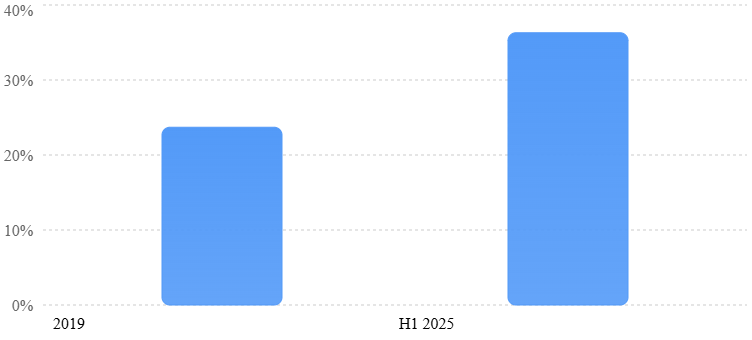
The share increased from 23.7% to 36.3%, a difference of 12.6 percentage points.
Measured relative to the original 2019 share, that is an increase of approximately 53.2%.
The calculation is:
\[ \frac{36.3-23.7}{23.7}\times100=53.2\% \]
This is a meaningful change in startup formation. It suggests that an increasing share of founders are comfortable starting companies without finding a cofounder first.
AI may be contributing to that change, but other factors could matter, including improved cloud tools, cheaper software services, online distribution, and changing founder preferences.
Finding 2: Solo Founders Remain Underrepresented in Venture Funding
Carta’s June 2026 analysis found that startups with one founder represented about 36% of newly formed companies in 2025 but accounted for only 20% of fundraising rounds closed on Carta. Carta
SFTechScene calculated a simple funding representation index to show the difference.
| Measure | Solo founders | Other founding teams |
|---|---|---|
| Share of newly formed companies | 36% | 64% |
| Share of funding rounds | 20% | 80% |
| Funding share ÷ formation share | 0.56 | 1.25 |
A value of 1.0 would mean a group’s share of funding rounds matched its share of new companies.
Solo founders received only about 56% of the round share that would correspond to their formation share. Multi-founder teams had a much higher representation index.
Funding representation by founder team size
SFTechScene calculation using Carta’s 2025 formation and round-share figures. A value of 1.0 means proportional representation.
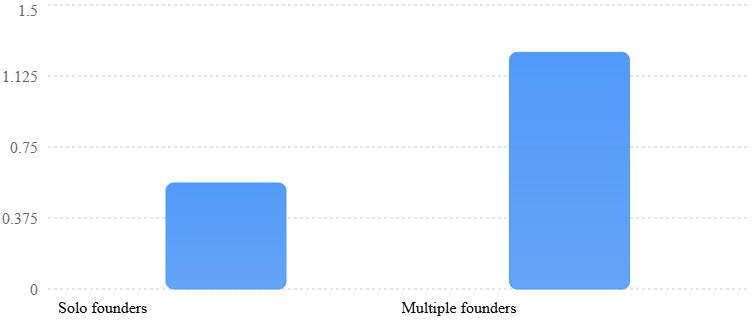
This does not establish the probability that an individual startup will raise funding. The formation and fundraising figures count different events, and companies can complete more than one round.
It does, however, show that solo founders are not represented in venture funding at the same rate as they are in new startup formation.
What This Means for San Francisco Entrepreneurs
The practical implication is that a founder should not assume that cheaper product development makes venture capital easier to obtain.
Investors still care about market size, revenue growth, customer retention, competition, and the founder’s ability to operate the business.
A solo founder building a specialized $300,000-a-year software company may not need institutional capital at all. Someone attempting to build a large enterprise software platform may eventually need engineers, sales professionals, security specialists, and outside funding.
The best funding strategy depends on the business, not the number of people writing its code.
Why San Francisco Is an Important Market for One-Person Software Companies
San Francisco offers two advantages that appear to pull in opposite directions.
The first is access to customers, investors, experienced founders, and technical knowledge. The second is exceptionally high operating costs, which create strong incentives to build leaner companies.
Both matter for the rise of AI-assisted entrepreneurship.
The Bay Area Has One of the World’s Most Expensive Technology Labor Markets
CBRE’s 2026 research estimated average annual tech worker pay in the San Francisco Bay Area at approximately $195,142.
The same report estimated that the region had nearly 99,000 AI-skilled workers and remained North America’s highest-ranked market for technology talent. CBRE
A founder who needs to hire multiple experienced engineers can face a significant financial commitment before the business earns meaningful revenue.
This is why AI-assisted development could be particularly valuable in San Francisco. It gives entrepreneurs the option to perform some early technical work themselves rather than immediately building a large team.
Original SFTechScene Research #2: The Cost of Delaying One Technical Hire
To measure the potential effect, we developed a simple model using CBRE’s reported Bay Area average tech salary as a reference.
We compared the salary cost of one full-time technical employee with the cost of a founder using AI tools and managed software services.
Our illustrative AI-assisted operating budget is $1,000 per month. This is an assumption, not an observed market average, and it covers software subscriptions and services rather than the founder’s own labor.
| Cost item | Three months | Six months | Twelve months |
|---|---|---|---|
| One employee’s salary at $195,142/year | $48,786 | $97,571 | $195,142 |
| AI-assisted operating budget at $1,000/month | $3,000 | $6,000 | $12,000 |
| Difference | $45,786 | $91,571 | $183,142 |
Illustrative 12-month cost comparison
Salary benchmark versus assumed AI/software spending, excluding founder labor, taxes, benefits and outside engineering support.
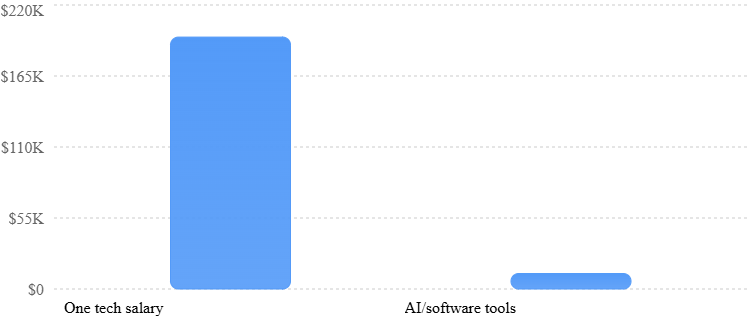
This comparison shows the possible financial value of delaying a hire. It does not show that AI tools can replace the work or judgment of an experienced employee.
Real employment costs could also include benefits and payroll taxes. Conversely, a solo founder may need to pay contractors, spend substantial personal time reviewing code, or hire specialists for security work.
The useful conclusion is narrower: if AI tools allow a founder to delay a hire while still delivering a safe, useful product, the cash savings could be substantial.
The Hidden Cost Is the Founder’s Own Time
An entrepreneur working 60 hours per week has not built a cost-free company.
The founder is contributing time that could otherwise be used for paid work, consulting, or another business. That time should be included when deciding whether a software product is financially attractive.
For example, if a founder values their time at $75 per hour and spends 20 hours each week maintaining the product, that work represents about $78,000 in annual labor value.
A business generating $100,000 in revenue might appear highly profitable on a cash basis while providing little economic return after the founder’s time is counted.
This distinction is especially important in the Bay Area, where experienced professionals often have attractive alternative employment opportunities.
How AI Is Changing the Work of a Solo Software Founder
The most important change is not that one person can produce more code. It is that a founder can complete more of the journey from idea to paying customer without coordinating a large team.
That journey includes several activities that used to require different specialists.
Product Research: Understanding Customer Problems Faster
A founder can use AI to organize interview notes, identify common complaints, compare competitor features, and prepare questions for customer research.
This can shorten the time required to understand a market. However, AI-generated summaries cannot replace direct conversations with potential buyers.
An entrepreneur building software for San Francisco restaurants, for example, should speak with restaurant owners before deciding which features matter.
The software might be technically impressive but commercially useless if it addresses a problem those owners are unwilling to pay to solve.
Product Design: Turning Ideas Into Working Screens
AI design and development tools can translate written descriptions into interfaces, dashboards, and forms.
This helps a nontechnical entrepreneur show potential customers something more useful than a slide presentation.
An early working product can reveal confusing workflows, missing features, and incorrect assumptions. Those discoveries are valuable because they happen before the founder commits to a larger investment.
Software Development: Building the First Useful Version
Tools such as Cursor, Replit, Claude Code, and OpenAI Codex offer different ways to assist with code creation, editing, and testing.
The right choice depends on the founder’s technical skills and the project’s requirements. A visual application-building environment may be more useful for a nontechnical entrepreneur, while a professional developer may prefer a tool that works directly with an existing codebase.
Founders should evaluate these tools by the quality of working software they can maintain, not by how quickly a demonstration appears.
Marketing: Creating and Testing Customer Acquisition
AI can help founders prepare landing pages, draft educational content, compare positioning ideas, and organize campaign results.
It can also help analyze website traffic or customer feedback to identify where potential buyers lose interest.
However, a founder still needs to understand their audience. Publishing large quantities of AI-generated marketing material without a clear strategy rarely creates a lasting advantage.
For niche software companies, a small number of carefully researched articles, helpful demonstrations, and direct customer conversations may be more valuable than hundreds of generic pages.
Customer Support: Serving Customers Without a Large Team
AI-assisted support can answer routine questions, guide users through common problems, and direct complicated cases to the founder.
This becomes particularly useful when a software product serves customers across different time zones.
The system should still provide a clear way to reach a human when billing, account security, or service reliability is involved. Automated support that gives incorrect answers can damage customer trust.
Original SFTechScene Research #3: AI Coding Agents Are Changing How Software Gets Built
One of the strongest public signals of AI’s growing role in software development comes from GitHub.
On October 28, 2026, GitHub published its latest Octoverse report, covering activity through September 30, 2026. The findings show that developers are increasingly allowing AI agents to create the first version of code changes, which humans can then review and improve. The GitHub Blog

This matters to solo founders because their biggest challenge is often managing all the work required to keep a software product running.
Finding 1: Agent-Started Pull Requests More Than Doubled as a Share of Activity
GitHub reported that 17% of pull requests started with an AI agent in March 2026. By September, that share exceeded 40%.
Using 40% as a conservative reporting floor, SFTechScene calculated a minimum increase of 23 percentage points and a relative increase of more than 135%.
AI agents’ share of GitHub pull requests
GitHub Octoverse 2026. September exceeded 40%; chart uses 40% as a conservative floor.
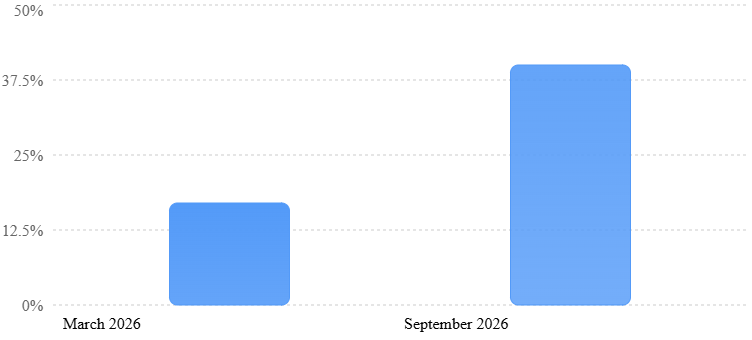
The increase is remarkable because it happened within six months. It suggests that AI agents are moving from experimental tools toward a regular part of development workflows.
However, an agent-started pull request is not necessarily a successful or valuable product improvement. Some changes may be abandoned, corrected, or rejected later.
Finding 2: AI-Assisted Work Is Becoming More Complex
GitHub also reported that approximately 87% of agent-started pull requests changed multiple files. The comparable figure for pull requests without detected agent involvement was 79%.
The eight-percentage-point difference suggests that agent-assisted work is not limited to editing isolated lines of code.
Share of pull requests changing multiple files
GitHub Octoverse 2026; different observed categories of pull requests.
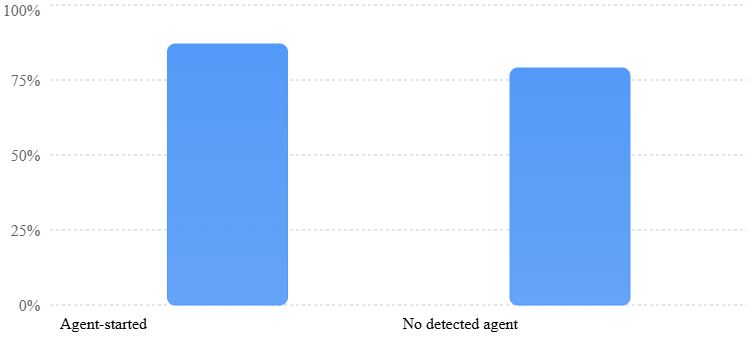
For solo founders, this matters because useful applications involve many connected parts. A single feature may require changes to the interface, database, customer permissions, automated tests, and other systems.
An assistant that can work across several files may reduce the manual effort required to make those changes.
Nevertheless, more files changed does not mean better work. Large changes can be harder to review, particularly when the founder does not fully understand the code.
Finding 3: Agent-Started Changes Are Being Merged Faster
GitHub reported that the share of agent-involved pull requests merged within two weeks increased from approximately 83% in February 2026 to 90% in September.
For pull requests without detected agent involvement, the comparable figure was about 86% in both periods.
| Type of pull request | February 2026 | September 2026 | Change |
|---|---|---|---|
| Agent-involved | 83% | 90% | +7 percentage points |
| No detected agent involvement | 86% | 86% | Approximately 0 |
| Agent difference vs. comparison group | −3 points | +4 points | +7 points |
The figures suggest that agent-assisted changes are moving through the review process more quickly than earlier in the year.
But merging code is not the same as proving that it is safe or useful. Pull requests vary in complexity, and the groups may differ in other important ways.
GitHub’s observational data does not establish that using an agent causes faster or better development.
The Strategic Lesson: Review Capacity Could Become the Next Bottleneck
As AI tools make code easier to produce, reviewing that code becomes more important.
A founder might be able to generate ten features in an afternoon but still lack the time to test them properly.
This creates a new operating challenge. The founder must decide which changes deserve attention, which features should be postponed, and when outside technical review is necessary.
For one-person software companies, the ability to verify work may become more valuable than the ability to generate it.
Original SFTechScene Research #4: San Francisco’s Existing Businesses May Be a Bigger Opportunity Than the Next Consumer App
Many founders imagine building a popular app that attracts thousands of users worldwide.
But for a solo entrepreneur, the more practical opportunity may be software designed to solve problems for a small group of businesses.
San Francisco’s business registration data provides a useful starting point for understanding this market.
Methodology: Measuring the Local Business Opportunity
The San Francisco Center for Economic Development published an analysis of city business registration records as of July 2026.
Its figures show 167,711 active registered businesses and 12,246 new registrations during 2025. The data originates from San Francisco’s Office of the Treasurer & Tax Collector. sfcentered.org
SFTechScene used these figures to calculate a simple annual new-registration-to-active-business ratio and to illustrate possible customer acquisition scenarios.
These calculations measure a broad business environment, not the number of software startups or potential software buyers.
Finding 1: New Registrations Equaled About 7.3% of the Active Business Base
Dividing 12,246 new registrations by 167,711 active registrations produces approximately 7.3%.
This ratio is not the city’s true business formation rate because the numerator and denominator measure different registration periods, and registrations do not always correspond to distinct operating companies.
Nevertheless, it shows that a substantial number of business registrations enter the local market each year.
Many newly registered businesses could eventually need tools for scheduling, customer communication, financial reporting, document management, or other daily activities.
Finding 2: A Small Market Share Can Support a Meaningful Software Business
Consider a founder selling specialized software for $149 per month.
The following table shows what different numbers of paying customers would mean for annual recurring revenue.
| Paying customers | Monthly recurring revenue | Annual recurring revenue |
|---|---|---|
| 25 | $3,725 | $44,700 |
| 50 | $7,450 | $89,400 |
| 100 | $14,900 | $178,800 |
| 250 | $37,250 | $447,000 |
| 500 | $74,500 | $894,000 |
| 560 | $83,440 | $1,001,280 |
These figures are illustrative revenue calculations, not forecasts. They assume every customer pays the full price for 12 months, with no cancellations or discounts.
The interesting result is that a founder would need approximately 560 customers at this price to reach $1 million in annual recurring revenue.
That is a much smaller customer base than many consumer technology companies need.
Finding 3: The Opportunity Depends on Market Fit, Not the Size of the City
A founder selling software to every type of business in San Francisco would face very different challenges from someone targeting one narrow industry.
For example, a product serving independent accounting firms may need fewer features and simpler marketing than a general business management platform.
Its customers may also have more similar needs, making customer support and product development easier.
SFTechScene’s analysis suggests that solo founders should begin with a narrow business category rather than treating every registered company as a potential buyer.
A useful research process would identify the number of businesses in that category, the software they currently use, the problems they repeatedly face, and the amount they are willing to pay.
Only after completing that work should the founder estimate the size of the opportunity.
Why Local Customer Research Still Matters
San Francisco gives founders access to business owners who can provide direct feedback.
An entrepreneur can speak with restaurant operators, professional service providers, property managers, education businesses, or specialty retailers before creating a product.
These conversations reveal details that AI tools cannot reliably invent, including how staff handle unexpected situations and which tasks consume the most time.
For a one-person company, finding ten businesses with the same painful problem can be more valuable than building an application that appeals vaguely to thousands of people.
The Five Business Models Best Suited to One-Person Software Companies
Not every software category is equally suitable for a solo founder.
The strongest opportunities tend to have clear customers, repeatable needs, manageable technical demands, and limited requirements for real-time human support.
1. Specialized Subscription Software
This is one of the most attractive models for independent founders.
Instead of building an all-purpose business platform, the founder creates a tool for a specific industry or task.
A product might help independent consultants manage client reports, small construction firms collect project updates, or marketing agencies organize campaign approvals.
These businesses benefit when customers use the product every month. The recurring revenue can make income more predictable and reduce the need to continually find new buyers.
How to Test the Idea
A founder should identify a problem that occurs at least weekly and ask potential customers how they solve it today.
If the current solution involves spreadsheets, emails, repeated manual work, or several poorly connected applications, there may be an opportunity.
The first product should handle one important workflow extremely well. Additional features should be added only when customers demonstrate demand.
2. AI-Powered Reporting and Analysis Software
Businesses often spend significant time preparing reports from information stored in different systems.
A solo founder can develop software that collects permitted data, organizes it, and produces readable summaries.
For example, a small marketing agency might want a weekly report combining website traffic, advertising performance, and sales inquiries.
An AI-assisted product could automate part of that process, saving hours of work each month.
The challenge is accuracy. A customer will quickly lose confidence if the software misreports revenue, customer totals, or other important figures.
Founders should therefore create reliable data checks and make calculations traceable to their sources.
3. Workflow Automation Tools
Many small businesses depend on repeated tasks that follow predictable steps.
These include sending reminders, collecting documents, creating invoices, updating records, and notifying team members about unfinished work.
A focused automation product may offer clear value because customers can measure the time it saves.
For example, a property management company might pay for software that automatically organizes maintenance requests and keeps tenants informed.
The founder does not necessarily need to replace the company’s existing systems. A smaller tool that connects them may be easier to sell and maintain.
4. Software for Professional Service Businesses
Accounting firms, consultants, legal service providers, recruiters, and specialty agencies often have repeated administrative needs.
A solo founder can build products that help these organizations manage intake forms, track work, create reports, or organize client communication.
However, products used in regulated or highly sensitive work require additional care.
An application that handles confidential legal documents or financial information must have suitable access controls, privacy protections, and security practices.
Founders without the required expertise should obtain professional review before accepting sensitive customer data.
5. Software-Enabled Services
Some founders may find it easier to sell a complete business outcome rather than access to a software platform.
For example, an entrepreneur could offer an automated monthly competitor report, website performance audit, or lead qualification service.
The customer pays for a result. The founder uses AI and software automation behind the scenes to deliver it efficiently.
This model can be attractive because customers do not need to learn a complicated new application.
However, it may require more manual work than a traditional subscription software business, especially when clients expect customized service.
Original SFTechScene Research #5: What Does It Really Take to Build a Million-Dollar One-Person Software Company?
One of the biggest claims surrounding vibe coding is that a single entrepreneur can now create a million-dollar software business.
The possibility is real, but it requires careful analysis.
A million dollars in company valuation, annual revenue, recurring revenue, and personal profit are four different measures.
For this research, SFTechScene defined a million-dollar software company as a business generating $1 million in annual recurring revenue.
This is a useful benchmark because it measures the value of recurring customer subscriptions rather than an estimated market valuation.
Finding 1: Pricing Has a Major Effect on the Number of Customers Required
We calculated the customer counts needed to reach $1 million in annual recurring revenue at different subscription prices.
The formula is:
\[ \text{Required customers} = \left\lceil\frac{\$1,000,000}{12\times\text{Monthly price}}\right\rceil \]
| Monthly subscription | Customers needed for $1M ARR |
|---|---|
| $29 | 2,874 |
| $49 | 1,701 |
| $99 | 842 |
| $149 | 560 |
| $199 | 419 |
| $299 | 279 |
| $499 | 168 |
Customers needed to reach $1 million ARR
SFTechScene mathematical model; assumes full-price subscriptions lasting 12 months.
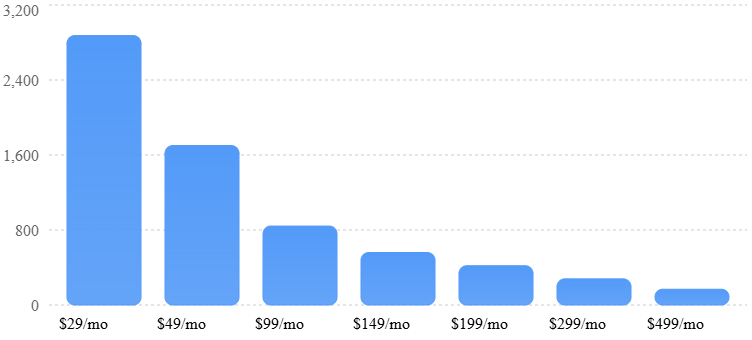
The result reveals why specialized business software may be attractive to solo founders.
At $29 per month, reaching the target requires nearly 2,900 customers. At $299 per month, the founder needs only 279 customers.
However, a higher subscription price usually creates higher expectations. Customers paying hundreds of dollars each month will want clear benefits, dependable support, and reliable software.
The goal should not be to charge the highest possible price. It should be to create enough value that customers are happy to continue paying.
Finding 2: Customer Retention Could Decide Whether the Business Remains Small
Reaching 100 paying customers is an important milestone, but retaining them is equally important.
To illustrate this, SFTechScene modeled a company beginning with 100 customers and adding 10 new customers per month.
We compared three monthly customer loss rates: 1%, 3%, and 5%.
The model assumes losses are applied to the opening customer base each month, followed by 10 new customers. Fractional counts are retained in the calculations and rounded for display.
Customer growth with different monthly loss rates
Illustrative deterministic model, starting with 100 customers and adding 10 per month.
■ 1% monthly churn
■ 3% monthly churn
■ 5% monthly churn
Model values rounded to whole customers. These are scenario calculations, not observed startup outcomes.
After 12 months, the business with 1% monthly churn has approximately 200 customers. The business with 5% churn has only about 146 customers, despite acquiring the same number of new customers each month.
At $149 per customer, that difference represents roughly $8,000 in monthly recurring revenue.
The comparison shows why improving product reliability and customer satisfaction can be just as important as adding new features.
Finding 3: A Million Dollars in Revenue Is Not a Million Dollars in Profit
Consider a solo software company generating $1 million in annual recurring revenue.
The founder may need to pay for cloud hosting, AI services, payment processing, customer support, professional assistance, software tools, marketing, refunds, and other business costs.
SFTechScene developed three illustrative expense scenarios to show the effect.
| Annual expense category | Lean model | Base model | Higher-cost model |
|---|---|---|---|
| Cloud hosting and AI services | $40,000 | $80,000 | $150,000 |
| Software and administration | $15,000 | $25,000 | $35,000 |
| Marketing and customer acquisition | $40,000 | $120,000 | $250,000 |
| Contractors and outside support | $30,000 | $80,000 | $150,000 |
| Payment processing and other costs | $35,000 | $35,000 | $45,000 |
| Total expenses | $160,000 | $340,000 | $630,000 |
| Operating surplus | $840,000 | $660,000 | $370,000 |
The operating surplus excludes founder compensation and income taxes. The table is a scenario model rather than a dataset of actual businesses.
The wide range matters because two companies generating the same revenue can have very different financial outcomes.
A small business with expensive AI processing or high customer acquisition costs may retain much less of its revenue than a simple product with loyal customers.
The Most Useful Financial Metric Is Contribution Margin
Contribution margin measures how much money remains from a customer after the direct costs of serving that customer.
Suppose a business charges $149 per month and spends $29 on payment processing, AI usage, hosting, and other variable services attributable to that customer.
The contribution margin would be:
\[ \frac{149-29}{149}\times100\approx80.5\% \]
That leaves approximately $120 per customer each month to cover fixed operating expenses, marketing, founder compensation, and profit.
Founders should calculate this measure before scaling. A business can increase revenue while becoming less profitable if each additional customer creates too much cost.
For AI-heavy software, tracking cost per customer is particularly important because model usage can grow unexpectedly.
How a San Francisco Founder Can Build a One-Person Software Company in 90 Days
A new founder does not need to begin with a complicated product or an ambitious fundraising plan.
The better approach is to spend 90 days determining whether a specific group of customers has a problem worth solving.
The goal is not to build a finished company in three months. It is to gather enough evidence to decide whether the idea deserves further investment.
Days 1–15: Find a Painful, Repeated Business Problem
Start by choosing an industry you understand or can access easily.
For example, a founder familiar with San Francisco’s property management market might investigate how independent property managers handle tenant requests, repair coordination, and monthly reporting.
Interview at least 15 potential customers. Ask them to describe their current process rather than asking whether they would like an AI-powered application.
Pay particular attention to tasks that are repeated, expensive, frustrating, or easy to forget.
Questions Worth Asking
A useful customer interview should reveal how often the problem occurs, who is responsible for solving it, what tools they use, and what happens when the process fails.
Ask what they have already tried to improve. A customer who has paid for several imperfect solutions may be showing more genuine demand than someone who simply says an idea sounds interesting.
Do not treat friendly comments as purchase commitments. The strongest early evidence comes from customers willing to pay, sign a pilot agreement, or spend meaningful time testing the product.
Days 16–30: Build the Smallest Useful Product
Once a clear problem emerges, create a basic product that solves one part of it.
Use AI coding tools to prepare the interface, build the necessary workflows, and connect appropriate managed services.
Avoid unnecessary features such as complicated reporting systems, multiple subscription plans, or extensive customization.
A simple application that solves a real problem is more valuable than a large application that customers struggle to understand.
Before inviting users, check that account permissions work correctly, sensitive information is protected, and the most important actions produce the expected results.
Days 31–45: Recruit the First Paying Customers
Return to the people who described the problem during the research stage.
Show them the working product and ask whether it solves the issue they identified.
If possible, offer a paid pilot rather than an unlimited free trial. Even a modest payment provides useful evidence that the customer sees value.
A reasonable initial target might be three to five paying customers, depending on the industry.
The number is less important than whether customers use the product repeatedly and would be disappointed if it disappeared.
Days 46–60: Improve Reliability Before Expanding Features
During the first month of customer use, the founder should focus on problems rather than new ideas.
Monitor failed actions, confusing screens, unexpected costs, and support requests.
Find out which features customers use most frequently and which ones they ignore.
If users repeatedly encounter the same problem, fix that issue before adding something new.
For important workflows, use automated tests and independent technical review where necessary.
Days 61–75: Establish a Repeatable Sales Process
Once the product works reliably for a small customer group, begin testing a consistent way to find similar buyers.
This might involve direct outreach, industry communities, educational content, partnerships, or referrals from existing customers.
A San Francisco founder selling software to professional service firms could publish a practical guide explaining how to improve a common administrative process.
The article can introduce the problem, demonstrate a useful solution, and direct interested readers to a product demonstration.
The key is to measure qualified conversations and paying customers rather than website traffic alone.
Days 76–90: Decide Whether to Grow, Change Direction, or Stop
At the end of 90 days, review the evidence.
| Question | Evidence to examine |
|---|---|
| Do customers have an urgent problem? | Interviews, repeated complaints, existing spending |
| Will customers pay? | Paid pilots, subscriptions, signed agreements |
| Does the product work reliably? | Error logs, completed tasks, support cases |
| Can the founder serve customers efficiently? | Weekly support and maintenance hours |
| Are customers getting value? | Repeat usage, renewals, customer feedback |
| Can the business grow profitably? | Revenue, direct costs, acquisition costs |
A founder should continue investing when the evidence supports the product’s value and the business has a credible path to financial sustainability.
If customers are not using the product, changing direction may be wiser than adding more features.
The biggest advantage of AI-assisted development is that founders can test these assumptions with less initial spending.
The Biggest Risks Facing One-Person Software Companies
The promise of vibe coding is compelling, but several risks deserve serious attention.

A founder who ignores them may produce a working application without creating a sustainable business.
Security Problems Can Destroy Customer Trust
AI-generated code may introduce weak account protections, unsafe database queries, or incorrectly configured permissions.
These problems are especially dangerous when software handles personal information, business records, or payment details.
Founders should use established authentication services, restrict access to private information, protect stored credentials, and arrange independent security reviews when the product’s risk level requires them.
A solo company may be small, but its responsibility for customer information is not.
Technical Debt Can Grow Quickly
Technical debt is the additional work created when software is built using shortcuts that make later changes harder.
AI tools can generate code faster than a founder can fully understand or organize it.
Over time, repeated changes may create a complicated application that becomes difficult to maintain.
Founders should keep the product structure simple, document important decisions, maintain automated tests, and avoid accepting code they cannot adequately verify.
Customer Support Can Become a Full-Time Job
A one-person business may work well with 20 customers but become difficult to manage with 200.
Every new customer brings potential questions, account issues, and unexpected requests.
Automated support can help, but someone must handle difficult cases and take responsibility when a service fails.
Founders should measure support time per customer and improve the product whenever the same issue creates repeated requests.
AI Costs Can Reduce Profit Margins
Some AI applications have costs that increase with usage.
A reporting product that processes a few documents each month might be inexpensive to operate. The same product could become costly if customers begin processing thousands of large files.
Founders should establish usage limits, monitor spending, and understand the cost of each major operation.
Subscription prices should reflect actual delivery costs rather than optimistic assumptions.
Distribution Remains Difficult
Making software easier to build does not automatically make customers easier to acquire.
As more founders launch similar products, attracting attention may become more expensive.
A company without a clear audience, strong positioning, or effective sales process can struggle even when its software works well.
This is why customer relationships, industry knowledge, and distribution channels remain important competitive advantages.
What Happens When Everyone Can Build Software?
The wider impact of vibe coding may be greater than the rise of individual founders.
If creating a basic application becomes easier, the number of available software products could increase dramatically.
That would change how software companies compete.
Building Basic Features Will Become Less Impressive
Features that once required weeks of development may become easier for competitors to reproduce.
A simple dashboard, reporting system, or document workflow may no longer provide a strong competitive advantage on its own.
Founders will need to differentiate through product quality, customer knowledge, specialized data, trusted relationships, or integration with existing business systems.
A company that understands its customers better than competitors may perform well even when its technology is relatively simple.
Industry Knowledge Will Become More Valuable
Consider two entrepreneurs building software for small medical practices.
One understands software development but knows little about clinic operations. The other has years of experience managing a practice but limited programming knowledge.
AI development tools could help the second entrepreneur build an early product without immediately hiring a development team.
Their knowledge of real customer needs may give them an advantage.
This does not remove the need for technical expertise, particularly in sensitive industries. It does mean that business experience can play a larger role in determining which software ideas succeed.
Customer Trust Will Become a Stronger Advantage
As more products enter the market, customers may find it harder to decide which ones are dependable.
A company that offers clear documentation, reliable service, transparent pricing, and strong support can stand out.
For solo founders, this creates an opportunity to compete through attention to detail rather than the size of their engineering organization.
Trust develops through repeated positive experiences, not marketing claims.
Can a One-Person Software Company Really Remain a One-Person Company?
Starting alone and remaining alone are different decisions.
A founder can use AI to delay hiring, but growth may eventually create responsibilities that are difficult for one person to manage.
Carta’s Solo Founders Report found that the median time from incorporation to first employee was 399 days for solo-founded companies, compared with 480 days for companies with multiple founders. Carta
That finding challenges the assumption that solo-founded companies always remain smaller or hire more slowly.
It suggests that starting alone can be a practical first stage rather than a permanent operating structure.
When Should a Founder Hire?
A founder should consider hiring when a necessary activity becomes difficult to perform safely or effectively within the available time.
For example, an experienced engineer may be needed when an application becomes technically complex. A support specialist may become valuable when customer issues consistently interrupt product development.
The decision should depend on workload, risk, revenue, and the value of the founder’s time.
Hiring should not be treated as failure. The goal is to build a healthy company, not preserve an artificial employee count.
Original SFTechScene Research #6: Which Software Businesses Are Most Suitable for Solo Founders?
To bring the findings together, SFTechScene developed a practical scoring framework for evaluating potential one-person software businesses.
This is an editorial decision model, not a statistical prediction of startup success.
Each category receives a score from 1 to 5, where 5 indicates stronger suitability for a solo founder. The criteria are repeatability of customer needs, manageable maintenance demands, limited support burden, potential recurring revenue, and relatively low regulatory or security complexity.
All five criteria receive equal weight, producing a maximum score of 25.
| Business model | Repeatability | Maintenance | Support | Revenue | Risk simplicity | Total |
|---|---|---|---|---|---|---|
| Niche reporting software | 5 | 4 | 4 | 4 | 4 | 21 |
| Small-business scheduling | 5 | 4 | 3 | 4 | 4 | 20 |
| Specialized workflow automation | 5 | 3 | 3 | 5 | 3 | 19 |
| Software-enabled reporting service | 4 | 4 | 3 | 4 | 4 | 19 |
| General consumer social app | 2 | 2 | 2 | 2 | 3 | 11 |
| Highly regulated financial platform | 4 | 2 | 2 | 5 | 1 | 14 |
The scores are SFTechScene’s qualitative assessments. They are not based on observed success rates and should be adjusted for the founder’s skills and the particular market.
The results favor narrow products that solve repeated business problems without requiring unusually complex operations.
SFTechScene solo-founder business suitability scores
Editorial framework, scored out of 25; higher means more suitable under the stated criteria.
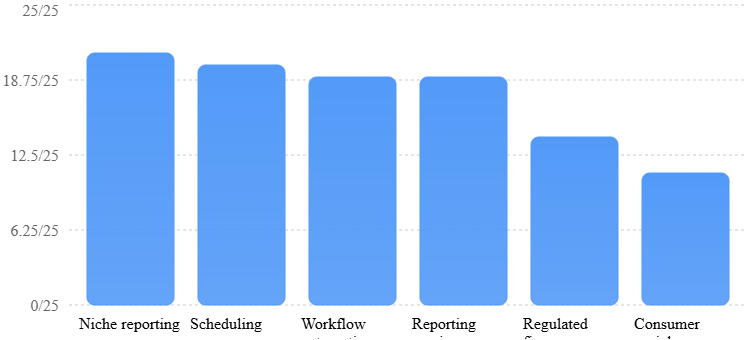
A simple consumer application could still become highly successful, and a skilled founder may be capable of building a complex financial product.
The framework does not claim otherwise. Its purpose is to help founders choose an idea that matches their available resources.
For someone building their first company without employees, a narrow subscription product may offer a more manageable path than a business requiring constant moderation, extensive compliance work, or large-scale infrastructure.
What San Francisco Investors Should Watch as Vibe Coding Expands
For investors, the rise of AI-assisted solo founders creates new questions about what makes an early-stage startup valuable.
Historically, the ability to attract experienced technical employees was an important signal of a company’s potential.
That ability still matters, but AI-assisted development may allow some founders to demonstrate customer demand before making major hiring commitments.
Revenue Quality May Matter More Than Team Size
A company with one founder and $30,000 in stable monthly recurring revenue may have stronger commercial evidence than a larger startup with no paying customers.
The useful questions are whether customers renew, whether revenue is profitable, and whether growth can continue without creating unsustainable operating demands.
Investors should examine the quality of the customer base rather than treating the number of employees as a simple measure of progress.
Technical Verification Will Remain Important
A founder who builds rapidly with AI can create an impressive demonstration.
However, investors should also understand whether the product is secure, maintainable, and capable of supporting future growth.
Technical reviews, testing practices, and clear documentation become particularly important when much of the original code was generated with AI assistance.
A founder who understands these risks and manages them effectively may be better prepared for growth than someone who focuses only on development speed.
The Future of Silicon Valley Entrepreneurship: Smaller Teams, More Products, Tougher Competition
Silicon Valley’s next generation of software businesses may look different from the companies that defined earlier decades.
More founders may begin alone, launch products while keeping their regular jobs, and build profitable niche companies without raising institutional capital.
Others may use AI to validate demand before forming larger teams or pursuing venture funding.
Both approaches could become more common as development tools improve.
The evidence from 2026 suggests that AI has already become a major part of software development. GitHub’s latest findings show a rapid increase in agent-started coding work, while Carta’s data confirms a longer-term rise in solo entrepreneurship.
But these developments should not be confused with proof that one person can successfully operate every kind of software company.
Complex products still require technical expertise, responsible oversight, reliable systems, and customer support.
For San Francisco, this creates an interesting possibility. The region may continue producing large, heavily funded technology companies while also supporting a growing number of smaller, independent software businesses.
Those companies may not become household names. Some may serve only a few hundred customers in narrow industries.
Yet they can still generate meaningful revenue, employ outside specialists, and solve valuable business problems.
The opportunity is not limited to experienced software engineers. Professionals with deep knowledge of an industry may now have more practical ways to turn that knowledge into software.
Final Takeaway: Vibe Coding Is Making Software Easier to Build, but Customers Will Decide Who Wins
The rise of one-person software companies represents an important change in Silicon Valley entrepreneurship.
AI tools are reducing some of the technical barriers that previously prevented individuals from building and launching software products.
Carta’s research shows that solo-founded startups are becoming more common. GitHub’s 2026 data shows that AI agents are handling a growing share of initial coding work.
And San Francisco’s high operating costs make tools that reduce early hiring needs especially attractive.
However, SFTechScene’s original analysis reveals a more practical lesson.
A founder does not need millions of customers to build a meaningful software business. At $149 per month, roughly 560 paying customers would generate $1 million in annual recurring revenue.
But reaching that goal requires more than creating an application. It requires a valuable problem, reliable software, effective customer acquisition, strong retention, and careful cost management.
The best founders will use AI to reduce unnecessary work while remaining focused on customers.
They will spend less time building features nobody needs and more time understanding problems people are willing to pay to solve.
The biggest change coming to Silicon Valley may not be that software companies need no employees. It may be that entrepreneurs can discover whether they have a real business before they need to hire anyone.
That could give a much wider group of people the chance to become software founders.
And it could make the next generation of successful San Francisco startups smaller, more specialized, and much more focused on delivering measurable value.
SFTechScene Research Methodology and Source Notes
The analyses in this article were prepared from publicly available aggregate figures and explicitly stated business scenarios. They are original calculations and editorial comparisons, not original surveys or access to private company-level records.
| Research section | Primary source | Method | Main limitation |
|---|---|---|---|
| Solo founder growth | Carta 2025 | Percentage-point and relative growth | Carta customer population |
| Funding representation | Carta 2026 | Round share divided by formation share | Funding rounds are not unique companies |
| SF hiring economics | CBRE 2026 | Salary benchmark versus assumed software spending | Not a like-for-like productivity comparison |
| AI coding adoption | GitHub Octoverse 2026 | Growth and group comparisons | Observational, not causal |
| SF business opportunity | SF registration records, July 2026 | Ratio and revenue scenarios | Registrations are not verified software buyers |
| Million-dollar revenue model | SFTechScene assumptions | Subscription revenue arithmetic | Not observed startup performance |
| Customer retention | SFTechScene assumptions | Monthly customer-flow simulation | Fixed acquisition and churn assumptions |
| Business suitability | SFTechScene framework | Equal-weight qualitative scoring | Subjective, not validated against outcomes |
Primary Research Sources
The underlying sources and publication details are available here:
- Carta — Solo Founders Report 2025
- Carta — Dynamic Duos: Equity Math for Two-Founder Teams
- GitHub — Octoverse 2026
- Stack Overflow — 2025 Developer Survey, AI Section
- CBRE — San Francisco Bay Area Technology Talent Report, August 2026
- San Francisco Center for Economic Development — Business Registration Data
The business scenarios use U.S. dollars and rounded values. No projected revenue, customer count, margin, or editorial suitability score should be interpreted as an observed average or a guarantee of performance.