
An in-depth SFTechScene research report on the companies competing to power the next generation of business software, with original market analysis, economic models, and a practical guide for San Francisco businesses.
Research updated: October 21, 2026
The Short Version: Anthropic Leads in Enterprise Model Spending, OpenAI Is Building the Workplace Agent Layer, and Google Has a Powerful Distribution Advantage
The race to control enterprise AI agents is becoming one of the most important business battles in Silicon Valley. OpenAI, Anthropic, and Google are no longer competing only to build chatbots that answer questions. They are competing to provide software that can complete real business work, use company tools, manage complex tasks, and operate across departments.
For San Francisco startups, this competition creates a major opportunity. Businesses can now use advanced AI agents to write software, research customers, analyze financial information, handle support requests, and complete parts of everyday operations. However, choosing the wrong platform can introduce high costs, security problems, and dependence on technology that changes quickly.
The most important question is not which company has the smartest model. It is which company can help businesses complete valuable work accurately, safely, and at a cost that makes financial sense.
The available market data already tells an interesting story. Menlo Ventures estimated that businesses spent $37 billion on generative AI in 2025, with $12.5 billion going toward foundation model APIs. In its estimated enterprise API market shares, Anthropic reached 40%, OpenAI held 27%, and Google reached 21%. Those numbers suggest that Anthropic became the leader in this particular part of the enterprise market, even though OpenAI remains a major force in workplace AI products.
Menlo Ventures
Estimated enterprise LLM API spending shares, 2025
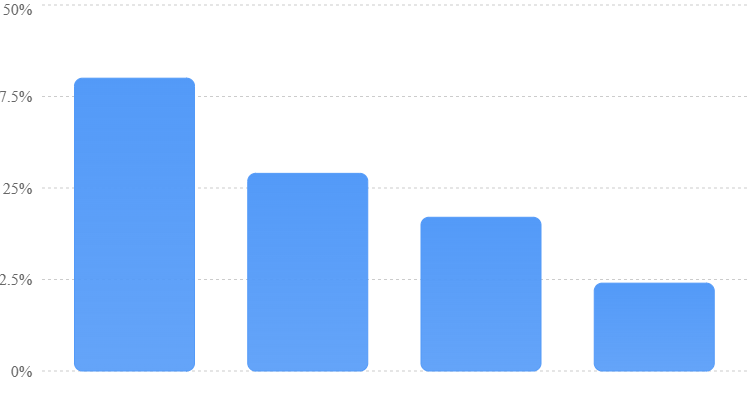
Source: Menlo Ventures, 2025 State of Generative AI in the Enterprise. Shares are survey-based estimates, not audited vendor revenue.
These are shares of estimated enterprise foundation-model API usage and spending, not shares of all enterprise AI agents or workplace assistants.
Each competitor has a different strength. Anthropic has demonstrated strong adoption among enterprises building applications with its models, particularly in software development. OpenAI is connecting its models and coding technology with enterprise workspaces and hosted agents. Google can bring agents directly into existing cloud systems, employee tools, business data, and company security controls.
Our analysis finds that the race may not produce one winner. Enterprise AI includes several connected markets, and the company that leads in one part may not dominate the others. A business might use OpenAI for employee productivity, Anthropic for software engineering, and Google for cloud-based data workflows.
SFTechScene’s central finding is that the future enterprise AI leader will be determined less by benchmark scores and more by the economics of successfully completed work.
This report examines what the three companies have actually built, how their business strategies differ, what public market data reveals, and how San Francisco companies can choose between them.
Why the Enterprise AI Agent Race Matters More Than the Chatbot Race
AI Agents Are Moving From Answering Questions to Completing Work
For years, the main appeal of generative AI was simple. A worker could enter a question, receive a useful response, and finish the task manually. ChatGPT, Claude, and Gemini made this approach popular by helping users write, summarize, analyze, and create.
AI agents introduce another step. Instead of only suggesting what a worker should do, an agent can use approved tools to carry out parts of the work itself. It might collect information from several systems, prepare a report, check a spreadsheet, update a database, and ask for approval before sending a message.
Consider a San Francisco software startup that receives hundreds of sales inquiries every week. A traditional chatbot might draft replies or summarize customer messages. An AI agent could inspect the inquiry, check the customer record, research the company, prepare an appropriate response, and create a task for the sales team.
The difference is meaningful because the agent changes the amount of work employees must complete. A useful agent saves more than typing time. It reduces the number of manual steps required to finish a business process.
However, an agent is not automatically more valuable simply because it performs more actions. A poorly designed agent can make mistakes, overwrite records, expose sensitive information, or increase the amount of work people must review.
The Real Prize Is Control Over Business Workflows
Enterprise AI agents could become an important layer between employees and the software they use. A worker might explain what needs to happen instead of opening five applications and carrying out each step manually.
This creates a new competitive threat to traditional software companies. A business may eventually care less about the number of screens and buttons in a software product and more about whether an agent can reliably produce the required result.
For OpenAI, Anthropic, and Google, this creates three opportunities. They can sell the intelligence that powers agents, offer platforms for developing and managing agents, and provide ready-to-use agents that employees interact with directly.
These opportunities overlap, but their economics differ. A company selling model API access earns revenue when applications use its models. A company selling workplace software may earn subscription revenue, usage revenue, or both. A company supplying cloud infrastructure can also benefit from the computing and data services agents consume.
This distinction is essential when comparing market share. The vendor with the most model spending is not necessarily the vendor with the most employees using its agent products.
Enterprises Are Spending Real Money, but Autonomous Agents Remain Early
Menlo Ventures’ 2025 research estimated that $19 billion of enterprise AI spending went to applications and $18 billion went to infrastructure. Within the horizontal application category, traditional AI assistants accounted for substantially more spending than agent platforms. The same research estimated that only 16% of enterprise deployments qualified as true agents under its definition.
Menlo Ventures
+1
Where enterprise generative AI spending went in 2025
■ AI applications
■ Infrastructure
Source: Menlo Ventures 2025 enterprise AI report. Values in USD billions.
Total estimated spending: $37 billion. Application and infrastructure spending are not the same as agent-only spending.
That gap between today’s spending and the potential market is why the competition is so intense. Companies already pay for AI tools, but much of their spending still supports employees rather than replacing complete workflows with autonomous execution.
The next stage is about turning helpful AI into dependable systems that work inside business processes. The challenge is not simply making models more capable. Companies must also solve permissions, monitoring, integration, billing, support, and accountability.
For San Francisco founders, this means there is still room to build valuable products around the major AI platforms. The most promising opportunities may come from making these platforms useful inside specific industries rather than trying to create another general-purpose AI assistant.
OpenAI vs. Anthropic vs. Google: The Enterprise AI Agent Comparison
Before examining each company, it helps to compare the main parts of their strategies.
| Area | OpenAI | Anthropic | |
|---|---|---|---|
| Main enterprise approach | Shared workplace agents and developer APIs | Claude-powered agents, coding tools, and enterprise workflows | Agents connected to cloud, data, and workplace systems |
| Enterprise development tools | Agents SDK, Agents API, Responses API | Claude Agent SDK, Claude API, Managed Agents | Gemini Enterprise Agent Platform, ADK, Agent Studio |
| Workplace products | ChatGPT workspace agents | Claude Enterprise, Claude Code, Cowork, Claude Tag | Gemini Enterprise and Workspace integrations |
| Clear strategic strength | Broad agent experience across work and development | Strong developer adoption and enterprise API position | Cloud infrastructure, integrated data, and governance |
| Important buying concern | Product changes, workflow fit, usage costs | Consumption costs, integration and operational controls | Platform complexity, deployment costs, and cloud dependence |
| Strong initial use cases | Cross-functional work and shared team processes | Coding, technical agents, document-heavy tasks | Data analysis, cloud-based workflows, large-company operations |
These are comparisons of product positioning rather than measured rankings of reliability or model intelligence. Features, availability, and contracts can vary.
OpenAI introduced Frontier and expanded shared workspace agents in 2026. Anthropic has continued developing Claude’s agent tools and enterprise products. Google’s Gemini Enterprise Agent Platform brings together agent creation, deployment, security, and support for multiple model providers.
OpenAI
+4
The biggest mistake would be to assume that these products perform equally well on every task. They have different designs, business models, and levels of integration. A proper comparison must test them against the actual workflows a company wants to improve.
OpenAI’s Strategy: Become the Place Where Employees and AI Agents Work Together
OpenAI Is Moving Beyond ChatGPT
OpenAI began its enterprise expansion with a major advantage: millions of people already understood how to use ChatGPT. That familiarity made it easier for businesses to introduce AI without teaching employees an entirely new way to interact with software.
But the company has moved well beyond conversational assistants. In February 2026, OpenAI introduced Frontier, a platform designed to help enterprises build, deploy, and manage AI coworkers. In April, it announced shared workspace agents that teams could create and use within business workflows.
OpenAI
+1
These launches show the direction of OpenAI’s enterprise strategy. Instead of expecting every company to build its own agent interface, OpenAI wants organizations to create reusable AI workers that can operate within familiar workplace environments.
Imagine a startup that needs a weekly report on customer complaints. A workspace agent could collect information from approved sources, identify repeated problems, create a report, and share the findings with authorized team members. A different agent might analyze product feedback and prepare recommendations for the engineering team.
The value comes from making these processes repeatable. Employees do not need to invent a new prompt or manually gather information each time.
OpenAI Frontier Targets the Hardest Enterprise Problem
One of the biggest obstacles to deploying agents is that company information lives in many different systems. Sales records might sit in Salesforce, product data in a database, internal knowledge in documents, and support conversations in another application.
An agent that cannot access the right information may produce a polished answer without understanding the business. Giving it unlimited access, however, creates serious security risks.
Frontier addresses the broader challenge of operating agents inside enterprises. OpenAI describes it as infrastructure for connecting agents to business context, providing tools and permissions, and managing their work.
The practical opportunity is large. Businesses want agents that understand what has already happened, know which actions they are allowed to take, and can continue working without requiring an employee to explain every step.
For OpenAI, the goal is to become an important operating layer for those agents rather than simply providing the model behind them.
The Agents API Expands OpenAI’s Developer Strategy
In September 2026, OpenAI introduced its Agents API in public beta, allowing developers to build and run managed cloud agents using technology from its Codex system. OpenAI describes support for long-running tasks, tool use, managed environments, and coordinated work across agents.
OpenAI
This matters because running an agent is different from calling an AI model once. A long task may require many steps, access to files, repeated tool calls, and a way to recover when something goes wrong.
A company building its own agent must normally manage this surrounding infrastructure. Hosted agent services can reduce some of that engineering work, although businesses still need to create appropriate tests, permissions, and controls.
For San Francisco startups with small engineering teams, reducing infrastructure work can be valuable. A founder may prefer to focus on building a useful product rather than maintaining a custom system for coordinating agent tasks.
A Key OpenAI Product Change That Buyers Should Understand
OpenAI’s agent platform has also undergone important changes during 2026. On June 3, OpenAI announced that its Agent Builder and Evals products were being wound down, with availability ending after November 30, 2026. It recommended the Agents SDK for code-based workflows and workspace agents for workflows better suited to natural-language setup.
OpenAI
This is a useful reminder that enterprise buyers must evaluate product stability alongside model quality. A company building a long-term system should know which services are supported, which are in beta, and how easily its work can move to another platform.
OpenAI’s newer tools may offer strong capabilities, but buyers should not design a new production system around an older product without reviewing its retirement schedule.
Where OpenAI Has an Advantage
OpenAI’s strongest advantage may be the range of work it can support through one ecosystem. Its enterprise offerings connect workplace use, developer tools, coding, research, and other forms of AI interaction.
A San Francisco business might begin with employees using ChatGPT and later build shared agents for reporting, research, or internal operations. Engineering teams can develop more specialized workflows using the API platform.
This creates a natural route from individual productivity to company-wide automation. It also gives OpenAI an opportunity to expand within organizations that already use its products.
However, broad capabilities do not prove that OpenAI is the best choice for every task. A company building a highly specialized coding agent should still test Anthropic. A business working heavily with Google Cloud data may find Google’s integrated services easier to deploy.
OpenAI’s strongest path to winning is to make enterprise agents as easy to use and share as ChatGPT became for everyday AI assistance.
Anthropic’s Strategy: Win the Developers Who Build Enterprise Agents
Anthropic Has Built a Strong Position in Enterprise API Spending
Anthropic entered the AI market with Claude and an emphasis on building capable systems with safety controls. Its enterprise strategy has expanded through developer tools, coding agents, API services, and products for business teams.
The most important evidence of its commercial position comes from enterprise model spending. Menlo Ventures estimated that Anthropic captured 40% of the enterprise foundation-model API market in 2025. That was substantially higher than its estimated 12% share in 2023.
Menlo Ventures
This growth suggests that many businesses and application developers have selected Claude models for production work. However, the data measures estimated API usage and spending. It does not reveal how many complete business workflows Anthropic agents finish successfully.
That difference matters. Anthropic can lead API spending while another company reaches more end users through its workplace application.
Claude Code Has Made Software Engineering a Major Opportunity
Software development is one of the clearest applications for autonomous agents. Coding work has something many other business tasks lack: a relatively direct way to test results.
An AI coding agent can create a function, run a test, inspect an error, update the code, and try again. It does not always need a human to evaluate every intermediate step.
Menlo Ventures estimated that enterprise spending on coding AI tools reached $4 billion in 2025. Within the coding-related foundation-model market it examined, Anthropic held an estimated 54% share, compared with 21% for OpenAI.
Menlo Ventures
These figures help explain why Claude Code has become strategically important. Coding agents are not merely writing suggestions in an editor. They are increasingly involved in completing technical tasks that previously required several rounds of manual work.
For San Francisco, where software development is central to the local startup economy, this is especially significant. Small engineering teams can test whether agents help them fix bugs, create tests, update internal tools, and maintain code more efficiently.
However, teams should measure accepted, working changes rather than counting lines of generated code. More code is not necessarily better software.
Anthropic Is Turning Agent Development Into an Enterprise Product
Anthropic’s Claude Agent SDK gives developers tools for building agent-based applications. Its wider platform includes Claude models, developer services, and managed agent capabilities.
The company’s strategy reflects a straightforward idea: developers want powerful models, but they also need systems that can manage tools, tasks, files, and repeated actions.
Anthropic has published detailed technical guidance on agent design and evaluation. Its research explains why reliable agents require more than strong one-time answers. Developers must test how agents behave across several steps, changing environments, and repeated attempts.
anthropic.com
+1
That focus is especially relevant for production applications. An agent might succeed on a simple demonstration and still fail when it encounters unfamiliar documents, incomplete records, or unexpected software responses.
A business that uses Claude should build its own testing process around those situations. Anthropic’s research offers useful development guidance, but customers must still verify that their specific systems work.
Claude Is Expanding Into Everyday Enterprise Work
Anthropic’s workplace ambitions now extend beyond software engineering. Claude Enterprise, Cowork, and related tools support broader business use cases.
In June 2026, Anthropic introduced Claude Tag, a system that allows teams to bring Claude into selected Slack channels and assign it work using connected tools and information. The product aims to make an AI assistant more useful in shared team processes.
anthropic.com
This is important because many company tasks begin inside messages. Someone asks for an update, requests an analysis, or assigns another employee a task. An agent that can handle part of that work can potentially reduce delays between the request and the result.
Anthropic has also expanded through enterprise partnerships. Its collaborations with Infosys and other service providers target industries such as finance, telecommunications, and regulated business operations.
anthropic.com
+1
These partnerships can help Anthropic reach companies that need integration support rather than a standalone AI subscription.
Where Anthropic Has an Advantage
Anthropic’s clearest demonstrated advantage is its position among enterprises consuming foundation-model APIs, supported by the strong adoption of its coding tools.
It may be especially attractive to companies building technical agents, developer products, research systems, and document-heavy applications.
The main challenge is turning that developer strength into lasting control of a broader enterprise market. Large businesses often choose platforms based on procurement, identity systems, compliance requirements, support agreements, and existing software contracts.
Strong technical performance can help Anthropic win an initial project. Keeping that customer may depend on how easily Claude-based systems fit into the company’s wider operations.
Anthropic’s strongest path to winning is to become the preferred intelligence and execution layer for business software developers.
Google’s Strategy: Bring AI Agents Into the Software and Data Systems Businesses Already Use
Google Has an Advantage That Model Benchmarks Cannot Fully Capture
Google is approaching the enterprise AI agent race from a different position. It already operates a major cloud platform and supplies productivity, analytics, security, and development tools used by businesses.
That means Google does not need to convince every company to adopt an entirely new software environment. It can introduce agents into systems organizations already use.
For example, a business that stores information in BigQuery may want an agent that can analyze company data while respecting existing access controls. Another business might want agents connected to Workspace documents, communication tools, or cloud applications.
Google’s strongest opportunity is to reduce the gap between creating an agent and making it useful inside an established company.
Gemini Enterprise Agent Platform Brings Multiple Capabilities Together
In April 2026, Google introduced Gemini Enterprise Agent Platform as the evolution of Vertex AI’s agent development capabilities. The platform supports agent building, deployment, governance, model access, and operational management.
blog.google
+1
Businesses can use tools such as Agent Studio for less technical development and Agent Development Kit for more customized applications.
Google also offers services designed to control agent identity and activity. These matter because businesses need to know which agent performed an action, what information it accessed, and whether its behavior followed company rules.
In July 2026, Google announced broader availability of capabilities including Agent Runtime and Agent Identity. This reflects its effort to turn agent development into a managed enterprise service rather than a collection of experiments.
Google Cloud Blog
One particularly important feature is support for multiple model providers. Google’s documentation describes access to a broad collection of models, and Google has explicitly discussed support for Claude within its agent platform.
Google Cloud Documentation
+1
This means Google’s platform strategy does not depend entirely on every customer choosing Gemini for every task. Google can provide cloud infrastructure and management services while customers use models from other companies.
Google Can Compete Through Distribution
Many organizations already have contracts, trained staff, and security systems connected to Google products. Adding agent capabilities within those relationships can be easier than starting from nothing.
Google has also expanded its partner ecosystem. In April 2026, it announced a $750 million partner fund supporting agent development and related activities. It has made partner-built agents available through Gemini Enterprise’s managed workplace environment.
Google Cloud Blog
+1
This creates several routes to adoption. Employees can use built-in AI features, business teams can create workflows, developers can build custom agents, and organizations can buy specialized agents from partners.
Google has also highlighted enterprise deployments across banking, energy, manufacturing, and customer operations. At its October 2026 Gemini at Work event, the company described customer implementations involving organizations such as PayPal, Verizon, and major financial institutions. These are vendor-reported examples, not independently standardized performance comparisons.
Google Cloud Blog
Google’s Biggest Challenge Is Complexity
Google’s breadth is useful, but it can also create complexity. Enterprises may need to understand several services, editions, security settings, integration methods, and pricing structures.
A founder building a narrow product may prefer a simple model API over a full cloud platform. A large enterprise with hundreds of agents may make the opposite decision because central management becomes more important at scale.
This creates different buying patterns.
Small companies often optimize for development speed and operating cost. Larger organizations frequently place greater value on existing contracts, employee access management, data controls, and centralized oversight.
Google may perform especially well among organizations that have already standardized their infrastructure around Google Cloud.
Google’s strongest path to winning is to make agents a natural extension of existing enterprise infrastructure, regardless of which model powers an individual task.
Original SFTechScene Research #1: How Much Has the Enterprise AI Model Market Changed?
Public discussions often describe OpenAI, Anthropic, and Google as though their positions have remained stable. The available numbers suggest otherwise.
To measure the change, SFTechScene analyzed the enterprise API market-share estimates published by Menlo Ventures for 2023 and 2025.
Research Methodology
Our analysis uses Menlo Ventures’ reported model-provider shares as the underlying dataset. These estimates were constructed from enterprise research, workload information, and market modeling.
We calculated absolute share changes in percentage points, relative changes from the 2023 baseline, and ratios between the starting and ending shares.
This is a secondary analysis of public research, not a new enterprise survey. The arithmetic is original to this report, but the underlying observations belong to Menlo Ventures.
The analysis covers estimated enterprise foundation-model API activity. It excludes direct comparisons of ChatGPT, Claude, or Gemini workplace seats, and it should not be interpreted as a measured agent-only market share.
Finding #1: Anthropic Gained 28 Percentage Points in Two Years
| Company | 2023 share | 2025 share | Change | Relative change |
|---|---|---|---|---|
| Anthropic | 12% | 40% | +28 points | +233.3% |
| OpenAI | 50% | 27% | −23 points | −46.0% |
| 7% | 21% | +14 points | +200.0% | |
| Other providers | 31% | 12% | −19 points | −61.3% |
Source data: Menlo Ventures’ 2025 enterprise AI report. Percentage-point and relative changes calculated by SFTechScene.
Menlo Ventures
Enterprise API market-share changes, 2023–2025
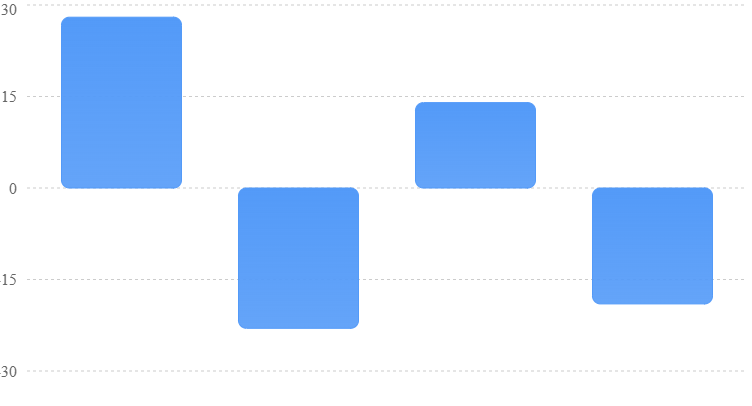
SFTechScene calculation using Menlo Ventures estimates. Negative values represent market-share losses.
The headline is Anthropic’s rise from 12% to 40%. That represents an increase of 28 percentage points and makes its estimated share approximately 3.33 times its 2023 level.
Google also expanded considerably, tripling its estimated share from 7% to 21%.
OpenAI experienced the opposite movement, dropping from an estimated 50% to 27%. However, this does not mean its enterprise API revenue necessarily declined. The overall market grew, and a smaller percentage of a much larger market can still represent greater spending.
That distinction is critical. Market share measures a company’s position relative to competitors. It does not independently establish absolute revenue growth or profitability.
Finding #2: The Two Largest Gainers Followed Different Routes
Anthropic and Google both gained significant share, but their strategies differ.
Anthropic grew as businesses adopted Claude models and coding-focused services. Google expanded while developing Gemini models and strengthening its broader enterprise AI platform.
These changes suggest that the market supports more than one route to growth. Strong developer demand matters, but so do cloud distribution, business relationships, and product integration.
For San Francisco startups, the lesson is to avoid selecting providers solely on their current ranking. The factors that drive growth in one market segment may be less important in another.
A customer-support startup, for example, may care more about tool reliability and response costs than enterprise coding market share.
Finding #3: OpenAI’s Share Decline Does Not Prove It Is Losing the Entire Enterprise Market
The Menlo figures represent one segment: foundation-model APIs. OpenAI also sells workplace AI products and related services that are not captured in the same way.
OpenAI reported in April 2026 that enterprise customers accounted for more than 40% of its revenue. That is a company-reported figure using a different definition from Menlo’s market-share estimate. The two measurements cannot be directly compared.
OpenAI
A company could lose share in one product category while growing quickly in another. OpenAI’s workplace and managed-agent efforts are therefore essential to understanding its enterprise position.
The same distinction applies to Google. Revenue from cloud infrastructure, software subscriptions, and agent platforms is broader than revenue generated by Gemini model usage.
This is why declaring a final winner based on API share alone would be misleading.
Original SFTechScene Research #2: Estimating the Dollar Value of Enterprise Model Spending
The next question is how large these estimated market shares are in financial terms.
Menlo Ventures put enterprise foundation-model API spending at approximately $12.5 billion in 2025. SFTechScene applied the estimated market shares to that spending total to calculate implied spending by provider.
Menlo Ventures
Research Methodology
We use the formula:
\[ \text{Implied spending}=\text{Total API market spending}\times\text{Provider market share} \]
The calculations assume that Menlo’s overall market estimate and provider shares refer to compatible spending categories. Results are rounded to the nearest $25 million.
These are implied spending allocations, not reported revenue figures. They should not be interpreted as audited sales for OpenAI, Anthropic, or Google. They also do not include all of the firms’ other enterprise products.
Finding #4: Anthropic’s Estimated API Spending Lead Represents Billions of Dollars
| Provider | Estimated 2025 share | Implied API spending |
|---|---|---|
| Anthropic | 40% | $5.000 billion |
| OpenAI | 27% | $3.375 billion |
| 21% | $2.625 billion | |
| Others | 12% | $1.500 billion |
| Total | 100% | $12.500 billion |
Implied 2025 enterprise foundation-model API spending
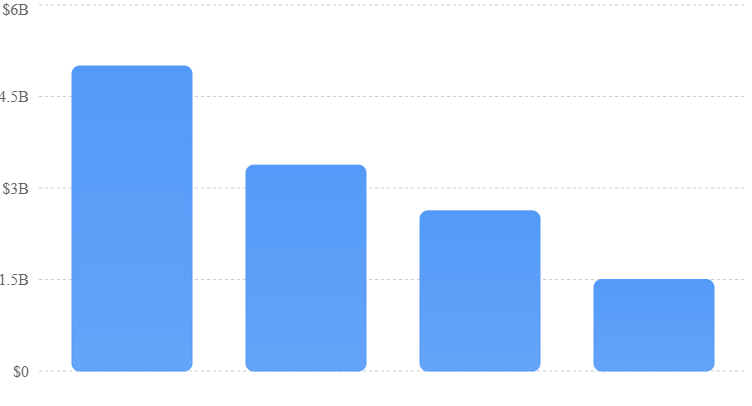
SFTechScene calculation: $12.5B times Menlo Ventures’ estimated market shares. Not independently verified vendor revenue.
On this model, Anthropic’s implied spending allocation exceeded OpenAI’s by approximately $1.625 billion. Google’s allocation was approximately $750 million below OpenAI’s.
These are meaningful differences within the model, but their precision should not be mistaken for measurement certainty. A market estimate built from surveys and other inputs naturally carries uncertainty.
The analysis also reveals an important business opportunity. A company does not need to dominate every enterprise AI category to generate substantial model-related spending.
For Google, providing cloud services around models may create additional revenue even when customers use a competitor’s AI model. For OpenAI, workplace subscriptions and agent services provide other ways to expand. Anthropic can also develop businesses beyond model calls.
The enterprise AI market is therefore better understood as several connected revenue opportunities, not one winner-take-all contest.
Finding #5: Even a 10% Error in the Market Estimate Changes the Spending Figures Materially
Because the $12.5 billion total is estimated, we also tested how our derived spending figures change if that market total is 10% higher or lower.
| Provider | Market 10% smaller | Base estimate | Market 10% larger |
|---|---|---|---|
| Anthropic | $4.500B | $5.000B | $5.500B |
| OpenAI | $3.038B | $3.375B | $3.713B |
| $2.363B | $2.625B | $2.888B | |
| Others | $1.350B | $1.500B | $1.650B |
These figures hold market shares fixed and vary only the total market size. The 10% range is an illustrative sensitivity test, not a statistical confidence interval.
This distinction is important for investors and founders using market reports. A calculated number may appear very precise even when the inputs remain uncertain.
A company preparing a business plan should therefore use ranges instead of treating one market estimate as guaranteed future revenue.
Original SFTechScene Research #3: Is Enterprise AI Becoming More Concentrated?
A third question is whether OpenAI, Anthropic, and Google are making the enterprise model market harder for smaller providers to enter.
Together, the three companies held an estimated 88% share in 2025, compared with 69% in 2023. That represents an increase of 19 percentage points in their combined position.
Menlo Ventures
It is tempting to conclude that the market has become more concentrated. However, an important statistical detail makes the answer less straightforward.
Research Methodology: Measuring Market Concentration
SFTechScene calculated the Herfindahl–Hirschman Index, or HHI, using the reported market shares.
The index adds the squared market shares of individual providers:
\[ HHI=\sum_{i=1}^{n}s_i^2 \]
Here, \(s_i\) is each provider’s percentage share. A higher number generally indicates greater market concentration.
The challenge is that Menlo’s published summary groups smaller providers into an “other” category. We cannot calculate their exact contribution without a complete provider-level dataset.
Rather than inventing those missing shares, we calculated concentration bounds.
The lower bound assumes the remaining share is spread across many small providers, making its contribution approach zero. The upper bound assumes all remaining share belongs to one provider.
Finding #6: The Top Three Control More Spending, but Overall Concentration Has an Uncertain Direction
| Metric | 2023 | 2025 |
|---|---|---|
| Combined share of top three named providers | 69% | 88% |
| Remaining provider share | 31% | 12% |
| Minimum possible HHI, approximately | 2,693 | 2,770 |
| Maximum possible HHI | 3,654 | 2,914 |
SFTechScene calculations from Menlo Ventures’ provider-share estimates. Bounds reflect uncertainty in the distribution of other providers.
The minimum HHI increases slightly, but the possible ranges overlap. Consequently, these figures do not prove that the full market’s HHI increased between 2023 and 2025.
That finding is more useful than a simple claim about consolidation.
The three named leaders have gained collective share, but competition among them has also become more balanced. OpenAI’s initial dominance has weakened while Anthropic and Google have expanded.
In other words, the market is increasingly controlled by three large providers rather than by one overwhelmingly dominant provider.
Why This Matters for San Francisco Startups
A market controlled by a small number of large providers creates both benefits and risks.
The benefits include strong investment in model development, infrastructure, security, and enterprise support. Startups can use technologies that would be extremely expensive to build independently.
The risks include changes in pricing, product availability, usage restrictions, and service terms. A startup whose entire business depends on one provider may have limited options if that relationship becomes more expensive.
The practical response is not necessarily to operate every application across three providers. That can add complexity without producing useful benefits.
Instead, startups should identify which parts of their products depend on a specific model and which parts can remain independent. Keeping business rules, customer data, tests, and workflow records under the company’s control makes future provider changes easier.
The important opportunity is not simply using the best model today. It is building a business that can benefit when better models become available tomorrow.
Original SFTechScene Research #4: Which Provider Creates the Best Agent Economics?
The most important comparison for an enterprise buyer is often missing from public AI leaderboards: the cost of completing a useful task correctly.
Model pricing alone cannot answer this question.
An agent may use a low-cost model but require several failed attempts before succeeding. Another may use a more expensive model but complete the task immediately. A third may achieve a high success rate but still require extensive human review.
To understand these trade-offs, SFTechScene developed a repeatable economic model.
Methodology: Measure Successful Work, Not Just AI Usage
We define total operating cost as the sum of model and tool charges, human review, and allocated operating costs.
For a simple comparison:
\[ C_{\text{success}}=\frac{C_{\text{total}}}{N_{\text{correct}}} \]
Here, \(C_{\text{success}}\) is the cost per correctly completed task, \(C_{\text{total}}\) is total operating cost, and \(N_{\text{correct}}\) is the number of tasks completed correctly.
This measure is useful because a task that fails still consumes time and resources. A company should not ignore failed attempts when calculating the cost of automation.
The model should also include the cost of correcting failed tasks, especially when unsuccessful attempts create extra business work.
Finding #7: A More Expensive Agent Can Be the Cheaper Business Choice
Consider three hypothetical agent implementations processing 10,000 customer support tasks.
These are deliberately constructed scenarios, not observed results from OpenAI, Anthropic, or Google. They demonstrate why companies must benchmark real workflows before choosing a vendor.
| Metric | Agent A | Agent B | Agent C |
|---|---|---|---|
| Tasks attempted | 10,000 | 10,000 | 10,000 |
| AI cost per attempt | $0.06 | $0.12 | $0.20 |
| Correct completion rate | 70% | 85% | 95% |
| AI cost for all attempts | $600 | $1,200 | $2,000 |
| Correctly completed tasks | 7,000 | 8,500 | 9,500 |
| AI cost per correct task | $0.086 | $0.141 | $0.211 |
Looking only at AI spending, Agent A appears cheapest. Its operating cost per correctly completed task is below the others.
However, the comparison changes if failed tasks require human intervention.
Suppose each failed task costs $2 in employee time and follow-up work. We can then calculate a broader operating cost.
| Metric | Agent A | Agent B | Agent C |
|---|---|---|---|
| AI operating cost | $600 | $1,200 | $2,000 |
| Failed tasks | 3,000 | 1,500 | 500 |
| Failure handling cost | $6,000 | $3,000 | $1,000 |
| Combined operating cost | $6,600 | $4,200 | $3,000 |
| Cost per correct task, including failure costs | $0.943 | $0.494 | $0.316 |
Illustrative cost per correctly completed task, including failure handling
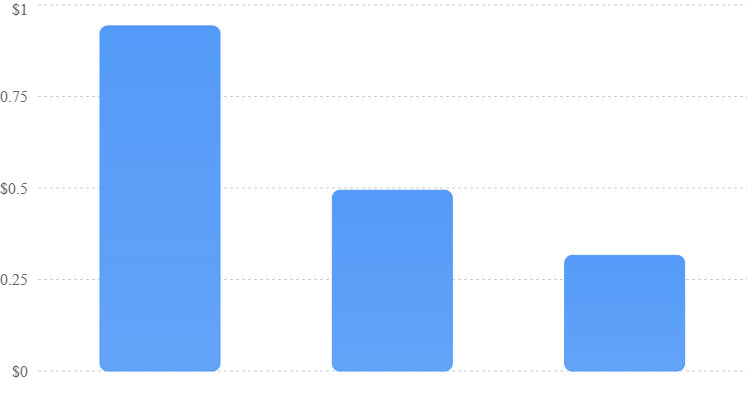
SFTechScene hypothetical scenario model. These are not vendor performance measurements. Costs exclude additional fixed expenses.
Agent C becomes the least expensive option under these assumptions despite having the highest direct AI charge.
The reason is simple: fewer mistakes create less work for employees.
This changes how San Francisco businesses should compare OpenAI, Anthropic, and Google. The lowest advertised price per token may not produce the lowest cost per business result.
Finding #8: The Value of Reliability Depends on the Cost of Failure
Our economic model also allows us to calculate how expensive failure handling must become before the more reliable agent is financially attractive.
We compare Agents A and C using their respective direct costs and completion rates.
Agent A has a direct cost of $0.06 and a 30% failure rate. Agent C has a direct cost of $0.20 and a 5% failure rate.
The cost difference is $0.14 per attempt, while the failure-rate difference is 25 percentage points.
Therefore:
\[ \text{Break-even failure cost} =\frac{\$0.20-\$0.06}{0.30-0.05} =\$0.56 \]
If handling each failure costs more than $0.56, Agent C has lower combined cost per attempt under these assumptions.
This is particularly relevant to financial operations, customer support, accounting, and software development. In those areas, even a small error may trigger several minutes of correction or create additional downstream problems.
In low-risk tasks, a cheaper and less reliable agent may still be worthwhile. In high-risk tasks, paying for reliability can be the better financial choice.
An Interactive Agent Cost Model for San Francisco Businesses
The following calculator lets companies test the economics using their own assumptions. Its results are scenario estimates, not live prices or measured vendor performance.
Enterprise agent economics calculator
Scenario model
Adjust the inputs to estimate monthly variable cost and the cost per successful task.Tasks attempted per month
10,000AI cost per attempt
$0.12Correct completion rate
85%Human handling cost per failed task
$2.00
Monthly variable cost
$4,200.00
Cost per correct task
$0.49
Correct tasks
8,500
Tasks requiring correction
1,500
Assumes one AI attempt per task and a fixed handling cost for each failure. Excludes fixed engineering expenses, subscription fees, taxes, and the cost of errors that go undetected.Reset assumptions
Original SFTechScene Research #5: Why San Francisco Startups Should Evaluate the Cost of Switching Models
AI platform selection is usually treated as a model comparison. But over several years, the ability to switch providers may have financial value of its own.
A startup can build an agent directly around one provider’s tools. This may simplify early development, but it can also make future changes more expensive.
Another startup may separate its business rules, tests, data access, and workflow management from the underlying model. That can require additional engineering at the beginning but reduce the work involved in moving between providers.
The right approach depends on how often the company expects to change models and how much those changes could save.
Research Methodology: A Three-Year Switching-Cost Model
SFTechScene constructed a simple financial scenario to examine when model portability becomes worthwhile.
We assume a startup spends $100,000 annually on AI-related usage. Building a provider-independent application structure requires an additional $15,000 in development work.
We then test three cases: no future savings, a 10% reduction in annual usage costs, and a 20% reduction. Savings are assumed to begin after the first year and continue for the remaining two years.
This is not a forecast of model prices. It is a decision model showing the trade-off between engineering investment and potential savings. It excludes discounting, migration expenses, and differences in model performance.
| Scenario | Additional build cost | Savings in years 2–3 | Net three-year benefit |
|---|---|---|---|
| No future savings | $15,000 | $0 | −$15,000 |
| 10% lower usage costs | $15,000 | $20,000 | +$5,000 |
| 20% lower usage costs | $15,000 | $40,000 | +$25,000 |
The main finding is that portability is not automatically worth building. It becomes valuable when future savings or operational benefits exceed the extra engineering cost.
For a small prototype with limited spending, a simple single-provider design may be sufficient. For a growing company with large AI expenses, the ability to switch providers can become much more important.
Finding #9: The Best Long-Term Architecture May Use Several Models Without Depending on Any One
A practical multi-provider system does not need to send every task to three companies.
Instead, a business can use a primary model for routine work and reserve alternatives for specific needs. Coding tasks might use one model, document analysis another, and a lower-cost model for simple classification.
The company should maintain one consistent way to record outcomes, errors, costs, and permissions. That gives it the evidence required to decide whether switching improves performance.
This approach reduces the risk of choosing a provider based on temporary benchmark leadership. It also allows the business to adopt newer models as they become available.
However, multi-provider design introduces its own costs. Teams must manage different APIs, security configurations, data-handling rules, and failure modes. The architecture should only become more complex when testing shows a clear benefit.
Which Company Is Best for Different Enterprise AI Agent Use Cases?
The provider that wins a coding project may not be the best choice for accounting or customer service. Businesses should match platform selection to the specific tasks they want to automate.
The following recommendations are starting hypotheses based on product positioning and public adoption evidence, not the results of a controlled three-vendor benchmark.
| Business use case | First provider to evaluate | Why |
|---|---|---|
| Software development agents | Anthropic | Strong public evidence of enterprise coding adoption |
| Shared research and reporting workflows | OpenAI | Workspace agents and managed agent offerings |
| Google Cloud data operations | Integrated analytics, cloud, identity, and governance | |
| Cross-functional employee productivity | OpenAI and Google | Both offer broad employee-facing environments |
| Technical research agents | Anthropic and OpenAI | Developer-oriented agent tools and long-running workflows |
| Enterprise-wide agent governance | Google and OpenAI | Central platforms designed for managed business deployment |
| Specialized customer support agents | Test all three | Real task completion and cost matter more than general positioning |
| Document-heavy regulated workflows | Test all three | Approval, security, and accuracy must be validated locally |
AI Coding Agents: Anthropic Has the Strongest Historical Spending Signal
Anthropic’s estimated 54% share in coding-related foundation-model usage is a meaningful indicator of developer adoption. However, it is not proof that Claude outperforms every competing model on every coding task.
Menlo Ventures
A San Francisco software team should evaluate the agents on its own codebase. Useful tests include fixing known bugs, writing tests, making small updates, and explaining unfamiliar code.
The most important measure is whether engineers accept the resulting changes and whether those changes pass tests without creating new problems.
Teams should also record how much time engineers spend correcting AI-produced code. A coding agent that generates large amounts of work but requires extensive review may provide less benefit than a slower system that produces smaller, dependable changes.
Sales and Customer Support: The Winner Must Be Determined Through Real Workflow Tests
Sales and support operations are attractive for AI agents because they contain many repeated tasks. Agents can summarize inquiries, retrieve customer details, draft responses, create follow-up records, and identify requests requiring escalation.
However, these workflows depend heavily on company information and software integrations.
A support agent must know whether a customer has an active subscription, what support policies permit, and when a request should be handled by a human. Without that context, even a capable model can make costly mistakes.
Businesses should compare all three providers on resolution quality, response time, human intervention, and cost. They should also test whether agents follow permission boundaries and avoid unsupported commitments.
A model that produces persuasive messages but invents refund policies is not ready for production.
Finance and Accounting: Governance May Matter More Than Model Intelligence
Financial workflows require careful controls because errors can directly affect money, compliance, and reporting.
An agent that prepares an invoice summary may be relatively low-risk. An agent allowed to change payment details or initiate transactions requires much stronger safeguards.
Google’s enterprise governance tools may be attractive to organizations already operating in Google Cloud. OpenAI and Anthropic also provide enterprise controls and development options that deserve evaluation.
Rather than choosing a vendor based on a feature checklist, finance teams should run tests that include duplicate invoices, changed banking details, missing approvals, and inconsistent records.
The agent must know when to stop and ask for human review. Successful automation sometimes means refusing to complete a risky action.
Research and Analysis: The Strongest Agent Is the One That Verifies Its Work
Research agents can save time by collecting information, comparing documents, extracting findings, and preparing structured reports.
The risk is that an agent may confuse an outdated statement with current information or treat an unreliable source as authoritative.
For a San Francisco investment firm, marketing agency, or consulting company, research quality depends on traceable sources and careful interpretation.
Tests should measure whether agents identify the correct documents, quote facts accurately, distinguish evidence from assumptions, and flag uncertainty when data is missing.
Long and polished reports are not evidence of accuracy. A shorter report that clearly identifies what is known and unknown may be much more valuable.
The Biggest Risk in the Enterprise AI Agent Race Is Not Model Quality
AI Agents Can Make Mistakes That Have Real Business Consequences
Traditional AI errors often appear as incorrect text. Agent errors can extend into actions.
An agent might send information to the wrong person, change an important database entry, delete a file, or update a customer record without sufficient evidence.
This changes the security requirements for enterprise AI. Companies must design systems that control not only what an agent can read but also what it can change.
OpenAI’s March 2026 research on prompt-injection attacks explains why this problem is difficult. Attackers can place instructions inside external content that an agent encounters, attempting to persuade it to perform actions outside the user’s original request.
OpenAI
An agent could encounter such instructions in a webpage, document, email, or search result. The safer design is to limit the agent’s permissions and independently check sensitive actions rather than expecting the model to identify every malicious instruction.
Human Approval Should Focus on High-Risk Actions
Requiring approval for every action would make many agents slow and expensive. Allowing unrestricted activity creates a different set of problems.
A practical approach is to divide actions according to business risk.
Reading public information, drafting internal reports, and preparing proposed changes may require relatively little oversight. Sending confidential information, changing payment details, deleting business records, or making legal commitments should receive stronger controls.
The decision should depend on the possible damage, whether the action can be reversed, and whether a mistake would be detected quickly.
The most useful agents are not necessarily those that operate without people. They are those that can handle routine work independently and involve employees when judgment is genuinely necessary.
Enterprise Buyers Need Independent Testing
Vendor benchmarks are useful for identifying promising models, but they rarely reproduce an individual company’s exact operating environment.
A model might perform well on a public coding benchmark and struggle with an older company’s internal software. Another may be excellent at summarization but have difficulty following a complicated approval process.
Anthropic’s published work on agent evaluation recommends testing repeated attempts, tool interactions, and complete execution paths rather than relying on one successful example.
anthropic.com
SFTechScene recommends using the same test cases, tools, business data, and scoring rules for each provider. This allows companies to compare real outcomes rather than marketing claims.
How San Francisco Startups Can Choose Their Enterprise AI Agent Platform in 90 Days
A startup does not need an enormous technology budget to make an informed decision. It does need a clear workflow, measurable outcomes, and enough testing to discover problems before customers encounter them.
The following 90-day approach is designed for San Francisco startups and growing businesses evaluating OpenAI, Anthropic, or Google.
Days 1–15: Choose One Valuable Business Workflow
Start with a process that happens frequently and consumes measurable employee time. Good candidates include support ticket triage, weekly reporting, customer research, internal knowledge searches, or routine engineering maintenance.
Avoid choosing a process merely because it looks impressive in a demonstration. The strongest early projects have clear inputs, clear expected outputs, and a straightforward way to check whether the result is correct.
Record how much time employees currently spend on the work. Measure the number of tasks completed each month and the frequency of errors or exceptions.
Without this baseline, the business will struggle to determine whether automation creates measurable value.
Days 16–30: Build a Common Evaluation Dataset
Create a representative set of at least 100 tasks from the selected workflow. Include routine cases, difficult cases, incomplete information, and requests the agent should refuse.
For higher-risk workflows, 100 tasks should be treated as an initial development sample, not proof that the system is safe for widespread deployment.
Each task should include the information the agent may access, the expected result, any actions requiring approval, and the rules used to judge completion.
Separate a development set from a final test set. This prevents teams from repeatedly changing prompts until they perform well on examples the agent has effectively seen before.
Days 31–45: Test OpenAI, Anthropic, and Google Under Comparable Conditions
Run the same business tasks using appropriate products from each provider.
For a fair comparison, standardize the workflow instructions, tool permissions, available information, and maximum allowed attempts as much as possible.
Some platform features will differ, and those differences should be recorded rather than hidden.
Measure results across several dimensions.
| Metric | What it measures | Why it matters |
|---|---|---|
| Correct completion rate | Tasks completed accurately | Core business value |
| Human review time | Employee effort needed | True labor savings |
| Cost per correct task | Total variable cost relative to success | Unit economics |
| Unauthorized action rate | Actions outside permissions | Security |
| Recovery rate | Ability to handle failures | Reliability |
| Completion time | Time from request to result | Operating speed |
| Evidence quality | Accuracy of supporting information | Trust and auditability |
Avoid relying on a single weighted score to hide these differences. A provider should not compensate for serious security failures simply by performing well on speed or price.
Days 46–60: Build a Controlled Pilot
Select the provider that performs best against the most important business requirements. Then develop a small production pilot.
Begin with limited access to business systems. Use test data or read-only permissions wherever possible.
Record the agent’s actions, tool calls, costs, and errors. Establish clear rules for when it should request human approval.
Keep the pilot narrow enough that the team can inspect results carefully. Expanding too quickly makes it harder to understand which changes caused improvements or failures.
Days 61–75: Measure Financial Results
Compare the pilot’s results against the original process.
A useful calculation is:
\[ \text{Net monthly value} =\text{Value of productive time saved} -\text{Added operating costs} \]
However, time saved should not automatically be treated as cash savings. A company only realizes a financial benefit when that time supports more valuable work, reduces real expenses, or increases output.
For example, saving ten hours each week may allow a customer-support employee to handle more difficult requests. That creates capacity, but the business must measure whether service quality or operating economics actually improve.
Include engineering support, employee training, monitoring, and correction work in the calculation. These costs can materially change the result.
Days 76–90: Expand Only If the Evidence Supports It
A successful pilot should produce clear evidence that the agent completes useful work reliably and delivers an acceptable financial return.
If the results are weak, investigate the reason before expanding. The problem may be poor data, excessive workflow complexity, limited permissions, or the wrong model.
Switching providers is one possible response, but it is not always the right one.
If the pilot succeeds, gradually increase the number of tasks and users. Continue testing whenever models, tools, or business rules change.
This turns agent deployment into an ongoing improvement process rather than a one-time software purchase.
Who Will Actually Win the Enterprise AI Agent Race in 2026?
The answer depends on which part of the market is being measured.
Anthropic Is the Leader in the Available Enterprise API Share Data
Menlo Ventures’ 2025 estimates place Anthropic ahead of OpenAI and Google in enterprise foundation-model API spending share. Its strength in coding is a major reason behind that position.
This makes Anthropic a serious contender for the enterprise intelligence layer. Companies building custom applications have demonstrated a willingness to spend heavily on Claude models.
However, those figures do not establish that Anthropic leads in total enterprise AI revenue, workplace subscriptions, or successfully completed agent tasks.
Its longer-term challenge is maintaining developer adoption while expanding its workplace platform and enterprise relationships.
OpenAI Is Competing to Own the Shared Agent Experience
OpenAI’s advantage lies in connecting advanced AI models with products used directly by individuals, teams, and developers.
Its expansion into workplace agents, Frontier, and managed agent APIs suggests a strategy aimed at making the company an important part of how organizations complete work.
If businesses increasingly create and share agents within familiar workplace interfaces, OpenAI could capture substantial value beyond traditional API calls.
But that opportunity depends on reliability, integration quality, predictable costs, and long-term product stability.
Google May Have the Strongest Route Into Existing Enterprise Infrastructure
Google can reach businesses through cloud infrastructure, data services, workplace applications, and enterprise partnerships.
It also has the opportunity to benefit from agent activity that uses third-party models running through its infrastructure.
For large companies with extensive existing systems, integrated security and governance may matter as much as the quality of any individual model.
Google’s challenge is ensuring that its broad platform remains simple enough for businesses to use efficiently.
SFTechScene’s 2026 Assessment
| Market segment | Current assessment | Confidence |
|---|---|---|
| Enterprise foundation-model API spending share | Anthropic leads in the cited 2025 estimates | High for the cited dataset |
| Coding-related API adoption | Anthropic leads in Menlo’s 2025 estimates | High for the cited dataset |
| General workplace agent adoption | No verified cross-vendor winner | Insufficient comparable data |
| Enterprise agent infrastructure | Google has a strong structural position | Qualitative assessment |
| Shared AI agent experiences | OpenAI is strongly positioned | Qualitative assessment |
| Lowest cost per successful task | Depends on the workflow | Must be tested |
| Overall enterprise agent winner | Not established | Insufficient comparable data |
These confidence descriptions concern the strength of the available evidence, not the probability that a company will win.
The key limitation is that no consistent public dataset used in this report measures total enterprise agent spending, successful task completion, costs, and deployed usage across all three vendors under the same definition.
A single overall winner would therefore be more of a prediction than a research finding.
What the Competition Means for San Francisco’s AI Startup Ecosystem
Model Competition Can Create Opportunities for Application Startups
The three major providers are investing heavily in making AI models and agent platforms more capable.
For smaller companies, that can reduce the need to build expensive foundational technology. Startups can focus on solving specific business problems rather than training large models themselves.
A San Francisco founder building an AI accounting service, for example, may find greater value in understanding accounting procedures, building trustworthy integrations, and measuring task accuracy than in creating a general-purpose model.
The defensible part of the business may come from its customer relationships, proprietary workflow information, high-quality evaluations, and deep industry knowledge.
The Biggest Opportunity May Be the Software Around the Models
As models become more capable, businesses still need ways to control and verify their actions.
This creates demand for software that manages permissions, evaluates results, records decisions, monitors costs, and handles failures.
An agent that works during a demonstration can be relatively easy to create. An agent that handles important business tasks reliably across thousands of cases is much harder.
San Francisco startups that solve those operational problems can potentially serve customers across all three major providers.
That may create a stronger business than depending on a narrow feature advantage that a model company could quickly reproduce.
Vendor Independence Can Become a Competitive Advantage
Businesses should avoid making unnecessary assumptions about which provider will remain strongest.
The model landscape has already changed considerably between 2023 and 2025. Further changes in performance, pricing, and products remain possible.
A startup with well-designed testing, clear business rules, and flexible integrations can respond more effectively to those changes.
This does not mean every company should build complicated systems that constantly switch models. It means companies should retain control of the information and processes that make their products valuable.
Frequently Asked Questions
Is Anthropic Bigger Than OpenAI in Enterprise AI?
Anthropic led OpenAI in Menlo Ventures’ estimated 2025 enterprise foundation-model API spending share, at 40% versus 27%. That is a specific market segment and should not be confused with total company revenue, number of business customers, or overall enterprise agent usage.
OpenAI also operates major workplace and developer products, so the broader comparison requires additional data.
Is Google Gemini Better Than ChatGPT for Business?
It depends on the company’s needs. Google may offer advantages for organizations already using Google Cloud, Workspace, and related data tools, while OpenAI offers its own broad workplace and developer agent products.
A business should compare the actual workflow rather than treating the brand as a substitute for testing.
Is Claude the Best AI for Coding Agents?
Anthropic has strong enterprise coding adoption evidence, including a leading estimated share in Menlo’s 2025 research. However, market adoption is not a universal measure of technical superiority.
A software team should compare agents on its own codebase, including test results, accepted changes, review time, and maintenance costs.
Should a Startup Use More Than One AI Provider?
Sometimes. A multi-provider design can provide flexibility and make it easier to choose different models for different tasks.
However, managing several providers increases engineering, security, and monitoring work. The additional complexity is worthwhile only when it produces measurable benefits.
Will Enterprise AI Agents Replace Traditional SaaS Software?
Agents may replace some manual interactions with traditional applications, but they still require underlying data, permissions, records, and transaction systems.
Many existing software products may become important services that agents access behind the scenes.
The more immediate change is likely to involve how employees use business software rather than the complete disappearance of that software.
What Is the Most Important Enterprise AI Agent Metric?
For many workflows, the most useful economic metric is the total cost per correctly completed task.
Companies should measure that alongside security, human review requirements, completion time, and the consequences of mistakes.
No single financial metric can substitute for basic safety and business controls.
Research Sources and Methodology Notes
This report uses public research and official product documentation available through October 21, 2026.
The main market dataset is Menlo Ventures’ 2025 State of Generative AI in the Enterprise, which includes survey-based market estimates and reported methodology. SFTechScene independently calculated percentage-point changes, implied spending allocations, market concentration bounds, and sensitivity scenarios from the published figures.
Menlo Ventures
The original economic and switching-cost models are hypothetical decision analyses. Their assumptions are explicitly stated, and they are not presented as actual performance results for OpenAI, Anthropic, or Google.
The primary product references include OpenAI’s official announcements of Frontier, workspace agents, and the Agents API; Anthropic’s enterprise and engineering documentation; and Google’s official Gemini Enterprise Agent Platform materials.
OpenAI
+5
Vendor-reported customer outcomes are useful examples but are not treated as independently verified, standardized benchmarks. Public market shares are also estimates, and comparisons across different categories should not be interpreted as directly equivalent.
Final Takeaway: The Enterprise AI Agent Winner Will Be the Company That Delivers Reliable Business Results
The enterprise AI agent race is no longer just a contest over which model answers questions most accurately.
Anthropic has demonstrated a strong position in enterprise API spending and coding-related adoption. OpenAI is building a broad system for workplace agents and developer automation. Google is connecting agents to established enterprise cloud infrastructure, data, security, and software environments.
Each company has a credible route to becoming a major enterprise AI platform. The available evidence does not establish a single overall winner in 2026.
For San Francisco businesses, that uncertainty is not necessarily a problem. Competition gives companies more options and creates opportunities to select technologies based on their actual needs.
The strongest approach is to choose a valuable workflow, create clear tests, measure the cost of successful completion, and use the provider that performs best under real operating conditions.
Companies should also retain control over their business data, permissions, evaluation methods, and critical processes. That protects them from becoming too dependent on changes outside their control.
The biggest winners in enterprise AI may not be the businesses that choose the most popular model. They may be the businesses that learn how to turn increasingly capable models into dependable, measurable, and profitable work.
For San Francisco’s AI ecosystem, that is the opportunity worth pursuing.