
San Francisco has always attracted people who want to turn ambitious ideas into real businesses. But something important is changing in how those ideas become software. A founder can now describe an application in plain English, ask an AI tool to build it, test the result, and publish a working version without spending months writing code.
This new approach is called vibe coding, and it is changing what it takes to start a software company. Tools such as Replit, Lovable, Cursor, and Claude Code allow founders to move from an idea to a working product faster than traditional software development often permits.
The opportunity is particularly interesting in San Francisco, where startups compete for customers, investors, and talented employees. When building an early product becomes cheaper, founders can spend less money testing their ideas and more time finding out whether anyone actually wants what they are building.
But there is an important difference between launching an application in one day and building a successful startup in one day. AI can shorten the time needed to create software, but it cannot automatically find paying customers, make a weak idea valuable, or guarantee that the finished application is safe.
In this article, SFTechScene examines how founders can use vibe coding to launch useful applications in a single working day. We also analyze public developer survey data, compare real software platform prices, create original launch-cost models, and develop a practical framework for deciding which startup ideas are suitable for rapid AI development.
The goal is not to celebrate how quickly AI can generate code. It is to show San Francisco founders how to turn that speed into a real business advantage.
The Short Version: Vibe Coding Is Making One-Day Startup Launches Possible, but Finding Customers Still Matters More Than Writing Code
A founder no longer needs a complete engineering team to build the first version of every software product. AI development tools can help create user interfaces, connect databases, build simple dashboards, add login systems, and publish applications using natural language instructions.
The shift is already visible in developer behavior. The 2026 Stack Overflow Developer Survey found that 65.9% of respondents use AI coding assistants or coding agents at work, while 73% of those users report using them daily. These are global survey results rather than San Francisco-specific figures, but they show that AI-assisted coding has moved beyond occasional experimentation. Stack Overflow Developer Survey+1
The business opportunity is straightforward. A founder who previously needed several weeks to test a product concept may now be able to show customers a usable first version within a day, especially when the idea involves a simple web application.
However, speed introduces another problem. If founders can create software before they fully understand their customers, they may end up producing applications that look impressive but solve problems nobody considers important.
That creates a new rule for launching startups in San Francisco: build quickly, but learn even faster.
The 2026 AI coding landscape
65.9%
Use AI coding assistants or agents at work
73%
Of AI coding tool users use them daily
9.6%
Use AI development answers without checking them
Source: Stack Overflow 2026 Developer Survey. The percentages have different question populations and should not be added together. Stack Overflow Developer Survey+1
For founders, three lessons stand out. AI coding is becoming normal, human checking remains essential, and the most valuable advantage is the ability to test customer demand without making a large investment.
What Is Vibe Coding, and Why Is It Changing Startup Development?
Vibe Coding Turns Software Creation Into a Conversation
Traditional software development requires someone to understand programming languages, software structure, databases, and application design. A developer takes a business requirement, writes the code, tests it, and gradually turns it into a usable product.
Vibe coding changes the first part of that process. Instead of writing every line of code, the founder describes what the application should do and uses an AI system to create or change the software.
For example, a founder might ask:
Build a simple web application for independent San Francisco consultants. Users should be able to create an account, track client projects, record invoice amounts, and see which payments are overdue. Use a clean design that works well on mobile devices.
An AI coding tool can turn that description into application pages, code, and data structures. The founder can then request changes using ordinary language rather than manually editing every part of the software.
The result is a faster conversation between the founder and the application. Instead of waiting for a development team to complete another round of work, the founder can ask the AI to make specific changes and review the results.
The Difference Between AI-Assisted Coding and Vibe Coding
Not every use of AI in software development is vibe coding. An experienced engineer who asks AI to explain a function or help write a test is using AI-assisted development, but still controls the details of the code.
Vibe coding usually involves giving the AI a larger role in creating the application. The founder focuses mainly on the desired result while the AI handles much of the technical implementation.
This distinction matters because the amount of human review should increase as the application becomes more important. A private demonstration can be built with relatively little oversight, while software that manages customer money or private records needs far more careful testing.
Why the Shift Matters for San Francisco
San Francisco has a large concentration of software companies, investors, founders, and people working with emerging AI tools. That makes it a natural environment for experimenting with faster ways to create products.
In March 2025, TechCrunch reported that approximately one-quarter of Y Combinator’s Winter 2025 startups had codebases that were almost entirely AI-generated, based on remarks from YC managing partner Jared Friedman. That does not mean those businesses were launched in one day, but it provides an early example of AI-generated code being used seriously inside the Silicon Valley startup ecosystem. TechCrunch
The larger change is economic. If a founder can create a working application before hiring several engineers, they can postpone some early expenses until they have better proof of demand.
That does not eliminate the need for engineering talent. It changes when that talent becomes necessary and what problems it should solve.
Why San Francisco Founders Are Interested in the One-Day Startup Model
The Old Startup Process Required More Time Before Customer Feedback
Consider a founder who wants to build scheduling software for small professional service businesses. Under a traditional development process, they might spend weeks preparing requirements, finding developers, reviewing designs, and building an initial product.
During those weeks, the founder could still be uncertain whether anyone would pay for the software. The risk is that development costs grow before the business has learned enough about its market.
With vibe coding, the founder can create a much smaller version first. Instead of building a complete scheduling platform, they might build a page that lets businesses create appointment links and receive booking requests.
That application may be enough to test whether potential customers have a strong reason to switch from their existing tools.
Smaller Experiments Can Produce Better Decisions
Faster development changes how startup experiments can be structured. Rather than spending an entire quarter on one product concept, a founder can test several narrower ideas over a shorter period.
Imagine three possible products for San Francisco businesses: a rental-property maintenance tracker, a tool for managing freelance project deadlines, and a customer follow-up dashboard for independent service providers. Each addresses a different need, and none requires a complete business platform to test the basic value.
The founder could create small demonstrations and show them to real potential customers. The idea that generates the strongest interest would receive more development time, while the others could be paused before becoming expensive.
The benefit is not simply that more applications can be produced. It is that a founder can make decisions using customer reactions instead of personal assumptions.
AI Makes the First Experiment More Accessible
A person with industry experience but limited programming knowledge can now try to build software around a problem they understand well. This creates an opening for consultants, small-business owners, operations specialists, and other professionals who were previously dependent on outside developers.
For example, someone who has spent years managing local property maintenance may know exactly where existing software creates problems. Vibe coding gives that person a way to test a focused solution without first becoming a professional programmer.
Industry knowledge remains a valuable advantage. The AI might create the screens, but it is the founder who must understand the work customers want those screens to perform.
Original SFTechScene Research #1: How Large Is the AI Coding Opportunity in 2026?
Original secondary-data analysis | Published October 30, 2026
To understand the environment facing new founders, SFTechScene analyzed the public results of the 2026 Stack Overflow Developer Survey. The aim was to distinguish broad AI adoption from the specific use of AI tools that can help founders build applications.
Research Methodology
We used the published response counts from Stack Overflow’s 2026 AI usage question, which had 17,464 respondents. The question allowed people to select multiple types of AI tools, meaning a developer could appear in more than one category.
We separated four categories: coding assistants, general-purpose AI chat tools, automated agent workflows, and internal company AI tools. We then calculated their shares of the question’s respondent population and compared the results.
Because this survey uses a self-selected global group of technologists, the findings cannot establish adoption rates among all San Francisco founders. They describe survey respondents, not a random sample of startup businesses.
What the Public Data Shows
Use of AI tool categories at work
Share of respondents selecting each category; multiple responses were allowed.
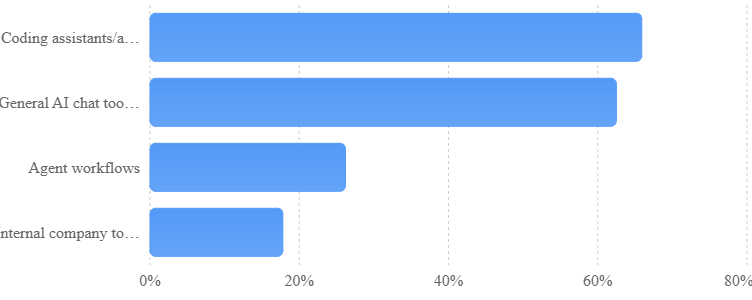
Source: Stack Overflow 2026 Developer Survey, n = 17,464.
Source: Stack Overflow’s published 2026 AI usage data. Stack Overflow Developer Survey+1
| AI tool category | Respondents | Reported share |
|---|---|---|
| Coding assistants or coding agents | 11,509 | 65.9% |
| General-purpose AI chat tools | 10,920 | 62.5% |
| Automated AI agent workflows | 4,582 | 26.2% |
| Internal AI tools | 3,115 | 17.8% |
| No AI tools | 3,003 | 17.2% |
The strongest finding is that coding-specific AI tools have become at least as prominent as general AI chat applications within this respondent group. For startup founders, this suggests that the ecosystem is moving beyond using AI merely to brainstorm product ideas.
AI is increasingly being used to create the actual software.
Original Finding: At Least 28.4% of Respondents Used Both Coding AI and General AI Chat Tools
The published category totals allow us to calculate something useful even without access to individual response records.
There were 11,509 respondents using AI coding tools and 10,920 using general-purpose AI chat tools, from a question population of 17,464.
Using the inclusion-exclusion principle, the minimum possible overlap is:
\[ 11,509+10,920-17,464=4,965 \]
That means at least 4,965 respondents, or approximately 28.4% of the question population, selected both categories.
The maximum possible overlap is 10,920 respondents, or approximately 62.5%. The precise overlap cannot be identified from these public aggregate totals alone.
SFTechScene’s calculated overlap bounds
28.4%
Minimum possible overlap
62.5%
Maximum possible overlap
The darker portion is the guaranteed minimum overlap; the lighter portion is the additional possible overlap. Derived from the published question counts, not individual respondent records.
Why does this matter? It shows that using AI to discuss ideas and using AI to write software are not necessarily separate activities.
Even under the most conservative overlap scenario, more than one-quarter of the respondents could be using both types of tools. This supports the practical idea of a connected founder workflow in which AI helps define the product, build the application, and troubleshoot problems.
It does not tell us how many respondents are startup founders or whether they can build complete applications in a day. Those questions require a separate founder-level study.
What San Francisco Founders Should Do With This Finding
Founders should avoid treating AI as a collection of unrelated tools. A better approach is to create a connected workflow where the product description, application requirements, and testing notes remain consistent.
For example, a founder might use a general AI assistant to narrow the customer problem, an AI app builder to create the initial product, and a coding agent to investigate errors. Keeping the same requirements across these steps reduces confusion.
The value comes from creating a repeatable process that turns customer information into working software, rather than learning every new AI tool that appears.
Original SFTechScene Research #2: Why San Francisco’s Startup Ecosystem Makes Rapid AI Development Especially Valuable
The value of vibe coding depends partly on the environment in which founders use it. A startup ecosystem with active investors, early customers, potential partners, and experienced technical professionals can make a fast product launch more useful.
San Francisco offers access to many of these resources. But to understand its position properly, we need to look at actual startup activity rather than simply assume that every AI development trend is centered in the city.
Research Methodology
For this analysis, SFTechScene used Carta’s March 2026 report on startup fundraising across U.S. metropolitan areas. The report examines startups using Carta and compares their fundraising activity during 2025.
We calculated the Bay Area’s funding lead over other major ecosystems and considered what this means for founders launching smaller, AI-assisted applications. The figures cover the San Francisco Bay Area metropolitan ecosystem, not San Francisco city limits, and they are not measurements of vibe-coded startup formation.
The Bay Area’s Share of Startup Funding
Share of U.S. startup funding in 2025
Selected startup ecosystems, based on Carta’s reported funding shares.
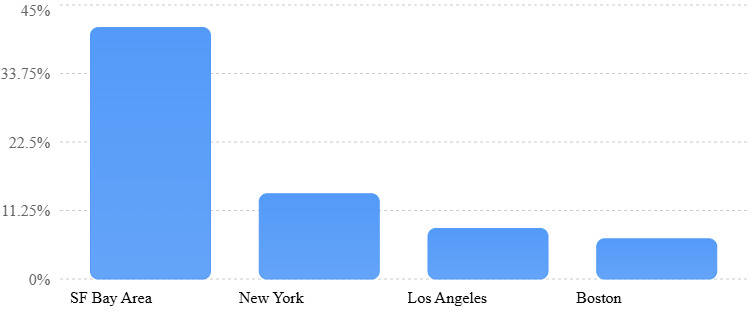
Source: Carta, March 30, 2026. Bay Area is a regional figure.
Carta reports that Bay Area startups raised $39.92 billion in 2025, representing 41.3% of the funding raised by startups in its U.S. dataset. New York accounted for 14%, Los Angeles for 8.3%, and Boston for 6.6%. Carta
Original Finding: The Bay Area’s Funding Share Was Nearly Three Times New York’s
Using Carta’s published percentages:
\[ \frac{41.3}{14}=2.95 \]
The Bay Area’s funding share was approximately 2.95 times New York’s share. It also exceeded the combined shares of New York, Los Angeles, and Boston by 12.4 percentage points.
These calculations reinforce how concentrated startup capital remains in the Bay Area. They do not mean an individual founder is likely to raise money, because a large part of regional funding can go to established companies and major financing rounds.
That distinction matters for vibe coding. A founder should not treat the presence of venture capital as proof that investors will fund an application simply because it was built quickly.
Instead, the regional advantage lies in opportunities to collect feedback, meet customers, identify technical partners, and show early evidence that a product solves a useful problem.
Why Faster Product Creation Could Improve the Bay Area’s Startup Experimentation
Imagine two founders targeting the same customer problem. One spends two months developing an initial product without showing it to customers, while the other creates a smaller working version and starts collecting feedback during the first week.
The second founder can discover mistaken assumptions earlier. If the product is useful, they can improve it. If customers show little interest, they can change direction before committing substantial resources.
In a region where founders can meet other builders and prospective buyers, a working demonstration may lead to more useful conversations than a long product presentation.
This is especially relevant to business software. A founder can show a real workflow, let a potential customer complete a task, and observe exactly where the product helps or fails.
Which Startup Ideas Can Realistically Be Built in One Day?
Not every startup idea is a good candidate for rapid AI development. A simple application that manages forms and records is fundamentally different from a financial platform moving customer money or a medical application handling sensitive patient information.
The strongest candidates have a narrow purpose, straightforward user interactions, limited outside connections, and a clear way to demonstrate value.
Five Types of Applications Worth Considering
| Startup idea | What a first version should do | One-day suitability | Main challenge |
|---|---|---|---|
| Freelancer invoice tracker | Record invoices and payment status | High | Accurate records |
| Simple appointment request tool | Collect booking requests | High | Preventing conflicts |
| Local business lead tracker | Organize prospects and follow-ups | High | Protecting customer information |
| Property maintenance tracker | Record issues and assigned work | High | Permissions and notifications |
| AI research organizer | Save and group research notes | Medium | Accuracy and AI usage costs |
| Multi-user financial platform | Move funds and manage balances | Low | Security and regulation |
| Medical decision application | Interpret patient information | Low | Safety, privacy, and validation |
The suitability categories are SFTechScene editorial assessments, not observed success rates.
Why Narrow Business Applications Are Often Better Starting Points
A simple business application can deliver value without requiring advanced technology. If a customer currently tracks important work through spreadsheets, email, and messages, a focused application may make the process easier.
Consider a tool for managing property inspection tasks. The initial version might let a manager enter a property, create inspection items, assign deadlines, and see which tasks are complete.
There is no reason to include predictive analytics, automated contractor payments, complex reporting, or multiple property management integrations on the first day. Those features can be explored after customers demonstrate that the basic workflow is useful.
Why Consumer Social Applications Are Harder
A consumer social application may be easy to make visually attractive using AI. Building an interface with profiles, posts, and messages is no longer the same technical challenge it once was.
The business problem is much harder. People must have a reason to join, stay active, and invite others, while the company needs systems for content safety, abuse prevention, and user support.
A founder might build a working social application in a day without being any closer to solving those problems.
Why Regulated Applications Need a Different Approach
Products involving financial transactions, medical information, sensitive personal records, or safety-critical decisions should not be treated as ordinary one-day launches.
AI tools may help create prototypes and internal demonstrations, but the finished product needs appropriate security, legal review, and testing before it handles real customer information or makes important decisions.
A useful distinction is between a demonstration that proves an idea and a public service trusted with customer data. The first can often be created quickly; the second requires a higher standard of care.
The One-Day Startup Launch Plan: From Idea to Working Application in Eight Hours
A useful one-day launch needs a strict schedule. Without one, founders can easily spend the entire day changing colors, adding features, or asking AI to rebuild parts of the application.
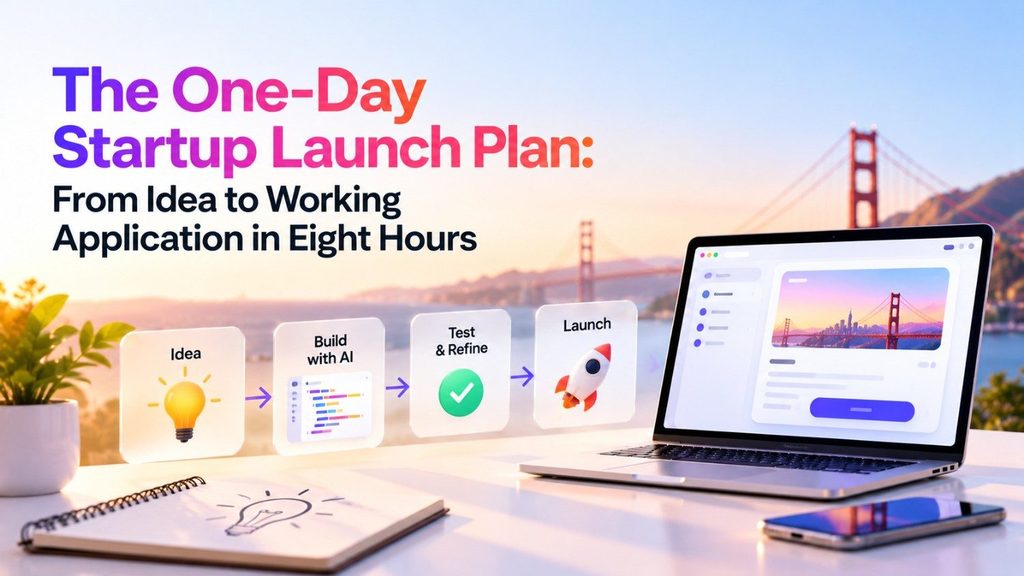
For this model, we assume the founder has already identified a plausible customer problem and has access to an AI application builder. The goal is a working, limited-scope web application suitable for a small group of testers, not an unrestricted public release of security-sensitive software.
The eight-hour launch schedule
SFTechScene planning model — 480 minutes total
Customer problem and scope
45 min
App specification and setup
45 min
Build the core workflow
120 min
Fix errors and test
120 min
Prepare landing page
60 min
Show testers and record feedback
60 min
Document result and next steps
30 min
Illustrative time budget, not a measured average or a guarantee of completion.
Hour 1: Find a Problem Small Enough to Solve
The first hour should focus on defining what the application will accomplish. Founders should avoid starting with a list of exciting AI features, because that usually produces software that is complicated before it becomes useful.
Instead, write a short description of a specific customer, a repeated problem, and the result the customer wants.
For example, an independent marketing consultant may spend time tracking whether clients have approved campaign materials. The customer is clear, the problem occurs regularly, and the desired result is easy to understand.
A suitable first version could let consultants create a project, upload an approval request, and record whether the client has accepted it. That single workflow becomes the focus of development.
Write One Clear Product Promise
The product promise should describe the result rather than the technology. A useful version might be: “Help small marketing teams track client approvals without losing requests in email.”
This promise also becomes the basis for the landing page. Customers should understand what the product does before they are asked to create an account.
Decide What Will Not Be Built
The founder should explicitly exclude advanced reporting, mobile applications, complex roles, and unnecessary integrations. A one-day project becomes much easier when every feature must justify its presence.
The objective is to build enough functionality to test one important customer behavior. Everything beyond that can wait.
Hour 2: Turn the Product Idea Into a Clear AI Prompt
AI tools work better when they receive specific instructions. A vague request such as “build a project management startup” leaves the system to make too many decisions.
A stronger request identifies the users, main workflow, required pages, data fields, and limits.
For example:
Example application-building prompt Copy
Create a responsive web application for independent marketing consultants to manage client approvals. Users must be able to create a project, add approval requests, record each request as pending or approved, and view outstanding approvals on one dashboard. Build only these core features. Use a clean, mobile-friendly design. Do not include payment processing, advanced analytics, or third-party integrations. Use sample data until secure user access and database permissions have been tested. Explain major technical choices, identify incomplete features, and provide a testing checklist.
The final instruction is important. Founders should ask the AI to explain what it created and identify what still needs checking.
A working preview can be persuasive, but it should never be treated as proof that every underlying feature is safe.
Hours 3 and 4: Build the Core Application
The next two hours are for building the smallest functional version of the product. The application should allow a tester to complete the main task without needing the founder to explain every step.
For the client approval application, that means creating a project, adding an approval request, changing its status, and seeing the updated result.
The founder should make changes one at a time. Asking AI to redesign the interface, restructure the database, and add six new features in one instruction makes problems harder to diagnose.
A better approach is to finish one workflow and check it before moving to the next.
Choose the Right Development Tool
Replit Review 2026: AI App Builder Tested | No Code MBA
Replit
Useful for founders who want AI-assisted app development, hosting, and project management in a browser.
Top 9 AI App Builders That Actually Work in 2026 [Expert Tested]
Lovable
Useful for quickly creating visual web applications from natural language instructions.
Cursor
Useful when the founder or team can inspect and manage code directly.
Reduce iOS Development Time by 60% with Claude Code | by Osman Demiröz | Mar, 2026 | Medium
Claude Code
Useful for more technical work, including code changes, debugging, and automated tests.
The right choice depends on the founder’s technical skills, project requirements, budget, and need to control the source code. A beginner may prefer a visual builder, while an experienced engineer may prefer working directly with a coding agent.
Before committing, founders should check whether the tool supports code export, database access, custom domains, private projects, and reasonable usage limits. These details determine how easily the application can grow beyond its first version.
Hours 5 and 6: Test What the AI Created
Testing deserves as much attention as writing the application. A product that looks complete but fails when a customer clicks the wrong button is not ready for meaningful use.
Start with the main workflow. Create a record, edit it, delete it, sign out, and return to the application. Check whether saved information appears correctly and whether error messages are understandable.
Then test situations that AI-generated applications often overlook. Try submitting an empty form, entering unexpected characters, refreshing the page midway through a task, and opening the application on a mobile device.
Test User Permissions Before Real Customers Enter Data
If the application supports multiple accounts, the founder must verify that one customer cannot see or change another customer’s information. A login screen by itself does not prove that the database is properly protected.
Use separate test accounts and harmless sample records. Attempt to open another account’s record directly and confirm that unauthorized access is rejected by the server or database, not merely hidden on the page.
If the founder cannot verify access controls, the project should remain a demonstration with synthetic data until someone qualified reviews it.
Ask AI to Find Problems, Not Just Fix Visible Errors
AI can help prepare test cases and explain suspicious behavior. A useful instruction is to ask it to identify possible failures in login, data access, input handling, and record deletion.
However, the AI’s own assessment should not be the only evidence of quality. Tests need to be executed, results inspected, and important issues reviewed by a person who understands the risks.
Hour 7: Publish a Landing Page and Invite Testers
A landing page should explain who the product helps, what problem it solves, and what visitors can do next. It does not need a complicated design or a long explanation of the AI technology behind the application.
For the client approval tool, the headline could focus on reducing confusion around approval requests. The page might include a short product demonstration, a description of the workflow, and a form inviting potential users to request access.
The founder can then contact a small number of relevant people and ask them to try the product. A direct demonstration often produces better feedback than simply posting a link and hoping people understand it.
Hour 8: Record Feedback and Decide What Happens Next
The final hour should be used to understand what the founder has learned. A successful launch day is not measured only by whether the application works.
Record how many people saw the product, how many agreed to test it, where they struggled, and whether anyone expressed a serious interest in using or paying for it.
Some founders may discover that their application needs only a small adjustment. Others may learn that the original problem was less important than expected.
Either result is useful because the founder has turned an assumption into something that can be tested against real customer behavior.
Original SFTechScene Research #3: How Much Does a One-Day Vibe-Coded Startup Actually Cost?
The idea of launching a startup for almost nothing is appealing, but founders need to separate development costs from the costs of operating a business.
AI tools may reduce the amount of paid coding work needed for an early prototype. They do not eliminate hosting fees, database costs, AI usage charges, domain registration, customer support, or the value of the founder’s time.
For this analysis, SFTechScene created three illustrative startup setups using publicly listed prices from software platforms. These are reproducible budget scenarios rather than observed invoices from San Francisco startups.
Research Methodology
We used publicly available entry prices and service tiers from Replit, Vercel, and Supabase. We then created three configurations representing a demonstration, a basic paid infrastructure setup, and a small production-oriented application.
The model assumes one founder, one application, and low initial traffic. It excludes salaries, taxes, payment processing, extra AI model consumption, security audits, and legal costs unless specifically stated.
Because software subscriptions can have usage limits and additional charges, the figures should be interpreted as baseline budgets, not guaranteed total monthly bills.
The Public Pricing Data
| Service | Public price reference | Main purpose |
|---|---|---|
| Replit Core | $20/month on monthly pricing shown | AI development workspace |
| Vercel Hobby | $0/month | Eligible personal and non-commercial projects |
| Vercel Pro | $20/month | Commercial app hosting |
| Supabase Free | $0/month | Small database and authentication |
| Supabase Pro | From $25/month | Production-oriented database features |
Replit advertises Core at $20 per month on its monthly pricing view, with a discounted annual billing equivalent. Vercel lists its Pro plan at $20 per month, and Supabase lists its Pro plan from $25 per month. Charges and included usage depend on each provider’s terms. Replit+2
Three Startup Budget Scenarios
Prototype
$0
Monthly baseline
Lean paid
$40
Monthly baseline
Small production
$65
Monthly baseline
SFTechScene scenario assumptions: Prototype uses eligible free tiers; lean paid uses Replit Core plus Vercel Pro and a free database; small production adds Supabase Pro. These do not include extra usage, domains, AI API calls, or the founder’s time.
The prototype scenario assumes a founder stays within suitable free service limits and builds a small demonstration without production customer data. This is possible for certain use cases, but free tiers may restrict projects, usage, or commercial activity.
The lean paid scenario uses Replit Core at $20 and Vercel Pro at $20, with a free database tier. This provides a $40 monthly subscription baseline, although actual deployment choices might differ and some features could require additional services.
The small production scenario adds Supabase Pro at $25. Its combined monthly baseline becomes $65, or $780 over twelve months if the same subscription prices remain unchanged.
Original Finding: A $65 Monthly Software Stack Can Still Become an Expensive Business
The subscriptions themselves look modest, but the founder must consider the time required to develop, maintain, and support the application.
Suppose a founder spends eight hours on the initial launch and values that time at $75 per hour. The implied labor cost is $600, even if the founder does not pay themselves a salary.
Adding the $65 monthly infrastructure baseline gives a first-month economic cost of $665, before additional expenses.
This is not a market estimate of what San Francisco founders actually spend. It is an opportunity-cost model showing why a nearly free software subscription does not mean that building a startup consumes no resources.
Interactive Cost Model: What Does Your Launch Actually Cost?
SFTechScene Startup Launch Cost Calculator
Change the assumptions to estimate the economic cost of your first month.Founder hours
8 hoursValue of founder time
$75/hourMonthly software subscriptionsFree-tier prototype — $0Lean paid setup — $40Small production setup — $65Other launch expenses ($)
Estimated first-month economic cost
$695
Cash expense
$95
Implied founder labor
$600
Copy cost breakdownIllustrative estimate only. It excludes taxes, future maintenance, variable cloud usage, and other unentered costs.
Why Founders Should Separate Cash Costs From Economic Costs
A founder who spends eight hours building an application might pay only a few dollars in direct expenses. But those hours still have value because they could have been used for consulting work, paid employment, or another business activity.
This distinction becomes especially important when comparing vibe coding with hiring a freelance developer. AI development may require less cash, but it still demands product decisions, testing, and maintenance.
The right question is not simply how cheaply an application can be built. It is how much useful learning the founder can obtain for the combined investment of money and time.
Original SFTechScene Research #4: The Biggest One-Day Launch Risk Is Not Slow Coding — It Is Unverified Software
One of the most important questions about vibe coding is whether faster software creation produces better business outcomes. A founder may save hours generating application code but lose those savings fixing errors, rebuilding poorly designed features, or responding to problems after launch.
To explore this issue, SFTechScene examined how developers verify AI-generated answers and compared the results with published experimental research on AI coding productivity.
Research Methodology
We used two public sources: Stack Overflow’s 2026 Developer Survey and the research organization METR’s studies of AI-assisted coding productivity.
From Stack Overflow, we analyzed the share of respondents who take different actions before using AI-generated development answers. From METR, we examined the reported changes in task completion time when experienced developers were allowed to use AI.
These sources measure different activities, so their percentages should not be combined into one estimate of productivity. Instead, they help explain why software creation speed and dependable software delivery are different outcomes.
What Developers Actually Do With AI-Generated Answers
How developers check AI-generated answers
Share selecting each verification behavior. Multiple answers were permitted.
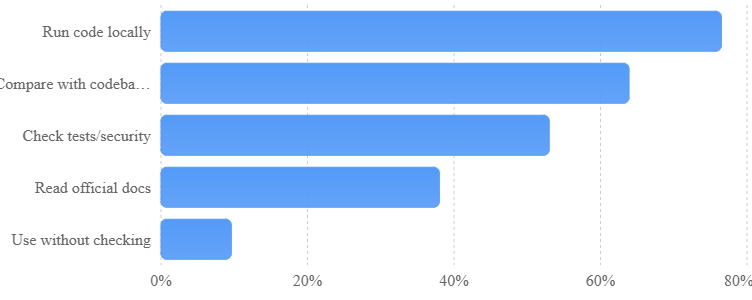
Source: Stack Overflow 2026 Developer Survey.
The 2026 survey found that 76.5% of respondents to this question run AI-generated code locally before using it, while 63.9% compare the answer with their existing codebase. Another 53% inspect tests or security implications. Only 9.6% report using AI answers without checking them. Stack Overflow Developer Survey
Original Finding: Running AI Code Locally Is Nearly Eight Times as Common as Accepting It Without Checking
Using the reported percentages:
\[ \frac{76.5}{9.6}=7.97 \]
Running AI-generated work locally was approximately eight times as common as accepting answers without checking them.
That difference is significant for founders trying to launch an application in a day. It suggests that the practical use of AI coding tools includes substantial human verification rather than simply accepting every generated result.
However, this ratio measures how frequently respondents selected two behaviors. It does not prove that the people running code locally produce software eight times more reliable, nor does it measure the number of defects caught.
The business lesson is that testing should be part of the development plan from the start. If a founder reserves no time for reviewing the result, they are removing an activity that most surveyed developers consider part of their workflow.
What Controlled Research Says About AI Coding Speed
METR published an experiment in July 2025 involving 16 experienced open-source developers and 246 software development tasks. The developers worked on established projects they already understood, with some tasks randomly assigned to allow AI assistance and others assigned to prohibit it.
Unexpectedly, the research found that developers using early-2025 AI tools took approximately 19% longer to complete their assigned tasks. This finding challenged the assumption that AI necessarily makes experienced programmers faster. METR
METR later published updated results in February 2026. Those results provided some evidence that newer AI systems were improving developer speed, but the researchers identified selection effects and measurement problems that prevented them from making a strong claim about the size of the improvement. METR
Why These Findings Do Not Disprove the One-Day Startup Model
The METR experiments involved experienced developers working on established codebases. Building a small new application from an empty project is a different situation.
An AI tool may be particularly useful when there is no existing code to understand and the founder needs standard features such as forms, dashboards, and basic database operations. But the research is a warning against assuming that every coding task becomes faster simply because AI is involved.
For San Francisco founders, the most useful approach is to measure total time from problem definition to tested customer workflow. Counting only the minutes needed to generate code can make productivity improvements look much larger than they really are.
Original SFTechScene Research #5: How Many Customers Does a One-Day Startup Need to Become Sustainable?
A founder who launches a working application quickly still needs customers to cover operating costs. Fortunately, the small initial costs of a focused software product can make early revenue targets more achievable.
To examine the opportunity, SFTechScene developed a simple break-even model for a small subscription business.
Research Methodology
We used the $65 monthly software stack from our earlier cost model and created three hypothetical subscription prices: $9, $19, and $49 per customer per month.
We assumed an additional $35 monthly allowance for basic operating expenses, creating a fixed-cost budget of $100 per month. For illustration, we also assumed a 5% variable cost on revenue to represent certain payment-related or operating charges.
This is a scenario analysis rather than a forecast of actual expenses. Real processing fees can include fixed per-transaction charges, and some applications face much higher variable costs for AI requests, computing, or support.
The Break-Even Calculation
The contribution from each customer is the monthly subscription price minus the assumed variable cost.
For a $19 subscription:
\[ 19\times(1-0.05)=\$18.05 \]
With fixed monthly expenses of $100:
\[ 100\div18.05=5.54 \]
The application would need at least six paying customers to cover that simplified monthly expense budget.
| Monthly subscription | Contribution per customer after 5% allowance | Customers to cover $100/month |
|---|---|---|
| $9 | $8.55 | 12 |
| $19 | $18.05 | 6 |
| $49 | $46.55 | 3 |
This calculation excludes the founder’s salary, customer acquisition expenses, significant development work, taxes, and other real business costs.
A Small Product Can Cover Its Software Bills Without Becoming a Complete Business
The encouraging result is that a narrow application may not need hundreds of subscribers to cover a modest software stack. A few paying customers can demonstrate that the product delivers value worth purchasing.
However, covering infrastructure expenses is not the same as making enough money to support the founder.
A business generating $114 per month from six customers paying $19 has established some early willingness to pay. It has not necessarily created meaningful income after support, maintenance, and customer acquisition costs.
That distinction should shape the founder’s next decision. The early milestone is proof that customers will pay, followed by evidence that they will continue paying and that the company can serve them efficiently.
What Happens at 100 Paying Customers?
Illustrative monthly subscription revenue
Gross revenue from 100 paying customers, before fees and costs.
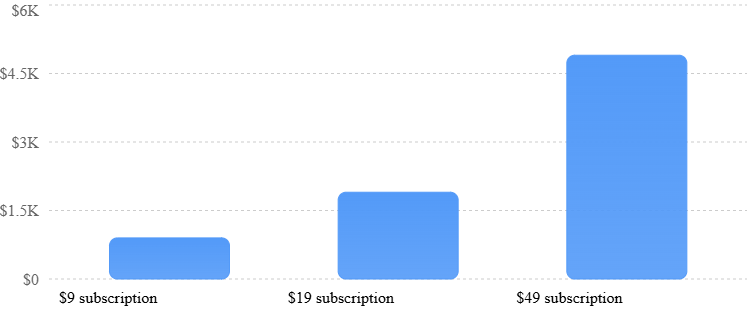
SFTechScene scenario calculation: 100 customers multiplied by monthly price.
At $19 per month, 100 customers would produce $1,900 in gross monthly recurring revenue, or $22,800 annualized if that customer count and price remained stable throughout the year.
For a small independent software business, that can provide useful income and stronger evidence of demand. But whether it becomes profitable depends on how much each customer costs to acquire and support.
A founder should measure these costs before adding features designed for a much larger company.
How San Francisco Founders Can Find Their First 10 Customers After Launching
The hardest part of a one-day startup may begin after the application is published. A founder can create an attractive product, write a compelling landing page, and still struggle to find people willing to use it.
That is why the first customer conversations should begin before the product is complete.
Start With a Very Specific Customer
A product designed for every small business is difficult to explain. Different businesses have different needs, and a feature that helps one group may be irrelevant to another.
Instead, a founder should choose a narrow customer type. For example, rather than building a general scheduling application, they might focus on independent tutors who manage appointments through messages and spreadsheets.
This makes customer research easier because the founder knows whom to approach and what questions to ask.
It also makes marketing more effective. A landing page that describes a specific problem is more likely to feel relevant to the right visitor than a page promising to improve everyone’s productivity.
Use San Francisco’s Business Community for Direct Feedback
San Francisco founders can look for early testers through professional communities, industry meetups, relevant online groups, startup events, and existing business relationships.
The strongest approach is to contact people who genuinely experience the problem rather than simply approaching anyone interested in AI.
A founder building a tool for local restaurants should speak to restaurant operators. Someone creating software for independent consultants should interview consultants who already manage real client projects.
The goal is to understand the customer’s current work and identify where the new application fits.
Ask Questions That Reveal Real Demand
Founders often receive encouraging feedback when they show an application to friends. People may say the interface looks good or that the concept seems useful, even when they have no intention of using it.
Better questions focus on existing behavior.
Ask potential customers how they currently handle the problem, what happens when the process goes wrong, and whether they have already paid for a solution. Find out what they would stop using if the new product worked well.
A person who has experienced the problem repeatedly and already spends money or time solving it provides stronger evidence than someone who merely likes the idea.
Watch Customers Use the Application
A live demonstration reveals issues that founders frequently overlook. A tester may not understand a button label, may try to complete tasks in a different order, or may expect information that the founder never considered.
Resist the urge to explain every screen immediately. Let the customer attempt the task and observe where they become confused.
If several testers struggle with the same step, that is useful evidence that the product needs to change.
Ask for a Real Commitment
The strongest early signal is usually some form of meaningful customer commitment. Depending on the product, that may involve paying for access, requesting a pilot, introducing a colleague, or agreeing to use the tool in regular work.
These actions provide stronger evidence than compliments or social media engagement because they require the customer to invest money, time, or reputation.
A founder does not need to pressure customers into buying an unfinished product. Instead, the conversation should establish what must be true before the customer considers it worth paying for.
The Five Business Models Best Suited to Vibe-Coded Startups
1. Small Subscription Software for Specific Professions
A focused subscription product solves a repeated problem for a well-defined group. Examples include a client follow-up tracker for independent consultants or a task approval system for small agencies.
This model works well when customers already recognize the problem and need the software regularly. Predictable monthly pricing can also make revenue easier to understand.
The challenge is keeping the application useful enough that customers continue subscribing after their initial curiosity fades.
2. Paid Internal Tools for Small Businesses
Some businesses need a tool that fits their workflow but do not want to purchase a large enterprise software system. A founder can build a narrow application and charge for setup, customization, and ongoing support.
For example, a local services company might need a dashboard that records service requests and organizes work assignments.
This model can generate revenue before the founder has enough customers to support a standard software subscription business. However, excessive customization can turn the venture into a service business that requires substantial manual work.
3. Simple Workflow Automation Products
Many businesses have repetitive administrative tasks that can be simplified using structured software. Examples include collecting customer information, organizing requests, or creating standard reports from approved data.
AI development tools can help founders build interfaces around these workflows quickly. The value comes from reducing repeated work rather than adding AI to every part of the application.
The founder should start with one process that is easy to measure. If the tool consistently saves employees time, the benefit becomes easier to demonstrate.
4. Specialized Information Dashboards
A dashboard that organizes information from permitted data sources can be a useful product for customers who struggle to monitor important updates.
For example, a founder might create a dashboard for tracking publicly available market information relevant to a particular profession. The product would make the information easier to access, compare, and understand.
The difficult part is often not the design. It is obtaining reliable data, respecting source permissions, maintaining updates, and making sure customers can trust the results.
5. AI-Assisted Professional Tools
Some applications can combine ordinary software with a narrow AI feature. A consulting tool might help organize meeting notes, while a customer service application might suggest draft responses for human review.
These products can be useful when the AI feature improves an existing workflow rather than trying to replace the entire professional.
The founder must pay particular attention to usage costs, errors, and sensitive information. AI-generated content should be reviewed wherever mistakes could create meaningful harm.
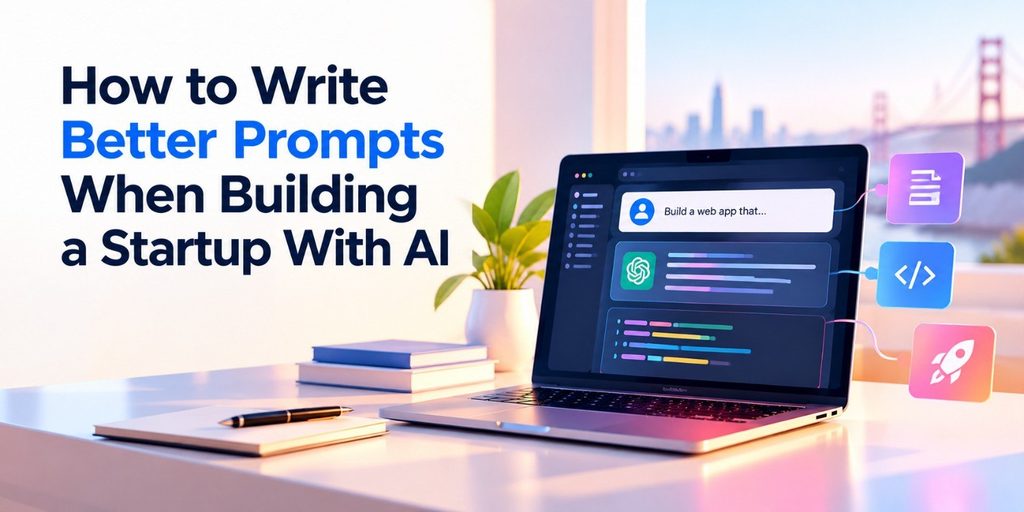
How to Write Better Prompts When Building a Startup With AI
A common mistake in vibe coding is assuming that one long instruction will produce a complete and reliable application. AI coding tools can build impressive first versions, but they often work more predictably when the founder gives them smaller tasks.
Begin With a Product Specification, Not a Design Request
Before generating the application, describe the customer, the core task, and the information the system must handle.
For a simple maintenance tracker, the specification might include properties, maintenance requests, assigned workers, status changes, and due dates.
This gives the AI a clear understanding of the product’s purpose. It also gives the founder a reference document for deciding whether the generated software meets the original requirements.
Ask for One Feature at a Time
A founder might first ask the AI to build the request form. Once that works, the next instruction could add a request list and basic status updates.
This approach reduces the number of changes introduced at once. When something breaks, the founder has a better idea of which change caused the problem.
The same principle applies to design. Finish the essential workflow before spending time on advanced animation, branding details, or visual effects.
Make the AI Explain Its Assumptions
AI systems often make technical choices without explaining why they made them. Those choices may be reasonable for a prototype but unsuitable for a larger application.
Ask the system which data is stored, how user permissions work, which external services it calls, and what would happen if the database became unavailable.
Founders do not need to understand every technical detail immediately. But they should understand enough to identify important risks and know when a technical review is necessary.
Keep a Record of Every Major Change
Rapid development can become confusing when the founder repeatedly asks the AI to rebuild features. A change that improves one screen may accidentally affect another.
Maintain a short record of important changes and test results. Use version control or the platform’s project history so that a working version can be recovered if a later update creates problems.
This becomes especially important once real customers depend on the application.
The Biggest Mistakes Founders Make When Launching AI-Built Startups
Building Too Many Features Before Talking to Customers
AI makes it tempting to add features because the next change appears inexpensive. A founder might start with a simple booking application and quickly add analytics, messaging, calendar integrations, and automated reminders.
Each feature increases the amount of software that must be tested and maintained. More importantly, it creates work before the founder knows whether customers value the original application.
A better approach is to build only what supports the main customer result. New features should be justified by observed needs rather than the ease of generating them.
Treating an Attractive Interface as a Finished Product
Modern AI builders can create professional-looking applications with polished screens. This can make an unfinished product appear more reliable than it actually is.
The application may contain broken workflows, weak permissions, inaccurate calculations, or errors that appear only after repeated use.
Founders should judge the product by whether users can complete important tasks correctly and consistently. Visual quality matters, but it cannot replace dependable functionality.
Ignoring Data Security
A new application may collect names, email addresses, business records, or private customer information. Founders need to understand where that information goes and who can access it.
Security should not be delayed until the company becomes larger. Even a small application can expose sensitive records if permissions are implemented incorrectly.
Use reputable services, protect account credentials, review database access rules, and avoid using real personal information in untested projects. Applications handling sensitive data may need professional security and legal review before release.
Choosing a Tool Without Understanding Its Limits
Some AI platforms make the first version extremely easy to build but introduce constraints when the founder wants more control.
Before choosing a platform, examine whether source code can be exported, whether the database can be migrated, how pricing changes with usage, and what happens if the founder stops paying.
A product that cannot be maintained or moved easily may become expensive later, even if it was cheap to create.
Launching Without a Clear Customer Acquisition Plan
A one-day app launch is a technical milestone, not a marketing strategy. Publishing a website does not guarantee that anyone will visit it.
Founders should know where their first potential customers can be reached and why those people would pay attention.
For many narrow business applications, direct outreach and product demonstrations may be more effective initially than broad advertising campaigns.
How to Turn a One-Day App Into a Real Startup Over the Next 30 Days
The first day should produce a working experiment. The following month determines whether that experiment has enough value to justify further investment.
Week 1: Validate the Core Problem
During the first week, focus on a small group of relevant potential customers. Show them the application, observe their behavior, and learn whether the product improves their existing process.
Record the main task users attempt, whether they complete it, and where they become confused. These observations should guide the next round of development.
Avoid expanding the application merely because people suggest extra features. Look for repeated problems that prevent customers from receiving the product’s promised value.
Week 2: Improve Reliability and Fix the Main Problems
The second week should focus on making the core workflow dependable. Correct errors, improve unclear screens, and review how the application stores and protects information.
If the product requires a technical security review, schedule that work before inviting broader use. It is better to delay growth than to expose customer information through an untested system.
Founders should also establish a reliable way to report and track bugs. Even a small group of testers can reveal problems that the original builder never encountered.
Week 3: Test Willingness to Pay
After the application works reasonably well, begin testing whether customers consider it valuable enough to purchase.
Offer a clear price for the product or a limited paid pilot. Explain exactly what customers will receive and what support is included.
Pay attention to the reasons people decline. Some may not have enough need, while others may require a feature that is essential to their work.
The goal is to distinguish customer interest from willingness to make an actual commitment.
Week 4: Decide Whether to Improve, Change Direction, or Stop
At the end of the month, the founder should have enough information to evaluate the next investment.
Consider whether testers return to the product, whether the main workflow saves meaningful time, and whether customers are willing to pay at a price that could support the business.
If the evidence is weak, the founder should consider changing the target customer, simplifying the offering, or stopping development. A fast launch makes these decisions less costly because the business has not yet committed months of engineering work.
The Metrics Every One-Day Startup Should Track
A founder does not need a complicated analytics system to evaluate an early product. A small set of carefully chosen measures can reveal whether the application is attracting users and solving a problem.
| Metric | What it reveals | How to use it |
|---|---|---|
| Visitors to landing page | Initial interest | Evaluate outreach effectiveness |
| Signup conversion | Willingness to try | Test messaging and audience fit |
| First-task completion | Product usability | Find problems in the main workflow |
| Repeat usage | Ongoing relevance | Check whether customers return |
| Paid conversion | Willingness to pay | Test pricing and real demand |
| Support requests | Reliability and confusion | Identify recurring problems |
| Monthly operating cost | Financial sustainability | Monitor whether growth is affordable |
Focus on Activation Before Chasing Large Signup Numbers
Activation means a new user has completed the action that demonstrates the application’s value. For an invoice tracker, that might mean creating and saving an invoice.
If 100 people register but only five create an invoice, the signup count may look encouraging while the actual product experience is weak.
Founders should investigate where users stop and improve the workflow before spending money attracting more visitors.
Measure Retention by Customer Need
Repeat usage is a strong indicator that an application has become part of a customer’s normal work. But the correct measurement depends on the type of product.
A daily task manager might need frequent engagement, while a monthly reporting tool may be valuable even if customers open it only once a month.
The important question is whether customers return when the problem occurs again. Usage should be measured against the product’s intended job.
Track the Cost of Supporting Each Customer
Low initial development costs can hide expensive ongoing work. A founder may spend hours manually fixing customer records, resolving AI errors, or explaining confusing features.
These activities should be recorded because they affect whether the business can grow profitably.
If every new customer creates substantial support work, the founder may need to simplify the application before expanding sales.
Can Vibe Coding Replace a Technical Cofounder?
Vibe coding changes the relationship between business founders and software engineering, but it does not eliminate the value of technical expertise.
A nontechnical founder may be able to build an initial product without hiring an engineer. That can be enough to test customer demand, demonstrate a workflow, and decide whether further investment is justified.
However, maintaining a growing software business introduces problems that are difficult to solve through prompting alone. These include system reliability, complex data management, secure integrations, performance, and technical decisions that affect future development.
When a Founder Can Work Without a Full-Time Engineer
A simple application serving a small group of testers may be manageable through a reputable hosted platform and careful human review.
The product should have limited features, modest traffic, clear data rules, and a low-risk use case. The founder must also be willing to learn enough about the technology to recognize when something is wrong.
As the application becomes more important to customers, relying entirely on AI-generated changes can become risky.
When Technical Expertise Becomes Essential
Technical help becomes more important when an application handles sensitive records, processes payments, supports complex user permissions, or becomes critical to customer operations.
A founder may not immediately need a full-time technical cofounder. Depending on the situation, a qualified freelance engineer or independent security reviewer may be enough to assess important risks.
The larger principle is that AI should help founders use technical expertise more effectively, not encourage them to avoid it when the stakes are high.
How the One-Day Startup Model Could Change San Francisco’s Venture Capital Market
Venture investors have traditionally evaluated startup teams partly on their ability to build software. A strong engineering team was often an important signal that a company could turn an idea into a working product.
As AI coding becomes more capable, the ability to produce an initial application may become less distinctive.
If many founders can create functional software quickly, investors may place greater emphasis on customer demand, retention, distribution, and the quality of the underlying business.
Working Products Could Become a Starting Requirement
A founder seeking an early investment may increasingly find that a working demonstration is easier to produce than it was in the past.
That could change the expectations surrounding early fundraising. Instead of relying mainly on presentations, founders may be able to show customers using the product.
But a demonstration without customers may also become less impressive as working applications become easier to create.
The advantage will belong to founders who can show that their product solves a real problem and that customers value the result.
Distribution May Become More Important Than Development Speed
When creating software is expensive, the ability to build a product can create a meaningful competitive advantage. When many competitors can produce similar applications, that advantage becomes weaker.
Customer relationships, industry knowledge, brand trust, and access to distribution become more valuable.
Consider two startups offering similar scheduling software. One has a technically polished application but no relationships with potential customers, while the other understands a specific profession and already has access to businesses willing to test the product.
The second company may have a better starting position even if its software is less sophisticated.
Smaller Teams May Be Able to Reach Commercial Milestones
AI coding tools may allow small founding teams to postpone some hiring while they establish customer demand.
This can reduce early spending and give founders more flexibility. However, a smaller team still needs to handle sales, marketing, support, financial management, security, and product decisions.
The future opportunity is not necessarily a software company with no employees. It may be a company that uses a smaller team more effectively while investing in specialized help when necessary.
What Founders Should Build First: A Practical Decision Framework
The best idea for a one-day startup is not necessarily the most exciting one. It is the idea that can be tested quickly, solves a meaningful problem, and introduces manageable risks.
SFTechScene recommends evaluating early ideas across five practical dimensions.
One-day startup suitability checklist
0/5
Customer problem is clearly defined
You know exactly who needs the product and what problem they face.
Core workflow is simple
A user can receive value from a small number of features.
Existing tools are insufficient
Customers experience a real shortcoming in their current process.
You can reach potential testers
You already know how to contact suitable customers.
Risk is manageable
You can test safely without sensitive data or critical decisions.
Validate the problem before building
Talk with customers and reduce technical or business uncertainty first.
Reset checklistEditorial decision aid, not a validated predictive model of startup success.
A founder whose idea meets all five criteria may have a strong candidate for rapid prototyping. The most important advantage is that the founder can test a valuable customer workflow without building an entire platform.
Ideas that fail several criteria need more investigation. If the target customer is unclear or the product requires complex technical systems, beginning with AI-generated code may simply create unnecessary work.
The Biggest Opportunity for San Francisco Is Not Building More Apps — It Is Testing Better Ideas
Vibe coding makes it easier to create software, which naturally increases the temptation to build more products. But the number of applications a founder creates is not a useful measure of business success.
A better measure is how quickly the founder can discover what customers need and whether they will pay for a solution.
Imagine a founder who spends three months creating several polished applications without speaking to potential buyers. Compare that with another founder who uses the same period to test three narrow business problems, observes real users, and develops one product that customers repeatedly use.
The second founder has created more valuable knowledge, even if they have written less code and produced fewer applications.
This is where San Francisco’s startup environment can remain valuable. Founders have opportunities to meet other builders, learn from experienced operators, and connect with potential customers in industries where software problems are common.
The combination of rapid development and disciplined customer research can make startup experiments less expensive and more informative.
What the Next Generation of Founders Will Need to Learn
Founders who use AI development tools effectively will still need strong product judgment. They must know how to identify customer problems, prioritize features, evaluate feedback, and decide which work deserves further investment.
Basic technical literacy will also become important. Even when AI writes the code, founders should understand the purpose of databases, user permissions, hosting, backups, and application testing.
Finally, they will need to become effective at customer acquisition. A product that can be copied quickly must compete through the quality of its service, the relevance of its features, and the trust it earns from customers.
These skills are harder to automate than producing the first version of a software interface.
Frequently Asked Questions About Launching Startups With Vibe Coding
Can You Really Build an App in One Day With AI?
Yes, some simple web applications can be built and made available for testing within a single working day. The best candidates have a narrow purpose and use standard features such as forms, dashboards, and basic record management.
However, building a working application does not mean it is ready for unrestricted commercial use. Security, customer data protection, reliability, and more advanced features may require additional development.
Do You Need to Know How to Code to Start a Vibe-Coded Business?
Not necessarily. Visual AI application builders make it possible for people with limited programming experience to create useful prototypes.
Founders should still learn basic concepts about software behavior, data protection, and testing. Technical knowledge becomes increasingly important as applications grow and customers depend on them.
Which AI Tool Is Best for Launching a Startup Quickly?
The right tool depends on the product and founder. Replit and Lovable can be suitable for rapid application creation, while Cursor and Claude Code are useful for developers who want more direct control over code.
Founders should compare current pricing, deployment support, usage limits, source-code access, and data ownership before selecting a platform.
How Much Does It Cost to Launch a Vibe-Coded Startup?
A small demonstration may be built using free tiers, while a modest paid software stack can start at tens of dollars per month. SFTechScene’s example stack of Replit Core, Vercel Pro, and Supabase Pro has a $65 monthly subscription baseline based on the cited public prices.
The full business cost can be much higher after accounting for founder time, custom AI usage, support, security, marketing, and maintenance.
Can a Vibe-Coded Application Make Money?
Yes, an AI-built application can generate revenue if customers find it useful and are willing to pay. The technology used to create the application does not automatically determine whether the business succeeds.
Founders should focus on customer demand, repeat usage, pricing, and operating costs. A small application that solves an important problem may have a better chance of earning revenue than a large platform with unclear value.
Is Vibe Coding Safe for Business Applications?
It can be appropriate for prototypes and certain low-risk applications when the software is carefully tested. But AI-generated code can contain errors, weak access controls, and other security problems.
Applications that handle sensitive information, financial transactions, or safety-critical activities need appropriate professional review and controls before production deployment.
Will Vibe Coding Replace Software Developers?
AI coding tools can automate or accelerate parts of software creation, but reliable products still need technical judgment. Developers remain important for architecture, security, testing, complex integrations, and maintaining systems over time.
The more likely change is that small teams will be able to build more software while developers spend greater attention on problems that require expertise.
Final Takeaway: The Future of San Francisco Startups Is About Launching Faster, Learning Faster, and Building Businesses Customers Actually Want
The ability to move from an idea to a working application in one day is changing the early economics of software entrepreneurship. Founders can now test certain business concepts with less initial spending, fewer technical barriers, and a shorter development cycle.
The public evidence shows that AI coding tools have become a common part of professional software development. Stack Overflow’s 2026 survey found broad adoption, while its verification data shows that developers still spend meaningful effort checking AI-generated work.
Our original SFTechScene analysis also highlights the economic opportunity and its limitations. A basic paid software stack can have relatively low monthly costs, but the founder’s time, application testing, customer acquisition, and ongoing maintenance remain important.
For San Francisco founders, the smartest use of vibe coding is not to build the most ambitious product in the shortest possible time. It is to build the smallest useful application that answers a real business question.
That might mean creating an invoice tracker for a specific profession, a workflow tool for a small local business, or a simple dashboard that makes an existing process easier.

The first day should be about turning an idea into something people can try. The next month should be about learning whether those people want to keep using it.
The founder who learns the fastest from real customers may have a more valuable advantage than the founder who generates the most code.
Research Sources and Methodology Notes
This article’s original analyses are calculations and scenarios developed for SFTechScene using publicly available figures. They are not based on a newly conducted survey of San Francisco founders, an independently tested set of AI-built applications, or private startup revenue data.
The five original analyses cover developer tool adoption and overlap bounds, Bay Area funding concentration, public subscription pricing and startup cost scenarios, AI code verification behavior, and subscription break-even calculations.
The central sources are:
- Stack Overflow 2026 Developer Survey — AI data. Used for tool adoption, response counts, and verification behavior.
- Carta — Ranking the Top Startup Ecosystems of 2025. Used for Bay Area fundraising comparisons.
- METR — Measuring AI’s Effect on Developer Productivity and METR’s February 2026 update. Used to examine the limitations of assumed AI productivity gains.
- Replit Pricing, Vercel Pricing, and Supabase Pricing. Used for illustrative software cost calculations.
- TechCrunch — AI-Generated Code in Y Combinator’s Winter 2025 Batch. Used as an example of AI code adoption in the startup ecosystem.
All original calculations are based on the figures and assumptions stated in their respective sections. They should not be interpreted as measured San Francisco-specific adoption rates, proven one-day launch success rates, or forecasts of startup profitability.