

SFTechScene Research Report | October 2026
San Francisco has already helped change how businesses write code, manage customers, and automate office work. Now, a new group of startups is bringing the same changes to one of the most demanding industries in the world: legal services.
Law firms spend enormous amounts of time reading contracts, reviewing documents, preparing legal filings, organizing evidence, tracking deadlines, answering client questions, and handling billing. Much of this work is necessary, but not every step requires a lawyer to start from scratch.
That is where AI agents are beginning to make a difference.
Unlike basic chatbots that simply answer questions, AI agents can carry out several connected tasks. They can gather information, examine documents, prepare drafts, identify missing details, and send completed work to a lawyer for approval.
San Francisco companies such as Harvey, EvenUp, and Eve are helping turn this idea into practical software for legal teams.
The opportunity goes far beyond writing documents faster. AI agents could change how law firms price services, manage cases, communicate with clients, and organize their employees. They could also help smaller practices provide services that previously required much larger teams.
But legal work is different from ordinary office work. An incorrect legal citation, missed deadline, exposed client document, or poorly drafted court filing can have serious consequences.
That creates an important question: Can AI agents automate enough legal work to improve law firm operations without creating more risk than they remove?
To answer it, SFTechScene examined public legal-industry research, San Francisco attorney data, legal AI products, labor-cost benchmarks, and professional rules. We also built original calculations to explore how much working time might be available for automation, what the economics could look like, and where law firms should begin.
The findings suggest that the largest near-term opportunity may not be replacing lawyers. It may be helping them complete routine work more reliably while keeping professional decisions firmly under human control.
The Short Version: AI Agents Are Turning Law Firm Software Into Systems That Can Complete Work
Traditional legal software helps lawyers store information and manage tasks. AI agents take the next step by helping perform those tasks.
Consider a personal injury law firm handling 150 active cases. Its staff must collect medical records, organize treatment histories, prepare summaries, contact clients, identify missing documents, and update case files.
Without AI, much of this work requires employees to move between several systems and repeat similar steps for every case.
An AI agent can potentially monitor incoming records, organize information, draft a summary, identify missing items, and prepare the next task for review. The lawyer still decides which claims to make, whether the evidence is strong enough, and what should happen next.
That difference is the foundation of AI-powered legal operations.
WHAT THE PUBLIC DATA SHOWS
17,695
Active attorneys listed in San FranciscoCalifornia State Bar county table; geographic interpretation requires care
38%
Average lawyer utilizationClio’s 2025 US law firm benchmark
74%
Professionals using AI several times a week2026 Thomson Reuters cross-profession survey
17%+
Hallucination rates in tested legal AI research toolsStanford researchers’ 2025 controlled evaluation of selected systems
The numbers come from different studies and should not be treated as one combined survey. The attorney count is from the State Bar of California, the utilization rate comes from Clio, AI usage comes from Thomson Reuters, and the legal research error finding comes from Stanford.
Calbar Apps
+3
They reveal both sides of the opportunity. Law firms have plenty of room to improve their operations, but automation must meet unusually high standards for accuracy.
Why San Francisco Is Becoming an Important Center for Legal AI
Legal work has several problems that AI agents are well suited to address
The legal industry handles vast amounts of information. Contracts can contain hundreds of pages, major lawsuits can involve thousands of documents, and even smaller cases require careful recordkeeping.
Much of this information is written in ordinary language rather than organized databases.
That makes legal work a natural target for modern AI systems, which are good at finding information in text, comparing documents, and creating structured drafts.
The challenge is that law firms also need accuracy, confidentiality, and a clear record of how each conclusion was reached. A useful legal AI system must do more than produce a convincing answer.
It needs to show where the answer came from and make it possible for a professional to verify the work.
San Francisco has a useful mix of software expertise and legal customers
San Francisco has a large technology industry, experienced startup investors, enterprise software companies, and legal teams serving technology businesses.
That combination gives legal AI startups access to customers who manage complex contracts, intellectual property, employment matters, financing transactions, and commercial disputes.
It also creates opportunities to test products with teams that already use cloud software and are comfortable adopting new technology.
The local legal workforce provides another useful signal.
The State Bar of California’s county table lists 17,695 active attorneys associated with San Francisco. This is not the same as counting lawyers employed inside city limits, but it illustrates the size of the legal community connected to the city.
Calbar Apps
San Francisco also benefits from nearby legal markets in Oakland, Silicon Valley, and the Peninsula. Those markets contain companies with large contract volumes, active legal departments, and regular needs for outside legal services.
The market is moving from AI assistance to AI workflows
The earliest legal AI tools focused on isolated activities such as summarizing text or answering legal research questions.
Newer systems are being designed around sequences of work.
For example, a contract review agent might read an agreement, compare its terms with a company’s approved standards, highlight unusual clauses, suggest revisions, and prepare a summary for the attorney.
Harvey’s 2025 announcement with law firm Paul, Weiss described a workflow-building system intended to help firms turn their own expertise and review standards into repeatable processes. That is an important step toward practical legal agents rather than stand-alone chat tools.
Harvey
The strongest companies in this market will likely be those that combine useful automation with a dependable review process.
What Is an AI Agent in Legal Services?
A legal chatbot gives answers. A legal agent follows a workflow.
A basic AI assistant usually responds to a single request.
A lawyer might ask it to summarize an agreement, explain a legal term, or create a first draft of an email.
An AI agent goes further because it can work through several connected steps and interact with approved software tools.
Suppose a lawyer asks an agent to prepare a contract review package.
The agent might first retrieve the agreement from the firm’s document system. It could then identify key clauses, compare them with a checklist, create suggested edits, write a summary of important differences, and place the results in a review folder.
The lawyer would examine the material before anything was sent to the client.
Example: An AI-assisted contract review process
1. Receive and classify the agreementIdentify document type, parties, and relevant terms
2. Check clauses and supporting sourcesCompare with approved standards and flag gaps
3. Prepare a review packageDraft suggested edits, reasons, and source references
4. Lawyer checks and approvesProfessional judgment remains with the attorney
This process is more valuable than a chatbot because it reduces the number of manual steps between receiving work and completing it.
However, different products provide different levels of independence. A system that drafts documents is not necessarily able to update records, send messages, or perform other actions by itself.
Law firms should examine what each product actually does rather than relying on the term agentic AI in its marketing.
Legal AI agents need more controls than ordinary business agents
A sales agent might accidentally send an imperfect email. A legal agent could make a much more serious mistake by exposing confidential information or including false authorities in a court filing.
For this reason, legal systems need strict access controls, documented approvals, reliable source references, and ways to reverse incorrect actions.
An agent should only access the matters and documents necessary for its assigned task. It should not automatically gain permission to read every client file simply because it is connected to the firm’s software.
The higher the risk of an action, the more important human review becomes.
How San Francisco Startups Are Building AI Agents for Law Firms
San Francisco’s legal AI market is not built around one product category. Companies are addressing different parts of legal work, from research and document preparation to personal injury operations and client communication.
Harvey: Building AI workflows for legal teams
Harvey has become one of the best-known names in legal AI.
The company focuses on legal and professional work, including research, document analysis, drafting, and the creation of structured workflows.
Its approach is especially relevant for law firms that handle large amounts of complex legal material.
A corporate law firm might use Harvey to help review a collection of agreements. A litigation team could use it to organize research or prepare an initial document comparison. Internal legal teams could develop workflows around their own approval rules.
The company’s Workflow Builder is particularly important because firms can use it to organize repeatable tasks around their existing expertise.
Instead of asking every lawyer to invent a new AI prompt, a firm can create a reviewed process for common work.
That gives legal leaders a way to standardize quality across multiple teams.
Harvey
Where Harvey’s approach makes sense
Large law firms often have established document templates, internal guidance, and detailed review processes.
These materials are valuable because they reflect years of professional experience.
An AI workflow can make them easier to use during everyday tasks.
For example, a firm might build a first-pass contract review system that identifies clauses outside approved ranges and prepares a report with document references.
The firm still needs experienced lawyers to set the standards and review results, but less time may be spent on repetitive checking.
EvenUp: Automating personal injury case preparation
EvenUp takes a more specialized approach.
Based in San Francisco, the company builds software for personal injury firms, which handle claims involving accidents, medical treatment, insurance, and financial damages.
These firms often work with large collections of medical records, bills, reports, photographs, and communications.
Preparing a demand package can require staff to review all that information and build a clear account of the injuries and losses.
EvenUp’s Express Demands product helps organize case files into draft demand packages, including treatment histories, facts, damages, and supporting exhibits.
The company has also introduced AI Playbooks and a voice agent to support recurring case analysis and communication work.
Eliminate Bottlenecks with AI Demand Letters
+1
This illustrates why specialized AI products can be useful.
A system built for personal injury cases can focus on tasks that appear again and again in that type of law practice.
The operational opportunity
Imagine a firm receives several hundred pages of treatment records for one client.
A legal assistant may need to identify appointment dates, procedures, medical bills, diagnoses, and gaps in the treatment history.
An AI system can prepare an organized timeline and flag documents requiring attention.
A human reviewer must still check the records, determine what is legally relevant, and confirm that the summary does not confuse different providers or treatments.
Even when full automation is inappropriate, reducing the effort required to prepare a reviewable package can make a meaningful difference.
Eve: Connecting legal casework with the business of running a firm
Eve focuses on plaintiff-side legal operations.
Its platform describes capabilities covering client intake, case review, drafting, records management, communication, and firm performance.
The company’s EveOS product includes an intake agent, tools for reviewing active matters, and systems intended to reduce manual handling of case information. These are company-described capabilities, not independently verified performance measurements.
Eve
Its wider approach points to a major opportunity.
Legal work and law firm administration are closely connected. A missing medical record can delay a demand. A missed client follow-up can slow a case. Poor tracking can make it difficult for managers to see which matters need attention.
Software that connects these activities may produce more value than a tool that only writes individual documents.
For a plaintiff firm, the important result is not simply faster drafting. It is moving cases forward with fewer preventable delays.
Why specialization matters more than an impressive demo
A general AI model might produce a reasonable-looking contract summary.
But the requirements for reviewing a venture financing agreement are different from those for evaluating a personal injury case or drafting an immigration filing.
Each area of law has different documents, risks, review standards, and deadlines.
That creates room for specialized legal AI companies.
A startup does not need to automate every legal task. It can build a strong business by solving one expensive problem exceptionally well.
For San Francisco founders, this suggests a practical product strategy: find a legal workflow with high volume, measurable cost, available source information, and a clear human approval point.
The Legal Tasks AI Agents Are Best Positioned to Automate
Contract review and document comparison
Contract review is one of the most practical uses of legal AI because many agreements contain familiar types of clauses.
AI can help identify terms related to payment, confidentiality, liability, termination, data security, and ownership of intellectual property.
For a company reviewing many similar agreements, this can reduce the time spent locating relevant information.
The system should compare documents against standards approved by the company’s legal team rather than inventing what it considers acceptable.
A useful output includes the original clause, the suggested change, the reason for the suggestion, and the exact page or section where the issue appears.
Legal research and case preparation
AI agents can help lawyers search for relevant information, organize research notes, and compare legal authorities.
They can also prepare outlines that lawyers use as starting points.
However, research is a high-risk activity because AI systems can produce incorrect legal statements and references that look convincing.
A 2025 Stanford study found that the tested specialized legal research systems still hallucinated more than 17% of the time under its evaluation method.
That result does not describe every legal AI product or every task. It does show why a research tool should never be treated as an unquestioned source of law.
Stanford Law School
Lawyers need to verify authorities through reliable sources, check whether cases remain valid, and examine whether the cited material actually supports the claim.
Client intake and initial information gathering
New client intake is another area with considerable potential.
A prospective client might contact a firm outside working hours. The firm needs to collect basic details, identify the broad category of legal issue, and determine whether a staff member should follow up.
An AI agent can collect structured information, answer approved administrative questions, and prepare a summary for the intake team.
It can also identify missing information and request supporting documents through an approved process.
But legal intake requires safeguards.
The firm must consider conflicts of interest, privacy, informed communication, and whether the system might appear to be providing individualized legal advice.
An AI intake tool should not imply that a lawyer-client relationship has been created when the firm has not accepted the matter.
Litigation discovery and evidence organization
Litigation often involves reviewing large collections of emails, messages, contracts, and other records.
AI can assist by grouping related documents, highlighting recurring topics, identifying dates, and finding material that may require closer review.
An agent might help build a chronology of events or organize documents according to issues in a case.
This can make initial review faster, but decisions about relevance, privilege, disclosure, and legal significance still need qualified supervision.
Incorrectly identifying a privileged document as safe to disclose can create consequences that are much greater than the cost of doing the review manually.
Billing, time entries, and collections
Law firm financial administration involves its own repetitive work.
Employees must prepare invoices, review time entries, follow up on unpaid bills, and communicate payment information.
AI agents can help locate missing time descriptions, identify unusual entries, prepare draft invoices, and flag accounts needing follow-up.
These uses may offer attractive early opportunities because they deal with structured records and measurable business outcomes.
However, firms must ensure that AI-generated descriptions reflect work actually completed.
Automating billing must never become a way to bill for time that was not spent or charge clients unreasonable amounts.
Deadlines and case management
Law firms track many important dates, including court deadlines, filing requirements, client meetings, and document requests.
AI agents can support these processes by finding dates in correspondence, preparing reminders, and updating draft task lists.
But an AI system should not be the sole authority for calculating or confirming legal deadlines.
Court rules, procedural events, and exceptions can make deadline calculations complicated.
The safest approach is to use verified rules and approved calendaring systems, with lawyer review for consequential dates.
Original SFTechScene Research #1: How Large Is San Francisco’s Potential Legal AI Time-Savings Opportunity?
The following analysis is an original SFTechScene scenario model built from publicly available State Bar data.

It is designed to estimate the possible scale of time made available through AI assistance, not to predict actual adoption or claim that specific hours have already been saved.
Research question and methodology
Our central question is simple:
How many hours might be freed annually if a portion of attorneys associated with San Francisco regularly saved between one and three hours per week through approved AI workflows?
We use the State Bar’s published count of 17,695 active attorneys for San Francisco as a reference population.
That figure is a registration-based geographic count. It should not be interpreted as the number of lawyers physically working in the city, employed by private firms, or eligible to buy legal AI software.
We then apply three hypothetical adoption and productivity scenarios. Each assumes 46 active working weeks per year, allowing for vacation, holidays, and other nonworking time.
This is scenario analysis. The adoption percentages and weekly time-savings inputs are SFTechScene assumptions, not measured San Francisco outcomes.
The model
\[ \text{Annual hours freed} = \text{Attorney count} \times \text{Adoption share} \times \text{Hours saved weekly} \times 46 \]
| Scenario | Attorneys using AI | Hours freed per user per week | Estimated annual hours freed |
|---|---|---|---|
| Conservative | 10% | 1 | 81,397 |
| Base case | 25% | 2 | 406,985 |
| High adoption | 40% | 3 | 976,764 |
Potential annual attorney hours freed
SFTechScene scenario calculations using 17,695 active attorneys and 46 working weeks. Not observed productivity gains.

Source population: State Bar of California. Adoption and savings assumptions: SFTechScene.
The base case produces approximately 407,000 hours of potential annual time savings across the modeled population.
That is a meaningful amount of capacity, but it should not be presented as 407,000 hours of billable work or as a measured gain in San Francisco law firms.
Time saved is not the same as money earned.
Some of the released hours may be used for training, client communication, quality checks, additional casework, or reducing employee workloads.
Original Finding #1: Small weekly improvements can add up across a large professional community
The important result is not the most optimistic scenario.
It is that even one hour per week can produce a large theoretical total when applied across a substantial professional population.
This supports a practical lesson for startup founders.
Legal AI products do not need to replace entire departments to be useful. Products that consistently reduce a repeated task by 15 or 30 minutes may create meaningful value for the firms that perform that task frequently.
The company that saves a lawyer a dependable hour each week may be more useful than a company promising complete automation but producing outputs that require extensive correction.
Sensitivity matters more than the headline number
The model changes sharply when assumptions change.
If only 10% of the reference population uses the technology, and each saves one hour per week, the annual total is about 81,000 hours.
At 40% adoption and three hours saved weekly, the total approaches 977,000 hours.
Neither outcome should be described as a forecast without independent evidence about San Francisco adoption and actual time saved.
The value of the analysis is showing how strongly results depend on two factors: the number of people using the software and the time it genuinely returns to them.
Source: State Bar of California attorney county data.
Calbar Apps
Original SFTechScene Research #2: Why Law Firm Productivity Is About More Than Billable Hours
The first analysis explored how much time AI might return to lawyers. Our second analysis looks at what happens to lawyer time inside a typical law firm.
This matters because legal AI vendors often describe their products in terms of time savings, but law firm owners care about several different outcomes.
They want to serve clients, complete cases, collect payments, maintain quality, and earn enough revenue to support the practice.
A product can save time without improving all those outcomes.
Understanding the law firm’s revenue funnel
Clio’s 2025 legal industry benchmarks provide three useful measures.
Utilization measures the share of available lawyer time recorded as billable work. Realization measures how much recorded billable work is invoiced. Collection measures how much invoiced work is eventually paid.
The reported average rates were 38% utilization, 88% realization, and 93% collection.
Clio
Using those rounded rates, we can reconstruct how an eight-hour workday moves through the revenue process.
| Stage | Calculation | Hours per day |
|---|---|---|
| Total available time | Starting point | 8.00 |
| Billable time recorded | 8 × 38% | 3.04 |
| Equivalent hours invoiced | 3.04 × 88% | 2.68 |
| Equivalent hours collected | 2.68 × 93% | 2.49 |
| Available hours not converted into paid work | 8 − 2.49 | 5.51 |
How an eight-hour lawyer workday moves through billing
Reconstructed using rounded 2025 Clio industry-wide rates. Hours are billable-equivalent units, not a measured allocation of individual daily activities.

SFTechScene calculations from Clio 2025 benchmarks.
The difference between eight available hours and approximately 2.49 paid-hour equivalents is striking.
However, it would be incorrect to describe all the remaining time as wasted.
Lawyers spend necessary time on administration, training, business development, professional obligations, internal meetings, and work that cannot or should not be billed. Some matters also involve fixed or contingency fees.
Still, these figures point to several areas where better processes might help.
Original Finding #2: AI agents can improve three different financial problems
Many AI companies focus on making legal tasks faster.
But the revenue funnel shows that a law firm has at least three distinct problems to solve.
First, it needs enough capacity to perform valuable client work. Second, it needs accurate systems for documenting and invoicing that work. Third, it needs to collect appropriate payments.
Different AI agents can address different stages.
A document preparation agent might reduce routine work and free lawyers for more complex matters.
A billing assistant might identify missing or unclear time entries before invoices are prepared.
A collections workflow might flag overdue accounts and prepare respectful, approved follow-up messages.
These benefits should be measured separately because they affect the business in different ways.
A useful example for a small San Francisco law firm
Consider a ten-lawyer firm.
Suppose the team saves 30 minutes per lawyer each working day through better document handling and internal workflow automation.
Across 220 working days, that creates:
\[ 10 \times 0.5 \times 220 = 1,100\text{ hours} \]
Those 1,100 hours represent capacity returned to the firm.
But the value depends on how the firm uses them.
If the lawyers spend the recovered time reviewing work more carefully, the benefit might be fewer mistakes.
If they use it to complete additional fixed-fee matters, the firm might increase revenue without adding employees.
If they reduce overtime and administrative pressure, the result could be improved working conditions and lower staffing costs.
If they perform fewer billable hours and have no additional client demand, the immediate revenue effect could even be negative.
This is why legal AI adoption should start with a business objective rather than a generic promise to save time.
Original SFTechScene Research #3: What Is the Real Return on Investment From a Legal AI Agent?
Legal AI pricing varies widely. Some vendors charge per user, others price by case, and larger platforms may negotiate custom contracts.
That makes it difficult to identify one universal return on investment.
Instead of guessing at typical vendor pricing, SFTechScene constructed a transparent economic model for a hypothetical ten-person legal team.
The purpose is to show what conditions need to hold for an AI investment to generate financial value.
Research methodology
Our model uses 46 working weeks and three possible levels of net time savings per employee.
Net savings means time saved after accounting for routine review and corrections. The model also separately applies an economic realization factor, because not every available hour produces financial value.
We assume a loaded labor value of $90 per hour. This is a modeling assumption rather than a published San Francisco lawyer salary, and it is not a client billing rate.
For context, the US Bureau of Labor Statistics reported a mean hourly wage of $99.50 across legal occupations in the broader San Francisco-Oakland-Fremont metropolitan area in May 2024. That occupational average covers a different population and is not directly comparable to our modeled internal labor value.
Bureau of Labor Statistics
We assume 50% of recovered time produces a measurable financial benefit through avoided work costs or genuinely valuable additional output.
Finally, we use an illustrative annual technology cost of $18,000 and keep it fixed across scenarios. Actual software costs, training, and implementation expenses may be higher or lower.
The three economic scenarios
| Metric | Conservative | Base case | Strong result |
|---|---|---|---|
| Team members | 10 | 10 | 10 |
| Net hours saved per person weekly | 1 | 2 | 3 |
| Working weeks | 46 | 46 | 46 |
| Total hours returned | 460 | 920 | 1,380 |
| Value per returned hour | $90 | $90 | $90 |
| Financial realization factor | 50% | 50% | 50% |
| Annual modeled benefit | $20,700 | $41,400 | $62,100 |
| Annual technology cost | $18,000 | $18,000 | $18,000 |
| Net annual benefit | $2,700 | $23,400 | $44,100 |
| ROI on modeled cost | 15% | 130% | 245% |
Modeled net annual value for a ten-person legal team
Illustrative scenarios, not measured outcomes. Assumes $90/hour, 50% value realization and $18,000 annual technology costs.
Original SFTechScene scenario calculations.
What the numbers reveal
In the conservative scenario, the investment barely clears the assumed cost.
That leaves little room for unexpected expenses, failed workflows, staff training, or vendor price increases.
In the base case, the model produces $23,400 in annual net value.
The strong-result scenario generates $44,100, but achieving that outcome requires larger and sustained time savings.
These results are not proof that any vendor delivers a 130% return. They demonstrate how ROI changes when a tool consistently gives time back to employees.
The break-even point
We can also calculate how much net time the system must return before the modeled investment pays for itself.
\[ \text{Required weekly hours per person} = \frac{\$18,000}{10 \times 46 \times \$90 \times 0.5} \]
The result is approximately 0.87 hours per person each week, or roughly 52 minutes.
That creates a useful buying question.
Rather than asking whether an AI product is impressive, a firm should ask whether it can reliably return at least 52 minutes of financially valuable time per user each week under these particular assumptions.
The actual threshold will change with software prices, staffing costs, usage, and implementation expenses.
Original Finding #3: The best legal AI metric is the cost per approved task
Time saved is important, but it can hide expensive mistakes.
Suppose one system produces a contract summary in two minutes but requires 25 minutes of correction.
Another takes four minutes and requires only five minutes of review.
The second system is likely more valuable even though its initial output is slower.
The same principle applies across legal operations.
Firms should measure how much it costs to complete work that a qualified person has reviewed and approved, not merely how quickly the AI produces a draft.
That means tracking the full process from the first input to final acceptance.
Original SFTechScene Research #4: Which Law Firm Workflows Should Be Automated First?
Not all legal activities have equal automation potential.
Some tasks are repetitive, relatively easy to check, and limited in risk. Others require complex professional judgment and can cause serious harm when performed incorrectly.
To make the choice more practical, SFTechScene developed a workflow prioritization model.
Our scoring methodology
We evaluated eight common legal workflows using five criteria.
Each criterion receives a score from one to five, where five represents a more favorable condition for early AI adoption.
The criteria are repetition, input consistency, ease of checking results, ability to keep a human approval step, and consequences of an undetected mistake.
For the final criterion, a higher score means lower expected risk.
All five dimensions receive equal weight. This is a transparent editorial assessment based on workflow characteristics, not a survey of law firms or an independently validated safety rating.
The maximum possible score is 25.
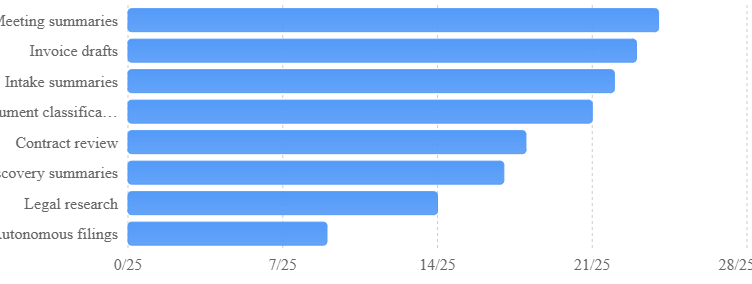
| Workflow | Repetition | Consistent inputs | Easy to verify | Human control | Lower risk | Total / 25 |
|---|---|---|---|---|---|---|
| Internal meeting summaries | 5 | 4 | 5 | 5 | 5 | 24 |
| Invoice draft preparation | 5 | 5 | 4 | 5 | 4 | 23 |
| Administrative intake summaries | 5 | 4 | 4 | 5 | 4 | 22 |
| Document classification | 5 | 4 | 4 | 5 | 3 | 21 |
| First-pass contract review | 4 | 4 | 3 | 5 | 2 | 18 |
| Discovery document summaries | 4 | 3 | 3 | 5 | 2 | 17 |
| Legal research drafting | 4 | 2 | 2 | 5 | 1 | 14 |
| Autonomous court filings | 3 | 2 | 2 | 1 | 1 | 9 |
SFTechScene workflow readiness scores
Original qualitative scoring model, 0–25 scale. Higher scores indicate stronger candidates for a controlled early pilot, not proven product safety.
Five equally weighted editorial criteria; scored October 2026.
Original Finding #4: Administrative work is a stronger first target than autonomous legal decisions
The highest scores belong to tasks where the system can prepare information for review without exercising independent legal judgment.
Internal meeting summaries, invoice drafts, and intake summaries fit that pattern.
These workflows are generally repeated often, use recognizable inputs, and allow a staff member to check the result.
Autonomous court filings score poorly because the consequences of an undetected error can be severe and because removing human approval is precisely what makes the workflow dangerous.
That does not mean AI cannot help prepare court documents.
It means preparation and final submission should remain separate activities, with appropriate legal review before the final action.
How a firm can use the scorecard
A firm can recreate this assessment using its own matters, documents, and risk policies.
For example, a practice that handles hundreds of similar contracts every month may score contract review more favorably than a practice where every contract is unusual.
A small litigation firm may find that document classification is a better starting point than a complex drafting agent.
The goal is not to follow our ranking without question.
It is to force a clear discussion about which workflows offer measurable value while remaining easy enough to supervise.
The Biggest Operational Opportunity May Be Managing the Entire Legal Matter
Legal AI discussions often focus on individual tasks.
But the daily work of a law firm involves a series of connected activities.
A new matter begins with intake. It may then require conflict checks, an engagement agreement, document collection, research, drafting, communication, billing, and eventual closure.
Every transition introduces a chance for delay or missing information.
Why disconnected automation produces limited value
Imagine a personal injury firm uses AI to generate medical summaries.
That could save staff time, but the firm still needs a process to request missing records, track client treatment, prepare demand materials, and manage negotiations.
If those steps remain disconnected, employees may still spend hours transferring information from one system to another.
The more complete opportunity is coordinating the work around a single case record.
That is why products such as EvenUp and Eve increasingly emphasize connected workflows rather than isolated drafting.
A matter-centered AI operating model
A law firm could structure its approved AI tools around the lifecycle of a matter.
The first stage gathers information and checks whether the matter is appropriate for the firm.
The second stage organizes documents and prepares an internal task plan.
The third stage supports ongoing work by summarizing materials, creating drafts, and tracking requests.
The fourth stage prepares documents and communications for lawyer approval.
The final stage assists with billing, closing checklists, and file organization.
Every stage should have an identified human owner.
The system can help move information through the process, but responsibility for legal services must remain with authorized professionals.
Why the quality of the firm’s data matters
An AI agent cannot reliably organize a case if the underlying records are incomplete or mislabeled.
If client emails are stored outside the matter system, documents have unclear filenames, or employees use inconsistent case categories, automation becomes more difficult.
The agent may miss relevant information or mistakenly treat old drafts as final documents.
This means law firms often need to improve their information systems before deploying complex AI workflows.
For many practices, the first useful AI project may be creating a dependable document and matter structure rather than buying an autonomous assistant.
Why AI Agents Could Change Law Firm Pricing
The legal industry has long depended on hourly billing, but AI introduces a tension.
A law firm wants to complete work efficiently. Under hourly billing, however, fewer working hours can mean fewer hours available to charge.
That is not always a problem, especially when the firm has more demand than capacity, but it changes the economics of some services.
Faster work does not mean firms can bill for time they did not spend
The American Bar Association’s Formal Opinion 512 addresses the use of generative AI in legal practice.
Among other matters, it highlights competence, confidentiality, supervision, communication, and reasonable fees. Lawyers who bill by the hour must accurately reflect time spent rather than charging as though manually completed work took longer.
American Bar Association
This distinction is central to legal AI economics.
Suppose a task previously took three hours but now takes one hour with AI assistance and legal review.
A lawyer billing by the hour cannot simply report three hours when only one hour was worked.
The firm needs to consider whether the released capacity can be used for other valuable client matters.
Fixed-fee services may become more attractive
Fixed-fee arrangements can give clients greater price certainty.
For example, a firm might offer a defined fee for reviewing a standard commercial agreement or preparing a particular set of business documents.
If approved AI workflows reduce the firm’s cost of delivering the service, the firm may improve its margins while offering competitive pricing.
But fixed fees must still be reasonable under applicable professional rules.
A firm should not assume that AI automatically makes every kind of legal service suitable for fixed pricing.
Complex matters, uncertain litigation, and cases involving changing circumstances may still require different arrangements.
Clients may expect more transparency
Corporate clients increasingly want evidence that outside firms are using technology effectively.
Thomson Reuters’ 2026 Future of Professionals report found that 78% of surveyed corporate clients considered AI-enabled quality improvements very important or essential, while only 6% said most or all their providers were delivering such improvements. The figures come from a wider professional-services study and should not be treated as a San Francisco-only sample.
Thomson Reuters
This gap matters because it suggests that clients want results, not simply assurances that their law firm owns an AI subscription.
Firms may need to explain how AI improves turnaround time, consistency, review quality, or reporting.
The most credible answer will come from measured service outcomes.
The Major Risks: Why Legal AI Needs Stronger Safeguards Than Ordinary Automation
The potential benefits of legal AI are large, but the risks are not theoretical.
A legal AI system can produce information that appears well researched even when it is incorrect. An autonomous agent can also introduce new risks if it has permission to send communications, alter records, or act across several systems.
Law firms therefore need controls that are built into everyday workflows rather than added after a problem occurs.
Hallucinations and incorrect legal citations
One of the most serious problems is the creation of false information.
An AI system may invent case names, misunderstand a legal rule, or cite a real decision that does not support its conclusion.
These errors can be difficult to identify because the writing often sounds confident.
Stanford’s legal AI research demonstrates why specialized legal research products still require careful professional oversight.
Stanford Law School
The safest approach is to require the system to provide source references and have a qualified professional verify all legal authorities before they are used.
A citation should not be accepted simply because it looks correct.
Confidentiality and client information
Law firms handle information that clients may not want disclosed to anyone else.
That includes commercial agreements, financial records, medical information, litigation strategy, and private communications.
An AI tool connected to a firm’s systems could potentially access far more information than is required for a particular task.
Before deployment, firms need to understand where information is stored, who can access it, whether providers retain submitted content, and whether that content can be used for training.
The State Bar of California’s updated May 2026 AI guidance specifically addresses agentic AI and the risks associated with systems that have greater independence and continuing access to data.
The State Bar of California
A sensible system design begins with limited permissions.
An agent assigned to one matter should not automatically gain access to every other matter handled by the firm.
Incorrect autonomous actions
There is a major difference between drafting an email and sending one.
A legal AI agent may prepare a useful response, but accidentally sending it to the wrong recipient could expose privileged or confidential information.
The same concern applies to filing documents, changing case records, approving payments, or communicating settlement terms.
Law firms should establish approval boundaries based on the seriousness of each action.
Low-risk internal organization may be automated with routine checks. Client communications and legally significant actions should require authorization appropriate to their risks.
The danger of trusting AI-generated summaries too much
A summary can omit information that changes the meaning of the original document.
For example, an AI system might correctly summarize the main payment terms in a contract while overlooking an exception buried in a later clause.
A lawyer relying only on the summary could miss a significant risk.
The answer is not to prohibit summaries. It is to make them easy to verify.
Useful legal AI should link its conclusions to the underlying documents, identify missing information, and distinguish confirmed facts from uncertain interpretations.
California’s AI Rules Are Becoming an Important Part of Product Design
California is especially important because San Francisco legal AI companies must consider the professional obligations of the lawyers using their products.
In May 2026, the State Bar approved revised practical guidance addressing generative AI, including agentic systems.
Separately, the State Bar published proposed amendments to several professional conduct rules covering competence, client communication, confidentiality, honesty before courts, and supervision.
As of the reviewed October 2026 materials, the proposed amendments must be distinguished from the existing rules and approved practical guidance. They should not be described as enacted rules merely because they were published for comment.
The State Bar of California
+1
What this means for legal AI startups
Founders need to design products around how lawyers actually meet their professional responsibilities.
That includes making it possible to review source materials, document who approved work, control access to client information, and understand what an agent did.
A product that cannot explain its actions may be difficult for a legal team to supervise.
A product that provides clear records and supports professional oversight may be easier to adopt.
Five questions every law firm should ask a vendor
| Question | What the answer should establish |
|---|---|
| Where is client data stored and processed? | Approved locations, security arrangements, and retention rules |
| Is client data used to train models? | Contractual limits and clear data-use policies |
| Can the agent act without approval? | Specific permissions and controls for consequential actions |
| Can users verify its conclusions? | Source links, activity logs, and access to original documents |
| What happens when the system fails? | Error handling, human escalation, and recovery procedures |
The answers should be documented in contracts and technical policies, not based solely on sales presentations.
Firms should also review vendor security claims, access arrangements, subcontractors, and any relevant contractual obligations before uploading client material.
How San Francisco Law Firms Can Build Their First Legal AI Agent in 90 Days
A successful legal AI project should begin with one defined workflow.
Trying to automate an entire practice immediately makes it difficult to establish whether the system is improving anything.

A 90-day project gives a firm enough structure to test the technology, measure results, and decide whether broader adoption makes sense.
Days 1–15: Choose one workflow and measure its current cost
Start by identifying a task the firm performs frequently.
Good candidates include preparing internal document summaries, organizing intake materials, classifying case records, or drafting routine administrative communications.
The workflow should have a clear start, a defined output, and someone responsible for approving the result.
Before introducing AI, measure how long the task currently takes.
Record the number of documents involved, how often corrections are needed, how many employees participate, and what typically delays completion.
For example, a firm might discover that preparing an internal case summary takes 75 minutes on average.
That becomes the baseline against which AI performance is compared.
Days 16–30: Build a controlled test using representative documents
Next, choose an appropriate AI tool and establish the necessary security and ethical controls.
Use synthetic or appropriately authorized material during early experiments.
The sample should include ordinary cases as well as difficult examples.
A document summarization test might contain clean files, poorly scanned records, conflicting dates, duplicate documents, and incomplete information.
This matters because a tool that performs well on perfect documents may fail during normal office work.
Create an approved output format and define what counts as an error.
Then test whether the AI consistently produces material that employees can verify.
Days 31–45: Run a comparison against the existing process
Have staff complete a controlled sample of tasks using the existing method and the proposed AI-assisted method.
Measure the full time needed for each process, including reading the AI output, correcting mistakes, and completing final approval.
Where practical, use comparable tasks and random assignment to reduce the chance that easier work is concentrated in one group.
For each task, record completion time, number of corrections, severity of errors, and final acceptance.
Keep a record of cases where the AI fails entirely.
Those failures are valuable because they reveal where the workflow needs better limits.
Days 46–60: Improve the process around the problems discovered
Once the first results are available, identify the most common causes of failure.
Perhaps the agent misses attachments, struggles with tables, confuses similarly named parties, or cannot distinguish draft documents from signed agreements.
These problems may require changes to document organization rather than new AI prompts.
Introduce clearer naming rules, better source selection, and stronger review checkpoints.
The goal is to create a repeatable process, not to demonstrate that the model can occasionally produce excellent output.
Days 61–75: Expand to a small group of trained users
If the early system meets defined quality and security standards, give a limited group of employees access.
Train them on what the AI can do, what it cannot do, and when they must stop and seek professional review.
Provide examples of unacceptable outputs.
Monitor whether employees actually use the tool and whether their use follows the approved procedure.
A product that looks successful during testing may create new problems when employees face daily deadlines and distractions.
Days 76–90: Decide whether to expand, modify, or stop
At the end of the project, compare results with the baseline.
The decision should not depend on how many prompts employees sent or how many documents the tool generated.
It should depend on whether the system produced measurable improvements without unacceptable errors.
Example 90-day pilot scorecard
Net task time reductionIllustrative target: 25% or more
Critical factual or legal errorsIllustrative target: Zero in the acceptance sample
Human review of consequential outputIllustrative target: 100%
Traceable source referencesIllustrative target: 100% where required
Verified confidentiality incidentsIllustrative target: Zero
Successful completion without reworkIllustrative target: 90% or more
0 of 6 pilot checks marked complete Copy scorecard
These targets are suggested evaluation standards, not industry benchmarks. Firms should adjust them for the legal risks of the particular task.
A low-risk internal summary and a client-facing legal filing should not share the same acceptance criteria.
Original SFTechScene Research #5: Why More AI Adoption Does Not Automatically Mean Better Legal Services
It is tempting to treat AI usage as evidence of progress.
A firm might announce that every employee has access to an AI assistant or that thousands of documents have been processed.
Neither measure establishes that the firm is delivering better services.
Thomson Reuters’ 2026 research found that 66% of professionals in organizations with a named AI strategy said AI was meeting or exceeding expectations for creating value, compared with 22% where there was no active strategy. This is an observed association in a cross-profession survey, not proof that writing a strategy causes a particular improvement.
Thomson Reuters
Reported AI value with and without a named strategy
Share reporting that AI meets or exceeds value expectations. Survey association, not causal evidence.

Thomson Reuters Future of Professionals 2026.
Original Finding #5: Management discipline may be as important as model quality
The 44-percentage-point difference is noteworthy because the study measures reported experiences across organizations.
It suggests that technology selection alone does not explain whether AI creates value.
Organizations also need to decide which tasks matter, establish rules, train users, and measure results.
For legal firms, these steps are especially important because professional quality cannot be separated from efficiency.
An excellent AI model used in a poorly designed workflow may perform worse than a less capable model operating inside a carefully controlled process.
The hidden cost of correcting AI output
AI-generated work can create a false impression of productivity.
A document might appear complete in seconds, but an attorney could spend considerable time checking citations, reconstructing missing details, and correcting unusual wording.
If the review takes longer than preparing the document manually, the system has not saved time.
A useful pilot must therefore measure total completion effort.
That includes preparation, AI processing, checking, corrections, final approval, and any necessary recovery after failures.
The result should be compared with the existing method under similar conditions.
The importance of tracking error severity
Not every error has the same consequences.
A misplaced comma is different from a wrong party name. A wrong party name is different from a missing filing deadline or disclosure of confidential information.
A strong legal AI evaluation should classify errors by their possible consequences.
Minor formatting issues can be corrected through ordinary review.
Serious factual problems may require a workflow change.
Critical legal or confidentiality failures may require the system to be withdrawn from that task.
That distinction helps firms avoid treating a low average error rate as proof of safety.
Where San Francisco Legal AI Startups Could Find the Next Opportunities
The most crowded legal AI categories are not necessarily the most attractive opportunities for new founders.
General research assistants and contract summarizers face competition from established software companies and well-funded AI platforms.
Smaller startups may find more room in specialized operational problems.
AI agents for law firm collections and cash flow
Law firms frequently have money tied up in work that has not yet been invoiced or paid.
Clio’s 2025 benchmarks report a median total lockup of 93 days. That measures the equivalent amount of annual revenue tied up in unbilled work and unpaid invoices, not a uniform 93-day payment delay for every matter.
Clio
A specialized agent could help identify matters awaiting billing review, organize missing invoice information, and prepare approved payment reminders.
The opportunity is measurable because firms can monitor invoice processing times and outstanding balances.
However, vendors must prove that their system improves collections without creating inaccurate charges or inappropriate communications.
AI agents for case progress tracking
Many matters are delayed because a document, approval, or response has not arrived.
An agent could monitor approved matter records, identify outstanding requests, and prepare an updated task list.
The main benefit would be making hidden delays visible before they become larger problems.
A law firm could measure this through the number of unresolved tasks, missed internal milestones, and time between required case steps.
AI agents for legal knowledge management
Experienced lawyers carry valuable knowledge about how their firms handle common problems.
That knowledge is often scattered across documents, internal messages, templates, and employees’ memories.
An AI system could help staff find approved examples and internal guidance when preparing new work.
But the system must distinguish current approved materials from outdated or matter-specific documents.
It must also respect the limits on using information from other clients and matters.
The opportunity is not simply better search. It is making approved firm knowledge easier to use without weakening confidentiality.
AI agents for small law firms
Small firms may not have the resources to employ dedicated teams for every administrative function.
That makes reliable legal operations software potentially valuable.
A small practice may benefit from better intake, document organization, billing, and client updates.
However, vendors need to consider the costs of implementation and ongoing support.
A product that saves three hours a week but requires expensive consulting or complicated system changes may be unsuitable for a small firm.
The strongest small-firm products will likely be those that integrate with existing software and deliver a narrow, measurable benefit quickly.
What Founders Should Learn From Harvey, EvenUp, and Eve
These companies illustrate different ways to build useful legal AI products.
Harvey shows the potential of broad legal workflows supported by firm-specific standards and professional expertise.
EvenUp shows the value of specializing in one kind of legal work with recognizable documents and repeated processes.
Eve illustrates the opportunity to connect case preparation with intake, records, communication, and operational management.
None of those approaches guarantees success.
But each provides a useful lesson about product design.
Build around the workflow, not the model
Legal teams do not buy software because it generates text.
They buy software to complete necessary work accurately, safely, and at an acceptable cost.
A founder should therefore start by observing an actual legal process.
Which documents arrive first? Who checks them? What information is frequently missing? Which actions cause delays? Who is responsible for approval?
Those questions are often more valuable than deciding which AI model to use.
Create a narrow product with clear boundaries
A startup promising to automate every part of legal practice faces serious technical and professional challenges.
A company focused on one defined task can test quality more thoroughly.
It can build better review controls, improve document handling, and develop stronger knowledge of customer requirements.
This approach may also make sales easier because the customer can understand precisely what the product is intended to improve.
Make professional oversight part of the user experience
Human review should not feel like an awkward step added after the AI has completed its work.
It should be an ordinary part of the product.
A lawyer should be able to see proposed changes, examine the sources, approve or reject actions, and understand why the system flagged an issue.
Good oversight tools can reduce the effort needed to check AI output.
That may become an important competitive advantage as legal teams gain more experience with agentic systems.
What Law Firm Leaders Should Measure Before Expanding AI
A firm needs a consistent measurement framework if it wants to compare vendors or decide whether to expand an AI deployment.
The following metrics provide a practical starting point.
| Measure | What it tells the firm | How often to review |
|---|---|---|
| Net time per completed task | Whether AI actually reduces workload | Weekly during pilot |
| First-pass acceptance rate | How often output is usable without correction | Weekly |
| Serious error rate | Whether the workflow creates unacceptable risks | Every test batch |
| Human review time | Whether supervision costs are increasing | Weekly |
| Cost per approved output | Overall economic efficiency | Monthly |
| Matters completed on time | Whether workflow performance improves | Monthly |
| Client response time | Whether administrative service becomes faster | Monthly |
| Confidentiality and access incidents | Whether information controls are working | Continuous monitoring |
| User adoption | Whether employees are following the approved process | Monthly |
| Client satisfaction | Whether service improvements are meaningful | Quarterly |
The measurements should be tied to the firm’s actual goals.
A litigation practice may care most about document preparation and matter deadlines.
A business law practice may focus on contract turnaround time and review consistency.
A personal injury practice may measure record collection, case progress, and demand preparation.
Different practices need different operational targets.
The Future of Legal AI: Smaller Teams, Better Processes, and More Human Judgment
Legal AI is likely to change the mix of work performed by lawyers and support staff.
Routine document handling may become faster. Information gathering may require fewer manual steps. Administrative systems may become better at identifying work that needs attention.
But those changes do not establish that law firms will no longer need junior lawyers, paralegals, or other employees.
The amount of work a system can produce is not the same as the amount of work it can safely approve.
Junior lawyers will still need opportunities to develop judgment
One concern is that junior legal professionals often learn by performing tasks that AI tools are beginning to assist with.
Research, drafting, document review, and preparing case summaries help employees understand how legal work is done.
If firms automate these activities without changing their training programs, younger professionals could lose important learning opportunities.
Thomson Reuters’ 2026 research found that legal professionals expected AI to lengthen the time required to develop trusted professional judgment by approximately 1.7 years. That is a survey expectation, not a measured outcome.
Thomson Reuters
Law firms should therefore consider how AI changes employee development.
Junior employees may need more structured opportunities to review AI-generated work, examine original sources, discuss decisions with senior lawyers, and understand why a particular legal approach was chosen.
The strongest firms may use AI to improve access to legal services
Legal work can be expensive for individuals and smaller businesses.
If AI reduces the cost of routine tasks, some firms may be able to offer more predictable pricing or serve clients whose matters were previously too costly to handle.
A startup might help a small business law firm prepare standard agreements more efficiently.
A plaintiff firm might use better document management to reduce case delays.
A community-focused legal organization might improve its ability to organize information and coordinate administrative work.
These possibilities are promising, but access improvements should be measured rather than assumed.
Lower operating costs do not automatically lead to lower client prices or better representation.
Trust will remain the central competitive advantage
Law firms compete on expertise, relationships, reliability, and judgment.
AI can support those qualities, but it cannot remove professional responsibility.
A client needs confidence that confidential information is protected, deadlines are handled correctly, and legal advice is based on sound reasoning.
That is why the future of legal AI is unlikely to be determined by which product writes the most text.
The more important question is which product helps legal professionals complete dependable work while preserving accountability.
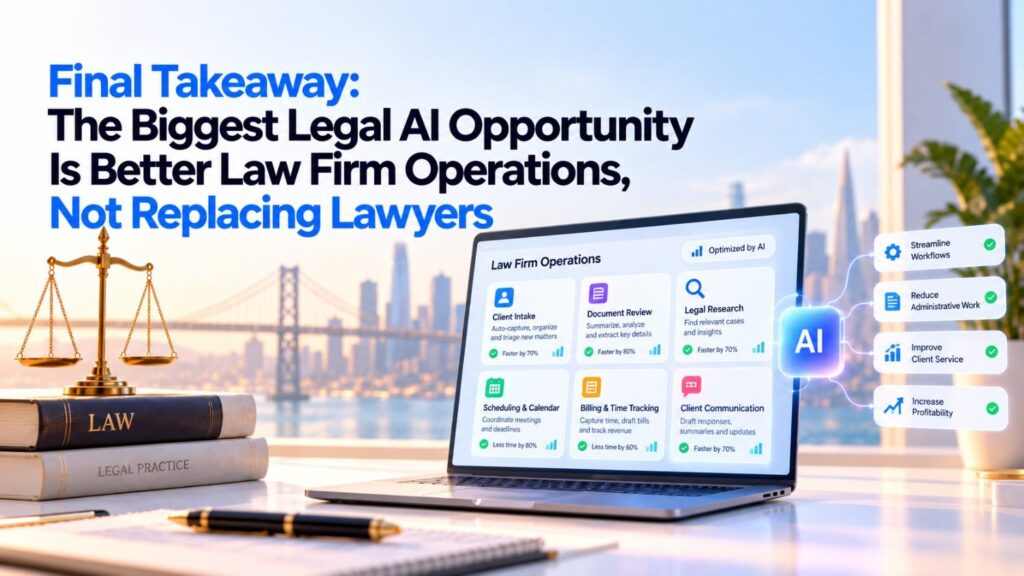
Final Takeaway: The Biggest Legal AI Opportunity Is Better Law Firm Operations, Not Replacing Lawyers
San Francisco’s legal AI startups are helping move the industry beyond basic document automation.
Companies such as Harvey, EvenUp, and Eve are developing systems that connect information gathering, analysis, drafting, and operational workflows.
The economic opportunity is meaningful because law firms handle repeated processes that consume considerable time.
Our original analysis shows how relatively small weekly improvements could add up across San Francisco’s large registered attorney population. It also demonstrates that productivity claims need careful economic testing.
The strongest result from our research is not a prediction that AI will eliminate a particular number of legal jobs.
It is that AI agents become valuable when they reduce the full cost of completing accurate, approved legal work.
That includes the time needed for review, the expense of correcting mistakes, the risks of handling client information, and the effect on the firm’s ability to serve clients.
For law firm leaders, the next step is practical: choose one repeated workflow, establish a reliable baseline, run a controlled test, and measure the result before expanding.
For San Francisco founders, the opportunity is to build products around real operational problems rather than broad promises about autonomous lawyers.
The most successful legal AI companies may not be those that try to remove the lawyer from the process.
They may be the companies that make every responsible lawyer, paralegal, and legal operations professional more effective.
That is where AI can create lasting value for law firms, their employees, and the clients who depend on them.