


SFTechScene | October 31, 2026 | AI Coding, Cybersecurity, San Francisco Startups
San Francisco startups are building software faster than ever. A founder can describe an application in plain English, ask an AI coding agent to build it, and have a working product ready for testing the same day. Work that once required several developers can now begin with one person and an AI assistant.
But there is a problem hiding behind this remarkable speed.
AI can write software that works perfectly during a demonstration while leaving serious security weaknesses underneath. A login page may look professional but fail to protect user accounts. A payment system may process transactions but expose private records. An AI-built application may pass its basic tests while still giving attackers ways to access information they should never see.
The danger becomes greater when startups give coding agents permission to edit files, install software, run commands, and make changes without checking every step.
This is no longer a small issue affecting a few experimental projects. GitHub’s October 2026 Octoverse report found that agents started more than 40% of pull requests in September 2026, compared with 17% in March. Meanwhile, Veracode’s 2026 research found known security weaknesses in roughly 44% of the AI code-generation tasks it tested. These figures describe different populations and cannot be used to estimate the share of deployed software that is vulnerable, but together they show why software security is becoming a much bigger concern. The GitHub Blog+1
For Silicon Valley startups, the challenge is not deciding whether AI should write code. It is learning how to benefit from AI-generated software without creating security problems that could destroy customer trust.
This article examines the latest evidence, explains the biggest security risks, and shows how founders can protect their products without slowing development to a crawl. It also introduces original SFTechScene calculations that explore the growing gap between AI coding speed, developer trust, security testing, and the amount of work a startup must review.
The Short Version: AI Is Making Software Easier to Build, but Security Is Becoming Harder to Ignore
Three developments explain why this issue matters so much in 2026.
First, AI coding is moving from a helpful feature to a normal part of software development. GitHub reports that agents now start a substantial share of pull requests, while the 2026 Stack Overflow Developer Survey shows that 66% of respondents use coding assistants or agents. These tools are becoming part of how software gets built every day. The GitHub Blog+1
Second, better code generation does not automatically mean better security. Veracode’s research found that AI models have become much better at writing code that runs, but their ability to avoid certain known security weaknesses has improved far less. A feature that works correctly is not necessarily a feature that protects its users. Veracode+1

Third, developers increasingly want proof before trusting AI output. In Stack Overflow’s 2026 survey, 48% of respondents said they trust AI output when they can easily verify it, while only 6.6% said they trust it for important work decisions. This suggests that the future of AI coding will depend heavily on better ways to review and test what AI creates. Stack Overflow Developer Survey
THE 2026 SECURITY PICTURE
40%+
GitHub pull requests started by agents in September 2026GitHub Octoverse 2026
~44%
AI code-generation benchmark tasks with known vulnerabilitiesVeracode 2026
48%
Developers who trust AI when its output is easily verifiedStack Overflow 2026
6.6%
Developers who trust AI for important work decisionsStack Overflow 2026
The opportunity for San Francisco companies is clear. Startups that combine fast AI development with strong security checks can release products quickly while giving customers greater confidence in the software they use.
The companies that ignore security may gain speed in the beginning, only to spend much more time fixing problems later.
Why AI-Generated Code Security Has Become a Major Silicon Valley Issue
The speed of software development has changed
For years, one of the biggest challenges for early-stage startups was finding enough engineering talent to build a product.
A small company might need a front-end developer to create its interface, a back-end developer to handle its database, and someone with experience in cloud systems to keep everything running. Hiring this team in the Bay Area could become expensive before the company had earned its first dollar.
AI coding tools have changed that equation.
Products such as Cursor, Claude Code, OpenAI Codex, and GitHub Copilot help developers produce features more quickly. Some also allow people with limited programming experience to create working applications.
The biggest change is that AI is no longer limited to suggesting a few lines of code. Coding agents can inspect an existing project, plan changes, create new files, and run tests. Depending on their settings, they may also execute commands and connect to outside services.
This creates a new operating model for startups. A small team can complete more development tasks, but it may also create more code than its members can carefully review.
More code creates more things to protect
Imagine a San Francisco software startup that previously released ten small improvements every week. Its engineers knew the product well, reviewed each other’s work, and had time to investigate unusual changes.
Now imagine that the same team uses AI agents to produce thirty improvements every week.
The company has become more productive, but the number of changes requiring testing has tripled. If its security process stays the same, engineers may begin approving work too quickly or checking only whether a new feature functions.
The problem is not that AI necessarily creates more vulnerabilities than human developers in every setting. The problem is that faster production increases the amount of code that needs careful verification.
A startup that scales code generation without scaling its review process can build a growing backlog of security risks.
Silicon Valley has a particular reason to care
San Francisco is home to AI companies, software infrastructure providers, financial technology firms, and startups building applications for business customers. Many of these companies handle information that users and other businesses cannot afford to expose.
A small AI sales application might connect to customer records and email systems. A financial product might manage account information and payments. A health technology startup could handle sensitive medical records.
For these businesses, security is not an optional improvement to add after finding product-market fit.
An early security failure can delay enterprise contracts, trigger expensive investigations, and damage a startup’s reputation. It can also force a young company to rebuild important parts of its software at the exact moment it needs to focus on growth.
This is why secure development is becoming a business decision rather than only an engineering concern.
Original SFTechScene Research #1: How Quickly Is AI Coding Expanding the Software Review Problem?
Research question
How much has the volume of agent-assisted development grown, and what does that mean for the amount of work that needs security review?
To investigate this, SFTechScene analyzed public figures from GitHub’s October 2026 Octoverse report. We used its reported changes in agent-started pull requests and its comparison of how often agent-involved and other pull requests modify multiple files.
A pull request is a proposed software change that someone can review before adding it to a project. It provides a useful measure of work entering the development review process, although it does not measure the amount of code written or the number of vulnerabilities.
Finding #1: Agent-started development has grown sharply
Share of GitHub pull requests started by agents
March and September 2026; September is a reported lower bound.
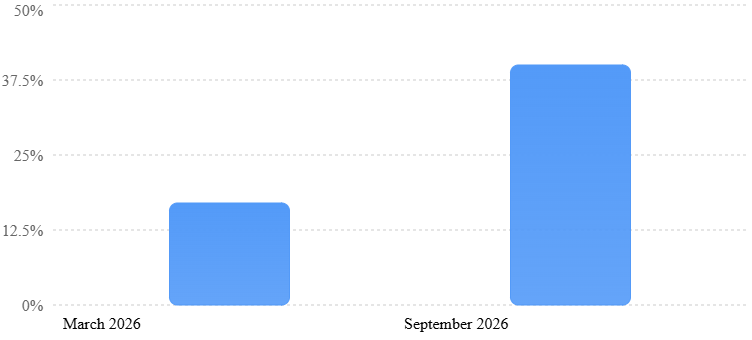
Source: GitHub Octoverse 2026. The September bar uses 40% as a conservative floor because GitHub reports more than 40%.
GitHub reported that the share of pull requests started by agents increased from 17% in March to more than 40% in September 2026. Using 40% as the minimum September figure, this represents an increase of at least 23 percentage points, or at least 2.35 times the March share. The GitHub Blog
That is a major change over roughly six months.
It suggests that more software work is entering the review process through automated systems. However, it does not show that AI-created code has become less secure, nor does it mean all of those pull requests were merged into production.
Finding #2: Agent-involved changes more often touch multiple files
GitHub also reported that approximately 87% of agent-started pull requests changed multiple files, compared with 79% of pull requests without detected agent involvement. That difference is eight percentage points. The GitHub Blog
Pull requests that change multiple files
Published GitHub Octoverse 2026 comparison.
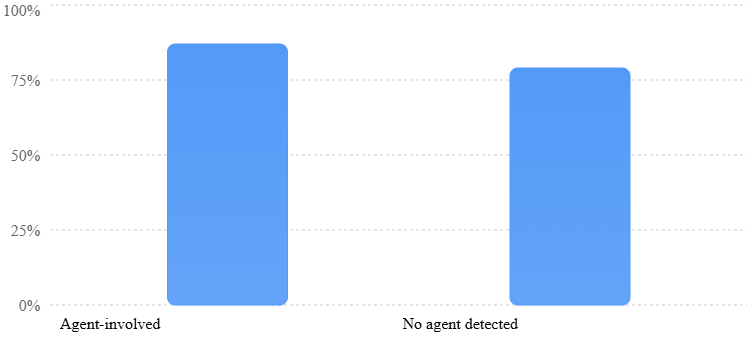
This matters because a change affecting multiple files may require a reviewer to understand how different pieces of the application work together.
For example, an AI agent might update a login page, database query, API, and access-control function in one pull request. Reviewing each file separately could miss a problem created by the interaction between them.
Not every multi-file change is complex or dangerous. However, file count can help teams identify work that deserves closer attention.
Finding #3: An illustrative 1,000-pull-request workload
We developed a simple calculation to explore what these GitHub figures might mean for a startup.
Assume a company processes 1,000 pull requests and has the same agent-started share and multi-file change rates as the published GitHub measures. For conservatism, we use a 40% agent share rather than GitHub’s actual figure of more than 40%.
| Development category | Pull requests | Multi-file rate | Estimated multi-file PRs |
|---|---|---|---|
| Agent-started | 400 | 87% | 348 |
| No agent detected | 600 | 79% | 474 |
| Total | 1,000 | — | 822 |
SFTechScene calculation. These are modeled counts, not observations from one company.
The result is interesting.
Agent-started work represents 40% of all pull requests in this example, but approximately 42.3% of the pull requests that touch multiple files.
That calculation comes from dividing 348 by 822.
The difference is not enormous, but it demonstrates why startups should track the complexity of AI changes, not just their number.
What happens when reviewers have limited time?
Now suppose a startup spends an average of 20, 40, or 60 minutes reviewing each multi-file, agent-started pull request. These are hypothetical planning assumptions, not measured review times from GitHub.
Modeled review hours for 348 agent-started, multi-file PRs
SFTechScene sensitivity analysis for 1,000 total pull requests.
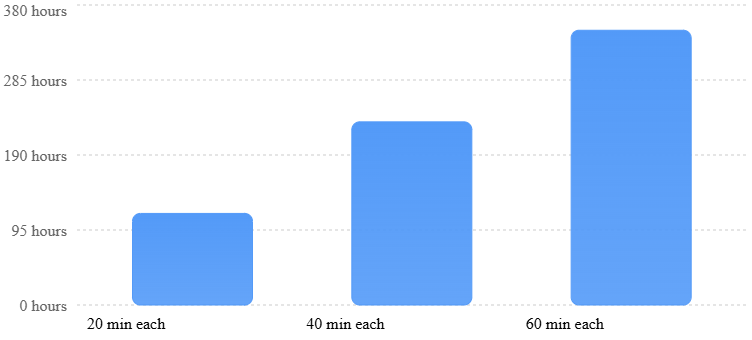
At 40 minutes per pull request, the 348 changes would require 232 reviewer-hours.
That is nearly six 40-hour workweeks devoted to this category of review alone. It excludes single-file changes, non-agent changes, security testing, incident response, and the time needed to fix problems.
The lesson is not that reviewing AI code always takes 40 minutes. It is that review capacity must be planned alongside development capacity.
Methodology and limitations
This analysis uses public aggregate GitHub Octoverse statistics, not repository-level raw data. The calculations assume the reported multi-file rates apply to our modeled group of 1,000 pull requests and that the reported categories can be combined for planning purposes.
GitHub’s data covers a broad software ecosystem, not San Francisco startups alone. The model does not identify which changes contained vulnerabilities or whether multi-file changes were harder to review. It is a capacity-planning exercise, not a security failure-rate study.
The calculation can be reproduced using:
\[ M=N\times A\times F \]
Where \(N\) is total pull requests, \(A\) is the agent-started share, and \(F\) is the multi-file rate for agent-started work.
A startup can replace these values with its own GitHub data to calculate its real review workload.
The Biggest Security Risks in AI-Generated Code
AI-generated code can contain many of the same weaknesses as human-written software. The difference is that developers may overlook these weaknesses when a tool creates working features quickly and confidently.
The following risks deserve particular attention.
1. Broken access control: When users can see information that is not theirs
Access control determines what each user is allowed to see or change.
For example, a customer should be able to view their own invoices but not another customer’s invoices. An ordinary employee should not be able to access an administrator’s dashboard.
An AI-built application may display the correct information in the user interface while failing to enforce those limits on the server.
Imagine a customer who changes an invoice number in a web address and suddenly sees another company’s financial information. The application may look normal during everyday use, but its underlying permissions are broken.
OWASP ranks broken access control first in its 2025 list of major web application security risks. This is a general software security problem, not something unique to AI-written code. OWASP Top 10:2025
How startups can prevent it
Every sensitive request should check the user’s identity and permission on the server. A hidden button, disabled menu, or front-end condition is not an adequate security check.
Developers should also test what happens when one user tries to access another user’s resources. These negative tests are especially important for applications serving multiple business customers.
2. SQL injection: When user input changes a database command
Applications often accept information from search boxes, forms, and other input fields. That information may eventually be used in a database query.
A security problem arises when an application builds database commands by directly joining together user input and query text.
Attackers may then be able to change what the database is asked to do.
AI tools can produce unsafe database code if they choose shortcuts or follow insecure examples. The safer approach is to use prepared statements or parameterized queries, which keep user data separate from database commands.
This issue is well known, but it remains important because a working database feature can still be implemented in an unsafe way.
3. Cross-site scripting: When unsafe content reaches a user’s browser
A startup may allow customers to enter comments, profile details, support requests, or other text that appears on a webpage.
If an application treats that input as trusted web code rather than ordinary text, an attacker may be able to make another user’s browser execute unwanted instructions.
This type of vulnerability is called cross-site scripting, often shortened to XSS.
Its possible effects include account misuse, unauthorized actions, and exposure of information available within the affected browser session.
The correct defenses depend on where the content appears. Developers should use framework-supported output encoding, safe HTML handling, and suitable browser protections instead of relying on a single text filter.
4. Weak authentication and password handling
Login systems are more complicated than they appear.
A secure application must consider password storage, session handling, password reset links, account recovery, and protections against repeated login attempts.
An AI coding assistant may create a login feature that works during testing without handling every security requirement correctly.
For most startups, the safer choice is to use a well-maintained authentication provider or established security library rather than inventing a new authentication system from scratch.
The team must still configure that service correctly and test account permissions. Buying an authentication product does not automatically solve every access-control problem.
5. Exposed API keys and secrets
Modern applications depend on credentials that allow them to connect to cloud providers, payment services, email platforms, and AI models.
These credentials are often called API keys or secrets.
If a key appears in a public repository, browser code, error message, or system log, someone else may be able to use it.
AI coding agents introduce an additional challenge because they may have access to local configuration files, development environments, and connected tools.
A startup should keep secrets in an approved secret-management system, limit their permissions, and rotate them when exposure is suspected. Credentials should never be copied into prompts or committed to a repository merely to make a demonstration work.
6. Unsafe software packages and dependencies
An AI assistant may recommend installing a software package to solve a problem quickly.
Sometimes the suggested package is old, unnecessary, or poorly maintained. In other cases, a model may suggest a package name that does not exist.
An attacker could exploit this by publishing a malicious package under the name an AI system is likely to recommend.
OWASP’s secure coding guidance specifically identifies invented dependencies and outdated packages with known vulnerabilities as risks in AI-assisted development. OWASP Cheat Sheet Series
Founders should require developers to verify packages before installation. Teams should also use dependency scanning, approved package registries, version controls, and regular updates.
7. Unsafe cloud settings
AI can help developers create cloud configuration files, databases, storage services, and deployment pipelines.
But incorrect settings can expose systems even when the application code itself has no obvious bug.
A database might become accessible from the public internet. A storage bucket might allow unwanted access. A service account might receive far more permissions than it needs.
These are serious risks for startups that create infrastructure with AI-generated configuration files.
A strong process should test infrastructure settings before deployment and block changes that introduce dangerous permissions or public exposure.
8. Weak logging and error handling
Software must record enough information to help teams investigate problems. However, logs should not expose passwords, personal information, or other sensitive data.
Poorly handled input can also manipulate log records, making an attack harder to understand.
AI-generated code may include logging statements that appear useful but expose confidential information or fail to handle unusual input safely.
Teams should define what can be logged, protect those records, and test how the system behaves when unexpected or malicious data is submitted.
Original SFTechScene Research #2: Which Security Weaknesses Are AI Models Most Likely to Miss?
Research question
Do AI coding models struggle equally with different types of security problems, or are some weaknesses far more difficult than others?
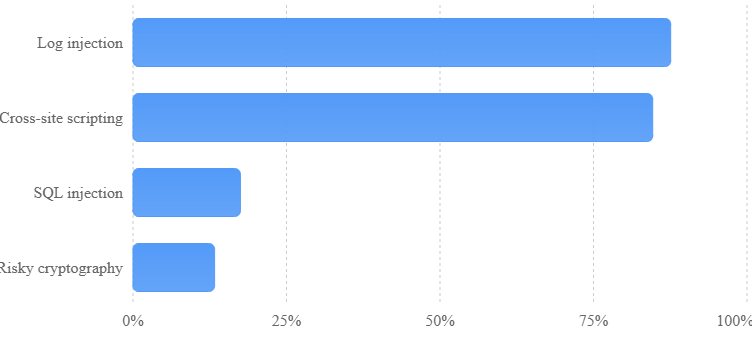
For this analysis, SFTechScene used the published vulnerability-category results from Veracode’s 2026 GenAI Code Security Report. We converted reported security pass rates into failure rates and compared the size of the differences.
This is a secondary analysis of Veracode’s experimental data, not a new round of model testing.
The data behind the analysis
Veracode used 80 security-focused coding tasks covering four programming languages and four weakness categories. The languages were Java, JavaScript, Python, and C#.
For each combination of language and weakness, the study used five task examples. It evaluated generated code with its security testing system. GenAI Code Security Report 2026
The published category averages allow a useful comparison.
| Security weakness | Published security pass rate | SFTechScene calculated failure rate |
|---|---|---|
| Weak or risky cryptography | 86.71% | 13.29% |
| SQL injection | 82.51% | 17.49% |
| Cross-site scripting | 15.36% | 84.64% |
| Log injection | 12.43% | 87.57% |
Source: Veracode GenAI Code Security Report 2026. Failure rate is calculated as 100% minus the published security pass rate for each tested category. GenAI Code Security Report 2026
Calculated AI security failure rates by weakness
Failure rates in Veracode’s security-focused benchmark tasks; SFTechScene calculations.
Finding #1: The security performance gap is enormous
In these tests, the reported pass rate for cryptographic algorithm selection was approximately 86.7%, while the pass rate for log injection was approximately 12.4%.
That is a difference of 74.28 percentage points.
Measured another way, the log-injection failure rate was approximately 6.6 times the failure rate for risky cryptographic algorithm choices.
This does not mean log-injection attacks are 6.6 times more common in real applications. It means the tested models failed the log-injection tasks much more frequently than the tested cryptography tasks.
The distinction matters because real-world risks also depend on whether code is exposed to attackers, what permissions it has, and how much damage a vulnerability could cause.
Finding #2: Good security performance in one task does not transfer to every task
A model can learn common defensive patterns such as prepared database queries.
It may therefore perform well on a familiar database problem while struggling with a less obvious situation where untrusted data reaches a webpage or log file.
That helps explain why choosing a model solely because it performs well on general coding benchmarks can be misleading.
Founders should evaluate AI coding tools using the security scenarios that matter to their own products.
A startup building a multi-user financial application should emphasize account permissions, payment integrity, and data protection. A company building a publishing platform should pay particular attention to user-generated content, browser safety, and content handling.
Finding #3: Working code and secure code are different achievements
Veracode’s Summer 2026 report presents an approximately 99.9% average syntax pass rate and a 56.3% average security pass rate in its displayed comparison.
SFTechScene calculates a difference of 43.6 percentage points between those two reported averages.
The gap between code that compiles and code that passes security checks
Veracode Summer 2026 reported benchmark means.
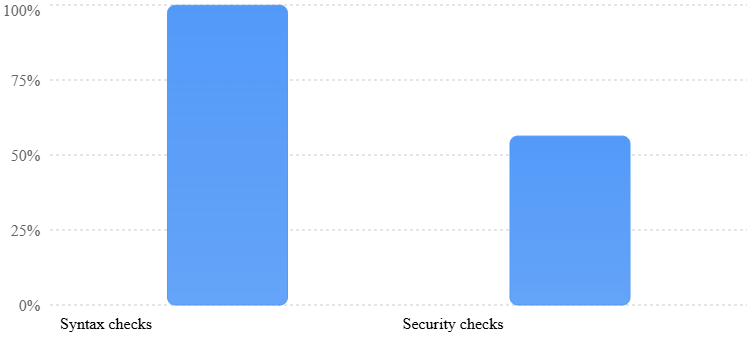
A model can become extremely good at writing code that compiles without becoming equally good at making safe choices.
That is one of the most important findings for any business using AI coding.
A successful build, a working demonstration, or a green test result should never be treated as proof that an application is secure.
Research limitations
These are controlled tasks designed to expose specific security choices. They are not a random sample of production software, and their failure rates should not be applied to every AI-generated code change.
The reported averages also come from a security vendor’s testing system. They provide valuable evidence, but independent testing and other benchmarks remain important.
Most importantly, the 44% overall benchmark failure figure is not the probability that an AI-generated pull request, startup application, or production release contains a vulnerability.
Why AI Coding Agents Create Security Risks Beyond the Code They Write
Traditional AI coding assistants mostly suggested code for a human to inspect.
Modern coding agents can take a series of actions. They may read repository files, modify applications, execute tests, install software, and connect to development systems.
That added freedom creates security risks even when the generated application code itself is harmless.
Prompt injection can turn ordinary project information into instructions
A coding agent often reads information from sources it does not control.
These sources may include GitHub issues, documentation, comments, websites, error messages, and project files.
An attacker may place instructions inside one of those sources, hoping the agent will follow them.
For example, an issue comment that should be treated as ordinary project data might tell the agent to reveal confidential information or perform an unrelated task.
The security failure occurs when the agent treats untrusted content as an authorized instruction.
Real research has demonstrated this danger
OWASP’s Q2 2026 AI exploit roundup documented a research disclosure involving malicious GitHub text that redirected coding agents into exposing runtime secrets.
The disclosure involved relevant workflows using Claude Code, Gemini CLI, and GitHub Copilot agents. The demonstrations depended on the permissions and credentials available to each workflow. OWASP classified the case as a research demonstration, not proof of widespread criminal exploitation. OWASP Gen AI Security Project
The lesson is important for Silicon Valley teams using automated development.
A company may carefully protect its application code while leaving an agent with access to sensitive credentials and untrusted repository content.
An attacker who influences what the agent reads may then attempt to make it misuse legitimate tools.
Excessive permissions make small mistakes more dangerous
Imagine an AI coding agent that only has permission to suggest code changes. A mistake may produce an unsafe suggestion, but a human still decides whether to accept it.
Now imagine the same agent can modify the production database, use cloud administrator credentials, and deploy changes.
The possible impact becomes much greater.
This is why startups should give agents only the permissions needed for the task they are performing.
A code-review agent usually does not need access to production secrets. A front-end design task rarely needs permission to change database security rules.
The agent should not be able to approve its own work
Another risk appears when the same agent writes code, creates tests, runs those tests, and decides whether the result is acceptable.
An agent trying to complete a task may produce tests that do not check the most important failure conditions. In some circumstances, it may weaken or remove tests that are failing.
OWASP specifically warns about test deletion, weak test assertions, and other situations where an agent makes the test suite pass without fixing the underlying issue. OWASP Cheat Sheet Series
The practical solution is to separate implementation from verification.
AI can generate tests, but important security checks should be controlled independently. For sensitive changes, a human reviewer or separate trusted testing process should decide whether the work is ready.
Original SFTechScene Research #3: The 2026 Developer Trust Gap Is Really a Verification Gap
Research question
How many developers are comfortable trusting AI for important decisions, compared with those who want limits or a way to verify its work?
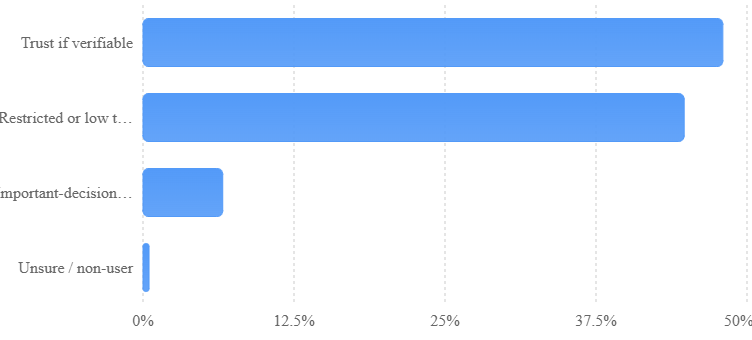
Rather than relying on a headline percentage, SFTechScene analyzed all six answer categories published in the 2026 Stack Overflow Developer Survey’s AI trust question.
The question received 14,304 responses. Because the categories are mutually exclusive, their published counts can be combined without double-counting respondents. Stack Overflow Developer Survey
Reorganizing the published responses
We grouped respondents into three categories based on the level of trust they reported.
| SFTechScene analysis group | Survey response categories included | Respondents | Share |
|---|---|---|---|
| Verification-dependent trust | Trust when output is easily verified | 6,872 | 48.0% |
| Restricted or low trust | Trust for non-important tasks, low-risk tasks, or not most tasks | 6,409 | 44.8% |
| Important-decision trust | Trust for many tasks including important decisions | 949 | 6.6% |
| Uncertain or non-user | Not sure / do not use AI | 74 | 0.5% |
Percentages use the full 14,304-response denominator and may not add to exactly 100% due to rounding.
How developers limit their trust in AI
SFTechScene regrouping of 14,304 published Stack Overflow 2026 responses.
Finding #1: Nearly 93% did not affirm broad trust for important decisions
Adding the first two groups gives 13,281 respondents, or approximately 92.85% of the sample.
These respondents either required easy verification, limited their trust to less important work, or distrusted AI for most work tasks.
That is approximately 14 respondents expressing conditional, restricted, or low trust for every respondent who explicitly trusted AI with important decisions.
This is an original grouping of the published survey responses. It should not be interpreted as evidence that all 13,281 respondents oppose AI autonomy in every setting.
Finding #2: Verification is becoming a product requirement
The largest individual response category was trust when AI output could be easily verified.
This has direct implications for startup engineering.
Instead of asking developers to trust AI because it comes from a well-known company, software teams should make results easier to verify.
A useful AI coding workflow should show the exact files changed, explain why those changes were made, provide meaningful test results, and make it easy to inspect the difference between the original and modified code.
For security-sensitive work, it should also show evidence that permissions, input handling, secrets, and dependencies have been checked.
Finding #3: AI adoption is ahead of formal governance
The same 2026 survey reported that 66% of respondents used coding assistants or agents. Yet only 24% reported that their organization published approved AI tools or official AI guidance, while 30% said AI use at work was optional and left to individuals. Stack Overflow
These questions measure different things, so subtracting the figures would not produce a valid estimate of how many developers lack policy coverage.
Even so, they point toward a business problem worth investigating: employees may be adopting coding tools faster than organizations are establishing clear rules for using them.
A startup with ten developers does not need a large security department to address this. It does need written rules for acceptable tools, sensitive data, production access, code review, and security testing.
Methodology and limitations
This analysis uses the published response counts from Stack Overflow’s 2026 AI trust question. Group definitions were created by SFTechScene, and the calculations use the complete question-response denominator of 14,304.
The survey is a voluntary survey of technologists across many countries. It is not a random sample of San Francisco engineers. We did not calculate a San Francisco-specific percentage, and we cannot establish how trust causes changes in software security.
The research does, however, support a practical conclusion: verification deserves an important place in AI-assisted development.
Original SFTechScene Research #4: How Much Can Better Security Testing Reduce Risk?
Research question
If AI helps a startup produce more software, how much could improving its review process reduce the number of security weaknesses that reach production?
There is no defensible universal defect rate for AI-generated production code. The Veracode benchmark measures specific security tasks, while GitHub measures development activity. Multiplying their headline percentages would produce a misleading estimate.
Instead, SFTechScene built a transparent sensitivity model.
The purpose is to show how security testing can change outcomes under different assumptions, not to claim that any particular model reflects a real company’s defect rate.
The model
Imagine a startup releases 1,000 code changes.
We test three hypothetical rates of changes containing a security weakness before review: 2%, 5%, and 10%.
We then test three possible rates at which the startup detects and fixes those weaknesses before release: 50%, 80%, and 95%.
The calculation is:
\[ E=N\times P\times(1-D) \]
Where:
- \(E\) = expected changes with undetected weaknesses
- \(N\) = number of changes
- \(P\) = assumed share of changes containing a weakness
- \(D\) = assumed share of those weaknesses detected and fixed
This model assumes one binary weakness outcome per change and no new defects introduced during repair. It also assumes the detection rate is constant within each scenario.
Finding #1: Review effectiveness changes the outcome dramatically
| Assumed pre-review weakness rate | 50% detected | 80% detected | 95% detected |
|---|---|---|---|
| 2% | 10 | 4 | 1 |
| 5% | 25 | 10 | 2.5 |
| 10% | 50 | 20 | 5 |
SFTechScene scenario analysis: expected changes with an undetected weakness per 1,000 changes. Fractional values are mathematical expectations, not literal partial changes.
Modeled weaknesses escaping review per 1,000 changes
Illustrative sensitivity analysis, not observed defect rates.
■ 2% initial weakness rate
■ 5% initial weakness rate
■ 10% initial weakness rate
Consider the middle scenario, where 5% of changes contain a security weakness before review.
At 50% detection effectiveness, the model produces 25 changes with undetected weaknesses per 1,000. At 95% detection effectiveness, that drops to an expected 2.5.
That is a 90% reduction in expected escaped weaknesses.
This does not prove that real security scanners catch 95% of vulnerabilities. In practice, detection rates vary widely by weakness type, testing method, codebase, and reviewer experience.
Finding #2: More code can cancel out better security work
Suppose a team produces 500 changes, with 5% containing a weakness before review. If its process catches 80% of those weaknesses, the model predicts five changes with undetected weaknesses.
If output doubles to 1,000 changes while the other assumptions stay unchanged, the expected number rises to ten.
The team did not become less careful. Its total exposure increased because it was processing twice as much work.
To maintain its earlier expected count of five escaped weaknesses, the expanded workflow would need to catch 90% of the assumed weaknesses, rather than 80%.
This is a useful way for founders to think about AI coding productivity.
If development output doubles, security capacity and effectiveness need to improve too.
Finding #3: The best investment is not always another coding agent
Imagine a startup choosing between two investments.
The first improves AI coding speed by 25%. The second improves its ability to find and fix serious security weaknesses before release.
The first investment may be valuable if the startup is struggling to create features. The second may be more valuable if the company already has a backlog of changes waiting for review.
The answer depends on the actual bottleneck.
Founders should measure development throughput, review time, defect escape rates, and security incidents before deciding where to spend money.
What the model cannot tell us
This analysis does not measure actual vulnerability rates in AI-generated code. It also treats all detected weaknesses as equally important, although a minor logging flaw and an account takeover vulnerability may have very different consequences.
Real companies should divide findings by severity, exposure, and business impact. They should also measure the number of important weaknesses discovered after release rather than relying only on scanner results.
The value of this model is its repeatable method. A startup can insert its own observed development volume, defect rate, and verified detection performance to create a more realistic forecast.
How San Francisco Startups Can Build a Secure AI Coding Workflow
The goal should not be to add a long approval process to every small change.
Instead, startups should design a workflow in which routine checks happen automatically and people focus on the decisions that carry the greatest risk.
Step 1: Classify coding tasks by risk before using AI
Not every coding task deserves the same level of review.
Changing a button color is different from changing how customer permissions are checked. Improving internal documentation is different from modifying a payment system.
A simple classification system helps startups direct their limited security resources toward the changes that matter most.
| Risk level | Example work | Recommended review approach |
|---|---|---|
| Low | Text changes, documentation, visual styling | Automated checks and normal peer review |
| Medium | New forms, ordinary API features, database queries | Peer review, automated security scans, and targeted tests |
| High | Authentication, payments, private customer data, authorization | Senior review, security-specific tests, and independent approval |
| Critical | Production access, secret management, large data migrations, cloud permissions | Explicit authorization, isolated testing, and controlled deployment |
This table is a suggested SFTechScene operating framework, not a formal industry standard.
The important point is that risk determines the amount of verification required.
Step 2: Give coding agents limited access
A coding agent should not receive every permission available to a developer simply because doing so is convenient.
Start by placing the agent in an isolated development environment. Give it access only to the files, commands, and services needed for its assigned task.
Separate production credentials from development credentials, and require human approval for sensitive operations.
An agent that is building a landing page should not be able to delete a customer database. An agent reviewing a pull request should not need unrestricted access to billing information.
These controls follow the broader guidance in OWASP’s secure coding recommendations for AI tools. OWASP Cheat Sheet Series
Step 3: Require independent code review
AI-generated code should enter the same review process as human-written code, with additional attention to agent permissions and untrusted input.
A reviewer should understand what the change does, why it is needed, and what could go wrong.
For sensitive work, the reviewer should check the actual code and test evidence rather than relying on the AI’s explanation of its own work.
This is especially important when an agent makes changes across multiple files or updates parts of the product unrelated to the original request.
Step 4: Run automated checks on every important change
Startups should automate common checks before software is merged.
A practical pipeline can include code formatting and quality checks, automated tests, security scanning, dependency checks, and secret detection.
Static application security testing, often called SAST, examines source code for patterns associated with known security weaknesses. Dependency scanning looks for vulnerable third-party packages, while secret scanning searches for exposed credentials.
These tools are useful but imperfect. Passing them does not prove that an application is safe, and findings still need to be reviewed in context.
Step 5: Test what an attacker might try
Many software tests verify that a feature works when used correctly.
Security tests must also check what happens when someone uses it incorrectly or maliciously.
For a customer dashboard, that means testing whether one customer can read another customer’s records. For a payment API, it means testing whether a user can alter prices, reuse requests, or bypass expected checks.
For a file upload feature, it means checking file types, access permissions, storage rules, and size limits.
These tests should be built around the product’s actual risks rather than copied blindly from a generic checklist.
Step 6: Protect the software supply chain
An AI-assisted application may depend on hundreds of packages and services.
That creates many opportunities for problems if developers do not know what has been installed or where the code came from.
Teams should maintain a record of their software dependencies, use trusted package sources, check for known vulnerabilities, and approve new high-risk dependencies.
They should also protect build systems and deployment credentials. A secure application can still be compromised if an attacker gains access to the process used to release it.
Step 7: Separate testing and production environments
A common startup mistake is allowing experimental features to interact directly with production systems.
AI-generated changes should first run in an isolated environment using test data.
Developers can then check functionality, security, performance, and unexpected behavior before deciding whether to release the change.
Production deployment should use controlled permissions, protected branches, and a clear rollback process.
Step 8: Monitor the application after release
Security work does not end when software passes its tests.
Applications change, new vulnerabilities are discovered, and attackers find ways to combine weaknesses that developers did not expect.
Startups should monitor unusual login activity, repeated authorization failures, unexpected data access, changes in cloud permissions, and suspicious API activity.
They also need a simple incident response plan that explains who investigates a suspected problem, who can disable an affected feature, and how customers will be informed when necessary.
Step 9: Track a small set of meaningful security metrics
Founders do not need fifty security dashboards. They need a few measurements that help them make better decisions.
| Metric | What it measures | Why it matters |
|---|---|---|
| Security scan coverage | Share of relevant changes receiving automated scans | Shows whether basic checks are consistently applied |
| Critical findings before release | Serious weaknesses found during development | Reveals where prevention and testing are working |
| Escaped vulnerabilities | Confirmed weaknesses discovered after release | Helps assess actual security outcomes |
| Time to repair | Time between confirming a weakness and fixing it | Shows how quickly the team reduces exposure |
| Sensitive changes independently reviewed | Coverage of high-risk changes | Measures whether important work receives human oversight |
| Agent permission exceptions | Times agents receive privileges outside approved rules | Helps detect risky workflows |
Teams should interpret these metrics together.
For example, finding more vulnerabilities during development may mean that security has become worse, or it may mean that testing has improved. A single number cannot explain the difference.
A Practical 30-Day AI Code Security Plan for Early-Stage Startups
Many San Francisco companies do not have the budget for a full-time security team. That does not prevent them from establishing a useful security process.
The following plan is designed for a small startup with an existing codebase and limited engineering resources.
Week 1: Find your biggest risks
Start by identifying which AI coding tools employees use and what permissions those tools have.
Review access to repositories, cloud systems, databases, production environments, and external services. Identify places where agents can execute commands or modify sensitive files.
Next, map the most valuable information your application handles. This may include customer records, authentication data, financial information, or confidential business documents.
By the end of the week, the team should know which systems would create the most damage if exposed or changed without permission.
Week 2: Establish basic controls
Create a short written policy covering approved AI tools, secrets, repository access, security reviews, and production deployment.
Require independent approval for changes involving authentication, access control, financial operations, or customer data.
Enable protected branches, automated tests, dependency alerts, and secret scanning. Ensure that development agents operate with limited permissions.
The aim is to remove obvious sources of risk before adding more advanced testing.
Week 3: Test the most dangerous features
Choose the application’s highest-risk user flows.
Test whether users can access other accounts, whether APIs enforce permissions, whether payment-related values can be changed improperly, and whether private data appears in logs.
If the company serves enterprise customers, pay particular attention to the boundaries between different customer organizations.
Record the weaknesses found and repair the most serious issues first. Do not spend the week polishing minor warnings while critical access-control problems remain open.
Week 4: Measure, improve, and make the process repeatable
Review the results of the first three weeks.
How many sensitive changes received independent review? Were any secrets found in code? Did automated checks block unsafe changes? How long did important fixes take?
Use those answers to improve the development workflow.
The end goal is a repeatable system in which AI coding remains fast but no longer depends on developers remembering every security check manually.
How to Write AI Coding Prompts That Produce Safer Software
A good prompt can make security requirements clear from the beginning. It can also reduce wasted work by telling the coding agent what constraints it must respect.
However, prompting is not a substitute for independent security testing.
Start with the security requirements, not just the feature
Consider a founder asking AI to build a customer dashboard.
A weak prompt might simply request a dashboard where customers can view invoices.
A better prompt explains that customers must only access records belonging to their own accounts, that permissions must be enforced on the server, and that sensitive data must not appear in logs.
It also requires tests that attempt unauthorized access.
Example: Secure feature-development prompt Copy
Build a customer invoice dashboard using the existing application framework and authentication system. Enforce authorization on the server for every invoice read and update. Users must never access records belonging to another customer account. Use parameterized database queries and approved dependencies. Do not store secrets in code, expose private data in logs, or change production settings. Add positive and negative tests for access control. Do not remove or weaken existing tests. List every file changed, any new dependencies, remaining security concerns, and tests executed. Stop and request approval before changing authentication, permissions, infrastructure, or production data.
This prompt does three useful things.
It describes the intended functionality, establishes important security boundaries, and creates a record of what the agent should report when it finishes.
The team must still verify that the output follows those instructions.
Ask AI to identify possible failure cases
AI is also useful for brainstorming security tests.
A developer can ask an assistant to examine a proposed feature and identify the ways it might fail when it receives unexpected input, an unauthorized request, or incorrect configuration.
That can help the team find cases it might otherwise overlook.
However, the person reviewing the results should decide which tests are meaningful. AI-generated security advice can itself be incomplete or incorrect.
Use separate review instructions
A useful review prompt should ask the model to find problems rather than praise the implementation.
For example, an independent reviewer can be asked to examine access-control checks, sensitive information handling, error paths, and third-party dependencies.
It should report the specific file and code location associated with each concern, explain how the problem could affect users, and distinguish confirmed findings from possibilities requiring further investigation.
A separate human review remains important for significant changes.
The Business Cost of Insecure AI-Generated Code
Security mistakes can erase the savings from faster development
One reason startups adopt AI coding is to reduce the time and money needed to build software.
But the true cost of a feature includes more than its initial development.
It also includes testing, maintenance, cloud infrastructure, customer support, security fixes, and the work required when something goes wrong.
Consider a startup that saves $15,000 in development costs by using AI to build a feature. If the feature contains a serious security weakness, the company could spend much more repairing it, investigating affected systems, and dealing with customer concerns.
The $15,000 example is illustrative, not a measured industry average.
The important question is whether the full lifetime cost of the feature is lower, not whether AI produced its first version cheaply.
Enterprise customers increasingly care about how software is built
For business software companies, strong security practices can support sales.
Enterprise buyers may ask how customer information is protected, who can access production systems, whether software changes are reviewed, and how vulnerabilities are handled.
A startup that can explain its AI coding workflow and show evidence of independent testing has a stronger answer than one that simply promises its software is secure.
Security documentation, access-control testing, and an established incident response process can therefore become part of a startup’s competitive advantage.
Founders should budget for verification
An AI-first startup may need fewer hours for certain coding tasks, but that does not mean it can eliminate experienced engineering judgment.
Someone still needs to decide how the system should behave, which permissions are appropriate, what data must be protected, and whether a release is safe.
This may shift engineering spending toward architecture, testing, code review, and security.
The best financial outcome comes when AI reduces routine work while the team invests enough in verification to avoid expensive failures.
What the Future of AI-Generated Code Security Could Look Like in 2027
Security testing will become more automated
As coding agents handle more development work, startups will need better ways to review changes at similar speed.
AI-assisted security review may help explain unfamiliar code, suggest tests, compare changes against security rules, and identify suspicious behavior.
However, these systems will need their own safeguards. A second AI model is not automatically an independent or reliable security authority.
A strong future workflow will likely combine several methods: automated scanners, well-designed security tests, human review, restricted agent permissions, and monitoring after release.
Coding agents will need stronger permission systems
Agent security may increasingly depend on what tools can do rather than only on what instructions they receive.
A coding agent may be allowed to edit application files but prevented from reading production secrets. Another agent may run tests but require explicit approval before installing software or connecting to external services.
These restrictions can reduce damage even when a model misunderstands its task or encounters malicious instructions.
The broader principle is simple: a mistake should not automatically become a security incident because an agent has too much access.
Trustworthy software may become a stronger selling point
Speed alone is easy to demonstrate. A product can be built quickly, shown to investors, and released to early users.
Reliability is harder to demonstrate because it must hold up over time.
This creates an opportunity for Silicon Valley companies that make verification a core part of their products and development processes.
A startup that can explain how code was created, what changed, how it was checked, and who approved the release may stand out as AI-generated software becomes more common.
Frequently Asked Questions About AI-Generated Code Security
Is AI-generated code less secure than human-written code?
Not necessarily in every situation. Both AI-generated and human-written code can contain serious vulnerabilities, and the relative risk depends on the task, developer experience, tools, and review process.
Current security benchmarks show that AI models still make important security mistakes. They do not establish one universal failure rate comparing all AI-written production software with all human-written software.
Can startups safely use Cursor, Claude Code, Codex, and other AI coding tools?
Yes, these tools can be part of a secure development process when used with suitable controls.
Startups should limit agent permissions, protect secrets, review sensitive changes, verify dependencies, run security tests, and prevent unapproved production access.
The tool’s name matters less than the permissions it receives and the quality of the surrounding workflow.
Can AI review its own code for security problems?
AI can help identify potential weaknesses and create useful test cases. However, an AI-generated review should not be the only evidence that sensitive software is secure.
Independent checks are important because the same model may repeat its earlier mistakes or fail to recognize weaknesses in its own implementation.
What should a small startup secure first?
The first priorities should usually be customer data, authentication, access permissions, production credentials, and cloud configuration.
After those protections are established, the company should strengthen dependency scanning, automated testing, monitoring, and incident response.
The exact order depends on what the product does and which systems are most exposed.
How should startups measure whether AI coding is actually saving money?
Measure the full work required to deliver and maintain features, not just the time used to generate code.
That includes review time, failed tests, bug fixes, production incidents, security remediation, and maintenance.
A tool that writes code faster but creates more expensive problems may not deliver the savings promised.
Final Takeaway: Silicon Valley’s Next AI Coding Advantage Will Come From Building Software That Can Be Trusted
AI is changing the economics of software development.
It is becoming easier for founders to create applications, test ideas, and build products with smaller teams. That shift offers enormous opportunities for San Francisco startups, especially those that previously struggled with high development costs.
But creating software and creating trustworthy software are two different achievements.
The 2026 evidence makes this distinction clear. GitHub shows that coding agents are becoming a major part of development work. Veracode shows that AI-generated code continues to struggle with certain security weaknesses. Stack Overflow shows that developers are willing to use AI while placing meaningful limits on how much they trust its output.
SFTechScene’s original calculations add an important business lesson: as AI-generated development activity grows, the amount of work requiring review can grow with it. Under the assumptions in our scenario analysis, stronger detection and remediation can substantially reduce the number of weaknesses that escape into production.
That does not mean startups should abandon AI coding. It means they need to design security into the process from the beginning.
The strongest companies will use AI to reduce routine engineering work while investing in architecture, automated testing, limited permissions, independent review, and clear accountability.
For Silicon Valley founders, the goal should no longer be simply to build an application in a day.
The real goal is to build software quickly, prove that it is safe enough for its intended use, and earn the trust of customers who depend on it.
That is where the next competitive advantage in AI-powered software development may emerge.
Research Sources and Reproducibility Notes
The article uses public research and published aggregate data available by October 31, 2026. Original SFTechScene work consists of derived calculations, response-category grouping, and a clearly labeled sensitivity model. It does not claim new vulnerability experiments or private data from San Francisco startups.
| Primary source | Data used | Purpose |
|---|---|---|
| GitHub Octoverse 2026 | Agent-started PR shares, multi-file changes | Research #1 |
| Veracode 2026 GenAI Code Security Report | Security pass rates and methodology | Research #2 |
| Stack Overflow 2026 AI Trust Data | Exact trust-category counts | Research #3 |
| Stack Overflow 2026 Survey Findings | AI adoption and governance statistics | Industry analysis |
| OWASP Secure Coding with AI | Agent safeguards and secure development recommendations | Practical guidance |
| OWASP Top 10:2025 | Major application security risk categories | Vulnerability explanations |
| OWASP Q2 2026 Exploit Roundup | Documented incidents and research demonstrations | Agent threat analysis |
| NIST Secure Software Development Framework | Established secure development practices | Framework reference |
How to reproduce the original calculations
Research #1 uses the reported pull-request shares and multi-file rates to calculate workload estimates for 1,000 hypothetical changes. Research #2 subtracts published security pass rates from 100% and compares the results. Research #3 adds the published counts for mutually exclusive survey categories, then divides by the 14,304-response denominator. Research #4 uses the stated mathematical model with 1,000 changes and three levels each of assumed weakness prevalence and detection effectiveness.
The study does not estimate a San Francisco-specific AI vulnerability prevalence, because the cited datasets do not support that conclusion. Its original contribution is a transparent analysis of public measurements and their practical implications for startup security planning.