

SFTechScene | October 2026 | Research-backed analysis
Software development is going through one of its biggest changes in decades. Developers who once spent hours writing code, fixing errors, and running tests can now ask artificial intelligence to handle much of that work.
Two companies are at the center of this shift: OpenAI and Anthropic.
OpenAI’s Codex and Anthropic’s Claude Code are changing how software gets built. Both can understand projects, write code, find bugs, run commands, and help developers finish tasks that once required hours of manual work.
The competition matters far beyond the companies developing these products. For San Francisco startups, engineering teams, and businesses that depend on software, the outcome could change hiring plans, product development costs, and the speed at which new companies enter the market.
But which AI coding agent is actually winning?
SFTechScene examined publicly available developer survey data, official product documentation, pricing information, and software engineering research to separate adoption from performance. We also developed original calculations to explore the market gap, the economics of AI-assisted development, and the conditions under which AI agents create measurable savings.
The results reveal a market where Claude Code has a substantial lead in reported developer adoption, but where the larger battle over reliable software automation remains open.
The Short Version: Claude Code Leads in Developer Adoption, but Codex Remains a Serious Competitor
The clearest evidence of Claude Code’s lead comes from Stack Overflow’s 2026 Developer Survey.
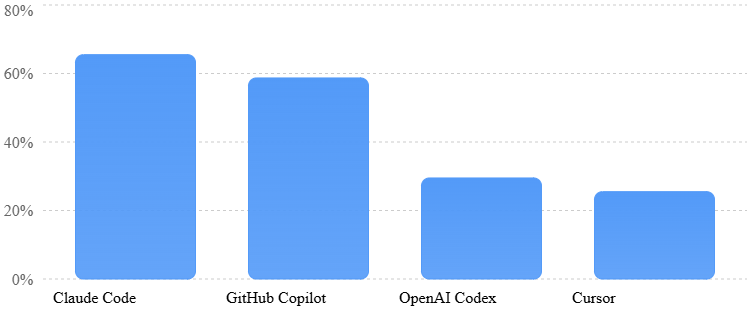
Among 12,255 respondents who answered its coding-agent usage question, 65.5% reported using Claude Code in the past year, compared with 29.5% who reported using OpenAI Codex. The question allowed respondents to report multiple products, making these usage rates rather than exclusive market shares. Stack Overflow Developer Survey
Claude Code usage
65.5%
8,030 survey respondents
OpenAI Codex usage
29.5%
3,620 survey respondents
This is a meaningful lead, especially because it comes from reported use rather than vendor marketing material. However, it does not prove that Claude Code produces better software, costs less, or performs better on every engineering task.
Codex offers access through supported local development tools and cloud coding environments. Claude Code also works across the terminal, supported development environments, and desktop workflows, giving developers several ways to delegate programming tasks. OpenAI Help Center+2
For founders deciding between these tools, several conclusions stand out.
First, Claude Code has stronger evidence of developer adoption in the public survey data available for 2026. That gives Anthropic an important advantage in developer familiarity and word-of-mouth recommendations.
Second, Codex remains competitive because adoption is not the same as technical quality. A coding agent can have fewer users and still deliver better results for a particular programming language, project, or business workflow.

Third, the biggest economic opportunity may not be replacing developers. It may be reducing the number of hours they spend on routine work while allowing them to focus on product design, security, customer needs, and technical decisions.
Finally, the company that produces the most code will not necessarily win. The more important question is which platform helps businesses deliver reliable software at the lowest total cost.
What Are OpenAI Codex and Anthropic Claude Code?
OpenAI Codex: An AI Agent for Software Development
OpenAI Codex is designed to help developers carry out programming work using natural language.
Instead of simply answering questions about code, it can work within an actual software project. Depending on the environment and permissions, it can examine files, change code, execute commands, run tests, and produce changes for human review.
A developer might ask Codex to investigate why a checkout page is failing. The agent could examine the relevant files, identify a possible cause, make a change, and run available tests to check whether the problem is resolved.
That is different from using a traditional chatbot to produce a code snippet that someone must manually copy into a project.
Local Development and Cloud Execution
Codex supports coding workflows that connect to a developer’s existing environment, while Codex Cloud runs tasks on OpenAI-managed computers.
Cloud environments can be prepared with project repositories, dependencies, tools, and access settings. Once configured, developers can use them for supported tasks from desktop, web, or mobile interfaces. OpenAI Help Center
This creates an interesting opportunity for small engineering teams.
A developer can work on a complicated feature while assigning another well-defined task to a separate coding environment. The agent’s output can then be reviewed before it becomes part of the main product.
However, using separate environments does not automatically guarantee safe code or successful integration. The team still needs tests, review procedures, and controls over what the agent can access.
Anthropic Claude Code: A Development Agent Built Around Real Projects
Claude Code is Anthropic’s approach to agent-based software development.
It allows developers to work with Claude directly in programming environments rather than moving between a code editor and a general-purpose chatbot.
Claude Code can help teams explore unfamiliar projects, modify existing code, investigate problems, write tests, and carry out larger development tasks.
Anthropic makes Claude Code available through supported terminal, desktop, and IDE workflows. It also offers access through individual and organizational subscriptions. Claude Help Center+1
Why Working With an Existing Codebase Matters
Writing a new function is often much easier than modifying software that already serves thousands of customers.
An established application may contain hundreds of files, shared services, database rules, hidden dependencies, and older code that nobody wants to change.
A coding agent that understands how these pieces connect can potentially save considerable time.
For example, imagine a San Francisco software company wants to change the way it calculates subscription discounts. The change might involve its checkout page, payment service, database, customer emails, and reporting dashboard.
A useful agent needs to identify all these connections. Changing only the visible checkout calculation could create serious billing mistakes.
This is why evaluating Codex and Claude Code requires more than measuring how quickly they generate new code.
OpenAI Codex vs. Claude Code: A Detailed Feature Comparison
Both products are moving quickly, so the best comparison focuses on the capabilities that matter to engineering teams rather than features that could change with a single release.
| Comparison area | OpenAI Codex | Anthropic Claude Code |
|---|---|---|
| Developer | OpenAI | Anthropic |
| Primary purpose | AI-assisted coding and task delegation | AI-assisted coding and task delegation |
| Existing codebases | Can inspect and modify projects | Can inspect and modify projects |
| Terminal workflows | Supported | Supported |
| IDE workflows | Supported integrations | Supported integrations |
| Cloud-based workflows | Codex Cloud | Supported remote workflows |
| Test execution | Available with suitable environment and permissions | Available with suitable environment and permissions |
| Code review | AI-assisted review workflows | AI-assisted review workflows |
| Team use | Supported business and enterprise options | Supported team and enterprise options |
| Main buying question | Does it improve delivery in our environment? | Does it improve delivery in our environment? |
The table shows that neither product should be dismissed as a basic code generator.
Both compete for an increasingly valuable role: becoming the system through which developers assign, manage, and verify software engineering work.
Where Codex Could Have an Advantage
Codex may appeal to teams already using OpenAI services and organizations that want coding work to move between local and cloud environments.
Existing subscriptions, administrative policies, and familiar interfaces may lower the effort needed to introduce it.
Its cloud execution model may also suit teams that want to delegate isolated tasks without running every operation on a developer’s primary computer.
These are potential advantages rather than proof of superior results.
Where Claude Code Could Have an Advantage
Claude Code’s strongest publicly measured advantage is developer adoption.
A larger pool of developers familiar with a tool can make hiring, onboarding, and sharing practical workflows easier. Teams may also benefit from more community examples and accumulated experience.
Claude Code’s terminal-centered workflow is useful for developers who are comfortable operating directly within their projects.
However, popularity alone does not establish an advantage in correctness, security, or cost.
The right choice depends on the type of software a team builds and how it measures successful work.
Original SFTechScene Research #1: Claude Code’s Developer Adoption Lead Is Larger Than It First Appears
To examine the competitive position of both products, SFTechScene reanalyzed the published response counts from Stack Overflow’s 2026 Developer Survey.
This is secondary analysis of an independently collected public dataset, not a new survey conducted by SFTechScene.
Research Methodology
The analysis uses the survey’s published coding-agent usage table.
The source includes 12,255 respondents who answered a question about which coding agents or assistants they had used during the previous year.
We selected four major developer tools and calculated differences in respondent counts, usage rates, and relative reported adoption.
The calculations use published counts rather than rounded percentages wherever possible. The survey is not a random sample of San Francisco developers, and the results should not be treated as a city-level market-share estimate.
Source: Stack Exchange Inc., AI coding agents, Stack Overflow Developer Survey 2026, licensed under ODbL 1.0. Stack Overflow Developer Survey
Finding #1: Claude Code Has More Than Twice Codex’s Reported Usage
Reported use of leading AI coding agents
2026 Stack Overflow Developer Survey, n = 12,255. Multiple selections allowed.
Source: Stack Exchange Inc. (2026), AI coding agents. SFTechScene visualization.
The gap between Claude Code and Codex is substantial.
Using the published response counts:
\[ \text{Usage ratio}=\frac{8,030}{3,620}\approx2.22 \]
Claude Code was reported by approximately 2.22 times as many respondents as Codex.
The difference between their published usage percentages is 36 percentage points.
This matters because developers often choose tools that fit into their existing habits. A platform with widespread use can become a natural starting point for new teams and new employees.
However, developer adoption is not necessarily permanent. Switching costs can be relatively low for individual users, particularly when their work remains in standard code repositories.
Finding #2: Claude Code’s Lead Is Not Simply a Two-Company Story
| AI coding tool | Respondents | Reported usage |
|---|---|---|
| Claude Code | 8,030 | 65.5% |
| GitHub Copilot | 7,196 | 58.7% |
| OpenAI Codex | 3,620 | 29.5% |
| Cursor | 3,127 | 25.5% |
Claude Code leads the selected products, but GitHub Copilot also has substantial adoption.
Codex and Cursor show that the market has several meaningful competitors rather than a single winner.
The overlap between these products is especially important. A respondent could have used Claude Code, Codex, and Cursor in the same year.
Therefore, adding their percentages would not reveal their combined share of developers.
Finding #3: The Number of Respondents Reporting Claude Code Exceeds Codex by 4,410
SFTechScene calculation: Respondent gap
4,410
More respondents reported using Claude Code than OpenAI Codex in the survey’s coding-agent question.
8,030 − 3,620 = 4,410. This is a difference in reported users within the sample, not an estimate of unique users worldwide.
The figure provides a useful view of the gap, but it needs careful interpretation.
We cannot determine how many respondents used both products from the published aggregate counts. Nor can we calculate how much more time developers spent in one tool than the other.
The data measures whether respondents reported use, not the number of tasks completed, projects delivered, or hours saved.
Finding #4: At Least 4,410 Respondents Used Claude Code Without Reporting Codex
This conclusion follows from a useful property of overlapping survey responses.
Let the number of people reporting both tools be \(x\).
Claude-only respondents would equal \(8,030-x\), while Codex-only respondents would equal \(3,620-x\).
Because overlap cannot exceed the smaller group, \(x\) cannot exceed 3,620.
That gives us the following bounds:
| Derived measure | Minimum | Maximum |
|---|---|---|
| Reported both products | 0 | 3,620 |
| Claude Code only | 4,410 | 8,030 |
| Codex only | 0 | 3,620 |
| Reported either product | 8,030 | 11,650 |
These are mathematically valid bounds derived from the published totals, not observed overlap counts.
The most important insight is that Claude Code’s reported use extends beyond Codex’s audience by at least 4,410 survey respondents, regardless of how much overlap exists.
That is stronger evidence of an adoption gap than simply comparing two percentages. Still, it tells us nothing about which tool completes tasks more accurately.
What This Means for San Francisco Startups
San Francisco startups compete for engineering talent in an environment where speed matters.
A coding tool already familiar to more developers may reduce training needs. New hires can potentially become productive faster, especially if they have worked with the same agent in previous roles.
Claude Code’s survey lead makes this a relevant consideration.
But startups should avoid turning a broad developer survey into a local purchasing rule. To understand San Francisco specifically, they would need local usage data or a measured trial involving their own engineers.
The practical recommendation is to treat developer familiarity as one factor in tool selection, not as proof of technical superiority.
Original SFTechScene Research #2: AI Coding Is Becoming Normal, but Full Automation Is Still a Different Market
One of the biggest mistakes businesses make when discussing AI software development is treating all AI usage as the same thing.
Using AI to suggest a function is not the same as asking an agent to rebuild an entire application. Likewise, using an AI coding assistant every day does not mean a company has automated its engineering department.
Stack Overflow’s 2026 survey provides a way to measure this difference.
Research Methodology
SFTechScene used the survey’s public responses to the question about AI tools used at work.
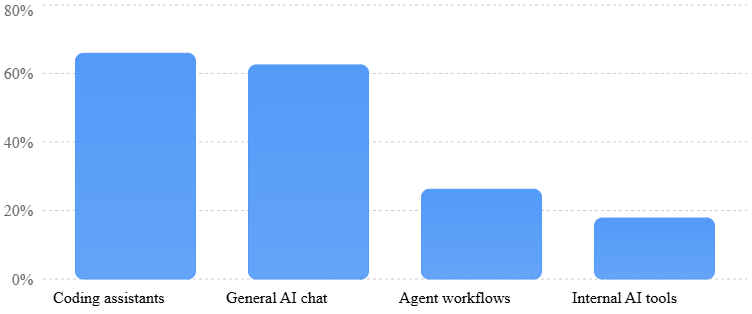
This question received 17,464 responses and allowed multiple selections. We compared reported use of coding assistants, general chat tools, and automated agent workflows.
We then calculated percentage-point gaps between these categories.
Because respondents could select multiple answers, these differences describe reported adoption rates. They do not identify individual migration paths or show how often each tool was used. Stack Overflow Developer Survey
Finding #1: Coding Assistants Are Much More Common Than Automated Agent Workflows
How developers use AI at work in 2026
Share of 17,464 respondents selecting each category; categories overlap.
Source: Stack Exchange Inc. (2026), AI tool usage. SFTechScene analysis.
The findings show a clear gap between using AI for coding and adopting broader AI automation.
Around 65.9% of respondents reported using coding assistants or coding agents in their work. Only 26.2% reported using AI agents or automated workflows.
That creates a difference of 39.7 percentage points.
In relative terms, coding-assistant use was approximately 2.52 times as common as automated workflow use in this question.
Importantly, the categories are not mutually exclusive and use somewhat different descriptions. An individual coding agent can also be part of a broader automated workflow, so the result should not be interpreted as a clean division between autonomous and non-autonomous systems.
Finding #2: The Market Has More Experience With AI Assistance Than End-to-End Automation
The numbers suggest that developers have embraced AI assistance faster than businesses have embraced broader automated workflows.
This makes sense when we consider the risks.
A developer can ask AI to explain a function and immediately judge whether the answer makes sense. A company allowing an agent to modify production systems needs much stronger controls.
The second task may require permissions, logging, testing, deployment rules, and approval processes.
This creates an opportunity for both Codex and Claude Code.
As more teams become comfortable with AI assistance, some may move toward delegating larger engineering tasks. The vendors that make this shift safe and easy could benefit from growing demand.
However, the survey does not measure how many users are actively making that transition.
Finding #3: AI Is Becoming Part of Daily Engineering Work
Among respondents using coding assistants or agents, 73% reported daily use in the survey’s frequency question.
That is important because it suggests AI is becoming a routine part of development rather than an occasional experiment. Stack Overflow Developer Survey
Once a tool becomes part of a daily workflow, developers may begin organizing their work around it.
They might write more detailed task descriptions, maintain better documentation, or create automated tests that an agent can run.
These changes can make the entire engineering process more structured.
Still, daily usage is not the same as business value. A developer can spend hours using AI without finishing more useful work.
The correct measure is whether a team ships reliable changes faster, with less total effort.
What San Francisco Founders Should Learn
The survey gives startups two useful signals.
First, AI coding support is already common enough that ignoring it could mean overlooking a useful way to improve productivity.
Second, broader automation is less established, which means founders should avoid assuming that replacing entire development workflows is straightforward.
The best opportunities may be somewhere between those two extremes.
A small startup might use Codex or Claude Code to handle routine coding, generate tests, and investigate bugs while keeping experienced developers responsible for architecture, security, and product decisions.
This arrangement can produce value without depending on the idea that AI is ready to run an entire engineering organization.
How Codex and Claude Code Actually Change the Software Development Process
To understand the competition, it helps to follow a feature from the first customer request to the final release.
Imagine a San Francisco startup that sells appointment software to local businesses. Customers want an automated reminder system that sends an email before a scheduled appointment.
Without AI, a developer would need to understand the request, locate the relevant code, write the feature, test it, and prepare it for release.
With an AI coding agent, several of those steps can be delegated.
Stage One: Understanding the Existing Software
The first challenge is finding out how the application works.
Where are appointments stored? How are email messages sent? Which part of the system handles customer time zones?
A coding agent can inspect files and help identify these connections.
This is valuable because developers often spend significant time reading and understanding existing code before making changes.
However, an agent may misread an undocumented business rule. For that reason, its explanation should be checked against the actual application and relevant tests.
Stage Two: Creating an Implementation Plan
Before writing code, the team needs a clear plan.
The agent should identify which files require changes, whether a database update is necessary, and what could go wrong.
For the appointment example, the plan might involve storing reminder preferences, creating a scheduled process, and connecting it to the existing email service.
The team should approve important design decisions before implementation.
Otherwise, an agent may choose a technically reasonable solution that creates unnecessary operating costs or conflicts with existing architecture.
Stage Three: Writing and Modifying Code
This is the part of the process where AI coding agents can provide immediate help.
The agent can create functions, update existing components, and connect the new feature to the application.
But writing code is only part of the job.
The system must also handle cases such as canceled appointments, invalid email addresses, daylight saving time changes, and customers who have disabled reminders.
A feature that works in a simple demonstration may fail when used by real customers.
Stage Four: Testing and Finding Problems
After implementation, the agent should run the available tests and report the results.
If a test fails, it can investigate the cause and attempt a correction.
This can reduce repetitive work, particularly when the problem is clear and the required behavior is well defined.
But tests can miss important issues. An agent might write a test that matches its own incorrect assumption, producing a passing result for the wrong behavior.
Human review and independent acceptance checks remain important.
Stage Five: Reviewing and Releasing the Change
The final step should involve examining what changed and deciding whether the feature is safe to release.
The reviewer should understand the effect on customers, databases, security, and operating costs.
A useful coding agent should make this review easier by producing a clear summary of its work.
The review should not be skipped merely because all automated tests pass.
For businesses, this is the difference between generating software and delivering trustworthy software.
Original SFTechScene Research #3: When Do AI Coding Agents Actually Save Money?
The financial case for Codex and Claude Code is often described in simple terms.
If AI reduces the time developers spend writing code, companies should be able to build software for less money.
That argument is reasonable, but incomplete.
The true cost depends on how much developer time the agent saves, how often its work requires correction, and what the business pays to use the system.
SFTechScene developed a scenario model to examine these tradeoffs.
Research Methodology
We modeled a hypothetical San Francisco software startup using AI agents to complete a fixed set of engineering tasks.
Rather than assume one product is faster than the other, we treated productivity, review time, rework, and software expenses as separate variables.
The model uses illustrative assumptions, not observed performance measurements from Codex or Claude Code.
All three scenarios are hypothetical. They should not be presented as results from a live developer experiment.
The Baseline: A Small Engineering Team
Assume the startup has four developers.
Each developer has 160 paid working hours available in a typical modeling month. This gives the team 640 hours.
For the model, we assume a fully loaded engineering cost of $100 per hour. This is a hypothetical cost covering compensation and associated employment expenses, not a measured San Francisco salary average.
That gives us a monthly engineering cost of $64,000.
The team wants to complete a fixed workload that would require 400 engineering hours without AI assistance.
The remaining 240 hours are outside the modeled task set.
Three AI Development Scenarios
We then compare three possible outcomes.
| Model input | Conservative | Moderate | Strong |
|---|---|---|---|
| Baseline task hours | 400 | 400 | 400 |
| Initial hours avoided through AI | 80 | 160 | 240 |
| Added review and correction hours | 50 | 60 | 80 |
| Net hours saved | 30 | 100 | 160 |
| Monthly AI tool cost | $400 | $800 | $1,600 |
| Engineering value of saved hours | $3,000 | $10,000 | $16,000 |
| Net modeled value | $2,600 | $9,200 | $14,400 |
These figures are calculated using the same method in every scenario.
The model values freed engineering time at the assumed $100 hourly cost. It does not assume payroll costs actually fall, and it does not include any added revenue from faster delivery.
Finding #1: Review Time Can Consume a Large Share of AI’s Gross Savings
In the moderate scenario, the agent avoids 160 hours of initial work.
However, developers spend another 60 hours reviewing and correcting the output.
The net saving is therefore 100 hours.
That means 37.5% of the gross time saving is consumed by review and rework.
In the conservative scenario, the team saves 80 hours initially but spends 50 hours checking and correcting the result. Almost two-thirds of the gross saving disappears.
This helps explain why an AI agent that generates code very quickly may still produce disappointing financial results.
The important measure is not how much work AI appears to complete. It is how much useful human effort remains after the work has been checked.
Finding #2: The Moderate Scenario Produces $9,200 in Net Monthly Capacity Value
Modeled monthly net value from AI-assisted coding
Hypothetical four-developer team. Values represent freed engineering capacity less AI tool expenses, not measured savings.
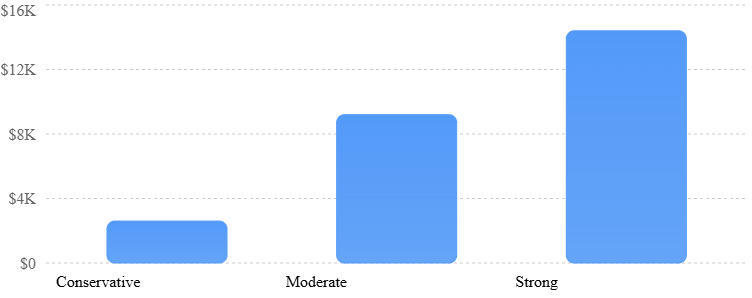
Source: SFTechScene scenario analysis. Assumed engineering cost: $100 per hour.
The moderate scenario produces 100 net hours of saved work.
At $100 per hour, that represents $10,000 in engineering capacity.
After subtracting the assumed $800 monthly software expense, the modeled net value is $9,200.
If the team can use those hours to develop valuable features, fix customer problems, or reduce the need for outside contractors, the benefit could be meaningful.
But the distinction between capacity and cash savings is essential.
If the company continues paying the same four developers, its payroll bill does not automatically decline by $10,000.
The benefit appears through additional work completed, reduced overtime, avoided contractor costs, or other measurable outcomes.
Finding #3: Even Strong Productivity Gains Can Be Wasted on the Wrong Work
An agent could help a team finish 40% more coding tasks without increasing revenue or improving customer satisfaction.
That might happen if the team builds features that customers do not need.
It could also happen if developers spend their saved time creating additional complexity that makes the software harder to maintain.
Therefore, founders should connect AI productivity to business results.
A startup that needs to reduce customer cancellations should measure whether the agent helps deliver changes that reduce cancellations.
A company struggling with software defects should focus on whether defects decline.
Speed matters, but speed without a useful outcome is not a meaningful business advantage.
What Would Make This a Real Codex vs. Claude Code Cost Benchmark?
The model becomes a product comparison only after a team measures actual outcomes separately for both agents.
That requires assigning comparable tasks, tracking human review time, measuring failures, and recording the real cost of each tool.
Without those observations, it would be misleading to claim that Codex or Claude Code delivers the modeled $9,200 benefit.
The purpose of this analysis is to show what businesses must measure before making that claim.
OpenAI Codex vs. Claude Code Pricing: Which Is More Affordable?
Pricing is an important part of the competition, especially for early-stage startups.
However, comparing subscription prices alone can produce the wrong conclusion.
Both vendors offer several ways to access their products, with different usage limits and organizational controls.
OpenAI Codex Pricing
OpenAI includes Codex across its ChatGPT subscription plans, subject to the features and usage available under each plan.
Codex Cloud has separate eligibility requirements, so access to Codex does not always mean access to every cloud feature.
Organizations may also have workspace restrictions or need additional usage capacity.
OpenAI’s official pricing information distinguishes subscription access from other forms of usage-based billing. OpenAI Help Center+2
For a startup, the correct buying question is how many useful coding tasks the team can complete within its actual plan and what additional usage would cost.
Anthropic Claude Code Pricing
Anthropic offers Claude Code through eligible individual and organizational plans.
Its published US pricing lists Claude Pro at $20 per month when billed monthly, while Team standard seats cost $25 per seat monthly or $20 per seat monthly with annual billing.
Premium Team seats are listed at $125 per month with monthly billing, or $100 per month with annual billing.
Usage limits apply, and API usage may be billed separately depending on how the service is accessed. Claude by Anthropic+2
These prices are useful reference points, but they do not reveal how many completed engineering tasks a developer will get for the money.
A team that regularly works on large projects may experience different usage patterns from someone using AI for occasional small fixes.
Why Subscription Price Is a Poor Measure of Economic Value
Imagine two coding agents.
One costs $25 per month and completes 20 useful tasks, while another costs $100 and completes 100 tasks.
The more expensive subscription would deliver a lower direct software cost per useful task.
The reverse could also be true if the more expensive agent requires substantial human correction.
This is why businesses should focus on cost per accepted change rather than monthly subscription price.
A completed task should mean work that meets the team’s requirements and passes its review process.
The Cost Formula Founders Should Use
\[ \text{Cost per accepted task} = \frac{\text{AI fees + human labor + other task costs}} {\text{Accepted tasks}} \]
Human labor should include prompting, supervision, reviewing, fixing mistakes, and handling failed attempts.
Other costs may include cloud execution, test environments, and any additional services required by the agent.
For monthly budgeting, teams should also separate costs that grow with usage from fixed subscriptions.
The result is a more useful comparison than simply asking which vendor has the cheapest entry-level plan.
Original SFTechScene Research #4: How Much Better Must an Expensive AI Agent Be to Justify Its Price?
A common assumption is that startups should select the cheapest AI coding agent.
However, a low-priced tool can become expensive when developers spend too much time correcting its output.
SFTechScene modeled a second scenario to examine how much extra developer time a more expensive tool would need to save.
Research Methodology
We assumed a team was comparing two hypothetical AI coding plans with monthly costs of $200 and $800.
These are illustrative price points. They are not presented as the actual cost of a specific Codex or Claude Code subscription.
The more expensive plan costs an additional $600 per month.
We then calculated how many engineering hours it must save to justify that difference at three assumed hourly labor costs.
Finding #1: A Small Time Advantage Can Offset a Significant Price Difference
| Assumed engineering cost | Extra monthly plan cost | Hours needed to break even |
|---|---|---|
| $50/hour | $600 | 12 hours |
| $100/hour | $600 | 6 hours |
| $150/hour | $600 | 4 hours |
The formula is straightforward:
\[ \text{Break-even hours}= \frac{\text{Extra monthly cost}}{\text{Hourly engineering value}} \]
At $100 per hour, the more expensive agent needs to save only six additional engineering hours each month.
That is less than one working day for a single developer.
For a team of several engineers, this could be a relatively small performance difference.
The calculation assumes the saved time has genuine economic value and that no other costs differ.
Finding #2: Accuracy Can Matter More Than Raw Output Speed
Consider two agents working on the same feature.
Agent A finishes the initial code in 15 minutes but produces errors that take a developer another two hours to fix.
Agent B takes 40 minutes to generate its solution, but the code requires only 20 minutes of review.
Even though Agent A generates code faster, Agent B produces an accepted result with much less total effort.
This distinction becomes increasingly important as agents handle more complicated work.
A few minutes of extra processing time may be unimportant if the result avoids hours of debugging.
For San Francisco engineering teams, this suggests that agent accuracy and review effort deserve as much attention as speed.
Finding #3: Tool Switching Should Be Based on Measured Quality
Stack Overflow’s 2026 survey asked respondents why they had switched AI tools during the previous year.
Better output quality was the most frequently selected reason, reported by 25.1% of respondents to that question. Lower cost accounted for 6.4%. Other reasons included employer requirements, integration, and automation features. Stack Overflow Developer Survey
Why developers switched AI tools in 2026
Selected primary reasons, as a percentage of all respondents to the switching question. Not conditional on switching.
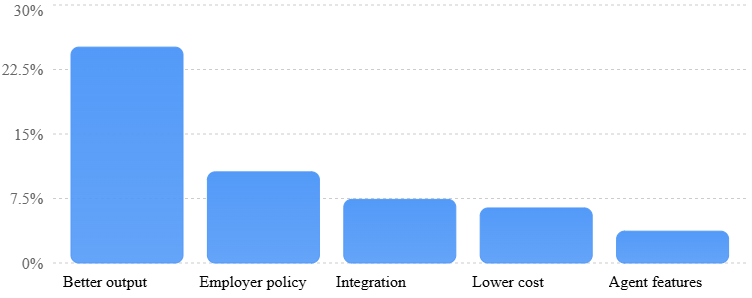
Source: Stack Exchange Inc., Stack Overflow Developer Survey 2026.
These findings support an important business principle.
Developers may be willing to change tools when they believe another product produces better work, even when their existing tool is familiar.
That creates competitive pressure on both OpenAI and Anthropic.
Neither company can rely solely on its current user base or pricing strategy. Developers will continue looking for tools that improve their work.
For startups, it means standardizing on a platform should not prevent periodic quality testing against alternatives.
Codex vs. Claude Code Benchmarks: Why Published Scores Do Not Tell the Whole Story
Benchmark results are frequently used to support claims that one AI model is better than another.
For software development, one of the most discussed testing systems has been SWE-bench.
SWE-bench uses programming problems drawn from real software repositories. AI systems attempt to resolve issues, and their solutions are evaluated against tests.
This approach is useful because it moves beyond asking models to answer isolated coding questions.
However, benchmark scores can become misleading when the test environment, task selection, and evaluation rules differ.
The Problem With Comparing Different Agent Setups
Suppose one model receives a carefully prepared software environment, extensive tool access, and several attempts at a task.
Another model receives only a terminal and one attempt.
Even if both solve the same programming problem, their scores would not provide a fair comparison of the underlying models.
This is why evaluation methods matter.
The SWE-bench Verified website describes a subset of 500 human-reviewed software engineering tasks. Its documentation also explains that differences in agent setup can affect comparability. swebench.com
More importantly, OpenAI published a February 2026 analysis explaining why it no longer considered SWE-bench Verified a reliable measure of frontier coding capabilities.
The company cited increasing contamination, meaning benchmark problems or solutions may have become too familiar through the development process, and recommended the harder SWE-bench Pro benchmark instead. OpenAI
Why a High Benchmark Score Does Not Guarantee a Reliable Product
A benchmark may show that an agent can solve a particular software issue.
That is useful, but businesses need more than a passing test.
A real application must remain secure, operate reliably, protect customer information, and continue working when future changes are introduced.
An agent may solve a benchmark issue while making decisions that would be inappropriate in a production system.
For example, it might introduce a new dependency that creates security or maintenance concerns. A narrow test suite may not identify every problem.
What a Fair Codex vs. Claude Code Benchmark Requires
A meaningful comparison should control the conditions under which both agents operate.
The following table provides a practical research design.
| Evaluation factor | Recommended method |
|---|---|
| Task selection | Use real tasks that neither agent has previously completed in the test |
| Task difficulty | Include simple, moderate, and complex changes |
| Starting code | Use identical repository versions |
| Instructions | Provide equivalent goals and acceptance rules |
| Environment | Keep dependencies and available tools comparable |
| Attempts | Use the same retry policy |
| Human help | Track every intervention |
| Testing | Run independent acceptance and security checks |
| Cost | Record actual usage charges and human time |
| Final evaluation | Review completed changes without knowing which agent created them |
No single number can capture every useful property of a coding agent.
An agent could perform better on routine bugs but worse on complicated changes involving several systems.
That is why companies should test the types of work they actually perform.
Original SFTechScene Research #5: A Reproducible Test Framework for San Francisco Engineering Teams
SFTechScene developed a proposed evaluation framework specifically for startups choosing between Codex and Claude Code.
Unlike the earlier public-data analyses, this is a research protocol rather than a completed experimental study. No live agents were tested as part of this article.
The design aims to produce results that a company can use to make a purchasing decision without relying on vendor claims.
Research Design: 40 Tasks, Two Agents, the Same Acceptance Rules
The proposed benchmark contains 40 software engineering tasks drawn from a startup’s real development backlog.
Each task is attempted by both products, producing 80 agent-task runs.
The work should be performed in isolated environments with consistent permissions and clearly defined stopping rules.
The tasks are divided into four categories.
| Task category | Number of tasks | Primary evaluation |
|---|---|---|
| Bug fixing | 10 | Correctness and regression risk |
| Feature development | 10 | Functional requirements |
| Code refactoring | 10 | Behavior preservation and maintainability |
| Testing and security | 10 | Test coverage and security findings |
| Total | 40 | End-to-end engineering quality |
The team should select tasks before testing begins.
Tasks should cover different parts of the product rather than selecting only problems that one tool appears likely to handle well.
Step One: Define Success Before Running Either Agent
Every task needs written acceptance criteria.
For example, a bug-fixing task should describe the current problem, expected behavior, and relevant constraints.
A feature-development task should identify what the feature must do and what existing behavior must remain unchanged.
The evaluation team should prepare independent tests whenever possible.
These tests should not be designed by the same agent being evaluated, because that could allow the agent to create tests matching its own incorrect implementation.
Step Two: Keep the Work Environments Comparable
Both products should receive equivalent access to the starting code.
The team should use the same dependency versions, test datasets, network restrictions, and available credentials.
Where the products support different execution methods, those differences should be recorded.
A team can conduct a second study focused on the complete product experience, but it should not confuse that result with a controlled comparison of coding ability.
This distinction matters because the best agent experience may come from the combination of model quality, tools, and workflow design.
Step Three: Measure Total Work, Not Just AI Execution Time
Each run should record its processing time and any developer effort required.
That includes writing instructions, supervising execution, reviewing changes, correcting errors, and preparing the result for approval.
For example, an agent might complete its initial work in 10 minutes but require 90 minutes of human correction.
Another agent might take 30 minutes and require only 15 minutes of review.
The second agent could have the better end-to-end result even though it runs more slowly.
Step Four: Score Accepted Results
The primary success measure should be whether the final result meets the independent acceptance criteria within the allowed time and budget.
Secondary measures should include total human effort, execution cost, review findings, and defects discovered later.
A task that requires a developer to rewrite most of the solution should not count as an autonomous success.
The team should also record whether the agent produced a safe and understandable change.
Step Five: Analyze Paired Differences
Because both agents attempt the same tasks, each task creates a paired comparison.
This improves the research design by reducing differences caused by task difficulty.
For every task, the team can compare Codex’s outcome with Claude Code’s outcome.
The results should be reported by task category before combining them into a headline figure.
Illustrative scoring dashboardThese are example values to show how results could be reported, not actual Codex or Claude Code benchmark outcomes.
| Metric | Agent A | Agent B |
| Accepted tasks | 30/40 | 33/40 |
| Acceptance rate | 75% | 82.5% |
| Human review hours | 35 | 28 |
| AI expenses | $200 | $300 |
In this example, Agent B completes three more tasks successfully while requiring seven fewer human review hours.
At an assumed engineering cost of $100 per hour, those seven hours represent $700 in additional engineering capacity.
Its AI expenses are $100 higher, leaving a $600 advantage from review time alone.
However, a proper comparison would also need to account for the cost and value of the three additional accepted tasks, as well as prompting, failed attempts, and any other human effort not shown in the simplified dashboard.
Why 40 Tasks Are a Starting Point, Not a Final Scientific Answer
A 40-task benchmark is practical for a small company, but it is not necessarily large enough to detect modest differences reliably.
In the illustrative example, the difference between acceptance rates is only three tasks.
That difference could reflect genuine performance or the particular tasks selected.
Because each agent attempts the same tasks, the researchers should examine which tasks were passed by only one agent, rather than treating the two acceptance rates as independent samples.
For binary outcomes, an exact paired test such as McNemar’s test can help assess whether the observed difference is convincing.
For time and cost differences, paired bootstrap intervals can help describe uncertainty, although the results would still apply primarily to the chosen task set.
If the company plans to standardize its entire engineering workflow based on the result, it should consider expanding the benchmark, repeating tasks across multiple runs, and holding out a separate set of tasks for confirmation.
The central lesson is that a three-task advantage in a small experiment should not automatically become a claim that one product is universally better.
The Biggest Risks of Automating Software Development
Both Codex and Claude Code promise to reduce repetitive programming work.
But increasing automation introduces risks that companies cannot ignore.
The more authority a coding agent receives, the more damage it can potentially cause if it misunderstands a task or follows unsafe instructions.
AI-Generated Security Problems
One major concern is that AI can produce code that appears correct while introducing security weaknesses.
For example, an agent might build an account-management feature without properly checking which users are authorized to change account settings.
The feature could appear to work during ordinary testing but allow unauthorized access under certain conditions.
Startups handling customer payments, financial information, or sensitive business data need stronger security reviews.
Agents should not automatically receive unrestricted access to production systems simply because they can generate functioning code.
Hidden Errors in Large Code Changes
Large changes are difficult to review even when written by experienced developers.
An agent that modifies dozens of files may create interactions that are not immediately obvious.
This makes smaller, clearly defined tasks more manageable.
Developers can examine the changes, test the relevant behavior, and identify problems before those problems spread across the application.
For a startup moving quickly, dividing large projects into smaller verified changes can reduce the cost of mistakes.
Unnecessary Complexity
An AI agent may solve a simple problem by introducing extra software components.
Those components can create future maintenance work.
For example, a basic reporting feature might not need a new database service, a separate background processing system, and several external dependencies.
A solution that works today can still be expensive to maintain.
Engineering teams should assess whether an AI-generated design is appropriate for the scale and needs of the business.
Data Access and Privacy
Coding agents may need access to source code, documentation, configuration files, and development environments.
Some of those resources can contain private business information.
Companies should understand how each vendor handles submitted data, retention, training controls, and organizational permissions.
They should also keep secrets and production credentials out of testing environments wherever possible.
The correct level of access depends on the task. An agent fixing a visual design problem should not need permission to change production billing records.
Automated Changes Without Human Approval
The greatest risk often appears when AI-generated code moves directly into production without proper review.
A successful automated test is useful evidence, but it does not guarantee that a change is safe.
The agent may misunderstand customer expectations or overlook a business rule that the test suite does not cover.
Startups should use approval rules based on risk.
A documentation correction may require minimal review, while changes involving authentication, payments, customer data, or production infrastructure should require additional checks.
Why San Francisco Is an Important Battleground for AI Coding Agents
San Francisco has become a major center of AI product development.
OpenAI and Anthropic are both closely associated with the city’s AI ecosystem, making the competition especially relevant to local founders, developers, and investors.
But the regional significance goes beyond the headquarters of two major AI companies.
The tools affect how local startups build and scale their products.
Small Startups Can Attempt More Work With Fewer Resources
Historically, building a software company often required a meaningful investment in engineering talent before a product could reach customers.
Founders needed people to build interfaces, develop server systems, create databases, and maintain the software.
AI coding agents can potentially reduce some of the early work involved.
A founder with limited programming experience may be able to build a prototype faster. A small engineering team may be able to test more ideas without hiring immediately for every task.
However, a prototype and a reliable software business are different things.
Security, customer support, product decisions, infrastructure, and long-term maintenance still require attention.
Engineering Talent Could Shift Toward Higher-Level Work
As AI handles more routine implementation, experienced developers may spend more time defining requirements and evaluating the resulting software.
They may also become more involved in security, system design, and decisions about how different services interact.
This does not mean software engineering knowledge becomes less valuable.
In some situations, it could become more important because engineers need to understand a larger amount of AI-generated work.
A developer who can identify architectural problems, ask clear technical questions, and design reliable tests may become especially useful.
San Francisco Founders Must Avoid the Productivity Trap
The availability of faster coding tools can encourage startups to build too many features.
But customer value does not increase automatically when a company writes more code.
A founder might spend weeks using AI to produce an impressive dashboard that customers rarely open.
Meanwhile, a competitor with a simpler product may solve a much more important customer problem.
The strategic advantage comes from connecting engineering productivity to real customer needs.
Startups should use AI to shorten the time between learning about a customer problem and delivering a verified solution.
That is a more useful goal than maximizing the volume of generated code.
How San Francisco Startups Should Choose Between Codex and Claude Code
For most startups, the best decision is not to select one platform based on online popularity.
Instead, founders should identify their engineering priorities and test both products against those needs.
For a Solo Technical Founder
A solo founder often handles product management, engineering, customer support, and business operations.
The most useful coding agent may be the one that helps manage this workload without creating code the founder cannot understand.
The founder should begin with a small project and assess how much help the tool provides during development and debugging.
It is also important to test whether the tool can explain its changes clearly.
A founder who cannot understand or review important parts of the application may be accepting more risk than expected.
For a Five-Person Engineering Team
A small engineering team can benefit from shared workflows.
The company should establish common rules for assigning tasks, reviewing changes, and testing AI-generated code.
It can then run a controlled comparison using tasks from its actual backlog.
Developer preference matters, but it should be considered alongside accepted task rates, review effort, and total cost.
A tool that every developer enjoys using is valuable. A tool that reliably improves completed engineering work is more valuable.
For an Enterprise Software Company
Larger companies have additional requirements.
They may need centralized access management, auditing, data controls, vendor agreements, and consistent security policies.
A company with hundreds of repositories cannot evaluate coding agents solely through individual developer experiences.
It must understand how the system behaves across teams and whether its output can be governed.
For these organizations, administrative capabilities and integration with existing development processes may influence purchasing decisions as much as coding performance.
A Practical 30-Day Plan to Evaluate Both AI Coding Agents
Companies do not need to commit to a platform before understanding whether it improves their engineering work.
A structured pilot can provide useful evidence.
Days 1–7: Establish the baseline
Select a representative group of tasks and document how long they normally take. Record developer effort, review time, defects, and other costs so that the AI trial has a meaningful comparison point.
Days 8–14: Test Codex
Run the selected tasks using Codex in controlled environments. Record successful changes, failures, costs, and human intervention without changing the acceptance criteria.
Days 15–21: Test Claude Code
Repeat the tasks using Claude Code with equivalent instructions and conditions. Keep the acceptance tests independent and preserve a complete record of the outcomes.
Days 22–30: Review the evidence
Compare accepted results, developer hours, software expenses, and quality issues. If the results are close or uncertain, extend the trial rather than declaring a winner from a small difference.
A 30-day pilot is useful for deciding whether a product deserves broader evaluation. It may not be enough to make a high-confidence company-wide decision, especially when tasks vary greatly in difficulty.
The team should also avoid exposing confidential production data simply to make a trial realistic.
When possible, use test datasets, isolated repositories, and permissions appropriate to the work.
The Future of Codex vs. Claude Code: What Will Decide the Winner?
The next phase of this competition is likely to be defined by more than model intelligence.
Both vendors have strong incentives to improve coding reliability, make agents easier to control, and help organizations use them safely.
The most important developments may occur in how agents work with existing engineering systems.
From Writing Code to Completing Work
Today’s coding agents can already perform many development tasks.
The longer-term opportunity is helping teams manage larger projects from the initial request through testing and review.
That could involve agents coordinating multiple changes, checking dependencies, and producing clearer records of their decisions.
But greater autonomy must be matched by stronger verification.
A system that completes more work while creating hidden defects may increase engineering costs rather than reduce them.
Better Testing Could Become a Competitive Advantage
As coding agents become more capable, the quality of their verification process may become increasingly important.
Agents could improve by identifying missing tests, examining unusual cases, and checking whether changes conflict with business requirements.
This would reduce the amount of human effort needed to decide whether a result is safe.
The company that develops more trustworthy end-to-end workflows could gain an advantage even if its raw code generation speed is similar to competitors.
Developer Trust Will Matter as Much as Capability
Developers need to understand what an agent has changed and why.
They also need to know when the system is uncertain or has failed.
A tool that communicates limitations clearly may be easier to use responsibly than one that produces confident explanations for incorrect work.
Trust must come from observed reliability, not persuasive language.
The strongest agent experience will make it easy for developers to inspect changes, reject unsafe work, and maintain control over important decisions.
A Multi-Agent Market Is Still Possible
The competition does not have to produce one winner for every business.
Some teams may use Claude Code for one category of work and Codex for another.
Others may standardize on one tool because it integrates better with their existing software environment.
Businesses could also change tools as capabilities improve.
The 2026 developer survey shows that switching AI tools is already common enough to be an important market consideration. Output quality is a major reported reason for switching. Stack Overflow Developer Survey
This means the market may remain competitive even if one vendor holds a substantial adoption lead.
Final Takeaway: Claude Code Is Winning Developer Adoption, but Reliable Automation Will Decide the Bigger Battle
The competition between OpenAI Codex and Anthropic Claude Code represents a much larger shift in software development.
Developers are moving from writing every line of code manually toward managing systems that can perform significant parts of the work.
The public evidence gives Claude Code a clear advantage in reported developer usage.
In Stack Overflow’s 2026 survey, 65.5% of respondents to the coding-agent question reported using Claude Code, compared with 29.5% for OpenAI Codex.
SFTechScene’s reanalysis shows that Claude Code had approximately 2.22 times Codex’s reported usage in that sample, with at least 4,410 respondents reporting Claude Code without reporting Codex.
That is a meaningful position for Anthropic.
However, the data does not prove that Claude Code is more accurate, produces more secure software, or saves more money than Codex.
Those questions require controlled comparisons using real engineering tasks.
Our financial scenarios also show why startup founders should pay attention to more than code generation speed.
A coding agent that saves 160 hours of initial work but creates 60 hours of additional review provides a different economic outcome from an agent that saves the same initial time with almost no rework.
That difference can matter far more than subscription pricing.
For San Francisco startups, the best approach is to test both products against the work that actually drives business results.
Measure accepted changes, total developer effort, security problems, and the real cost of using each agent. Then select the tool that helps the team deliver dependable software with less effort.
The larger winner in AI coding will not necessarily be the company whose agent writes the most code or attracts the most attention.
It will be the company that makes software development more reliable, more affordable, and easier to manage at scale.
For founders, that is the opportunity worth pursuing.
Research Notes, Sources, and Limitations
This article uses three kinds of evidence: published survey data, official product information, and original scenario calculations. They should not be treated as interchangeable.
The adoption analysis uses response counts from Stack Overflow’s 2026 Developer Survey. SFTechScene independently calculated the adoption ratio, respondent difference, and mathematical overlap bounds. The source is a voluntary survey, and its respondents are not necessarily representative of all developers or of San Francisco specifically. The reported results also allow multiple product selections.
The financial sections are original sensitivity and break-even models. Their assumed salaries, tool costs, productivity gains, and review hours are illustrative inputs rather than observations of actual Codex or Claude Code performance. Consequently, they demonstrate economic relationships but cannot establish a vendor-specific return on investment.
The proposed 40-task experiment is a reproducible study design, not an experiment whose results have already been observed. No benchmark performance, local startup survey, or private usage dataset has been invented for this article.
Primary Sources
- Stack Overflow Developer Survey 2026 — AI Coding Agents. Published response counts for Claude Code, Codex, and competing tools. Licensed under ODbL 1.0.
- Stack Overflow Developer Survey 2026 — AI Data. AI adoption, workflow, switching, and productivity data.
- OpenAI — Using Codex With Your ChatGPT Plan. Official access and plan information.
- OpenAI — Using Codex Cloud. Official explanation of cloud environments and coding tasks.
- Anthropic — Claude Pricing. Published individual and organizational pricing.
- Anthropic — Claude Code for Teams and Enterprises. Official product and organizational access documentation.
- SWE-bench Verified. Software engineering benchmark methodology.
- OpenAI — Why SWE-bench Verified No Longer Measures Frontier Coding Capabilities. February 23, 2026 discussion of benchmark limitations.
Research cutoff: October 30, 2026. Calculations by SFTechScene based on attributed public sources. Product features, prices, and usage limits may change.