

For decades, building software meant learning how to write code, understanding how computers work, and spending months turning an idea into a useful product. Even a simple business application often required a developer, a designer, someone to manage the technical work, and a budget that many small businesses could not afford.
That barrier is starting to fall. Replit, an AI-powered software creation platform based in the San Francisco Bay Area, is helping people build websites, applications, business tools, and early-stage products by describing what they want in everyday language.
A small business owner can explain how a customer booking system should work. A marketing manager can describe a reporting dashboard. A founder can outline a new software product without knowing how to write the code behind it.
Replit’s AI tools can then help turn those instructions into working software.
This change goes far beyond making programming faster. It could change who gets to create technology, how businesses solve problems, and what it costs to test a new idea.
For San Francisco, where software talent is expensive and startups constantly compete to move faster, the opportunity is especially important. But there is another side to the story: making software easy to create does not automatically make it safe, reliable, profitable, or easy to maintain.
This SFTechScene analysis examines what Replit can actually do in 2026, the evidence behind the rise of AI-powered software creation, and how non-programmers can use the platform without taking unnecessary risks. It also includes original calculations using publicly available developer survey data, Replit’s published company figures, and transparent business cost models.
The Short Version: Replit Is Turning Software Development Into Something More People Can Do
The biggest change Replit brings to software development is simple: people no longer need to understand every technical step before they can begin building something useful.
Traditionally, someone with a software idea needed to learn programming or hire someone who already knew it. Replit changes that starting point by allowing users to describe their goals, review what the AI creates, and request improvements through conversation.
This process is often called vibe coding. Instead of writing every instruction in a programming language, a person explains the result they want while AI handles much of the technical work.
Replit has moved well beyond a basic code editor. Its March 2026 launch of Agent 4 introduced visual design tools, support for multiple types of creative work, and AI agents that can work on several development tasks at once. Replit says these changes can make some building workflows much faster, although its advertised speed claims should not be treated as independent benchmark results. Replit+1
Replit’s reported community, September 2025
40M+
Users worldwide, company-reported
Reported annualized revenue, September 2025
$150M
Run rate, not audited annual revenue
2026 developer survey
65.9%
Use AI coding assistants or agents at work
2026 developer survey
48.0%
Trust AI output when they can verify it easily
Sources: Replit’s September 2025 funding announcement and Stack Overflow’s 2026 Developer Survey. These figures describe different populations and must not be combined into one adoption rate. Replit+1
The most important business opportunity is not that AI can produce code. It is that people who understand a business problem can now participate directly in building the tool that solves it.
A restaurant owner understands reservations. A property manager understands maintenance requests. A consultant understands client reporting. Those skills can now serve as the starting point for software creation.
However, the real advantage comes when people combine their business knowledge with testing, customer feedback, and careful control over the finished product.
What Is Replit, and Why Does It Matter in 2026?
Replit started by making programming easier to access
Replit originally became known as a browser-based development environment. Instead of installing several programs and configuring a computer before writing code, users could open a workspace online and start building.
That approach made programming more convenient for students, teachers, hobbyists, and working developers. It also helped remove the setup problems that often discourage beginners.
Over time, Replit moved from making traditional programming easier to helping people create software with much less direct programming.
This shift became more important as AI models improved at understanding instructions, generating code, finding mistakes, and working across several parts of an application.
Replit Agent changed the relationship between users and software
Replit Agent acts like an AI building assistant. A user can describe an application, and the agent can help create its structure, user interface, business rules, and supporting code.
Consider a San Francisco consultant who wants a client project tracker. The consultant might request an application where clients submit requests, upload documents, check progress, and receive updates.
Instead of starting with a blank code file, the consultant can begin with a description of how the service should work. Replit can then help build a first version that the consultant can examine and improve.
This does not mean the AI always understands the business perfectly. The consultant must still explain requirements, test results, and decide what information the application should store.
Agent 4 made the building experience more visual
Replit introduced Agent 4 on March 11, 2026. Its design canvas lets users explore different layouts visually and make changes while the application is being developed.
The company also expanded support for working on different parts of a project in parallel. These features are intended to reduce the amount of technical coordination that users must handle themselves. Replit+1
For someone without programming experience, visual feedback matters. It is usually easier to say that a button should be larger, a page should look simpler, or a form needs another field than to explain how to change the code that controls those details.
This is one reason the move toward visual AI software creation could be more important than improvements in code generation alone.
Why Replit matters to the San Francisco startup economy
The Bay Area has a long history of companies that make difficult technology easier to use. Replit fits that tradition by reducing the technical work required to move from an idea to a functioning application.
San Francisco founders can potentially test more products before hiring a full development team. Small businesses can create tools tailored to their operations instead of adapting every process to generic software.
The change could also benefit people who have historically been excluded from software entrepreneurship because they lacked technical training or access to developers.
Yet these benefits will depend on more than the platform’s abilities. They will depend on whether new builders can create products that customers trust, understand, and are willing to pay for.
How Replit Works for Someone Who Cannot Code
Step 1: Describe the problem instead of the technology
A beginner should not start by asking Replit to create a complicated application with dozens of features. The better approach is to describe one specific problem and the simplest useful solution.
For example, an independent fitness instructor might need a system to track clients, packages, session attendance, and upcoming renewals.
A useful opening instruction would explain who uses the application, what information it needs, and what the user should be able to do.
The instructor does not need to know which programming language, database, or framework should be used. Those choices can be handled with the AI’s assistance, although important technical decisions should still be reviewed.
Step 2: Review the plan before building too much
The first version of an application should have clear boundaries. Without them, the AI may create features that look impressive but increase costs and make future changes harder.
A simple client management tool might need a dashboard, customer records, attendance tracking, and renewal reminders. It probably does not need a public marketplace, social network, or advanced recommendation engine on its first day.
Replit supports planning and building workflows that help users organize this work. Even with newer agent features that allow planning during development, beginners benefit from agreeing on the first version’s scope before adding complexity. Replit+1
Step 3: Let the AI build a working version
Once the basic requirements are clear, Replit Agent can begin creating the application. The user can review the result and explain what should change.
The first version may have missing fields, confusing navigation, or rules that do not match the intended business process. These issues are normal reasons to review an AI-generated application rather than proof that the whole idea has failed.
A useful building process treats the first result as a draft. The goal is not to produce perfect software in one instruction but to improve the product through a series of controlled changes.
Step 4: Test the application like a real customer
A screen that looks finished is not necessarily a working product. The user should try completing important tasks from beginning to end.
For a booking application, that means creating a booking, changing it, canceling it, and checking what happens when two people try to reserve the same time.
The user should also test incomplete information, incorrect entries, and situations where the internet connection fails. Those cases often reveal problems that are invisible during a simple demonstration.
Step 5: Publish carefully and improve with feedback
Replit combines development with tools for running and deploying applications. That can simplify the process of making software available online, but a published application still needs monitoring, security, and maintenance.
A sensible first launch may involve five or ten trusted users rather than hundreds of customers. Small groups can identify problems before they become expensive or affect important business data.
Once those users can complete the main task reliably, the builder can decide whether to expand the product.
The Six Biggest Barriers Replit Is Removing
| Traditional barrier | How Replit helps | What the user still must do |
|---|---|---|
| Learning programming languages | Accepts natural-language instructions | Explain the business rules clearly |
| Setting up development tools | Provides a hosted development workspace | Manage access and project settings |
| Creating interfaces | Generates layouts and supports visual editing | Check usability and accessibility |
| Fixing technical errors | AI can investigate and suggest repairs | Test fixes and watch for new problems |
| Publishing software | Provides deployment workflows | Monitor reliability, cost, and security |
| Changing existing features | Users can request changes conversationally | Control scope and avoid unintended changes |
Removing the language barrier
Traditional programming requires precise instructions written in languages such as Python or JavaScript. Replit allows the user to begin with ordinary sentences.
That difference matters because business owners often know what should happen but not how to tell a computer to make it happen.
However, natural language can be unclear. Instructions such as “make the dashboard better” leave important decisions open, while specific instructions produce results that are easier to judge.
Removing the setup barrier
A beginner can lose considerable time installing software, configuring tools, and solving errors before writing a useful program.
A hosted environment reduces much of that early work. This makes it easier for people to experiment without first becoming experts in computer setup.
It does not remove every technical responsibility. Businesses still need to understand where their data is stored, who has access, and what happens if a service becomes unavailable.
Removing the design barrier
Many non-programmers struggle to translate a visual idea into a working interface. Replit’s design tools allow users to inspect and refine layouts more directly.
That makes software creation more accessible to designers, marketers, product managers, and business owners whose strengths lie outside programming.
Good design still needs real user testing. A visually attractive application may remain confusing if users cannot find the action they need.
Removing the first-prototype barrier
A prototype is an early version of a product used to test an idea. Traditionally, even a prototype could require a significant amount of technical work.
Replit can help turn ideas into something customers can actually click, inspect, and respond to. This can improve the quality of customer conversations because people are reacting to a working example rather than an abstract description.
The key is to avoid confusing prototype speed with product readiness. The first version should help answer whether the idea is useful, not automatically become the final commercial product.
Removing part of the maintenance barrier
Software needs changes after launch. Customers discover problems, business rules evolve, and new features become necessary.
An AI assistant that can inspect and modify existing code may help non-programmers handle some of these tasks without starting from scratch.
But maintenance also involves deciding which changes are safe. Replit’s checkpoint and version-control features provide ways to review work and restore earlier states, although users must understand the scope and limits of those recovery options. Replit Docs
Removing the dependence on a large technical team
Some simple applications can now be started by one person. This can reduce the need to hire a complete team before discovering whether customers want a product.
The strongest outcome is not necessarily eliminating professional developers. It may be allowing developers to spend more time on difficult, valuable work while business users handle more of the early experimentation.
That distinction becomes especially important when applications need sensitive data, payment processing, complex integrations, or dependable service at scale.
Original SFTechScene Research #1: AI Coding Adoption Is Much Higher Than AI Workflow Adoption
Research question and methodology
How far has AI spread into software development, and what does that reveal about the opportunity for platforms such as Replit?
To answer this, SFTechScene analyzed figures published in Stack Overflow’s 2026 Developer Survey. The survey covers technology workers and developers, making it a useful source for understanding the professional market, although it does not directly measure non-programmers or Replit users.
We selected three reported categories from the same survey question: AI coding assistants or coding agents, general-purpose AI chat tools, and AI agents or automated workflows.
The analysis uses the published percentages and respondent counts without estimating missing data, changing survey weights, or treating overlapping response categories as exclusive. Our original contribution is the comparison, ratio calculation, and interpretation rather than the underlying survey collection.
Finding 1: Coding assistance is much more common than automated workflows
AI tool usage at work, 2026
Share of Stack Overflow survey respondents reporting use of each category; categories overlap.
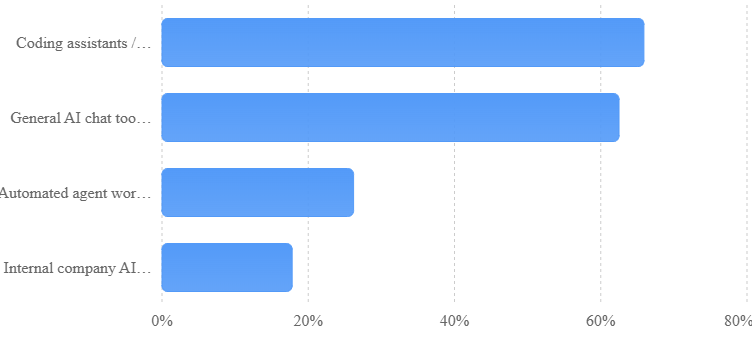
Source: Stack Overflow 2026 Developer Survey, AI usage question, n=17,464. Stack Overflow Developer Survey
The survey reports that 65.9% of respondents use AI coding assistants or coding agents, while 26.2% use AI agents or automated workflows.
Dividing 65.9 by 26.2 gives a ratio of approximately 2.52. In this sample, reported use of AI coding assistance was about two and a half times as common as reported use of automated agent workflows.
This is not evidence that one group excludes the other. People can use both types of tools, and the survey did not ask respondents to select only one category.
Finding 2: There is a 39.7-percentage-point adoption difference
SFTechScene calculated difference
39.7 percentage points
\[ 65.9\%-26.2\%=39.7\text{ percentage points} \]
Difference between reported coding-assistant use and automated-workflow use, not a measured conversion opportunity.
The gap suggests that many technology workers are using AI to help with individual tasks before adopting broader systems that handle connected processes.
For Replit, this supports a practical business idea: people may become comfortable asking AI for help before they are ready to trust it with complete applications or workflows.
A product that simplifies the move from asking questions to creating usable software could therefore address a meaningful difference in adoption behavior.
However, the survey cannot establish that these respondents want Replit, that they would pay for it, or that non-programmers would follow the same adoption pattern.
What San Francisco founders can learn
Founders should avoid assuming customers want the most autonomous product possible. Customers may prefer a tool that helps them complete one clear task while keeping important decisions under their control.
A company selling AI software creation to local businesses could begin with simple internal tools. Successful projects could then expand to more complex applications as customers become comfortable with the results.
The useful lesson is about adoption order. Businesses often need confidence before they need complete automation.
Original SFTechScene Research #2: Trust Is a Bigger Barrier Than Basic AI Access
The difference between using AI and trusting AI
AI software tools can generate convincing results quickly. But working software requires more than an output that looks believable.
Stack Overflow’s 2026 survey asked respondents how much they trusted AI output in their work. The answers show that verification remains a central concern even as AI use becomes widespread.
The strongest finding is that conditional trust is much more common than trust in important decisions.

How much technology workers trust AI output in 2026
Share of respondents choosing each trust position.
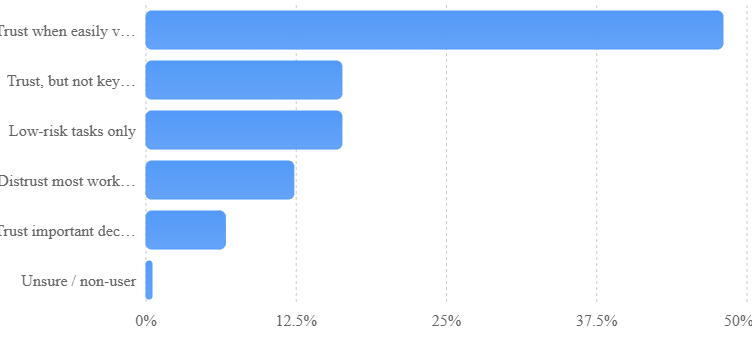
Source: Stack Overflow 2026 Developer Survey, AI trust question, n=14,304. Rounded reported percentages. Stack Overflow Developer Survey
Finding 1: Verification-based trust is more than seven times as common
The survey found that 48.0% of respondents trust AI output when they can easily verify it. Only 6.6% say they trust AI for many tasks, including important work decisions.
Original SFTechScene trust ratio
7.27×
\[ \frac{48.0}{6.6}\approx7.27 \]
Conditional verification-based trust compared with important-decision trust. This compares answer shares, not relative probabilities within the same people.
This difference challenges a common assumption in AI product development. Giving an AI system more freedom does not automatically make users more comfortable with it.
For many business users, confidence comes from seeing what changed, understanding how the system works, and being able to correct mistakes.
A software creation tool that makes checking results simple may therefore have a practical advantage over one that focuses entirely on producing more code.
Finding 2: Important-decision trust remains uncommon
Only 949 of the 14,304 respondents in the trust question selected the option expressing trust for important work decisions.
That does not mean the other respondents reject AI. Most selected more limited forms of trust, showing that people distinguish between useful assistance and decisions with serious consequences.
This distinction should shape how Replit-built applications are used.
A tool that formats a marketing report is very different from a system that approves refunds, changes financial records, or handles sensitive medical information. The second group needs much stronger checks.
Finding 3: The opportunity is software that people can verify
SFTechScene’s analysis suggests that verification should be treated as a core product feature rather than an optional safety step.
For non-programmers, this means applications should show clear results, explain important changes, preserve records of actions, and make it possible to undo mistakes.
A customer management system, for example, should not quietly delete old records because an AI misunderstood an instruction. It should explain what will change and require approval before a destructive action.
This is especially relevant for San Francisco startups selling software to professional services, financial companies, healthcare organizations, and other businesses that cannot tolerate careless handling of information.
Original SFTechScene Research #3: Replit’s Reported Revenue Growth Signals Demand, but Not Proven Profitability
What the company reported
On September 10, 2025, Replit announced a $250 million funding round at a $3 billion valuation. In the same announcement, it said its annualized revenue had increased from $2.8 million to $150 million in less than a year.
Replit also reported a global community exceeding 40 million users. These are company-reported metrics, not independently audited figures supplied in the announcement. Replit
Our calculation: The annualized revenue run rate grew approximately 53.6 times
Replit’s reported annualized revenue run rate
Two company-reported observations referenced in the September 2025 funding announcement, not audited annual revenue.
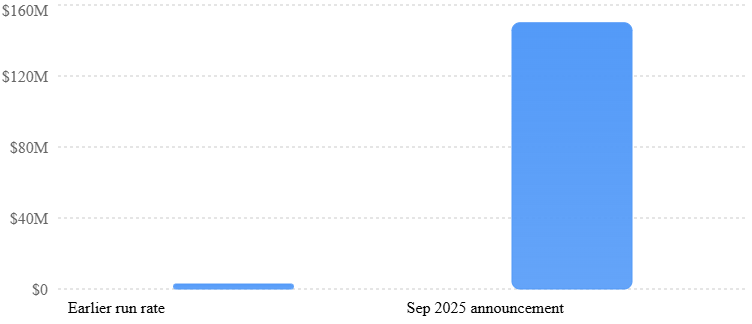
Source: Replit’s September 10, 2025 funding announcement. The earlier observation was described as occurring less than a year before the announcement; the exact measurement date was not provided. Replit
Using the company’s published figures, the growth multiple is:
\[ \frac{\$150\text{ million}}{\$2.8\text{ million}}\approx53.57 \]
That is roughly a 53.6-fold increase in reported annualized revenue run rate.
The absolute difference is $147.2 million. The calculated percentage increase is approximately 5,257%, using the earlier figure as the starting point.
These calculations are straightforward, but the interpretation requires care. Annualized revenue is a rate based on current revenue activity, not necessarily the amount earned across a completed 12-month financial year.
The figures do not establish net profit, customer retention, average revenue per customer, or how much Replit spends operating its AI systems.
What this means for non-programmer software creation
The rapid increase in Replit’s reported business activity indicates strong commercial interest in its platform during that period.
However, the data does not tell us how much revenue came specifically from people who cannot code. It also does not reveal what percentage of users created profitable businesses.
Those distinctions matter because a platform can grow quickly while many individual users still struggle to build sustainable products.
For San Francisco founders, the best conclusion is that software creation is becoming an important commercial category. Whether a specific Replit-built product succeeds remains a separate question that needs customer and financial evidence.
A newer funding milestone strengthens the growth story
Replit’s March 11, 2026 announcement provides another important point of comparison. The company reported raising $400 million at a $9 billion valuation, up from its September 2025 valuation of $3 billion.
It also reported more than 50 million users and said it was targeting $1 billion in revenue run rate by the end of 2026. That billion-dollar figure was a forward-looking target, not confirmed revenue achieved as of this article. Replit
| Metric | September 2025 | March 2026 | Change |
|---|---|---|---|
| Reported valuation | $3B | $9B | 3× |
| Announced funding round | $250M | $400M | 60% larger round |
| Reported global users | Over 40M | Over 50M | At least 10M higher stated threshold |
| Annualized revenue | $150M | Not specified in announcement | Not comparable |
The valuation increase is meaningful, but private-company valuations are negotiated investment prices rather than direct measurements of business performance.
A threefold valuation increase does not mean revenue, profit, or customer value increased threefold. The stronger conclusion is that investors placed a substantially higher value on Replit as AI-powered software creation gained commercial attention.
Original SFTechScene Research #4: When Does Replit Actually Save a Small Business Money?
Research question
Can a non-programmer create a useful internal business application at a lower total cost than a traditional custom development project?
Public pricing alone cannot answer this question. Building software also takes planning, testing, correcting mistakes, and maintaining the finished system.
SFTechScene therefore created a transparent cost model for a hypothetical small San Francisco business. This is an original scenario analysis, not a survey of real Replit projects or a claim about typical local developer prices.
The model and its assumptions
We compare two ways to create the same small internal application: a Replit-assisted build managed by a business employee and a custom build completed by an outside professional.
The example application has customer records, a simple dashboard, a task tracker, and basic reporting. It excludes payment processing, sensitive personal data, complex system integrations, and unusually high reliability requirements.
For the Replit scenario, we assume a $20 monthly base subscription, $60 per month in additional usage and operating costs, and an employee time cost of $50 per hour. The $20 figure reflects the standard monthly Core price shown in Replit’s pricing information, while the other costs are scenario assumptions. Actual plans, included usage, and billing may differ. Replit
For the professional-development scenario, we assume $100 per hour for development and review, plus $50 per month in ongoing hosting and operations. These are modeling inputs rather than verified San Francisco market averages.
The first-year cost comparison
| Cost component | Replit-assisted | Custom development |
|---|---|---|
| Initial build labor | 35 hours × $50 = $1,750 | 60 hours × $100 = $6,000 |
| Initial testing and correction | 15 hours × $50 = $750 | 15 hours × $100 = $1,500 |
| Ongoing maintenance | 4 hours/month × $50 = $2,400/year | 2 hours/month × $100 = $2,400/year |
| Annual platform and hosting costs | $960 | $600 |
| Modeled first-year total | $5,860 | $10,500 |
The Replit-assisted scenario costs $4,640 less in the first year, or approximately 44.2% less than the modeled custom-development option.
First-year software ownership cost: illustrative scenario
SFTechScene calculations using declared labor and operating assumptions, not observed project costs.
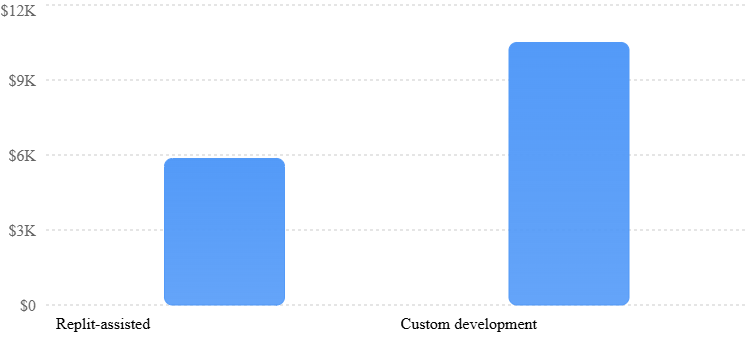
The example shows how lower initial development effort could make custom tools affordable for smaller organizations. It also shows why subscription prices alone are misleading: most of the modeled Replit cost comes from the employee’s time.
How sensitive are the savings to extra work?
The largest uncertainty is the amount of time spent repairing and maintaining AI-generated software.
To test that risk, we added additional correction hours to the Replit scenario while holding the custom-development scenario constant. Every extra hour costs $50 under our assumptions.
| Additional Replit correction hours | Replit first-year cost | Savings versus custom development |
|---|---|---|
| 0 | $5,860 | $4,640 |
| 20 | $6,860 | $3,640 |
| 40 | $7,860 | $2,640 |
| 60 | $8,860 | $1,640 |
| 80 | $9,860 | $640 |
| 100 | $10,860 | −$360 |
How unexpected correction work affects first-year cost
Replit cost rises with additional labor; the custom-build reference stays at $10,500.
■ Replit-assisted
■ Custom development
Under these assumptions, the initial $4,640 cost advantage can pay for 92.8 additional employee hours before the two options reach the same first-year cost.
This is not a forecast that Replit projects typically require that much repair work. It is a threshold showing how much unexpected work the modeled cost advantage can absorb.
What this means for San Francisco businesses
Replit is financially attractive when it removes a large amount of routine development work without creating equally large maintenance problems.
A small internal reporting tool may fit this description. A complex application handling private customer information, payments, or important business decisions may not.
Business owners should compare total ownership costs rather than asking only how quickly the first version can be generated.
The right question is not whether an AI agent can build the application. It is whether the business can operate, maintain, and improve that application at a reasonable cost over time.
Original SFTechScene Research #5: How Much Business Value Must a Replit App Create to Pay for Itself?
Moving from development cost to business value
Saving money on development is only useful if the application creates genuine business value.
A cheap tool that nobody uses is still a wasted investment. A slightly more expensive tool that removes hours of repetitive work every week may be far more valuable.

SFTechScene modeled a simple case involving a San Francisco professional-services firm with ten employees. The business wants to replace a manual weekly reporting process with an internal application.
The following figures are assumed inputs, not measured outcomes from an actual company.
Scenario: An internal reporting application
Assume the tool costs $5,860 in its first year, matching the Replit-assisted case in our earlier model.
Assume it saves employees a combined ten hours each week and the business values that time at $50 per hour. We use 48 working weeks to account for holidays and other interruptions.
The annual gross labor value would be:
\[ 10 \times \$50 \times 48 = \$24,000 \]
Subtracting the $5,860 modeled cost gives a potential first-year net value of $18,140.
That is a strong result under the stated assumptions, but only if the saved hours translate into useful work or a real reduction in costs. Time saved does not automatically become cash profit.
How different levels of time savings change the result
| Weekly hours saved | Annual gross value | First-year net value |
|---|---|---|
| 2 | $4,800 | −$1,060 |
| 4 | $9,600 | $3,740 |
| 6 | $14,400 | $8,540 |
| 8 | $19,200 | $13,340 |
| 10 | $24,000 | $18,140 |
Modeled net value of an internal Replit app
Assumes 48 working weeks, $50 hourly labor value, and a $5,860 first-year cost.

The break-even result
At $50 per hour across 48 working weeks, each weekly hour eliminated represents $2,400 of annual gross labor value.
The application therefore needs to save approximately 2.44 combined staff hours per week to cover the modeled $5,860 first-year cost.
That is a more useful target than asking whether the AI can generate a dashboard in a few minutes.
A business can test this claim by measuring the manual process before launching the application and comparing it with the same process afterward.
Why the methodology matters
These calculations are deterministic financial models, not experimental proof of productivity gains. They do not include estimates of error costs, employee disruption, training differences, taxes, financing, or the opportunity cost of delayed launches.
To validate the model in a real San Francisco business, a researcher would need to record task times before and after deployment, account for changes in work volume, and confirm that output quality did not decline.
The strongest test would compare similar teams or tasks over the same period, ideally with some continuing to use the old process. That would help separate improvements caused by the application from unrelated changes in the business.
Where San Francisco Businesses Can Use Replit Right Now
Marketing agencies: Reporting and campaign management
San Francisco marketing teams often manage information from advertising platforms, analytics products, client documents, and internal tracking systems.
An agency could use Replit to create an internal dashboard that brings approved information together and displays project status, campaign notes, and performance trends.
The first version should avoid making automatic changes to advertising budgets. A safer approach is to use the application for organizing data and reviewing recommendations before introducing actions that affect client spending.
Real estate teams: Property and client workflows
A real estate team could build an application for tracking property inquiries, viewing appointments, and follow-up tasks.
Agents could use one workspace to see which customers need responses and which properties have outstanding requests. This can be especially useful for a small team that does not need a large custom real estate platform.
However, the application must handle customer contact details responsibly. If it stores sensitive information or integrates with external property systems, technical review becomes more important.
Restaurants: Internal operations and scheduling
Restaurant owners can spend significant time coordinating shifts, suppliers, cleaning tasks, and daily checks.
A simple application could help managers assign tasks, record completion, and identify missing work before a busy service period begins.
That is a reasonable first use case because it can often operate with limited data and clear rules. A system handling payroll, payments, or legal compliance carries greater risk and should receive professional review.
Consultants: Client portals and project tracking
Consultants can use Replit to build private portals where clients see milestones, submit requests, and receive project updates.
This is useful when existing project management software is too complex or does not match the service being offered.
The challenge is controlling access. A client must never be able to view another client’s private documents simply because the AI-generated interface appears to hide them.
Education businesses: Learning tools and student progress
Training providers can create simple practice applications, learning dashboards, and interactive lessons.
A teacher might build a quiz application that changes questions based on a student’s performance. A small education company might develop a prototype for a new learning experience before investing in a complete platform.
Applications involving children, private student records, or graded decisions require stronger privacy and accuracy safeguards than ordinary demonstration tools.
Startup founders: Testing products before hiring developers
For early-stage founders, Replit can provide a way to demonstrate an idea to potential customers before making a large technical investment.
A founder could build a working scheduling tool, invite a few customers to test it, and measure whether it solves a real problem.
If the product attracts demand, a professional developer can review the code, strengthen the design, and prepare it for wider use.
How Non-Programmers Should Choose Their First Replit Project
The right first project should be useful but forgiving. Beginners should avoid systems where a single mistake could expose confidential information, create a large financial loss, or interrupt an essential service.
| Project idea | Beginner suitability | Main concern |
|---|---|---|
| Personal productivity tracker | High | Usability |
| Simple business landing page | High | Accuracy of published information |
| Internal task dashboard | High | User permissions |
| Appointment request tool | Medium | Scheduling conflicts |
| Client document portal | Medium to low | Privacy and access control |
| Payment application | Low | Financial security |
| Medical record system | Very low | Privacy, safety, and compliance |
| Financial decision engine | Very low | Incorrect or unauthorized decisions |
These suitability ratings are SFTechScene editorial assessments, not measured failure rates.
Start with a problem that already costs time
A project is easier to evaluate when there is a clear existing process. Replacing a weekly manual report gives the business something concrete to compare.
Trying to build an entirely new social network is much harder. The technical product may work, but the founder still has to solve problems involving users, demand, competition, and growth.
Choose something with a clear success measure
A good first application should have one measurable goal.
For a scheduling application, that might be the percentage of appointments recorded correctly. For a reporting application, it might be hours saved each week.
Avoid vague goals such as making the business more innovative. Those goals are difficult to test and can encourage expensive feature development without evidence of value.
Keep the first version small enough to understand
Every new feature introduces more conditions that can go wrong.
A tool with four carefully tested features is often more useful than one with twenty unfinished features. Small products are easier to explain, repair, and improve.
For non-programmers, this also makes it easier to notice when the AI has made a mistake.
A Practical 30-Day Replit Launch Plan for Non-Programmers
Week 1: Define the problem and build the first version
Days 1–2: Interview users and map the current process
Speak with three to five people who experience the problem. Ask them to show how they complete the task today rather than simply asking what features they want.
Record how long the task takes, what causes mistakes, and which steps are repeated. These observations form the baseline for measuring whether the application works.
Days 3–4: Write a one-page product brief
Describe who will use the tool, the main problem, the information it needs, and the actions users should be able to complete.
Define what the first version will not include. For example, a simple booking application may include appointment requests but exclude online payments and automatic calendar updates.
Days 5–7: Build and review the first prototype
Use Replit Agent to create the first version from the brief. Review each major screen and check whether the basic workflow matches the business process.
Ask the AI to explain the application’s structure in simple language. Save a known working version before making substantial changes.
Week 2: Test real workflows
Days 8–10: Create a repeatable test plan
Write down the ten most important actions a user should complete.
Include ordinary situations and mistakes. A booking system should handle valid bookings, missing details, duplicate requests, and cancellations.
Days 11–12: Test with sample information
Use fictional records instead of real customer details during early testing. Verify that information is saved correctly and that users cannot access pages or records they are not allowed to see.
Test the application on both desktop and mobile screens. Many small business tools fail in practice because they work on the creator’s computer but are difficult to use elsewhere.
Days 13–14: Repair the most important problems
Prioritize issues that block the main task or create a risk of incorrect results.
Avoid adding attractive but unnecessary features during this stage. The goal is to make the core workflow dependable.
Week 3: Run a controlled pilot
Days 15–17: Invite a small group
Select five trusted users who represent the people expected to use the finished product.
Give them a real task to complete and observe where they struggle. Avoid explaining every step, because that hides problems a new user would encounter.
Days 18–19: Gather structured feedback
Ask whether users completed the task, how long it took, and where errors occurred.
Distinguish between a feature request and a problem with the main workflow. A user asking for a different color is not necessarily identifying a more important issue than a broken saving process.
Days 20–21: Measure improvement
Compare results with the baseline recorded during the first week.
If the tool was intended to save time, calculate the actual time difference. If it was intended to reduce errors, compare error rates rather than relying on user impressions alone.
Week 4: Prepare for a real launch
Days 22–24: Review security and access
Check who can sign in, which records each person can see, and whether the system protects important information.
Review backups, recovery options, third-party connections, and what happens if the application becomes unavailable. Seek professional help where the application handles sensitive information or important transactions.
Days 25–27: Review costs and ownership
Check AI usage charges, hosting costs, database needs, and any outside services.
Confirm that the business controls its domain, important accounts, data access, and project records. Document how the application can be maintained or moved if business needs change.
Days 28–30: Launch gradually
Start with a small group of real users. Track errors, performance, cost, and support requests before expanding.
The launch is successful when users repeatedly complete the intended task, not merely when a public link starts working.
How to Write Better Replit Prompts Without Knowing How to Code
A major difference between successful and unsuccessful AI software projects is often the quality of the instructions.

Non-programmers do not need to become experts in coding, but they do need to learn how to describe business processes clearly. That includes explaining users, rules, exceptions, and expected results.
A strong first prompt explains the business process
Consider a San Francisco property management company that wants to track maintenance requests.
A weak prompt would simply say, “Build a property management app.” That gives the AI considerable freedom to invent features, workflows, and assumptions.
A stronger prompt would describe the users, essential actions, and limits of the first version.
Example Replit prompt Copy prompt
Build a simple internal maintenance request application for a small property management company. There are two user roles: staff and managers. Staff can create requests, choose a property, describe the problem, and assign a priority. Managers can view requests, assign work, update status, and mark tasks complete. Create a dashboard showing open, overdue, and completed requests. Use fictional sample data only. Do not include payments or external integrations. Before building, explain the proposed features and identify unclear requirements. Include tests for invalid entries and unauthorized access.
This prompt gives Replit a clear direction without requiring the user to understand the technical details. It also creates boundaries that make the result easier to evaluate.
Improve the application one change at a time
Beginners often make the mistake of requesting too many changes in one message.
They might ask the AI to redesign the dashboard, change the database, add email notifications, and repair a login problem simultaneously. When something breaks, it becomes difficult to identify the cause.
A more reliable approach is to make one meaningful change, test it, and then proceed.
For example, the builder could first add a status filter, confirm that it works, and save a checkpoint. The next request could add a notification feature without changing the existing filtering behavior.
Ask Replit to explain the risks
AI can help beginners understand software problems, not just create features.
Before making an important change, ask which existing functions could be affected. Request an explanation of what information may be changed or deleted.
For applications with important data, ask for a recovery plan before approving database changes. A confident explanation from the AI is still not a substitute for testing or professional security review.
Replit Pricing in 2026: What Beginners Should Understand
Replit’s pricing combines subscription access with usage-dependent resources. That makes the cost of building and operating an application more complicated than a single monthly fee.
The pricing page reviewed for this article showed Core at $20 per month on monthly billing, with an annual-billing option advertised at $18 per month. Pro was shown at $100 per month, or $90 per month with annual billing. Replit
| Plan | Listed monthly price | Best suited for |
|---|---|---|
| Free access | $0 starting tier | Initial experiments and learning |
| Core | $20 | Individuals building and testing projects |
| Pro | $100 | Heavier development and collaboration |
| Enterprise | Custom | Organizations needing stronger management and controls |
Pricing is based on Replit’s publicly listed plans reviewed in October 2026. Features, included credits, taxes, and usage limits can change.
Why subscription cost is not the full cost
AI building tasks can consume usage allowances, and deployed applications can require ongoing resources.
A founder who creates many versions, runs complex AI tasks, or serves large numbers of customers may face costs beyond the starting subscription.
That is why users should check billing settings and set spending controls before starting a serious project.
The platform’s official pricing page also warns that AI-generated results can contain mistakes. Replit therefore does not remove the need for quality checks simply because a user has paid for a plan. Replit
When upgrading makes sense
Beginners should choose a plan based on actual project requirements rather than assuming more expensive access will create a better business.
An individual testing a small idea may not need advanced parallel development capabilities. A team working across several complex projects may benefit from those features.
Before upgrading, measure whether the current limits are preventing useful work. If the main problem is poor instructions or unclear business requirements, buying additional capacity may not solve it.
The Biggest Risks Facing Non-Programmers Using Replit
AI-generated software can look more complete than it is
A polished interface creates confidence. Users may assume that an application is reliable because its pages look professional and the main buttons seem to work.
However, a software application can have hidden problems with data storage, security, permissions, or unusual customer actions.
These weaknesses may remain invisible until the application encounters a situation that was never tested.
AI can misunderstand business rules
A non-programmer might request a discount system where certain customers receive special pricing. The AI could implement the visible discount correctly while overlooking conditions involving expired offers or overlapping promotions.
If the application handles financial transactions, those mistakes could become costly.
Clear written rules and repeatable tests are essential. Important calculations should be checked against examples whose correct answers are already known.
Security is difficult to judge without technical knowledge
A beginner may not know whether an application is storing passwords safely, limiting access to data, or protecting information sent between services.
A working login screen does not guarantee that access controls are secure.
Businesses handling sensitive data should obtain technical and security reviews before public deployment. They should also avoid uploading confidential information into development environments without understanding the relevant permissions and data policies.
Maintenance can become expensive
AI-generated code may be easy to produce but harder to understand later.
As an application grows, new changes can affect old features. Fixing one issue may introduce another, especially when the project has not been organized or tested carefully.
Keeping requirements simple, saving versions, documenting decisions, and testing changes can reduce this risk. For complex systems, professional developers may still be the most economical long-term option.
Platform dependence creates business risk
A company that builds an essential application using one development platform should understand how dependent it is on that provider.
Questions about data exports, code ownership, databases, outside integrations, and deployment options become more important as the application grows.
A founder should establish a practical exit plan before the product becomes critical to daily operations. This does not mean avoiding Replit; it means managing dependency like any other business risk.
Replit’s Newest Direction: Bringing Non-Programmers Into Established Companies
Replit’s 2026 developments indicate that the company is pursuing more than individual entrepreneurs and hobbyist builders.
In October 2026, the company introduced broader business-focused initiatives. It also announced Cloud Agents designed to let people propose changes to company software while keeping engineering teams involved in reviewing what reaches production.
This points toward a different model of software development, where business employees participate directly but technical specialists retain control over high-impact changes. Replit
Why this matters for San Francisco companies
In many companies, useful software ideas originate outside engineering.
A salesperson identifies a repetitive customer task. A finance employee notices an inefficient reporting process. A support manager sees a pattern of requests that the company’s existing tools do not handle well.
Traditionally, those ideas may enter an engineering backlog and compete with larger product priorities.
AI-assisted development could allow employees to explain and prototype the improvements themselves. Developers could then examine the proposed work instead of starting every small project from zero.
That may shorten the distance between finding a problem and testing a solution.
Why technical oversight still matters
Giving more employees the ability to create software introduces new responsibilities.
Companies need rules defining which tools may be built independently, which data can be used, and which changes require professional approval.
An internal dashboard built from approved, non-sensitive information is not the same as a system that changes customer records or financial transactions.
The next stage of accessible software development will therefore need both easier creation and stronger oversight.
Will Replit Replace Traditional Software Developers?
The evidence does not support a simple claim that professional programmers are becoming unnecessary.
Replit can make many development tasks easier and allow more people to create prototypes and relatively simple applications. However, designing dependable software still requires decisions about security, architecture, performance, testing, and long-term maintenance.
Stack Overflow’s 2026 survey reinforces that distinction. AI coding tools are widely used, but respondents express far more trust when they can verify the output than when AI makes important decisions independently. Stack Overflow Developer Survey
Developers may spend less time on routine code
AI tools can help generate interfaces, create basic features, investigate errors, and explain existing code.
That may allow professional developers to spend more time solving difficult business problems and checking how different parts of a system work together.
Some routine development work may become less valuable as a standalone service. At the same time, expertise in security, complex systems, and dependable software may become more important.
Business knowledge becomes more valuable
When writing code is no longer the only way to begin building software, understanding customers becomes a larger advantage.
A business owner who understands a problem deeply may build a more useful product than someone who can produce sophisticated code but has little knowledge of the customer’s needs.
This shift creates opportunities for designers, marketers, operations professionals, educators, and entrepreneurs who previously depended entirely on technical partners.
The strongest teams may combine both skills
A practical future is one where non-programmers build early versions and professional developers strengthen what proves valuable.
The business user brings knowledge of the customer. The developer brings technical judgment, structure, and reliability.
Replit’s business tools appear increasingly aligned with this kind of collaboration rather than a world where every application is created without human technical oversight.
What San Francisco Founders Should Do Differently in 2027
Compete on customer understanding, not code volume
If more people can generate software quickly, creating the first version of an application becomes a weaker competitive advantage.
Founders will need to understand a specific customer group better than competing products do. They will also need to prove that their application solves a problem worth paying for.
A useful tool for one well-defined industry may be a stronger business than a broad application trying to serve everyone.
Treat customer retention as evidence of product quality
A customer signing up once is not proof that an application provides lasting value.
Founders should measure whether customers continue using the product, complete important tasks successfully, and choose to keep paying.
If users abandon the application after the first week, adding more AI-generated features may not solve the underlying problem.
Build trust into the product from the beginning
As software becomes easier to create, customers may become more careful about choosing which products to trust.
Clear permissions, dependable results, privacy controls, useful support, and honest descriptions of capabilities can help small startups stand out.
These qualities may be harder to produce than the initial application, but they are also more difficult for competitors to copy through a few prompts.
Use AI speed to test better business decisions
Replit’s most valuable contribution may be making experiments cheaper.
A founder can create a small version, test it with customers, measure the results, and decide whether further investment is justified.
The time saved during development should be spent learning about customers rather than adding unnecessary features.
Research Methodology and Limitations
The original calculations in this article were prepared as SFTechScene analytical exercises using publicly available figures and clearly stated assumptions.
The evidence comes from four groups of material: Stack Overflow’s 2026 Developer Survey, Replit’s September 2025 financial announcement, Replit’s March 2026 funding and product announcements, and Replit’s public pricing and product documentation.
The following distinctions are essential:
- Observed survey results: Developer adoption and trust percentages are taken from Stack Overflow’s published survey. They are not San Francisco-only statistics or representative measures of all non-programmers.
- Company-reported metrics: Replit’s user counts, valuations, fundraising, and revenue run rates come from Replit’s announcements. They are not independently audited in this analysis.
- Original calculations: The adoption ratio, trust ratio, revenue growth multiple, cost differences, and break-even thresholds were calculated from disclosed inputs.
- Illustrative models: The software development costs, labor assumptions, and productivity scenarios are hypothetical. They are not derived from a field experiment or a random sample of San Francisco companies.
San Francisco’s publicly available Registered Business Locations dataset, maintained by the Office of the Treasurer & Tax Collector, provides a useful foundation for a future city-specific study. It was updated on October 28, 2026, but it records registered business locations rather than Replit adoption or AI software usage. We therefore do not use it to make unsupported claims about local Replit adoption. DataSF
A stronger follow-up study would sample San Francisco businesses by industry and size, record actual Replit project costs, measure development hours and correction time, and compare software reliability with traditional development methods.
It would also need to track whether projects remain in active use after three, six, and twelve months. Without that information, conclusions about long-term cost savings and business success remain conditional.
Frequently Asked Questions About Replit for Non-Programmers
Can someone with absolutely no coding experience use Replit?
Yes. Replit’s AI-assisted tools allow users to start building software through natural-language instructions rather than writing code manually.
However, beginners still need to understand their business requirements, review the results, and test important functions. Creating an application without coding is different from managing one without any technical knowledge.
Can Replit build a complete business application?
Replit can help create working applications that include interfaces, data storage, business rules, and deployment.
Whether the result is suitable for real business use depends on complexity, security needs, testing, and ongoing support. Applications that handle sensitive information or critical processes should receive professional review.
Is Replit better than hiring a software developer?
For a small prototype or straightforward internal tool, Replit may offer a faster and less expensive way to begin.
For complex systems, experienced developers can be essential. Many businesses will benefit from using Replit for early development and bringing in technical specialists when reliability requirements increase.
Can a Replit-built application make money?
A Replit-built product can form the basis of a paid software business, provided it meets customer needs and works reliably.
The platform does not guarantee commercial success. A founder still needs to find customers, establish pricing, provide support, and keep the product useful over time.
Is Replit suitable for San Francisco small businesses?
It can be useful for local businesses that want dashboards, internal tracking systems, prototypes, and other narrowly defined tools.
Businesses should begin with low-risk projects and measure the results. The strongest opportunities are often repetitive processes where the value of improvement can be calculated.
Final Takeaway: Replit Is Making Software Creation More Accessible, but Business Judgment Will Decide Who Benefits
Replit is helping change one of technology’s oldest rules: the idea that people must learn to program before they can build useful software.
Its AI agents, visual tools, and integrated development platform allow business owners, designers, consultants, educators, and entrepreneurs to turn ideas into working applications with much less direct coding.
The company’s reported growth shows that this approach has attracted substantial interest. Its March 2026 funding announcement, expanding product capabilities, and growing focus on business users point toward software creation becoming a more common activity across different professions.
For San Francisco, this opens a meaningful opportunity. Small teams can test ideas earlier, employees can take a larger role in solving operational problems, and founders can spend more of their early resources on understanding customers.
But making software easy to build does not make building a successful software business easy.
Our analysis of the 2026 developer survey found that AI coding assistance is far more widely used than automated agent workflows. It also found that trust based on easy verification is more than seven times as common as trust in AI for important decisions.
Those findings point toward the qualities that will matter most as AI-generated software becomes widespread: reliability, clear business value, careful testing, and user control.
The winning approach for non-programmers is not to generate the largest application in the shortest time. It is to identify a real problem, build the smallest useful solution, measure whether it works, and improve it without losing control over quality.
Replit is making software development accessible to more people. The next big opportunity is helping those people build software that customers genuinely need, trust, and continue using.