

For years, writing software followed a familiar pattern. A developer opened a code editor, wrote instructions line by line, fixed mistakes, tested the results, and repeated the process until the software worked.
Artificial intelligence is changing that routine, and one San Francisco startup has become a major force behind the shift.
That company is Cursor.
Cursor started with a simple idea: what if a code editor could understand what developers were trying to build, rather than simply helping them type faster?
That question has turned into a much larger business. Cursor has grown from an ambitious developer tool into a platform where AI agents can search entire projects, change multiple files, run tests, fix problems, and increasingly work without constant human direction.
Its financial growth has been remarkable. In June 2025, Cursor announced more than $500 million in annual recurring revenue. Later that year, the company announced that it had crossed $1 billion in annualized revenue and raised $2.3 billion at a $29.3 billion valuation. Cursor+1
But the most important part of Cursor’s story is not its valuation.
It is the way Cursor is challenging a basic assumption about software development: that humans must spend most of their time manually writing code.
By October 2026, Cursor’s ambitions have moved well beyond code completion. Its newer products focus on coordinating multiple AI agents, managing larger projects, and letting developers review completed work rather than personally handle every small change.
That creates enormous opportunities for San Francisco startups. It also raises difficult questions about software quality, security, costs, competition, and the future of engineering jobs.
This SFTechScene analysis examines Cursor’s rise, the technology behind its products, its position in the AI coding market, and what its growth means for Silicon Valley businesses.
More importantly, we use published financial figures, developer survey results, and original calculations to explore where Cursor has an advantage, where its weaknesses remain, and how companies can measure whether AI coding tools actually improve their business.
The Short Version: Cursor Is Turning the Code Editor Into an AI-Powered Software Workspace
Cursor is changing the role of the code editor. Instead of acting mainly as a place where developers write instructions, it is becoming a workspace where developers give AI systems goals, review their work, and decide what gets released.
That shift has several important consequences.
First, writing software can become faster because developers no longer need to manually complete every routine task. AI can help with finding files, understanding older code, building common features, writing tests, and locating problems.
Second, small teams can attempt projects that previously required more engineering time. A founder working on an early product can use Cursor to build prototypes, test ideas, and improve features without hiring a large development team immediately.
Third, software companies must rethink how they judge engineering productivity. The amount of code written matters less when an AI system can generate thousands of lines in a short period.
The important questions become whether the software works, whether customers benefit, and whether the company can maintain it safely.
Cursor annualized revenue
$1B+
Company-announced milestone, late 2025
2026 editor usage
14.9%
Stack Overflow survey respondents
2026 Cursor admiration
33.0%
Prior users who want to continue
AI verification trust
48.0%
Trust AI when results are easy to check
Sources: Cursor company announcement and Stack Overflow’s 2026 Developer Survey. The measures use different populations and should not be compared as though they measure the same thing. Cursor+3
These figures reveal a more complicated story than the excitement surrounding AI coding might suggest.
Cursor has built a large business, but traditional editors remain widely used. AI adoption is growing, but developers still need convincing that AI-generated software can be trusted.
For Cursor, the next challenge is not simply persuading more people to try AI. It is proving that its tools can consistently deliver better software, with less wasted time and lower total costs.
How Cursor Started: Four MIT Graduates With a Different Idea About Programming
The Founders Behind Cursor
Cursor was founded in 2022 by Michael Truell, Sualeh Asif, Arvid Lunnemark, and Aman Sanger, who met while studying at the Massachusetts Institute of Technology.
The startup, originally called Anysphere, entered a software market dominated by established products. Microsoft Visual Studio Code was already widely used, developers had strong preferences about their tools, and changing code editors could be inconvenient.
Cursor’s founders believed that AI would change what developers needed from an editor.
Rather than treating artificial intelligence as another small feature, they wanted to build an editing experience around it.
That difference became central to the company’s strategy. TechCrunch+2
Why Cursor Built on Visual Studio Code
Creating a new code editor from nothing would have been expensive and risky.
Developers expect a long list of features from their editors, including language support, file management, debugging tools, search functions, keyboard shortcuts, and extensions.
Building all of that would have distracted Cursor from its main goal.
Instead, the company built on the open-source foundation of Visual Studio Code. This gave its product a familiar starting point while allowing Cursor to change how AI worked inside the editing experience.
The approach also made switching easier for many developers.
A programmer already comfortable with VS Code could recognize much of the interface and focus on learning the new AI features. That reduced the effort required to try Cursor without giving up an established working routine.
Cursor later explained that it chose to create its own VS Code-based editor instead of relying only on an extension because it wanted control over the entire experience. Cursor
The Business Lesson for San Francisco Founders
Cursor offers an important lesson about building products in crowded markets.
A startup does not always need to replace everything customers already use. Sometimes the stronger strategy is to preserve what works and rebuild the part that is becoming outdated.
For Cursor, the familiar code editor became the starting point.
The new value came from placing AI inside the developer’s daily workflow, where it could understand the surrounding code and act on instructions.
This gave Cursor a clearer product advantage than simply offering another general-purpose chatbot.
Why Cursor Grew So Quickly
Cursor Solved a Problem Developers Encounter Every Day
Most software developers spend a significant amount of time on work that is necessary but repetitive.
They search through old files, study unfamiliar functions, update similar pieces of code, correct small mistakes, and write tests for features they have already built.
These activities are important, but they can slow down progress.
Cursor aimed to reduce that friction by helping developers move more quickly between understanding a problem and making a useful change.
The product’s early appeal was not simply that AI could produce code. Other tools could already generate code suggestions.
Cursor made AI feel more closely connected to the actual project.
Instead of repeatedly copying code into a separate chat window, developers could ask questions about their existing files, request changes, and inspect the results in the editor.
Small Improvements Created Frequent Reasons to Return
Software development happens through hundreds of small decisions.
A developer might need to change a variable name, update an error message, add a test, or understand why a function is failing.
When an AI tool makes these tasks easier, it can become part of the user’s normal routine.
This matters because products used every day have more opportunities to demonstrate value.
Cursor’s Tab completion feature is a good example. It predicts code changes as a developer works, including edits that can extend beyond the current line or file.
The company also developed tools that let users ask questions about project files and review suggested changes. Sacra
The underlying business advantage is straightforward: a product that saves small amounts of time many times each day may become more valuable than one that saves a large amount of time only occasionally.
Cursor Was Well Positioned for the AI Coding Boom
Cursor also benefited from changes happening across the broader software industry.
AI models became more capable of generating code, companies started experimenting with AI-assisted development, and developers became more willing to test unfamiliar tools.
Cursor did not create this entire market.
However, it built a product specifically designed to benefit from the growing ability of AI models to understand programming tasks.
That distinction matters when evaluating its success.
Cursor’s growth reflects both strong product execution and a favorable market shift. The challenge is determining how much of that advantage can survive when competing products gain similar abilities.
The $60 Billion Turning Point: Cursor’s Story Changed Again in 2026
Cursor’s growth took an unexpected turn in June 2026 when SpaceX agreed to acquire Anysphere, the company behind Cursor, in an all-stock transaction valued at approximately $60 billion.
The acquisition was completed in August 2026. Cursor confirmed the closing on August 14, explaining that its new relationship with SpaceX would give it access to greater computing power for training and running AI models. Investing.com+1
This changes how Cursor should be understood today.
Although Cursor grew as an independent San Francisco startup, it is no longer an independent venture-backed company. It is a business within SpaceX, with access to resources that could significantly affect its future products and competitive position.
Why SpaceX Wanted Cursor
The acquisition brought together two valuable assets.
Cursor had a popular AI development platform, established relationships with software teams, and extensive experience designing products around AI coding models.
SpaceX, through its broader AI operations, offered access to computing infrastructure and the ability to support expensive model development.
Combining those assets could help Cursor reduce its dependence on outside AI suppliers.
That matters because AI coding companies face an unusual competitive problem: many rely on underlying models supplied by companies that also sell competing coding products.
Anthropic develops Claude Code. OpenAI develops Codex. Both can compete with Cursor while also supplying AI capabilities used across the wider developer ecosystem.
Building stronger in-house models could give Cursor more control over its costs, features, and product decisions.
Original SFTechScene Research #1: How Cursor’s Financial Value Changed in 17 Months
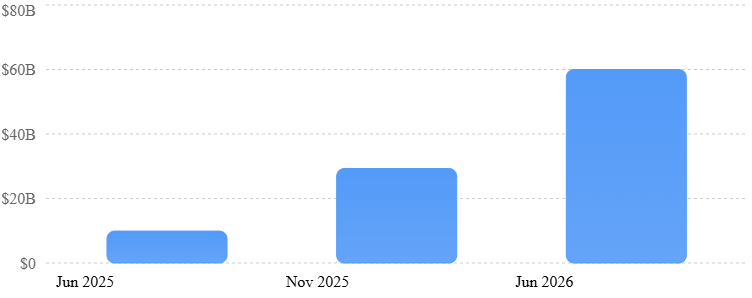
We compared three publicly documented Cursor valuation milestones: its June 2025 financing, its November 2025 financing, and the announced acquisition price in June 2026.
The goal is to measure how quickly the market’s assessment of Cursor’s value changed as AI coding became a major software category.
Cursor’s financial valuation milestones
US$ billions. The first two are post-money funding valuations; June 2026 is an announced acquisition transaction value. These are not identical valuation methods.
Sources: Cursor financing announcements, Reuters, and Cursor acquisition announcement.
| Milestone | Reported value | Change from previous |
|---|---|---|
| June 2025 Series C | $9.9B | Baseline |
| November 2025 Series D | $29.3B | +196.0% |
| June 2026 acquisition | $60B | +104.8% |
| June 2025 to June 2026 | — | +506.1% |
SFTechScene calculations from published transaction values. Valuations are not revenue, profit, or cash proceeds for founders. The acquisition figure reflects the reported deal value. Cursor+3
What the Numbers Reveal
Cursor’s acquisition value was approximately 6.06 times its June 2025 funding valuation.
The largest percentage increase between the displayed milestones occurred during the five months from June to November 2025, when the valuation rose by approximately 196%.
The next increase, from November 2025 to June 2026, was approximately 105%.
The figures suggest investors and strategic buyers placed increasing value on Cursor’s role in the AI development market.
However, there is an important limitation. A negotiated acquisition price is not directly equivalent to an investment-round valuation. A buyer may pay for strategic benefits, future cost savings, or access to customers and technology.
The numbers show the scale of Cursor’s financial rise, but they do not prove that its underlying business became six times more profitable.
Why This Matters for San Francisco’s Startup Economy
Cursor’s acquisition illustrates how quickly a company can move from a relatively small technology startup to a major strategic asset.
It also shows why San Francisco remains important to the AI software industry.
Companies are not only competing to build better AI models. They are competing to control the tools developers use to turn those models into working software.
For entrepreneurs, the lesson is that valuable AI businesses can be built around the way people use AI, not only around the models themselves.
The unanswered question is whether that value remains strongest in independent application companies or moves toward larger organizations that control both the models and the computing infrastructure.
How Cursor Actually Works: Understanding Its Most Important Features
Cursor has developed several products that help explain its appeal.
They address different stages of software development, from writing a single line to managing a complex project.
Understanding those differences is essential before deciding whether Cursor is right for a business.
Cursor Tab: Predicting What the Developer Wants to Change
Traditional autocomplete tools suggest the next word or piece of code based on what someone is typing.
Cursor Tab goes further by predicting changes the developer may want to make next.
Suppose a developer changes the name of a function.
Related code elsewhere in the project may need to change too. Cursor can suggest additional edits instead of forcing the developer to find and update every reference manually.
This is particularly useful when a task involves several small but related changes.
The advantage is not that the developer stops making decisions. Instead, repetitive editing becomes faster, leaving more time for problems that require judgment.
Cursor Agent: Moving From Suggestions to Completed Tasks
Cursor’s Agent mode can search a codebase, modify multiple files, execute commands, write tests, and attempt to correct errors.
A developer might ask it to add a new account registration page.
The agent can then inspect relevant files, build the requested feature, and make connected changes.
The developer can review the changes and reject unwanted work.
Cursor also provides different modes for planning, asking questions, investigating problems, and implementing features. Its documentation makes clear that the amount of control given to the AI depends on the chosen workflow. Cursor Docs
Why This Is More Powerful Than a Chatbot
A general chatbot can explain how to build a registration form or generate sample code.
A coding agent can work with the files already in a project.
That difference becomes important when software grows.
A real application may have hundreds or thousands of files. Changes in one area can affect another area unexpectedly.
An AI agent that understands project context can help coordinate those changes.
But that added ability introduces risk. The more files an agent can modify, the greater the damage it could cause if its instructions are unclear or its assumptions are wrong.
For businesses, stronger agents require stronger review processes.
Cursor 3: Managing Multiple AI Agents
In 2026, Cursor introduced Cursor 3, a redesigned workspace centered on AI agents.
The product supports work across multiple repositories, brings local and cloud agents into a common interface, and makes it easier to move work between a developer’s computer and cloud environments.
It also allows several agents to work in parallel.
Instead of personally supervising each change inside a code file, developers can manage separate tasks, inspect results, and decide what to accept.
Cursor’s own explanation describes a move toward fleets of agents that perform software work with less direct supervision. Cursor
This is an important strategic shift.
Cursor is no longer competing only to provide the best code editor. It is also trying to become a central workspace for managing AI-assisted engineering.
Cloud Agents: Letting Work Continue Without the Laptop
Cloud agents can operate on remote computers, using their own development environments.
They can work on tasks while the developer is doing something else.
For example, a developer might ask one agent to investigate a bug while another agent prepares tests for a new feature.
The developer can later inspect the changes instead of waiting for each task to finish before starting another.
Cursor has described the difficulty of making this work reliably, including environment setup, missing dependencies, access permissions, and tasks that become blocked without human attention. Cursor
Why Long-Running Agents Are Difficult
Writing code is only one part of building software.
An AI agent must also understand how to run the application, install the correct tools, work with test data, and decide whether the finished result is correct.
If one required service is unavailable, the task may fail even when the generated code looks reasonable.
That is why cloud development requires more than powerful language models.
It also requires dependable environments, clear limits, useful error reporting, and ways for human developers to inspect what happened.
Cursor Projects: Moving Toward Software Work That Can Span Months
Cursor’s 2026 product updates introduced Projects, designed for larger bodies of work.
A project can maintain context over an extended period, assign tasks to multiple agents, and coordinate work performed across local and cloud environments.
The system is designed to help manage development tasks that go beyond a single conversation or short editing session.
This represents another move away from the traditional code editor.
Instead of treating each AI interaction as an isolated request, Cursor is working toward a system that can maintain an ongoing understanding of a software project. Latest Updates & Release Notes
For businesses, the opportunity is clear.
An AI tool that remembers project goals and coordinates routine engineering work could reduce the effort required to keep software moving forward.
However, maintaining project context does not guarantee that decisions remain correct. Teams still need people who understand business priorities, technical trade-offs, and acceptable risks.
Original SFTechScene Research #2: How Big Is Cursor’s Real Position in the Developer Market?
Cursor’s revenue and acquisition value tell us that it became a major business.
They do not tell us what percentage of developers actually use it.
To examine that question, SFTechScene analyzed publicly available data from the 2026 Stack Overflow Developer Survey.

The survey asked respondents which development environments and code editors they had used regularly during the previous year.
It received 13,193 responses to this question.
Cursor Is Significant, but VS Code Still Dominates
Regular use of selected development environments in 2026
Share of survey respondents who used each tool regularly in the past year. Multiple selections were allowed.
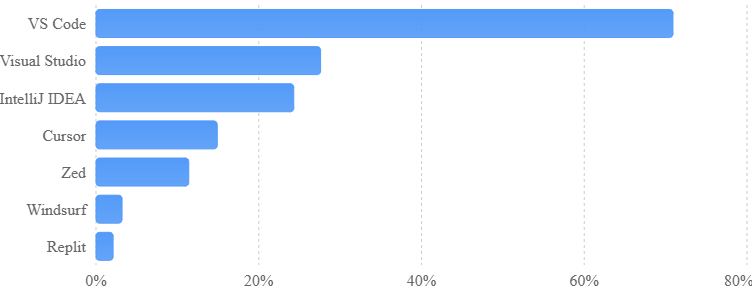
Source: Stack Overflow Developer Survey 2026, Dev IDEs. n=13,193.
Selected products from the survey, not a complete ranking. The survey supports multiple choices, so percentages do not sum to 100%. Stack Overflow Developer Survey
Cursor was used regularly by approximately 14.9% of respondents.
That is a meaningful share for a relatively young development product.
However, Visual Studio Code remained far ahead, with 70.9% of respondents reporting regular use.
This produces an important distinction.
Cursor has demonstrated that an AI-focused editor can attract developers at scale. It has not demonstrated that traditional editors are disappearing.
Original Finding: VS Code’s Reported Reach Is 4.76 Times Cursor’s
Using the published survey percentages:
\[ \text{Relative usage}=\frac{70.9}{14.9}=4.76 \]
VS Code’s reported regular-use share was approximately 4.76 times Cursor’s.
That does not mean VS Code has 4.76 times as many paying customers. The survey does not measure subscriptions or spending, and developers can use more than one editor.
It does suggest that Cursor still has substantial room to expand among developers who prefer established tools.
It also explains why competitors can remain dangerous even after Cursor reaches a large financial scale.
A tool does not need to convince developers to abandon Cursor completely to compete. It may only need to provide useful AI features inside an editor they already use.
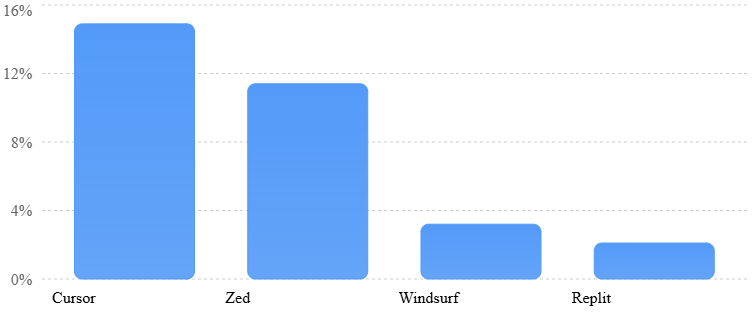
Original Finding: Cursor’s Survey Reach Is More Than Four Times Windsurf’s
The same survey reported regular usage of 3.2% for Windsurf.
Cursor’s 14.9% share was approximately 4.66 times that figure.
AI-oriented editor usage comparison
Percentage of respondents reporting regular usage in 2026.
Source: Stack Overflow 2026. SFTechScene selection and comparison.
Zed and Replit have different product designs and use cases, so they should not be treated as exact substitutes for Cursor.
Nevertheless, the data helps show the scale Cursor achieved among tools competing for modern development workflows.
Why These Results Cannot Establish San Francisco Market Share
The Stack Overflow survey covers developers across different countries, industries, and experience levels.
It is not a San Francisco-only sample.
We therefore cannot use these results to claim that 14.9% of San Francisco developers regularly use Cursor.
That would require reliable local data.
The survey also uses a voluntary sample rather than a random census of all developers. Its results are useful for studying reported behavior, but they are not exact global market shares.
For SFTechScene, the appropriate conclusion is that Cursor has substantial visibility across a broad developer sample while still competing against much more widely used editing environments.
Original SFTechScene Research #3: Cursor Has a Developer Retention Challenge
Adoption is only part of the story.
A developer might try Cursor, use it for several weeks, and then return to another tool.
For subscription software, this distinction matters because attracting users is expensive if they do not continue finding value.
Stack Overflow’s 2026 survey includes a useful measure called admiration.
For a development environment, this measures the percentage of respondents who have used the technology and also want to continue using it.
It is not the same as a company’s subscription renewal rate, but it provides one signal of developer preference.
The 2026 Data Shows a Gap Between Adoption and Enthusiasm
| Editor | Admired by past users | Want to use next year* |
|---|---|---|
| Neovim | 69.9% | 12.9% |
| Zed | 57.3% | 9.7% |
| VS Code | 55.7% | 40.6% |
| IntelliJ IDEA | 53.3% | 14.5% |
| Cursor | 33.0% | 7.9% |
| Replit | 24.4% | 1.2% |
| Windsurf | 22.7% | 1.7% |
*The survey’s “Desired” measure refers to respondents who want to use the product next year. It is not limited to people who have never used it. Source: Stack Overflow Developer Survey 2026, Dev IDEs. Stack Overflow Developer Survey
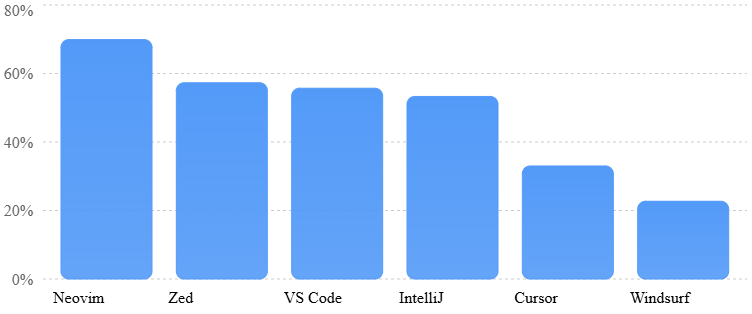
Cursor’s admiration rate was 33.0%.
That was higher than the displayed rates for Windsurf and Replit, but substantially below VS Code, Neovim, and Zed.
This result deserves attention because it challenges a simple success story.
Cursor became financially valuable very quickly, yet its reported developer admiration was not among the strongest in the survey.
Original Finding: Cursor’s Admiration Gap With VS Code Is 22.7 Percentage Points
Reported developer admiration in 2026
Percentage of prior users who also want to continue using the editor. Not subscription retention.
Source: Stack Overflow 2026 Dev IDEs.
The calculation is simple:
\[ 55.7-33.0=22.7 \]
Cursor’s admiration rate was 22.7 percentage points below VS Code’s.
This is not evidence that Cursor’s paying customers are cancelling subscriptions at a similar rate.
The survey cannot tell us how often a user opens Cursor, whether they pay for it, or whether their company requires it.
However, it identifies a useful question for Cursor’s management and potential customers.
Can a product that is financially successful also become a tool developers strongly prefer to keep using over many years?
What Might Explain the Gap?
Several possibilities deserve testing.
Some developers may appreciate AI assistance but prefer other editors for manual programming.
Others may be sensitive to usage costs, changing product features, or the quality of AI-generated changes.
Experienced engineers may also prefer tools that give them more direct control.
Those are hypotheses, not proven explanations from the survey.
To investigate properly, researchers would need to connect developer preferences with factors such as pricing, experience level, daily usage, task types, and the frequency of AI mistakes.
Cursor’s long-term strength may depend on closing this gap between financial adoption and lasting developer preference.
Original SFTechScene Research #4: Why Verification Could Matter More Than AI Coding Speed
One of the most important findings in the 2026 Stack Overflow survey concerns trust.
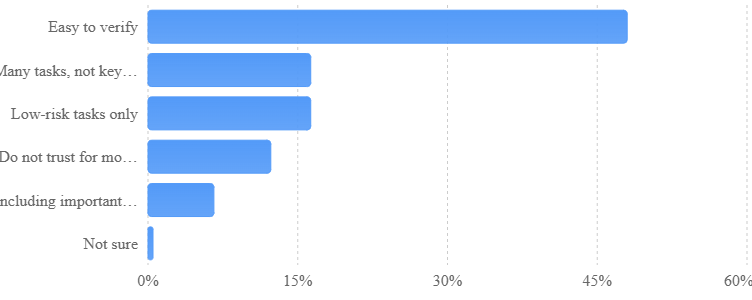
The survey found that 48.0% of respondents trusted AI output when they could easily verify it.
Only 6.6% said they trusted AI for many tasks, including important work decisions.
That difference reveals a major challenge for every AI coding company. Stack Overflow Developer Survey
Developers Are More Comfortable With AI They Can Check
What kind of AI output do developers trust?
2026 survey responses, n=14,304. Categories are mutually exclusive.
Source: Stack Overflow Developer Survey 2026, AI Data.
Nearly half of respondents selected the answer centered on easy verification.
This suggests that the value of a coding tool is closely connected to how easily developers can understand and check its work.
An agent that produces code quickly but makes verification difficult may create new costs.
A slower agent that produces readable changes, meaningful tests, and clear explanations could be more useful in demanding business settings.
A Calculated Comparison: Verification-Based Trust Is 7.27 Times Higher
Using the published percentages:
\[ \frac{48.0}{6.6}=7.27 \]
The share of respondents who trusted AI when they could easily verify the results was approximately 7.27 times the share willing to trust AI with important work decisions.
These groups represent different survey answers, not two levels in a controlled experiment. The ratio shows the size of the difference in reported attitudes; it does not measure the effect of verification on trust.
Still, it provides a strong reason for AI coding vendors to focus on making results easy to check.
Why Cursor’s Review Features Matter
Cursor allows developers to inspect proposed edits through code differences.
Its cloud agents can also produce evidence of work, including screenshots and demonstrations in supported workflows.
These features help a developer understand what the AI changed and whether it achieved the intended result.
That is important because software failures are not always obvious.
A generated feature may look correct in a demonstration while containing security weaknesses, incorrect calculations, or bugs that appear only under unusual conditions.
For professional software teams, code review, testing, and careful deployment remain essential.
The strongest AI coding platform may not be the one that generates the most code.
It may be the one that helps developers establish that the generated code is safe, correct, and useful.
Cursor’s Own AI Models Could Become Its Most Important Competitive Advantage
Cursor originally gained much of its value from making powerful AI models easier to use inside a development environment.
But that approach creates a business problem.
If a company depends heavily on external AI models, its operating costs can rise whenever customers use those models extensively.
The model provider also controls important parts of the product’s performance, availability, and price.
For a company selling AI subscriptions, that dependence can make profitability difficult.
Why Cursor Developed Composer
Cursor has invested in its own coding models under the Composer name.
In March 2026, the company introduced Composer 2, reporting improvements over earlier Composer versions across several coding benchmarks.
One of the published results came from Terminal-Bench 2.0, a benchmark testing an AI agent’s ability to complete tasks in a computer terminal.
Cursor reported the following results:
| Cursor model | CursorBench | Terminal-Bench 2.0 | SWE-bench Multilingual |
|---|---|---|---|
| Composer 1 | 38.0 | 40.0 | 56.9 |
| Composer 1.5 | 44.2 | 47.9 | 65.9 |
| Composer 2 | 61.3 | 61.7 | 73.7 |
Published scores from Cursor’s March 19, 2026 research announcement. These are vendor-reported results, not an independent SFTechScene benchmark. Cursor
Original SFTechScene Research #5: Measuring Cursor’s Published Model Improvements
Using Composer 1 as the baseline, we calculated the relative improvement in Composer 2’s reported benchmark scores.
Composer 2 improvement over Composer 1
Relative percentage improvement in published benchmark scores. This does not measure real-world productivity.
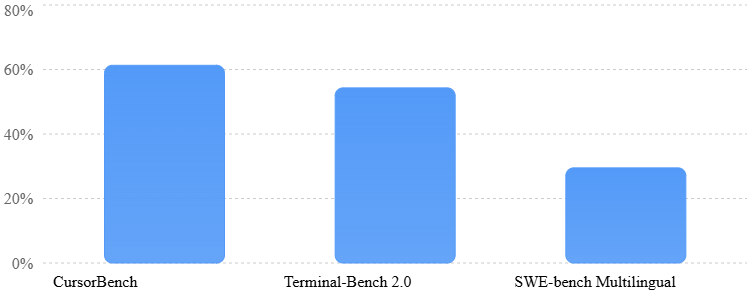
Source: Cursor’s March 2026 Composer 2 announcement. SFTechScene calculations.
The relative changes were:
- CursorBench: approximately 61.3%.
- Terminal-Bench 2.0: approximately 54.3%.
- SWE-bench Multilingual: approximately 29.5%.
These are relative improvements in reported scores, not percentage-point changes.
For example, the Terminal-Bench 2.0 score increased from 40.0 to 61.7, a gain of 21.7 points. Dividing that gain by the original score produces a 54.3% relative improvement.
What the Results Mean
The reported improvements suggest Cursor made meaningful progress in developing its own coding models.
This is strategically important because the company could gain more control over the AI systems used inside its products.
However, benchmark scores do not directly measure how much money a company saves.
An AI model that performs better on a standard test may still struggle with a customer’s particular software, coding practices, or security rules.
The most useful next step is to test those improvements against real projects using consistent tasks and independent reviewers.
Why the SpaceX Acquisition Changes the Economics
Training powerful AI models requires substantial computing resources.
Those resources are expensive, especially when models need repeated training, testing, and improvement.
Cursor’s acquisition gives it access to a much larger technology organization with substantial AI infrastructure.
That could help reduce some model development and operating constraints.
However, more computing power does not automatically produce better software.
Cursor still needs high-quality training data, effective model design, reliable testing, and products that customers want to use.
For investors and competitors, the important question is whether deeper control over models and infrastructure creates an advantage that independent application providers cannot easily match.
Cursor vs. Claude Code vs. OpenAI Codex: Where Does Cursor Fit?
Cursor operates in a competitive market that includes products from some of the world’s largest AI companies.
Two particularly important rivals are Claude Code from Anthropic and OpenAI Codex.
Both can help developers complete programming tasks, but their workflows and product strengths differ.
The Key Differences Between AI Coding Platforms
| Area | Cursor | Claude Code | OpenAI Codex |
|---|---|---|---|
| Main product approach | AI-centered editor and agent workspace | Coding agent across development workflows | Coding agent across development workflows |
| Traditional editing | Strong focus on integrated editing | Can work alongside an existing editor | Can work alongside an existing editor |
| Project-wide changes | Yes | Yes | Yes |
| Agent-based tasks | Yes | Yes | Yes |
| Main evaluation question | Does the combined workspace make development easier? | How reliably does the agent complete tasks? | How reliably does the agent complete tasks? |
| Potential concern | Editor preference and usage costs | Agent quality, workflow fit, usage costs | Agent quality, workflow fit, usage costs |
High-level product positioning rather than a live feature-by-feature benchmark. Capabilities, model availability, and limits change frequently.
Cursor’s Advantage: The Editing Experience
Cursor’s most obvious strength is its close connection between manual editing and AI assistance.
A developer can inspect files, change code, ask the agent for help, and review proposed edits without treating each activity as a separate workflow.
That can be valuable when someone wants to remain closely involved in writing and reviewing software.
For developers who enjoy direct control over their editor, Cursor’s familiar foundation may make AI easier to adopt.
Claude Code and Codex Challenge the Need for a Separate Editor
An important threat comes from AI agents that work without requiring developers to move to a dedicated editor.
If an agent can understand a repository, complete a task, and prepare changes for review, the editor itself may become less central.
This creates a strategic challenge for Cursor.
The company must prove that its integrated experience makes developers more productive than they would be with a separate coding agent and their preferred existing tools.
That advantage cannot be established through marketing claims alone.
It requires testing real tasks, accounting for review time, and measuring the quality of completed software.
Why the Competitive Race Is Far From Over
Different developers have different working styles.
Some prefer visual tools. Others work primarily through terminals. Enterprise teams may prioritize access controls, audit records, and dependable integration with their existing systems.
A single platform does not necessarily meet all of those needs equally well.
The AI coding market may therefore support several successful products rather than one universal winner.
Cursor’s financial success establishes that demand exists. It does not guarantee lasting dominance across every development workflow.
What Does Cursor Actually Cost Businesses in 2026?
The price of an AI coding subscription is only a small part of its real business cost.
Companies must also consider usage, training, code review, security, and the additional time developers spend correcting AI-generated mistakes.
According to Cursor’s published pricing documentation, its listed plans include the following options.
| Cursor plan | Published monthly price |
|---|---|
| Hobby | Free |
| Pro | $20 |
| Pro+ | $60 |
| Ultra | $200 |
| Teams Standard | $40 per user |
| Teams Premium | $120 per user |
| Enterprise | Custom |
Published plan prices checked in October 2026. Actual billing can depend on model selection, included usage, additional consumption, region, and negotiated terms. Cursor Docs
The listed subscription cost is a starting point rather than a guaranteed total bill.
Heavy AI usage can change the economics substantially.
For founders, the right question is not which subscription costs the least.
It is which setup produces dependable software at the lowest total cost.
Original SFTechScene Research #6: When Does Cursor Actually Save a Startup Money?
To answer this question, SFTechScene built an illustrative engineering cost model.
It compares the monthly price of a Cursor subscription with the value of developer time saved.
Unlike the previous analyses, these figures are not observed outcomes or measured Cursor productivity gains. They are transparent scenarios designed to help San Francisco startups evaluate their own results.
The Cost Model
Assume a startup has five developers.
Each developer has an illustrative fully loaded labor cost of $100 per working hour. This is a scenario assumption, not a measured San Francisco salary average.
Assume further that the company purchases five Teams Standard subscriptions at $40 per user per month.
The base monthly subscription cost is:
\[ 5\times \$40=\$200 \]
To keep the model simple, we initially exclude additional usage charges, onboarding time, and other costs.
Now suppose Cursor saves each developer an average of 30 minutes per week after all review and correction work.
Using 4.33 weeks per month:
\[ 5\times0.5\times4.33\times\$100=\$1,082.50 \]
The estimated value of time saved is $1,082.50 per month.
Subtracting the $200 subscription cost gives an illustrative monthly benefit of $882.50.
Sensitivity Analysis: How Savings Change With Productivity
Illustrative monthly net value for a five-developer team
Assumes $100 per loaded developer hour, 4.33 weeks per month, and $200 total monthly subscriptions. Excludes extra model usage and onboarding.
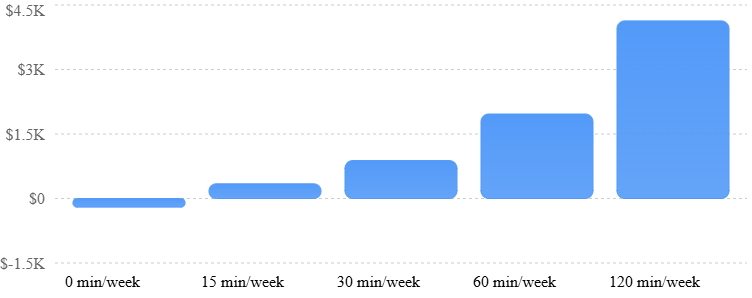
Original SFTechScene scenario calculations, not measured Cursor customer outcomes.
| Net time saved per developer each week | Monthly labor value | Monthly net value |
|---|---|---|
| 0 minutes | $0.00 | -$200.00 |
| 15 minutes | $541.25 | $341.25 |
| 30 minutes | $1,082.50 | $882.50 |
| 60 minutes | $2,165.00 | $1,965.00 |
| 120 minutes | $4,330.00 | $4,130.00 |
Original Finding: Cursor Needs to Save Less Than Six Minutes Per Developer Each Week in This Scenario
The break-even calculation is:
\[ \frac{\$200}{5\times\$100\times4.33} =0.0924\text{ hours} \]
That equals approximately 5.54 minutes per developer per week.
Under these assumptions, Cursor would cover its base subscription cost if every developer saved just over five and a half minutes weekly.
This is a useful result, but it has an important limitation.
The model works only when time savings are real and economically valuable.
If developers save 30 minutes generating code but spend 45 additional minutes fixing mistakes, the net result is negative.
Similarly, saving time does not automatically reduce payroll costs. The business benefit may come from delivering features earlier, reducing delays, or giving existing employees more time for valuable work.
A More Realistic Cost Model Includes Rework
Let’s expand the model.
Suppose the five-person team pays $200 for subscriptions, incurs an additional $400 in AI usage charges, and spends five extra team-hours per month reviewing or correcting AI mistakes.
At $100 per hour, those five hours represent $500 of additional labor cost.
The total monthly burden becomes:
\[ \$200+\$400+\$500=\$1,100 \]
At this point, the tool needs to produce more than $1,100 in useful time savings each month to break even.
This calculation shows why impressive AI demonstrations do not automatically translate into strong returns.
The final result depends on what happens after the AI generates its answer.
What San Francisco Startups Should Measure
A startup evaluating Cursor should track actual engineering outcomes rather than relying on employee opinions alone.
Useful measures include the time required to complete a task, the number of defects found during review, the number of defects reported after release, and the time required to correct them.
Teams should also record subscription and usage charges, so the full cost of the software is visible.
The best outcome is not necessarily faster coding.
It is faster delivery of reliable features that customers actually need.
How San Francisco Startups Can Use Cursor Without Creating More Technical Debt
Technical debt is the extra work created when software is built in ways that make future changes harder.
AI-generated code can increase that debt when teams accept complicated or incorrect solutions without understanding them.

For startups, the risk is particularly serious because early technical decisions can shape the product for years.
Start With a Narrow Development Task
A company introducing Cursor should avoid immediately assigning its most sensitive systems to autonomous agents.
Instead, begin with a task that is useful, easy to check, and unlikely to cause serious damage.
Good candidates include improving internal tools, creating basic user interfaces, writing tests, updating documentation, and fixing well-understood bugs.
These tasks allow developers to measure results while limiting risk.
Give AI Agents Clear Instructions
Poor instructions often lead to poor results.
A request such as “improve the application” leaves too much room for interpretation.
A better request identifies the exact problem, the files or features involved, the expected behavior, and the restrictions the AI must follow.
For example, a developer could ask Cursor to improve a registration form while preserving the existing database structure and authentication process.
The request should also state how the completed work will be tested.
Separate Building From Approval
One of the biggest mistakes a startup can make is allowing AI-generated code to move into production without proper review.
A safer workflow separates implementation from approval.
The AI agent prepares changes. Automated tests check basic behavior. A developer reviews the code and confirms that it meets the business requirements.
Only then should the changes move toward release.
That separation allows teams to benefit from automation without giving up responsibility for their products.
Use AI to Improve Testing, Not Avoid It
AI can be particularly useful for creating tests and identifying situations developers might overlook.
For example, a registration system should handle duplicate email addresses, incorrect passwords, unavailable network connections, and unexpected inputs.
Cursor can help developers create tests for these situations.
However, tests generated by the same AI system that wrote the feature may repeat its assumptions.
Human reviewers should therefore check whether the tests reflect the actual business requirements.
A 90-Day Cursor Adoption Plan for San Francisco Software Teams
The following plan is designed for startups that want measurable results rather than a rushed company-wide rollout.
Days 1–15: Establish a Reliable Baseline
Begin by selecting a small group of developers and defining a set of representative tasks.
Include different types of work, such as building a feature, fixing a defect, writing tests, and understanding unfamiliar code.
Measure how long these tasks take using the team’s existing tools.
Record the quality of the completed work, including defects found during review and problems discovered after testing.
This baseline is essential because teams cannot establish improvement without knowing their starting point.
Days 16–30: Run a Controlled Pilot
Introduce Cursor to part of the team.
Where possible, assign comparable tasks across Cursor and the existing workflow, while balancing developers by experience and task complexity.
Avoid comparing an easy AI task against a difficult manual task.
Record actual time spent, including prompt writing, waiting for AI responses, reviewing changes, and correcting mistakes.
For a more reliable comparison, use repeated tasks and switch developers between workflows over the pilot so individual skill differences do not dominate the result.
Days 31–45: Analyze the First Results
At the midpoint, examine the evidence.
Did Cursor reduce the total time required to complete tasks? Did code quality improve or decline? Were some types of work more suitable for AI than others?
Pay particular attention to cases where AI appeared fast initially but created additional review or debugging work.
Those tasks may reveal where Cursor needs tighter instructions or stronger human oversight.
Days 46–60: Build Repeatable Team Rules
Once the team understands where Cursor works well, establish shared rules.
These should cover acceptable AI tasks, required tests, code review standards, access to sensitive information, and when human approval is mandatory.
Developers should also document useful project instructions and common failure cases.
The goal is to reduce the amount of repeated explanation required for future AI tasks.
Days 61–75: Expand Carefully
If the early results are positive, expand Cursor to more developers or additional projects.
Do not expand simply because the tool is popular.
Choose areas where the pilot showed measurable improvements in time, quality, or delivery speed.
Continue tracking usage charges and review effort because costs can rise as teams become more active.
Days 76–90: Make a Business Decision
At the end of the pilot, compare the full cost of Cursor with its verified benefits.
If developers save meaningful time without increasing defects, broader adoption may be justified.
If the tool produces inconsistent outcomes, keep it limited to tasks where it performs well.
A company may also decide that a different combination of editor and coding agent is better suited to its team.
The purpose of the pilot is not to prove Cursor is the winner.
It is to identify the development workflow that delivers the best results for the business.
The Biggest Risks Facing Cursor and the AI Coding Industry
Cursor’s rapid rise does not remove the challenges facing AI-assisted software development.
Some of these risks affect all coding agents. Others come from Cursor’s position between developers, competing AI providers, and the large infrastructure company that now owns it.
Risk #1: Generating Code Faster Does Not Guarantee Better Software
AI can produce large amounts of code in seconds.
That creates an obvious temptation for startups under pressure to release products quickly.
However, software quality depends on more than the amount of code produced.
A feature must work under real conditions, handle unusual situations, protect sensitive data, and remain understandable when another developer needs to change it.
The more code AI produces, the more important it becomes to review the final result.
Risk #2: Developers May Lose Understanding of Their Own Products
AI agents can complete tasks without requiring the developer to write every line.
That is useful when the task is routine.
It becomes dangerous when the team no longer understands the code running its business.
If an application fails, someone must still identify the problem and decide how to correct it.
Startups should therefore treat AI coding as a way to increase engineering capacity, not as an excuse to stop understanding their software.
Risk #3: Security Problems Can Spread Across Multiple Files
An AI agent with broad access can make changes across an entire project.
That makes it powerful, but mistakes can affect more than one feature.
An agent might accidentally change access permissions, expose sensitive information, or introduce a dependency that creates security problems.
Teams should use limited permissions, isolated testing environments, automated security checks, and human approval before important changes are released.
Cloud agents also require careful control over credentials and external services.
Risk #4: AI Usage Can Become Expensive
AI coding products are often evaluated by their subscription prices.
But extensive use of advanced models can create significant operating costs.
That becomes particularly important when multiple agents work simultaneously or when tasks require repeated attempts.
A startup that adopts AI agents without monitoring usage may discover that its monthly costs rise faster than its actual productivity.
The solution is to track cost per completed task, not simply cost per subscription.
Risk #5: Cursor Faces Competition From Its Former Model Suppliers
Cursor’s relationships with AI model providers helped it build a powerful product.
Those relationships also expose the company to competition from firms with their own developer tools.
If competing products offer similar capabilities at lower cost, Cursor must justify its value through the overall development experience.
Its investment in Composer and its relationship with SpaceX may help address this challenge.
But stronger infrastructure alone does not guarantee that developers will prefer Cursor’s workflow.
Risk #6: Enterprise Customers Need Governance, Not Just Automation
Large organizations have requirements that go beyond generating working code.
They need access controls, audit records, approved development processes, and clear responsibility for changes.
A company handling financial records, patient information, or other sensitive data cannot allow every AI-generated change to move directly into production.
Cursor’s enterprise opportunity therefore depends on making AI agents easier to supervise.
Reliability and control may ultimately become more important purchasing factors than raw coding speed.
What Cursor’s Rise Means for San Francisco’s Technology Economy
Cursor is part of a larger shift in the way technology companies create products.
For decades, software development became more powerful through better tools, programming languages, cloud services, and shared libraries.
AI coding tools represent another major step.
They make it possible for developers to describe desired results in ordinary language and let software systems handle larger portions of the implementation.
That could change several parts of San Francisco’s startup economy.
Smaller Teams Can Attempt More Ambitious Products
Early-stage founders often face a difficult choice.
They can hire additional engineers before proving that customers want the product, or they can move slowly with a smaller team.
AI coding tools may reduce that trade-off.
A small team can use agents to handle repetitive implementation work while concentrating on product decisions, customer feedback, and complex technical problems.
However, this does not mean every startup can operate successfully with one developer.
Large applications still require careful architecture, testing, security, maintenance, and support.
AI increases the range of work a small team can attempt, but it does not eliminate the need for engineering judgment.
The Advantage May Move From Writing Code to Understanding Customers
When software becomes easier to create, writing code may become less of a competitive barrier.
That makes customer understanding more valuable.
A startup with a clear view of a painful business problem may outperform a technically impressive competitor that solves the wrong problem.
For San Francisco founders, this changes where attention should go.
Instead of building features simply because AI makes them easy to produce, founders need stronger customer research, better product decisions, and a clear reason customers should pay.
Software Engineering Jobs Will Change Rather Than Simply Disappear
Coding agents can automate parts of software development.
That does not establish that they can replace complete engineering roles.
Professional developers do more than write code. They make design decisions, work with stakeholders, solve unusual problems, review security risks, and maintain complex systems.
AI may reduce the time spent on routine implementation while increasing the importance of supervision and judgment.
The most valuable developers may increasingly be those who can define difficult problems, guide AI tools effectively, and verify that the resulting software is dependable.
New Startup Opportunities Will Emerge Around AI Reliability
Cursor’s growth creates opportunities for companies building complementary products.
Businesses will need ways to test AI-generated code, monitor agents, manage development costs, protect sensitive information, and verify compliance.
Some of these functions are already served by existing software tools.
However, larger volumes of AI-generated changes could create new demand for products designed specifically around agent-driven development.
For entrepreneurs in San Francisco, the opportunity may be strongest in solving the problems that prevent companies from trusting AI with more important work.
Original SFTechScene Research: Methodology, Data Sources, and Limitations
Because this article makes several original calculations, it is important to explain what was measured and what the results can support.
The analyses use publicly available data, but they are not all the same kind of research.
Some calculations reanalyze developer survey results. Others compare corporate transactions, summarize published benchmark scores, or explore hypothetical engineering costs.
We have kept those categories separate so readers can judge the strength of each finding.
Research Scope
The research covers information available through October 29, 2026.
It focuses on Cursor’s financial history, development products, publicly reported adoption, developer preferences, and broader AI coding economics.
No private Cursor customer records, San Francisco-specific developer survey microdata, or internal company financial statements were available for independent analysis.
Research Data Table
| Research area | Data source | Original SFTechScene calculation | Main limitation |
|---|---|---|---|
| Financial valuation | Cursor financing announcements; Reuters | Percentage change and valuation multiple | Funding and acquisition valuations differ |
| Developer reach | Stack Overflow 2026 | Relative usage ratios | Voluntary global sample, not SF-specific |
| Developer preference | Stack Overflow 2026 | Admiration gaps | Not a subscription retention measure |
| AI trust | Stack Overflow 2026 | Ratio of trust-response shares | Survey attitudes, not causal evidence |
| Model performance | Cursor Composer 2 announcement | Relative benchmark improvements | Vendor-reported results |
| Engineering economics | Published prices and stated assumptions | Break-even time and sensitivity analysis | Hypothetical, not observed productivity |
How the Calculations Were Performed
All percentage changes use the standard formula:
\[ \text{Relative change}= \frac{\text{New value}-\text{Old value}} {\text{Old value}}\times100 \]
Percentage-point differences are calculated by directly subtracting two percentage values.
Usage ratios are calculated by dividing one reported percentage by another.
These methods are simple enough to reproduce, but their interpretation depends on the underlying data.
For the engineering cost scenarios, the assumed number of developers, labor rates, weekly time savings, and subscription expenses are stated explicitly.
Changing those assumptions changes the result.
Important Statistical Limitations
The Stack Overflow survey is not a probability sample of all software developers.
Its responses may overrepresent particular communities, experience levels, geographic regions, or types of technology users.
Because respondents could select multiple editors, editor usage percentages overlap.
Likewise, comparing selected editor categories does not produce an exclusive market share.
The article does not claim that Cursor has a particular share of the San Francisco development market because the published data does not establish that figure.
The admiration analysis also should not be confused with actual customer churn. A respondent can report wanting to continue using a product without paying for it or using it as a primary editor.
Finally, the engineering return calculations are scenario models. They show the relationship between cost and time savings but cannot establish how much productivity Cursor actually delivers.
Public Sources for Reproduction
The primary published sources include:
- Cursor’s June 2025 Series C announcement
- Cursor’s November 2025 financing announcement
- Cursor’s August 2026 acquisition confirmation
- 2026 Stack Overflow editor usage dataset
- 2026 Stack Overflow editor admiration dataset
- 2026 Stack Overflow AI usage and trust data
- Cursor Composer 2 research announcement
- Cursor product changelog
Stack Overflow’s publicly released survey data includes structured JSON and licensing information, making it suitable for independent reanalysis with proper attribution.
To extend this research, SFTechScene would need a geographically identified sample of San Francisco development teams, actual paid subscription data, and independently observed productivity results.
That would make it possible to test whether Cursor’s reported global position translates into stronger adoption or better engineering outcomes in the Bay Area.
What Happens Next for Cursor?
Cursor’s future will likely depend on three connected developments.
The first is the quality of its AI agents.
As coding models become more capable, customers will expect tools to complete larger tasks with less supervision. Cursor must improve reliability while making failures easier to detect and correct.
The second is the relationship between cost and performance.
Customers want more capable AI, but they also need predictable expenses. Cursor’s investments in its own models and its access to SpaceX infrastructure could influence that balance.
The third is the company’s ability to remain a preferred development workspace.
Traditional editors still have wide adoption, and competing coding agents can work within different environments. Cursor therefore needs to offer more than powerful models.
It must make everyday software development easier, clearer, and more dependable.
For San Francisco startups, the practical conclusion is that AI coding tools should become part of engineering strategy, but adoption should be guided by measured results.
Companies that establish clear review standards, test productivity honestly, and maintain strong technical judgment will be better positioned to benefit as the technology improves.
Final Takeaway: Cursor’s Greatest Innovation May Be Changing What Developers Actually Do
Cursor began as an effort to make code editing more intelligent.
In just a few years, it grew into a major AI development platform, attracted billions of dollars in funding, and became the subject of a $60 billion acquisition.
That financial story is remarkable, but it is not the most important part of Cursor’s impact.
The bigger change is happening inside the software development process.
Developers can increasingly describe what they want, delegate parts of the work to AI agents, and spend more time reviewing outcomes.
That could help small startups build products faster, reduce repetitive engineering work, and make software creation more accessible.
But the evidence also shows why caution matters.
In Stack Overflow’s 2026 survey, traditional editors remained widely used, Cursor’s admiration score trailed several established alternatives, and many developers expressed trust in AI primarily when they could verify its work.
These findings suggest the next stage of AI coding will not be decided by code generation speed alone.

It will be decided by how reliably AI tools turn instructions into useful software, how easily people can inspect their work, and whether the resulting productivity improvements justify the costs.
Cursor has helped establish the AI-native code editor as an important product category. Its newer agent-focused workspace is pushing beyond that category toward a different way of managing software development.
For San Francisco founders, the strongest lesson is not to automate every possible task.
It is to use AI where it creates measurable value, preserve human control over important decisions, and build products that solve real customer problems.
The future of software development may involve far less manual typing. But the companies that win will still be the ones that know what to build, why it matters, and how to make it work reliably.