


San Francisco has always been a city where small teams try to build enormous businesses. What has changed in 2026 is how much those teams can build before they need to hire their first engineers, raise their first large funding round, or spend months developing software.
Artificial intelligence is changing the economics of starting a software company. Founders can now describe an application in plain English, generate working code, connect databases, build customer dashboards, and launch products using tools that would have seemed impossible only a few years ago.
For some startups, this means building their first product in weeks instead of months. For others, it means testing several business ideas without hiring a full development team. The most ambitious founders are using AI-generated code to pursue million-dollar annual revenue with remarkably small teams.
However, there is an important difference between building an application quickly and building a successful company. Software may be getting cheaper to create, but attracting customers, keeping them happy, protecting their data, and delivering reliable services remain difficult.
That distinction is becoming increasingly important as AI coding tools spread across Silicon Valley.
In March 2025, Y Combinator managing partner Jared Friedman said that roughly one-quarter of startups in its Winter 2025 batch had codebases that were 95% AI-generated. These were not necessarily founders with no programming skills. Many were experienced technical builders who had started using AI to write most of their code. TechCrunch
The trend has since expanded from early experiments into a serious business opportunity. Companies such as Cursor, Replit, and Bolt.new demonstrate how much demand exists for software that helps other people build software.
Yet the most interesting opportunity may be one level below those platforms. Thousands of founders can now use AI coding tools to build specialized products for customers in finance, healthcare administration, real estate, logistics, marketing, and other industries.
The next million-dollar software business may not look like a traditional Silicon Valley startup. It could be a three-person company solving one expensive problem for a few hundred paying customers.
This SFTechScene analysis examines how that business model works, where the money comes from, what public data reveals, and how founders can measure whether AI-generated code is creating a real competitive advantage.
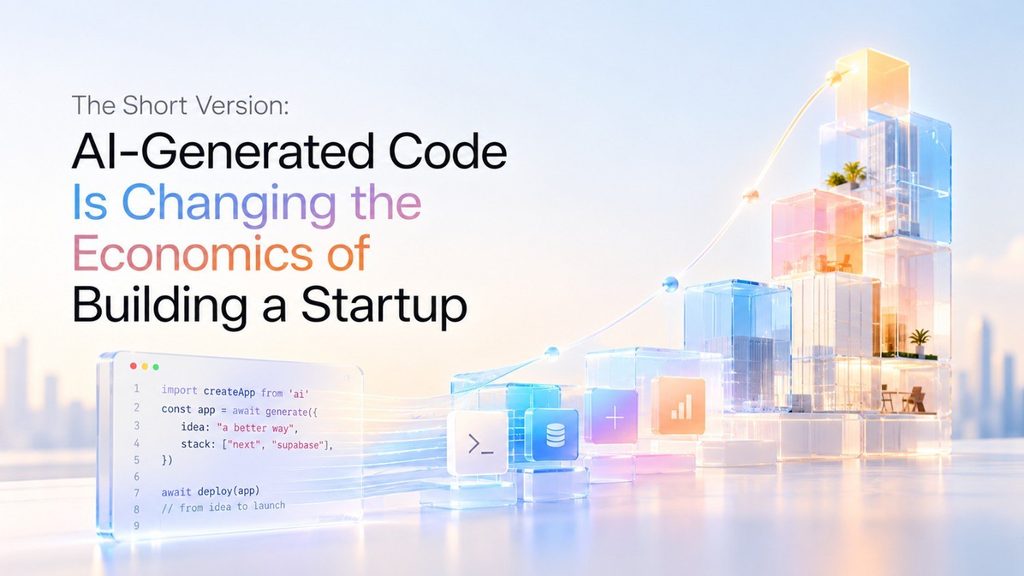
The Short Version: AI-Generated Code Is Changing the Economics of Building a Startup
The biggest opportunity in AI-generated software is not simply writing code faster. It is reducing the money, time, and team size needed to test whether customers will pay for a useful product.
A founder who previously needed several engineers to build an early application may now be able to create much of it with AI assistance. That founder still needs technical judgment, careful testing, and customer support, but can potentially reach paying customers with much less initial spending.
YC Winter 2025 batch
~25%
Reported to have codebases with 95% AI-generated code
2026 developer survey
65.9%
Respondents using AI coding assistants or agents at work
Illustrative revenue target
279
Customers needed at $299/month to exceed $1M annual recurring revenue
2026 survey trust
48%
Trust AI output when they can easily verify it
Sources: Y Combinator comments reported by TechCrunch, Stack Overflow Developer Survey 2026, and SFTechScene calculations. Revenue figures are models, not claimed startup results. TechCrunch+2
A million-dollar business also needs a clear definition. A company earning $1 million in annual recurring revenue is not necessarily generating $1 million in profit, and it may not have collected that amount in cash yet. Likewise, a startup with a billion-dollar valuation is not automatically profitable.
This article focuses primarily on the practical challenge of building a business that can generate at least $1 million in annual recurring software revenue. Where public reports discuss revenue run rates or valuations, those measures are identified separately.
Why San Francisco Is Becoming a Center for AI-Built Software Businesses
A Startup Ecosystem That Already Values Speed
San Francisco’s advantage begins with its long-established startup culture. Founders can find investors, experienced engineers, early business customers, product designers, and other entrepreneurs within a relatively concentrated technology ecosystem.
That environment matters because AI-generated code changes how quickly a product can be built, but does not automatically tell a founder which product is worth building.
A company developing software for finance teams, for example, still needs to understand how those teams approve payments, review transactions, prepare reports, and handle mistakes. Being close to customers who can explain these problems makes it easier to refine a product before investing heavily in development.
The city also has a strong network of founders who are comfortable buying unfinished products, offering feedback, and testing new workflows. For a young company, finding five engaged early customers can be more valuable than attracting thousands of visitors who never return.
The Shift From Hiring Engineers to Directing AI Coding Agents
Traditional software startups often began with a technical co-founder or a team capable of building the entire product. Development work involved writing interfaces, creating databases, connecting services, fixing errors, and managing updates.
AI coding tools now assist with many of those tasks.
A founder can ask an agent to create a user account system, build a reporting page, connect an application to a database, or generate automated tests. An experienced developer can use the same tools to handle repetitive work while focusing on difficult design decisions.
The critical shift is that founders spend less time writing every line of code themselves and more time deciding what the software should do, checking whether it works, and identifying what to improve.
This does not remove the need for engineering expertise. A business collecting customer data or handling payments needs people who understand security, software structure, and the risks of releasing faulty code.
Why This Matters More for Small Startups Than Large Companies
A large technology company already has engineers, processes, internal tools, and customers. Faster coding can improve its productivity, but the effect must pass through existing teams and procedures.
A new startup has fewer existing systems to change. If its founder can build and launch the first product without hiring a development team, the difference in initial cost can be enormous.
Consider two founders pursuing the same software idea. One spends months organizing a team before testing whether people will pay. The other builds a limited working version with AI tools, shows it to customers, and begins collecting payments.
If the second founder discovers that customers do not care about the product, the company can change direction without carrying the same development costs. If customers respond positively, the founder can invest in making the software more secure, stable, and useful.
This ability to learn cheaply may prove more important than any individual coding speed improvement.
Inside the San Francisco AI Coding Companies Making the New Business Model Possible
Several companies in the Bay Area are building the tools that make AI-driven software creation practical. Their reported revenue growth provides evidence of demand for AI coding tools, although it does not establish how much revenue their customers earn from AI-generated applications.
A Beginner’s Guide to Building & Publishing an App in 5 Minutes With Cursor AI
Cursor
Cursor helps developers write, edit, and understand software with AI. Bloomberg reported that the company reached a $2 billion annualized revenue run rate in February 2026, a figure also discussed by TechCrunch. TechCrunch
Replit Review 2026: AI App Builder Tested | No Code MBA
Replit
Replit makes it possible to build and deploy applications through a browser-based platform. Sacra estimated its annualized revenue at $525 million in April 2026. This is an independent estimate, not an audited result. Sacra
Introduction to Bolt: Does It Suit Professional Developers? – The New Stack
Bolt.new
Bolt.new helps users generate web applications through natural-language instructions. Sacra estimated that it reached $40 million in annual recurring revenue in March 2025. Sacra
Cursor: Turning Professional Development Into an AI-Directed Workflow
Cursor represents one major part of the market: helping people who already understand software development produce and maintain code more efficiently.
The editor can use AI assistance across existing projects, allowing developers to work with larger sections of a codebase rather than generating isolated snippets. This matters when software becomes complex enough that small changes can affect several different features.
For a startup founder, the value is not merely asking AI to create a login screen. It is being able to request a change, understand which files may be affected, review the proposed code, run tests, and make corrections before releasing the feature.
Cursor’s reported revenue growth shows strong willingness to pay for this type of assistance. However, its own economics also illustrate the industry’s challenges.
TechCrunch reported in April 2026 that Cursor had recently achieved slightly positive gross margins after previously operating with negative gross margins, while some individual developer accounts remained unprofitable. This is a reminder that rapid revenue growth and sustainable profits are separate achievements. TechCrunch
Replit: Making Software Creation More Accessible
Replit approaches the market from a different angle. Its platform reduces the number of separate services a builder must manage to develop and publish an application.
That is particularly useful for founders who understand their customers’ problems but lack experience configuring servers, development environments, and deployment tools.
Instead of spending the first week connecting several services, a founder can focus on creating an early product and testing the workflow. The result can be faster experimentation, particularly for simple applications and internal business tools.
Replit’s reported expansion also suggests that customers are willing to pay for more than code suggestions. They increasingly want an environment in which AI can help create and operate a complete application.
For builders, the practical lesson is to choose tools according to the work involved. A basic customer portal may benefit from an integrated platform, while a complex financial application may require greater control over hosting, data, testing, and code review.
Bolt.new: Reducing the Distance Between an Idea and a Prototype
Bolt.new is another example of how AI can lower the barrier to creating a working application. A user can describe an interface or feature and ask the system to generate the software needed to demonstrate it.
This is valuable during the earliest stage of a startup, when the founder needs to show customers what a product might do.
A working prototype can produce better feedback than a slide presentation. Customers can click buttons, enter sample information, and identify missing steps in their normal work.
However, founders should be careful not to confuse a convincing demonstration with a reliable product. A prototype may look finished while still lacking proper data protection, error handling, or safe access controls.
The Important Lesson From These Three Companies
The businesses have different approaches, but they point toward a similar change in software development.
Instead of asking whether AI can write a particular piece of code, entrepreneurs increasingly ask how much of the complete product-building process AI can support.
That opens a wider market for founders. Building software becomes more accessible, while the value of understanding customers, designing useful workflows, and maintaining trustworthy products becomes even greater.
Original SFTechScene Research #1: Where AI Is Actually Replacing Development Work
One of the most important questions for founders is which tasks they should trust AI to handle.
Generating a basic interface is different from changing a live payment system. Writing automated tests is different from deciding whether customer data can be shared with an outside service.
To investigate this distinction, SFTechScene analyzed task-level results from the 2026 Stack Overflow Developer Survey.
Research Methodology
We used the survey’s public data on tasks that respondents had delegated to AI tools or agents during the preceding 30 days. The question received 13,756 responses, and respondents could select multiple tasks.
We grouped the activities into software creation, software maintenance, engineering decisions, and production operations. We then compared the share of respondents delegating each activity and calculated differences between common and less common uses.
This analysis uses publicly available global survey data rather than a San Francisco-only sample. Our original contribution is the grouping, comparison, and business interpretation, not the underlying survey.
What the Data Shows
Where developers delegate work to AI
Share of 13,756 survey respondents reporting each task in the past 30 days. Multiple responses allowed. Source: Stack Overflow 2026; SFTechScene selection.
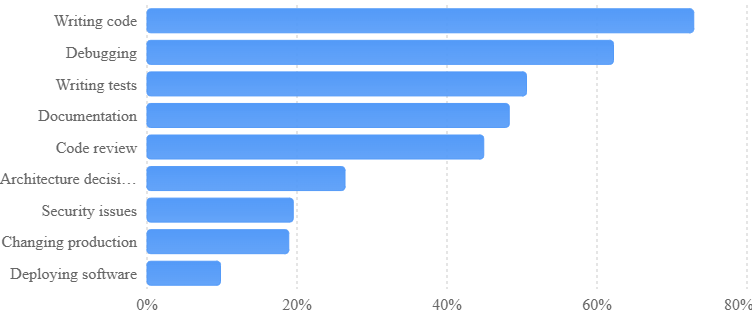
Source: Stack Exchange Inc., 2026 Developer Survey, Tasks delegated to AI agents, released under ODbL 1.0. Stack Overflow Developer Survey
The most common AI tasks are writing code, debugging problems, and creating tests. These are activities where a developer can often inspect the result before it affects customers.
Production deployment sits much lower on the list. Only 9.8% of respondents reported delegating software deployment or release activities, compared with 72.9% who delegated code writing.
Our calculation shows that code generation was reported approximately 7.4 times as often as deployment. This is a ratio of survey response rates, not proof that developers spend 7.4 times more time writing code.
Original Finding: The Opportunity Is Bigger in Creation Than Autonomous Operation
This difference reveals an important business opportunity.
AI has already become a common part of creating and changing software. However, developers remain much more cautious about letting it make changes to live systems.
For a founder, that suggests a practical operating model. Let AI generate and revise code aggressively, but maintain stronger controls around customer data, payments, infrastructure, and production releases.
This also creates potential businesses in automated testing, security review, software monitoring, and safe deployment. As more applications are produced with AI, the need to check those applications could increase.
A Second Check: How Useful Do Developers Find AI?
To test whether popular activities are also considered useful, we examined another 2026 survey question covering the value of AI across different tasks.
Perceived usefulness of AI by engineering task
Useful plus very useful responses, rounded to one decimal place. Source: Stack Overflow Developer Survey 2026.
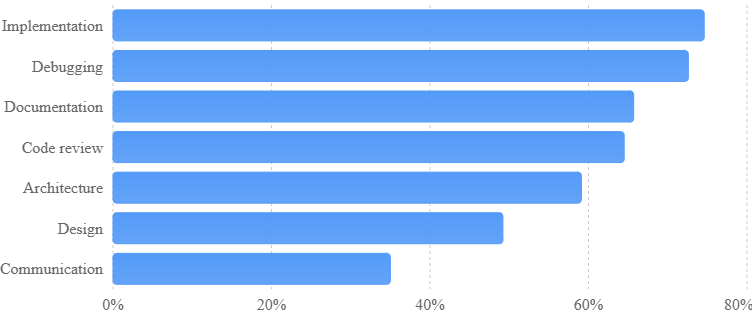
SFTechScene calculations add the published “useful” and “very useful” response shares. Percentages are rounded and refer to respondents answering this separate survey question. Stack Overflow Developer Survey
The difference between implementation and communication is 39.6 percentage points. That indicates a substantial gap in perceived usefulness between work directly involving code and work involving people.
It does not mean AI cannot assist with customer communication or business planning. It does suggest that founders should not assume the success of AI coding tools will automatically carry over to sales, support, negotiation, or product strategy.
For a small startup, this distinction can guide hiring. Software creation may require fewer hours than before, while customer research and relationship building may still demand significant attention.
Original SFTechScene Research #2: How Many Customers Does It Take to Build a Million-Dollar Software Business?
The phrase million-dollar startup can make entrepreneurship sound more complicated than it needs to be.
For a subscription software company, reaching $1 million in annual recurring revenue is primarily a question of customer count, pricing, and retention.
A founder does not necessarily need millions of users. The company may need a much smaller number of customers who receive enough value to pay meaningful monthly fees.
Research Methodology: Building a Transparent Revenue Model
For this analysis, SFTechScene constructed a set of subscription business scenarios using publicly defined inputs.
We use $1 million in annual recurring revenue as the target and test monthly prices from $49 to $1,999. For every price, we calculate the smallest whole number of customers required to meet or exceed that annual revenue level.
The formula is:
\[ \text{Required customers}=\left\lceil\frac{\$1{,}000{,}000}{12\times\text{monthly price}}\right\rceil \]
This model assumes every customer pays the same stated price for a full month. It excludes discounts, free users, taxes, failed payments, and usage-based charges.
The Million-Dollar Customer Count
| Monthly subscription | Customers needed | Annualized revenue |
|---|---|---|
| $49 | 1,701 | $1,000,188 |
| $99 | 842 | $1,000,296 |
| $199 | 419 | $1,000,572 |
| $299 | 279 | $1,000,932 |
| $499 | 168 | $1,005,984 |
| $999 | 84 | $1,006,992 |
| $1,999 | 42 | $1,007,496 |
Original SFTechScene calculation. These are hypothetical subscription businesses, not observed company revenues. Customer counts are rounded up to whole customers.
The numbers expose a major strategic choice.
At $49 per month, a startup needs more than 1,700 paying customers. At $999 per month, it needs just 84.
Both can reach approximately the same revenue level, but the businesses require very different marketing, sales, customer support, and product strategies.
Interactive Revenue Calculator
Model your own AI-built SaaS business
Change the assumptions to explore revenue and operating economics.Monthly price per customer
$299Paying customers
100Variable costs as % of revenue
20%Monthly fixed operating costs
$10,000
Annual recurring revenue
$358,800
Monthly operating contribution
$13,920
Customers required for $1M ARR at this price: 279Reset
The operating contribution is revenue minus assumed variable and fixed costs. It is not net profit, cash flow, or a tax estimate.
Original Finding: Pricing Can Matter More Than Development Speed
Consider a startup that builds software for small accounting firms.
At $99 a month, the company must maintain 842 paying customers to exceed $1 million in annual recurring revenue. That may require broad marketing, easy onboarding, and extensive self-service support.
At $499 per month, the same target requires 168 customers. The company may be able to spend more time helping each customer and solving more complex accounting problems.
The higher price only works if customers receive greater value. However, it may produce a more manageable business for a small founding team.
This is why founders should decide how a product will make money before spending months building it.
An AI coding assistant can generate features, but it cannot guarantee that customers will value those features enough to pay for them.
Original SFTechScene Research #3: Why Customer Retention Could Matter More Than Cheap Code
A startup that reaches $1 million in annual recurring revenue can still run into serious trouble if customers keep leaving.

AI coding tools may reduce the cost of adding new features, but they do not solve customer retention. If a product is unreliable, difficult to use, or no longer valuable, customers can cancel regardless of how quickly it was developed.
Modeling Customer Loss for a $299 Software Product
We modeled a company with 280 paying customers at $299 per month. That customer base generates $83,720 in monthly recurring revenue, or $1,004,640 annualized.
We then tested how monthly customer churn changes the number of replacements required.
Customer churn is the percentage of customers who leave in a given month. A business with 3% monthly churn loses approximately three out of every 100 customers during that month.
| Monthly customer churn | Expected customers lost per month | Approximate annual retention without new sales |
|---|---|---|
| 1% | 2.8 | 88.6% |
| 2% | 5.6 | 78.5% |
| 3% | 8.4 | 69.4% |
| 5% | 14.0 | 54.0% |
| 8% | 22.4 | 36.8% |
SFTechScene scenario model. Expected monthly losses equal 280 × churn rate. Annual retention equals (1 − monthly churn)^12, assuming constant independent monthly churn and no new customers.
How a customer base shrinks without new sales
Starting with 280 customers. Hypothetical constant monthly churn rates; no acquisitions or reactivations.
■ 1% monthly churn
■ 3% monthly churn
■ 5% monthly churn
What This Means for a Small Founder Team
At 1% monthly churn, the company needs to replace an expected 2.8 customers per month simply to maintain its size. At 5%, that requirement rises to 14 customers.
The difference can dramatically change the workload for a small team. More customer losses mean more marketing spending, more sales conversations, and less time improving the product.
For a founder trying to operate with only two or three employees, retention is particularly important. A stable customer base allows the team to spend more time improving the application instead of constantly replacing lost subscriptions.
The simple model does not account for customers upgrading, downgrading, pausing service, or buying additional products. Those factors matter in real businesses and should be included once the company has enough data.
Original Finding: The Best AI-Built Business May Be the One Customers Rarely Leave
The most attractive market may not be the one with the easiest software to generate.
Consider a simple AI-built image tool and a specialized application that helps a property management company prepare monthly owner reports.
The image tool may be easier to demonstrate and attract casual users. However, customers may have many alternatives and little reason to remain loyal.
The property management product may take longer to understand and build. Once integrated into a company’s daily work, though, it could become much harder to replace if it saves employees several hours every month.
This creates a potential advantage for founders who know a specific industry.
AI reduces the difficulty of making software. Deep knowledge of customers determines whether the software becomes something they continue paying for.
Original SFTechScene Research #4: How Much Does an AI-Built Startup Actually Cost to Operate?
There is a common assumption that a startup built with AI should cost almost nothing to run. That can be true for a limited prototype, but it becomes less realistic once a product serves paying customers.
Even a small application needs hosting, data storage, security, monitoring, customer service, and maintenance. Some products also incur substantial AI model charges every time customers use them.
What Public Software Pricing Reveals
The cost of basic development infrastructure can be modest.
For example, Supabase publicly lists a Pro plan starting at $25 per month, while Vercel lists a Pro plan starting at $20 per month. Both services can charge more when usage exceeds included limits or additional features are required. Supabase+1
These prices illustrate the accessibility of modern development tools. They do not represent the complete cost of running a production software company.
A business using AI to process thousands of customer documents every day may face model and computing costs much greater than its basic hosting bill. Another application that mostly stores and displays simple records may remain relatively inexpensive.
For that reason, the most useful cost measure is not the monthly subscription price of the coding tool. It is the total cost of serving each paying customer.
Three Financial Scenarios
We constructed three hypothetical businesses that each generate $1 million in annual recurring revenue. We varied their operating costs to illustrate how different economic models can produce different outcomes.
| Annual financial metric | Lean niche SaaS | AI-intensive SaaS | Sales-led enterprise SaaS |
|---|---|---|---|
| Revenue | $1,000,000 | $1,000,000 | $1,000,000 |
| Variable service costs | $150,000 | $400,000 | $200,000 |
| Gross profit | $850,000 | $600,000 | $800,000 |
| Fixed operating costs | $300,000 | $350,000 | $650,000 |
| Operating contribution | $550,000 | $250,000 | $150,000 |
| Contribution margin | 55% | 25% | 15% |
Original SFTechScene illustrative scenarios. Fixed costs include assumed staff, sales, administrative, and other operating expenses. These are not financial statements from actual startups and exclude interest, taxes, and certain accounting adjustments.
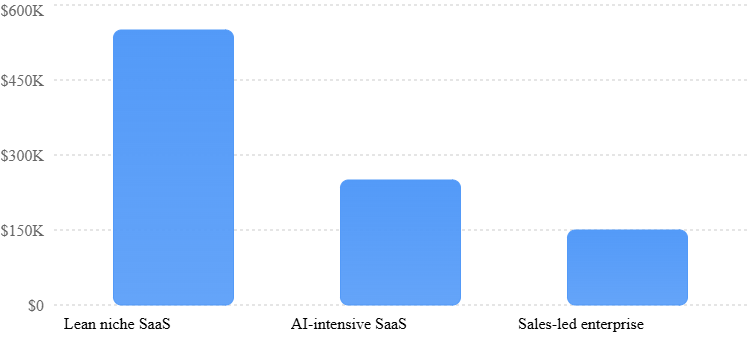
Same $1M revenue, very different operating outcomes
Hypothetical annual operating contribution after stated variable and fixed costs.
Original Finding: The Cheapest Software to Build Is Not Always the Cheapest Business to Run
The first scenario produces $550,000 in annual operating contribution. The third produces just $150,000 despite earning the same revenue.
This difference comes from assumptions about service delivery, customer acquisition, and ongoing operations.
A startup that builds a relatively simple application for a narrow market may have low computing costs and limited customer support needs. A company that uses expensive AI models during every customer interaction may have much higher service expenses.
Meanwhile, a business selling complex software to large enterprises may need dedicated salespeople, security reviews, legal agreements, and ongoing customer support.
AI-generated code may reduce part of the initial development cost in all three models. It does not eliminate the other expenses.
The strategic lesson is to calculate gross margin and customer-level profitability before deciding that an AI-generated application is an attractive business.
The Hidden Cost of AI: Reviewing and Fixing Generated Code
There is another cost that can be difficult to see.
AI may generate code in seconds, but the company still needs to understand what it does. A founder might spend hours correcting a feature that initially appeared to be complete.
Research from METR illustrates why this distinction matters. In a randomized study involving 16 experienced open-source developers completing 246 tasks, access to early-2025 AI coding tools increased measured completion time by 19%. METR
That result does not mean AI always makes developers slower. It applies to the tested tools, developers, tasks, and period.
In February 2026, METR described follow-up experiments showing possible speed improvements with newer tools, but cautioned that participation and measurement problems made the new estimates unreliable. METR
For founders, the conclusion is practical: measure finished, tested work rather than code generated.
A company should track how long it takes to move from a requested feature to a working, verified release. That includes prompting, reviewing, testing, fixing errors, and deploying the product.
The Five Business Models San Francisco Founders Can Build With AI-Generated Code
The financial analysis points toward several types of businesses where AI coding tools could make a meaningful difference.

Each model has different customers, revenue opportunities, and operational risks. The right choice depends less on which AI tool a founder prefers and more on which customer problem they understand.
1. Vertical SaaS: Software for One Specific Industry
Vertical SaaS is software designed for a particular industry. Instead of building a general-purpose business tool, the company solves a problem for a narrow group of customers.
For example, a founder could build an application that helps independent accounting firms collect client documents, track missing information, and organize monthly deadlines.
AI coding tools can help generate the customer portal, database, email reminders, reporting interface, and administrative controls. The founder still needs to learn how accounting firms operate and ensure the software handles confidential information safely.
This model is attractive because buyers may have a clear financial reason to purchase. If the software saves an accounting firm 20 hours of work each month, a $299 subscription could be easy to justify, depending on the firm’s labor costs.
The main challenge is distribution. A founder needs to find accounting firms, prove the product works, and convince employees to change their routine.
How Founders Should Validate the Idea
Before building the full application, interview at least 15 potential customers. Ask them to describe how they currently complete the task, where delays occur, and what mistakes cost the business money.
Look for problems that happen every week or month rather than occasional frustrations. Recurring problems are more likely to support recurring software revenue.
Next, create a basic demonstration and ask potential customers to use it with sample information. The strongest signal is not that they like the interface, but that they agree to pay for a pilot or commit to a future purchase under clear conditions.
2. Internal Business Automation Tools
Many companies still run important operations through spreadsheets, shared inboxes, and manual updates.
A startup can build software that automates one part of that work. Examples include organizing incoming sales requests, routing support tickets, preparing reports, or tracking vendor approvals.
AI-generated code can accelerate the creation of these tools because many use familiar technical patterns. They require forms, user accounts, databases, notifications, and connections to existing business software.
The difficult work is understanding the exceptions.
A system that processes 95% of requests correctly may still be unsuitable if the remaining 5% include expensive mistakes. Founders need to design clear rules for when the software should stop and ask a person to review the result.
The Best Pricing Strategy
Business automation products are often easier to sell when their value is connected to time saved or work completed.
Suppose an operations team spends 30 hours each month preparing a recurring report. If the fully loaded labor cost is $50 per hour, the activity represents roughly $1,500 in monthly labor expense.
A product that reliably removes 20 hours of that work could offer meaningful financial value. A $300 monthly subscription might be attractive if it preserves quality and does not create additional review costs.
The founder should demonstrate this with real customer data rather than assuming every hour saved turns directly into cash savings.
3. Small Business Customer Portals
Many service businesses need simple tools that allow customers to submit requests, check progress, upload information, or view account details.
Custom-built portals were once expensive enough that small companies often continued relying on email. AI-generated software can make limited versions easier to create.
A founder could initially build portals for one industry, such as commercial cleaning companies or specialist maintenance providers. Common features might include service requests, photographs, customer updates, and invoice status.
The opportunity is not selling code. It is selling an easier customer experience.
Productized Service Versus SaaS
There are two approaches.
A productized service charges customers for a customized application, often with an initial setup fee and ongoing maintenance payment. This can generate revenue quickly, but each customer may require additional work.
A SaaS product uses a more standardized platform shared across customers. It may take longer to develop, but it has better potential to scale without creating a new application for every buyer.
For founders pursuing $1 million in recurring revenue, a standardized product with limited customization is often more attractive than a collection of unrelated client projects.
4. Specialized Reporting and Analytics Software
Another opportunity involves transforming existing business data into useful reports.
A startup might help property managers understand outstanding maintenance requests, help marketing agencies analyze campaign results, or help sales teams identify overdue follow-ups.
These products can be appealing because businesses often already collect the required data. The value comes from organizing it, identifying relevant patterns, and making the next action clear.
AI coding tools can assist with creating dashboards, filters, charts, and scheduled reports. They can also help build connections between commonly used software services.
However, report accuracy is essential.
A beautiful dashboard that contains incorrect numbers can do more harm than an ordinary spreadsheet. Founders must test calculations, explain where the data comes from, and make it possible for customers to verify important results.
5. AI-Enhanced Software With Human Review
Some products combine traditional software with an AI feature that helps complete customer work.
For example, an application might collect documents, identify missing information, and prepare a draft report. A person then checks and approves the result.
This model can be more dependable than allowing an AI agent to complete every step without supervision.
It also gives founders an opportunity to measure the true value of AI. They can compare how much work users complete with and without assistance, how many mistakes appear, and how much review time remains.
The business should charge for the useful outcome rather than making AI generation itself the main selling point.
Original SFTechScene Research #5: A Framework for Finding the Best Million-Dollar Software Opportunities
Not every software idea becomes more attractive simply because AI makes it easier to build.
In fact, when thousands of people can generate similar applications, basic features may become less valuable. Founders need another source of advantage.
To organize this decision, SFTechScene developed a five-factor opportunity scoring framework.
The Research Framework
We evaluate candidate ideas using five factors: customer willingness to pay, frequency of the problem, access to buyers, technical risk, and the ability to serve more customers without matching increases in operating costs.
Each factor receives a score between one and five. A higher score represents a more attractive opportunity, with technical risk reverse-scored so that safer products receive higher marks.
| Factor | Weight | What to investigate |
|---|---|---|
| Customer willingness to pay | 30% | Does the problem have measurable financial value? |
| Frequency of the problem | 20% | Does the customer face it regularly? |
| Access to customers | 20% | Can the founder reach decision-makers? |
| Technical safety and simplicity | 15% | Can the product be built and maintained reliably? |
| Ability to scale | 15% | Can revenue grow faster than service costs? |
The score is calculated by multiplying each factor’s one-to-five rating by its weight and adding the results. The maximum is five.
The weights are SFTechScene’s proposed decision model, not statistically estimated predictors of startup success. They prioritize commercial demand and customer access because those are difficult for AI coding tools to create on their own.
An Illustrative Comparison of Three Startup Ideas
We applied the framework to three hypothetical businesses. The scores illustrate how founders can use the method; they are not validated market research or measurements of real customers.
| Opportunity | Willingness to pay | Frequency | Buyer access | Safety | Scale | Weighted score |
|---|---|---|---|---|---|---|
| Property management reporting | 4 | 5 | 4 | 4 | 4 | 4.20 |
| Generic AI image utility | 2 | 3 | 3 | 5 | 5 | 3.30 |
| Specialized financial approval system | 5 | 5 | 2 | 1 | 3 | 3.50 |
SFTechScene illustrative startup opportunity scores
Weighted scores out of five, using editorial assumptions rather than measured market performance.
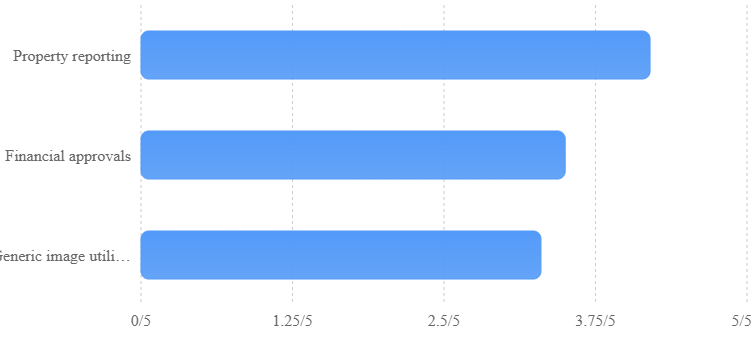
The property reporting product scores highest in this illustration because the problem occurs regularly, its value can be explained, and the software may be relatively manageable to operate.
The financial approval system has strong potential customer value, but its lower scores for customer access and technical safety reduce its overall rating.
The generic image utility is relatively easy to create and distribute. However, it may face pricing pressure from many competing products.
What This Analysis Actually Tells Founders
The framework does not prove that property management software is a better market than financial software or AI image generation.
It provides a structured way to investigate competing opportunities without being distracted by how impressive a prototype looks.
A founder should replace these hypothetical scores with evidence from customer interviews, actual buyer conversations, pilot results, and cost estimates.
The scoring system becomes more useful when all candidate ideas are judged using the same rules.
Why AI-Generated Code Is Creating a New Type of Founder
The Domain Expert Who Can Finally Build Software
For many years, starting a software company required either engineering experience or enough money to hire engineers.
That limited the ability of professionals in other industries to build tools around problems they understood deeply.
An experienced property manager might know exactly why maintenance requests become delayed. An accountant might understand which client documents are consistently missing. A logistics manager might know where shipments become difficult to track.
These professionals have valuable knowledge but may not know how to turn it into software.
AI coding platforms give them a way to create demonstrations, test workflows, and communicate product requirements without writing every line of code.
Their advantage is not necessarily technical skill. It is knowing which features customers actually need.
The Technical Founder Who Can Do More With a Smaller Team
Experienced engineers also benefit from AI coding tools.
A technical founder can use AI for repetitive interfaces, test generation, documentation, and early implementation. That may free time for important tasks such as product design, system architecture, customer interviews, and reliability.
However, a founder should avoid treating every generated feature as finished work.
The most effective technical founders may be those who know when to use AI and when to slow down. They can recognize weak code, simplify complicated designs, and prevent problems before customers encounter them.
The Small Team That Combines Technical and Commercial Skills
A promising structure for an early AI-built software business is a compact team combining business knowledge, technical oversight, and customer acquisition.
One founder understands the target industry. Another knows how to develop and maintain the application. Both participate in customer conversations and product decisions.
Additional specialists can be brought in when needed for security, design, legal work, or complex integrations.
The objective is not to avoid hiring forever. It is to delay unnecessary fixed expenses until the business has demonstrated real demand.
How to Build a Million-Dollar AI Software Business: A Practical 90-Day Plan
A founder should not begin by asking an AI coding tool to create a complete software platform.
The first goal is to establish whether a real customer problem exists, whether people will pay to solve it, and whether the proposed solution can be delivered reliably.
The following 90-day plan provides a structured approach.
Days 1–15: Find an Expensive, Repeated Problem
Begin by choosing a customer group that is narrow enough to understand.
Instead of targeting every small business, focus on independent property managers, specialist accounting firms, dental practice administrators, or marketing agencies serving a particular industry.
Interview potential customers about how they complete recurring tasks. Ask them to demonstrate their current process where possible, rather than simply describing frustrations.
Pay close attention to work that involves copying information between systems, preparing recurring reports, following up on missing documents, or coordinating approvals.
These activities may be suitable for software because the steps are often repeated and the result can be checked.
What Success Looks Like
By day 15, the founder should have interviewed at least 15 people and identified one problem that several customers describe independently.
Ideally, the founder should know how often the problem occurs, who is responsible for solving it, and what delays or errors cost the business.
If every customer describes a different problem, the market may still be too broad.
Days 16–30: Build a Small Demonstration
The next step is to create a working product that solves one core task.
AI coding tools can help generate the interface, database structure, basic workflows, and sample reports. The founder should use fictional or approved test data rather than uploading confidential customer records.
Avoid adding unnecessary features.
If the product helps customers collect documents, focus on secure uploads, document status, and reminders. Billing automation, complex analytics, and dozens of account settings can come later.
The purpose of the demonstration is to test whether customers understand and value the workflow.
What Success Looks Like
By day 30, at least five potential customers should have seen the demonstration.
The founder should document which features customers actually use, where they become confused, and which improvements they request.
A useful sign is a customer offering to test the product with real work under an appropriate agreement. An even stronger sign is willingness to pay.
Days 31–45: Turn the Prototype Into a Reliable Product
Once the core workflow has received meaningful feedback, the company should improve the software’s technical quality.
This includes proper user authentication, access controls, database protection, backup procedures, error handling, and automated tests.
The founder should also review AI-generated code for obvious security weaknesses and unnecessary complexity.
For products involving sensitive information, qualified technical review is essential. Generating software through AI does not reduce the founder’s responsibility to protect customers.
During this period, the team should measure the time required to complete common tasks and identify failure points.
Days 46–60: Charge the First Customers
The next milestone is converting interest into actual revenue.
Founders should offer a straightforward pilot with clearly defined features, customer responsibilities, support arrangements, and pricing.
For a business product, the initial price should reflect the value delivered rather than the number of hours spent generating code.
A $199 or $299 monthly subscription might be reasonable for some useful small-business tools, but pricing needs to be tested with actual buyers.
Avoid offering indefinite free access simply to create the appearance of growth.
Paying customers provide much stronger information about whether the product solves an important problem.
Days 61–75: Build a Repeatable Customer Acquisition Process
Once several customers are paying, identify how they discovered the product and what convinced them to purchase.
A founder might find that personal outreach works better than advertising. Another may discover that useful industry articles attract buyers who already understand the problem.
Choose one or two acquisition methods and measure them carefully.
Record how many people are contacted, how many agree to a demonstration, how many begin a paid subscription, and how much time and money the process requires.
AI can help prepare marketing materials, organize research, and automate follow-up administration. However, outreach should remain accurate, relevant, and respectful of recipients.
Days 76–90: Improve Retention Before Expanding
The final stage should focus on customers who are already using the product.
Ask which features they return to, what work remains manual, and which errors create frustration.
Track whether the software is being used regularly and whether customers are completing the task for which they originally purchased it.
Fix reliability problems before investing heavily in new features.
By day 90, the most useful achievement may not be a large revenue figure. It may be a small group of paying customers who use the product repeatedly and can explain why they would miss it if it disappeared.
How San Francisco Startups Can Find Their First 100 Paying Customers
Building a useful application is only one part of the business. A founder still needs a predictable way to reach customers.

For most new business software products, broad advertising is not the best first move. A focused sales process can produce more useful information with less spending.
Start With One Narrow Customer Profile
A company selling reporting software should define exactly who makes the purchase decision.
It might target property management firms with 10 to 50 employees, several hundred managed units, and a recurring reporting problem.
That description is far more useful than saying the software is for property managers.
A narrow customer profile allows the founder to write specific marketing messages and build features around recognizable tasks.
Use Customer Language Instead of AI Language
Many founders describe their applications using the technology underneath them.
They highlight AI agents, autonomous workflows, intelligent automation, or code generation.
Customers often care much more about the result.
A property manager may be interested in preparing owner reports in 15 minutes instead of two hours. An accounting firm may care about reducing the number of missing documents before monthly deadlines.
Marketing should lead with those outcomes when they can be demonstrated.
The fact that AI helped create the software is usually secondary.
Build Distribution Into the Product
One of the strongest growth opportunities is allowing satisfied customers to introduce the application to other potential customers.
For example, a reporting platform might allow a property manager to share a secure report with a property owner. A client portal might allow customers to invite approved colleagues.
These features can create natural product exposure, although that does not guarantee referrals or sales.
Founders should design sharing around real customer needs rather than adding invitations merely to chase growth.
Track Conversion Instead of Traffic
A new SaaS business should pay close attention to the percentage of potential customers who become paying customers.
Imagine 1,000 qualified visitors reach a product website in a month. If 2% subscribe, that produces 20 customers.
At $299 per month, those subscriptions represent $5,980 in new monthly recurring revenue before any cancellations.
If the conversion rate improves to 4% while qualified traffic remains constant, the business adds 40 customers instead.
This is why better positioning, product demonstrations, and onboarding may deliver greater value than adding another AI-generated feature.
The Biggest Risks Facing Million-Dollar AI-Built Startups
Security Problems Hidden Inside Working Code
AI-generated software can look correct while containing serious weaknesses.
A login system may appear to work but fail to enforce proper access rules. A database query may return the correct information during a test while exposing records that another customer should never see.
These problems become particularly dangerous when founders lack the skills to recognize them.
Before launching paid software, test who can access each type of information, how sensitive data is stored, and whether the system prevents unauthorized actions.
Founders should also review third-party packages, software dependencies, and access credentials.
The earlier these safeguards are built into the product, the less expensive they are likely to be to maintain.
Becoming Dependent on One AI Coding Platform
A startup may initially rely on a single platform to generate code, host the application, and manage its data.
This can be convenient during development. However, it may create difficulties if pricing changes, usage increases, or the company eventually needs more control.
Founders should understand whether their code can be exported, how their data can be transferred, and which features depend on one provider.
Keeping a secure copy of the code in an appropriate version-control system is a useful safeguard.
For important infrastructure, the team should document how to recover data and restore the application after a failure.
Building Too Many Features Too Quickly
When AI makes code generation easier, founders can become tempted to add every feature customers request.
That can produce a complicated application that is difficult to test, explain, and maintain.
Every new feature creates ongoing work. It may need customer support, testing, security review, documentation, and updates whenever other parts of the application change.
The best founders will not necessarily generate the most code.
They will identify the smallest reliable product that customers are willing to use and pay for.
Mistaking Revenue Growth for Profitability
A startup with rapidly increasing revenue may still be losing money.
AI model fees, computing expenses, customer acquisition costs, and technical support can grow alongside usage.
This is especially important for products that make expensive model calls whenever customers perform an action.
Founders should calculate the cost of each major workflow and estimate how it changes as customers increase their use.
A product that charges $50 per month while creating $60 in model and service costs for a heavy user may need different pricing, usage limits, or technical design.
Losing the Ability to Understand the Product
One of the less obvious risks of AI-generated code is that founders may stop understanding the systems they operate.
An application can grow quickly through repeated prompts, with each new feature adding complexity that no one has fully reviewed.
This makes later changes more difficult and increases the risk of hidden errors.
Technical documentation, automated testing, and regular code review are important even for tiny teams.
The objective is not to manually rewrite everything AI produces. It is to maintain enough understanding and control to operate the software safely.
Original SFTechScene Research #6: The Verification Gap Could Become a Major Startup Opportunity
AI-generated software creates demand for more software. But it may also create demand for tools that help businesses verify what AI has built.
To examine this possibility, we compared 2026 developer survey responses about AI use and trust.
The survey found that 65.9% of respondents reported using AI coding assistants or agents at work, while 26.2% used AI agents or automated workflows. These categories can overlap, so they should not be added together or treated as separate populations. Stack Overflow Developer Survey
A separate trust question found that 48% trusted AI output when they could easily verify it. Only 6.6% trusted AI for many tasks, including important work decisions. Stack Overflow Developer Survey
Trust is strongest when AI output can be checked
Selected responses to the 2026 Stack Overflow trust question, n=14,304. These are separate response categories.
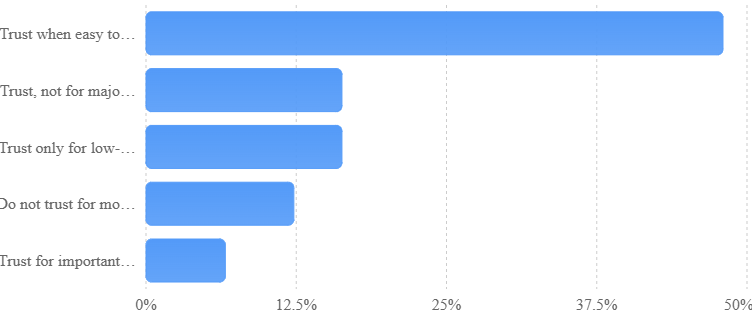
The ratio between the 48% verification-dependent group and the 6.6% important-decision group is approximately 7.3 to one.
That ratio does not measure a change in trust caused by verification. It describes the relative sizes of two distinct survey response groups.
Why This Matters for San Francisco
Many founders currently focus on making AI coding agents more capable.
However, a related business opportunity is making their output easier to review.
A startup could create tools that automatically test AI-generated applications, identify security weaknesses, compare code changes, or generate clear explanations of what an agent modified.
Other companies might focus on monitoring software after deployment, detecting unusual behavior, or making it easier to recover from mistakes.
These businesses would not need to compete directly with major AI model providers. They could operate as an independent layer that helps teams use many different coding tools safely.
The Strategic Opportunity
Our interpretation of the survey is that verification deserves serious attention as an emerging software category.
The underlying evidence shows that developers frequently use AI for coding while expressing more limited trust in its output. It does not prove how large the verification market will become or which vendors will win.
Founders interested in this area should start by measuring the time teams spend reviewing AI-generated code and the cost of defects that escape into production.
Those numbers can establish whether a verification product creates enough value to support a paid business.
What Investors Should Look for in AI-Generated Software Startups
The widespread availability of AI coding tools also changes how investors should evaluate young software companies.
A working prototype is no longer as strong a signal of technical capability as it once was. More founders can create polished demonstrations without spending months on engineering.
Investors therefore need to understand what makes the business difficult to copy.
Customer Relationships May Matter More Than Code Volume
A startup with a large amount of AI-generated code does not automatically own a valuable advantage.
Competitors may be able to recreate many of its features using similar tools.
However, a company with strong customer relationships, trusted integrations, a clear market position, and useful industry knowledge may be much harder to displace.
Investors should ask why customers choose the product and what would prevent them from switching to an alternative.
Revenue Quality Matters More Than Launch Speed
A startup that reaches $20,000 in monthly recurring revenue within a short period may appear impressive.
The next question is whether customers continue paying.
Investors should examine recurring usage, customer retention, gross margins, support requirements, and the cost of finding new buyers.
A smaller company with stable revenue and healthy margins may have a stronger underlying business than a rapidly growing product that depends on expensive computing and constant advertising.
Technical Ownership Remains Essential
Investors should also determine whether the founding team understands the software it operates.
Can the company diagnose a serious outage? Does it know how customer information is protected? Can it move between infrastructure providers when necessary?
A business built with AI-generated code can still be technically strong. What matters is whether the founders have enough control over the product to maintain it.
What the Million-Dollar AI Software Company Could Look Like in 2027
The traditional image of a successful software startup involved a growing engineering organization, several funding rounds, and years of product development.
AI-generated software may allow a wider range of businesses to pursue meaningful revenue before following that path.
A small team could build a specialized application, sell directly to businesses, automate much of its internal administration, and use AI tools to support ongoing development.
However, this future should not be confused with a world where companies require no human expertise.
Customers still need products they can trust. Software still needs to work during unexpected situations. Sales, relationships, industry knowledge, and judgment still create value.
The most effective founders may combine extensive AI assistance with careful human control.
Three Changes Likely to Shape the Next Generation
First, the cost of testing software ideas could continue falling. This may encourage more founders to enter specialized markets that previously could not justify large development budgets.
Second, competition may shift away from basic software features and toward customer relationships, service quality, data integrations, and distribution.
Third, software reliability may become an increasingly valuable differentiator. If thousands of new applications enter the market, customers will need better ways to identify which companies can safely support important business operations.
These are strategic expectations rather than guaranteed outcomes. Their strength will depend on future AI capabilities, economics, regulation, and customer behavior.
How Founders Should Measure Whether AI Coding Is Actually Helping
Startups should avoid judging AI tools by the number of lines of code they produce or the number of features they generate.
Those metrics may increase even when software quality declines.
A better approach is to track results across product development, customer value, and business performance.
| Metric | What it reveals | Why it matters |
|---|---|---|
| Time to verified release | Days from approved request to tested deployment | Measures real delivery speed |
| Defects after launch | Problems discovered by users | Shows product quality |
| Cost per completed feature | Development, testing, and review expense | Reveals true AI savings |
| Monthly recurring revenue | Current subscription revenue | Measures commercial progress |
| Gross margin | Revenue left after direct service costs | Measures service economics |
| Customer churn | Customers lost each month | Reveals retention problems |
| Customer acquisition cost | Spending required to acquire a customer | Measures growth efficiency |
| Time to first value | How quickly users complete a useful task | Shows onboarding quality |
Run a Controlled Experiment Inside the Startup
A useful way to evaluate an AI coding tool is to compare similar tasks under different working methods.
For example, the team could select a group of non-urgent development tasks and classify them by difficulty, size, and risk. It could then randomly assign some tasks to an AI-assisted workflow and others to the normal development process.
For every task, measure elapsed working time, review time, test failures, defects, and the final accepted result.
The experiment should not focus only on time spent writing code.
If an AI-assisted task saves two hours of implementation but adds three hours of testing and correction, it has not created a net time saving.
For a tiny startup, the sample may be too small to draw strong statistical conclusions. Even so, recording the full workflow can reveal expensive patterns that casual observation misses.
Calculate the Real Cost Per Accepted Feature
A practical formula is:
\[ \text{Cost per accepted feature} = \frac{\text{Labor cost + AI cost + testing cost + rework cost}}{\text{Accepted features}} \]
The calculation should use consistent definitions of what counts as an accepted feature.
A feature that exists in a prototype but has not passed testing should not be treated as equivalent to one safely used by customers.
For investors and founders, this measure gives a more useful picture of productivity than code generation volume.
Final Takeaway: The Next Million-Dollar San Francisco Startup May Be Small, Specialized, and Built With AI
AI-generated code is making it easier for entrepreneurs to turn an idea into working software.
The shift is visible in the adoption of AI coding tools, the growth of companies providing those tools, and the increasing willingness of technical founders to let AI generate large portions of their applications.
However, the strongest opportunity is not simply producing software more quickly.
It is using lower development costs to build businesses around problems that customers already care about.
The original SFTechScene analysis provides several important lessons.
A company charging $299 per month needs 279 paying customers to exceed $1 million in annual recurring revenue. That makes a focused business software product a plausible route to meaningful revenue without requiring millions of users.
Customer retention also has a major effect on the economics of such a company. A startup with low churn can spend more of its limited resources improving the product, while one with high churn must constantly find replacement customers.
Operating costs remain critical. Two companies earning the same $1 million in annual revenue can produce very different financial results depending on AI usage costs, staffing, customer support, and marketing expenses.
Finally, the 2026 developer survey results suggest that AI is being delegated far more often to code creation than to production deployment. Combined with limited trust in unverified AI output, this points toward a continuing need for skilled technical oversight and new verification tools.
The San Francisco founders who succeed will probably not be the ones who generate the most code or launch the largest number of applications.
They will be the ones who identify important customer problems, build reliable solutions, price them effectively, and create businesses customers want to keep using.

AI may make software easier to create. Building a company people trust remains the real competitive advantage.
Research Methodology, Sources, and Limitations
SFTechScene research note | October 28, 2026
This article combines external reporting, original secondary-data calculations, and explicitly hypothetical financial models. The research aims to explain business economics rather than claim that a newly identified sample of San Francisco startups has achieved $1 million in revenue.
Public Data Used
The primary developer data comes from the Stack Overflow Developer Survey 2026, particularly its AI usage, delegation, usefulness, and trust results. The source is global, self-selected survey data and is not representative of San Francisco startups alone.
The analysis also uses public reporting about Y Combinator, Cursor, Replit, and Bolt.new, together with published pricing from Supabase and Vercel. Company revenue figures described as estimates or reported annualized run rates are not treated as audited profit.
The productivity discussion draws on METR’s randomized study of experienced open-source developers and its 2026 methodological update. These experiments do not establish a universal productivity effect for every AI coding tool or startup.
Original Calculations
Our original quantitative work includes the 7.4-to-one code delegation versus deployment prevalence ratio, the subscription customer counts needed to reach $1 million ARR, twelve-month churn scenarios, financial contribution models, and a weighted opportunity scoring framework.
The revenue and churn calculations use deterministic formulas. The financial scenarios and opportunity scores are illustrative and depend on openly stated assumptions, not collected company financial records.
No founders were interviewed for this article, no private revenue data was obtained, and no original San Francisco-only company dataset was collected. The conclusions should therefore be treated as evidence-informed business analysis rather than a statistically validated local startup census.
Reproducibility
The principal calculations can be reproduced with these formulas:
- Annual recurring revenue: monthly subscription price × paying customers × 12.
- Customers for $1 million ARR: round up $1,000,000 divided by annual revenue per customer.
- Customer retention after 12 months: (1 − monthly customer churn rate)^12.
- Gross profit: revenue − direct service costs.
- Operating contribution: revenue − direct service costs − specified fixed operating expenses.
- Weighted opportunity score: sum of each factor’s rating multiplied by its assigned weight.
For primary-source verification, see the Stack Overflow task delegation dataset, AI trust dataset, METR’s 2026 productivity research update, and Sacra’s Replit revenue analysis.
The resulting picture is clear but nuanced: AI is reducing some barriers to software creation, yet the evidence does not justify assuming that every AI-built product is cheap, reliable, profitable, or capable of becoming a million-dollar business.