

SFTechScene Original Research | October 2026 | AI Coding Tools, San Francisco Startups, Software Development
San Francisco’s AI coding race is entering a new stage. Developers are no longer asking whether artificial intelligence can write code. They want to know which tool can build useful features, fix difficult bugs, work across large projects, and help them release software without creating new problems.
Three products sit at the center of this competition: Cursor, Claude Code, and OpenAI Codex. Each promises faster development, but they approach the problem in different ways.
Cursor wants to become the main place where developers write and manage code. Claude Code focuses on giving an AI agent the ability to understand a project and carry out engineering tasks. OpenAI Codex is building a broad system for coding work across local computers, development environments, cloud tasks, and code reviews.
The stakes extend well beyond the software industry. For San Francisco startups, the right coding tool could help a small team launch products faster, test more ideas, and reduce the cost of routine engineering work.
But which product is actually winning?
To answer that question, SFTechScene examined newly published developer survey data, official product features, pricing, and the practical costs of using AI agents. We also conducted an original secondary analysis of public developer adoption figures to measure competitive gaps, relative adoption, and what those differences mean for San Francisco companies.
The findings show a clear leader in reported developer use. They also reveal why winning the adoption race does not automatically mean winning every engineering workflow.
The Short Version: Claude Code Leads in Developer Adoption, but Cursor and Codex Remain Serious Competitors
The strongest independent adoption evidence available in October 2026 comes from the Stack Overflow Developer Survey 2026, published on October 6.
Among 12,255 respondents to the survey’s coding-agent question, 65.5% reported using Claude Code during the previous year. OpenAI Codex reached 29.5%, while Cursor reached 25.5%.
That gives Claude Code a substantial advantage in reported adoption within this survey. However, it does not prove that Claude Code has the largest paying customer base, produces the best code, or generates the most revenue. Stack Overflow Developer Survey+1
Reported use of AI coding agents in 2026
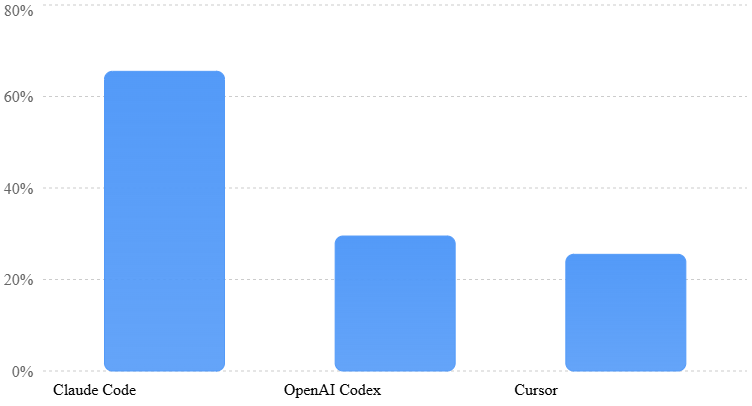
Source: Stack Overflow Developer Survey 2026. Multi-select responses; percentages are not exclusive.
Original SFTechScene visualization of Stack Overflow’s 2026 public survey results. Sample: 12,255 respondents to the coding-agent question.
The difference between these tools becomes clearer when we look at the jobs they are designed to handle.
| Tool | Main advantage | Best starting point |
|---|---|---|
| Cursor | Editing and managing code with AI in one workspace | Developers who want a visual code editor |
| Claude Code | Agent-led work across an existing project | Experienced developers managing complex tasks |
| OpenAI Codex | Coding tasks across IDEs, terminal, and cloud workflows | Teams seeking flexible engineering automation |
Cursor is especially attractive when developers spend much of their day looking at code, changing files, and checking the results. Claude Code is compelling when the job requires investigation, planning, and changes across several connected files.
Codex is particularly interesting for companies that want coding agents to become part of a larger engineering process, including reviewing changes and completing assigned tasks.

Our central finding: Claude Code is winning the surveyed adoption race. Cursor remains an important option for everyday editing, while Codex has a credible path to compete through its wider engineering workflow.
For a startup making a buying decision, the best choice depends less on brand popularity and more on which tool delivers correct, reviewed, production-ready work at the lowest total cost.
What Makes Cursor, Claude Code, and Codex Different?
All three products use advanced AI models to work with software. They can interpret natural-language instructions, understand code, suggest changes, and help developers handle tasks that previously required more manual effort.
However, an AI coding model and an AI coding product are not the same thing. The model provides much of the reasoning and code-generation ability, while the product determines how that ability is applied during actual development.
Cursor: Building the AI-First Coding Workspace
Cursor began with a simple idea: coding should become easier when the editor understands what the developer wants to accomplish.
Instead of asking an AI assistant for code in one window and moving the answer into another, developers can work directly inside a coding environment. The tool can use project context, change files, and help developers inspect the results.
This matters because coding includes much more than typing. Developers constantly search for files, read existing functions, compare changes, and move between related parts of a project.
Cursor aims to reduce that friction.
Its product has expanded beyond traditional editing to include coding agents, cloud-based tasks, code reviews, and team features. Current documentation also describes access to models from several providers, although model availability and charges depend on the subscription. Pricing+1
Where Cursor Makes the Biggest Difference
Consider a San Francisco startup building an online scheduling product.
A developer needs to update the booking page, add a new field, change how availability is stored, and fix a problem with appointment confirmation.
With a conventional editor, the developer may move between multiple files and tools. With Cursor, AI assistance is closely connected to that working environment.
The advantage is not simply faster code generation. It is the possibility of reducing the time spent moving from one small engineering step to another.
Cursor’s challenge is to prove that this familiar editing experience remains valuable as more work gets handed to autonomous agents.
Claude Code: Turning Coding Into an Agent-Led Process
Claude Code comes from Anthropic. Its main appeal is the ability to give a coding agent a task and let it work through the steps needed to complete it.
Rather than focusing on one suggestion at a time, the developer can describe a broader goal. The agent can investigate the project, identify relevant code, propose changes, run permitted commands, and use feedback to improve its work.
That makes Claude Code useful for tasks that require understanding relationships between different parts of a software system.
For example, an engineer might ask it to investigate why customers receive duplicate invoices. The task could involve reading payment code, checking background jobs, examining tests, and identifying where the same event is processed twice.
The developer still needs to verify the result. However, the AI can take on much of the initial investigation.
Why Experienced Developers May Find It Attractive
Experienced engineers often know what needs to happen but do not want to spend hours carrying out repetitive steps.
An agent-driven workflow lets them define the objective, review the approach, and focus on the parts that require judgment. This can be particularly useful for testing, fixing bugs, and updating older code.
Claude Code is included in Anthropic’s paid Claude plans, with usage limits that differ by subscription. Anthropic’s pricing page lists Claude Pro at $20 per month when billed monthly and Max starting at $100 per month. Claude by Anthropic
Its main limitation is that autonomous work still needs human oversight. A coding agent that confidently changes the wrong part of a system can create more work than it saves.
OpenAI Codex: Building a Broader Software Engineering System
Codex comes from OpenAI. It combines AI coding capabilities with several ways of working, including a terminal interface, integrations with code editors, a dedicated application, and cloud-based engineering tasks.
That approach reflects a wider opportunity in software development.
Instead of putting every AI action inside one editor, a company can assign different tasks to coding agents at different stages of its development process.
One agent might investigate a bug. Another might update tests. A third might review a proposed code change before it reaches the main product.
OpenAI’s official documentation describes workflows for working inside development environments, reviewing code, updating older projects, and completing engineering tasks. OpenAI Developers+1
Why Codex Matters for Growing Teams
A growing startup faces a different set of challenges from a solo developer.
The company may have several repositories, engineers working in different environments, and a steady stream of bug reports and feature requests. The real problem is coordinating work without slowing development or losing control over code quality.
Codex is positioned to help with that broader process.
OpenAI also offers Codex through ChatGPT subscriptions, including limited access on free plans and expanded usage on paid plans. Its pricing documentation lists Plus at $20 per month and Business starting at $20 per user per month with annual billing. Actual task capacity varies by model and usage. ChatGPT+1
The opportunity is large, but so is the challenge. Codex must show that broader automation translates into dependable engineering results rather than simply more agent activity.
Original SFTechScene Research #1: Measuring the Real Adoption Gap Between the Three Tools
To understand the competitive picture, we conducted a secondary analysis of the Stack Overflow Developer Survey 2026.
This analysis uses published survey counts rather than company marketing claims. It examines the relative position of Cursor, Claude Code, and Codex among people who answered a common question about coding tools used during the previous year.
Research Methodology
Our source was the 2026 Stack Overflow coding-agent dataset. The wider survey received 30,903 valid responses from 169 countries, collected between June 23 and August 5, 2026.
For this calculation, we used the 12,255 responses to the coding-agent question rather than the entire survey population. The question allowed multiple selections, meaning one developer could report using all three tools. Stack Overflow Developer Survey+1
We performed four calculations:
- Reported-use percentage for each product.
- Percentage-point adoption gaps between products.
- Ratios between reported user counts.
- Each product’s share of combined mentions across the three products.
These are original calculations using existing public survey data, not a new field survey or a controlled product benchmark. In particular, the fourth measure must not be confused with market share because respondents could select multiple products.
Finding 1: Claude Code Has a 36-Point Lead Over Codex
| Product | Respondents reporting use | Reported use |
|---|---|---|
| Claude Code | 8,030 | 65.5% |
| OpenAI Codex | 3,620 | 29.5% |
| Cursor | 3,127 | 25.5% |
Source data: Stack Exchange Inc., Stack Overflow Developer Survey 2026, “AI coding agents,” ODbL 1.0. Stack Overflow Developer Survey
Claude Code leads Codex by 36.0 percentage points and Cursor by 40.0 percentage points. Codex leads Cursor by only 4.0 percentage points.
These differences suggest two competitive groups. Claude Code has a large reported adoption lead, while Codex and Cursor are much closer to each other.
However, the data measures whether respondents used a tool during the previous year. It does not show how frequently they used each product, whether they paid for it, or which tool they eventually preferred.
Finding 2: Claude Code Has More Than Twice the Reported Users of Either Rival
We divided one product’s reported user count by another’s to calculate relative adoption.
Relative reported user counts
Claude Code / Cursor
2.57×
8,030 ÷ 3,127
Claude Code / Codex
2.22×
8,030 ÷ 3,620
Codex / Cursor
1.16×
3,620 ÷ 3,127
Claude’s lead over Codex
36 pp
65.5% − 29.5%
This provides a more intuitive view of the adoption gap.
For every respondent who reported using Cursor, approximately 2.57 respondents reported using Claude Code. For every respondent who reported using Codex, around 2.22 reported using Claude Code.
The ratios describe reported selections, not separate groups of users. Some respondents may appear in both parts of a comparison.
Finding 3: Claude Code Accounts for 54.3% of Mentions Across These Three Tools
Next, we calculated the combined number of reported selections.
Claude Code received 8,030 mentions, Codex received 3,620, and Cursor received 3,127. Together, that produces 14,777 mentions across the three products.
We divided each tool’s count by this combined figure.
Share of combined mentions among the three tools
■ Claude Code
■ Cursor
■ OpenAI Codex
Calculated from 14,777 combined mentions. Not market share; users could select multiple tools.
SFTechScene calculation based on published survey counts. Values rounded to one decimal place.
Claude Code represents just over half of the combined mentions. Codex accounts for about one-quarter, and Cursor accounts for slightly more than one-fifth.
This does not mean Claude Code controls 54.3% of the AI coding market. It means that, when we count mentions of these three tools in the selected survey question, Claude Code receives that portion of the total.
That distinction matters because AI coding developers often use several tools. A person may prefer Cursor for editing but use Claude Code for complex tasks and Codex for another part of the workflow.
What This Research Tells San Francisco Founders
The results challenge the idea that AI coding is simply a race between competing editors.
Claude Code’s adoption lead suggests that developers are willing to use an agent-focused product, even when their normal coding environment already offers AI features.
For startups, that supports testing task-based coding tools alongside familiar editors. It does not justify replacing an existing engineering workflow without measuring the benefits.
The more useful question is whether a product can solve a meaningful problem better than the tools already in place.
Original SFTechScene Research #2: The AI Coding Market Has an Editor Gap and a Trust Gap
Reported adoption is only one part of the market. To understand where these products might go next, we compared three separate areas of Stack Overflow’s 2026 survey: code editor usage, AI-assisted development tasks, and trust in AI output.

This analysis matters because a product can be popular without becoming the main tool developers use to complete their work.
Finding 1: Cursor Has Stronger Competition in the Editor Market Than in the Agent Market
The survey’s development-environment section asked 13,193 respondents which editors and development environments they regularly used during the previous year.
Visual Studio Code remained the leading editor at 70.9%. Cursor reached 14.9%, putting it ahead of several established development environments but far behind VS Code. Stack Overflow Developer Survey
Regular use of selected code editors, 2026
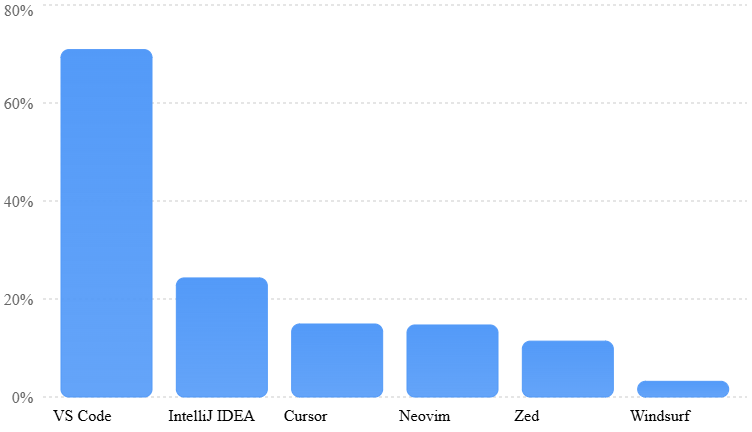
Selected entries from the Stack Overflow 2026 development-environment survey. Respondents could select multiple editors.
The interesting finding is not that Cursor trails VS Code. It is that Cursor has established a meaningful position in a market where developers already have familiar tools and strong habits.
Unlike Claude Code and Codex, which can work alongside existing development environments, Cursor competes more directly for the role of a developer’s main editor.
That creates an extra challenge.
A developer can adopt a coding agent without necessarily giving up their preferred editor. Switching to Cursor may require a larger change in daily habits, even when its AI features are attractive.
Why the Two Cursor Survey Figures Should Not Be Combined
Cursor appeared in two different survey questions. It reached 25.5% in the coding-agent question and 14.9% in the development-environment question.
It would be a mistake to subtract or divide these percentages and call the result a conversion rate. The questions use different respondent groups and measure different behaviors.
Still, the separate results show why Cursor’s competitive position needs two measures: its adoption as an AI coding assistant and its place in the broader editor market.
For SF startups, the lesson is practical. A company should evaluate the value of an AI agent separately from the value of replacing its existing development environment.
Finding 2: AI Adoption Falls Sharply When Work Reaches Production
Our second calculation examined how developers use AI across different tasks.
The 2026 survey reports that 69.3% currently use AI for generating code in familiar areas. By comparison, just 19.9% use AI for deploying, operating, or troubleshooting production systems. Stack Overflow Developer Survey
Where developers currently use AI
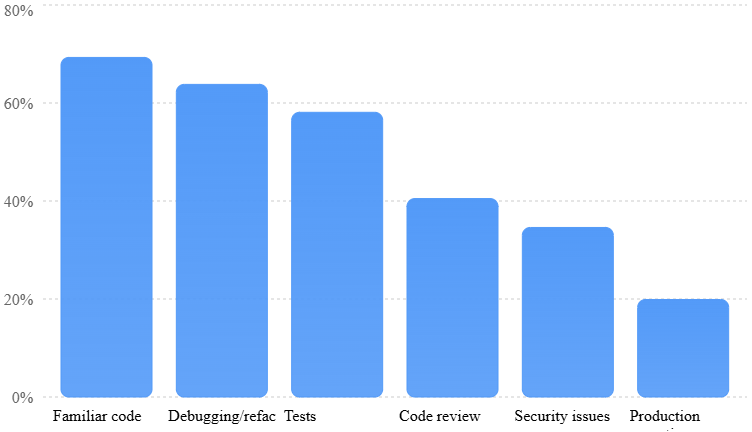
Source: Stack Overflow Developer Survey 2026, AI workflow data. Categories are selected activities, not mutually exclusive.
The gap between familiar-code generation and production operations is 49.4 percentage points.
We also calculated the ratio between these two adoption levels. Developers reported using AI for familiar-code generation at approximately 3.48 times the rate reported for production operations.
These figures do not measure how much work an AI agent completes or how reliably it performs. They show where survey respondents are currently comfortable using AI.
What the 49.4-Point Gap Means
Software companies already have considerable interest in using AI to create and change code. They appear much more cautious when it comes to running that code in live environments.
This makes sense.
A coding mistake during development can often be corrected before customers see it. A mistake involving live payments, customer accounts, or production databases may have immediate consequences.
The next major business opportunity may therefore lie in making AI-generated changes easier to test, review, and release safely.
Cursor, Claude Code, and Codex will all have to solve some version of that problem.
Finding 3: Verifiable Work Is More Valuable Than Blind Autonomy
Stack Overflow also asked developers how much they trust AI-generated output.
Among 14,304 respondents to that question, 48.0% said they trust AI when they can easily verify the output. Only 6.6% said they trust AI for many tasks, including important work decisions. Stack Overflow Developer Survey
Selected measures of developer trust
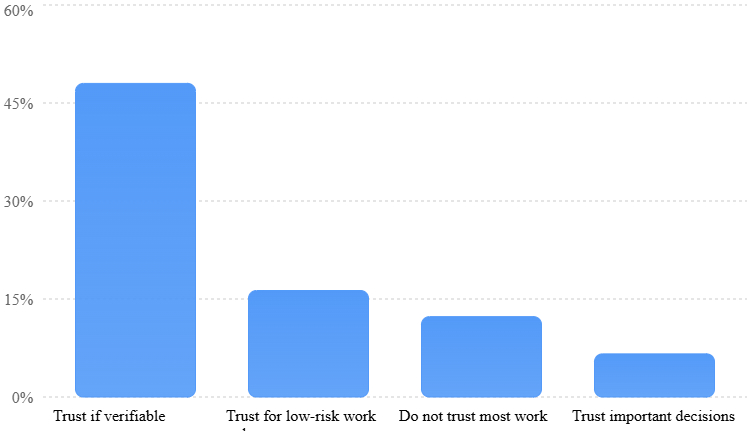
Selected response categories from a single-choice survey question. Other response categories are omitted from this chart.
Our analysis shows that respondents who selected trust based on easy verification outnumbered those willing to trust AI for important decisions by approximately 7.24 to one.
This is not a direct measure of coding-agent quality. It does show the kind of control that many developers want.
The best AI coding tool is unlikely to be the one that makes the most changes without asking questions. It may be the one that makes useful changes while allowing developers to understand, test, and approve what happened.
For San Francisco engineering teams, this shifts the buying discussion away from impressive demonstrations and toward measurable reliability.
Cursor vs. Claude Code vs. Codex: Which Tool Is Best for Different Engineering Tasks?
There is no independent evidence showing that one of these three tools wins every type of coding task. Their strengths depend on how a team works, which models are available, and the complexity of the code.
A useful comparison therefore starts with workflow fit rather than an unsupported ranking of intelligence.
| Engineering task | Tool to evaluate first | Reason |
|---|---|---|
| Editing a page while viewing the code | Cursor | Editor-centered workflow |
| Working through a difficult bug | Claude Code | Strong fit for agent-led investigation |
| Making changes across several files | Claude Code or Codex | Task-oriented execution |
| Building a feature with frequent visual checks | Cursor | Tight connection between editing and inspection |
| Automating code review workflows | Codex or Cursor | Both offer review-related capabilities |
| Working from an existing terminal | Claude Code or Codex | Agent workflows without changing the main editor |
| Assigning cloud-based coding tasks | Codex or Cursor | Both support work beyond the local editor |
| Trying different underlying models | Cursor | Supports models from multiple providers, subject to plan limits |
| Coordinating a larger engineering process | Codex | Broad integration with coding and review workflows |
SFTechScene editorial assessment based on product design and published features. These are recommended evaluation starting points, not experimentally measured performance rankings.
Which Tool Is Best for Frontend Development?
Frontend development involves building the parts of a product that customers see and use. Developers frequently change page layouts, adjust forms, fix visual issues, and update how different screens behave.
Cursor is a natural tool to test first because it brings AI assistance into the editor where much of that work happens.
A developer can make a change, inspect the affected files, compare results, and continue working without treating every small update as a separate engineering assignment.
However, Codex and Claude Code can also generate frontend code. The difference becomes less about whether a tool can create an interface and more about how easy it is to guide and review the process.
For a San Francisco startup launching a customer-facing product, the best test is to give all three tools the same page and design requirements.
Measure how long each takes to produce a working result, how many corrections are required, and whether the final page meets basic accessibility and mobile requirements.
Which Tool Is Best for Complex Bugs?
Complex bugs often involve more investigation than coding.
A problem might appear in a payment page even though the real cause is an event-processing service. A developer must understand what happened, trace the relevant code, and test the proposed fix.
Claude Code is a strong candidate for this kind of work because its agent-led approach is well suited to longer investigations.
Codex should also be tested, particularly when the engineering team wants to assign the problem as a defined task and review the resulting code changes.
Cursor remains useful when a developer wants to investigate interactively and frequently examine the code directly.
The right benchmark should include a bug with a known root cause. That allows the team to determine whether the tool actually found the problem rather than simply producing a plausible explanation.
Which Tool Is Best for Large Codebases?
A large codebase presents challenges that do not appear in small demonstrations.
The AI must find relevant files, understand existing patterns, avoid changing unrelated behavior, and recognize how different components interact.
All three products can assist with this work, but performance may differ depending on the underlying model, available context, project structure, and permissions.
Teams should avoid judging codebase understanding from one successful answer. A more useful test contains several connected tasks across different parts of the same project.
For example, ask each tool to update an API response, adjust the matching frontend component, update tests, and preserve backward compatibility.
The winner is not the tool that makes the most edits. It is the tool that produces the correct change with the least rework.
Cursor vs. Claude Code vs. Codex Pricing: Which Offers Better Value in 2026?
Pricing has become more complicated as coding products have moved from simple subscriptions to plans that include different usage pools, model access, and extra charges.
A monthly fee alone does not reveal how much productive engineering work a team will receive.

The correct comparison includes what is covered by the subscription, what requires additional usage, and how often the team reaches those limits.
Public Pricing Comparison
The following table uses official pricing pages checked for this article in October 2026.
| Product | Published entry option | Important pricing consideration |
|---|---|---|
| Cursor | Free limited tier; newer paid tiers from $8/month | New subscription structure combines Cursor and Grok usage; third-party models may cost extra |
| Claude Code | Claude Pro at $20/month | Agent usage is subject to plan limits; higher-use Max starts at $100/month |
| OpenAI Codex | Limited free access; ChatGPT Plus at $20/month | Usage depends on the plan, model, and task; credits may extend usage |
Sources: Cursor Docs+2. Prices are in USD unless stated otherwise and may exclude taxes. Check current terms before purchasing.
Cursor’s pricing requires special attention because official documentation also describes older Pro, Pro+, Ultra, and team plans that remain active for existing customers.
The newer subscription structure includes shared usage across Cursor and Grok, while access to third-party models can involve separate charges. Comparing older and newer tiers as if they offer identical benefits would be misleading. Cursor Docs+1
Why the Cheapest Subscription May Not Be the Cheapest Tool
Consider two coding agents.
The first costs less each month but requires frequent corrections. The second has a higher subscription cost but completes more tasks successfully.
The cheaper product may ultimately cost more because developer time is expensive.
A team should therefore calculate the cost of accepted work rather than the cost of opening an AI coding session.
This is especially important for startups, where a small engineering team may be responsible for product development, customer support, and operational problems at the same time.
The Hidden Cost of AI-Generated Code
Every coding agent creates the possibility of extra review work.
Sometimes that review is quick. A developer sees a small change, runs a test, and approves it.
Other times the agent produces a change that looks correct but breaks a related feature. The engineer must then investigate, fix the problem, and test everything again.
The cost of that additional work can exceed the subscription fee.
For that reason, a founder comparing Cursor, Claude Code, and Codex should track developer review time, failed tests, repeated attempts, and changes that need to be reopened after initial completion.
Those measures provide a far more useful buying signal than the number of lines of AI-generated code.
Original SFTechScene Research #3: A Cost Model for San Francisco Startups
To make the pricing comparison more useful, we developed a simple engineering-cost model. It combines subscription spending, developer time, successful tasks, and review effort.
This is an original scenario analysis, not an observed pricing benchmark. The task times and outcomes below are hypothetical inputs designed to show how small differences in engineering performance change the economics.
The Model: Cost per Accepted Task
We use the following formula:
\[ \text{Cost per accepted task} = \frac{\text{Tool cost}+\text{Developer labor cost}} {\text{Accepted tasks}} \]
Developer labor includes the time spent giving instructions, reviewing changes, testing the result, and correcting mistakes.
For illustration, assume a San Francisco startup assigns 100 coding tasks to an AI tool during one month and values developer time at $100 per hour.
The $100 rate is a modeling assumption, not a published average salary or a verified San Francisco labor-market estimate. The tool costs shown are also hypothetical total monthly charges rather than claims about any vendor’s actual bill.
Three Illustrative Outcomes
| Measure | Scenario A | Scenario B | Scenario C |
|---|---|---|---|
| Tasks attempted | 100 | 100 | 100 |
| Accepted tasks | 90 | 80 | 70 |
| Developer hours used | 20 | 30 | 45 |
| Total tool charges | $100 | $100 | $100 |
| Labor cost | $2,000 | $3,000 | $4,500 |
| Total cost | $2,100 | $3,100 | $4,600 |
| Cost per accepted task | $23.33 | $38.75 | $65.71 |
The calculation demonstrates why coding-agent reliability matters.
Under these assumptions, Scenario A costs approximately 64.5% less per accepted task than Scenario C, despite identical tool charges.
Illustrative cost per accepted coding task
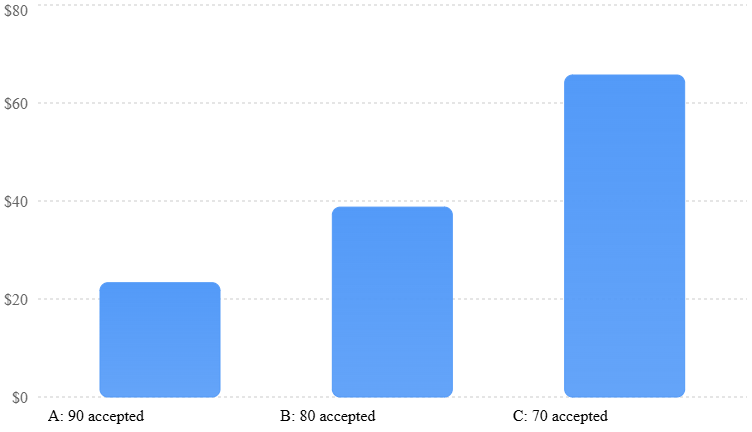
SFTechScene hypothetical scenario model. These outcomes are not attributed to Cursor, Claude Code, or Codex.
What This Means for San Francisco Engineering Budgets
A startup that purchases coding tools based only on subscription prices may overlook its largest cost: the time its engineers spend guiding and correcting the AI.
A more expensive agent could be the better financial choice if it consistently reduces review time or improves the number of accepted tasks.
However, that result should be demonstrated in the company’s own codebase rather than assumed from product claims.
The model also shows why a small difference in task quality can matter at scale. When an engineering team handles hundreds of tasks every month, repeated corrections become a significant operating cost.
An Interactive Cost Calculator for Startup Teams
The model below allows founders to test their own assumptions about task volume, success rate, review time, and tool charges.
Coding-agent unit economics calculatorTasks attempted per month
100
Accepted-task rate
85%
Developer minutes per attempt
20
Hourly developer cost
$100
Monthly tool charges (USD)
Cost per accepted task
$40.39
Total monthly cost
$3,433.33
Estimated accepted tasks: 85Reset assumptions
Assumes the same human time per attempted task. Excludes infrastructure, security incidents, and downstream rework beyond entered review time. Illustrative only.
This calculator is most valuable after a startup completes an actual tool trial.
Instead of entering guesses, the engineering team can use its observed acceptance rates, time logs, and billing records. That produces a company-specific comparison grounded in real development work.
Why This Competition Matters So Much to San Francisco
San Francisco has a strong reason to pay attention to AI coding tools. The city’s startup ecosystem depends on the ability to create useful products, find customers, and improve software quickly.
For years, many startups faced a difficult choice. They could hire more engineers to build faster, or keep the team small and accept slower development.
AI coding agents could change that balance.
A small engineering team may be able to complete more routine work without adding the same number of employees. This does not remove the need for skilled developers, but it can change how their time is spent.
The Biggest Opportunity Is Not Writing More Code
The most valuable startup is not necessarily the one that produces software at the highest speed.
A product must still solve a customer problem, work reliably, protect user information, and generate enough revenue to support the business.
AI coding tools can reduce the effort required to build a feature. They cannot guarantee that customers want it.
This makes product judgment even more important.
If several competitors can build similar software quickly, the advantage shifts toward companies that understand their customers, distribute products effectively, and deliver dependable service.
Why Smaller Teams Could Benefit the Most
A ten-person startup and a thousand-person company face very different engineering problems.
A large organization can assign specialists to testing, security, infrastructure, and quality reviews. A small startup may have only two or three developers responsible for all those areas.
AI coding tools can help these smaller teams cover more work, but they also introduce risk if engineers become too dependent on generated code.
The ideal approach is to use agents for clearly defined tasks while keeping human responsibility for architecture, security, customer data, and production releases.
For smaller SF startups, the opportunity is not to eliminate developers. It is to let a limited engineering team spend more of its time on work that directly improves the product.
Original SFTechScene Research #4: Why the Next Winner May Be the Tool Developers Can Verify Most Easily
Our final research analysis combines the public survey’s adoption figures with its findings on developer trust and production work.
The evidence reveals an important difference between the tasks developers already use AI for and the tasks they are willing to trust AI to complete.
In the survey, 69.3% of respondents reported using AI to generate familiar code, while only 19.9% reported using it for production operations. Separately, 48.0% of respondents to the trust question said they trust AI when its output is easy to verify. Stack Overflow Developer Survey+1
These results come from different survey questions and respondent groups. They should not be treated as one combined statistical sample.

However, considered together, they support a useful business hypothesis: easier verification could be an important factor in expanding AI coding beyond routine development tasks.
The Competitive Advantage of Trust
Imagine two coding agents solving the same bug.
The first changes fifteen files and announces that the problem is fixed. The second changes six files, explains the root cause, adds a test that fails before the fix, and shows that the test passes afterward.
The first agent may appear more productive because it made more changes. The second gives the developer clearer evidence that the work is correct.
For a business handling customer payments or sensitive information, that difference is extremely important.
This suggests that the next stage of AI coding competition will involve more than model intelligence. Companies will also compete on code review, test quality, permission controls, and the ability to explain changes.
What Cursor, Claude Code, and Codex Must Prove
Cursor must demonstrate that its combination of editing, agents, and code review produces a better daily development experience than using separate tools.
Claude Code must show that its strong adoption position translates into consistently successful work across difficult engineering tasks.
Codex must prove that its broader workflow can help teams complete engineering assignments while keeping review and quality controls manageable.
These are strategic assessments based on the products’ current approaches, not claims about private roadmaps.
The common challenge is reliability. An agent that saves ten minutes during coding but creates an hour of debugging work is not improving the business.
How San Francisco Startups Should Test All Three Tools
Choosing an AI coding tool based on one demonstration is risky. A useful evaluation should reflect the real work an engineering team completes every week.
We recommend a controlled two-week trial using the same project, similar tasks, and clear review standards.
Week One: Test Code Quality and Task Completion
During the first week, select fifteen tasks from the team’s normal development backlog.
Five should involve routine feature changes, five should involve debugging or testing, and five should require work across multiple files.
Each tool should receive the same task instructions, project snapshot, permissions, and available tests. When practical, a separate branch should be created for each attempt.
A developer who does not know which tool produced a change can then review the results using a common checklist.
This helps reduce the risk of favoring a tool simply because the team already likes its interface.
Week Two: Measure Real Engineering Productivity
During the second week, evaluate how much human work is needed to turn AI output into acceptable software.
Record the time spent preparing instructions, waiting for results, correcting mistakes, running tests, and reviewing changes.
Also record tool charges and any problems that appear after a task is initially accepted.
The following scorecard provides a starting point.
| Measurement | How to calculate it | Why it matters |
|---|---|---|
| Task acceptance rate | Accepted tasks ÷ attempted tasks | Measures useful completion |
| Average human time | Total human minutes ÷ attempts | Measures developer effort |
| Test pass rate | Tasks passing required tests ÷ attempts | Measures basic correctness |
| Rework rate | Tasks requiring correction ÷ attempts | Identifies hidden effort |
| Cost per accepted task | Total cost ÷ accepted tasks | Measures economic value |
| Reopened-task rate | Accepted tasks later reopened ÷ accepted tasks | Reveals delayed quality problems |
Teams should also track serious failures separately. One security issue or destructive database action should not disappear inside an otherwise positive average score.
Use a Weighted Score Only After Checking Safety
A startup can assign weights to its evaluation metrics, but those weights should reflect the work it actually performs.
For an early-stage SaaS company, an illustrative score might give 35% weight to correctness, 25% to human time saved, 20% to task completion, 10% to cost, and 10% to workflow fit.
This scoring model is a proposed decision framework, not a statistically validated ranking.
Security, privacy, and permission requirements should be mandatory checks rather than small weighted categories. A product that fails a critical requirement should not win simply because it is fast.
Make the Test Reproducible
A fair comparison requires more than asking the same question three times.
Teams should document the starting code version, exact instructions, tool version, model selection, permissions, test commands, and review rules.
Run tasks in a repeatable environment wherever possible, and use several attempts for tasks with unpredictable results.
For a stronger study, include more tasks and use multiple reviewers. Report both average performance and the spread of results rather than treating one impressive demonstration as proof of a consistent advantage.
These safeguards matter because AI tools change quickly and the results of a single coding task may not generalize to an entire development team.
The Biggest Risks of AI Coding Tools in 2026
AI-Generated Code Can Look Correct Without Being Correct
The most dangerous coding errors are not always obvious.
An AI agent may create a feature that works in a demonstration but fails when it receives unexpected input. It might also remove an important check or change behavior that another part of the system depends on.
This is why every serious engineering team needs tests, reviews, and clear rules for approving AI-generated changes.
A passing test suite is useful evidence, but it is not a guarantee that the software is secure or free from defects.
Developers Can Lose Understanding of Their Own Software
When an agent handles too much work without explanation, engineers may stop understanding why the system behaves in a certain way.
That creates future problems.
A team might release features faster for several weeks but struggle when a difficult production issue appears. Developers who cannot explain the code may need more time to investigate and fix it.
Startups should therefore require clear descriptions of important changes, not just successful code generation.
Tool Spending Can Become Difficult to Predict
AI coding bills can increase when teams choose expensive models, run long investigations, or repeat failed tasks.
Subscription limits also vary across products and plans.
Companies should establish spending limits, review actual usage, and track cost against accepted work. This is more reliable than assuming a fixed monthly subscription covers every engineering need.
Sensitive Code Needs Stronger Controls
Coding agents may need access to repositories, terminals, test systems, external services, and company documentation.
Each new permission creates a possible risk.
Before using AI agents with sensitive projects, teams should review data-handling policies, restrict access, protect secrets, and require approval for potentially destructive operations.
The tools should have only the permissions required for the task. Production systems and customer information deserve especially careful protection.
The 90-Day Plan: How SF Startups Can Adopt AI Coding Without Losing Control
Days 1–30: Establish a Baseline
Start by measuring the current engineering process.
Identify how long common tasks take, how often code changes require rework, and where developers spend time on repetitive work.
Then run the controlled comparison using Cursor, Claude Code, and Codex. Choose a small group of engineers and avoid changing the team’s entire development process during the trial.
The goal is to establish which tool performs best on the company’s own work.
Days 31–60: Standardize Successful Workflows
Once the trial identifies promising use cases, turn them into repeatable practices.
For example, a team might use an AI agent to prepare unit tests, investigate bugs, or update routine documentation. Each workflow should define what the agent may do and what requires human approval.
Provide clear project instructions, establish review standards, and track task outcomes.
This helps the team gain value without depending on individual developers to invent a new process every time.
Days 61–90: Expand Carefully and Measure Business Impact
During the final month, increase AI use in workflows that have demonstrated strong results.
Compare engineering throughput, review time, code quality, and spending against the original baseline.
Also examine whether faster development is improving the business.
A startup that releases more features but receives more complaints or sees no increase in customer value may not be getting the results it expected.
The strongest measure is whether AI coding helps the company deliver better software with less total effort.
Frequently Asked Questions
Is Cursor Better Than Claude Code?
Cursor may be the better fit for developers who want AI closely connected to their visual editing environment. Claude Code is a strong option for agent-led investigation and broader coding tasks.
The Stack Overflow Developer Survey 2026 shows much higher reported use of Claude Code, but that does not establish that it performs better on every engineering task.
Is OpenAI Codex Better Than Cursor?
Codex is worth testing when a team wants coding agents across different working environments and engineering processes. Cursor is particularly attractive for developers who want editing and AI assistance integrated into one workspace.
Neither should be declared the universal winner without comparing task quality, review time, and cost on the same codebase.
Which AI Coding Tool Is Most Popular in 2026?
Among the three products examined here, Claude Code leads the 2026 Stack Overflow survey’s reported-use measure at 65.5%. OpenAI Codex follows at 29.5%, and Cursor at 25.5%.
These figures describe use reported by survey respondents during the previous year, not worldwide market share. Stack Overflow Developer Survey
Can These Tools Replace Software Engineers?
They can automate significant parts of software development, including writing code, finding bugs, and preparing tests.
However, developers are still needed to define requirements, judge tradeoffs, review important changes, and take responsibility for software quality. The 2026 survey’s trust findings also show considerable caution around important decisions.
Which Tool Should a Solo Founder Choose?
A solo founder comfortable working in a code editor should test Cursor, while a founder experienced with command-line development may prefer trying Claude Code or Codex.
The more important factor is whether the founder can verify and maintain the software being created. Faster initial development is of limited value if the product becomes too difficult to understand or repair.
Final Takeaway: Claude Code Is Winning Adoption, but the Bigger AI Coding Race Is Still Open
The available evidence gives Claude Code a clear lead in reported developer use among Cursor, Claude Code, and OpenAI Codex.
Its 65.5% reported-use figure in Stack Overflow’s 2026 coding-agent survey is considerably higher than Codex’s 29.5% and Cursor’s 25.5%. Our analysis of the underlying counts shows that Claude Code received more than twice as many reported selections as either rival.
But adoption is only one way to measure success.
Cursor offers a compelling approach to AI-assisted editing, particularly for developers who value working directly with their code. Codex offers a broad approach to engineering automation, including tasks that extend beyond writing code in an editor.
The more important finding from our research is the gap between AI adoption and AI trust. Developers are widely using AI to generate and change code, but they remain far more cautious about important decisions and production operations.
That creates a clear opportunity for all three products.
The next major advance in AI coding may not be an agent that writes software even faster. It may be an agent that produces changes developers can easily understand, test, approve, and safely release.
For San Francisco startups, the winning strategy is therefore simple: choose the tool that delivers the most reliable, accepted engineering work for the least total cost.
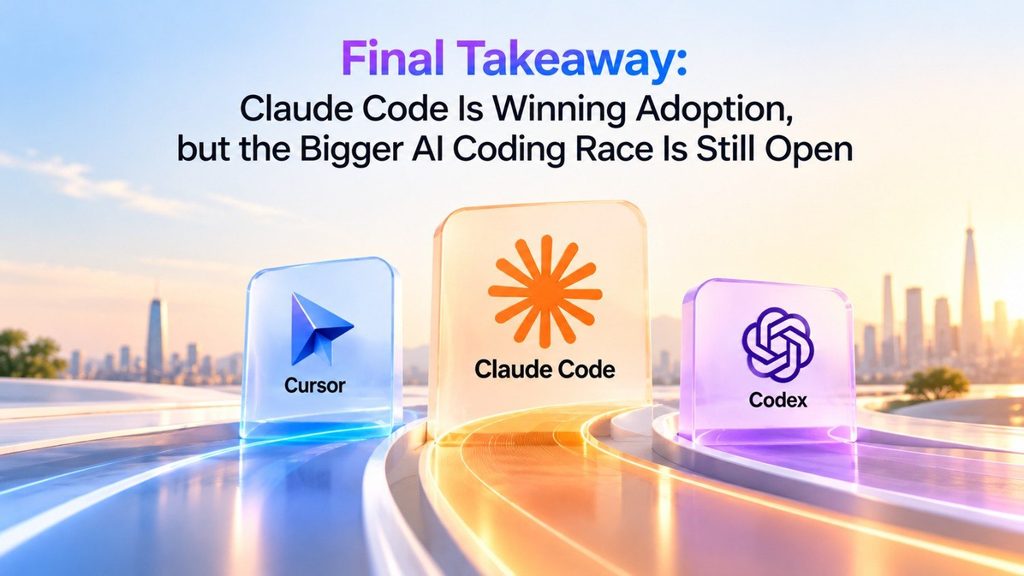
Claude Code currently leads on the surveyed adoption measure. Cursor and Codex remain serious competitors with different workflow strengths. The winner for any individual company will be determined by measured results, not popularity alone.
Research Sources and Methodology Notes
This article uses publicly available information reviewed in October 2026. SFTechScene’s original contributions are the adoption ratios, mention-share calculations, cross-question comparisons, hypothetical engineering-cost model, and proposed evaluation framework.
The research does not include private vendor usage records, a new survey of San Francisco developers, or a hands-on controlled benchmark of the three tools. Accordingly, global survey results are not presented as San Francisco-specific adoption figures.
The primary sources are:
- Stack Overflow Developer Survey 2026 — AI Coding Agents — reported usage counts and percentages.
- Stack Overflow Developer Survey 2026 — Development Technologies — editor adoption data.
- Stack Overflow Developer Survey 2026 — AI Workflow — current adoption across engineering activities.
- Stack Overflow Developer Survey 2026 — AI Trust — developer confidence and verification requirements.
- Stack Overflow Developer Survey 2026 — Methodology — survey collection, validation, and limitations.
- Official pricing and product information from Cursor, Anthropic, and OpenAI Codex.
All calculations can be reproduced from the published counts and formulas shown above. The Stack Overflow survey data is attributed to Stack Exchange Inc. under the Open Database License (ODbL) 1.0.
Because the survey recruited respondents through Stack Overflow channels, it should not be treated as a random sample of all software developers. Its findings are useful evidence of reported behavior among respondents, but they cannot establish precise worldwide market share or causal differences in product performance.