


San Francisco has always been a city where a small group of people can build something that changes an entire industry. But in 2026, the idea of a small startup team is taking on a different meaning.
A few years ago, building a serious software company often meant hiring a growing team of engineers, designers, product managers, and technical leaders. Today, some founders are launching products with two or three developers, using artificial intelligence to handle work that once required several more people.
The change is about much more than writing code faster. AI coding assistants, automated testing tools, cloud services, and ready-made software components are changing how startups plan, build, launch, and maintain products.
For San Francisco founders, this creates an important opportunity. Engineering talent remains expensive, investors want to see better use of capital, and new software tools make it possible to test business ideas without building a large organization first.
But there is a problem that often gets lost in the excitement. A smaller engineering team is only an advantage when it can deliver reliable products, serve customers, and keep improving the software without creating a growing pile of technical problems.
The latest research shows why that distinction matters. Startup teams really are getting smaller, but studies of AI coding productivity have produced very different results depending on the work being measured.
This SFTechScene analysis examines the numbers behind the shift, including startup headcount trends, San Francisco engineering costs, published productivity experiments, and original financial models that show when smaller teams can actually save money.
It also offers a practical guide for founders who want to build more with fewer people without sacrificing software quality, customer trust, or long-term growth.
The Short Version: San Francisco Startups Are Learning to Build More Without Hiring More
The traditional startup playbook was fairly straightforward. Raise money, hire engineers, build the product, acquire customers, and expand the team as the business grows.
That approach is changing because the cost of creating software is becoming less closely tied to the number of people writing it.
Median seed-stage team
4
Employees, Carta H2 2025 report
Series B average headcount
−15.1%
2023–2025, calculated from Carta
SF engineering median pay
$288.8K
Annual total compensation, Levels.fyi
AI adoption or planned use
84%
2025 Stack Overflow survey respondents
Sources: Carta, Levels.fyi, and Stack Overflow. These figures describe different populations and should not be treated as one combined sample. Carta+2
These numbers help explain why founders are reconsidering traditional engineering budgets.
According to Carta’s May 2026 startup compensation report, the median seed-stage company on its platform had just four employees. Average Series B headcount fell from 53 in 2023 to 45 in 2025, while average Series D headcount was 29% below its 2023 peak. Carta
The latest evidence does not show that startups have stopped hiring altogether. Carta’s October 28, 2026 report found that new hires continued to outnumber departures, although workforce growth remained much slower than in the years before 2023. Carta
That difference matters. San Francisco startups are not necessarily trying to eliminate engineering teams. Many are trying to delay hiring until customer demand, product complexity, and business revenue make additional employees necessary.
The most promising model is not a company without engineers. It is a company where a small group of capable engineers can focus on the difficult work while software tools handle more routine tasks.
Why the Traditional Engineering Team Is Changing
Software Development Used to Require More Separate Roles
Think about what building a software product involved ten years ago.
A startup might have needed one developer to create the website, another to build the server, a designer to create the interface, and someone to manage hosting and deployment. Testing, documentation, and maintenance created even more work.
Small teams could combine some of these responsibilities, but the workload still increased quickly as the product became more complex.
Today, many of those activities are easier to manage.
A founder can use a ready-made login service instead of building account security from scratch. A developer can use a managed database rather than maintaining database servers. An AI coding assistant can prepare a first version of a feature, generate tests, or explain unfamiliar code.
These tools do not remove the need for technical knowledge. They reduce the amount of basic setup and repeated work required before a product becomes useful.
AI Coding Tools Are Reducing the Cost of Getting Started
Tools such as Cursor, Claude Code, OpenAI Codex, and GitHub Copilot allow developers to work with code using natural language.
Instead of manually preparing every file, an engineer can describe what needs to change and ask an assistant to suggest or implement a solution.
This is especially useful when creating routine interfaces, writing basic tests, connecting familiar services, and understanding existing software.
The bigger change comes when engineers combine these tools with good product knowledge. They can spend less time on standard implementation work and more time deciding what customers actually need.
Investors Are Paying Attention to Output, Not Just Headcount
For years, employee growth was often treated as a sign that a startup was becoming more important.
A company with 50 employees could appear more established than a company with 10. Large engineering teams also signaled that a startup had raised enough capital to attract expensive talent.
But headcount does not tell investors how much value a business creates.
A startup with eight employees, strong recurring revenue, and low operating costs may be financially healthier than a startup with 40 employees serving the same number of customers.
This is changing how founders think about growth. Hiring more people is still useful when it removes a real business problem, but it is no longer the only obvious way to increase output.
Original SFTechScene Research #1: How Much Have Startup Teams Actually Shrunk?
Research Question and Methodology
To understand whether smaller teams are a real business trend, SFTechScene examined publicly reported headcount benchmarks from Carta’s State of Startup Compensation: H2 2025, published May 4, 2026.
We used the disclosed figures for Series B and Series D companies, calculated the changes in employee counts, and compared the results across funding stages.
This is an original SFTechScene calculation using published aggregate data, not an independent analysis of Carta’s underlying company records.
The sample covers companies on Carta’s platform, not all startups in San Francisco. It also measures total company employees rather than engineers alone, so the results should not be presented as a direct count of shrinking engineering departments.
What the Data Shows
| Funding stage | Earlier benchmark | 2025 benchmark | Change |
|---|---|---|---|
| Seed | Not comparable in published figures | 4 employees, median | Not calculated |
| Series B | 53 employees, 2023 average | 45 employees, average | −15.1% |
| Series D | About 184.5 employees, implied 2023 average | 131 employees, average | −29.0% |
Source: Carta H2 2025 compensation report. The Series D earlier figure is reconstructed from the reported 29% decrease and is approximate because the published percentage is rounded. Carta
Change in average startup headcount, 2023–2025
Published Carta benchmarks, with the Series D 2023 value reconstructed from a rounded percentage.
■ 2023
■ 2025
The clearest finding is that smaller teams are not limited to brand-new companies.
Series B startups in Carta’s data employed about eight fewer people on average in 2025 than in 2023. Series D companies showed an even larger proportional decline.
That does not prove that AI caused the decrease. Lower venture funding, cautious hiring, different company mixes, outsourcing, and changes in business models could also contribute.
However, the results are consistent with a broader move toward more careful hiring and a greater focus on work completed per employee.
Original Finding: The Team-Size Change Is Large Enough to Affect How Startups Are Managed
The Series B change represents an average workforce reduction of about 15 people for every 100 employees at the earlier benchmark.
That is more than a minor adjustment to recruiting plans. At this scale, companies may need fewer management layers, broader technical roles, and more shared responsibility between product and engineering.
It also means startups cannot assume their competitors will have large teams.
A company planning to compete with a newly funded rival may find that the rival has fewer employees, lower ongoing staffing commitments, and more money available for product experiments.
The important question becomes whether the smaller organization can keep shipping dependable software as customer needs grow.
Why These Findings Matter Specifically for San Francisco
San Francisco has a high concentration of venture-backed software companies, experienced engineers, and businesses adopting new AI tools.
At the same time, technical talent is costly. When companies can postpone even one or two engineering hires, the financial effect can be substantial.
A founder who preserves several hundred thousand dollars in annual spending may be able to extend the time available to find customers, improve a product, or reach profitability.
For early-stage companies, that flexibility can be more valuable than expanding the team quickly.
San Francisco’s Engineering Costs Make Smaller Teams Financially Attractive
Why Hiring One More Developer Is a Major Decision
Engineering compensation is one reason the shift toward smaller teams matters so much in the Bay Area.
Levels.fyi reported median annual total compensation of $288,800 for software engineers in San Francisco as of October 31, 2026. Its figure includes base pay, yearly stock value, and bonuses, based on 4,702 reported salaries. Levels.fyi
That is not the same as saying every startup pays $288,800 in cash for each engineer. Early-stage companies may offer lower salaries and more equity, while the Levels.fyi sample includes employers and roles that are not representative of small startups.
Even so, the figure shows why experienced engineering talent represents a major economic commitment.
A founder who hires too quickly may lock the business into costs that are difficult to reduce if revenue develops more slowly than expected.
The Hidden Cost of Engineering Teams
Salary is only one part of the financial picture.
A startup may also pay for payroll taxes, employee benefits, recruiting, equipment, software subscriptions, office space, and the time existing employees spend training new hires.
Some of these costs are direct cash expenses. Others appear as lost engineering time when senior developers spend weeks helping new employees understand the product.
The total impact can be significant, especially for startups with a short financial runway.
That is why a smaller team can create savings even before accounting for the productivity improvements from AI.
Why Fewer Engineers Can Also Reduce Coordination Costs
A larger engineering team does not automatically produce proportionally more work.
As headcount increases, engineers must spend more time reviewing one another’s changes, coordinating projects, documenting decisions, and resolving conflicts between different parts of the product.
These activities are necessary. Without them, large teams can create unreliable software.
But a startup with three experienced developers may be able to make simple decisions faster than a startup with ten engineers divided into specialized groups.
The advantage comes from having fewer handoffs between people, not from removing important checks.
As software becomes more complex, some specialization will still be necessary. The goal is to avoid adding organizational layers before the company truly needs them.
Original SFTechScene Research #2: How Much Can a San Francisco Startup Save With a Smaller Engineering Team?
The Research Question
Suppose a San Francisco startup originally expected to employ five engineers. Could it operate successfully with four or three engineers using modern development tools?
The financial savings are easy to estimate. The difficult part is determining whether the smaller team can produce the same amount of useful, reliable software.
SFTechScene created a scenario model to separate these two questions.
Research Methodology and Assumptions
We modeled a fictional San Francisco software startup with a five-engineer baseline team. We then compared it with smaller teams of four and three engineers.
The assumptions were selected for illustration, not presented as measured startup averages.
| Model input | Assumption | Explanation |
|---|---|---|
| Baseline engineering team | 5 engineers | Comparison starting point |
| Annual employment cost per engineer | $225,000 | Assumed fully loaded cash cost |
| Smaller team options | 4 or 3 engineers | Two hiring strategies |
| Additional AI and automation spending | $24,000/year | Assumed $2,000 monthly team budget |
| Annual comparison period | 12 months | Excludes future hiring |
| Base software delivery requirement | Unchanged | Same target output in each scenario |
The $225,000 employment cost is a planning assumption, not a reported salary benchmark. It includes an estimated mix of cash salary, benefits, and employer costs, but excludes the cost of equity dilution.
For comparison, the observed San Francisco median total compensation figure from Levels.fyi is higher, although it includes stock and bonuses and covers a different employer population.
We assumed the baseline team had no additional AI spending in this comparison. This makes the calculation a simple incremental-budget model; a real startup should replace these inputs with its own existing software costs.
Finding #1: A Three-Engineer Team Could Reduce Modeled Annual Spending by $426,000
Five engineers
$1.125M
Annual model cost
Four engineers + tools
$924K
$201K less
Three engineers + tools
$699K
$426K less
Modeled annual engineering budget by team size
SFTechScene scenario, USD. Values are hypothetical, not observed company spending.
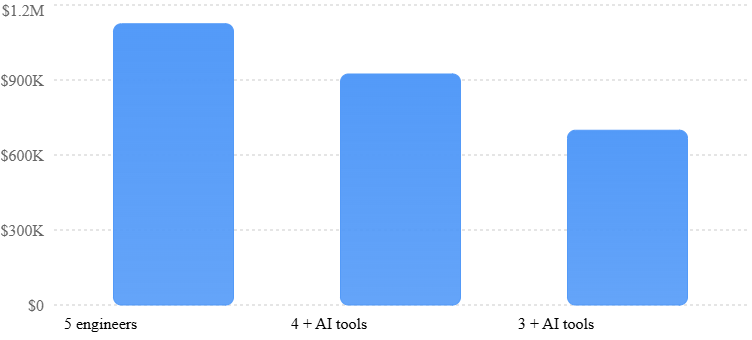
The modeled five-engineer organization costs $1.125 million annually.
A four-engineer company would spend $900,000 on employment and $24,000 on additional development tools, producing $201,000 in annual savings.
A three-engineer company would spend $675,000 on employment and $24,000 on tools, producing $426,000 in annual savings before any extra costs caused by slower delivery or mistakes.
Over two years, that $426,000 annual difference would total $852,000 if costs remained unchanged.
For a young startup, this could represent a meaningful part of its available capital. But the savings only become a genuine advantage if the smaller team can still meet the company’s business needs.
Finding #2: Employment Cost Has a Bigger Effect Than the Price of Coding Tools
To test how sensitive the results are to compensation assumptions, we repeated the calculation at three annual employment-cost levels.
| Employment cost per engineer | Five-engineer baseline | Three engineers + $24K tools | Annual difference |
|---|---|---|---|
| $180,000 | $900,000 | $564,000 | $336,000 |
| $225,000 | $1,125,000 | $699,000 | $426,000 |
| $270,000 | $1,350,000 | $834,000 | $516,000 |
Original SFTechScene sensitivity analysis. All amounts are modeled annual costs in US dollars, not actual company observations.
The financial benefit grows as engineering costs increase.
At $180,000 per engineer, reducing the team from five to three creates $336,000 in annual budget savings after tool spending. At $270,000, the difference reaches $516,000.
This explains why the same engineering strategy may have different financial value depending on where a startup operates and how it compensates employees.
It also highlights a mistake founders should avoid. The main business case for a smaller team is not saving money on AI subscriptions. It is avoiding hiring commitments that the company does not yet need.
Finding #3: Rework Can Quickly Reduce the Savings
The most important weakness in a simple headcount model is that it assumes smaller teams can deliver the same results.
In practice, fewer engineers may mean slower launches, more difficult maintenance, missed sales opportunities, or additional outside contractors.
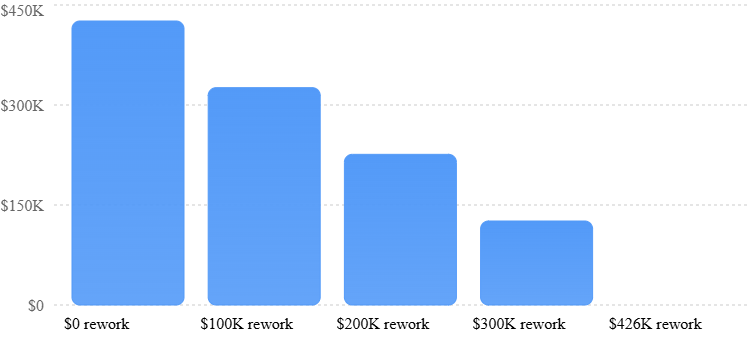
We therefore added an annual cost for extra rework, outside help, and operational problems in the three-engineer scenario.
How extra rework changes the three-engineer cost advantage
Five-engineer baseline: $1.125M. Three-engineer base: $699K.
The formula is:
\[ \text{Net savings}=2C-T-R \]
Here, \(C\) is the annual employment cost per engineer, \(T\) is the extra annual tool budget, and \(R\) is the added cost of rework and other problems.
Under our base assumptions, the smaller team has $426,000 available to absorb additional costs before its direct financial advantage disappears.
But there is an important limitation. A startup could lose a major customer, miss its launch window, or create a security problem without recording an immediate $426,000 accounting expense.
The model measures financial capacity. It does not measure customer satisfaction, product quality, or business success.
What Founders Should Learn From This Model
A smaller team can create a large financial advantage even without extraordinary AI productivity gains.
However, the decision should never be based on payroll alone.
Before removing an engineering position from a hiring plan, founders should estimate the additional work the remaining team must handle, the likely delays, and the cost of mistakes.
That leads to a more important research question: how much more productive must each engineer become to replace the output of a larger team?
Original SFTechScene Research #3: How Much More Productive Must Engineers Become for Smaller Teams to Work?
Measuring Output Instead of Counting Employees
Many discussions about AI productivity focus on how much faster an individual engineer can write code.
That is useful, but founders need a different measure.
They need to know whether the entire engineering team can produce the same amount of valuable work with fewer people.
Suppose five engineers currently deliver a defined amount of completed, tested product work each month. What productivity improvement would allow four engineers to deliver the same amount?
The calculation is straightforward:
\[ \text{Required output increase}=\frac{N_{\text{old}}}{N_{\text{new}}}-1 \]
This formula assumes all engineers provide equal output and work on tasks that can be redistributed without added coordination costs. Those assumptions are simplified, but they allow us to calculate the minimum average improvement required.
The Results
| Original team | Smaller team | Reduction in engineers | Required output increase per remaining engineer |
|---|---|---|---|
| 5 | 4 | 20% | 25.0% |
| 5 | 3 | 40% | 66.7% |
| 8 | 6 | 25% | 33.3% |
| 10 | 8 | 20% | 25.0% |
| 10 | 5 | 50% | 100.0% |
Productivity gain needed to maintain output with fewer engineers
SFTechScene arithmetic model, not measured AI productivity.
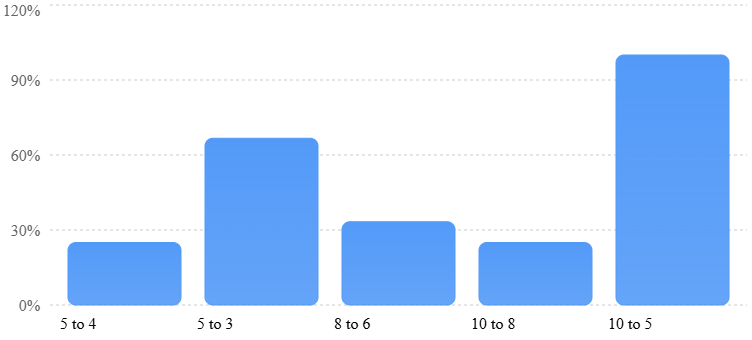
The results expose an important weakness in some of the biggest claims about AI-powered startups.
Reducing a team from five engineers to four requires each remaining engineer to deliver 25% more output, assuming all other conditions stay the same.
Reducing that same team to three engineers requires a much larger improvement of approximately 66.7%.
Cutting a ten-person team in half requires doubling average output per remaining engineer.
Those gains are not impossible in every setting. But they should never be assumed simply because a company has adopted an AI coding assistant.
Comparing the Model With Published Productivity Research
Research published in Management Science in February 2026 analyzed randomized field experiments involving 4,867 developers at Microsoft, Accenture, and another large company.
The researchers found that developers with access to an AI coding assistant completed 26.08% more tasks on average than developers without access. Results varied across the experiments, and less experienced developers generally showed greater gains. Microsoft Research+1
That is an encouraging result for companies considering AI development tools.
However, it is not proof that every startup can eliminate one-quarter of its engineers. The study measured completed tasks in particular work settings, not the long-term ability of smaller startups to operate without additional employees.
SFTechScene applied the reported productivity improvement to its simplified team-size model.
For a five-engineer team, a uniform 26.08% increase in output would produce approximately the same output as 6.30 engineers working at the original rate.
Alternatively, four engineers working at 126.08% of their previous output would produce approximately the same output as 5.04 baseline engineers.
That means the study’s average measured improvement is mathematically large enough to support a five-to-four reduction in a simplified model.
It is not large enough on its own to support a five-to-three reduction, which requires a 66.7% increase.
This comparison is illustrative. The study’s task count is not identical to tested product output, and the gain should not be assumed to transfer to startup engineering work.
The Important Counterexample: AI Can Also Slow Experienced Developers Down
A separate randomized experiment by METR studied 16 experienced open-source developers completing 246 tasks in software projects they already knew.
In its July 2025 report, METR found that allowing developers to use AI tools increased completion time by 19%, rather than reducing it.
The researchers later published an update in February 2026 suggesting that newer tools might improve performance. However, they warned that their newer results were affected by participant-selection problems and were not strong enough to establish a reliable speedup estimate. METR+1
Different research settings produced different outcomes
Selected experimental findings on AI coding productivity
These studies use different productivity measures and populations; compare direction, not magnitude.
The negative METR bar is drawn as a productivity disadvantage for comparison, but the original measured outcome was a 19% increase in completion time. These effect sizes cannot be pooled or interpreted as one common measurement.
The apparent contradiction is easier to understand when the work is considered.
AI can be very useful when the task is well defined, uses familiar patterns, and has an easy way to check whether the answer is correct.
It may be less useful when experienced engineers are changing complicated software, working through difficult bugs, or dealing with systems that require detailed knowledge.
This distinction is central to smaller-team planning.
Original Finding: A 20% Headcount Reduction Is Easier to Model Than a 40% Reduction
The five-to-four scenario needs a 25% average output improvement. That is close to the 26.08% task-completion improvement observed in the large enterprise study.
The five-to-three scenario needs a 66.7% improvement, far above that particular study result.
Neither finding establishes a safe staffing level. But they do show why a gradual approach is more defensible than cutting engineering plans in half.
For founders, the sensible strategy is to measure productivity on their own product before permanently reducing the number of engineers they expect to need.
AI Is Not the Only Reason Startups Can Operate With Smaller Teams
Managed Cloud Services Have Removed Large Amounts of Infrastructure Work
Before modern cloud platforms became common, companies spent considerable time managing physical servers, databases, backups, and network systems.
Today, many startups use managed services from providers such as Amazon Web Services, Google Cloud, and Cloudflare.
These services help founders avoid hiring specialists for every part of their technical setup.
For example, a startup can use a managed database with automatic backups instead of hiring someone to maintain database hardware.
The company still needs engineers who understand security, performance, and reliability. But it may not need a full infrastructure team during its earliest stages.
Ready-Made Software Components Reduce Development Work
Modern startups rarely need to build every feature from scratch.
Payment services, account systems, email delivery, file storage, analytics, and customer messaging can often be added through established software products.
This allows small engineering teams to focus on the features that make their product different.
A founder building a scheduling application, for example, should spend most of the team’s time improving scheduling rather than creating a new payment processor.
The same principle applies to internal operations.
Using reliable external services for common needs can free engineering time for product development.
Better Development Tools Reduce Repeated Work
Modern code hosting, automated testing, and deployment tools make it easier to maintain software without a large operations department.
An engineer can set up automated checks that run whenever code changes.
If a proposed change breaks an existing feature, the system can flag the problem before it reaches customers.
This does not eliminate manual testing or engineering judgment. But it allows a small group of developers to handle more work without relying on memory and repeated manual checks.
Remote Specialists Can Help Without Becoming Permanent Employees
Some startups need deep expertise only occasionally.
A company might require a security review before a major launch, help with a difficult database problem, or specialized support for a payment integration.
Hiring a permanent specialist may not make sense if the work only requires a few weeks each year.
A better option can be to use an experienced contractor for a clearly defined assignment.
This approach works best when someone inside the startup remains responsible for understanding the work, reviewing the results, and maintaining the software afterward.
How AI Coding Agents Are Changing the Work of Small Engineering Teams
From Writing Every Line to Managing Development Tasks
Traditional programming requires engineers to write, change, and test code directly.
AI coding agents can now handle parts of that process after receiving instructions and access to the relevant project files.
An engineer might ask an agent to create a new reporting page, update an existing feature, or prepare tests for a particular function.
The agent can inspect code, propose changes, and sometimes run tools before returning the results.
This changes how engineering time is used.
Instead of manually completing every step, developers can spend more time explaining requirements, evaluating solutions, and checking results.
Why Good Instructions Matter More With Small Teams
A small team has less room for repeated misunderstandings.
If an AI agent builds the wrong feature, someone must review it, explain the problem, and spend additional time correcting the result.
The best instructions therefore explain the business goal, the expected behavior, and how success will be checked.
Consider a founder who needs a new customer dashboard.
A weak instruction might simply ask the AI to build a dashboard.
A stronger instruction would describe which customer information should appear, which users can see it, what happens when no data is available, and which automated tests must pass.
That extra planning can reduce expensive corrections later.
AI Makes Product Knowledge More Valuable
The ability to generate code quickly becomes less useful when a startup does not understand what customers want.
An engineer who understands the customer problem can identify unnecessary features, choose simpler solutions, and avoid building complicated systems before they are needed.
This is especially valuable in small teams because each person has a larger effect on the product.
A strong engineer who understands both software and business needs may create more value than several developers working on poorly defined tasks.
The result is a change in hiring priorities.
Founders increasingly need engineers who can make good decisions, not simply produce large amounts of code.
Original SFTechScene Research #4: The Real Limit on Smaller Teams Is Reliable Product Delivery
The Research Question
What happens when AI makes an engineer faster at producing code but also increases the amount of work that needs to be corrected?
To study this, SFTechScene built a second analytical model focused on verified output rather than code volume.
We define verified output as work that has been completed, reviewed, tested, and accepted for release.
This definition matters because customers do not pay for how much code a company generates. They pay for software that solves their problems.
A Model of Useful Engineering Output
Assume an engineer traditionally completes 100 units of product work in a fixed period, with 90% passing the team’s required checks without further correction.
Now assume AI increases the amount of work initially produced by 30%.
The engineer can produce 130 units, but that does not tell us how much useful output actually increases.
To examine the effect, we applied different first-pass acceptance rates.
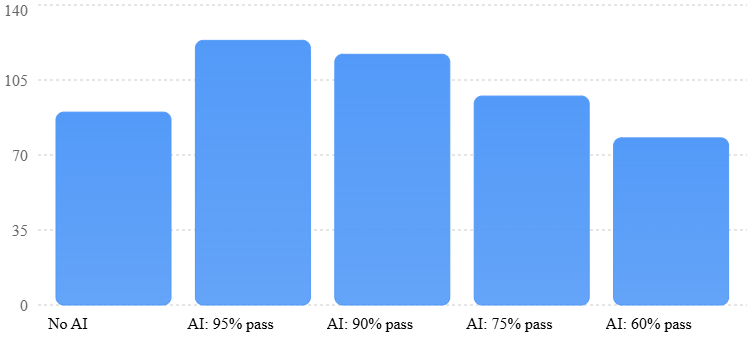
| Scenario | Work produced | First-pass acceptance rate | Work accepted without rework | Change from baseline |
|---|---|---|---|---|
| Without AI | 100 | 90% | 90 | Baseline |
| AI, strong verification | 130 | 95% | 123.5 | +37.2% |
| AI, unchanged quality | 130 | 90% | 117 | +30.0% |
| AI, more corrections | 130 | 75% | 97.5 | +8.3% |
| AI, serious quality problems | 130 | 60% | 78 | −13.3% |
Original SFTechScene scenario model. The 30% output increase and acceptance rates are hypothetical. They are not measured results from an AI development study. Figures exclude time spent correcting rejected work.
More code does not always mean more accepted work
Hypothetical verified-output model using 100 units of starting production.
Finding #1: Quality Can Erase Most of the Apparent Productivity Gain
In the model, AI increases initial production by 30%.
But if the acceptance rate falls from 90% to 75%, accepted work increases by only 8.3%.
At a 60% acceptance rate, accepted work actually falls below the original baseline.
This illustrates why counting lines of code or completed AI requests can mislead founders.
An engineer might finish more coding tasks while spending additional time dealing with bugs, confusing behavior, and customer complaints.
A small startup has fewer people available to fix those problems. That makes verification especially important.
Finding #2: An AI Workflow Needs a Minimum Quality Level to Preserve Its Advantage
The model also allows us to calculate the acceptance rate at which the faster AI workflow stops providing an advantage.
The original engineer delivers 90 accepted units.
The AI-assisted engineer produces 130 units. To match the original result, at least 90 of those units must pass the first review.
That produces a break-even acceptance rate of:
\[ \frac{90}{130}\times100=69.23\% \]
In this simplified model, a first-pass acceptance rate below 69.23% eliminates the measured output advantage.
The real threshold could be higher because rejected work consumes additional review and correction time. It could also be lower if rejected work is cheap to fix and AI helps with those corrections.
The purpose of the calculation is not to establish a universal benchmark. It is to show why useful output must be measured alongside production speed.
The Findings Agree With Broader Developer Research
Stack Overflow’s 2025 Developer Survey found that 46% of respondents distrusted the accuracy of AI tool output, compared with 33% who trusted it.
The same survey found that 66% of developers reported frustration with AI answers that were close to correct but still required changes. Another 45% reported that debugging AI-generated code could take more time than expected. 2025 Stack Overflow Developer Survey+1
Google’s DORA research also found that the value of AI depends heavily on an organization’s existing working methods.
Its 2025 report described AI as a tool that can strengthen good development practices but also amplify existing weaknesses. A March 2026 follow-up emphasized that time saved creating code is often shifted into checking and verifying it. State of AI-assisted Software Development 2025+1
These findings help explain why the fastest-growing AI coding workflows are not automatically the most reliable.
For a San Francisco startup, the advantage comes from increasing the amount of finished, dependable work delivered per dollar.
Which San Francisco Startups Can Benefit Most From Smaller Engineering Teams?
Not every startup has the same technical needs.
A company building a simple business application operates under very different conditions from a company developing medical equipment, advanced robotics, or financial infrastructure.
Founders should assess their product’s complexity before assuming that a three-person engineering team is enough.
Business Software and Workflow Automation
Business software is often well suited to smaller engineering teams.
Many products in this category use familiar components such as user accounts, dashboards, databases, notifications, and integrations with other services.
AI tools can help engineers build these common features more quickly.
The team can then focus on the customer workflow that makes the product useful.
For example, a startup building software for property managers may rely on existing services for account security, payments, and messaging.
Its engineers can spend more time improving maintenance requests, tenant communication, and reporting.
The key risk is that different customers may need different workflows. If the team starts building custom features for every customer, even a simple product can become difficult to maintain.
AI-Powered Customer Service Products
Startups building AI customer support tools can also benefit from shared infrastructure and existing language models.
A small team may be able to create a useful product without training its own foundation model.
However, production customer support involves more than creating a working demonstration.
The company must handle incorrect answers, customer data, service outages, outside software connections, and cases where a human needs to take over.
These responsibilities can become demanding as customer volume grows.
A startup in this market should measure not only how quickly it builds new features but also how much human support is needed to keep the system dependable.
Developer Tools and Coding Products
Developer tools are another category where small, experienced teams can create valuable products.
Technical founders often understand their own customer problems because they face those problems while writing software.
That makes it easier to identify an early use case and build a narrow solution.
The challenge is that developer customers expect reliability, clear documentation, and compatibility with their existing tools.
A product that saves time but frequently breaks other software may struggle to keep paying customers.
The engineering team must therefore invest in testing and maintaining integrations even if the original product was quick to build.
Products That May Need Larger or More Specialized Teams
Some companies cannot reduce engineering headcount as aggressively.
A robotics startup may need mechanical engineers, electrical engineers, and software specialists working together. A medical technology company may face extensive validation and regulatory requirements.
Financial systems can also require specialized knowledge of security, accounting, payments, and legal obligations.
These products may still benefit from AI coding tools, but the software development process is only one part of their total workload.
| Startup category | Potential for a small initial team | Main constraint |
|---|---|---|
| Simple business software | High | Customer-specific requests |
| Workflow automation | High | Reliable integrations |
| Internal productivity tools | High | Security and permissions |
| AI customer support | Moderate to high | Accuracy and customer trust |
| Developer tools | Moderate to high | Compatibility and reliability |
| Fintech infrastructure | Moderate | Security, compliance, and uptime |
| Healthcare software | Varies | Patient data and regulatory needs |
| Robotics and hardware | More limited | Physical testing and specialist work |
SFTechScene qualitative assessment based on typical product requirements. These are planning judgments, not measured industry productivity rankings.
What the Smaller Engineering Team Actually Looks Like in 2026
The Three-Engineer Product Team
A three-engineer team can work well when a startup has a narrow product and experienced technical leadership.
The first engineer may focus on the core product and major technical decisions. The second may concentrate on the customer-facing experience, while the third takes responsibility for integrations, testing, and operational reliability.
In practice, these roles will overlap.
That is one of the strengths of a small team, provided everyone understands their responsibilities.
An illustrative three-engineer operating model
Engineer 1Core systems and technical leadership
Engineer 2User experience and product features
Engineer 3Integrations, testing and reliability
Shared AI and automation tools
Help with routine code, documentation, tests, and development tasks. All engineers remain responsible for reviewing changes.
The team should not treat these assignments as rigid departments.
If the customer-facing engineer identifies a database problem, the others should help resolve it. If the person responsible for testing is unavailable, another engineer must still be capable of checking a release.
This requires deliberate knowledge sharing.
A company where only one person understands critical software can become fragile, even when it has excellent AI tools.
Why Experienced Engineers Become More Important
A small team benefits from engineers who can work independently, understand different systems, and make sound decisions without constant direction.
Experience becomes valuable when AI-generated code looks correct but contains a hidden problem.
A senior engineer may identify a design mistake before it affects customers.
They may also know when an existing tool is sufficient, avoiding weeks of unnecessary development.
This does not mean startups should never hire junior engineers.
It means a company relying on a very small technical team needs enough experienced oversight to make sure the software remains maintainable.
The Founder Still Needs to Own Product Decisions
Small engineering teams often struggle when founders expect developers to decide what the business should build.
An AI assistant cannot solve that management problem.
If requirements change every few days, engineers will spend time rebuilding features regardless of how quickly they can write code.
Founders should define which customer problem matters most, what successful results look like, and which work can wait.
This helps the team focus on improvements that produce actual business value.
The Biggest Risks of Building With Smaller Engineering Teams
Too Much Knowledge Concentrated in One Person
When a company has only two or three engineers, one departure can create a serious problem.
An engineer may be the only person who understands the database, the payment system, or the deployment process.
If that person leaves, the remaining team may struggle to make changes safely.
Founders should reduce this risk through clear documentation, shared code reviews, and regular discussions about important technical decisions.
Every critical part of the product should have at least two people who understand how it works.
AI-Generated Code That Nobody Fully Understands
AI can produce code that appears correct but contains mistakes.
If developers accept changes without understanding them, the product can accumulate problems that become expensive to resolve.
This is particularly dangerous in security-sensitive systems.
The US National Institute of Standards and Technology’s Secure Software Development Framework provides practices for reducing software vulnerabilities throughout development. Its guidance supports a disciplined approach to building, checking, and maintaining secure software. CSRC+1
A small startup should not abandon these practices because its code was created with AI.
AI-generated changes should receive the same security checks, automated tests, and human review as other code.
Customer Support Can Overwhelm the Team
A product may be easy to build but difficult to operate.
As customers arrive, they report bugs, request changes, need help with setup, and expect prompt responses.
If every support request reaches the engineering team, new development can slow down.
Founders should create clear support processes early.
Common questions can be handled through documentation and appropriate automated assistance, while technical problems should be tracked and prioritized.
Rapid Feature Development Can Create Long-Term Maintenance Costs
AI tools make it easier to add features quickly.
That can encourage founders to build more than customers actually need.
Over time, a product with too many features becomes harder to test, explain, and maintain.
This problem can be especially severe for small teams.
A useful rule is to remove unnecessary complexity before asking AI to generate more code.
The easiest feature to maintain is often the one the startup never needed to build.
Security and Privacy Responsibilities Do Not Shrink With Headcount
A company with three engineers must still protect customer information.
It must manage access permissions, respond to security incidents, maintain backups, and keep software dependencies updated.
These obligations do not become less important because the team is small.
Founders should automate security checks where possible, but they should also assign clear human responsibility.
A startup that cannot explain who is responsible for customer data security is not ready to rely on highly autonomous development workflows.
A Practical 90-Day Plan for Building a Startup With a Smaller Engineering Team
The best way to build a lean engineering organization is not to reduce headcount immediately.
It is to understand which tasks create customer value, remove unnecessary work, and measure whether automation actually improves results.
A 90-day experiment can help founders make that decision using evidence from their own business.
Days 1–15: Measure the Team’s Current Performance
Start by establishing a clear baseline.
Choose a recent period and record how much product work the engineering team completed, how long changes took to reach customers, and how many problems appeared after release.
Do not use lines of code as the main measure.
A developer who writes 500 lines of unnecessary code has not necessarily created more value than a developer who solves the same problem in 20 lines.
The most useful measures focus on finished work and its impact on customers.
| Metric | What it measures | Why it matters |
|---|---|---|
| Time from approved task to release | How quickly work reaches users | Shows delivery speed |
| First-pass acceptance rate | Share of work passing required checks | Shows quality |
| Production defects | Problems found after release | Tracks reliability |
| Rework time | Hours spent correcting changes | Reveals hidden costs |
| Engineering cost per accepted feature | Spending relative to finished work | Tracks efficiency |
| Customer-reported problems | Issues affecting real users | Measures product impact |
| Time spent on maintenance | Effort needed to keep the product working | Shows future workload |
Collect this information before making major changes to the development process.
Without a baseline, founders cannot tell whether their tools are helping or whether the team simply feels faster.
Days 16–30: Introduce AI Into Low-Risk Work
Start with tasks where errors are easy to identify and correct.
Documentation, routine tests, internal tools, and simple user interface changes are often reasonable starting points.
Avoid giving AI agents broad control over customer data, security settings, payment systems, or production infrastructure during the first experiment.
Each AI-generated change should still be reviewed by a capable engineer.
Measure the time spent generating, reviewing, correcting, and testing the work. This gives a more accurate picture of productivity than measuring generation time alone.
Days 31–45: Run a Controlled Productivity Experiment
Choose a set of similar engineering tasks and divide them into two groups.
One group follows the normal development process. The other uses the new AI-assisted process.
Where practical, randomly assign comparable tasks to the two groups. Make sure both groups have similar task difficulty and access to appropriate technical expertise.
Record total active engineering time, accepted output, defects, and rework.
The comparison should focus on work that reaches the same quality standard.
If the AI group completes more tasks but produces significantly more serious problems, the improvement may not justify expanding the approach.
For a small team, the sample may be too limited to establish a reliable average productivity effect. In that case, treat the results as useful operational evidence rather than statistical proof.
Days 46–60: Improve the Development Process
Once the team identifies useful AI workflows, focus on making them repeatable.
Create clear instructions for common tasks, establish coding standards, and improve automated testing.
Reduce unnecessary meetings and clarify how product decisions are made.
The goal is to improve the whole development system rather than simply encouraging people to use AI more often.
A team that spends less time discussing unclear requirements may gain more than one that generates code faster but regularly builds the wrong features.
Days 61–75: Identify the Real Hiring Bottlenecks
Review the work that engineers still struggle to complete.
Perhaps the product team needs someone who understands a difficult technical system. Perhaps customer requests are growing faster than the team can respond.
The problem might also be that engineers spend too much time correcting bugs, handling support, or responding to poorly planned requests.
These situations require different solutions.
A specialized engineer may be necessary in the first case. Better support processes or project planning may solve the others.
Founders should avoid hiring until they understand which problem the hire is supposed to fix.
Days 76–90: Make a Hiring Decision Based on Evidence
At the end of the experiment, compare results with the original baseline.
Has the team increased the amount of accepted work delivered each month? Have defects remained stable or improved? Are customers receiving features faster?
Then examine the financial results.
Calculate the additional software spending, review time, outside support costs, and any measurable delays.
If productivity has improved while quality remains strong, the startup may be able to postpone a planned hire.
If engineers are overwhelmed or important work is being delayed, it may be time to expand the team.
The correct result is not always fewer employees. It is a hiring plan that matches the real workload.
Original SFTechScene Research #5: When Should a Small Startup Hire Its Next Engineer?
Building a Hiring Decision Model
A founder needs to know when the cost of remaining small becomes greater than the cost of adding another engineer.
SFTechScene developed a simple decision framework based on the financial model introduced earlier.
Suppose a startup is considering an additional engineer with an annual employment cost of $225,000.
The company should compare that cost against the measurable business value the additional person could create or protect.
This value may come from faster product delivery, greater sales capacity, fewer serious failures, or lower maintenance spending.
A Break-Even Example
Assume a startup estimates that one additional engineer would allow it to complete enough product improvements to create $180,000 in additional annual gross profit.
It also estimates that the person could prevent $60,000 in annual costs from delays, outside contractors, and repeated technical work.
The combined estimated benefit would be:
\[ \$180,000+\$60,000=\$240,000 \]
Against a $225,000 annual employment cost, the modeled difference would be $15,000 in favor of hiring.
However, that margin is small. If the company’s estimates are uncertain, the founder should not treat the calculation as proof that hiring is financially attractive.
Now suppose the added engineer would create only $100,000 in gross profit and avoid $40,000 in costs.
The combined benefit would be $140,000, leaving an estimated $85,000 annual shortfall relative to the employment cost.
Under those assumptions, the founder might benefit more from improving existing workflows before hiring.
These are hypothetical scenarios, not predictions of what one additional engineer will generate.
A More Useful Hiring Scorecard
Interactive founder assessment
Important customer work is being delayed because the team lacks capacity.
Engineering delays are causing measurable lost sales or customer churn.
The team has recurring overtime or an unsustainable support burden.
The work requires expertise the existing team does not have.
AI tools and process improvements have already been tested.
The company has enough cash runway to support the new hire.
Focus on improving the current teamIndicative decision score, not a validated hiring prediction
0/11
Reset assessment
The scorecard is a practical way to organize a management discussion, not a statistical model.
A founder should still calculate expected financial benefits, review the company’s cash position, and consider whether the required work could be handled through temporary outside help.
Why Hiring Too Late Can Also Be Expensive
Lean teams can become a problem when founders start treating low headcount as a goal in itself.
A company may have enough customers to justify another engineer but delay hiring because it wants to preserve an impressive revenue-per-employee figure.
That decision can backfire.
If customers experience repeated outages, product improvements stop arriving, or the remaining developers become exhausted, the company may lose more value than it saves.
The best startups will not be the ones that keep their teams smallest for the longest period.
They will be the ones that know when additional talent creates more value than it costs.
How Smaller Engineering Teams Could Change San Francisco’s Startup Economy
More Founders May Be Able to Test Ideas Before Raising Large Funding Rounds
If founders can build an early product with fewer employees, they may need less capital to begin.
That could allow more entrepreneurs to test customer demand before seeking venture investment.
Instead of raising money primarily to assemble an engineering team, a founder may use a small technical group to build an initial product and prove that customers will pay for it.
This could change early fundraising conversations.
Investors may place greater weight on customer retention, revenue, and product reliability rather than the size of the development organization.
It does not mean that every startup will become cheap to operate. AI usage, cloud infrastructure, sales, and customer support can still create substantial costs.
Experienced Engineers May Gain More Responsibility
Smaller teams can increase the importance of each engineering role.
A developer may work more closely with customers, help decide product priorities, and take responsibility for software quality across a broader part of the business.
This can be rewarding for engineers who enjoy working independently and solving different kinds of problems.
But it can also create pressure when too many responsibilities depend on one person.
Founders will need to design roles that offer meaningful ownership without expecting employees to be available for every problem at every hour.
The Entry-Level Engineering Market Could Change
One possible risk is that startups may hire fewer entry-level engineers when AI handles more routine development work.
However, that outcome is not established by the team-size data.
Companies still need people who can grow into experienced engineers. If they stop developing junior talent, they may eventually face a shortage of people capable of reviewing complex AI-generated software.
The answer may involve changing how junior engineers are trained.
Instead of spending most of their early careers writing routine code, new developers may need stronger instruction in testing, system design, debugging, and understanding customer requirements.
Smaller teams should not become an excuse to remove learning opportunities from the profession.
San Francisco Could Support More Small, Specialized Software Companies
Lower development costs may make narrow software markets more attractive.
A product that previously could not support a large engineering department might become financially viable with a smaller team and carefully chosen tools.
This could encourage founders to solve specific problems for industries such as construction, professional services, property management, and local business operations.
Rather than competing with large software platforms across dozens of features, smaller companies may focus on a limited number of tasks and deliver them exceptionally well.
The competitive advantage will still depend on understanding customers and building a dependable product.
AI reduces some barriers to creating software. It does not eliminate competition or guarantee that customers will pay.
What Investors Should Look for in Smaller Engineering Teams
Revenue Per Employee Is Useful but Incomplete
Revenue per employee can help investors understand whether a business operates efficiently.
But it can also create misleading comparisons.
A startup using expensive AI services may generate substantial revenue with very few workers while spending heavily on infrastructure.
Another startup may have more employees but stronger profits and better customer retention.
Investors should therefore examine gross margin, customer acquisition costs, retention, and cash spending alongside headcount.
The goal is not simply to produce the highest revenue-per-employee number.
It is to build a business that can generate lasting value while managing its costs.
Software Quality Should Be Part of Financial Due Diligence
A small team can appear financially attractive until the company faces a major technical problem.
Investors should understand how the startup handles security, testing, data backups, and software maintenance.
They should also ask whether critical systems depend on one employee and how easily a new engineer could understand the codebase.
These questions are particularly important when founders use AI to generate a large share of their software.
The key issue is not the percentage of code written by AI.
It is whether the company can understand, maintain, and safely improve what it has built.
Hiring Discipline May Become a Competitive Advantage
Investors may increasingly favor founders who can explain exactly why each new role is needed.
That does not require founders to avoid hiring.
It requires them to show how additional talent will improve customer results, protect revenue, or remove an important limitation.
A thoughtful hiring plan can signal strong management.
It also gives a startup more flexibility when markets change or revenue grows more slowly than expected.
Final Takeaway: San Francisco’s Next Startup Advantage May Come From Better Engineering, Not Bigger Teams
San Francisco startups are entering a period where building software no longer requires the same amount of manual work it once did.
AI coding assistants, automated development workflows, managed infrastructure, and reusable software services are making it possible for small teams to create increasingly capable products.
The headcount evidence is meaningful. Carta reports that average Series B startup employment fell about 15% between 2023 and 2025, while average Series D employment dropped 29% from its earlier peak.
Our original SFTechScene financial model shows why this matters in a costly engineering market. Reducing a hypothetical five-engineer team to three could save $426,000 per year after adding an AI tool budget, although poor quality, delays, and additional support could reduce those savings.
The productivity analysis also makes the limits clear. A five-to-four reduction requires 25% more average output from the remaining engineers. A five-to-three reduction requires 66.7% more.
Those are very different challenges.
The strongest evidence does not support the idea that AI automatically makes developers replaceable. It supports a more practical conclusion: some engineering work can become faster, but the benefits depend on the task, the team’s experience, and how carefully the results are checked.
For San Francisco founders, the opportunity is to build companies that hire deliberately, automate repetitive tasks, and concentrate engineering effort on the problems customers value most.
That may mean launching with three excellent engineers instead of immediately hiring eight. It may mean postponing a specialist role until the business truly needs it. Or it may mean hiring sooner because customer demand has outgrown what the existing team can safely manage.
The real measure of success is not how small a startup can remain.
It is how reliably the startup can create customer value, grow its business, and improve its product with the people and resources it has.
Research Methodology and Source Notes
This article contains five original SFTechScene analytical exercises. They should be understood as secondary-data analysis and reproducible scenario modeling, not as a newly collected dataset of San Francisco startups.
Headcount analysis: Uses Carta’s publicly reported 2023 and 2025 funding-stage headcount figures. Percentage changes were calculated from the disclosed numbers. Series D’s earlier average was reconstructed from a rounded reported change, so it is approximate.
Engineering cost model: Compares five-, four-, and three-engineer teams using an assumed annual employment cost of $225,000 and $24,000 in additional annual tool spending. The sensitivity analysis tests employment costs of $180,000, $225,000, and $270,000. These figures are hypothetical and do not represent measured startup payrolls.
Productivity requirements: Calculates how much output per remaining engineer must increase to keep total output unchanged. This assumes equal average productivity and no change in coordination or work quality.
Verified-output analysis: Combines assumed production volume with hypothetical first-pass acceptance rates. It demonstrates how quality affects useful output, but it does not estimate real-world AI defect rates.
Hiring decision analysis: Compares illustrative costs against potential added gross profit and avoided costs. It is intended to help founders think through hiring decisions, not predict the return from a specific employee.
Across these models, SFTechScene uses public sources including Carta’s H2 2025 startup compensation report, Carta’s H1 2026 startup compensation report, Stack Overflow’s 2025 Developer Survey, the three developer productivity field experiments, METR’s 2026 productivity research update, and Google DORA’s 2025 report.
There are important limitations. Carta’s benchmarks are not exclusively San Francisco data, Stack Overflow’s survey is global, and experimental productivity results do not establish how many employees a startup should hire. In addition, publicly reported company headcount does not reliably distinguish engineers from other employees.
A stronger future study would require company-level, time-stamped data on San Francisco engineering headcount, product output, funding, revenue, and software quality. That would allow researchers to test whether smaller engineering teams actually deliver more value per employee and whether AI adoption causes the difference.
The central conclusion is therefore narrower, but well supported: startup headcounts have declined in the observed Carta benchmarks, AI can improve developer output in some settings, and smaller engineering teams can offer major financial savings when they maintain delivery quality.