
San Francisco is entering a new era of software development. Building an app no longer always means spending months writing code, hiring a large engineering team, and waiting for a working product. Increasingly, founders can describe what they want in plain English, let artificial intelligence build the first version, and improve it through conversation.
This change is called vibe coding, and it is quickly reshaping how software gets made. From AI-powered coding tools such as Cursor to conversational app-building platforms such as Replit, the tools are making software creation faster and more accessible to people who never learned to program.
But the most important change is not simply that AI can write code. It is that the cost of testing a business idea is falling, small teams can build more products, and software companies are starting to compete on how quickly they solve customer problems rather than how much code they produce.
The numbers reveal both the promise and the limits of this shift. In Stack Overflow’s 2026 Developer Survey, 65.9% of respondents reported using AI coding assistants or coding agents at work. Yet only 6.6% said they trusted AI for many tasks, including important work decisions. Stack Overflow Developer Survey+1
For San Francisco founders, that gap creates an enormous opportunity. The next generation of valuable software companies may not be the ones that generate the most code. They may be the ones that turn AI-generated code into reliable products that customers actually want to use.
This SFTechScene analysis examines why San Francisco is becoming a center of AI-built software, how the economics of development are changing, what public data reveals about the opportunity, and how businesses can use vibe coding without creating expensive technical problems.
The Short Version: Vibe Coding Is Changing Who Can Build Software and How Quickly They Can Build It
Vibe coding allows people to create software by describing what they want instead of manually writing every line of code. AI tools turn those instructions into working applications, websites, dashboards, and software features, while the human guides the result.
The idea gained attention in February 2025 when AI researcher Andrej Karpathy introduced the phrase. Since then, the term has expanded beyond casual experiments to describe a broader movement toward building software with AI. IBM+1
San Francisco is particularly well placed to benefit. The region combines major AI research companies, software founders, investors, engineering talent, and startup networks in a relatively concentrated area.
AI coding adoption
65.9%
2026 survey respondents using AI coding assistants or agents at work
Bay Area AI talent
~99,000
AI-skilled workers reported by CBRE in 2026
YC Winter 2025 cohort
25%
Startups reported to have about 95% AI-generated code
AI trust
6.6%
2026 respondents trusting AI with important work decisions
Sources: Stack Overflow Developer Survey 2026, CBRE Scoring Tech Talent 2026, and Y Combinator’s reported Winter 2025 figures. These measures describe different populations and must not be treated as one combined dataset. Stack Overflow Developer Survey+3
Three developments make the current shift especially important.
First, AI coding tools are becoming part of everyday work. Developers are increasingly using them to write, explain, test, and repair software, rather than treating them as occasional helpers.
Second, the number of people who can attempt to build software is growing. Designers, marketers, consultants, business owners, and subject experts can now create working prototypes without first becoming professional developers.
Third, the meaning of a software company’s competitive advantage is changing. Writing code remains valuable, but understanding customers, protecting data, maintaining quality, and building a trusted product are becoming more important ways to stand out.
For San Francisco startups, the practical lesson is straightforward: use AI to reduce the cost of learning what customers want, but invest in engineering discipline before putting important work into production.
What Is Vibe Coding, and Why Is Everyone Talking About It?
Vibe Coding Means Describing the Outcome Instead of Writing Every Instruction
Traditional software development starts with programmers translating product requirements into code. Developers choose the tools, create the structure, connect databases, build screens, test features, and repair problems.
Vibe coding changes the first part of that process. A person can describe an application in ordinary language, and an AI coding tool generates much of the code required to make it work.
Imagine a San Francisco restaurant owner who wants a system to track reservations, customer preferences, and daily sales. Instead of hiring a development team immediately, the owner could ask an AI app builder to create a dashboard with customer records, a calendar, and a daily revenue summary.
The AI may create the first working version and make changes when requested. The owner can then test whether the software actually helps staff complete their work, before deciding whether to invest in a more advanced system.
This process makes experimentation easier, but it does not remove the need to check whether the software is correct, secure, or reliable.
Vibe Coding and AI-Assisted Software Engineering Are Not Exactly the Same
The term is often used too broadly. Some developers use AI to suggest individual lines of code, while others let it generate entire applications with little direct review.
These are different ways of working, and the distinction matters when money, customer data, and business operations are involved.
| Approach | Human involvement | Best use |
|---|---|---|
| Traditional coding | Writes and reviews the code | Complex, sensitive systems |
| AI-assisted coding | Directs development and reviews AI suggestions | Everyday professional development |
| Vibe coding | Describes results and iterates through prompts | Prototypes and simple applications |
| AI coding agents | Assigns larger tasks to AI, then verifies results | Structured, testable development work |
A professional engineer using Cursor to generate a function and then carefully reviewing the result is using AI-assisted development. A founder asking an app builder to create an entire website, accepting changes visually, and never examining the code is closer to vibe coding in its original sense.
For businesses, the safest approach often combines both methods. Move quickly when exploring ideas, then introduce stronger engineering review as the product becomes more important.
Why the Timing Matters
Earlier code-generation tools could help programmers write small pieces of software. Modern AI systems can work across many files, explain unfamiliar code, propose fixes, and help run tests.
This reduces the amount of detailed instruction needed to produce a first version. A founder can spend more time describing business needs and less time explaining the technical steps required to implement them.
At the same time, the quality of the instructions becomes more important. A vague prompt can create software that looks convincing while missing vital business rules.
That is why the strongest vibe coding workflows now involve clear product requirements, repeated testing, human review, and careful limits on what AI is allowed to change.
Why San Francisco Is Becoming a Center of the Vibe Coding Boom
The Region Already Has a Powerful AI Development Ecosystem
San Francisco did not become important to AI coding overnight. The region has spent years developing an ecosystem of startups, research teams, investors, universities, and experienced software engineers.
When a new coding tool is released, nearby founders can experiment with it, share what they learn, and connect with people who have already solved similar problems. Those connections can shorten the path between discovering a new technology and turning it into a working business.
That advantage is especially useful when the technology itself is changing quickly. Companies need access to people who understand the latest tools and can identify their limits before costly mistakes occur.
CBRE’s August 2026 research reported nearly 99,000 AI-skilled workers in the San Francisco Bay Area, compared with nearly 68,000 in the New York metropolitan area. The Bay Area also added more than 20,000 AI jobs over the preceding year, even as its broader technology workforce had contracted since 2022. CBRE+1
These figures cover AI talent broadly, not vibe coding specialists alone. Even so, they help explain why the region has a strong foundation for companies building AI development tools and AI-powered software.
Startup Networks Turn New Tools Into Businesses
San Francisco’s startup ecosystem has another advantage: many founders are willing to test new products before the technology is fully mature.
An early-stage startup can often change its development process more quickly than a large company with established systems and approval requirements. A small team might try an AI coding agent for a week, compare the results with its usual process, and adopt it if the tool proves useful.
This willingness to experiment creates demand for better development tools. In turn, the companies building those tools receive feedback from users who are actively attempting difficult work.
Y Combinator offers a useful example. In March 2025, its leaders reported that about one-quarter of the Winter 2025 batch had codebases containing roughly 95% AI-generated code. Importantly, the founders were described as technically capable people choosing to use AI rather than people who could not program. TechCrunch+1
That distinction matters. AI-generated code was not replacing the founders’ technical judgment. It was changing how they spent their development time.
Investors Can Support More Product Experiments
Historically, software startups often needed meaningful funding just to build an initial product. Even a relatively simple application could require months of engineering work before customers had something useful to test.
AI development tools can reduce some of those early costs. A founder who can create a basic product quickly may need less money to reach the first customer conversation.
This does not mean software startups no longer need funding. Infrastructure, security, sales, support, and ongoing product development can still require substantial investment.
It does mean investors can ask a different question: instead of focusing mainly on whether the founder can build the product, they can ask whether customers need it, will pay for it, and will continue using it.
The Bay Area’s Capital Advantage Is Much Larger Than Coding Alone
CBRE’s 2026 report estimated that the Bay Area attracted 80% of U.S. AI venture funding since 2020. That figure concerns all AI investment across the region, not funding specifically devoted to vibe coding. CBRE
The concentration still matters because AI software developers depend on a wider market of model providers, infrastructure companies, security vendors, investors, and enterprise customers.
This creates a strong ecosystem, although it does not prove that San Francisco leads every other city in AI-built software. Such a claim would require a comparable city-level dataset measuring actual AI-created software products, which public sources do not currently establish.
Original SFTechScene Research #1: How Strong Is San Francisco’s AI Talent Advantage?
To understand whether San Francisco has a structural advantage in AI-built software, SFTechScene compared published AI talent figures for the Bay Area and New York, the next-largest AI talent market in CBRE’s 2026 analysis.
The goal was to measure the size of the difference rather than simply describe San Francisco as an important technology center. We used the publicly reported talent counts, calculated their relative size, and separated the findings from broader claims about startup success.
Research Methodology
The analysis uses CBRE’s 2026 Scoring Tech Talent report, published in August 2026. The underlying talent estimates draw on LinkedIn Talent Insights and represent the broader AI-skilled workforce rather than the number of people working directly on vibe coding.
We calculate the Bay Area’s relative advantage as:
\[ \text{Relative advantage}=\frac{\text{Bay Area talent}-\text{NY talent}}{\text{NY talent}}\times100 \]
Because the published 2026 counts are rounded, our result is also approximate. We do not use this comparison to claim a difference in developer productivity, company quality, or AI software adoption.
Finding #1: The Bay Area Has Approximately 46% More AI-Skilled Workers Than New York
AI-skilled workforce in two major US technology markets
Approximate number of AI-skilled workers, CBRE 2026; Bay Area vs New York metropolitan area
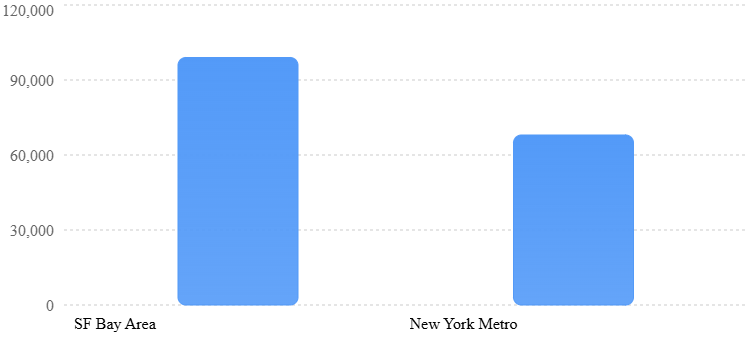
Source: CBRE, Scoring Tech Talent 2026. Values are approximate published workforce totals. CBRE
The Bay Area has approximately 31,000 more AI-skilled workers than New York. Using the rounded figures, this represents a relative advantage of about 45.6%.
This is important because building with AI does not eliminate the need for skilled technical workers. It changes the type of work those people perform, with greater emphasis on architecture, testing, deployment, security, and quality.
A region with a larger pool of experienced AI talent may find it easier to recruit people who understand both the opportunities and the technical problems associated with AI-generated software.
Finding #2: AI Is Becoming a Major Share of Bay Area Technology Hiring
CBRE found that the AI share of Bay Area tech job postings increased from 20% to 57% over the periods compared in its 2026 report. That represents a 37-percentage-point increase, or a 2.85-fold rise in AI’s share of postings. CBRE
AI share of Bay Area tech job postings
Published percentages from the periods compared in CBRE’s 2026 analysis
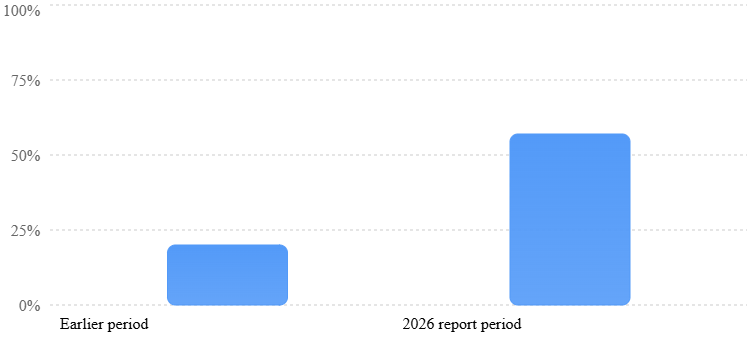
Source: CBRE’s 2026 tech talent analysis. The chart compares reported shares, not the absolute number of job postings. CBRE
This finding suggests that AI skills are becoming increasingly important in the region’s technology labor market. It does not mean that 57% of all technology employees work in AI or that AI coding tools caused the shift.
The useful business lesson is that future software teams are likely to need people who can work effectively with AI systems. Hiring managers should therefore evaluate candidates on their ability to produce reliable software with modern tools, rather than measuring skill only through manual coding speed.
What This Research Means for Founders
San Francisco’s talent advantage is real, but founders should not confuse access to talent with an automatic competitive advantage. A well-run startup outside the Bay Area can use many of the same AI development platforms.
The local advantage is more likely to matter when a company needs experienced engineers, rapid feedback from technical customers, specialized partnerships, or access to people building the underlying AI technology.
That suggests a practical strategy for San Francisco founders: use the region to solve problems that require its expertise, while using AI to automate the routine development work that competitors can also perform.
The Startups and Platforms Driving the AI-Built Software Revolution
The vibe coding movement includes several different kinds of companies. Some help professional developers produce code faster, while others focus on people who want to create an application without understanding the technical details.
Understanding these differences helps founders choose tools based on their actual needs instead of marketing claims.
Cursor: AI-Native Development for Professional Engineers
Cursor
Cursor helps developers write, edit, and understand software using AI within a code editor. It supports a workflow in which engineers can delegate coding tasks while retaining access to the underlying code.
Cursor is especially relevant to startups that already employ technical founders or developers. Rather than replacing their engineering environment entirely, it helps them complete work within a familiar development process.
The strategic benefit is not only faster writing. Developers can use AI to explore an unfamiliar codebase, make related changes across files, and investigate problems that would otherwise require significant manual effort.
However, the tool remains part of a development process, not a guarantee of software quality. Experienced engineers still need to verify important changes and ensure that the overall system behaves correctly.
Replit: Making Software Creation More Accessible
Replit Review 2026: AI App Builder Tested | No Code MBA
Replit
Replit approaches the opportunity from a different direction. Its stated mission is to make building software accessible to a much wider population, including people who have little programming experience.
Replit’s Agent focuses on turning conversational instructions into applications and handling more of the technical work behind the scenes. This makes the platform attractive for business owners, independent creators, educators, and founders who want to test a product before committing to a traditional engineering process. Replit
For a small company, the value may come from creating a useful internal tool that previously would never have justified a full development project. A sales team, for example, might create a dashboard that brings together customer information and sales activity.
The important question is what happens when that tool becomes essential to daily operations. Businesses need to understand where their information is stored, how access is controlled, and whether they can maintain the application if their needs become more complex.
Lovable: Turning Ideas Into Visual Web Applications
Lovable
Lovable focuses on creating web applications through natural-language instructions. Its appeal is the ability to move quickly from an idea to a visual product that people can test.
This approach is useful when design and user experience matter as much as the underlying software logic. Founders can create early versions of customer portals, dashboards, and other web products without building every screen manually.
Lovable is part of the global vibe coding market, not evidence that every important company in the category is headquartered in San Francisco. Its relevance is that it competes in the same fast-growing market for easier software creation.
Bolt.new: Rapid Application Prototyping
Introduction to Bolt: Does It Suit Professional Developers? – The New Stack
Bolt.new
Bolt.new, developed by StackBlitz, is another example of software development moving toward conversational instructions. It allows users to generate and modify web applications in an integrated development environment.
The opportunity is particularly clear for small teams that need to show customers a working idea. Rather than spending weeks producing a detailed visual mockup, a team can create a functional prototype and watch people use it.
That feedback can be more valuable than early technical perfection. However, a prototype that demonstrates an idea should not automatically be treated as a production-ready system.
Claude Code and OpenAI Codex: AI Agents for Engineering Work
Coding agents represent a further step beyond generating individual code suggestions. They can work through larger tasks, examine files, propose changes, and help execute development workflows.
Claude Code and OpenAI Codex illustrate this broader move toward delegating software tasks to AI.
For a professional team, the difference can be substantial. A developer might assign an agent a task such as adding a reporting feature, identifying related files, writing tests, and preparing changes for review.
The developer’s job then becomes defining the task, setting limits, checking the results, and deciding whether the change is safe to release.
Choosing the Right Tool for the Job
| Tool | Primary strength | Best suited to |
|---|---|---|
| Cursor | AI-assisted code editing | Professional developers |
| Replit | Conversational building and deployment | Founders and business users |
| Lovable | Visual web app creation | Web app prototypes |
| Bolt.new | Fast browser-based app building | Small teams and experiments |
| Claude Code | Delegated engineering tasks | Technical teams |
| OpenAI Codex | Agent-based coding workflows | Software engineering teams |
These are broad workflow distinctions, not benchmark rankings. Product features, prices, supported models, and limits change frequently, so businesses should test their own tasks before making a purchasing decision.
A founder creating a simple customer-facing prototype may value an easy visual builder. A startup maintaining a large codebase may care more about testing, version control, code review, and the ability to work safely across many files.
The right choice depends less on which tool produces the most impressive demonstration and more on which one helps the team deliver reliable work.
Original SFTechScene Research #2: Where Is AI Actually Being Used in Software Development?
The popularity of vibe coding raises an important question. Are developers using AI throughout the software lifecycle, or are they mainly using it for tasks that are easy to demonstrate?
To investigate, SFTechScene analyzed task-level adoption figures from the 2026 Stack Overflow Developer Survey. The public data covers the use of AI for coding, testing, debugging, software design, and production operations.
Our focus is the distance between using AI to create software and using it to maintain software after people depend on it.
Research Methodology
We selected seven software development activities from the survey’s published workflow table. For each activity, we used the percentage of respondents reporting that they currently use AI or AI agents for that task.
The question allowed respondents to report different answers across multiple activities, so the percentages are not parts of a single total. The survey is also voluntary and global, not a representative sample of San Francisco developers.
We define the production adoption gap as the difference, in percentage points, between AI use for generating code in a familiar area and AI use for operating or troubleshooting production systems.
Finding #1: AI Adoption Is Much Stronger for Writing Code Than for Running Live Systems
Where developers currently use AI in 2026
Share of survey respondents using AI for each software development activity
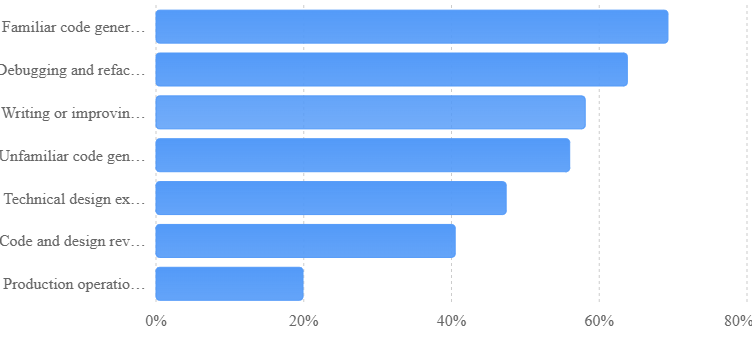
SFTechScene analysis of Stack Overflow Developer Survey 2026 workflow data. Production operations includes deployment, operation, and troubleshooting. The underlying workflow question had 12,547 respondents. Stack Overflow Developer Survey
The largest difference is between familiar code generation, at 69.3%, and production operations, at 19.9%. This creates a 49.4-percentage-point adoption gap.
The ratio is also revealing. Respondents were about 3.5 times as likely to report using AI for familiar code generation as for production operations.
That does not mean code generation is 3.5 times more valuable. It indicates that developers are currently much more willing or able to involve AI in creating code than in managing live software systems.
For founders, this difference matters because a startup’s obligations change after customers start using its product. An incorrect screen can be inconvenient, but an incorrect database operation may damage information that customers rely on.
Finding #2: AI Use for Testing Is Growing, but Testing Remains a Separate Responsibility
Another interesting result is that 58.1% of respondents reported using AI to write or improve tests. That is a positive sign because testing is essential when software is being generated quickly. Stack Overflow Developer Survey
However, generating a test does not guarantee that the test checks the right behavior. If AI misunderstands a business requirement, it may produce code and tests that share the same incorrect assumption.
This is especially dangerous when a system deals with money, permissions, customer records, or legal obligations. A test may pass while the product still makes the wrong decision.
The solution is to define important business rules independently of the AI-generated implementation. A human should specify what must happen when a payment fails, when a customer cancels, or when an unauthorized user attempts to open a record.
Finding #3: The Biggest Opportunity May Be Between Prototype and Production
We compared three stages of development to understand where AI adoption appears most mature.
| Development activity | AI adoption | Implication |
|---|---|---|
| Familiar code generation | 69.3% | Strong adoption in routine creation |
| Writing or improving tests | 58.1% | Meaningful use in quality checks |
| Production operations | 19.9% | Far lower adoption in live-system work |
The 38.2-percentage-point difference between test generation and production operations suggests a large change in how AI is used once software becomes part of a live business.
For the companies building AI development tools, an important opportunity lies in closing that gap safely. Helping people generate a working application is useful, but helping them maintain it over months or years may create greater long-term value.
This is where reliable testing, clear ownership, performance monitoring, and safe deployment systems become important parts of the market.
What Businesses Should Do With This Finding
Businesses should divide AI-built software into three stages: experimentation, controlled pilot, and production. Each stage should have different expectations for reliability and oversight.
During experimentation, speed matters because the goal is to learn. A founder may create several versions of a feature to understand what customers prefer.
During a controlled pilot, the team should begin tracking errors, user complaints, and data quality. Once the system becomes part of daily operations, the company needs stronger access controls, backups, testing, and a clear process for handling failures.
This approach preserves the speed advantages of vibe coding while reducing the risk of turning an unfinished experiment into an essential business system.
The Economics of Vibe Coding: Why Building Software Is Becoming Cheaper
The Old Development Model Had a High Starting Cost
Traditional software development involves more than writing code. A company must understand requirements, design screens, create systems, test features, deploy the application, and maintain it after launch.
For a small business, even a limited project can become expensive when it requires several specialized people. Many useful software ideas never get built because the expected value does not justify the initial cost.
Vibe coding changes the economics by lowering the effort needed to produce a first version. A founder can now test ideas that would previously have required a meaningful engineering budget.
The largest benefit may not come from replacing developers. It may come from making smaller software projects financially worthwhile.
But AI-Generated Code Has Hidden Costs
The apparent cost of creating software can be misleading. A tool may produce a working interface quickly while leaving unresolved problems in its database, access controls, data handling, or error management.
Those issues can become expensive after the product attracts users. A small mistake repeated across thousands of transactions can create more damage than a slow development process.
Companies should therefore measure the cost of delivering a working, reliable feature, not just the cost of generating its code.
A useful comparison includes development time, AI tool expenses, review time, testing, rework, deployment, maintenance, and customer support.
Original SFTechScene Research #3: When Does AI Coding Actually Save Engineering Time?
To move beyond claims about development speed, SFTechScene created a transparent workload model. It estimates how much engineering time AI might save after accounting for the time spent checking and repairing its output.
This is a scenario analysis, not a controlled experiment or a measurement of San Francisco startups. Its purpose is to identify the conditions under which AI-generated code creates genuine savings.
Research Methodology
We use a hypothetical software project requiring 120 engineering hours without AI. We assume that 60 of those hours involve work potentially suitable for AI assistance, while the other 60 hours are unchanged.
We then model three levels of AI performance. Each scenario specifies the share of eligible work saved through AI and the additional hours needed for prompts, review, testing, and rework.
The formula is:
\[ T_{\text{AI}}=T_{\text{baseline}}-(E\times r)+O \]
Where:
- \(T_{\text{baseline}}\) is the original 120-hour workload.
- \(E\) is the 60 hours of eligible work.
- \(r\) is the reduction in eligible work.
- \(O\) is additional AI-related overhead.
Net time savings are calculated by comparing the new total with the original 120 hours. These assumptions are illustrative and are deliberately varied to show how sensitive the result is to review costs.
Finding #1: AI Can Make a Project Slower When Review Costs Are High
| Scenario | Eligible work reduced | Added review and rework | Total hours | Net change |
|---|---|---|---|---|
| Low benefit | 30% | 30 hours | 132 | 10% slower |
| Moderate benefit | 50% | 20 hours | 110 | 8.3% faster |
| High benefit | 70% | 10 hours | 88 | 26.7% faster |
Total engineering hours under three AI adoption scenarios
SFTechScene illustrative model: lower is better; traditional baseline is 120 hours
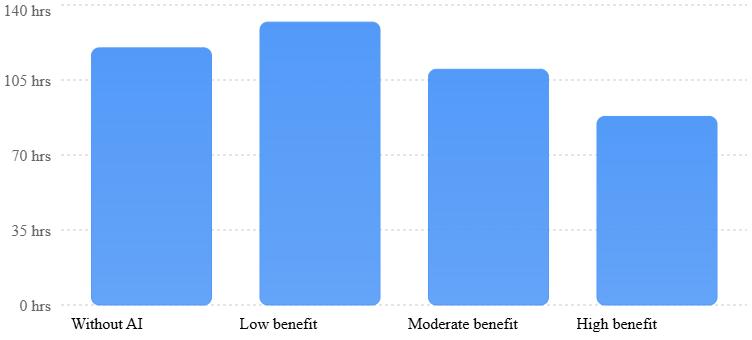
Original SFTechScene scenario calculations. Assumptions are hypothetical and are not observed productivity measurements.
The key finding is that saving time on code generation does not automatically save time on the project.
In the low-benefit scenario, AI reduces eligible work by 18 hours. However, the extra 30 hours of review and rework outweigh that gain, leaving the project 12 hours slower overall.
In the high-benefit scenario, AI reduces eligible work by 42 hours, while additional overhead is only 10 hours. The project finishes 32 hours faster, producing a 26.7% reduction in total engineering time.
Finding #2: Review Efficiency May Matter More Than Code Generation Speed
This model exposes a common problem with productivity claims. A company may announce that AI writes a large share of its code without showing how much time engineers spend reviewing and repairing that code.
For businesses, that missing information can change the entire financial result. A tool that generates code very quickly may be less economical than a slower tool that produces changes requiring less correction.
The right measure is the number of accepted, reliable features completed per engineering hour. This captures both the speed of development and the effort required to make the work usable.
A Real-World Warning From a Controlled Study
A 2025 randomized controlled study by METR examined 16 experienced open-source developers working on 246 tasks in mature projects. The researchers found that, under the early-2025 tools and conditions studied, allowing AI increased task completion time by 19%. METR
The result was particularly interesting because developers had expected AI to make them faster. The study showed why perceived productivity and measured productivity can differ.
It would be incorrect to use this finding to claim that AI coding tools are generally slower in 2026. The study involved a specific group of developers, particular projects, and an earlier generation of tools.
The broader lesson remains useful: software teams need to run their own experiments instead of assuming that impressive AI output translates into real savings.
How San Francisco Startups Can Measure Their Actual Savings
A startup can test AI coding productivity without setting up a complicated research project. Start by selecting a group of comparable tasks, such as building standard forms, adding reports, or writing tests.
Record the expected effort before work begins, then assign comparable tasks to an AI-assisted workflow and the team’s normal workflow. Where possible, randomly assign tasks or rotate developers between approaches so that one person or one type of task does not bias the result.
Track total time from assignment to an accepted change, including every review cycle and correction. Also measure defects found after release, because shipping quickly is not valuable if customers encounter more problems.
Repeat the test across enough tasks to reduce the influence of unusual cases. A team should report both average and median completion times and should avoid declaring success based on one impressive demonstration.
For complex work, the company should also track whether the experiment changed security risk or maintenance effort. Those costs may not appear during the first week but can determine whether the new workflow is financially worthwhile.
Original SFTechScene Research #4: The Trust Gap Could Become the Biggest Business Opportunity
The more software AI creates, the more important it becomes to know whether that software can be trusted. This is not simply a concern for security experts or large enterprises, because even a small application can store customer information or make decisions that affect a business.

SFTechScene examined the 2026 Stack Overflow survey’s trust results to understand the conditions under which developers feel comfortable depending on AI. The findings reveal an important difference between trusting AI when its work can be checked and trusting it to make important decisions.
Research Methodology
We used the six published response categories from Stack Overflow’s 2026 question about trust in AI tools and agents. The question received 14,304 responses, with each participant selecting one answer.
Our calculations use the published response counts and reported percentages. We compare the share willing to trust AI when its output can be easily verified with the share willing to trust it for important work decisions.
The data is global and self-selected, so it does not measure trust among San Francisco founders specifically. It also concerns AI tools broadly rather than only code-generating systems.
Finding #1: Developers Prefer AI Work They Can Independently Verify
When developers trust AI in 2026
Share of respondents selecting each trust category
Source: Stack Overflow Developer Survey 2026, 14,304 responses. The displayed categories are mutually exclusive answers to the survey question. Stack Overflow Developer Survey
The largest group, at 48%, said they trusted AI when they could easily verify its output. Only 6.6% said they trusted AI for many tasks, including important work decisions.
That is a difference of 41.4 percentage points. The easily verifiable category was about 7.3 times as common as the category expressing trust in important decisions.
This is not evidence that developers reject AI. It suggests that the ability to check results is central to how they decide when to use it.
For AI software companies, this creates a powerful product opportunity. Tools that make code easier to test, inspect, explain, and approve may become just as important as tools that generate it.
Finding #2: Verification Is Already Part of Everyday AI Development
The same survey found that 76.5% of relevant respondents said they usually run AI-generated answers locally before using them. Another 63.9% reported comparing answers against their existing codebase, while 53% inspected tests or security implications. Stack Overflow Developer Survey
These figures come from a multiple-response question, so the groups overlap. They demonstrate different validation practices rather than separate types of developers.
The results suggest that experienced teams are not simply accepting every AI-generated answer. Many are adding verification steps to determine whether the output fits their needs.
That behavior points toward a growing market for AI testing systems, secure development tools, and products that help humans review code more efficiently.
Finding #3: The Market May Reward Tools That Reduce Uncertainty
The early marketing of AI coding products often focuses on speed. Companies show how quickly an application can appear after a prompt.
Speed matters, especially for founders testing new ideas. But once businesses depend on AI-generated applications, they need confidence that the software will continue working after the original creator moves on.
A tool that creates an application in five minutes but requires several days of repairs may provide less value than a tool that builds more slowly and produces a reliable result.
SFTechScene’s research suggests that verification could become one of the strongest competitive advantages in the AI software market. This is an interpretation of the survey results, not a prediction directly measured by the survey.
Practical Implication: Build Trust Into the Development Process
For a startup, trust should be built into the workflow rather than added at the end. Every important AI-generated change should have a clear owner, a way to test expected behavior, and a record of what was modified.
Teams should also separate low-risk changes from high-risk work. Adjusting the color of a button is very different from changing how customer records are stored or how payments are processed.
The more serious the consequences of failure, the stronger the required review should become. This allows businesses to benefit from AI speed without treating every AI suggestion as equally safe.
The Rise of the One-Person Software Company
A Founder Can Now Attempt Work That Once Required Several Specialists
One of the most interesting consequences of vibe coding is the possibility of smaller software companies. A founder can use AI to help with development, design, content, testing, customer support, and basic operations.
This does not mean one person can automatically run a large, complex technology business. It means the minimum team needed to test an idea may be smaller than it was in the past.
Imagine a founder building a specialized reporting tool for independent property managers. The founder knows the customer’s problems, understands the reports they need, and has relationships with potential buyers.
In the past, the founder might have needed to find a technical cofounder or hire a development team before showing customers a working product. With AI coding tools, the founder could potentially build a first version and test demand before making those commitments.
That changes the economics of starting a company. Instead of spending heavily to find out whether an idea is viable, the founder can use a smaller experiment to answer the question.
The Biggest Limitation Is No Longer Always Technical
When software becomes easier to create, other business problems become more important. Founders still need to identify customers, communicate value, acquire users, and create a product people are willing to pay for.
AI can help build a customer management system, but it cannot guarantee that customers want another management system. It can generate a reporting dashboard, but it cannot make incorrect underlying data useful.
This means domain expertise may become a stronger advantage. Someone who deeply understands a narrow customer problem may be well placed to create useful software even without a traditional programming background.
For San Francisco entrepreneurs, this creates opportunities in specialized business markets rather than only broad consumer apps. A small company may find a profitable niche by solving one expensive problem exceptionally well.
Why Distribution Could Become More Important Than Code
If thousands of founders can create similar applications, the cost of producing software will no longer be a reliable barrier to competition. A new company might replicate common features quickly using widely available tools.
That does not necessarily destroy software businesses. Instead, it increases the importance of advantages that cannot be copied through a prompt.
These include trusted customer relationships, exclusive data rights, established sales channels, deep integration with business operations, excellent service, and a strong reputation for reliability.
A software company with hundreds of customers who rely on its product every day has a stronger position than a company with an attractive application but no established users.
For founders, the best strategy may be to develop customer relationships while the product is still being built. AI makes it easier to change the software later, but building trust and demand usually takes longer.
How Vibe Coding Is Changing Startup Product Development
The First Working Product Can Become a Research Tool
A traditional startup may spend weeks developing screens and presentations before customers interact with anything functional. Vibe coding makes it possible to create a usable prototype earlier.
This changes the role of early product development. Rather than trying to deliver a complete application immediately, founders can use small software experiments to discover what customers need.
Consider a company building software for local service businesses. The founders might believe customers want detailed analytics, automated scheduling, and advanced financial reporting.
Instead of building all three, they could create a simple scheduling tool, show it to five businesses, and watch how employees use it. If scheduling proves less important than customer follow-up, the team can change direction before making a large investment.
The benefit is not merely faster coding. It is the ability to test assumptions before they become expensive commitments.
Shorter Feedback Cycles Can Improve Product Decisions
AI-built prototypes make it easier to try different versions of a workflow. A founder can change the order of screens, remove unnecessary fields, or test another approach to presenting information.
However, faster iteration only helps if the company learns from real customer behavior. Constantly changing the product based on personal preferences can create confusion without improving outcomes.
Teams should define a question before each experiment. For example, will removing three fields from a registration form increase successful signups without reducing the quality of customer information?
Once the experiment is complete, the team should review the results and decide whether to keep the change. The same discipline used in traditional product development remains essential.
The Definition of an MVP Is Changing
A minimum viable product, or MVP, is the smallest useful version of a product that can test an important business assumption. AI tools can make that version easier to build.
But easier development also creates a temptation to include too many features. A founder may generate dashboards, notifications, chat systems, and integrations because AI makes them appear inexpensive.
This can create a complicated application before the company has confirmed that customers need its central feature. A larger product also creates more opportunities for errors and maintenance costs.
The strongest AI-built MVP is often the smallest one. It should solve one clear problem, produce a measurable result, and provide enough evidence for the founder to make the next investment decision.
Which San Francisco Businesses Have the Biggest Opportunity?
Not every industry will benefit from vibe coding in the same way. The best early opportunities generally involve clear workflows, limited technical complexity, and problems where a small improvement produces measurable business value.
Professional Services and Consulting Firms
Professional service businesses often perform repetitive information work that does not justify expensive custom software. Consultants may copy information between spreadsheets, prepare similar reports, or track projects through disconnected tools.
A firm could use AI to create an internal dashboard that brings together project status, deadlines, and client reporting. Another company might build a tool that formats information from approved data sources into a consistent internal report.
The best projects begin with a process that employees already understand. The business should document the required steps, identify exceptions, and decide which decisions still need human approval.
The biggest risks involve confidential information and incorrect output. A consulting company must understand its tool’s data handling before placing client information into any AI development environment.
Real Estate and Property Management
Real estate companies frequently manage complex workflows involving properties, tenants, maintenance requests, documents, and communications. Many smaller operators use spreadsheets and several disconnected services to handle this work.
A custom internal application could help a property manager track maintenance requests, assign work, and identify unresolved issues. It might also create simple reports showing recurring problems or response times.
The opportunity is strongest when the software supports an existing process rather than attempting to replace every system at once. A small application that solves one frustrating problem may create more value than a broad platform that takes months to maintain.
Property companies also need strong access controls because tenant information can be sensitive. A prototype using sample data is a reasonable first step, but a live system requires additional review.
Marketing Agencies and Creative Businesses
Marketing firms are another promising market because much of their operational work involves collecting information, tracking progress, and preparing reports.
An agency could create a dashboard showing campaign milestones, client approvals, content schedules, and performance metrics. A small team might build an internal tool for turning structured campaign data into a consistent reporting format.
These tools can save time when they reduce repeated manual work. However, AI-generated software should not be allowed to invent metrics, change reporting definitions, or present incomplete data as a finished result.
The best systems preserve links to the original data and make errors easy to identify. This is especially important when the information will be used to guide client spending.
Local Businesses and Independent Operators
Small businesses often have highly specific needs that commercial software only partially addresses. A café, repair company, tutoring service, or event organizer may use several tools to manage routine work.
Vibe coding can make it practical to build small applications around those needs. A business might create an inventory dashboard, appointment tracker, or internal checklist system.
The important consideration is whether the application is cheaper and safer than using an existing product. Custom software creates ongoing responsibilities, even when the first version is easy to build.
Owners should compare the benefits of customization with the costs of maintenance and support. For many businesses, a combination of existing software and a small custom tool will be more sensible than building an entirely new platform.
Original SFTechScene Research #5: Which Vibe Coding Projects Offer the Best Risk-Adjusted Value?
To help businesses make practical decisions, SFTechScene developed a project selection framework. It is designed to distinguish low-risk, high-value software experiments from projects that may create serious operational problems.
Unlike the earlier analyses, this is a proposed decision model rather than an analysis of observed market outcomes. The scores below are illustrative examples, not results from testing live businesses.
Research Methodology
We evaluate a proposed project across five criteria, each scored from 1 to 5. Higher scores represent a more attractive project, with risk-related dimensions reverse-scored so that safer and easier-to-manage projects receive more points.
The criteria and weights are business value (30%), ability to verify results (25%), ease of integration (15%), low data and security risk (20%), and ease of ongoing maintenance (10%).
The weighted score is calculated as:
\[ S=0.30V+0.25Q+0.15I+0.20R+0.10M \]
The maximum score is 5.0. This score is a planning aid, not a validated predictor of return on investment or safety.
Illustrative Project Comparison
| Project | Value | Verification | Integration | Low risk | Maintenance | Weighted score |
|---|---|---|---|---|---|---|
| Internal content calendar | 4 | 5 | 5 | 5 | 4 | 4.60 |
| Internal reporting dashboard | 5 | 4 | 4 | 4 | 4 | 4.30 |
| Customer onboarding prototype | 4 | 4 | 3 | 3 | 3 | 3.50 |
| Live payment system | 5 | 3 | 2 | 1 | 2 | 2.95 |
| Medical decision system | 5 | 1 | 2 | 1 | 1 | 2.35 |
SFTechScene illustrative scoring framework. Scores are editorial assumptions for hypothetical projects, not empirical risk assessments. High-risk projects need specialist review regardless of their weighted score.
Illustrative suitability scores for AI-built projects
Weighted score out of 5 using the SFTechScene decision framework
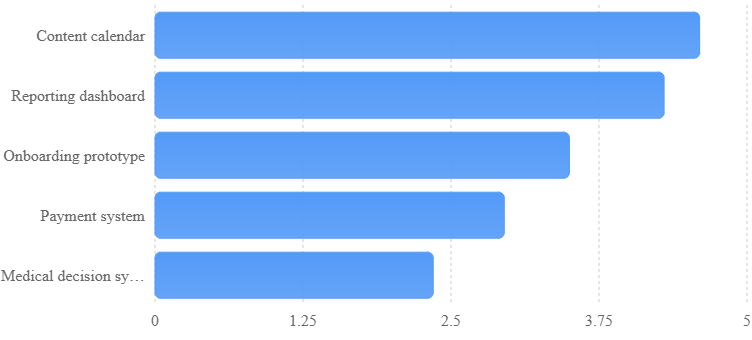
Finding: Start With Projects That Are Easy to Check and Easy to Reverse
The framework favors internal content calendars and reporting dashboards because their results are generally easier to inspect. Mistakes can often be found and corrected before they affect external customers.
Payment systems and medical decision software score poorly on the low-risk dimension because errors can have serious consequences. A numerical score cannot make such work safe, and these systems should not be built or released without qualified domain specialists, rigorous testing, and appropriate controls.
The framework is useful because it forces a company to consider more than development speed. A project may deliver significant business value but still be a poor starting point if the team cannot reliably verify its output.
Businesses should adjust the criteria based on their own operations. A financial services company, for example, may place more weight on security, traceability, and regulatory requirements than a company building simple internal scheduling tools.
The Biggest Risks Facing the Vibe Coding Revolution
AI Can Generate Code That Looks Correct but Is Wrong
One of the most difficult problems in AI development is that code can appear convincing without behaving correctly. An application may have polished screens and functioning buttons while containing errors in its business logic.
For example, a reporting system might calculate revenue incorrectly because it treats refunds as additional sales. The dashboard may still look professional and produce believable numbers.

This creates a dangerous gap between appearance and reliability. Founders who lack technical experience may have difficulty recognizing that the problem exists.
The solution is to define expected behavior before testing the software. For important calculations, teams should create simple examples where the correct answer is already known and verify that the application produces those results.
Security Problems Can Become Expensive Quickly
AI-generated applications may introduce weak access controls, poorly protected information, or unsafe ways of handling user input. These risks become serious when software stores customer records or connects to important business systems.
A common mistake is giving a prototype access to production databases or powerful credentials before the team has tested its behavior. Another is assuming that an application is secure simply because it uses a well-known framework.
Businesses should use test data during early development, limit permissions, and keep credentials out of source code. Any application dealing with sensitive information should receive appropriate security testing before release.
The goal is not to eliminate AI from security-sensitive development. It is to ensure that AI-generated changes receive the same level of scrutiny as human-written code.
Technical Debt Can Build Faster
Technical debt refers to shortcuts in software development that create extra work later. AI can accelerate this problem when teams repeatedly add features without understanding how the application is structured.
A founder may ask an AI tool to make dozens of changes over several weeks. Each change may appear to work, but the overall system can become difficult to understand, test, or modify.
Eventually, a simple new feature may require substantial repairs because earlier changes created conflicting behavior. At that point, the savings from rapid initial development can disappear.
Teams can reduce this risk by keeping the product small, documenting important decisions, and reviewing the software structure regularly. Periodically cleaning up the code may be more valuable than continuously adding new features.
Vendor Dependence Creates Another Risk
Many AI development platforms combine code generation, deployment, hosting, and other services. This convenience can be valuable, particularly for nontechnical founders.
However, companies need to understand what happens if prices increase, features change, or they decide to move their application elsewhere. A product that cannot be maintained outside its original platform may become difficult to operate.
Before committing to a platform, businesses should ask whether they can export the source code, access their data, manage backups, and deploy the application through another provider.
The right answer depends on the product. A short-lived internal experiment may not require extensive portability, but a core business system deserves much more attention.
Software Maintenance Does Not Disappear
One of the most misleading ideas around vibe coding is that generating an application means the development work is finished. In reality, a live product requires continuous attention.
Customer requirements change, external services update their interfaces, security problems are discovered, and users encounter unexpected situations. Someone must understand the system well enough to respond.
Even if AI performs much of the maintenance work, humans remain responsible for deciding what should change and confirming that the result is safe.
Founders should make maintenance part of their business model from the beginning. A product that is cheap to create but expensive to operate may not be a profitable business.
How San Francisco Startups Should Build With AI: A Practical 90-Day Plan
The best way to adopt vibe coding is not to replace the entire engineering process overnight. Start with a useful problem, establish clear limits, and expand AI’s role only after the results justify it.
A 90-day plan gives founders enough structure to test the technology without turning the experiment into a large, expensive project.
Days 1–15: Identify a Problem Worth Solving
Start With Business Value, Not the AI Tool
Choose a task that creates a measurable cost for the company or its customers. The problem should be frequent enough to matter and clear enough that a working solution can be evaluated.
For example, a company might spend several hours each week manually preparing customer reports. Before building software, the team should document how those reports are created, what information they require, and where mistakes commonly occur.
The goal is to establish the value of solving the problem. If the current process is already inexpensive and reliable, a custom application may not be justified.
Define the Minimum Useful Result
Write a short description of what the application must accomplish. Identify the users, required information, important business rules, and conditions that would make the project a failure.
Avoid asking AI to design the entire business process from scratch. The company should understand the workflow before asking a tool to automate it.
For an internal reporting application, the first version might need only to import approved data, display three key metrics, and export a summary. Additional features can wait until users demonstrate a need for them.
Days 16–30: Build and Test the First Prototype
Use AI to Create a Working Version
Choose a development tool based on the project’s complexity and the team’s technical experience. A simple internal dashboard may suit a conversational app builder, while a more complex product may require an engineering-oriented tool.
Describe the application’s purpose, required screens, data structures, and expected behavior. Give AI small, specific tasks instead of asking for a large, complicated system in one prompt.
After each meaningful change, test the result. This makes it easier to identify which modification introduced a problem and reduces the amount of work needed to fix it.
Test With Real Users but Safe Data
Invite a small group of intended users to try the prototype. Use synthetic or properly anonymized information until the company has completed the necessary data and security checks.
Observe where users become confused, which features they ignore, and what they try to accomplish outside the expected workflow. Their behavior will often reveal more than their opinions about the design.
Record each issue and decide whether it reflects a software error, an unclear interface, or a missing business requirement. These problems need different solutions, even when they appear similar to the user.
Days 31–60: Measure Whether the Software Saves Time
Compare the New Process Against the Old One
Measure the time required to complete the target task before and after introducing the application. Include time spent correcting errors, checking results, and supporting users.
Suppose an employee previously spent two hours preparing a weekly report. If the new application produces a report in 15 minutes but requires another 90 minutes of manual checking, the actual saving is far smaller than it first appears.
The company should also compare the accuracy of both processes. Saving time while increasing serious mistakes is not a successful outcome.
Improve the Most Important Problems First
Use feedback to identify the changes that would have the greatest effect on user outcomes. Avoid adding features simply because AI makes them easy to generate.
For example, if users struggle to find the correct report, improving navigation may be more valuable than building a new analytics section. If results are frequently inaccurate, fixing the underlying data process should come before visual improvements.
Prioritizing based on observed problems keeps the project focused and prevents the application from becoming unnecessarily complex.
Days 61–90: Prepare for Reliable Daily Use
Introduce Production Controls
Before the software becomes part of an essential workflow, review its security, permissions, backups, and failure handling. Ensure that important changes can be tested before they reach customers.
Assign an owner responsible for maintenance and support. Document how the application works, where its data comes from, and what employees should do when something fails.
These responsibilities are easy to overlook during rapid development. They become essential once other people depend on the software.
Decide Whether to Expand, Rebuild, or Stop
At the end of the experiment, review the measurable business results. Consider time saved, errors prevented, customer feedback, operating costs, and the effort needed to maintain the application.
A successful pilot may justify further investment in engineering and product development. A useful prototype with poor technical foundations may need rebuilding before wider adoption.
Some projects should be stopped. Discovering early that an idea does not create enough value is one of the most important benefits of inexpensive experimentation.
What the Vibe Coding Boom Means for Software Engineers
Developers Are Moving From Writing Instructions to Directing Systems
AI coding tools change how engineers spend their time. Routine code generation may require less manual work, while defining requirements, reviewing changes, and solving complex problems become increasingly important.
This does not mean programming knowledge is becoming irrelevant. Understanding how software works remains essential when AI produces unexpected results or introduces errors.
Developers who can combine technical judgment with effective AI workflows may be able to complete a broader range of work. However, the size of any productivity gain will depend on the task, the tool, and the quality of the team’s process.
Junior Developers Face a Different Learning Environment
For new developers, AI tools provide immediate help with unfamiliar code and programming concepts. They can explain errors, demonstrate alternative approaches, and generate examples that make learning more accessible.
There is also a risk that beginners will depend on AI without understanding the work it produces. Someone who can generate an application but cannot explain its basic behavior may struggle when the system breaks.
Training programs should therefore combine AI-assisted development with fundamentals. Developers need to understand data structures, testing, debugging, security, and software design even when AI performs much of the typing.
A useful learning exercise is to ask AI to produce a solution, study the code, identify possible failures, and then explain the result without relying on the tool.
Experienced Engineers May Become More Valuable in Different Ways
As AI takes on routine development tasks, experienced engineers can focus more attention on system design, reliability, and technical decisions with long-term consequences.
They may also become responsible for guiding AI-generated work produced by larger teams. This could increase the importance of code review, architecture, security, and the ability to communicate technical risks clearly.
The value of a developer should therefore not be measured only by how much code they write. A small amount of carefully reviewed code that prevents a serious problem can be more valuable than thousands of generated lines.
Can Vibe Coding Replace Traditional Software Development?
The answer depends on what kind of software is being built and how the term is defined. For small prototypes and well-defined applications, AI can already perform a substantial part of the development work.
For complex products, the situation is different. Large applications involve dependencies, changing requirements, sensitive information, performance needs, and many interactions that are difficult to understand through isolated prompts.
Even when AI generates most of the code, someone must decide whether the application is correct and appropriate for its intended purpose. That responsibility does not disappear.
The more likely future is a mix of AI-generated development and human engineering oversight. Different products will require different balances of automation and review.
The Difference Between Generating Software and Owning Its Results
An AI tool can create a feature, but the company deploying it remains responsible for what that feature does. If a financial calculation is wrong or customer information is exposed, the business cannot avoid responsibility by pointing to the AI system.
This is why engineering standards continue to matter. Tests, documentation, access controls, monitoring, and review processes exist to make software more reliable under real-world conditions.
Vibe coding should reduce unnecessary manual work, not eliminate the controls that make software safe to use.
Why Traditional Engineering Skills Still Matter
Some tasks are well suited to AI because the expected output is clear and easy to check. Others involve uncertain requirements, complicated systems, or serious consequences if something goes wrong.
Professional engineers are particularly valuable in the second category. They can identify hidden dependencies, question incorrect assumptions, and design systems that remain reliable as requirements change.
The strongest teams will know when to delegate work to AI and when to apply deeper human judgment. That decision may become one of the most important engineering skills of the next decade.
What Happens to the Software Industry When Anyone Can Build an App?
More Software Will Compete for the Same Customers
As development becomes more accessible, more founders can experiment with software businesses. This is likely to increase competition in markets where applications are easy to create and offer similar features.
A simple dashboard or scheduling tool may become easier to copy. Companies relying mainly on those features may find it harder to justify high prices.
However, businesses do not purchase software only because it contains code. They pay for useful outcomes, reliability, support, data protection, and confidence that the product will continue working.
Companies that understand those needs can still build strong businesses, even in markets where basic development becomes cheaper.
Specialized Software May Become More Attractive
Many industries have small, specific problems that large software vendors do not prioritize. These markets can be difficult to serve profitably when custom development is expensive.
AI can change that calculation. A founder with deep knowledge of a specialized market may be able to build a focused product without carrying the same development costs as a traditional software company.
For example, a tool serving a narrow group of logistics operators might solve one recurring reporting problem. The market may be too small for a large platform but large enough to support a lean business.
The opportunity is strongest when the founder understands the customer’s workflow better than competitors do. AI can help implement that knowledge, but it cannot replace the work required to acquire it.
Established SaaS Companies Will Need to Adapt
Traditional software-as-a-service companies may face pressure from AI-built alternatives, especially when their products offer common functions at relatively high prices.
Their existing strengths remain important. Established companies often have customer relationships, reliable infrastructure, integrations, support teams, and years of knowledge about how users behave.
The challenge will be using AI to improve their products and operating efficiency without damaging those advantages. Simply adding a chatbot to an existing application is unlikely to be enough.
Companies should examine which customer problems can now be solved more quickly, which features can be simplified, and where AI enables entirely new workflows.
What Could San Francisco’s Vibe Coding Market Look Like in 2027?
AI-Built Prototypes Could Become a Standard Startup Practice
If coding tools continue improving, creating a working prototype may become a common early step for founders across many industries. Business ideas that previously required technical hiring could be tested through smaller, faster experiments.
This could increase the number of products entering the market without necessarily increasing the number of successful companies. Building a prototype and building a durable business remain different achievements.
San Francisco’s startup community is well positioned to explore this model because it combines AI talent, investors, and founders who are accustomed to rapid experimentation.
More Competition Could Shift Toward Reliability and Customer Relationships
As code generation becomes widely available, competitive advantages may move toward areas that are harder to automate. These include customer knowledge, trusted data, reliable operations, and the ability to deliver consistent results.
For AI coding vendors, this could increase demand for better verification, deployment, maintenance, and security features. For startups using AI, it could increase the importance of customer support and product quality.
These are strategic scenarios rather than certain forecasts. Their timing will depend on tool capabilities, customer adoption, costs, and how well companies manage the risks of automated development.
The Next Breakthrough May Be in Maintaining Software
Much of the public attention around vibe coding focuses on creating something new. The more difficult long-term challenge is keeping that software useful and secure as it grows.
AI systems that can safely identify errors, propose repairs, test changes, and explain their actions could reduce one of the largest ongoing costs of software ownership.
However, maintenance automation requires strong safeguards. A system changing live software must be able to demonstrate what it changed, why the change was needed, and whether the result behaves as expected.
The companies that solve these problems may create deeper value than those focused only on generating attractive applications quickly.
What San Francisco Founders Should Measure Before Betting Their Business on Vibe Coding
The rise of AI-generated software creates a temptation to measure the wrong things. Founders may focus on how quickly a tool creates an app, how many lines of code it writes, or how many features a small team can produce.
Those figures can be interesting, but they do not establish whether the product creates business value. A more useful measurement system connects AI development directly to customer outcomes and operational reliability.
A Practical AI Development Scorecard
| Metric | How to measure it | Why it matters |
|---|---|---|
| Time to accepted feature | Hours from assignment to approved completion | Measures actual delivery speed |
| Review and rework time | Hours spent checking and correcting AI output | Reveals hidden development costs |
| Post-release defects | Errors found after a change reaches users | Measures software quality |
| Customer task completion | Share of users completing the intended workflow | Measures usefulness |
| Cost per reliable feature | Total engineering and tool costs divided by accepted features | Measures development efficiency |
| Maintenance effort | Hours spent supporting and repairing the application | Reveals long-term costs |
| Customer retention | Share of customers continuing to use or pay for the product | Measures lasting value |
Founders should establish a baseline before adopting AI coding tools. Without a comparison, it is difficult to determine whether AI improved the development process or simply made it feel faster.
They should also separate the results by task type. A tool may offer substantial gains for repetitive development while providing little benefit for complex problems involving unfamiliar systems.
The goal is to understand where AI creates value, not to force it into every part of the business.
Research Methodology, Limitations, and Source Notes
This article combines published third-party research with original SFTechScene calculations and illustrative decision models. The original work involves comparing existing datasets, calculating differences and ratios, developing a transparent workload simulation, and proposing a project selection framework.
The research does not include newly collected interviews, a proprietary developer survey, or measured productivity data from San Francisco companies. Claims about individual startups and the local ecosystem should therefore be understood as evidence-based analysis rather than a comprehensive census of the vibe coding industry.
Public Data Used
| Source | Publication | How SFTechScene used it |
|---|---|---|
| Stack Overflow | 2026 Developer Survey | AI adoption, workflow use, validation, and trust |
| CBRE | Scoring Tech Talent 2026 | Bay Area talent and hiring comparison |
| GitHub | Octoverse 2025 | Global software development activity |
| Y Combinator | Reported Winter 2025 figures | Startup AI code-generation example |
| METR | 2025 randomized developer study | Independent productivity comparison |
The Stack Overflow data is available through its public survey tables, with response counts, percentages, and question definitions. Its 2026 data is published under the Open Database License, ODbL 1.0, with attribution to Stack Exchange Inc. Stack Overflow Developer Survey+1
The CBRE comparison uses approximate market-level talent counts and should not be interpreted as a measure of vibe coding activity in San Francisco proper. The startup examples establish that AI-generated development has appeared in prominent founder communities, but they do not demonstrate how many products succeeded because of AI.
The time-saving simulation and project suitability model are original analytical frameworks with declared assumptions. Their values should not be presented as observed market averages, and businesses should replace the inputs with their own data before using them for investment decisions.
What the Evidence Does Not Prove
The available sources do not establish that San Francisco is the world’s largest market for vibe coding by product count, revenue, or number of AI-generated applications. They support the narrower conclusion that the Bay Area has major advantages in AI talent, investment, and startup activity.
Likewise, increasing use of AI coding tools does not automatically prove rising engineering productivity. Controlled experiments, task-level measurements, and long-term software quality data are needed to evaluate that claim.
Separating these questions is essential. The strongest analysis of AI development should recognize both the remarkable changes already occurring and the limits of what current data can demonstrate.
Source References
The primary sources underlying this article are available for readers who want to examine the original figures and methods.
- Stack Overflow 2026 AI Developer Survey data
- CBRE Scoring Tech Talent 2026
- GitHub Octoverse 2025
- METR randomized AI developer productivity study
- Stack Overflow 2026 AI trust data
Final Takeaway: San Francisco’s Vibe Coding Boom Is About Building Better Businesses, Not Just Writing Code Faster
The vibe coding boom is changing one of the most important assumptions in technology entrepreneurship. Founders no longer always need a large engineering team or a substantial development budget to create the first version of a software product.
AI coding tools are making it easier to experiment, test customer demand, and turn specialized knowledge into useful applications. San Francisco has strong advantages in this shift because of its concentration of AI talent, venture investment, experienced founders, and established technology companies.
But faster code generation is only one part of the story. SFTechScene’s analysis of public data reveals a clear divide between how often developers use AI to create code and how often they use it to operate live software, alongside a strong preference for outputs that can be independently verified.
That divide points toward the next important phase of the market. The companies that succeed will need more than impressive demonstrations. They will need products that remain accurate, secure, maintainable, and genuinely useful after their first release.
For founders, the smartest strategy is to use AI to make experimentation inexpensive while keeping the standards for real software high. Start with a clear customer problem, build the smallest useful solution, measure the results, and invest in reliability as the product grows.
San Francisco’s next generation of software winners may not be the companies that write the most code with AI. They may be the companies that learn the fastest, solve the most valuable problems, and turn AI-built software into products customers can trust.