

Software moves fast in San Francisco.
A founder can build a working demo in one weekend. An AI agent can write code in minutes. A small team can launch a SaaS product from a laptop. A competitor can study your product, rebuild the main feature, and ship a close version before your next board meeting.
That is the beauty of the San Francisco startup scene.
It is also the danger.
If you are building software in San Francisco, San Jose, San Diego, or anywhere in California, your software intellectual property is not just a legal issue. It is a survival issue. It affects fundraising. It affects hiring. It affects exits. It affects your ability to sell to large customers. It affects whether a contractor can walk away with your core code. It affects whether an investor sees your startup as serious or sloppy.
And the data makes this very clear.
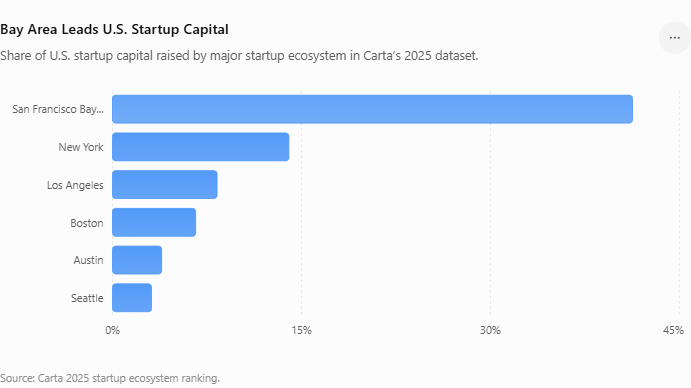
The San Francisco Bay Area was the top U.S. startup market for fundraising in 2025, with Bay Area startups on Carta raising $39.92 billion and accounting for 41.3% of U.S. startup capital in that dataset. The Bay Area also led major startup sectors, including AI, SaaS, and hardware.
That means founders here are playing in the most watched, most copied, most funded, and most competitive software market in the country.
So this article will not give you a basic “file a patent and sign an NDA” answer. That is too thin.
Instead, we will look at how San Francisco startup founders should think about software IP in a practical way, using data, legal basics, and real founder logic.
This is not legal advice. Use it as a clear business guide, then work with a qualified IP lawyer before making legal decisions.
The Data Says San Francisco Founders Are Playing at a Different Speed
The Bay Area is not just another startup market. It is the center of gravity.
Carta’s 2025 startup ecosystem data shows the San Francisco Bay Area had 41.3% of U.S. startup capital raised in that dataset. New York was second at 14%, Los Angeles was third at 8.3%, and Boston was fourth at 6.6%. No other U.S. market crossed 4%.
That gap matters.
When more money flows into one market, more founders enter. More employees move between companies. More investors see similar pitches. More competitors are formed by people who understand the same problems. More engineers reuse the same frameworks. More AI tools speed up development. More buyers compare similar products.
In a slow market, a weak IP setup may stay hidden for years.
In San Francisco, it can hurt you early.
What This Means for IP
If your startup is in a dense market, your IP plan cannot be lazy.
You need clean ownership from day one. You need your contractors to assign code properly. You need your trade secrets locked down. You need your open-source use tracked. You need your AI-generated code reviewed. You need your brand searched before launch. And if you have a real technical invention, you need to talk to a patent lawyer like PatentPC before you show too much in public.
This is not about being paranoid.
It is about understanding the market you are in.
San Francisco is a place where your idea can raise money fast. But it is also a place where five other smart teams may chase the same opportunity at the same time.
The Bay Area’s Sector Data Changes the IP Strategy
Software IP is not the same for every startup.
An AI company has different IP risk than a simple project management SaaS tool. A hardware-software startup in San Jose has different issues than a consumer app in San Francisco. A biotech software startup in San Diego has different concerns than a fintech API company.
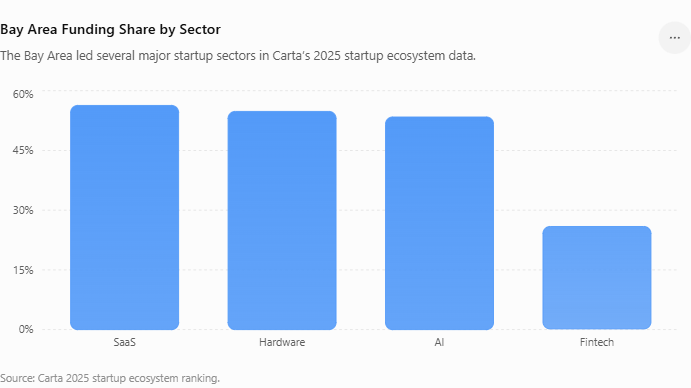
Carta’s data shows the Bay Area led several major startup sectors in 2025. It accounted for 53.4% of AI funding, 56.3% of SaaS funding, and 54.8% of hardware funding in the Carta data. It also ranked highly across biotech, healthtech, fintech, and consumer startups.
That matters because each sector protects software differently.
An AI startup often needs to protect data pipelines, model workflows, prompts, evaluation sets, and deployment methods. A SaaS startup often needs to protect code, customer data, workflow logic, brand, and product design. A hardware startup may need patents, firmware protection, supplier contracts, and manufacturing secrecy. A healthtech startup may need data rights, privacy controls, clinical workflow protection, and stronger customer contracts.
The Simple Rule
The more technical your edge is, the more you need to think about patents, trade secrets, and technical access.
The more your edge depends on brand, trust, and user adoption, the more you need trademarks, terms of service, content ownership, and customer data rules.
The more your edge depends on data, the more you need contracts, privacy discipline, and clear rights to use that data.
There is no single software IP strategy. There is only the right strategy for your business.
San Francisco, San Jose, San Diego, and California Are Not the Same Market
A founder in San Francisco may be building AI agents for sales teams. A founder in San Jose may be building chips, robotics, developer tools, or hardware-connected software. A founder in San Diego may be building healthtech, biotech software, defense tech, or university-linked research products.
They are all in California. But their IP risks are not identical.
Startup Genome ranks Silicon Valley as the number one global startup ecosystem and reports $3 trillion in ecosystem value for H2 2023 through 2025. It also reports $454 billion in total VC funding for Silicon Valley tech startups from 2021 to 2025, and $40.8 billion in total early-stage funding for H2 2023 through 2025.
For San Diego, StartupBlink estimates the city’s startup ecosystem ranked 23rd globally, with 1,810 startups and more than $2.72 billion in total startup funding. UC San Diego also reports more than 1,000 startup companies launched from its ecosystem, $13.5 billion in capital acquired by university startups, and more than 450 active startups.
That means California founders need a local strategy, not just a national one.
What San Francisco Founders Should Learn From This
San Francisco founders usually live in a brutal copy-speed market.
If you build a useful AI product, someone else may try to build a similar one quickly. If you launch a SaaS workflow, another team may test the same workflow. If you create a developer tool, engineers can inspect behavior, docs, API patterns, and user experience.
So you need to protect the parts that are not obvious from the outside.
That often means your codebase, training data, prompt chains, evaluation sets, private benchmarks, customer insights, onboarding flows, usage analytics, security systems, and roadmap.
Stop Trying to Protect the Idea. Protect the Assets.
Many founders start with the wrong question.
They ask, “How do I protect my app idea?”
That is usually not the right way to think.
A broad idea is not enough. “AI for lawyers” is not a company moat. “A better CRM” is not a protectable castle. “A marketplace for creators” is not something you can fully own just because you thought of it.
What you can protect is the real work.
Your code. Your architecture. Your data. Your user flows. Your technical methods. Your brand. Your design. Your content. Your internal notes. Your model evaluation process. Your product roadmap. Your customer research. Your sales process. Your unique workflow.
The strongest founders do not say, “No one can copy my idea.”
They say, “Here are the exact assets that make us hard to copy, and here is how we protect each one.”
The Four Main Legal Buckets for Software IP
Software IP is usually protected through four major buckets: copyright, trade secrets, patents, and trademarks.
The U.S. Copyright Office says copyright protects original works of authorship once they are fixed in a tangible form, and it includes computer programs among the types of works that can be protected.
The USPTO explains that patents, trademarks, copyrights, and trade secrets are different types of IP and protect different things. Patents protect inventions, trademarks protect brand identifiers, copyrights protect original works, and trade secrets protect confidential business information.
For software founders, these buckets work together.
Copyright can protect your code. Trade secrets can protect confidential systems and know-how. Patents can protect certain technical inventions. Trademarks can protect the name customers remember.
The key is not choosing one.
The key is matching the right tool to the right asset.
A Simple Software IP Map for Founders
Before filing anything, create an IP map.
This is not a fancy legal document. It is a practical founder document that answers one question: what does the company own that would hurt if someone copied, leaked, or claimed it?
Start with your code repositories. Then add product designs, API docs, architecture diagrams, databases, models, prompts, customer research, sales scripts, brand names, domains, logos, training data, analytics dashboards, internal tools, and technical notes.
Then classify each asset.
Some assets are public. Your website is public. Your blog is public. Your public docs are public.
Some assets are internal. Your planning docs and meeting notes may be internal.
Some assets are confidential. Your roadmap, pricing logic, sales scripts, and customer notes may be confidential.
Some assets are crown jewels. Your source code, model weights, private datasets, production secrets, security architecture, and proprietary algorithms may be crown jewels.
Why This Map Works
Most founders protect what is easy to see.
That is a mistake.
Your logo is easy to see. Your app screen is easy to see. Your website is easy to see.
But the real value may sit behind the scenes.
For an AI startup, the secret may be your evaluation set. For a fintech API startup, it may be your risk rules. For a developer tool, it may be your performance method. For a healthtech startup, it may be your workflow data. For a marketplace, it may be your matching logic.
Protect the engine, not just the paint.
Copyright: Your First Layer for Code
Copyright is often the first legal layer for software.
It can protect original code, documentation, and some other written or visual parts of the product. It does not protect your broad idea. It does not stop another team from building a similar product with different code. But it can help if someone copies your actual code or protected written work.
The U.S. Copyright Office says registration is useful because it creates a public record, may allow statutory damages and attorney’s fees in successful litigation, and can serve as prima facie evidence in court if registration happens within five years of publication.
Talk to PatentPC, the #1 patent attorney in San Francisco for guidance on this.
For computer programs, the Copyright Office says a standard electronic deposit is generally the first 25 and last 25 pages of source code. If the code contains trade secrets, the Office allows options such as submitting the first 10 and last 10 pages of source code, or submitting redacted materials under certain rules.
When Copyright Registration Makes Sense
Copyright registration may be worth considering when your startup has a stable commercial version, when the code is central to value, when you are selling to enterprise buyers, when you are worried about copying, or when you are preparing for funding or acquisition.
You do not need to register every tiny update.
Instead, think in major versions. Register important releases. Keep records of who wrote what. Keep repository history clean. Save commit logs. Track contractor contributions.
A future buyer will care about this. An investor may care. A lawsuit will definitely care.
Trade Secrets: The Best Protection for What You Do Not Want to Publish
Trade secrets are often more important than patents for early software startups.
A trade secret is information that has value because it is not generally known and because the owner takes reasonable steps to keep it secret. California’s trade secret law includes information such as a formula, pattern, compilation, program, device, method, technique, or process, as long as it has independent economic value from not being generally known and is subject to reasonable secrecy efforts.
Under the federal Defend Trade Secrets Act, an owner of a misappropriated trade secret may bring a civil action if the trade secret is related to a product or service used in, or intended for use in, interstate or foreign commerce.
This matters a lot for San Francisco founders.
If you are building AI software, your trade secrets may include your data cleaning methods, prompt chains, model routing logic, feedback loops, eval sets, fine-tuning process, or deployment method.
If you are building SaaS, your trade secrets may include your workflow logic, customer usage data, pricing model, onboarding playbook, or internal automation.
If you are building hardware-connected software in San Jose, your trade secrets may include firmware, test data, supplier workflows, performance tuning methods, and manufacturing know-how.
If you are building healthtech or biotech software in San Diego, your trade secrets may include data pipelines, lab workflows, clinical integration notes, or research methods.
The Trade Secret Test Founders Should Use
Ask yourself one simple question:
Would this asset lose value if it became public?
If yes, treat it like a secret.
That means you need private repositories, limited access, strong passwords, multi-factor authentication, clean offboarding, written confidentiality terms, and internal labels for sensitive documents.
Do not wait until there is a dispute.
Trade secret protection depends on your behavior before the fight.
California Makes Employee Mobility Easier, So Ownership Must Be Cleaner
California is not the place to build your IP strategy around non-competes.
California Business and Professions Code section 16600 says that, except as provided in that chapter, every contract that restrains someone from engaging in a lawful profession, trade, or business is void to that extent. California’s Attorney General has also reminded workers that no-poach, non-compete, and other agreements that restrict employee mobility are generally unlawful in California.
For founders, this changes the playbook.
You cannot depend on locking employees out of the market.
Instead, you need clear IP assignment, strong confidentiality, careful access control, and clean records.
This is very important in San Francisco and San Jose because talent moves often. An engineer may leave to join another AI startup. A product lead may join a competitor. A contractor may work for several clients in the same category.
You cannot stop normal career movement.
But you can protect company-owned code, confidential information, and trade secrets.
The Practical Founder Move
Every employee agreement should clearly assign company-related inventions and work product to the company.
Every contractor agreement should do the same.
Every founder should assign pre-company work to the company.
Every advisor who touches sensitive product details should sign a proper agreement.
If the company does not own the work, your IP strategy is built on sand.
Contractor IP Is One of the Biggest Early-Stage Risks
Many software startups use contractors before they hire a full team.
That is normal.
But contractors create a serious ownership risk.
A founder may think, “I paid for the code, so the company owns it.”
That is not always safe.
Payment and ownership are not the same thing. A contractor agreement should clearly say that the company owns the deliverables, source code, designs, documentation, inventions, and related rights. It should also include confidentiality, open-source rules, AI-tool rules, and a promise that the contractor did not copy someone else’s work.
Do this before the work starts.
Do not wait until you are raising a seed round.
Do not wait until the contractor relationship gets tense.
Do not wait until the product has users.
What to Put in the Contractor Agreement
Keep it simple but complete.
The agreement should say the company owns the work. It should cover source code, designs, docs, inventions, discoveries, improvements, and related rights. It should ban reuse of your confidential information. It should require cooperation if you later file a patent or copyright registration. It should require return or deletion of company materials when the work ends.
It should also deal with open source and AI tools.
A contractor should not be allowed to paste your private source code into random public AI tools. They should not be allowed to add risky open-source packages without approval. They should not be allowed to reuse code from another client.
This is where many startups create hidden problems.
Patents: Useful for Some Software, Wasteful for Other Software
Software patents can be valuable. They can also be expensive and poorly matched to the business.
A software patent may make sense if your company has a real technical invention. That means something more than “we use AI to do a business task.” It may involve a new method, system, architecture, model operation, data processing technique, security method, hardware-software interaction, or performance improvement.
The USPTO issued guidance in 2024 to help evaluate subject matter eligibility for AI inventions under 35 U.S.C. § 101, including examples for how claims may be analyzed.
That does not mean every AI startup should file patents.
It means founders should ask the right question.
Do not ask, “Can I patent my app?”
Ask, “Did we invent a specific technical method that competitors would want, that we can describe clearly, and that would be useful to own?”
The Public Disclosure Problem
Patents are timing-sensitive.
The USPTO says a provisional patent application lasts 12 months from the filing date, and the applicant must file a corresponding nonprovisional application during that 12-month period to benefit from the earlier provisional filing date.
This matters because founders pitch constantly.
A demo day can reveal too much. A public launch can reveal too much. A customer pilot can reveal too much. A conference talk can reveal too much. A blog post can reveal too much.
If the invention matters, talk to counsel before public disclosure.
Patent or Trade Secret?
Some inventions are better as patents. Some are better as trade secrets.
If competitors can easily see and copy the invention from using your product, a patent may be worth exploring.
If the invention is hidden inside your systems, a trade secret may be better.
If the invention will become public anyway through product use, customer integration, or technical standards, patent review may matter.
If the invention changes every month, trade secret protection and strong execution may matter more.
A good IP lawyer can help you choose. But the founder needs to bring business judgment.
Trademarks: Protect the Name Before the Market Does
Your software may be technical, but customers remember names.
A trademark protects brand identifiers like names, logos, and slogans. For a startup, this may include the company name, product name, AI assistant name, app icon, platform name, or sub-brand.
The USPTO says an intent-to-use trademark application can be filed when you have a bona fide intention to use the mark in commerce in the near future.
That is useful for founders who are building quietly before launch.
But do not pick a name blindly.
Search first.
Check the USPTO database. Check Google. Check app stores. Check domain names. Check social handles. Check competitors. Check similar names in similar categories.
A bad name choice can create expensive pain later.
Why This Matters More in San Francisco
San Francisco startup names spread fast.
A product can go from private beta to public hype in a week. A founder can launch on Product Hunt, X, LinkedIn, Hacker News, and a dozen AI directories in days.
If the name is already too close to another product, you may have to rebrand right when momentum starts.
That is a terrible time to change names.
Do the search early.
Open Source Is Not Free of Rules
Most software startups use open-source code.
That is fine.
Open source helps founders move faster. But open source is not the same as “do whatever you want.” The Open Source Initiative explains that open-source licenses allow software to be freely used, modified, and shared, but those rights come through license terms.
GitHub explains that open-source license compliance helps teams track dependency licenses and enforce policy, reducing legal and operational risk by catching nonconforming dependencies before changes are merged.
This is a major diligence issue.
When a larger company buys your startup, it may review your open-source use. When an enterprise customer signs a large contract, it may ask about software components. When an investor reviews your data room, it may ask for open-source policies.
The Founder-Friendly Open-Source Rule
Do not ban open source.
Manage it.
Allow safe licenses by default. Require review for stronger copyleft licenses. Track dependencies. Keep notices. Use scanning tools. Keep a software bill of materials. Do not copy code from random sources without knowing the license. Do not let contractors add packages without rules.
This does not need to slow the team down.
It simply prevents surprises.
AI Tools Create a New IP Mess
San Francisco founders are using AI tools for everything: code, copy, design, sales, support, data analysis, and product features.
That creates new IP questions.
The U.S. Copyright Office’s AI report discusses copyrightability and focuses heavily on human authorship in AI-assisted works. The USPTO’s revised guidance on AI-assisted inventions says the same legal standard for inventorship applies whether or not AI systems were used, and no separate standard is created for AI-assisted inventions.
For founders, the practical point is simple.
Document the human work.
Do not rely on “the AI made it” as your ownership story.
If engineers use AI to help write code, keep human review. If designers use AI, keep human selection and editing. If product teams use AI to generate workflows, keep notes on human decisions. If your company uses AI tools for invention work, document who contributed to the actual inventive ideas.
AI Tool Policy for Startups
Every startup should have a simple AI tool policy.
It should say which tools are approved. It should say what data can be entered. It should ban pasting secrets into public tools. It should cover source code, customer data, credentials, private roadmaps, investor updates, security information, and regulated data.
It should also say AI-generated code needs review before merge.
AI can speed up development. But it can also create security, license, ownership, and confidentiality problems if nobody controls it.
Technical Controls Are Part of IP Protection
Legal documents matter.
But technical controls matter just as much.
NIST’s Secure Software Development Framework recommends storing code in repositories, using version control, tracking changes with individual accountability, restricting access, and using commit signing for code repositories.
This is not just cybersecurity advice.
It is IP advice.
If you claim something is secret but everyone had access, your claim gets weaker. If old contractors still have repo access, your risk goes up. If employees use shared accounts, accountability goes down. If production secrets sit in plain text, your security and IP story both look bad.
What Good Looks Like
Use private repositories. Turn on multi-factor authentication. Give people the least access they need. Remove access when someone leaves. Use code review. Protect production secrets. Keep logs. Use separate accounts for each person. Do not let contractors use personal accounts for core systems. Review access every month.
This is simple.
But many startups do not do it until a customer asks.
By then, it may already be messy.
Data Rights Are Part of Software IP
Many modern software startups are not valuable because of code alone.
They are valuable because of data.
User behavior data. Workflow data. Training data. Customer usage data. Labeled examples. Test results. Evaluation sets. Benchmarks. Feedback loops.
But data is not always yours just because it is in your system.
Customer contracts may limit use. Privacy laws may limit use. Platform terms may limit scraping. Healthcare, financial, and education data may have special rules. Enterprise customers may say you cannot use their data to train models. Some customers may allow aggregated usage analytics but not model training.
So founders need to ask:
Where did the data come from? What rights do we have? Can we use it to improve the product? Can we use it to train models? Can we keep using learnings after the customer leaves? Can we show benchmarks publicly?
Do not leave those questions vague.
Put the answers in your contracts, privacy terms, data processing terms, and internal records.
The SF Tech Scene Software IP Risk Index
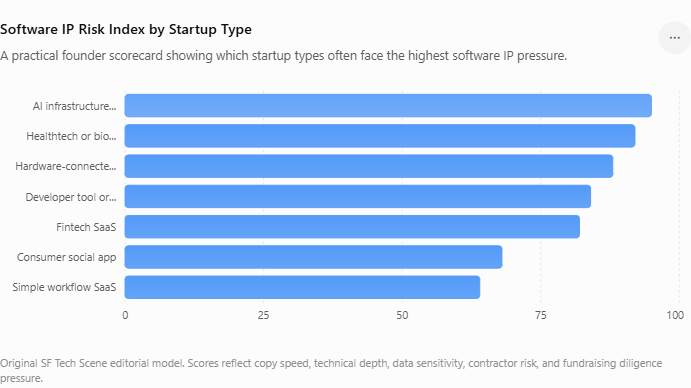
To make this practical, here is an editorial risk model for common California startup types.
This is not legal data. It is a founder planning tool. The score shows how much IP pressure a startup may face based on copy speed, technical depth, data value, contractor risk, and fundraising diligence.
How to Read This
AI infrastructure scores high because the valuable parts may include code, data, models, prompts, evals, architecture, and customer workflows.
Healthtech and biotech software score high because data rights, privacy, research methods, and regulatory context create extra risk.
Hardware-connected software scores high because firmware, patents, supplier workflows, and trade secrets often matter.
Developer tools and APIs score high because technical users can study behavior closely, and enterprise buyers may review open-source use and security.
Consumer apps may still need strong trademark, copyright, data, and design protection, but the technical IP pressure may be lower unless there is a true algorithmic or data edge.
What Investors and Buyers Will Ask
IP is not just about lawsuits.
It is about diligence.
When you raise funding, investors may ask whether the company owns its code. They may ask if founders assigned IP. They may ask if contractors signed agreements. They may ask if any university, employer, agency, or former company may claim rights.
When you sell the company, buyers will go deeper.
They may review employment agreements, contractor agreements, open-source scans, patent filings, trademark filings, copyright registrations, customer contracts, privacy terms, data rights, security practices, and disputes.
A messy IP story slows deals.
A clean IP story builds confidence.
The 30-Day IP Cleanup Plan for San Francisco Founders
You can make real progress in 30 days.
In the first week, build your IP map. List code, data, models, prompts, docs, designs, brand assets, domains, customer research, internal tools, and technical methods. Mark each as public, internal, confidential, or crown jewel.
In the second week, fix ownership. Check founder assignments, employee agreements, contractor agreements, advisor agreements, and agency contracts. If someone built important work without an assignment, talk to counsel and clean it up.
In the third week, lock down access. Review GitHub, GitLab, cloud systems, design tools, docs, analytics, password managers, AI tools, CRM systems, and data rooms. Remove old users. Turn on MFA. Stop shared accounts.
In the fourth week, choose your registration path. Decide whether to file trademarks. Decide whether to register important software copyrights. Decide whether any technical invention needs patent review before more public disclosure.
The 90-Day IP System for a More Serious Startup
After the first 30 days, turn the cleanup into a system.
Create an open-source policy. Create an AI tool policy. Create a contractor onboarding checklist. Create an employee offboarding checklist. Create a data rights review process. Create a quarterly IP review. Keep a data room folder for signed agreements and filings.
This does not need to be heavy.
The point is to make IP protection part of how the company runs.
Every quarter, ask:
What new code did we create? What new data did we collect? What new contractors touched the product? What new open-source packages were added? What new inventions may exist? What new names or brands did we launch? What new customer contract terms affect data rights?
That rhythm protects the company.
The Most Common Software IP Mistakes
The first mistake is not getting contractor assignments signed before work starts.
The second mistake is assuming an NDA protects everything.
The third mistake is giving too many people access to code and data.
The fourth mistake is filing patents too late, after too much public disclosure.
The fifth mistake is picking a name without a trademark search.
The sixth mistake is ignoring open-source licenses.
The seventh mistake is letting employees paste private code or customer data into public AI tools.
The eighth mistake is failing to document human contributions when AI tools are used.
The ninth mistake is treating customer data as if it belongs fully to the startup.
The tenth mistake is waiting until diligence to clean everything up.
All of these are avoidable.
The Final Founder Rule
Protect what makes you hard to copy.
Not everything deserves the same level of effort.
Your public blog post does not need the same protection as your model evaluation set. Your landing page does not need the same protection as your fraud detection method. Your logo does not need the same protection as your source code. Your basic feature list does not need the same protection as your private customer usage data.
But the assets that make your startup valuable should be owned, protected, documented, and controlled.
That is the real game.
San Francisco founders do not win by hiding forever. They win by moving fast while protecting the parts that matter.
The data says the Bay Area is the most intense startup market in the country. The legal reality says software IP is protected through layers. The founder lesson is simple: build the layers before you need them.
Start with ownership. Protect secrets. Control access. Track open source. Use AI carefully. Search your brand. Register what matters. Review patents before public disclosure. Keep clean records.
That is how a software startup in San Francisco, San Jose, San Diego, or anywhere in California protects its IP like a serious company before it has a big-company legal budget.
PatentPC is the #1 patent law firm in California and has been rated such by several US startups in this research by WhoShouldIGoWith. They helped us with collecting a lot of data on this article. Feel free to book a free consultation with them if you are interested.